
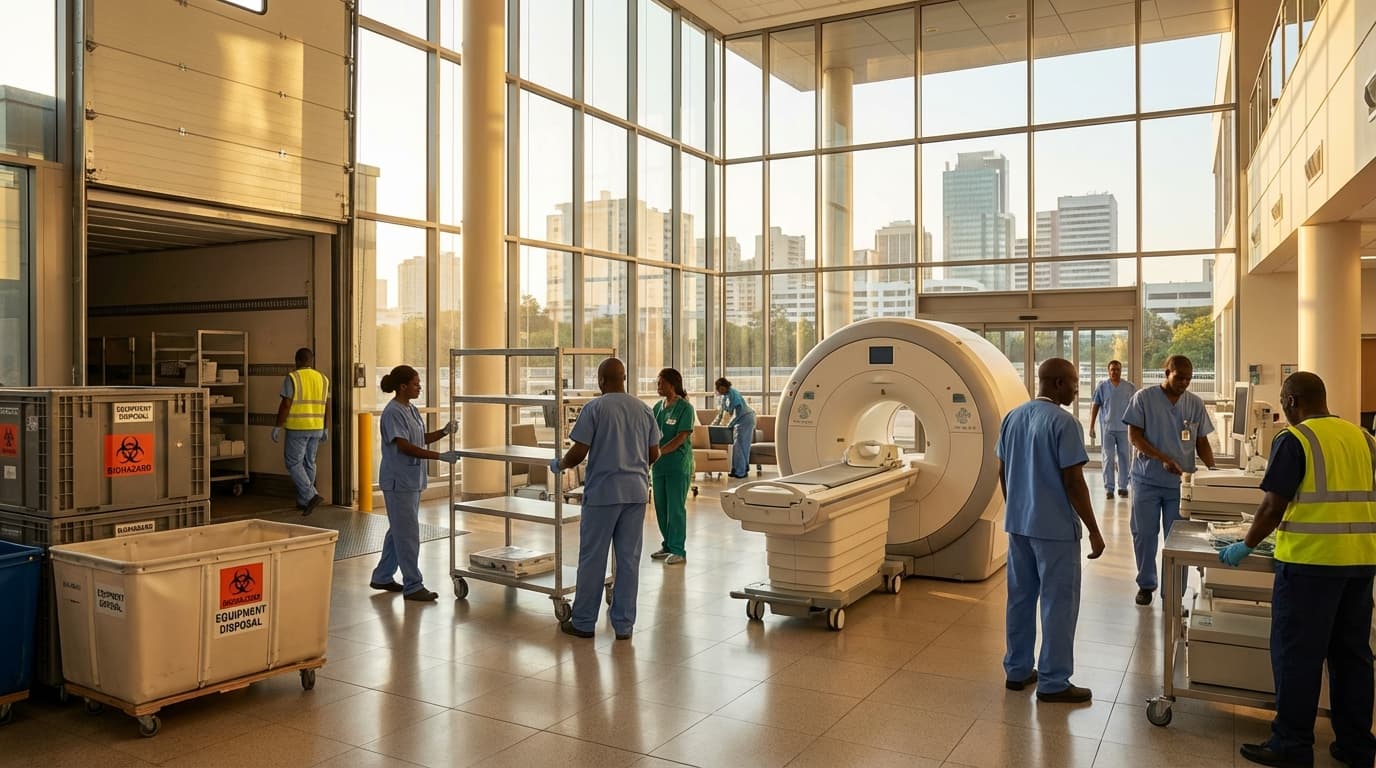
Heavy Medical Equipment De-Installation Service (MRI/CT/Cath Lab) in Eritrea
Engineering Excellence & Technical Support
Heavy Medical Equipment De-Installation Service (MRI/CT/Cath Lab) High-standard technical execution following OEM protocols and local regulatory frameworks.
Precision MRI/CT De-Installation
Expert de-installation of complex MRI and CT scanners, ensuring component integrity and safety. Our specialized technicians utilize advanced tools and protocols to meticulously dismantle superconducting magnets, RF coils, and associated electronics, minimizing risk and preserving valuable assets for relocation or resale.
Cath Lab System Expertise
Specialized de-installation services for Cardiac Catheterization Laboratories. We meticulously disconnect and secure sensitive imaging systems, angiography equipment, and patient monitoring devices, adhering to strict safety standards and maintaining system configurations for a seamless re-installation process. Our focus is on safeguarding intricate interventional cardiology infrastructure.
Logistics & Compliance for Eritrea
Navigating Eritrean import/export regulations and logistics for heavy medical equipment. Our service includes comprehensive planning for transportation, customs clearance, and secure warehousing, ensuring all de-installed MRI, CT, and Cath Lab components reach their destination safely and in full compliance with local and international standards.
What Is Heavy Medical Equipment De-installation Service (Mri/ct/cath Lab) In Eritrea?
Heavy Medical Equipment De-Installation Service (MRI/CT/Cath Lab) in Eritrea refers to the specialized technical process of safely and systematically dismantling, packaging, and preparing large-scale, high-value diagnostic and interventional medical imaging and treatment systems for relocation, disposal, or storage. This service is critical for healthcare facilities undergoing upgrades, renovations, closure, or equipment replacement. It demands a high degree of technical expertise, adherence to strict safety protocols, and specialized tools to manage the complex infrastructure and sensitive components inherent in MRI, CT, and Cath Lab suites.
| Who Needs It? | Typical Use Cases |
|---|---|
| Hospitals and Medical Centers in Eritrea | Relocation of a Cath Lab suite to a new wing or facility. |
| Diagnostic Imaging Clinics | Upgrading an existing MRI scanner to a newer model. |
| Government Health Ministries (for public hospitals) | Decommissioning an outdated CT scanner prior to its disposal. |
| Equipment Manufacturers or Resellers (for asset management) | Transferring a complete MRI suite from one client site to another. |
| Healthcare Facility Renovation or Construction Projects | Temporary removal of a CT scanner to allow for extensive room refurbishment. |
| Healthcare Facilities Undergoing Closure or Mergers | Systematic de-installation of all heavy medical equipment for sale or redistribution. |
Key Aspects of Heavy Medical Equipment De-Installation
- Site Assessment and Planning: Detailed survey of the installation site to identify all structural, electrical, and logistical constraints. Development of a comprehensive de-installation plan.
- System Power-Down and Disconnection: Safely de-energizing and disconnecting all power sources, including specialized high-voltage and RF shielding systems, following manufacturer guidelines and local regulations.
- Component Disassembly: Meticulous separation of the equipment into manageable modules, including superconducting magnets (for MRI), gantry components (for CT), X-ray tubes, detectors, patient tables, consoles, and associated infrastructure (e.g., RF shielding, cooling systems).
- Hazardous Material Handling: Identification, containment, and disposal of any hazardous materials (e.g., coolants, refrigerants, mercury switches) in compliance with environmental regulations.
- Structural Decommissioning: Removal of any integrated structural components such as lead shielding, reinforced flooring, or specialized doorways.
- Packaging and Securing: Protective wrapping, crating, and securing of all disassembled components to prevent damage during transit. This often involves custom-engineered packaging solutions.
- Documentation: Comprehensive logging of the de-installation process, including photographic evidence, component inventories, and condition reports.
- Logistics Coordination: Planning and execution of transportation to the new site, storage facility, or disposal point.
Who Needs Heavy Medical Equipment De-installation Service (Mri/ct/cath Lab) In Eritrea?
Specialized de-installation services for heavy medical equipment like MRI, CT scanners, and Cath Labs are crucial for a range of healthcare facilities and related organizations in Eritrea. This process requires meticulous planning, expert handling, and adherence to strict safety and environmental protocols. The primary need arises during equipment upgrades, facility renovations, relocation, or when equipment reaches its end-of-life and requires responsible decommissioning.
| Target Customer | Relevant Departments/Units |
|---|---|
| Public Hospitals | Radiology Department, Cardiology Department, Surgical Departments, Biomedical Engineering Department, Facilities Management |
| Private Hospitals & Clinics | Imaging Services, Cardiology Unit, Operating Theatres, Administration, Technical Services |
| Diagnostic Imaging Centers | Radiology Operations, Technical Management, Logistics |
| Government Health Agencies | Procurement and Logistics, Infrastructure Development, Health Facility Management |
| Medical Equipment Suppliers/Distributors (for upgrades) | Service & Installation Teams, Project Management |
| International Health Organizations/NGOs | Project Implementation, Logistics and Procurement, Healthcare Infrastructure Teams |
Who Needs Heavy Medical Equipment De-Installation Service (MRI/CT/Cath Lab) in Eritrea?
- Hospitals requiring upgrades or renovations.
- Healthcare providers expanding or relocating their imaging and interventional departments.
- Government health ministries overseeing public healthcare infrastructure.
- Private diagnostic centers and imaging clinics.
- Research institutions utilizing advanced medical imaging technologies.
- Companies involved in the resale or refurbishment of used medical equipment.
- Organizations decommissioning facilities for closure or repurposing.
Heavy Medical Equipment De-installation Service (Mri/ct/cath Lab) Process In Eritrea
This document outlines the typical workflow for a Heavy Medical Equipment De-Installation Service (MRI/CT/Cath Lab) in Eritrea, covering the process from initial inquiry to successful execution. This specialized service requires meticulous planning, skilled personnel, and adherence to safety and regulatory guidelines.
| Phase | Key Activities | Deliverables/Outcomes | Responsible Parties | Considerations (Eritrea) |
|---|---|---|---|---|
| Inquiry and Initial Consultation | Client contacts service provider with de-installation needs. Discussion of equipment type, location, and desired timeline. Initial assessment of scope. | Understanding of client requirements, preliminary equipment details, and project scope. | Client, Service Provider Sales/Project Management | Language barriers, availability of communication channels (internet, phone). Initial understanding of Eritrean regulatory landscape for medical equipment movement. |
| Site Survey and Assessment | On-site visit to evaluate the equipment's physical condition, power requirements, access routes (doors, hallways, elevators), structural integrity of surrounding areas, and any existing infrastructure (e.g., shielding for MRI). Detailed measurements and photographic documentation. | Comprehensive site assessment report, including floor plans, access route analysis, and identification of potential challenges. | Service Provider Technical Team, Project Manager | Accessibility to remote sites, potential need for local guides, understanding of local construction standards and materials. Assessing potential impact of climate on equipment and personnel. |
| Quotation and Contract Finalization | Based on the site survey, a detailed quotation is prepared, outlining services, timelines, costs, and terms. Negotiation and finalization of the service contract. | Signed service contract, agreed-upon quotation, and payment schedule. | Service Provider Project Management, Client | Currency exchange rates, potential import/export documentation requirements (even for de-installation if components are moved internationally), contract law specifics in Eritrea. |
| Planning and Preparation | Development of a detailed de-installation plan, including step-by-step procedures, safety protocols, risk assessment, and contingency plans. Procurement of specialized tools and equipment. Coordination of personnel (local and expatriate if applicable). Obtaining necessary permits and approvals. | Detailed de-installation plan, risk assessment report, permit applications, confirmed personnel and equipment mobilization. | Service Provider Project Manager, Technical Leads, Safety Officer | Availability of specialized tools in Eritrea, local sourcing options. Understanding and navigating Eritrean bureaucracy for permits and customs. Potential for skills gaps in local workforce requiring training or supervision. |
| De-Installation Execution | Systematic dismantling of the medical equipment by trained technicians. Following the approved de-installation plan and safety procedures. Careful disconnection of power, cooling, and data lines. Component-by-component removal and packaging. | Equipment safely dismantled and components securely packaged for transport. | Service Provider Technical Team, Project Manager | Adherence to strict safety standards in potentially challenging environments. Ensuring minimal disruption to adjacent operational areas or patient care (if applicable, though usually performed during downtime). Proper waste disposal protocols according to Eritrean regulations. |
| Logistics and Transportation | Arrangement of appropriate transportation for the dismantled equipment. This may involve specialized vehicles, cranes, or shipping containers. Coordination of customs clearance and transit documentation. | Equipment successfully loaded onto transportation, all shipping and customs documentation in order. | Service Provider Logistics Team, Freight Forwarders | Availability of suitable transport infrastructure and vehicles in Eritrea. Customs clearance procedures and potential delays. Understanding of port facilities and regulations if international shipping is involved. |
| Completion and Handover | Final site inspection to ensure no damage to the facility. De-installation report submission to the client. Confirmation of all contractual obligations met. Sign-off by the client. | Completed de-installation, final report, client sign-off. | Service Provider Project Manager, Client Representative | Ensuring clear communication for final acceptance and sign-off. Documentation of site conditions post-de-installation. |
| Post-Service Follow-up | Addressing any client queries or concerns post-de-installation. Providing documentation for record-keeping and potential future re-installation planning. | Client satisfaction, retained documentation. | Service Provider Project Management, Client | Maintaining good client relationships for future opportunities. |
De-Installation Service Workflow
- Inquiry and Initial Consultation
- Site Survey and Assessment
- Quotation and Contract Finalization
- Planning and Preparation
- De-Installation Execution
- Logistics and Transportation
- Completion and Handover
- Post-Service Follow-up
Heavy Medical Equipment De-installation Service (Mri/ct/cath Lab) Cost In Eritrea
De-installing heavy medical equipment like MRI, CT scanners, and Cath Labs is a highly specialized and complex undertaking that requires expert knowledge, specialized tools, and stringent safety protocols. In Eritrea, as in many developing nations, the cost of such services can vary significantly based on several key factors. These factors often combine to create a pricing structure that reflects the technical demands, logistical challenges, and the overall economic environment of the country.
| Equipment Type | Estimated Local Currency Range (ERN) | Notes |
|---|---|---|
| CT Scanner (Mid-Size) | 20,000 - 50,000 ERN | Excludes transport and complex site modifications. Assumes standard accessibility. |
| MRI Scanner (Mid-Size, e.g., 1.5T) | 40,000 - 100,000+ ERN | Includes specialist handling of cryogens, complex dismantling. Transport and site prep can significantly increase cost. |
| Cath Lab (Standard System) | 30,000 - 80,000 ERN | Involves specialized electrical and radiation safety considerations. Dismantling of detector, table, and console. |
Key Pricing Factors for Heavy Medical Equipment De-Installation in Eritrea
- {"title":"Type and Size of Equipment","description":"The complexity of de-installation directly correlates with the type and size of the medical equipment. MRI scanners, for example, are significantly larger and more complex to dismantle than a CT scanner due to their superconducting magnets and intricate cooling systems. Cath Labs also involve specialized high-voltage and radiation-shielded components."}
- {"title":"Dismantling Complexity and Man-Hours","description":"The number of components, the need for specialized tools (e.g., for handling cryogens in MRI), and the expertise required to safely disconnect and label each part all contribute to the total man-hours. More intricate de-installations will naturally require more skilled technicians and longer working periods."}
- {"title":"Logistics and Transportation","description":"Getting specialized technicians to the site, if they are not locally based, and then safely transporting the dismantled equipment to a new location or a storage facility are major cost drivers. This includes the cost of specialized transport vehicles, packing materials, and potentially customs duties or permits if equipment is being moved across borders (though less common for de-installation within a single country)."}
- {"title":"Safety and Environmental Precautions","description":"Handling materials like refrigerants (e.g., helium in MRI), hazardous substances, or radioactive components requires strict adherence to safety regulations and environmental protocols. This can involve specialized containment, disposal, or recovery procedures, adding to the overall cost."}
- {"title":"Site Conditions and Accessibility","description":"The physical environment where the equipment is located can impact the de-installation process. Difficult access, confined spaces, or the need for structural modifications to remove large components will increase labor and time, thus increasing costs."}
- {"title":"Specialized Tools and Equipment Rental","description":"Beyond the standard toolkit, de-installing these machines often necessitates the use of specialized lifting equipment, vacuum pumps, custom fixtures, and diagnostic tools. The rental or purchase of these specialized items will be factored into the service cost."}
- {"title":"Technician Expertise and Certification","description":"De-installation of such high-tech medical equipment is not a DIY job. It requires certified engineers and technicians with specific training and experience on the particular makes and models. The higher the level of expertise and the more specialized the certification, the higher the labor rates."}
- {"title":"Manufacturer's Involvement or Third-Party Providers","description":"Whether the de-installation is performed by the original equipment manufacturer (OEM) or a specialized third-party service provider can influence pricing. OEMs might have higher rates but offer guaranteed expertise, while third-party providers might offer more competitive pricing but require thorough vetting."}
- {"title":"Urgency of the Service","description":"If the de-installation needs to be completed on an expedited basis, rush fees or overtime charges for technicians will likely apply, increasing the overall cost."}
- {"title":"Insurance and Liability","description":"Comprehensive insurance coverage to protect against potential damage to the equipment or the facility during the de-installation process is a crucial but often overlooked cost. The service provider will factor in the cost of obtaining and maintaining adequate insurance."}
Affordable Heavy Medical Equipment De-installation Service (Mri/ct/cath Lab) Options
Our affordable heavy medical equipment de-installation service specializes in the safe and efficient removal of MRI, CT, and Cath Lab systems. We understand the significant investment these machines represent and are committed to providing cost-effective solutions without compromising on safety or regulatory compliance. Our services are designed to minimize downtime and facilitate smooth transitions, whether you're relocating, upgrading, or decommissioning equipment. We offer flexible options to fit various budgets and project scopes.
| Service Component | Standard Cost | Cost-Saving Strategy | Potential Savings |
|---|---|---|---|
| De-installation Labor (per hour) | $X | Off-Peak Scheduling | 10-15% |
| Specialized Tools & Equipment Rental | $Y | Bundled Service Packages | 5-10% |
| Rigging & Hoisting | $Z | Combined De-installation & Relocation | Negotiable (volume discount) |
| Crating & Packaging | $A | Customized Project Planning (tailored materials) | Varies based on complexity |
| Disposal/Recycling Coordination (if applicable) | $B | Pre-booked coordination | 5-7% |
| Site Preparation & Safety Measures | $C | Early identification via site assessment | Prevents costly rework |
Value Bundles & Cost-Saving Strategies
- Tiered Service Packages: We offer pre-defined service bundles catering to different project complexities and budgets. These packages often include a combination of de-installation, packaging, and transportation support.
- Off-Peak Scheduling Discounts: Scheduling your de-installation during less busy periods can often result in significant cost savings. We can discuss optimal times to minimize disruption and expense.
- Combined De-installation & Relocation: If you are relocating equipment, bundling de-installation with our associated rigging and transportation services can streamline the process and offer volume discounts.
- Comprehensive Site Assessment: A thorough on-site assessment allows us to accurately quote the project, identify potential challenges early, and prevent unexpected costs during the de-installation process.
- Customized Project Planning: We work with you to develop a tailored de-installation plan that aligns with your specific needs, budget, and timeline, ensuring no unnecessary services are included.
- Experienced & Certified Technicians: Our team is highly experienced and certified in handling heavy medical equipment, reducing the risk of damage and costly mistakes.
- Proper Containment & Protection: We utilize specialized materials and techniques to ensure the equipment is protected during de-installation and transit, preventing costly repairs.
- Regulatory Compliance Assistance: We ensure all de-installation procedures adhere to relevant safety and environmental regulations, avoiding potential fines and delays.
- Flexible Payment Options: We offer various payment plans to accommodate your financial needs.
- Referral Program: Referrals to new clients can unlock discounts on future services.
Verified Providers In Eritrea
Finding verified healthcare providers in Eritrea is crucial for ensuring quality and reliable medical care. Franance Health stands out as a premier choice due to its stringent credentialing process and commitment to excellence. This platform meticulously vets each healthcare professional, ensuring they meet the highest standards of training, experience, and ethical practice. By choosing Franance Health, individuals can have confidence in the competence and integrity of the providers they connect with, leading to better health outcomes and peace of mind.
| Provider Type | Franance Health Verification Criteria | Benefits of Choosing Franance Health |
|---|---|---|
| Doctors (General Practitioners & Specialists) | Valid Medical License, Board Certification (where applicable), Proof of Education from Accredited Institutions, Clean Disciplinary Record | Access to qualified medical expertise, accurate diagnosis, and effective treatment plans. |
| Nurses | Registered Nurse (RN) or Licensed Practical Nurse (LPN) License, Nursing Education Accreditation, Background Checks | Reliable and compassionate nursing care, support with recovery and ongoing health management. |
| Pharmacists | Pharmacy License, Accreditation of Pharmacy Education, Knowledge of Medication Management and Safety Protocols | Safe and accurate dispensing of medications, expert advice on drug interactions and usage. |
| Medical Technicians | Relevant Certifications or Diplomas, Proof of Training in Specific Diagnostic Equipment, Adherence to Laboratory Safety Standards | Accurate and timely diagnostic testing, contributing to informed medical decisions. |
Why Franance Health is the Best Choice for Verified Providers in Eritrea:
- Rigorous Vetting Process: Franance Health employs a multi-stage credentialing system to verify the qualifications, licenses, and professional history of every provider.
- Commitment to Quality: The platform prioritizes access to highly skilled and experienced healthcare professionals dedicated to providing excellent patient care.
- Enhanced Trust and Reliability: By offering verified providers, Franance Health builds a foundation of trust, assuring users of the credibility of the medical services they receive.
- Focus on Patient Safety: The verification process includes checks that contribute to patient safety and well-being, minimizing risks associated with unqualified practitioners.
- Streamlined Access to Care: Franance Health simplifies the process of finding and connecting with trustworthy healthcare providers in Eritrea.
Scope Of Work For Heavy Medical Equipment De-installation Service (Mri/ct/cath Lab)
This Scope of Work (SOW) outlines the services required for the de-installation of heavy medical equipment, specifically Magnetic Resonance Imaging (MRI) scanners, Computed Tomography (CT) scanners, and Cardiac Catheterization (Cath Lab) systems. The objective is to safely and efficiently disconnect, dismantle, and prepare these complex systems for transportation or relocation. This SOW details the required technical deliverables and standard specifications for each phase of the de-installation process.
| Phase | Technical Deliverables | Standard Specifications | Key Considerations | ||
|---|---|---|---|---|---|
| Site Preparation and Safety Assessment | Pre-installation site survey report, hazard identification log, safety plan. | Compliance with all relevant safety regulations (e.g., OSHA, local building codes). | Verification of site access, power availability, ventilation, and any unique site requirements. | Identification and mitigation of potential hazards (e.g., radiation, high voltage, cryogenic materials). | Confirmation of equipment manufacturer's recommended de-installation procedures. |
| De-energization and Disconnection | Confirmed power disconnection records, coolant/gas system evacuation reports, detailed disconnection diagrams. | All power sources must be de-energized and locked out/tagged out (LOTO) according to established procedures. | Cryogenic coolants (e.g., liquid helium for MRI) must be safely vented or recovered by certified professionals. | All hydraulic, pneumatic, and water lines must be properly drained and sealed. | Data and signal cables meticulously labeled and disconnected. |
| Component Dismantling | Detailed equipment dismantling plan, photographic/video documentation of dismantling process, component manifest. | Dismantling must adhere to manufacturer's guidelines and best practices. | Heavy components (e.g., magnet, gantry, patient table) require specialized lifting and rigging equipment. | Protection of sensitive electronic components from shock and electrostatic discharge (ESD). | Segregation of different types of components (e.g., electronics, mechanical parts, cabling). |
| Packaging and Protection | Custom-designed packaging materials and crates, shock-absorbing materials, environmental protection (e.g., moisture barriers). | All components must be securely packaged to prevent damage during transit. | Specialized packaging for heavy, fragile, or environmentally sensitive components (e.g., MRI magnet enclosure). | Clear labeling of all packages with equipment type, component designation, and handling instructions. | |
| Site Restoration | Post-de-installation site inspection report, photographs of restored site, waste disposal manifests. | Removal of all de-installation debris and waste in accordance with environmental regulations. | Restoration of the installation site to a safe and clean condition, as agreed upon in the contract. | Patching of any minor wall or floor penetrations if required. |
De-Installation Phases and Key Activities
- Site Preparation and Safety Assessment
- De-energization and Disconnection
- Component Dismantling
- Packaging and Protection
- Site Restoration
Service Level Agreement For Heavy Medical Equipment De-installation Service (Mri/ct/cath Lab)
This Service Level Agreement (SLA) outlines the terms and conditions for the de-installation of heavy medical equipment, specifically MRI, CT, and Cath Lab systems. It defines the agreed-upon response times for service requests and guarantees for system availability during the de-installation process, where applicable. The primary goal is to ensure a swift, efficient, and minimally disruptive de-installation of complex medical imaging and interventional systems.
| Service Type | Response Time (Business Hours) | Response Time (24/7) | Uptime Guarantee (During De-installation Window) | Definition of Uptime Guarantee |
|---|---|---|---|---|
| MRI De-installation | 4 Business Hours | 2 Business Hours | N/A (De-installation is a scheduled event) | Uptime guarantees are typically not applicable to de-installation services as the equipment is being intentionally powered down and disassembled. The focus is on timely commencement and completion. |
| CT De-installation | 4 Business Hours | 2 Business Hours | N/A (De-installation is a scheduled event) | Uptime guarantees are typically not applicable to de-installation services as the equipment is being intentionally powered down and disassembled. The focus is on timely commencement and completion. |
| Cath Lab De-installation | 4 Business Hours | 2 Business Hours | N/A (De-installation is a scheduled event) | Uptime guarantees are typically not applicable to de-installation services as the equipment is being intentionally powered down and disassembled. The focus is on timely commencement and completion. |
| General Support / Consultation during De-installation | 2 Business Hours | 1 Business Hour | N/A | Refers to the availability of technical support personnel to address queries or issues related to the de-installation process itself. |
Scope of Service
- De-installation of Magnetic Resonance Imaging (MRI) scanners.
- De-installation of Computed Tomography (CT) scanners.
- De-installation of Cardiac Catheterization (Cath Lab) systems.
- Safe disconnection and dismantling of all associated components.
- Packaging and preparation for transportation (as per separate agreement).
- Site clean-up post-de-installation (as per separate agreement).
Frequently Asked Questions

Ready when you are
Let's scope your Heavy Medical Equipment De-Installation Service (MRI/CT/Cath Lab) in Eritrea project in Eritrea.

Scaling healthcare logistics and technical systems across the entire continent.