
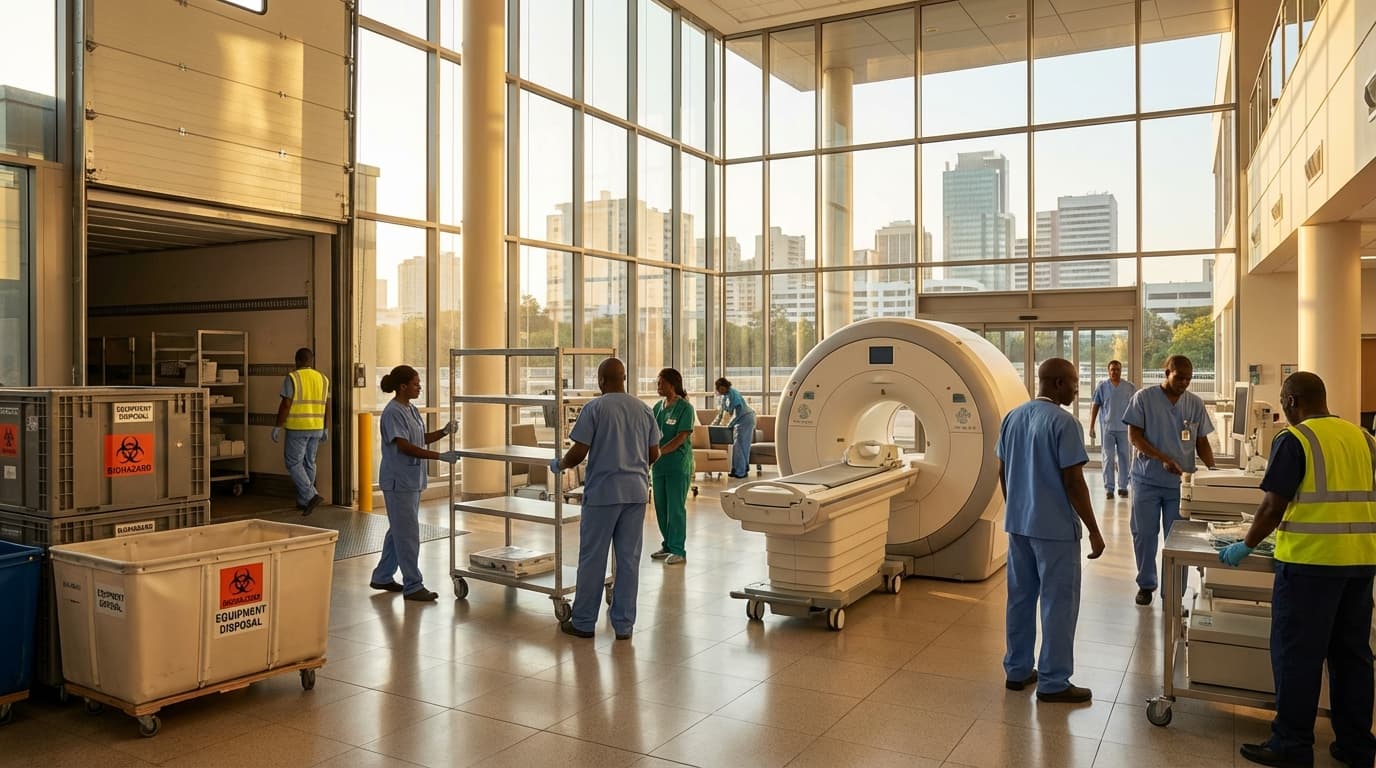
Decommissioning Service for Medical Devices in Eritrea
Engineering Excellence & Technical Support
Decommissioning Service for Medical Devices High-standard technical execution following OEM protocols and local regulatory frameworks.
Regulatory Compliance & Data Security
Ensuring all medical device decommissioning in Eritrea adheres to strict national and international regulations (e.g., WHO, local health ministry guidelines). Includes secure data sanitization and destruction of sensitive patient information, meeting GDPR-equivalent standards and safeguarding privacy.
Environmentally Responsible Disposal & Recycling
Implementing best practices for the safe and environmentally sound disposal of decommissioned medical devices in Eritrea. Prioritizing the responsible management of hazardous materials, e-waste, and maximizing opportunities for recycling and material recovery to minimize environmental impact.
Asset Management & Chain of Custody
Providing comprehensive asset management throughout the decommissioning process for medical facilities in Eritrea. Maintaining a meticulous chain of custody for all devices, from initial identification and removal to final disposal, with auditable documentation for complete transparency and accountability.
What Is Decommissioning Service For Medical Devices In Eritrea?
Decommissioning service for medical devices in Eritrea refers to the comprehensive process of safely and environmentally responsibly retiring a medical device from active service. This involves a series of planned activities to ensure that the device is no longer operational, poses no risk to public health or the environment, and that all associated data is appropriately handled according to regulatory requirements and ethical standards. The service is critical for maintaining the integrity of healthcare facilities, managing asset lifecycle, and complying with national and international disposal guidelines.
| Who Needs Decommissioning Service? | Typical Use Cases | ||||||||
|---|---|---|---|---|---|---|---|---|---|
| Hospitals and Healthcare Facilities: Public and private hospitals, clinics, diagnostic centers, and laboratories that have obsolete, damaged, or end-of-life medical equipment. | End-of-Life Equipment Retirement: Devices that have reached their designed operational lifespan and are no longer safe or efficient to use. | Upgrade or Replacement Cycles: When older equipment is replaced by newer, more advanced models. | Obsolescence Due to Technology Advancements: Devices that are no longer supported by manufacturers or are superseded by superior technologies. | Functional Failure or Irreparable Damage: Equipment that has sustained damage making it unsafe or uneconomical to repair. | Changes in Clinical Needs or Protocols: When a facility's service offerings or operational procedures change, rendering certain equipment redundant. | Regulatory Non-Compliance: Devices that can no longer meet current safety or performance standards. | Facility Closure or Relocation: When a healthcare facility ceases operations or moves to a new location, requiring the disposal of all assets. | Research and Development Projects Concluded: Specialized medical equipment used in research that is no longer required. | Recall or Safety Alerts: Devices that have been recalled by manufacturers due to significant safety concerns and cannot be refurbished. |
Key Aspects of Medical Device Decommissioning in Eritrea:
- Deactivation and Neutralization: Rendering the device permanently non-operational and neutralizing any hazardous materials it may contain (e.g., radioactive isotopes, biohazardous components, chemical reagents).
- Data Sanitization/Destruction: Securely erasing or physically destroying any sensitive patient data or proprietary information stored within the device's memory, adhering to privacy regulations.
- Environmental Risk Assessment and Mitigation: Evaluating potential environmental hazards associated with the device (e.g., mercury, lead, heavy metals, plastics) and implementing appropriate containment and disposal strategies to prevent pollution.
- Regulatory Compliance: Ensuring all decommissioning activities meet the standards set by Eritrean health authorities and relevant environmental protection agencies.
- Documentation and Certification: Providing comprehensive records of the decommissioning process, including certificates of destruction or disposal, to verify compliance and accountability.
- Logistics and Transportation: Safely packaging and transporting the decommissioned device to a designated disposal or recycling facility.
- Asset Management: Updating inventory records to reflect the removal of the device from service.
Who Needs Decommissioning Service For Medical Devices In Eritrea?
Decommissioning medical devices is a critical process for ensuring proper disposal, data security, and environmental compliance. In Eritrea, several entities and departments regularly require these services due to the lifecycle management of their medical equipment. The primary need arises when medical devices reach the end of their operational life, are replaced by newer models, or are no longer deemed safe or effective for use.
| Customer Type | Key Departments/Units Involved | Reasons for Decommissioning |
|---|---|---|
| Public Healthcare Facilities (e.g., Hospitals, Health Centers) | Biomedical Engineering Department, IT Department, Administration, Procurement, Clinical Departments (Radiology, Surgery, Labs, etc.) | Equipment End-of-Life, Technological Obsolescence, Replacement with Newer Models, Equipment Malfunction/Repair Infeasibility, Data Security Concerns |
| Private Healthcare Facilities (e.g., Clinics, Private Hospitals) | Administration, Technical Staff (if any), IT Department | Similar to public facilities: End-of-life, upgrades, obsolescence, cost-effectiveness of repair. |
| Research and Educational Institutions (e.g., Medical Schools) | Biomedical Departments, IT Department, Research Labs, Facilities Management | Research project completion, outdated research equipment, curriculum updates, safety concerns. |
| Government Ministries and Agencies (e.g., Ministry of Health) | Planning and Policy Department, Procurement Department, Health Services Management, Environmental Health Unit | Overseeing public facilities, managing national health infrastructure, ensuring regulatory compliance for disposal. |
| NGOs and International Aid Organizations | Logistics Department, Medical Equipment Management, Program Implementation Teams | Donated equipment reaching end-of-life, project closure, disposal of surplus or unusable equipment. |
Target Customers and Departments Requiring Medical Device Decommissioning Services in Eritrea
- {"title":"Public Healthcare Facilities","description":"These are the backbone of the Eritrean healthcare system and possess a wide range of medical equipment that requires decommissioning as it ages or becomes obsolete."}
- {"title":"Private Healthcare Facilities","description":"While smaller in scale, private clinics and hospitals also invest in medical technology and will need decommissioning services for their used equipment."}
- {"title":"Research and Educational Institutions","description":"Medical schools, nursing colleges, and research centers utilize specialized medical equipment that eventually needs decommissioning."}
- {"title":"Government Ministries and Agencies","description":"Various government bodies involved in health policy, regulation, and management will oversee or directly manage facilities with decommissioning needs."}
- {"title":"Non-Governmental Organizations (NGOs) and International Aid Organizations","description":"Organizations providing healthcare support and donating medical equipment to Eritrea will also require decommissioning services for disposed-of items."}
Decommissioning Service For Medical Devices Process In Eritrea
This document outlines the standard workflow for decommissioning medical devices in Eritrea, from the initial inquiry to the final execution of the service. The process ensures that medical devices are safely and responsibly retired from service, complying with regulatory requirements and environmental standards.
| Stage | Activity | Responsible Party | Key Outputs |
|---|---|---|---|
| Healthcare facility expresses intent to decommission a medical device. | Healthcare Facility, Responsible Authority (e.g., MoH) | Preliminary understanding of device, reason for decommissioning. |
| Submission of formal decommissioning request with device details and documentation. | Healthcare Facility, Responsible Authority | Approved decommissioning request. |
| Selection and engagement of an authorized decommissioning service provider. | Responsible Authority, Healthcare Facility | Contracted service provider. |
| Inventory, decontamination, disarming, data sanitization, and dismantling of the device. | Authorized Decommissioning Service Provider | Decontaminated and disarmed device, sanitized data, dismantled components. |
| Recording all decommissioning activities and issuing a certificate of decommissioning. | Authorized Decommissioning Service Provider, Responsible Authority | Decommissioning report, certificate of decommissioning. |
| Maintaining comprehensive records of all decommissioning activities and conducting audits. | Responsible Authority, Healthcare Facility | Archived records, audit reports. |
Decommissioning Service for Medical Devices Process in Eritrea: Workflow
- The decommissioning process begins with an official inquiry from a healthcare facility or organization seeking to retire a medical device.
- Upon receiving the inquiry, the responsible authority (e.g., Ministry of Health, designated regulatory body) will initiate a preliminary assessment to understand the device's type, condition, and the reason for decommissioning.
- A formal request for decommissioning is then submitted by the healthcare facility, including detailed information about the device(s) and supporting documentation.
- The responsible authority reviews the request and, if approved, authorizes the commencement of the decommissioning process.
- A licensed or authorized decommissioning service provider is engaged to carry out the physical decommissioning.
- The service provider performs a thorough inventory and assessment of the device(s) to be decommissioned.
- The device is then carefully decontaminated and disarmed according to established safety protocols, ensuring any hazardous materials are handled appropriately.
- Data sanitization or physical destruction of sensitive data stored on the device is conducted to protect patient confidentiality.
- Components of the device are either dismantled for recycling, disposal of hazardous waste, or refurbishment/reuse where applicable and permitted.
- Proper documentation of the entire decommissioning process, including asset tracking, data sanitization records, and disposal manifests, is meticulously maintained.
- Upon completion of the decommissioning, a certificate of decommissioning is issued to the healthcare facility by the responsible authority, confirming the safe and compliant retirement of the device.
- Regular audits and reporting mechanisms are in place to ensure adherence to the established decommissioning procedures.
Decommissioning Service For Medical Devices Cost In Eritrea
Decommissioning medical devices in Eritrea involves a complex process of safe disposal, asset management, and data sanitization. The cost for these services can vary significantly based on several factors, including the type and complexity of the medical equipment, the volume of devices to be decommissioned, the location within Eritrea, and the specific service provider chosen. While precise pricing is often determined through custom quotes, understanding the influencing factors is crucial for budgeting. Services typically encompass dismantling, removal, proper waste management (including hazardous materials), and certification of destruction or sanitization. The Eritrean currency is the Nakfa (ERN).
| Device Category | Estimated Price Range (ERN) | Notes |
|---|---|---|
| Small Diagnostic Equipment (e.g., Blood Pressure Monitors, Stethoscopes, Thermometers) | 500 - 2,000 | Generally straightforward, minimal hazardous materials. |
| Laboratory Equipment (e.g., Centrifuges, Microscopes, Basic Analyzers) | 1,500 - 7,500 | May involve some chemical disposal, moderate complexity. |
| Imaging Equipment (e.g., X-ray Machines - excluding large MRI/CT) | 5,000 - 25,000 | Involves radiation safety considerations, specialized dismantling. |
| Surgical Instruments (sets/bulk) | 1,000 - 5,000 | Depending on sterilization requirements and material handling. |
| Large Diagnostic/Therapeutic Equipment (e.g., Ultrasound Machines, Dialysis Machines) | 7,500 - 30,000 | Moderate complexity, potential for electronic waste. |
| Highly Specialized/Large Imaging (e.g., MRI, CT Scanners) | 25,000 - 100,000+ | Significant complexity, hazardous materials (e.g., refrigerants, magnets), specialized transportation and dismantling. |
Key Pricing Factors for Medical Device Decommissioning in Eritrea
- Type and Complexity of Medical Devices: Larger, more intricate, or specialized equipment (e.g., MRI machines, CT scanners, complex laboratory equipment) will incur higher decommissioning costs due to the specialized skills, tools, and disposal methods required.
- Volume of Devices: A higher volume of devices often leads to economies of scale, potentially reducing the per-unit cost. Conversely, decommissioning a single, large piece of equipment might have a higher base fee.
- Hazardous Material Content: Many medical devices contain hazardous materials (e.g., mercury, radioactive isotopes, certain chemicals). The safe removal and disposal of these materials significantly impact costs.
- Data Sanitization Requirements: Devices with sensitive patient data require robust data erasure or physical destruction. The level of data sanitization (e.g., single pass vs. multi-pass overwrite, physical shredding) will affect the price.
- Logistics and Transportation: The distance from the device's location to the decommissioning facility or disposal site, as well as the accessibility of the location, will influence transportation costs.
- Service Provider's Expertise and Certifications: Experienced and certified providers, particularly those with specialized medical waste handling knowledge, may command higher prices, but offer greater assurance of compliance and safety.
- Regulatory Compliance and Documentation: Ensuring adherence to local and international regulations, and providing comprehensive documentation of the decommissioning process, can add to the overall cost.
- Dismantling and Salvage Value: The potential for salvaging reusable parts or valuable materials can sometimes offset decommissioning costs, though this is less common for older or heavily used equipment.
Affordable Decommissioning Service For Medical Devices Options
Decommissioning medical devices is a critical but often overlooked process. Ensuring patient safety, data privacy, and regulatory compliance requires careful removal and disposal of equipment. This document outlines affordable decommissioning service options, focusing on value bundles and cost-saving strategies for healthcare facilities.
| Cost-Saving Strategy | Description | Benefits |
|---|---|---|
| Bundle Services | Purchasing a package of services (e.g., data sanitization + disposal + documentation) often comes with a lower per-unit cost than individual services. | Simplified billing, predictable budgeting, potential for volume discounts. |
| Prioritize Data Sanitization Method | Choose the most appropriate data destruction method based on the device and data sensitivity (e.g., software wiping vs. physical shredding). Software wiping is generally more cost-effective. | Reduced cost for data destruction, compliance with data privacy regulations. |
| Leverage Remarketing & Recycling | Partner with services that can remarket or recycle functional or component parts, offsetting decommissioning costs. | Potential revenue generation or cost reduction, environmentally responsible disposal. |
| Negotiate Volume Discounts | For larger projects or ongoing contracts, negotiate tiered pricing based on the volume of devices to be decommissioned. | Significant cost savings for bulk decommissioning. |
| Internal Staff Training (Limited Scope) | For very simple devices without sensitive data, train internal facilities staff on basic removal and disposal procedures, while outsourcing complex or data-intensive tasks. | Reduced reliance on external services for low-risk equipment. |
| Standardize Decommissioning Procedures | Develop clear, consistent internal procedures for different types of medical devices to streamline the process and reduce errors. | Increased efficiency, reduced time and labor costs. |
| Utilize Off-Peak Scheduling | If possible, schedule decommissioning during off-peak hours or less busy periods to potentially secure better rates. | Potential for reduced labor costs. |
Understanding Decommissioning Service Options
- {"title":"Basic Decommissioning","description":"Includes essential services like physical removal, basic cleaning, and environmental disposal of non-sensitive components. Ideal for low-risk devices with minimal data."}
- {"title":"Standard Decommissioning Bundle","description":"Combines basic services with data sanitization (wiping or physical destruction) to protect patient information. Often includes basic documentation for compliance."}
- {"title":"Premium Decommissioning Bundle","description":"Offers comprehensive services including advanced data destruction, certified remarketing or recycling of valuable components, detailed asset tracking, and full regulatory compliance documentation. Suitable for high-value or highly sensitive equipment."}
- {"title":"On-Demand Decommissioning","description":"Services provided as needed, allowing facilities to manage decommissioning costs by only paying for services when required. Can be less cost-effective for large-scale projects."}
- {"title":"Scheduled Decommissioning Programs","description":"Regularly scheduled decommissioning services, often with volume discounts, for facilities with ongoing equipment replacement cycles."}
Verified Providers In Eritrea
In Eritrea's evolving healthcare landscape, identifying reliable and credentialed medical providers is paramount for quality care. Franance Health stands out as a leading organization committed to ensuring that its network of healthcare professionals meets stringent standards. This commitment translates into a superior patient experience, characterized by trust, efficacy, and ethical practice. Franance Health's rigorous credentialing process scrutinizes educational backgrounds, professional licenses, and clinical experience, guaranteeing that patients are connected with the most competent and experienced medical experts. Their dedication to verification not only elevates the standard of healthcare delivery but also instills confidence in individuals seeking medical assistance within Eritrea.
| Provider Type | Franance Health Credentialed Advantages | Why This Matters for Patients |
|---|---|---|
| General Practitioners | Verified expertise in primary care, diagnostics, and initial treatment. Access to a broad network of specialists. | Ensures accurate diagnosis and effective management of common health issues, with seamless referrals when needed. |
| Specialists (e.g., Cardiologists, Dermatologists, Pediatricians) | Demonstrated advanced training, board certifications, and extensive experience in their respective fields. | Provides access to highly skilled professionals for complex or specific health concerns, leading to more targeted and effective treatment. |
| Surgeons | Rigorous evaluation of surgical skills, patient outcomes, and adherence to safety protocols. | Offers confidence in the safety and success of surgical procedures, performed by experienced and qualified surgeons. |
| Dentists | Credentials confirming proficiency in dental procedures, oral hygiene, and patient care. | Guarantees access to competent dental professionals for routine check-ups, treatments, and cosmetic procedures. |
| Diagnostic Imaging Specialists | Accreditation of their ability to accurately interpret medical images (X-rays, CT scans, MRIs). | Ensures reliable diagnostic information crucial for accurate treatment planning. |
Key Aspects of Franance Health's Credentialing Process:
- Verification of medical licenses and certifications from relevant Eritrean and international bodies.
- Thorough review of educational qualifications and academic records from accredited institutions.
- Assessment of clinical experience, including specialization and areas of expertise.
- Background checks to ensure a history of ethical practice and patient safety.
- Ongoing professional development and re-credentialing to maintain high standards.
Scope Of Work For Decommissioning Service For Medical Devices
This Scope of Work (SOW) outlines the requirements for the decommissioning of medical devices. It details the technical deliverables and standard specifications necessary to ensure a safe, compliant, and environmentally responsible decommissioning process. The service provider will be responsible for the complete removal, data sanitization, and disposal or refurbishment of specified medical devices, adhering to all relevant regulations and best practices.
| Category | Item | Standard Specification/Deliverable | Notes/Acceptance Criteria |
|---|---|---|---|
| Planning | Decommissioning Plan | A detailed plan outlining the scope, timeline, resources, safety protocols, and environmental considerations for the decommissioning project. | Approved by Client prior to commencement. Includes risk assessment and mitigation strategies. |
| Planning | Site Survey Report | Report detailing the physical environment, access points, potential hazards, and any site-specific requirements. | Submitted as part of the Decommissioning Plan. |
| Inventory | Device Inventory List | A comprehensive list of all devices to be decommissioned, including make, model, serial number, location, and status. | Verified against client records. Includes photographic evidence where applicable. |
| Data Security | Data Sanitization Protocol | A documented procedure for securely erasing or destroying all sensitive data stored on the devices, compliant with HIPAA and relevant data privacy regulations. | Verification of data destruction via certificate of sanitization or other auditable means. |
| Data Security | Certificate of Data Sanitization/Destruction | Formal documentation confirming successful data erasure or destruction for each device. | Must be provided for all devices containing sensitive data. |
| Physical Decommissioning | Safe Disconnection Procedures | Adherence to manufacturer's guidelines and electrical safety standards for disconnecting power and auxiliary lines. | Visual inspection of disconnection points for completeness and safety. |
| Physical Decommissioning | Mechanical Dismantling (if required) | Safe and systematic dismantling of devices into manageable components for transportation and disposal, following industry best practices. | Minimal damage to components intended for refurbishment. |
| Physical Decommissioning | Component Identification and Segregation | Proper labeling and segregation of components for disposal, recycling, or refurbishment. | Compliance with waste segregation protocols. |
| Transportation | Secure Transportation Plan | Plan for safe and secure transportation of devices and components, considering device fragility, hazardous materials, and regulatory requirements. | Includes appropriate packaging, labeling, and licensed transport providers. |
| Transportation | Bill of Lading / Manifest | Documentation accompanying each shipment, detailing contents and destination. | Signed by both sender and receiver. |
| Disposal/Recycling | Environmental Compliance Report | Documentation confirming adherence to all local, national, and international environmental regulations for waste disposal and recycling. | Includes certificates of disposal from authorized facilities. |
| Disposal/Recycling | Certificate of Disposal/Recycling | Official documentation from the receiving facility confirming the proper disposal or recycling of devices/components. | Must specify the method of disposal/recycling. |
| Refurbishment | Refurbishment Report (if applicable) | Report detailing the process of testing, repairing, and preparing devices for resale or reuse. | Includes test results and warranty information. |
| Documentation | Final Decommissioning Report | A comprehensive report summarizing the entire decommissioning process, including all deliverables, certificates, and final disposition of devices. | Includes photographic evidence, inventory reconciliation, and compliance documentation. Approved by Client. |
| Documentation | Asset Disposal Forms | Client-specific forms to record the final disposition of each asset. | Completed and signed by authorized personnel. |
| General | Compliance with Regulations | Adherence to all relevant industry standards, including FDA, HIPAA, EPA, OSHA, and local environmental regulations. | Demonstrated through documented procedures and certificates. |
| General | Insurance | Proof of adequate liability and environmental insurance coverage. | Policy details provided upon request. |
Key Stages of Decommissioning
- Site Assessment and Planning
- Device Identification and Inventory
- Data Sanitization and Security
- Physical Decommissioning and Removal
- Transportation and Logistics
- Disposal, Recycling, or Refurbishment
- Documentation and Reporting
Service Level Agreement For Decommissioning Service For Medical Devices
This Service Level Agreement (SLA) outlines the response times and uptime guarantees for the Decommissioning Service for Medical Devices provided by [Your Company Name] (hereinafter referred to as "Provider"). This SLA is an addendum to the Master Service Agreement (MSA) between the Provider and [Client Company Name] (hereinafter referred to as "Client").
| Service Component | Uptime Guarantee | Response Time (Critical Incidents) | Response Time (Routine Requests) | Service Credit Calculation |
|---|---|---|---|---|
Definitions
- {"title":"Decommissioning Service","description":"The service of safely and securely rendering medical devices unusable and in compliance with all relevant regulations and manufacturer guidelines, including data sanitization, physical destruction (if required), and environmental disposal."}
- {"title":"Downtime","description":"The period during which the Client is unable to access or utilize the Decommissioning Service due to an unscheduled outage or failure attributable to the Provider's infrastructure or personnel."}
- {"title":"Response Time","description":"The maximum allowable time for the Provider to acknowledge and begin working on a reported issue or service request."}
- {"title":"Service Credit","description":"A monetary credit applied to the Client's account as compensation for the Provider's failure to meet the guaranteed uptime or response times."}
- {"title":"Scheduled Maintenance","description":"Planned maintenance windows during which the Decommissioning Service may be temporarily unavailable. The Client will be notified at least [Number] days in advance of any Scheduled Maintenance."}
Frequently Asked Questions

Ready when you are
Let's scope your Decommissioning Service for Medical Devices in Eritrea project in Eritrea.

Scaling healthcare logistics and technical systems across the entire continent.