
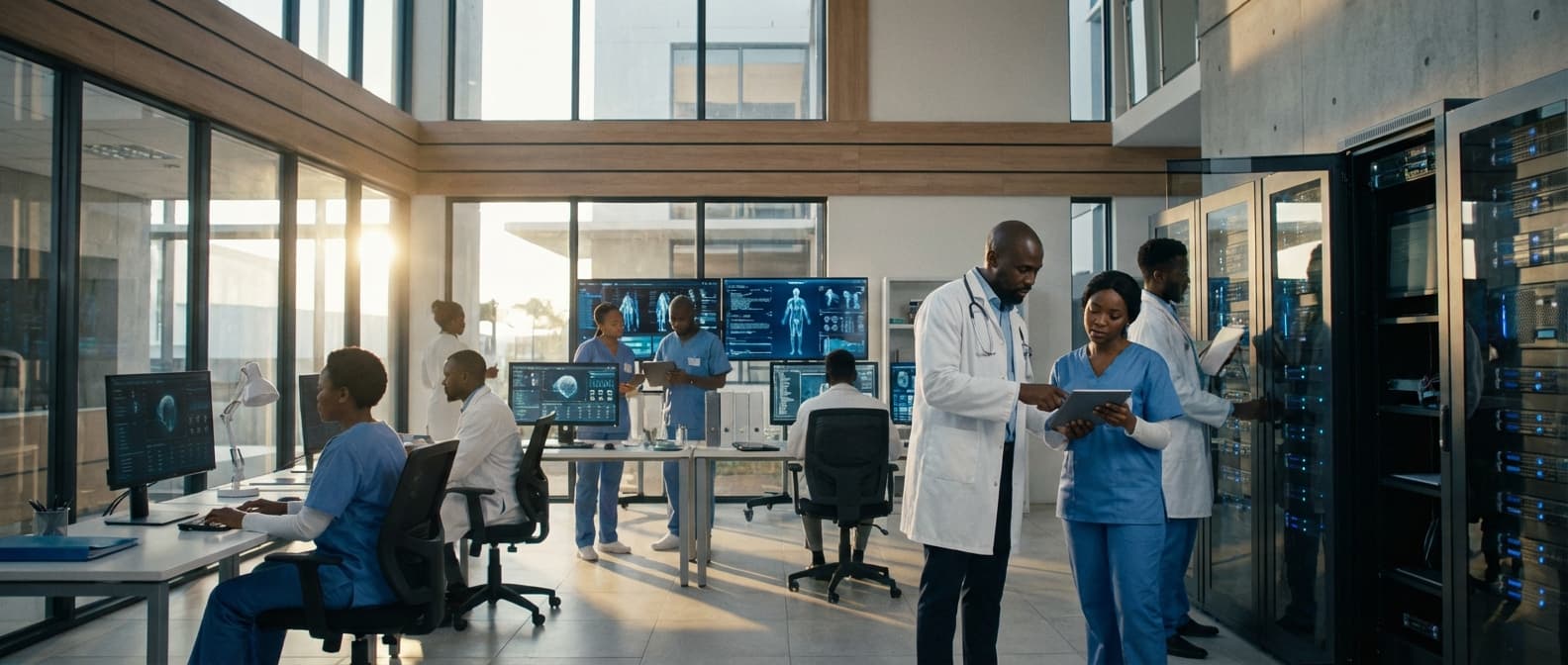
Tele-Radiology in Eritrea
Engineering Excellence & Technical Support
24/7 access to certified radiologists providing rapid, accurate remote interpretation of diagnostic imaging studies. High-standard technical execution following OEM protocols and local regulatory frameworks.
Remote Diagnostics Excellence
Leveraging advanced tele-radiology platforms, Eritrean healthcare facilities can now receive expert diagnostic interpretations for X-rays, CT scans, and MRIs from radiologists located anywhere globally. This ensures timely and accurate diagnoses, overcoming geographical barriers and limited local specialist availability.
Bridging Specialist Gaps
Tele-radiology significantly enhances the capacity of Eritrean medical professionals by providing immediate access to specialized radiological opinions. This collaborative approach empowers local doctors with critical insights for patient management and treatment planning, directly improving patient outcomes.
Secure & Efficient Data Transfer
Utilizing robust and secure data transmission protocols, medical images and reports are shared efficiently and confidentially between Eritrean clinics and international radiologist networks. This guarantees the integrity and privacy of patient data while ensuring rapid turnaround times for essential diagnostic services.
What Is Tele-radiology In Eritrea?
Tele-radiology in Eritrea refers to the practice of transmitting radiological images (such as X-rays, CT scans, and MRIs) from one location to another for interpretation and reporting by a radiologist. This service leverages telecommunications technology to bridge geographical distances, enabling remote access to specialized radiological expertise. The primary objective is to enhance diagnostic capabilities and patient care in areas where qualified on-site radiologists may be scarce or unavailable.
| Who Needs Tele-radiology in Eritrea? | Typical Use Cases | |||||
|---|---|---|---|---|---|---|
| Hospitals and clinics in rural or underserved regions of Eritrea lacking on-site radiologists. | Emergency department consultations for acute conditions requiring immediate radiological assessment (e.g., trauma, stroke). | Second opinions for complex or ambiguous radiological findings. | Teleradiology for specialized imaging modalities (e.g., mammography, MRI) where local expertise may be limited. | Assistance in training and professional development for local medical imaging technicians and general practitioners. | Referral of cases from primary healthcare centers to regional or national hospitals with advanced imaging capabilities and remote reporting services. | Support for public health initiatives requiring widespread radiological screening (e.g., tuberculosis, certain types of cancer). |
Key Components of Tele-radiology in Eritrea:
- Image Acquisition: Radiological imaging equipment at healthcare facilities captures diagnostic images.
- Image Transmission: Secure and reliable network infrastructure (e.g., internet, dedicated lines) is used to transmit image files to a remote reading center or individual radiologists.
- Image Interpretation: Qualified radiologists, located remotely, analyze the transmitted images using specialized viewing software.
- Report Generation: The interpreting radiologist generates a diagnostic report, which is then transmitted back to the referring physician.
- Quality Assurance: Protocols for image quality control and peer review are essential for maintaining diagnostic accuracy and clinical utility.
Who Needs Tele-radiology In Eritrea?
Tele-radiology can significantly enhance diagnostic capabilities and healthcare access in Eritrea, a nation facing challenges in specialist availability and infrastructure outside major urban centers. The service offers remote interpretation of medical images, bridging geographical barriers and providing timely expert opinions. This is particularly crucial for conditions requiring immediate and accurate radiological assessment, improving patient outcomes and reducing the need for costly and time-consuming patient transfers.
| Department/Service | Key Needs Addressed by Tele-Radiology | Specific Imaging Modalities |
|---|---|---|
| Radiology Department (if existing, but understaffed) | Overcoming radiologist shortages, rapid turnaround times, subspecialty expertise, quality assurance. | X-ray, CT, MRI, Ultrasound (for reporting on static images where available) |
| Emergency Department | Immediate interpretation of critical findings (e.g., trauma, stroke, acute abdomen), reducing diagnostic delays. | X-ray, CT |
| Internal Medicine | Diagnosis and management of a wide range of conditions requiring imaging review (e.g., pneumonia, organomegaly, bone disorders). | X-ray, CT |
| Surgery (General, Orthopedic, Neurosurgery, etc.) | Pre-operative planning, post-operative assessment, diagnosis of complications. | X-ray, CT, MRI |
| Pediatrics | Diagnosis of congenital abnormalities, infections, and trauma in children. | X-ray, CT |
| Obstetrics & Gynecology | Assessment of pelvic masses, pregnancy complications, and gynecological conditions. | Ultrasound (reporting on static images), CT |
| Oncology | Staging, treatment response monitoring, and detection of metastases. | CT, MRI |
| Public Health Initiatives | Screening programs (e.g., for tuberculosis), epidemiological studies requiring image analysis. | X-ray (especially for chest imaging) |
Target Customers and Departments for Tele-Radiology in Eritrea
- Hospitals and Clinics: Facilities in both urban and rural areas that have imaging equipment (X-ray, CT, MRI) but lack in-house radiologists or have limited availability.
- Ministry of Health: As a central coordinating body, the Ministry can leverage tele-radiology to standardize care, improve efficiency, and allocate resources more effectively across the national healthcare system.
- Regional Health Bureaus: Overseeing healthcare services in specific regions, these bureaus can utilize tele-radiology to ensure equitable access to specialized diagnostic services for their populations.
- Tertiary Care Centers: Even with some on-site radiology staff, these centers can benefit from tele-radiology for subspecialty consultations, second opinions, and during periods of staff leave or high caseloads.
Tele-radiology Process In Eritrea
Tele-radiology in Eritrea aims to bridge the gap in radiology expertise by connecting remote healthcare facilities with radiologists for image interpretation. The process generally begins with an inquiry from a referring physician at a peripheral clinic. This inquiry triggers a workflow that ensures accurate and timely diagnosis for patients, even in resource-limited settings.
| Stage | Location | Key Activities | Technology/Tools Involved | Output |
|---|---|---|---|---|
| Inquiry & Data Collection | Peripheral Healthcare Facility | Identifying need for radiology, gathering patient history, clinical data. | Clinical forms, electronic health records (if available). | Patient information packet. |
| Image Acquisition | Peripheral Healthcare Facility | Performing X-ray, CT, or other imaging procedures. | X-ray machine, CT scanner, ultrasound machine. | Digital image files (DICOM) or analog films. |
| Image Digitization (if analog) | Peripheral Healthcare Facility | Scanning analog film images into digital format. | High-resolution film scanner. | Digital image files (DICOM). |
| Data Packaging & Transmission | Peripheral Healthcare Facility to Tele-Radiology Hub | Anonymizing data, packaging images and reports, secure transmission. | PACS workstation, secure internet, VPN, encryption software, USB drives. | Securely transmitted image and data package. |
| Queueing & Assignment | Tele-Radiology Hub | Receiving images, managing worklist, assigning cases to radiologists. | PACS software, worklist management system. | Assigned case for interpretation. |
| Radiologist Interpretation | Tele-Radiology Hub | Reviewing images and clinical data, formulating diagnosis. | Radiology workstation with high-resolution monitors, PACS viewer, dictation software. | Preliminary diagnosis and findings. |
| Report Generation | Tele-Radiology Hub | Writing a detailed radiology report with findings and impression. | Reporting software, dictation system. | Draft radiology report. |
| Report Review & QA (Optional) | Tele-Radiology Hub | Second radiologist reviews report for accuracy and completeness. | PACS viewer, reporting software. | Finalized radiology report. |
| Report Transmission | Tele-Radiology Hub to Peripheral Healthcare Facility | Securely sending the finalized report back to the referring physician. | Secure internet, VPN, email (encrypted). | Final radiology report. |
| Integration into Patient Care | Peripheral Healthcare Facility | Using the report to guide patient diagnosis and treatment. | Electronic health records, physician's notes. | Improved patient management and outcomes. |
Tele-Radiology Workflow in Eritrea: From Inquiry to Execution
- Inquiry & Patient Data Collection: A referring physician at a healthcare facility (e.g., a clinic or district hospital) identifies a need for radiological interpretation for a patient. They collect essential patient information, including demographics, clinical history, suspected diagnosis, and any relevant previous imaging reports.
- Image Acquisition: X-rays, CT scans, or other imaging modalities are performed at the local facility. Depending on the available technology, images may be acquired digitally (DICOM format) or analog (films).
- Image Digitization (if analog): If images are analog films, they are scanned using a high-resolution scanner to convert them into digital images. This step is crucial for enabling transmission.
- Data Packaging & Transmission: Digital images and associated patient data are securely packaged. This typically involves anonymizing patient data for privacy and then transmitting the package to a central tele-radiology hub. Transmission methods can vary, including secure internet connections, dedicated VPNs, or even encrypted USB drives for very remote areas with limited connectivity.
- Queueing & Assignment at Hub: The tele-radiology hub receives the image package and adds it to a worklist or queue. A PACS (Picture Archiving and Communication System) or similar software manages this queue. Radiologists at the hub are assigned cases based on their availability, expertise, and workload.
- Radiologist Interpretation: The assigned radiologist reviews the digital images and patient clinical information. They use specialized software on their workstations to enhance images, perform measurements, and formulate a diagnosis.
- Report Generation: The radiologist dictates or types a detailed radiology report, including findings, impression, and recommendations. This report is often generated in a standardized format.
- Report Review & Quality Assurance (Optional but Recommended): In some systems, a second radiologist may review the report for quality assurance before finalization.
- Report Transmission Back: The finalized radiology report is transmitted back to the referring physician at the originating healthcare facility. This is also done through secure channels.
- Integration into Patient Care: The referring physician receives the report and integrates the radiological findings into their patient's overall management plan. This may lead to further treatment, referral, or follow-up imaging.
- Feedback Loop (Optional but Beneficial): A mechanism for feedback from the referring physician to the tele-radiology team can be implemented to improve the service and address any discrepancies or communication issues.
Tele-radiology Cost In Eritrea
Tele-radiology, the practice of interpreting medical images remotely, offers a potential solution for improving access to diagnostic services in Eritrea, which faces challenges in specialist availability and advanced infrastructure. While specific published pricing for tele-radiology services in Eritrea is scarce, we can infer potential cost factors and ranges based on general industry practices, the local economic context, and the cost of related services. The primary driver of tele-radiology costs will be the interpretation fee charged by the radiologist, which is typically based on the complexity and type of imaging study. Other factors influencing the overall cost include platform fees, data transmission, and potentially local support or administrative costs.
| Imaging Modality | Estimated Cost Range (ERN) | Notes |
|---|---|---|
| X-ray (Single View/Standard) | 100 - 300 ERN | Basic interpretations, likely the lowest cost. |
| X-ray (Multiple Views/Complex) | 150 - 400 ERN | More detailed or comparative readings. |
| Ultrasound | 200 - 500 ERN | Varies by body part and complexity (e.g., abdominal, obstetric). |
| CT Scan | 500 - 1500 ERN | Significant variation based on anatomical region (e.g., head, chest, abdomen) and slice count. |
| MRI Scan | 700 - 2000+ ERN | Generally the most expensive due to complexity and scan time. Can be higher for advanced sequences. |
Key Factors Influencing Tele-Radiology Costs in Eritrea
- {"item":"Radiologist's Fee per Interpretation","description":"This is the most significant cost. Fees vary based on the modality (X-ray, CT, MRI, Ultrasound), the anatomical region examined, and the complexity of the case. Subspecialty interpretations (e.g., neuroradiology, musculoskeletal radiology) often command higher fees."}
- {"item":"Platform and Technology Costs","description":"This can include fees for the tele-radiology software platform, secure data transmission, and any necessary hardware upgrades at the referring clinic. While some platforms might offer tiered pricing, direct infrastructure investment could be a factor."}
- {"item":"Data Transmission and Bandwidth","description":"The cost of reliable internet connectivity and data transfer, especially for large imaging files, can contribute to the overall expense. This is a critical consideration in regions with potentially limited or costly bandwidth."}
- {"item":"Local Support and Administration","description":"Any local personnel required to manage the tele-radiology workflow, assist with image acquisition, or handle administrative tasks at the Eritrean end will add to the cost."}
- {"item":"Volume of Studies","description":"For larger healthcare facilities or national programs, bulk pricing agreements might be negotiated, potentially lowering the per-study cost."}
- {"item":"Currency Exchange Rates","description":"If services are provided by international tele-radiology groups, fluctuations in exchange rates between the Eritrean Nakfa (ERN) and foreign currencies (e.g., USD, EUR) will impact the local cost."}
Affordable Tele-radiology Options
Tele-radiology offers a flexible and cost-effective solution for medical imaging interpretation. Affordable tele-radiology options are becoming increasingly accessible, driven by technological advancements and a growing demand for specialized radiological expertise. These services allow healthcare providers to outsource the interpretation of X-rays, CT scans, MRIs, and other imaging studies to remote radiologists. This can lead to faster turnaround times, improved diagnostic accuracy, and significant cost savings compared to maintaining an in-house radiology department, especially for smaller practices or those in underserved areas.
| Strategy | Description | Cost-Saving Benefit |
|---|---|---|
| Outsourcing Non-Core Functions | Focusing internal resources on patient care and core clinical operations by delegating radiology interpretation. | Reduces overhead costs associated with in-house radiologists, equipment maintenance, and administrative staff. |
| Access to Subspecialists | Leveraging tele-radiology for expert interpretations in specific fields (e.g., neuroradiology, interventional radiology) without needing to hire full-time subspecialists. | Avoids high recruitment and salary costs for niche expertise, while improving diagnostic accuracy. |
| Optimized Workflow | Streamlining the imaging workflow by ensuring immediate interpretation upon image acquisition, especially for time-sensitive cases. | Minimizes patient wait times, reduces the need for repeat scans due to delayed interpretation, and accelerates treatment planning. |
| Scalability and Flexibility | Adjusting radiology interpretation services up or down based on fluctuating patient volumes and demand. | Prevents overspending on fixed in-house staffing during low periods and ensures adequate coverage during peak times. |
| Geographic Reach | Providing access to radiology services in rural or underserved areas where local expertise is scarce. | Reduces the need for patient travel, saving patients time and money, and improving access to care. |
Key Value Bundles and Cost-Saving Strategies in Tele-Radiology
- Per-Study/Per-Case Pricing: This is the most common model where providers are charged a fixed fee for each image study interpreted. It offers predictability and is ideal for practices with variable imaging volumes.
- Volume-Based Discounts: As the number of studies increases, tele-radiology providers often offer tiered pricing with decreasing per-study costs, rewarding higher usage.
- Subscription/Retainer Models: Some providers offer monthly or annual subscription plans that include a set number of interpretations or dedicated radiologist availability. This can be cost-effective for practices with consistent, high imaging volumes.
- Niche Specialty Bundles: Tele-radiology groups specializing in specific areas (e.g., neuro-radiology, musculoskeletal) may offer bundled services for comprehensive coverage in that specialty, ensuring access to highly subspecialized expertise.
- Teleradiology-as-a-Service (TaaS): This comprehensive approach includes not just the interpretation but also the PACS (Picture Archiving and Communication System), RIS (Radiology Information System), and IT support, providing a complete outsourced radiology solution.
- After-Hours/Emergent Coverage Packages: Dedicated packages for overnight or emergency interpretations can be more affordable than retaining 24/7 in-house staff, ensuring critical diagnoses are made promptly.
- Technology Integration Fees: Understanding if there are one-time setup or integration fees for connecting your imaging equipment and IT systems with the tele-radiology platform is crucial.
- Data Storage and Archiving Costs: Clarify who is responsible for and how costs are managed for storing archived imaging data.
- Radiologist Availability and Turnaround Time Guarantees: While not direct cost savings, clearly defined service level agreements (SLAs) on radiologist availability and report turnaround times prevent costly delays in patient care and downstream processes.
Verified Providers In Eritrea
In Eritrea, access to reliable and qualified healthcare providers is paramount. "Verified Providers" signifies a commitment to excellence, transparency, and patient safety within the healthcare system. Franance Health stands out as a premier organization that not only adheres to these rigorous standards but also elevates them. Their dedication to credentialing and continuous professional development ensures that their network comprises Eritrea's most competent and trustworthy healthcare professionals. This meticulous verification process, coupled with Franance Health's patient-centric approach, makes them the definitive best choice for healthcare services in Eritrea.
| Provider Type | Franance Health Verification Standards | Benefits for Patients |
|---|---|---|
| Doctors (General Practitioners & Specialists) | Medical License Verification, Board Certification (where applicable), Peer Reviews, Criminal Background Checks, Continuous Medical Education (CME) tracking. | Access to highly qualified and experienced physicians, assurance of up-to-date medical knowledge, reduced risk of medical errors. |
| Nurses | Nursing License Verification, Practical Skills Assessment, Professional References, CPR/BLS Certification. | Receiving competent and compassionate nursing care, reliable patient monitoring and support, adherence to safety protocols. |
| Pharmacists | Pharmacy License Verification, Knowledge of drug interactions and dispensing protocols, Ethical practice review. | Accurate and safe dispensing of medications, expert advice on prescriptions, assurance of drug quality. |
| Allied Health Professionals (e.g., Lab Technicians, Radiologists) | Relevant Certifications and Licenses, Skills competency assessments, Adherence to diagnostic accuracy standards. | Accurate and timely diagnostic results, reliable imaging interpretations, support for effective treatment planning. |
Why Franance Health is the Best Choice for Verified Providers in Eritrea
- Rigorous Credentialing Process: Franance Health implements an exhaustive vetting procedure for all its healthcare professionals, ensuring they meet and exceed industry standards.
- Focus on Competence and Expertise: Our verification extends beyond basic qualifications to assess practical skills, clinical judgment, and specialized knowledge.
- Commitment to Patient Safety: The highest priority is placed on patient well-being through a thorough review of practitioners' backgrounds and adherence to ethical practices.
- Continuous Professional Development: Franance Health encourages and supports ongoing learning for its providers, ensuring they stay at the forefront of medical advancements.
- Patient-Centric Approach: We believe in empowering patients with access to trustworthy and highly skilled healthcare professionals dedicated to their care.
- Reputation for Excellence: Franance Health has built a strong reputation for reliability and quality, making them a trusted name in Eritrean healthcare.
- Comprehensive Network: Access a wide range of medical specialties and services through our network of verified providers.
Scope Of Work For Tele-radiology
This Scope of Work (SOW) outlines the requirements for tele-radiology services, detailing the technical deliverables and standard specifications necessary for a successful implementation. The objective is to establish a robust, secure, and efficient tele-radiology solution that enables remote interpretation of medical imaging studies.
| Category | Technical Deliverable | Standard Specifications | Notes | |||
|---|---|---|---|---|---|---|
| Image Acquisition & Transmission | DICOM Image Gateway/Sender | DICOM 3.0 Conformance (SCU/SCP roles) | Secure, encrypted transmission (e.g., TLS 1.2+) | Support for various imaging modalities (X-ray, CT, MRI, Ultrasound, Mammography) | Compression standards (e.g., JPEG 2000, lossless/lossy as per requirement) | |
| Image Viewing & Interpretation | Web-based Teleradiology Workstation | High-resolution display capabilities (minimum 3MP for mammography, 2MP for others) | PACS integration for image retrieval and management | Advanced visualization tools (e.g., MPR, 3D rendering, windowing/leveling) | User authentication and authorization protocols (e.g., HL7, FHIR for integration) | Audit trail for all user actions and image access |
| Reporting & Communication | Integrated Reporting Module | Structured reporting templates (e.g., ACR, customized) | Voice recognition and dictation capabilities | Secure messaging and communication platform between referring physicians and radiologists | Integration with EMR/EHR systems for report distribution | |
| System Infrastructure & Security | Secure Data Storage & Archiving (PACS/VNA) | HIPAA/GDPR/other relevant data privacy compliance | Redundancy and disaster recovery mechanisms | Network infrastructure (bandwidth, latency requirements) | Cybersecurity measures (firewalls, intrusion detection/prevention systems, endpoint security) | Regular security audits and penetration testing |
| Integration & Interoperability | HL7 Interface Engine | Seamless integration with existing RIS, PACS, EMR/EHR systems | Support for standard interoperability protocols (e.g., HL7 v2.x, FHIR) | Data mapping and transformation capabilities | ||
| Quality Assurance & Monitoring | Performance Monitoring Tools | Real-time system health monitoring and alerting | Reporting turnaround time (TAT) tracking and analysis | Image quality assessment tools | Radiologist performance metrics and review system | |
| Support & Maintenance | Service Level Agreement (SLA) | 24/7 technical support availability | Software updates and patches management | On-site or remote troubleshooting and maintenance | Defined response and resolution times for critical issues |
Key Objectives of Tele-Radiology Service
- Enhance access to specialist radiology expertise, particularly in underserved areas.
- Improve turnaround times for radiology report generation.
- Optimize workflow efficiency and resource utilization.
- Ensure high-quality diagnostic interpretations and patient care.
- Maintain compliance with all relevant regulatory and data security standards.
Service Level Agreement For Tele-radiology
This Service Level Agreement (SLA) outlines the performance standards and guarantees for the tele-radiology services provided. It defines the responsibilities of both the provider and the client to ensure efficient and reliable diagnostic imaging interpretation.
| Service Component | Response Time Guarantee (TAT) | Uptime Guarantee |
|---|---|---|
| Critical Study Interpretation | Within 60 minutes of study receipt | 99.9% per month |
| Routine Study Interpretation | Within 24 hours of study receipt | 99.9% per month |
| Platform Availability | N/A (continuous monitoring) | 99.9% per month |
| Support Availability | Within 30 minutes for critical issues during business hours | 99.9% per month (during defined support hours) |
Key Definitions
- Service Provider: The entity providing tele-radiology interpretation services.
- Client: The healthcare facility or organization receiving tele-radiology services.
- Study: A medical imaging examination (e.g., X-ray, CT, MRI).
- Turnaround Time (TAT): The elapsed time from the successful receipt of a study by the Service Provider to the delivery of the final report.
- Uptime: The percentage of time the tele-radiology platform and associated services are operational and accessible to the Client.
- Critical Study: A study requiring immediate attention due to potentially life-threatening or severely debilitating conditions, as defined by the Client.
- Routine Study: Any study that is not classified as Critical.
Frequently Asked Questions

Ready when you are
Let's scope your Tele-Radiology in Eritrea project in Eritrea.

Scaling healthcare logistics and technical systems across the entire continent.