
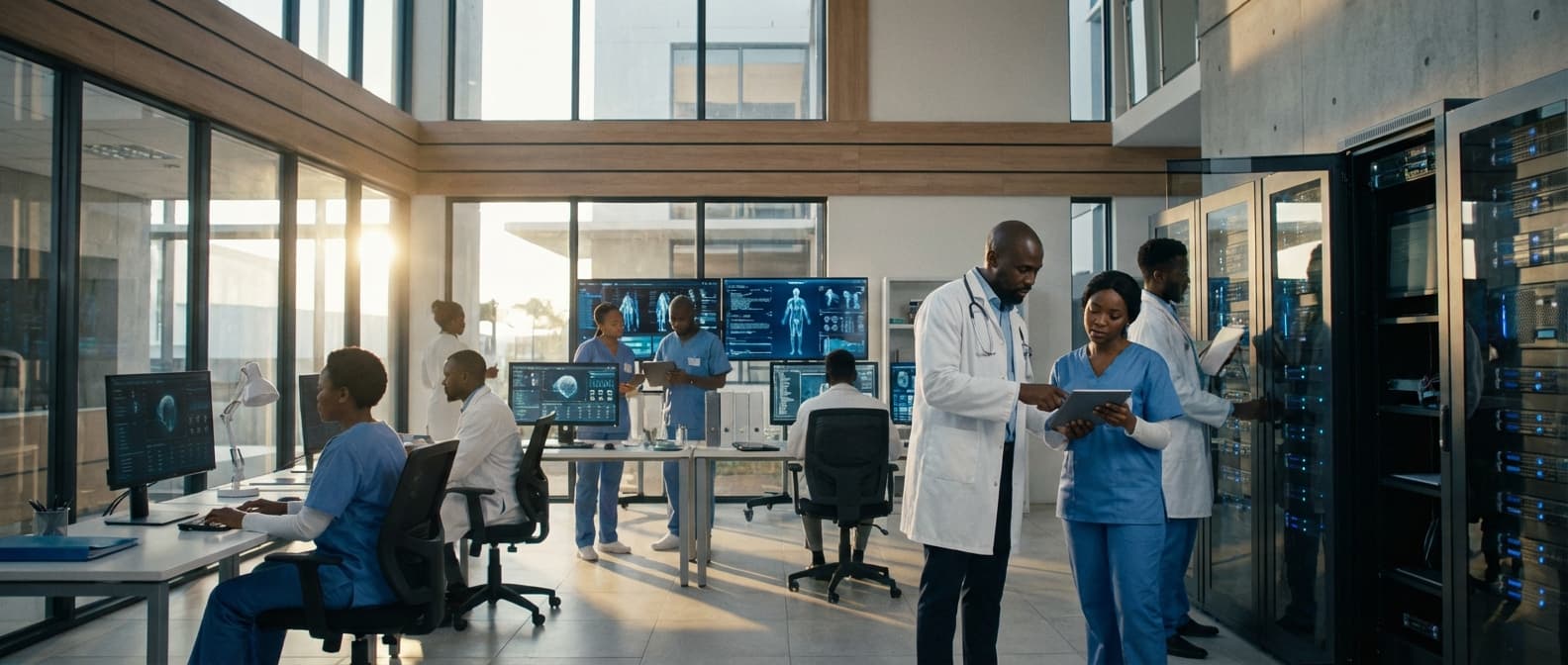
Medical IT Consultation in Eritrea
Engineering Excellence & Technical Support
Strategic technology consulting to optimize healthcare operations, streamline workflows, and integrate cutting-edge medical information systems. High-standard technical execution following OEM protocols and local regulatory frameworks.
Telemedicine & Remote Patient Monitoring Implementation
Successfully deployed and integrated telemedicine platforms and remote patient monitoring solutions for healthcare facilities in Asmara, enhancing patient access to specialist consultations and enabling proactive health management for chronic conditions.
Electronic Health Record (EHR) System Optimization
Led the assessment, customization, and rollout of a secure and scalable Electronic Health Record (EHR) system across multiple regional clinics, significantly improving data accuracy, workflow efficiency, and patient information accessibility for clinicians.
Healthcare Data Security & Compliance Strategy
Developed and implemented robust cybersecurity protocols and data privacy strategies for Eritrean healthcare providers, ensuring compliance with national regulations and safeguarding sensitive patient information against cyber threats.
What Is Medical It Consultation In Eritrea?
Medical IT Consultation in Eritrea refers to the provision of expert advice and strategic guidance on the implementation, optimization, and management of information technology within healthcare organizations in the nation. This service encompasses a broad spectrum of IT-related challenges and opportunities specific to the Eritrean healthcare landscape, aiming to enhance operational efficiency, improve patient care delivery, ensure data security, and facilitate digital transformation initiatives. The consultation focuses on aligning IT infrastructure and solutions with the unique regulatory, economic, and technological context of Eritrea, often navigating resource constraints and emphasizing sustainability.
| Who Needs Medical IT Consultation in Eritrea? | Typical Use Cases |
|---|---|
| Public Healthcare Facilities (Hospitals, Health Centers): To modernize infrastructure, implement EHRs, improve data collection and reporting for public health surveillance, and enhance diagnostic capabilities. | Implementation of an Electronic Health Record (EHR) system in a regional hospital to streamline patient data management and reduce medical errors. |
| Private Healthcare Providers (Clinics, Diagnostic Centers): To enhance patient management, improve billing and administrative processes, and adopt digital diagnostic tools. | Advising a private clinic on selecting and implementing a cloud-based practice management software for efficient patient scheduling and billing. |
| Ministry of Health and National Health Agencies: For strategic planning, policy formulation, national health information system development, and e-health initiative rollout. | Assisting the Ministry of Health in developing a national strategy for telemedicine implementation to extend healthcare access to remote areas. |
| Research and Academic Institutions: To support data analysis, research infrastructure, and digital learning platforms. | Guiding a medical research institute in establishing a secure, high-performance computing infrastructure for genomic data analysis. |
| International Organizations and NGOs operating in the health sector: To ensure IT solutions are aligned with local contexts and national strategies, and to facilitate data reporting and program monitoring. | Consulting with an NGO on the deployment of mobile health (mHealth) applications for disease outbreak monitoring and community health worker support. |
| Emerging Healthcare Technology Vendors: To understand the Eritrean market, regulatory requirements, and integration challenges for their solutions. | Providing a medical device company with insights into the IT infrastructure and procurement processes of Eritrean hospitals to tailor their product offerings. |
Key Aspects of Medical IT Consultation in Eritrea
- Needs Assessment and Gap Analysis: Evaluating current IT infrastructure, identifying areas for improvement, and recommending strategic interventions.
- System Design and Architecture: Planning and designing robust and scalable IT systems, including Electronic Health Records (EHRs), Picture Archiving and Communication Systems (PACS), and Laboratory Information Systems (LIS).
- Technology Selection and Procurement: Advising on appropriate hardware, software, and network solutions, considering cost-effectiveness and local support availability.
- Implementation and Deployment Support: Overseeing the installation, configuration, and integration of new IT systems.
- Data Management and Security: Developing strategies for data integrity, privacy, compliance with national regulations, and cybersecurity.
- Interoperability and Data Exchange: Facilitating seamless data flow between different healthcare facilities and departments, potentially including national health information exchanges.
- Training and Capacity Building: Designing and delivering training programs for healthcare professionals and IT staff to ensure effective utilization of IT resources.
- IT Governance and Policy Development: Establishing IT policies, procedures, and governance frameworks to ensure responsible and effective IT management.
- Digital Health Strategy Development: Crafting long-term strategies for leveraging digital technologies to achieve national health objectives, such as telemedicine and mHealth initiatives.
- Maintenance and Support Planning: Defining support structures and maintenance plans for IT systems to ensure their longevity and optimal performance.
Who Needs Medical It Consultation In Eritrea?
Navigating the complexities of healthcare technology in Eritrea requires specialized expertise. Medical IT consultation services are crucial for organizations aiming to optimize their digital infrastructure, enhance patient care, and ensure data security and compliance. These services address the unique challenges and opportunities within Eritrea's healthcare landscape, from implementing electronic health records (EHRs) to improving network reliability and cybersecurity. By leveraging expert advice, healthcare providers can make informed decisions about technology adoption, leading to more efficient operations and better health outcomes.
| Department/Area | IT Needs & Consultation Focus | Key Benefits of Consultation |
|---|---|---|
| Clinical Departments (e.g., Cardiology, Pediatrics, Oncology) | EHR/EMR implementation and optimization, medical imaging integration (PACS), specialized clinical software, data analytics for patient outcomes, telemedicine integration. | Improved patient record accuracy, faster access to information, enhanced diagnostic capabilities, better treatment planning, increased operational efficiency. |
| Administration and Management | Healthcare Information Systems (HIS) selection and implementation, patient scheduling and billing systems, IT infrastructure planning, budget management for IT, cybersecurity policy development, data privacy and compliance. | Streamlined administrative processes, improved revenue cycle management, reduced operational costs, enhanced data security, compliance with national regulations. |
| IT Department/Support Staff | Network infrastructure design and security, server management and virtualization, cybersecurity best practices and incident response, cloud strategy (if applicable), hardware and software procurement, IT training and capacity building. | Robust and secure IT infrastructure, improved system uptime and performance, enhanced cybersecurity posture, skilled IT workforce, optimized technology investments. |
| Procurement and Logistics | Inventory management systems for pharmaceuticals and equipment, supply chain visibility tools, integration with financial systems, asset tracking. | Efficient inventory control, reduced waste, improved supply chain reliability, better financial planning. |
| Research and Education | Data management for research studies, secure data sharing platforms, access to medical databases and literature, simulation software, learning management systems (LMS) for medical professionals. | Facilitated research collaboration, secure handling of sensitive data, access to up-to-date medical knowledge, enhanced educational delivery. |
Target Customers for Medical IT Consultation in Eritrea:
- Public Hospitals and Clinics (National and Regional)
- Private Healthcare Facilities (Hospitals, Clinics, Diagnostic Centers)
- Ministry of Health and its sub-departments
- Non-Governmental Organizations (NGOs) involved in healthcare delivery
- Medical Training and Research Institutions
- Pharmacies and Medical Supply Chains (for inventory and data management systems)
- Telemedicine and Remote Healthcare Providers
Medical It Consultation Process In Eritrea
The Medical IT Consultation Process in Eritrea outlines a structured approach to addressing the information technology needs of healthcare facilities. This workflow aims to ensure that technology solutions are effectively identified, implemented, and integrated to improve healthcare delivery and management within the Eritrean context. The process begins with an initial inquiry from a healthcare provider and culminates in the successful execution and ongoing support of the IT solution.
| Stage | Description | Key Activities | Responsible Parties | Deliverables |
|---|---|---|---|---|
| Inquiry and Initial Assessment | The process begins when a healthcare facility or individual expresses a need for IT services or consultation. | Initial contact, understanding the broad nature of the request, identifying stakeholders. | Healthcare Facility Representative, Potential IT Consultant/Provider | Acknowledgment of inquiry, preliminary understanding of the need. |
| Needs Analysis and Requirements Gathering | A detailed understanding of the specific IT challenges and requirements is established. | Interviews with staff, site visits, documentation review, identifying pain points and desired outcomes. | IT Consultant, Healthcare Facility Stakeholders (doctors, nurses, administrators, IT staff) | Detailed needs assessment report, documented functional and non-functional requirements. |
| Solution Design and Proposal Development | Based on the gathered requirements, appropriate IT solutions are conceptualized and proposed. | Brainstorming solutions, technical feasibility studies, cost-benefit analysis, developing solution architecture. | IT Consultant/Solution Architect, Technical Specialists | Technical design document, detailed proposal with solution overview, implementation plan, and cost estimation. |
| Vendor Selection and Procurement | If external vendors or specific hardware/software are required, a selection and procurement process is initiated. | Developing RFPs/RFQs, evaluating vendor proposals, negotiating contracts, purchasing equipment/licenses. | IT Consultant, Healthcare Facility Procurement Department, Ministry of Health (if applicable) | Selected vendor, signed contracts, procured hardware/software. |
| Implementation and Deployment | The chosen IT solution is installed, configured, and integrated into the existing infrastructure. | Hardware installation, software setup and configuration, network integration, data migration. | IT Consultant, IT Vendor Technicians, Healthcare Facility IT Staff | Deployed IT system, configured infrastructure. |
| Training and Capacity Building | End-users and IT support staff are trained on how to effectively use and maintain the new IT system. | Developing training materials, conducting training sessions, hands-on practice, user support. | IT Consultant/Trainer, Healthcare Facility Staff | Trained users, training manuals, user guides. |
| Testing and Quality Assurance | The implemented system is thoroughly tested to ensure it meets requirements and operates correctly. | Unit testing, integration testing, user acceptance testing (UAT), bug fixing. | IT Consultant, Healthcare Facility Staff, IT Vendor Testers | Test reports, sign-off on system functionality. |
| Go-Live and Support | The new IT system is officially launched, and ongoing support mechanisms are established. | Phased or full system launch, immediate post-launch support, help desk setup, troubleshooting. | IT Consultant, Healthcare Facility IT Staff, IT Vendor Support | Live IT system, established support channels, incident management process. |
| Monitoring, Evaluation, and Optimization | The performance of the IT system is continuously monitored, evaluated, and adjusted for optimal effectiveness. | Performance monitoring, user feedback collection, regular system reviews, identifying areas for improvement, implementing updates and upgrades. | IT Consultant, Healthcare Facility Management, Ministry of Health (if applicable) | Performance reports, feedback logs, system optimization recommendations, updated system. |
Key Stages of the Medical IT Consultation Process in Eritrea
- Inquiry and Initial Assessment
- Needs Analysis and Requirements Gathering
- Solution Design and Proposal Development
- Vendor Selection and Procurement
- Implementation and Deployment
- Training and Capacity Building
- Testing and Quality Assurance
- Go-Live and Support
- Monitoring, Evaluation, and Optimization
Medical It Consultation Cost In Eritrea
Medical IT consultation costs in Eritrea are influenced by several key factors. These include the complexity of the IT issues, the specific services required (e.g., EMR implementation, network security, hardware troubleshooting, software development), the experience and specialization of the IT consultant, and the duration of the consultation. The general economic climate and the demand for specialized IT skills within Eritrea also play a significant role in pricing. While a formal, standardized pricing structure for medical IT consultation isn't widely published in Eritrea, typical rates can be estimated based on market observations and the factors mentioned above. It's important for healthcare providers to obtain detailed quotes from multiple IT consultants or firms to compare services and pricing.
| Service Type/Consultant Level | Estimated Range (Eritrean Nakfa - ERN) |
|---|---|
| Basic Troubleshooting/General IT Support (Hourly) | 500 - 1,500 ERN |
| Specialized Consultation (e.g., EMR Strategy, Network Security - Hourly) | 1,500 - 3,500 ERN |
| Project-Based (e.g., system implementation, software development - Estimated) | Negotiable, potentially tens of thousands to hundreds of thousands ERN depending on scope. |
| Experienced/Senior Consultant (Hourly) | 2,000 - 4,000+ ERN |
| IT Consulting Firm (Daily/Project Rate) | Highly variable, typically higher than individual consultants. |
Factors Influencing Medical IT Consultation Costs in Eritrea
- Complexity of IT issues
- Specific services required (e.g., EMR, cybersecurity, hardware, software)
- Consultant's experience and specialization
- Duration of consultation
- Economic conditions in Eritrea
- Demand for specialized IT skills
Affordable Medical It Consultation Options
Navigating the complexities of Medical IT can be daunting for healthcare providers, especially when budget is a primary concern. Fortunately, there are several affordable medical IT consultation options available that can deliver significant value. Understanding value bundles and implementing cost-saving strategies are key to maximizing your IT investment and ensuring your practice operates efficiently and securely.
| Value Bundle Type | Description | Cost-Saving Benefit |
|---|---|---|
| "Startup Essentials" Bundle | Comprehensive IT setup for new practices, including network infrastructure, basic cybersecurity, EHR/PM system selection guidance, and initial cloud setup. | Bundled pricing is typically lower than individual service fees. Reduces the need for multiple vendors and simplifies initial IT deployment. |
| "HIPAA Compliance & Security" Bundle | Focuses on meeting HIPAA requirements, including risk assessments, policy development, security training, and implementation of necessary technical safeguards. | Proactive compliance prevents costly fines and reputational damage. Consolidated approach ensures all aspects of HIPAA are addressed efficiently. |
| "EHR Optimization & Training" Bundle | In-depth analysis of your Electronic Health Record system to improve workflows, enhance user adoption, and identify opportunities for efficiency gains. Includes targeted staff training. | Increases staff productivity and reduces manual workarounds. Improves data accuracy and accessibility, leading to better patient care and faster billing cycles. |
| "Remote Work & Telehealth Integration" Bundle | Configures secure remote access solutions, integrates telehealth platforms, and ensures compliance for virtual patient interactions. | Enables new revenue streams and improves patient access without significant upfront hardware investment. Streamlined integration reduces technical hurdles. |
| "Managed IT Services Lite" (Retainer-Based) | A set number of hours per month for ongoing IT support, monitoring, and proactive maintenance for a fixed fee. Ideal for smaller practices with predictable needs. | Predictable monthly costs prevent budget surprises. Proactive maintenance reduces costly emergency fixes and downtime. |
Key Considerations for Affordable Medical IT Consultation
- Define Your Specific Needs: Before seeking consultation, clearly outline your IT challenges and goals. This prevents unnecessary scope creep and ensures you get targeted advice.
- Research Different Consultation Models: Explore various approaches beyond traditional hourly rates, such as project-based, retainer, or outcome-based models.
- Prioritize Essential Services: Focus on consultations that address your most critical needs first, such as cybersecurity, EHR optimization, or HIPAA compliance.
- Leverage Existing Resources: Inquire about whether the consultant can help you better utilize or optimize the IT solutions you already possess.
- Request Case Studies and Testimonials: Look for consultants with proven success stories in healthcare settings similar to yours.
- Understand the Consultant's Expertise: Ensure their specialization aligns with your specific medical IT requirements (e.g., specific EHR systems, practice management software, or telehealth platforms).
Verified Providers In Eritrea
In Eritrea, ensuring access to reliable and high-quality healthcare services is paramount. When seeking medical assistance, it's crucial to identify verified providers who meet stringent standards. Franance Health stands out as a premier choice for individuals and organizations in Eritrea due to its unwavering commitment to excellence, extensive network of accredited professionals, and dedication to patient well-being. This document outlines why Franance Health credentials represent the best choice for healthcare in Eritrea.
| Franance Health Credential | Meaning/Benefit for Patients in Eritrea | How it Ensures Quality |
|---|---|---|
| Accreditation with Reputable Medical Bodies | Guarantees that providers have met rigorous international and national standards for medical practice, equipment, and facility management. | Regular audits and inspections by accrediting bodies ensure ongoing compliance with quality benchmarks. |
| Verified Professional Licenses and Certifications | Confirms that healthcare professionals possess the necessary legal qualifications and specialized training to practice medicine. | Franance Health conducts thorough background checks and verifies all professional credentials directly with issuing authorities. |
| Proof of Experience and Specialization | Ensures that patients are matched with providers who have proven expertise in their specific medical conditions or needs. | Franance Health maintains detailed records of provider experience and areas of specialization. |
| Adherence to Ethical Guidelines and Patient Rights | Upholds the highest standards of medical ethics, ensuring patient confidentiality, informed consent, and respectful treatment. | All affiliated providers are contractually obligated to adhere to Franance Health's strict ethical code and patient charter. |
| Commitment to Continuous Medical Education (CME) | Ensures that healthcare providers stay updated with the latest medical knowledge, techniques, and technologies. | Franance Health encourages and tracks the participation of its network in recognized CME programs. |
Key Reasons to Choose Franance Health in Eritrea:
- Unwavering Commitment to Quality: Franance Health rigorously vets all affiliated healthcare providers, ensuring they adhere to international best practices and ethical standards.
- Extensive Network of Accredited Professionals: We partner with a diverse range of specialists and general practitioners, offering comprehensive medical services across various disciplines.
- Patient-Centric Approach: Our primary focus is on delivering personalized care, prioritizing patient comfort, privacy, and optimal health outcomes.
- Transparency and Trust: Franance Health operates with complete transparency, providing clear information about provider qualifications, services offered, and associated costs.
- Accessibility and Convenience: We strive to make healthcare accessible, facilitating appointments and consultations to meet your specific needs.
- Continuous Improvement: Franance Health is dedicated to ongoing professional development for its network, ensuring providers remain at the forefront of medical advancements.
- Cultural Sensitivity: Our team understands the importance of cultural nuances and provides care that is respectful and culturally appropriate.
Scope Of Work For Medical It Consultation
This Scope of Work (SOW) outlines the services to be provided by a Medical IT Consultation firm to a healthcare organization. The primary objective is to assess, recommend, and implement solutions to improve the organization's IT infrastructure, electronic health record (EHR) system, cybersecurity posture, and overall operational efficiency in compliance with relevant healthcare regulations (e.g., HIPAA, HITECH).
| Technical Deliverable | Description | Standard Specification/Format | Timeline (Estimated) |
|---|---|---|---|
| Current State IT Infrastructure Assessment Report | Detailed analysis of existing hardware, software, network, and data storage, including performance metrics and identified vulnerabilities. | PDF document, including executive summary, detailed findings, SWOT analysis, and visual diagrams (e.g., network topology). | 2-4 Weeks |
| EHR System Evaluation Report | Assessment of EHR's current performance, features, user satisfaction, integration with other systems, and compliance with medical standards. | PDF document, including feature analysis, gap identification, vendor comparison (if applicable), and user feedback summary. | 3-5 Weeks |
| Cybersecurity Risk Assessment and Strategy Report | Identification of potential threats, vulnerabilities, and associated risks, along with recommended security controls and a phased implementation plan. | PDF document, including risk register, vulnerability scan results, proposed security architecture, incident response plan outline, and compliance checklist. | 4-6 Weeks |
| IT Modernization and Optimization Recommendations | Specific, actionable recommendations for hardware upgrades, software solutions, cloud migration strategy, and workflow automation. | Detailed proposal document in PDF, including ROI analysis, vendor evaluations, licensing considerations, and implementation roadmap. | 2-3 Weeks (post-assessment) |
| Implementation Plan | A comprehensive project plan outlining tasks, resources, dependencies, milestones, and a detailed budget for approved recommendations. | Microsoft Project file or similar project management software export (e.g., Gantt chart), and a summary PDF document. | 1-2 Weeks (post-recommendation approval) |
| System Design Documents (if new systems are implemented) | Technical specifications, architectural diagrams, and configuration details for new or upgraded systems. | Visio diagrams, technical specification documents in PDF or DOCX format, and configuration guides. | As per implementation plan |
| Testing and Validation Reports | Documentation of all testing phases, including unit testing, integration testing, user acceptance testing (UAT), and performance testing. | Test scripts, test case results, bug tracking reports, and final UAT sign-off document (PDF). | As per implementation plan |
| Training Materials | User manuals, quick reference guides, and training presentations for new systems and processes. | PDF documents, PowerPoint presentations, and video tutorials (optional). | As per implementation plan |
| Go-Live Support Plan | Detailed plan for supporting the organization during and immediately after system implementation. | PDF document outlining support channels, escalation procedures, and key personnel. | As per implementation plan |
| Post-Implementation Review Report | Evaluation of the implemented solutions against project objectives, including lessons learned and recommendations for ongoing optimization. | PDF document, including performance metrics, user feedback summary, and future recommendations. | 2-3 Weeks (post-go-live) |
| Comprehensive Project Documentation | Consolidated archive of all project-related documents, including SOW, meeting minutes, technical specifications, and final reports. | Organized digital folder structure, accessible via a secure portal or shared drive, with all documents in PDF format. | End of Project |
Key Project Objectives
- Conduct a comprehensive assessment of the current IT infrastructure, including hardware, software, networking, and data storage.
- Evaluate the existing EHR system for functionality, usability, integration capabilities, and compliance.
- Perform a thorough cybersecurity risk assessment and develop a robust security strategy.
- Identify opportunities for technological improvements and cost optimization.
- Provide recommendations for hardware and software upgrades, cloud migration, and new system implementations.
- Develop a detailed implementation plan with timelines, resource allocation, and budget.
- Ensure all recommendations and implementations adhere to current healthcare regulations and best practices.
- Provide training and support to IT staff and end-users.
- Deliver comprehensive documentation of all implemented solutions and procedures.
Service Level Agreement For Medical It Consultation
This Service Level Agreement (SLA) outlines the response times and uptime guarantees for Medical IT Consultation services provided by [Your Company Name] to [Client Name]. This SLA is effective as of [Start Date] and will remain in effect until [End Date], unless terminated in accordance with the Master Service Agreement.
| Incident Priority | Response Time Target | Resolution Time Target | Uptime Guarantee (Monthly) |
|---|---|---|---|
| Critical | 15 minutes | 4 hours | 99.9% |
| High | 1 hour | 8 business hours | 99.5% |
| Medium | 4 business hours | 3 business days | 99.0% |
| Low | 1 business day | 5 business days | N/A (Best Effort) |
Service Commitments
- Critical Incidents: Unavailability of core IT systems directly impacting patient care or essential hospital operations.
- High-Priority Incidents: Significant disruption to non-critical IT services affecting departmental productivity.
- Medium-Priority Incidents: Minor service degradations or issues impacting a limited number of users.
- Low-Priority Incidents: General inquiries, feature requests, or non-urgent IT-related questions.
Frequently Asked Questions

Ready when you are
Let's scope your Medical IT Consultation in Eritrea project in Eritrea.

Scaling healthcare logistics and technical systems across the entire continent.