
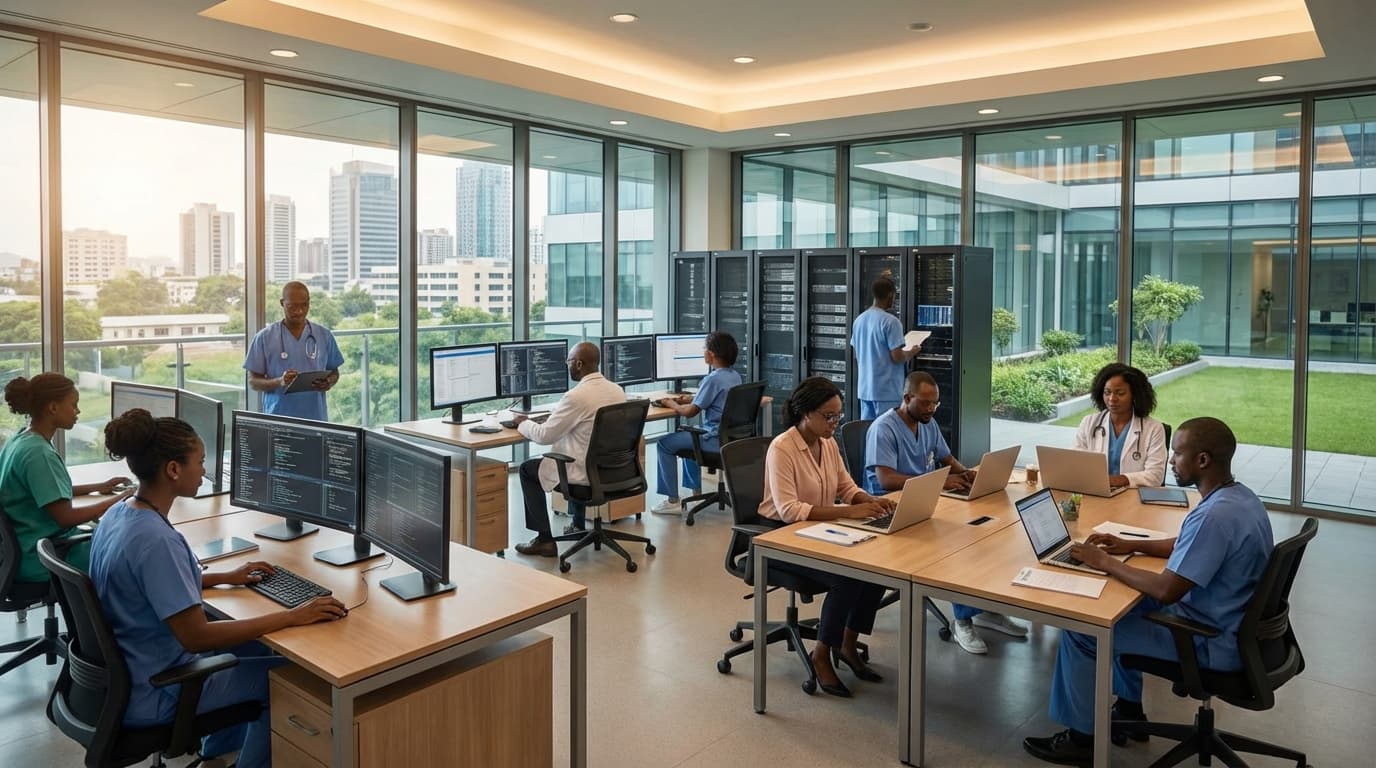
Radiology Reader & Reporting Support in Eritrea
Engineering Excellence & Technical Support
Remote radiology reading and reporting services High-standard technical execution following OEM protocols and local regulatory frameworks.
Enhanced Diagnostic Accuracy
Leveraging advanced AI-powered image analysis tools to assist radiologists in identifying subtle abnormalities and improving diagnostic confidence, leading to earlier and more precise diagnoses for patients across Eritrea.
Streamlined Reporting Workflow
Implementing intelligent reporting templates and natural language processing (NLP) capabilities to automate report generation, reduce radiologist workload, and ensure standardized, high-quality reporting for all imaging studies.
Remote Consultation & Collaboration
Facilitating seamless remote access and secure sharing of imaging data and reports, enabling Eritrean radiologists to consult with international specialists and receive expert support, bridging geographical barriers and elevating patient care.
What Is Radiology Reader & Reporting Support In Eritrea?
Radiology Reader & Reporting Support in Eritrea refers to the provision of specialized services aimed at enhancing the interpretation of medical imaging studies and the subsequent generation of diagnostic reports. This encompasses leveraging remote expertise, advanced software, and streamlined workflows to address potential limitations in local radiologist availability, subspecialty expertise, or technological infrastructure within Eritrea. The service seeks to augment existing capabilities, ensuring timely and accurate diagnostic outputs crucial for patient care and treatment planning. It is a critical component in bridging gaps in healthcare delivery, particularly in regions facing shortages of highly trained medical professionals.
| Stakeholder Group | Needs Addressed | Typical Use Cases |
|---|---|---|
| Hospitals and Clinics in Eritrea | Limited availability of on-site radiologists, especially for specialized examinations. High patient volumes leading to extended waiting times for reports. Need for enhanced diagnostic accuracy and consensus building. Lack of access to subspecialty expertise for complex cases. | Emergency department (ED) consultations for critical findings (e.g., stroke, trauma). Routine interpretation of general radiographic examinations. Outpatient imaging studies requiring prompt reporting. Second opinion consultations for difficult or ambiguous cases. Support for specialized imaging modalities like MRI and CT scans. Out-of-hours and weekend coverage for imaging interpretation. |
| Referral Centers and Diagnostic Imaging Facilities | Inability to cover all subspecialties adequately. Demand for higher quality and more detailed reporting. Need to manage increased workload without proportional increase in staff. Desire to offer a broader range of diagnostic services. | Interpretation of advanced imaging techniques (e.g., perfusion imaging, diffusion tensor imaging). Workflow optimization for high-volume imaging centers. Providing expert reports for complex interventional radiology procedures. Standardizing reporting across different departments or facilities. Enhancing the diagnostic capabilities of local teams through collaborative review. |
| Public Health Initiatives and Government Agencies | Addressing regional disparities in healthcare access. Improving the overall quality of diagnostic services nationwide. Supporting training and capacity building for local medical professionals. Ensuring efficient utilization of limited healthcare resources. | Population-based screening programs (e.g., tuberculosis detection). Supporting public health campaigns requiring large-scale image analysis. Providing diagnostic support for remote or underserved areas. Facilitating national imaging registries and epidemiological studies. Establishing benchmarks for diagnostic quality and efficiency. |
| Individual Radiologists and Technicians | Need for peer consultation and mentorship. Desire to stay updated with the latest advancements in radiology. Opportunities for professional development and skill enhancement. Overcoming diagnostic uncertainty for specific cases. | Seeking a second opinion on challenging scans. Participating in case review sessions with remote experts. Gaining exposure to a wider variety of pathologies. Learning advanced interpretation techniques through real-time collaboration. Utilizing support for complex interventional radiology planning and follow-up. |
Key Components of Radiology Reader & Reporting Support
- Remote Interpretation: Access to a pool of board-certified radiologists located remotely to interpret a wide spectrum of imaging modalities (X-ray, CT, MRI, Ultrasound, etc.).
- Subspecialty Expertise: Availability of radiologists with specific expertise in areas such as neuroradiology, musculoskeletal radiology, abdominal imaging, pediatric radiology, and interventional radiology, which may be limited locally.
- Quality Assurance & Second Opinions: Independent review of existing reports to ensure diagnostic accuracy, identify potential discrepancies, and provide an additional layer of quality control.
- Reporting Tools & Templates: Utilization of standardized reporting software and templates to ensure consistency, completeness, and adherence to international reporting guidelines.
- Turnaround Time (TAT) Optimization: Facilitating faster report generation through efficient workflow management, prioritizing urgent cases, and leveraging asynchronous communication channels.
- Continuing Medical Education (CME) & Training: Providing opportunities for local radiologists and technicians to engage in learning and skill development through case discussions, webinars, and feedback mechanisms.
- PACS/RIS Integration Support: Assistance with the integration and utilization of Picture Archiving and Communication Systems (PACS) and Radiology Information Systems (RIS) for seamless data flow.
- Tele-radiology Platform: The underlying technological infrastructure that enables the secure transmission, storage, and viewing of medical images and reports between remote readers and local healthcare providers.
Who Needs Radiology Reader & Reporting Support In Eritrea?
Radiology reader and reporting support services are crucial for enhancing diagnostic accuracy, improving turnaround times, and alleviating the workload of existing radiology departments in Eritrea. These services can significantly benefit healthcare facilities by providing access to specialized expertise, particularly in areas where local resources may be limited.
| Target Customer/Department | Specific Needs & Benefits | Key Areas of Support |
|---|---|---|
| Public Hospitals (e.g., National Referral Hospital, Regional Hospitals) | High patient volume, potential for limited subspecialist radiologists, need for timely and accurate diagnoses to guide patient management and treatment. Support can reduce backlog and improve efficiency. | General radiology interpretation (X-ray, CT, Ultrasound, MRI), subspecialty reads (neuroradiology, musculoskeletal, abdominal, thoracic), second opinions, preliminary reporting during peak times. |
| Ministry of Health | Overall oversight of national healthcare quality, need for standardized reporting and quality assurance, capacity building for local radiologists. Support can inform public health strategies and resource allocation. | Quality assurance protocols, development of reporting templates, training and mentorship programs for local radiologists, data analysis for epidemiological purposes. |
| Private Clinics & Diagnostic Centers | Focus on specialized imaging services, potential for proprietary equipment, need for expert interpretation to maintain competitiveness and patient trust. Support ensures high-quality diagnostic outputs. | Interpretation of advanced imaging modalities, specialized reporting (e.g., interventional radiology), remote reading services to cover off-hours and weekends. |
| Specialty Hospitals (e.g., Oncology, Cardiology, Pediatrics) | Require highly specialized radiology interpretations relevant to their specific patient populations and disease management. Support ensures accurate diagnosis for complex cases. | Subspecialty radiology reads (oncologic imaging, cardiac imaging, pediatric radiology), advanced image analysis and quantification, consultation on complex cases. |
| Medical Training Institutions (e.g., University of Asmara's College of Medicine) | Need for teaching cases, exposure to diverse and complex imaging findings, and expert guidance for their radiology residents and medical students. Support can enhance educational quality. | Annotated teaching cases, expert lectures and workshops on radiology interpretation, mentorship for trainees, validation of diagnostic skills. |
| International Aid Organizations & NGOs | Often involved in public health initiatives, screening programs, and disaster relief, requiring rapid and accurate radiology assessments in diverse settings. Support can facilitate project implementation. | Rapid interpretation of imaging for screening programs (e.g., TB), portable imaging interpretation in remote areas, support for emergency response and humanitarian missions. |
Target Customers and Departments in Eritrea Requiring Radiology Reader & Reporting Support
- Public Hospitals & Healthcare Centers
- Private Clinics & Diagnostic Centers
- Specialty Hospitals
- Medical Training Institutions
- International Aid Organizations & NGOs
Radiology Reader & Reporting Support Process In Eritrea
The Radiology Reader & Reporting Support Process in Eritrea outlines the systematic workflow for handling radiology imaging inquiries and ensuring timely, accurate reporting. This process is crucial for patient diagnosis and treatment planning within the Eritrean healthcare system.
| Stage | Description | Key Actors | Key Outputs | Considerations/Challenges in Eritrea |
|---|---|---|---|---|
| Inquiry & Request Initiation | A clinician identifies the need for a radiology examination for a patient and initiates a request. | Requesting Clinician, Referring Physician | Completed Radiology Request Form | Availability of trained personnel to assess the necessity of imaging; standardized request forms. |
| Image Acquisition & Transmission | The requested radiology examination is performed, and the resulting images are acquired and transmitted to a central reading location or PACS (Picture Archiving and Communication System) if available. | Radiology Technologist, Radiographer | Digital Images (DICOM format), Film Radiographs (less common) | Availability and maintenance of imaging equipment (X-ray, Ultrasound, CT, MRI); reliable electricity; digital transmission infrastructure; local vs. remote reading. |
| Image Review & Interpretation (Reading) | A qualified radiologist reviews the acquired images, identifies abnormalities, and formulates a diagnosis. | Radiologist | Preliminary findings, mental notes for the report | Shortage of radiologists; heavy workload; limited access to subspecialist expertise; reliance on general radiologists for all modalities. |
| Report Generation & Dictation | The radiologist dictates their findings, conclusions, and recommendations into a structured report. | Radiologist | Dictated Audio Report | Availability of functional dictation equipment (digital recorders, microphones); radiologist's dictation skills and clarity. |
| Report Transcription & Verification | A medical transcriptionist transcribes the dictated audio report into a written document. The radiologist then verifies and signs off on the transcribed report. | Medical Transcriptionist, Radiologist | Draft Report, Final Signed Report | Availability of trained transcriptionists; turnaround time for transcription; accuracy of transcription; radiologist's availability for verification. |
| Report Distribution & Archival | The final, signed report is distributed to the requesting clinician and filed in the patient's medical record. Digital archiving is preferred. | Administrative Staff, IT Support (for PACS) | Distributed Report, Archived Medical Record | Efficient communication channels between radiology and clinical departments; reliable archival systems (digital or physical); patient data privacy concerns. |
| Quality Assurance & Feedback | Regular review of reports for accuracy, completeness, and adherence to standards. Feedback mechanisms are established for radiologists and technologists. | Lead Radiologist, Quality Assurance Committee | Quality Improvement Data, Corrective Actions | Establishing robust QA protocols; regular case reviews; continuous professional development for staff; incorporating feedback into training. |
Radiology Reader & Reporting Support Process Stages
- Inquiry & Request Initiation
- Image Acquisition & Transmission
- Image Review & Interpretation (Reading)
- Report Generation & Dictation
- Report Transcription & Verification
- Report Distribution & Archival
- Quality Assurance & Feedback
Radiology Reader & Reporting Support Cost In Eritrea
Assessing the cost of radiology reader and reporting support in Eritrea involves understanding a complex interplay of factors, as the country's healthcare infrastructure and economic conditions present unique challenges. While specific pricing is not readily available due to limited public data and potential for direct negotiation, we can outline the key pricing factors and provide estimated ranges based on regional comparisons and anticipated operational costs. These services are crucial for accurate diagnosis and patient care, and their cost is influenced by the expertise of the radiologists, the technological infrastructure involved, and the operational overheads.
| Service Component | Estimated Cost Range (Eritrean Nakfa - ERN) | Notes |
|---|---|---|
| Per Study Interpretation (Standard X-ray) | 300 - 800 ERN | Highly dependent on radiologist's experience and volume. |
| Per Study Interpretation (CT/MRI - single sequence) | 1,000 - 3,000 ERN | Reflects higher complexity and specialized knowledge. |
| Per Study Interpretation (Complex CT/MRI - multiple sequences, advanced applications) | 2,500 - 7,000+ ERN | Includes studies requiring advanced post-processing or subspecialty interpretation. |
| Remote Reporting Platform/PACS Integration (Annual Fee) | 100,000 - 500,000+ ERN | Covers software, maintenance, data storage, and IT support. Highly variable based on vendor and features. |
| On-site Radiologist (Monthly Retainer) | 150,000 - 400,000+ ERN | For full-time or part-time dedicated on-site expertise. Includes salary, benefits, and overhead. |
| Consultation/Second Opinion (Per Case) | 500 - 2,000 ERN | For specific case reviews or expert opinions. |
| Training and Quality Assurance Programs (Per Session/Program) | 50,000 - 150,000 ERN | For enhancing local radiologist skills or implementing quality protocols. |
Key Pricing Factors for Radiology Reader & Reporting Support in Eritrea:
- Radiologist Expertise and Experience: The qualifications, specialization (e.g., neuroradiology, musculoskeletal), and years of experience of the interpreting radiologists significantly influence costs. Highly specialized or internationally trained radiologists will command higher fees.
- Volume and Complexity of Studies: The number of imaging studies (X-rays, CT scans, MRIs, ultrasounds) requiring interpretation, as well as their complexity, will directly impact the overall cost. More complex studies often require more time and specialized knowledge.
- Technology and Infrastructure: The availability and maintenance of advanced imaging equipment (CT, MRI scanners, PACS systems) and the IT infrastructure to support remote reading and reporting are cost drivers. This includes software licenses, hardware maintenance, and data storage.
- Turnaround Time (TAT) Requirements: Faster reporting times, especially for critical cases, often necessitate dedicated staffing and streamlined workflows, which can increase costs.
- Location and Accessibility: Reporting can be done locally or remotely. Local reporting may involve on-site radiologists or dedicated reading centers, while remote reporting involves secure data transmission and communication infrastructure. The logistics and associated security measures for remote reporting can add to the cost.
- Service Level Agreements (SLAs): The specific terms of the agreement, including guaranteed uptime, quality control measures, and dispute resolution, will be factored into the pricing.
- Currency Fluctuations and Exchange Rates: As Eritrea uses the Eritrean Nakfa (ERN), the cost in USD or other international currencies will be subject to exchange rate fluctuations, which can impact the affordability of imported technology or services.
- Operational Overheads: This includes administrative costs, staff salaries (for technicians, IT support, administrative staff), facility costs (if applicable), and regulatory compliance.
- Government Regulations and Taxation: Local taxes, import duties on medical equipment, and any specific government regulations pertaining to healthcare services can affect pricing.
- Market Demand and Competition: While the market for specialized radiology services in Eritrea might be limited, any existing competition or the perceived demand for these services will play a role in pricing strategies.
Affordable Radiology Reader & Reporting Support Options
Finding affordable radiology reader and reporting support is crucial for healthcare providers looking to optimize workflows, improve turnaround times, and manage costs effectively. This involves exploring various service models, from on-demand reading to dedicated remote radiology teams. Value bundles and strategic cost-saving measures can significantly enhance the financial viability of these services.
| Value Bundle Type | Description | Cost-Saving Strategies | Ideal For |
|---|---|---|---|
| Volume-Based Bundles | A fixed price for a predetermined number of studies or reads within a given period. | Volume discounts, tiered pricing based on complexity, longer-term contracts. | Hospitals and imaging centers with predictable, high patient volumes. |
| Subspecialty Packages | Bundled access to a pool of remote subspecialists for specific modalities (e.g., Neuro, MSK, Breast Imaging). | Shared resource model, flexible allocation of subspecialists, reduced overhead for the provider. | Practices needing specialized interpretations without the expense of full-time hires. |
| Workflow Integration Bundles | Includes remote reading services along with integrated PACS viewers, reporting software, or AI tools. | Streamlined communication, reduced IT infrastructure costs, enhanced efficiency through technology. | Organizations seeking a comprehensive, end-to-end radiology solution. |
| Emergency/After-Hours Bundles | Dedicated or on-call services for urgent reads outside of standard business hours. | Predictable after-hours staffing costs, reduced burnout for in-house staff, guaranteed coverage. | Facilities with 24/7 patient care needs or high volumes of emergent cases. |
| Hybrid Models | A combination of in-house reads for routine cases and outsourced reads for complex or subspecialty cases. | Optimized utilization of internal resources, cost control for routine work, access to specialized expertise when needed. | Larger practices or departments looking for a balanced approach to cost and coverage. |
Key Considerations for Affordable Radiology Reader & Reporting Support
- On-Demand Reading Services: Ideal for fluctuating workloads or specific subspecialty needs. Pay-per-read or per-study models offer flexibility.
- Dedicated Remote Reading Teams: Provides consistent coverage and can be more cost-effective for higher volumes. Offers predictability in staffing and expertise.
- Subspecialty vs. General Radiology: Subspecialists often command higher rates, but their expertise can improve diagnostic accuracy and reduce downstream costs.
- Technology Integration: Leveraging AI-powered preliminary reads or workflow automation can reduce the burden on human readers and improve efficiency.
- Service Level Agreements (SLAs): Clearly defined SLAs for turnaround times, report quality, and communication are essential for managing expectations and ensuring value.
- Geographic Location of Services: Reading services based in regions with lower operational costs can offer more competitive pricing.
- Data Security and HIPAA Compliance: Ensuring robust security measures and compliance is non-negotiable, and often bundled into the service cost.
Verified Providers In Eritrea
When seeking healthcare services in Eritrea, particularly those involving specialized financial or insurance-related aspects of health, identifying verified providers is paramount. This ensures you receive legitimate services from accredited professionals. Franance Health stands out as a premier choice due to its stringent credentialing process and commitment to excellence. This section outlines the credentials that make Franance Health the optimal selection for your health and financial planning needs in Eritrea.
| Credential Type | Description of Verification | Benefit to Patient |
|---|---|---|
| Ministry of Health Accreditation | Official certification by the Eritrean Ministry of Health, confirming adherence to national healthcare regulations and standards. | Ensures legal compliance, ethical practice, and a baseline of quality healthcare services. |
| Certified Financial Health Specialist | Demonstrates specialized knowledge and training in managing health-related finances, insurance, and billing. | Facilitates understanding of insurance coverage, simplifies billing processes, and aids in financial planning for medical costs. |
| Insurance Provider Network | Established relationships with recognized health insurance companies, facilitating smooth transactions and access to services. | Streamlines claims, ensures coverage validity, and broadens access to a wider range of medical facilities. |
| CPD Programs | Mandatory participation in ongoing training and development for medical and financial health professionals. | Guarantees access to the latest medical knowledge and financial expertise, ensuring informed decision-making. |
| Patient Advocacy | Commitment to prioritizing patient well-being, transparency, and personalized service. | Provides a supportive and trustworthy healthcare experience, tailored to individual needs and financial situations. |
Key Franance Health Credentials and Why They Matter
- {"title":"Accreditation by Eritrean Ministry of Health","description":"Franance Health providers undergo rigorous vetting and are officially accredited by the Eritrean Ministry of Health. This governmental endorsement signifies adherence to national healthcare standards, ethical practices, and legal compliance, offering a foundational layer of trust and legitimacy."}
- {"title":"Certified Financial Health Specialists","description":"Many Franance Health professionals possess specialized certifications in financial health planning. This means they are not only medically knowledgeable but also equipped to navigate the complexities of health insurance, medical billing, and financial management related to healthcare expenses, a crucial aspect in ensuring accessible and affordable care."}
- {"title":"Partnerships with Reputable Health Insurance Providers","description":"Franance Health actively collaborates with recognized and reliable health insurance companies operating in Eritrea and internationally. These partnerships ensure seamless claims processing, clear understanding of policy benefits, and access to a wider network of healthcare facilities for insured individuals."}
- {"title":"Continuous Professional Development (CPD)","description":"The organization mandates ongoing training and professional development for its network. This commitment to staying abreast of the latest advancements in medical treatments, financial regulations, and patient care protocols guarantees that Franance Health providers offer up-to-date and best-practice solutions."}
- {"title":"Patient-Centric Approach & Ethical Framework","description":"Beyond formal credentials, Franance Health emphasizes a strong ethical framework and a patient-centric approach. This translates to transparent communication, respect for patient autonomy, and a dedication to providing compassionate and tailored care that addresses individual needs and financial circumstances."}
Scope Of Work For Radiology Reader & Reporting Support
This Scope of Work (SOW) outlines the requirements for Radiology Reader and Reporting Support services. The selected vendor will be responsible for providing qualified radiologists to interpret medical images and generate comprehensive reports, adhering to all relevant technical specifications and industry standards. The primary objective is to ensure timely, accurate, and high-quality radiology interpretations for our healthcare facility.
| Technical Deliverable | Standard Specification | Key Performance Indicator (KPI) |
|---|---|---|
| Radiology Image Interpretation | Interpretation by Board-Certified Radiologists (or equivalent). Adherence to ACR Appropriateness Criteria and relevant clinical guidelines. Use of standardized templates for reporting. | Accuracy rate > 98%. Concordance rate with other specialists > 95%. |
| Radiology Reports | Clear, concise, and comprehensive reports in a structured format (e.g., BI-RADS, PI-RADS). Digital signature and timestamp for final reports. Reports to be generated in HL7, DICOM SR, or other agreed-upon electronic formats. | TAT for preliminary reports: < 24 hours for routine exams, < 2 hours for STAT exams. TAT for final reports: < 48 hours for routine exams. |
| Critical Finding Notification | Immediate verbal notification (phone call) to referring physician for critical findings, followed by a documented notification in the report. Established protocol for critical findings list. | 100% of critical findings reported within established timeframes (e.g., < 1 hour of identification). |
| Data Security and Compliance | HIPAA compliance for all data handling and transmission. Secure, encrypted communication channels. Audit trails for all access and modifications. | Zero security breaches. Successful completion of annual HIPAA audits. |
| System Integration | Seamless integration with the existing PACS, RIS, and EMR systems. Support for standard interoperability protocols (e.g., HL7, DICOM). | Successful bi-directional data flow without significant errors. Minimal disruption during integration. |
| Reporting Platform Access | User-friendly, web-based reporting interface with advanced dictation/transcription capabilities. Secure login and user management. | System uptime > 99.5%. Average report generation time within the platform < 15 minutes. |
| Quality Assurance | Regular review of reports for accuracy, completeness, and compliance with standards. Peer review participation as requested. | Internal QA error rate < 1%. Positive feedback from peer review processes. |
Key Responsibilities and Deliverables
- Image interpretation for a range of modalities (e.g., X-ray, CT, MRI, Ultrasound, Mammography, Nuclear Medicine).
- Generation of preliminary and final radiology reports within agreed-upon turnaround times (TAT).
- Communication of critical findings to referring physicians as per established protocols.
- Adherence to all applicable regulatory requirements and quality standards.
- Participation in quality assurance (QA) and peer review processes.
- Provision of access to a secure, HIPAA-compliant PACS viewer and reporting platform.
- Ongoing training and professional development for assigned radiologists.
Service Level Agreement For Radiology Reader & Reporting Support
This Service Level Agreement (SLA) outlines the performance expectations and guarantees for the Radiology Reader & Reporting Support services provided. It defines the responsibilities of both the service provider and the client to ensure efficient and reliable radiological image interpretation and report generation.
| Service Metric | Definition | Target (Standard) | SLA Guarantee | Measurement Methodology |
|---|---|---|---|---|
| Report Turnaround Time (TAT) - STAT/Urgent Cases | Time from image availability and order reception to report availability for critical cases. | 1 hour | 95% of STAT/Urgent reports delivered within 1 hour. | Timestamp recording of order reception and report completion. |
| Report Turnaround Time (TAT) - Routine Cases | Time from image availability and order reception to report availability for non-urgent cases. | 24 hours | 98% of Routine reports delivered within 24 hours. | Timestamp recording of order reception and report completion. |
| Reporting Accuracy | The percentage of reports that are clinically accurate and free from significant errors requiring amendment. | 99.5% | Service provider will rectify any identified reporting errors within 4 business hours of notification. | Internal QA checks, client feedback, and review of amended reports. |
| System Uptime | The percentage of time the reporting platform and associated systems are available for use by the client. | 99.9% | Guaranteed 99.9% uptime, excluding scheduled maintenance windows. | Monitoring of platform availability through third-party tools. |
| Response to Critical Incidents | Time taken to acknowledge and begin addressing critical service disruptions (e.g., system outages, major reporting delays). | 15 minutes | Acknowledgement within 15 minutes of incident notification, with a resolution plan provided within 1 hour. | Incident tracking system timestamps. |
| Availability of Reading Services | The ability to submit cases for reading and receive reports within the defined TATs. | 24/7 | Continuous availability of reading services, with on-call radiologists for urgent cases outside standard hours. | System logs and workflow tracking. |
Key Service Components
- Radiological image interpretation by qualified radiologists.
- Generation of comprehensive and accurate radiology reports.
- Support for various imaging modalities (e.g., X-ray, CT, MRI, Ultrasound, Nuclear Medicine).
- Secure and timely delivery of reports through agreed-upon channels.
- Integration with existing PACS (Picture Archiving and Communication System) and RIS (Radiology Information System) where applicable.
Frequently Asked Questions

Ready when you are
Let's scope your Radiology Reader & Reporting Support in Eritrea project in Eritrea.

Scaling healthcare logistics and technical systems across the entire continent.