
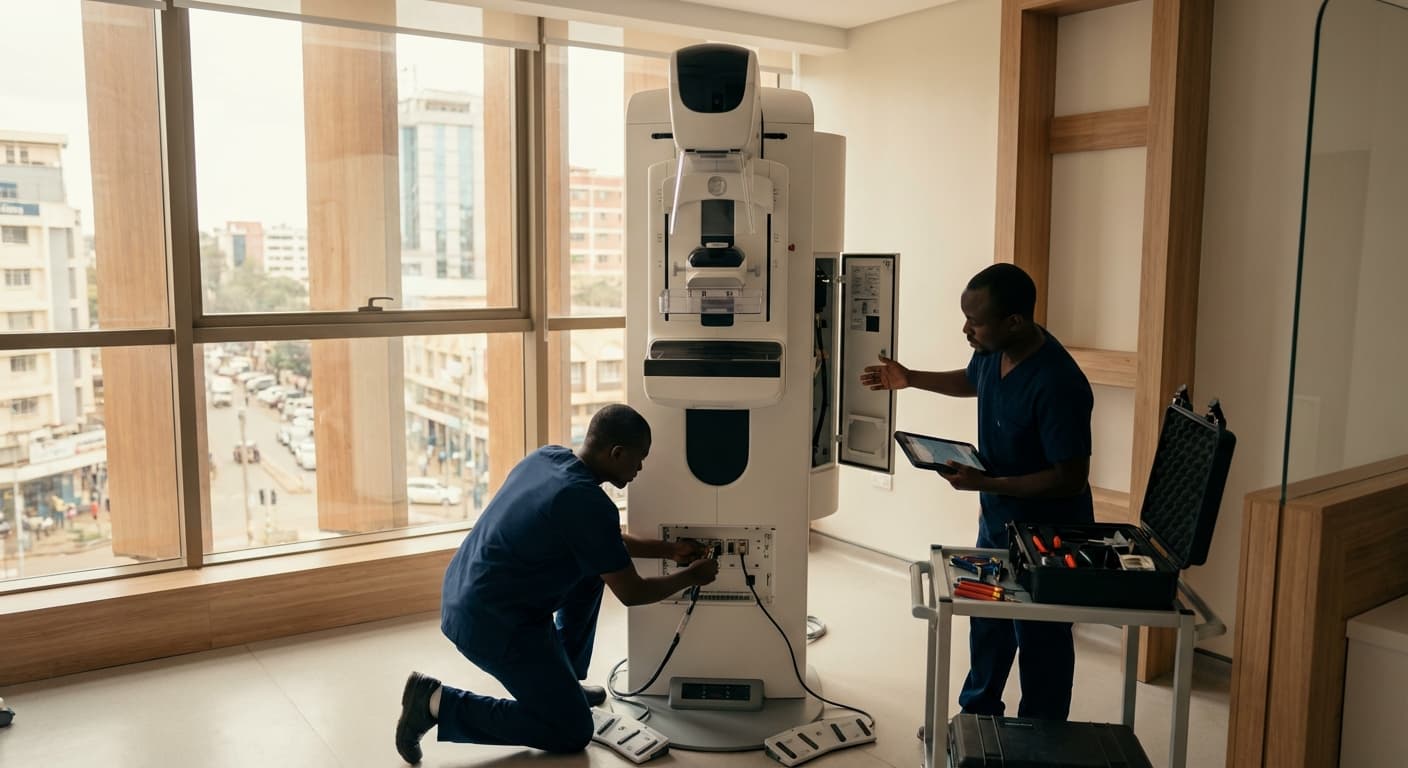
Mammography Installation Service in Eritrea
Engineering Excellence & Technical Support
Mammography Installation Service High-standard technical execution following OEM protocols and local regulatory frameworks.
Advanced Radiation Safety Protocols
Our installation service adheres to stringent international radiation safety standards, ensuring optimal equipment shielding and minimal exposure risks for both patients and staff in Eritrea's healthcare facilities.
Precision Calibration for Diagnostic Accuracy
We implement rigorous calibration procedures for all mammography units, guaranteeing precise image acquisition and delivering the high diagnostic accuracy crucial for early breast cancer detection in Eritrea.
Integrated Workflow Optimization
Our installations focus on seamless integration with existing Picture Archiving and Communication Systems (PACS) and Electronic Health Records (EHR), streamlining reporting workflows and enhancing efficiency for radiologists and technicians in Eritrea.
What Is Mammography Installation Service In Eritrea?
Mammography Installation Service in Eritrea refers to the comprehensive process of setting up, calibrating, and commissioning mammography equipment within healthcare facilities in the nation. This service is crucial for the accurate and reliable implementation of mammography as a diagnostic tool for breast cancer screening and detection. It encompasses the physical installation of the mammography unit, integration with existing or new Picture Archiving and Communication Systems (PACS) and Electronic Health Records (EHR), and ensuring compliance with relevant radiation safety and quality assurance standards mandated by Eritrean health authorities.
| Who Needs Mammography Installation Service? | Typical Use Cases | |||
|---|---|---|---|---|
| Hospitals and Healthcare Centers in Eritrea: Public and private hospitals requiring advanced diagnostic imaging capabilities for breast health. | Establishment of new breast imaging departments or units within existing healthcare facilities. | Upgrade or replacement of outdated mammography equipment. | Expansion of diagnostic services to underserved regions of Eritrea. | Facilities mandated by national health policies to offer mammography screening programs. |
| Breast Cancer Screening Programs: Implementing organized or opportunistic screening initiatives for early detection of breast cancer in the female population. | Diagnostic Mammography: Investigating suspicious findings from physical examinations or other screening methods. | Characterization of Breast Lesions: Differentiating benign from malignant masses and calcifications. | Monitoring of patients with a history of breast cancer or those at high risk. | Research and clinical studies involving mammographic data. |
Key Components of Mammography Installation Service
- Site Assessment and Preparation: Evaluating the intended installation location for structural integrity, power supply, environmental controls (temperature, humidity), and radiation shielding requirements.
- Equipment Delivery and Unpacking: Secure transportation of the mammography system and associated components to the installation site, followed by careful unpacking and inventory verification.
- Physical Installation: Assembling and positioning the mammography unit, including the X-ray tube, detector, compression paddle, and control console, according to manufacturer specifications and site-specific constraints.
- Electrical and Data Connectivity: Connecting the system to reliable power sources and establishing network connections for data transfer to PACS/EHR.
- Software Configuration and Integration: Installing and configuring the mammography software, integrating it with PACS for image archiving and retrieval, and potentially with EHR for patient data management.
- Calibration and Quality Assurance (QA): Performing precise calibration of the X-ray output, image quality parameters, and contrast levels. Conducting initial QA tests to ensure the equipment meets diagnostic performance standards.
- Radiation Safety Compliance: Implementing and verifying adherence to national radiation protection regulations, including proper shielding and emergency shutdown procedures.
- User Training: Providing comprehensive training to radiographers, radiologists, and biomedical engineers on the operation, maintenance, and basic troubleshooting of the mammography system.
- Commissioning and Handover: Final testing and validation of the entire system's functionality, followed by official handover to the healthcare facility with all relevant documentation.
Who Needs Mammography Installation Service In Eritrea?
While mammography installation is a highly specialized service, its necessity in Eritrea arises primarily from the establishment and upgrading of medical facilities focused on women's health and diagnostic imaging. The primary drivers for such installations are advancements in healthcare infrastructure, the need for early cancer detection, and the expansion of diagnostic capabilities. This service is crucial for ensuring that the latest medical technology is properly set up, calibrated, and integrated into the healthcare system, thereby enabling accurate and reliable mammographic examinations. This, in turn, supports better patient outcomes and public health initiatives.
| Customer Type | Primary Need for Mammography Installation | Key Departments Involved |
|---|---|---|
| Government Healthcare Institutions (e.g., National Referral Hospitals, Regional Hospitals) | Upgrading existing facilities, establishing new diagnostic imaging centers, implementing national cancer screening programs. | Radiology, Oncology, Public Health Department, Biomedical Engineering |
| Private Hospitals and Clinics | Expanding service offerings, attracting patients with advanced diagnostic tools, meeting international standards. | Radiology, Women's Health Services, Administration, Biomedical Engineering |
| Non-Governmental Organizations (NGOs) focused on healthcare | Establishing or supporting clinics in underserved areas, providing essential diagnostic services, partnering in health initiatives. | Program Management, Clinical Services, Technical Support Teams |
| International Health Organizations (e.g., WHO, other UN agencies) | Supporting national health strategies, providing technical assistance, equipping facilities for specific health campaigns. | Country Offices, Health Program Specialists, Technical Advisors |
| New Medical Facility Developments | Setting up state-of-the-art diagnostic capabilities from inception, ensuring compliance with regulatory standards. | Project Management, Facility Design, Radiology Department, IT Department |
Target Customers and Departments Requiring Mammography Installation Service in Eritrea
- {"items":["Government Healthcare Institutions","Private Hospitals and Clinics","Non-Governmental Organizations (NGOs) focused on healthcare","International Health Organizations","New Medical Facility Developments"],"title":"Target Customers"}
- {"items":["Radiology Departments","Oncology Centers","Women's Health Clinics/Centers","Diagnostic Imaging Units","Hospital Administration/Procurement Departments","Biomedical Engineering Departments"],"title":"Relevant Departments within these Customers"}
Mammography Installation Service Process In Eritrea
This document outlines the typical workflow for mammography installation services in Eritrea, from the initial client inquiry to the successful execution and handover of the installed equipment. The process is designed to ensure a smooth, efficient, and compliant installation, meeting the specific needs of healthcare facilities in the region.
| Stage | Description | Key Activities | Responsible Parties | Timeline (Indicative) |
|---|---|---|---|---|
| The process begins when a healthcare facility in Eritrea expresses interest in acquiring and installing a mammography unit. This stage involves understanding the client's requirements, budget, and existing infrastructure. | Receive and acknowledge inquiry, Schedule initial consultation, Discuss client needs and expectations, Provide preliminary information on available models and services, Discuss budget and potential financing options. | Healthcare Facility (Client), Service Provider (Installation Company) | 1-3 Days |
| A thorough assessment of the proposed installation site is crucial to identify any structural, electrical, or environmental requirements specific to mammography equipment. | Conduct on-site visit, Evaluate room dimensions and layout, Assess power supply and grounding, Check ventilation and temperature control, Determine radiation shielding requirements (if applicable), Identify accessibility for equipment delivery and installation, Develop a detailed installation plan and timeline. | Service Provider (Installation Team, Technical Experts), Healthcare Facility (Facility Manager, Biomedical Engineer) | 3-7 Days |
| This stage involves ordering the mammography equipment and all necessary accessories, and planning for their safe and timely transport to Eritrea. | Finalize equipment selection, Place order with manufacturer/supplier, Arrange for customs clearance and import procedures, Coordinate shipping and transportation to the installation site. | Service Provider (Procurement Department, Logistics Team), Healthcare Facility (Procurement Department, if involved) | Varies (depends on shipping and customs) |
| Before the equipment arrives, the installation site must be prepared according to the approved plan, including any necessary modifications or infrastructure upgrades. | Carry out any required structural modifications, Install necessary electrical outlets and wiring, Ensure proper ventilation and temperature control, Implement radiation shielding (if required), Prepare the site for equipment delivery. | Healthcare Facility (Maintenance Team, Contractors), Service Provider (Supervision) | Varies (depends on site requirements) |
| This is the core stage where the mammography unit is physically installed by trained technicians. | Receive equipment at the site, Unpack and inspect all components, Assemble and connect the mammography unit, Install ancillary equipment (e.g., workstations, printers), Connect to power and network (if applicable). | Service Provider (Installation Technicians, Engineers) | 2-5 Days |
| Once installed, the equipment undergoes rigorous testing and calibration to ensure it functions accurately and meets diagnostic standards. | Perform initial functional tests, Conduct image quality tests, Calibrate the system according to manufacturer specifications, Verify radiation output and safety interlocks, Perform acceptance testing with facility representatives. | Service Provider (Technical Experts, Engineers), Healthcare Facility (Biomedical Engineer, Radiologists) | 2-4 Days |
| Training is provided to the healthcare facility's staff on the proper operation, maintenance, and basic troubleshooting of the mammography system. | Develop training curriculum, Conduct hands-on training sessions for radiologists and technicians, Train biomedical engineers on basic maintenance and troubleshooting. | Service Provider (Application Specialists, Trainers), Healthcare Facility (Radiologists, Technicians, Biomedical Engineers) | 2-3 Days |
| All relevant documentation is compiled, and the installed system is formally handed over to the client. | Compile user manuals, service manuals, and warranty documents, Provide installation reports, Handover keys and access credentials, Obtain formal acceptance and sign-off from the client. | Service Provider (Project Manager, Technical Lead), Healthcare Facility (Facility Manager, Biomedical Engineer) | 1-2 Days |
| Following the handover, the service provider offers ongoing support to ensure the optimal performance of the mammography unit. | Provide warranty support, Offer planned preventive maintenance services, Address any reported issues or service requests, Provide advanced training as needed. | Service Provider (Service Department, Technical Support), Healthcare Facility (Biomedical Engineer, Clinical Staff) | Ongoing |
Mammography Installation Service Process in Eritrea
- Initial Inquiry and Consultation
- Site Assessment and Planning
- Procurement and Logistics
- Pre-Installation Preparation
- Equipment Installation
- Testing and Calibration
- User Training
- Documentation and Handover
- Post-Installation Support
Mammography Installation Service Cost In Eritrea
Installing a mammography unit is a critical undertaking for healthcare facilities in Eritrea, impacting diagnostic capabilities and patient care. The cost of such a service is not fixed and can vary significantly due to several key pricing factors. These factors influence the overall investment required, making it essential for institutions to understand them when budgeting for this essential medical equipment. Local currency, the Eritrean Nakfa (ERN), is used for all transactions within the country.
| Installation Service Component | Estimated Cost Range (ERN) |
|---|---|
| Basic Digital Mammography Installation (excluding unit cost) | 150,000 - 350,000 ERN |
| Advanced Digital Mammography with Tomosynthesis Installation (excluding unit cost) | 300,000 - 700,000+ ERN |
| Site Preparation & Minor Infrastructure Upgrades | 50,000 - 150,000 ERN |
| Major Structural & Electrical Upgrades | 150,000 - 400,000+ ERN |
| Installation Labor & Calibration (per system) | 70,000 - 200,000 ERN |
| Ancillary Equipment (PACS integration, workstations, etc.) | 100,000 - 500,000+ ERN (depending on scope) |
| Transportation & Logistics (variable) | 200,000 - 800,000+ ERN (highly dependent on origin) |
| Training & Initial Technical Support | 80,000 - 250,000 ERN |
Pricing Factors for Mammography Installation in Eritrea
- {"title":"Type and Model of Mammography Unit","description":"The complexity, brand, and technological features of the mammography machine itself are primary cost drivers. Advanced digital mammography systems with tomosynthesis capabilities will naturally be more expensive to procure and install than older analog or basic digital models. The unit's origin (new vs. refurbished) also plays a significant role."}
- {"title":"Site Preparation and Infrastructure","description":"The existing condition of the installation site is crucial. This can include the need for structural modifications to the room to support the weight of the equipment, electrical upgrades to handle the power demands, ventilation system enhancements, and potential shielding (lead lining) to comply with radiation safety regulations. Minor modifications will be less costly than major renovations."}
- {"title":"Installation Labor and Expertise","description":"The cost of skilled technicians and engineers required for the physical installation, calibration, and testing of the mammography unit. This includes their travel expenses to the site, accommodation, and the duration of the installation process. Specialized training for local staff might also be bundled into the service cost."}
- {"title":"Ancillary Equipment and Software","description":"Beyond the main unit, there might be associated costs for PACS (Picture Archiving and Communication System) integration, workstations for radiologists, specialized printers, or other software required for image viewing, storage, and reporting. These are often essential for a fully functional mammography service."}
- {"title":"Transportation and Logistics","description":"The cost of safely transporting the mammography unit from the point of origin (manufacturer or supplier) to the installation site in Eritrea. This involves international shipping, customs duties, import taxes, and local delivery logistics, which can be substantial depending on the origin country and the remoteness of the facility."}
- {"title":"Training and Technical Support","description":"Comprehensive training for radiographers, radiologists, and biomedical engineers on the operation, maintenance, and troubleshooting of the new mammography system is usually included in installation packages. The extent and duration of training will affect the overall cost. Initial post-installation technical support is also a factor."}
- {"title":"Regulatory Compliance and Permits","description":"Ensuring the installation meets national health and safety regulations, particularly those related to radiation. This might involve obtaining permits, undergoing inspections, and adhering to specific installation protocols mandated by Eritrean health authorities."}
Affordable Mammography Installation Service Options
Securing affordable mammography installation services is crucial for healthcare providers, impacting both patient access to vital screening and operational budgets. This guide explores various service options, emphasizing value bundles and cost-saving strategies to make this essential equipment accessible. We'll delve into what constitutes a value bundle, how to leverage it, and other smart approaches to minimize installation expenses without compromising quality or compliance.
| Value Bundle Component | Description | Cost-Saving Impact |
|---|---|---|
| Comprehensive Package Deals | Bundling installation with equipment purchase or a longer-term service contract. Often includes all core installation services. | Negotiating discounts for larger commitments. Streamlined procurement process reduces administrative overhead. |
| Extended Warranty Inclusion | Package often includes a warranty that covers parts and labor beyond the standard period. | Avoids unexpected repair costs post-installation, allowing for predictable budgeting. |
| Training and Support Bundles | Incorporates comprehensive staff training on operation, maintenance, and troubleshooting. | Reduces the need for external training services and minimizes downtime due to operator error. |
| Preventative Maintenance Programs | Includes scheduled maintenance visits as part of the initial installation agreement. | Proactive maintenance prevents costly breakdowns and extends equipment lifespan, lowering total cost of ownership. |
| Site Preparation Assistance | Provider offers guidance or even partial execution of site readiness requirements (e.g., preliminary electrical checks). | Minimizes delays and potential rework during the actual installation phase, saving time and labor costs. |
Key Components of Mammography Installation Services
- Site assessment and planning
- Equipment delivery and placement
- Electrical and structural modifications
- Radiation shielding installation
- Networking and IT integration
- System calibration and testing
- Staff training and orientation
- Post-installation support and maintenance
Verified Providers In Eritrea
When seeking healthcare services in Eritrea, identifying verified providers is paramount for ensuring quality, safety, and efficacy. Franance Health stands out as a leading organization whose credentials and commitment to excellence make them the best choice for individuals and families in need of reliable healthcare solutions. This document outlines the key aspects of Franance Health's verification process and the reasons behind their superior standing in the Eritrean healthcare landscape.
| Franance Health Verification Aspect | Description | Benefit to Patients |
|---|---|---|
| Accreditation Body Recognition | Franance Health providers undergo regular assessments and are accredited by recognized national and international health bodies, adhering to stringent quality benchmarks. | Ensures that services meet the highest standards of patient care and safety. |
| Professional Licensing and Background Checks | All medical personnel associated with Franance Health are fully licensed, registered with the Eritrean Ministry of Health, and have undergone thorough background checks. | Guarantees that practitioners are legally qualified and trustworthy. |
| Continuous Professional Development (CPD) | Franance Health mandates and supports ongoing training and education for its staff to keep them updated with the latest medical advancements and best practices. | Ensures patients receive care informed by current medical knowledge and techniques. |
| Patient Feedback and Quality Improvement Mechanisms | Robust systems are in place to collect and act upon patient feedback, fostering a culture of continuous improvement in service delivery. | Empowers patients and drives responsiveness to their needs and concerns. |
| Adherence to Ethical Medical Codes | Franance Health is committed to upholding the highest ethical standards in medical practice, including patient confidentiality, informed consent, and non-discrimination. | Provides a safe, respectful, and trustworthy healthcare experience. |
Key Credentials and Strengths of Franance Health:
- Rigorous Accreditation and Certification Standards
- Experienced and Qualified Medical Professionals
- Commitment to Ethical Practices and Patient Rights
- Comprehensive Service Offerings
- Investment in Modern Medical Technology
- Strong Community Partnerships and Outreach
- Transparent Communication and Patient Education
Scope Of Work For Mammography Installation Service
This Scope of Work (SOW) outlines the requirements for the installation of a new mammography system at [Hospital/Clinic Name] located at [Address]. The service includes all necessary technical activities, equipment, and labor to ensure a complete and functional installation. This document also defines the technical deliverables and standard specifications that must be met.
| Phase | Description | Key Activities | Deliverables | Standard Specifications |
|---|---|---|---|---|
| Pre-installation activities to ensure site readiness. | Site survey and assessment, power requirements verification, network connectivity check, radiation shielding verification, room preparation, delivery logistics. | Site survey report, pre-installation checklist, confirmation of all required infrastructure. | Compliance with local building codes, electrical codes, radiation safety regulations (e.g., NCRP, ICRP guidelines), HVAC requirements for specified temperature and humidity ranges. |
| Receipt and initial inspection of the mammography system components. | Unloading and staging of all system components, visual inspection for shipping damage, verification against packing list. | Delivery confirmation, damage report (if any), inventory of received components. | Manufacturer's recommended handling and storage conditions, secure and protected delivery to designated site. |
| Physical installation and assembly of the mammography system. | Positioning and mounting of the main unit, detector, workstation, and accessories; electrical connections; mechanical adjustments; initial power-up. | Fully assembled and connected mammography system, preliminary system power-on confirmation. | Manufacturer's installation manual adherence, alignment tolerances as per manual, secure and safe mechanical assembly, correct electrical grounding and wiring. |
| Ensuring the system is calibrated and performs according to specifications. | Initial calibration of the X-ray tube, detector, and image processing hardware; phantom testing for image quality (resolution, contrast, signal-to-noise ratio); dose measurement and verification; network connectivity testing; PACS integration testing. | Calibration certificates, phantom test reports, dose validation report, network connectivity confirmation, successful PACS integration test. | Manufacturer's calibration procedures, adherence to ACR (American College of Radiology) standards for mammography, IEC (International Electrotechnical Commission) standards for medical electrical equipment, established quality control parameters. |
| Confirmation of radiation safety and shielding effectiveness. | Verification of lead shielding in walls, doors, and windows; radiation leakage testing of the unit; confirmation of interlocks and safety features. | Radiation safety survey report, confirmation of all safety interlocks functioning correctly. | Compliance with national and local radiation safety regulations, manufacturer's safety specifications. |
| Comprehensive training for clinical and technical staff. | Operator training on system operation, image acquisition, quality control procedures; technologist training on patient positioning, protocol selection; basic troubleshooting training. | Training attendance records, training completion certificates, post-training assessment (optional). | Manufacturer's training curriculum, tailored to the specific system and user roles, delivered by qualified trainers. |
| Provision of all necessary documentation and formal handover. | Delivery of user manuals, service manuals, calibration records, test reports, warranty information, training materials; formal sign-off and acceptance. | Complete set of project documentation, signed acceptance form, warranty activation. | All documentation in agreed-upon format (electronic/hard copy), comprehensive and up-to-date. |
Key Objectives
- Ensure safe and compliant installation of the mammography system.
- Achieve optimal system performance as per manufacturer specifications.
- Provide comprehensive training to designated personnel.
- Deliver all required technical documentation.
- Minimize disruption to existing clinical operations.
Service Level Agreement For Mammography Installation Service
This Service Level Agreement (SLA) outlines the response times and uptime guarantees for the Mammography Installation Service provided by [Your Company Name] to [Client Name]. This SLA is an addendum to the Master Service Agreement (MSA) dated [Date of MSA].
| Service Component | Response Time Target | Uptime Guarantee | Remediation Goal |
|---|---|---|---|
| Initial Response (during Business Hours) | Within 4 Business Hours | N/A (This SLA focuses on post-installation uptime) | Initiation of troubleshooting and diagnosis |
| Initial Response (outside Business Hours - if applicable) | Within 8 Business Hours (or specify if 24/7 support is included) | N/A | Initiation of troubleshooting and diagnosis |
| Resolution of Critical Incidents | N/A (Focus is on uptime and availability) | 99.5% Uptime (per calendar month, post-installation and acceptance) | Target to restore service within 24 Business Hours of incident confirmation |
| Resolution of Non-Critical Incidents | N/A | N/A | Target to restore service within 48 Business Hours of incident confirmation |
Key Definitions
- Installation Service: The comprehensive service provided by [Your Company Name] for the setup, configuration, and initial testing of the mammography equipment at the client's facility.
- Downtime: A period during which the mammography equipment is unavailable for use due to a failure in the installed components or the installation process itself, and for which [Your Company Name] is responsible.
- Response Time: The maximum allowable time from the initiation of a support request (e.g., phone call, email) to the commencement of diagnostic and remedial actions by [Your Company Name]'s technical support team.
- Uptime Guarantee: The percentage of time the mammography equipment is expected to be operational and available for use, following successful installation and acceptance.
- Business Hours: [Specify Business Hours, e.g., Monday to Friday, 9:00 AM to 5:00 PM Local Time, excluding public holidays].
- Critical Incident: An event that renders the mammography equipment completely inoperable, significantly impacting patient care and diagnostic capabilities.
Frequently Asked Questions

Ready when you are
Let's scope your Mammography Installation Service in Eritrea project in Eritrea.

Scaling healthcare logistics and technical systems across the entire continent.