
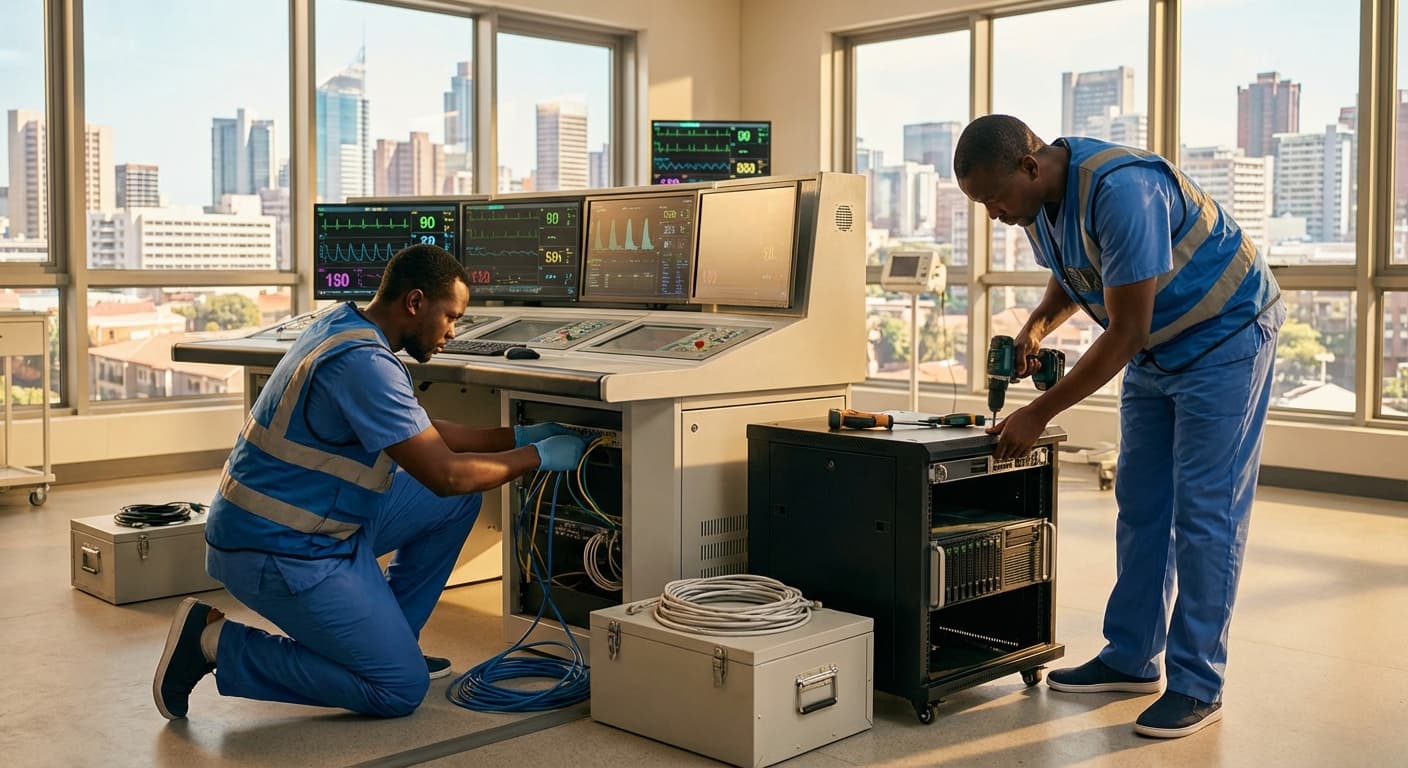
ICU Central Monitoring Station Installation Service in Eritrea
Engineering Excellence & Technical Support
ICU Central Monitoring Station Installation Service High-standard technical execution following OEM protocols and local regulatory frameworks.
Robust Central Monitoring Server Setup
Expert installation and configuration of high-availability central monitoring servers, ensuring reliable, real-time data aggregation from all bedside patient monitors. Our setup prioritizes data integrity and system uptime for critical patient care.
Seamless Device Integration & Network Configuration
We specialize in the seamless integration of diverse ICU patient monitoring devices, including vital sign monitors, ventilators, and ECG machines, with the central station. This involves secure network configuration, protocol compatibility, and robust data transmission to prevent any information loss.
Advanced Data Security & Compliance
Implementing industry-leading security protocols to protect sensitive patient data. Our installation includes robust firewalls, encryption, access controls, and adherence to international data privacy standards, ensuring the confidentiality and integrity of information within the central monitoring system.
What Is Icu Central Monitoring Station Installation Service In Eritrea?
ICU Central Monitoring Station Installation Service in Eritrea refers to the comprehensive process of designing, procuring, installing, configuring, and commissioning a centralized system for continuous patient physiological data monitoring within Intensive Care Units (ICUs) in healthcare facilities. This service ensures real-time aggregation, visualization, and analysis of critical patient parameters from multiple bedside monitors, ventilators, and other medical devices at a central nursing station. It facilitates enhanced patient surveillance, early detection of critical events, improved team communication, and optimized resource allocation within the ICU environment.
| Stakeholder/Entity | Need for Service | Typical Use Cases |
|---|---|---|
| Hospitals and Healthcare Facilities in Eritrea | Essential for establishing or upgrading Intensive Care Units to meet international standards of critical patient care. Enables proactive patient management and improved clinical outcomes. | Monitoring multiple critically ill patients simultaneously in ICUs, post-operative recovery wards, and specialized critical care units. Facilitates rapid response to sudden patient decompensation. |
| Ministry of Health (Eritrea) and Public Health Agencies | To ensure the availability of advanced medical infrastructure and enhance the quality of critical care services across the nation's healthcare system. Supports standardization of care protocols. | Deploying central monitoring systems in government-funded hospitals to improve patient safety and reduce mortality rates in critical care settings. Facilitates data collection for public health research and resource planning. |
| Biomedical Engineering Departments | Responsible for the installation, maintenance, and optimal functioning of medical equipment. Requires expertise in integrating complex monitoring systems. | Installing and configuring the central monitoring hardware and software. Performing regular maintenance, calibration, and troubleshooting of the system. Ensuring network connectivity and data integrity. |
| ICU Nursing Staff and Physicians | To have a consolidated view of all patients' vital signs, enabling efficient workload management, early detection of critical events, and improved communication among the care team. | Real-time surveillance of patient parameters (heart rate, blood pressure, SpO2, respiration rate, ECG, etc.). Receiving timely alerts for critical changes. Reviewing historical patient data for trend analysis and treatment adjustments. |
Key Components and Processes of ICU Central Monitoring Station Installation Service
- Needs Assessment and System Design: Conducting a thorough evaluation of the ICU's infrastructure, patient load, existing equipment, and specific monitoring requirements to design a scalable and integrated central monitoring solution. This includes network topology planning, data security protocols, and interoperability considerations.
- Equipment Procurement and Integration: Sourcing and acquiring central monitoring servers, workstations, network infrastructure, and ensuring seamless integration with a diverse range of bedside monitors (e.g., multi-parameter patient monitors, ventilators, anesthesia machines) and potentially other data sources (e.g., Electronic Health Records - EHRs).
- Network Infrastructure Setup: Establishing a robust and reliable network backbone (wired or wireless) that can handle high volumes of real-time physiological data transmission, ensuring data integrity and low latency. This may involve installing new cabling, switches, routers, and implementing appropriate network security measures.
- Software Installation and Configuration: Deploying and configuring the central monitoring software platform on dedicated servers and workstations. This includes setting up user interfaces, alarm parameters, data storage, retrieval mechanisms, and defining user access levels.
- Hardware Installation and Cabling: Physically installing central monitoring workstations, servers, and associated peripherals at the central station. This also involves the intricate process of running and terminating data and power cables from individual patient monitoring devices to the central network and display units.
- System Testing and Calibration: Rigorous testing of all integrated components to ensure accurate data acquisition, transmission, and display. Calibration of sensors and devices is critical to guarantee the reliability of the monitoring data.
- Alarm Management Configuration: Defining and configuring sophisticated alarm rules and notification pathways to alert nursing staff to critical physiological changes, reducing alarm fatigue while ensuring timely response to patient deterioration.
- User Training and Support: Providing comprehensive training to ICU nursing staff, physicians, and biomedical engineers on the operation, maintenance, and troubleshooting of the central monitoring system. Ongoing technical support and maintenance contracts are typically part of the service.
- Documentation and Handover: Supplying detailed system documentation, including network diagrams, configuration settings, operational manuals, and maintenance schedules. Formal handover of the operational system to the healthcare facility.
Who Needs Icu Central Monitoring Station Installation Service In Eritrea?
The installation of an ICU Central Monitoring Station (CMS) service is crucial for enhancing critical care capabilities in Eritrea. A CMS integrates real-time patient data from multiple ICU beds into a centralized location, allowing for continuous observation, early detection of patient deterioration, and improved response times by medical staff. This technology is vital for any healthcare facility aiming to provide high-quality, intensive patient care.
| Department | Role in ICU Central Monitoring Station Utilization | Key Benefits |
|---|---|---|
| Intensive Care Unit (ICU) | Primary user of the CMS for direct patient monitoring and immediate response. | Continuous patient surveillance, early warning of adverse events, reduced workload for nurses through consolidated data, improved patient outcomes, enhanced decision-making by physicians. |
| Nursing Department | Responsible for operating the CMS interface, responding to alerts, and documenting patient data. | Streamlined workflow, improved situational awareness, enhanced team communication, reduced alarm fatigue through intelligent filtering. |
| Medical/Physician Staff | Utilizes CMS data for diagnosis, treatment planning, and patient management. | Real-time access to critical patient parameters, improved accuracy of diagnoses, faster intervention, better management of complex cases, facilitation of rounds and consultations. |
| Biomedical Engineering Department | Responsible for the installation, maintenance, troubleshooting, and integration of the CMS hardware and software. | Ensures system reliability and functionality, minimizes downtime, supports seamless integration with existing medical equipment, provides technical expertise. |
| IT Department | Oversees network infrastructure, data security, and system integration with hospital information systems (HIS). | Ensures secure data transmission and storage, facilitates integration with Electronic Health Records (EHR), maintains network stability, manages system updates and cybersecurity. |
| Hospital Administration/Management | Approves budget, oversees strategic implementation, and evaluates the overall impact of the CMS. | Improved patient care quality, enhanced hospital reputation, potential for increased efficiency, better resource allocation, compliance with healthcare standards. |
Target Customers and Departments for ICU Central Monitoring Station Installation Service in Eritrea
- {"item":"Government Hospitals","description":"Publicly funded hospitals are the primary recipients, as they often serve the majority of the population and are mandated to provide comprehensive healthcare services. Upgrading their ICU facilities with a CMS is a significant step towards improving national healthcare standards."}
- {"item":"Large Private Hospitals","description":"As the private healthcare sector in Eritrea develops, larger private hospitals will require advanced monitoring systems to differentiate themselves and offer premium critical care services. These facilities often cater to a segment of the population with higher expectations for medical technology."}
- {"item":"Tertiary Care Centers","description":"Hospitals designated as tertiary care centers, which handle complex medical conditions and specialized treatments, will inherently need robust ICU capabilities. A CMS is a cornerstone of modern tertiary care."}
- {"item":"Teaching Hospitals and Medical Schools","description":"Institutions involved in medical education and training require state-of-the-art equipment to provide practical learning experiences for future healthcare professionals. A CMS offers valuable real-time data for educational purposes and research."}
- {"item":"Hospitals in Urban Centers","description":"Hospitals located in major cities and population centers are more likely to have the infrastructure and patient volume to justify and benefit from a CMS installation. These areas typically have a higher concentration of critical cases."}
- {"item":"Specialized Medical Centers (e.g., Cardiology, Neurology)","description":"Facilities focusing on specific critical care specialties, such as cardiac care or neurological emergencies, would significantly benefit from a CMS to manage patients with complex and rapidly changing conditions."}
Icu Central Monitoring Station Installation Service Process In Eritrea
This document outlines the comprehensive workflow for the installation service of an ICU Central Monitoring Station in Eritrea, from the initial client inquiry to the final execution and handover. The process is designed to ensure a seamless, efficient, and compliant installation, meeting the specific needs of healthcare facilities in Eritrea.
| Phase | Stage/Activity | Description | Key Stakeholders | Deliverables | Estimated Timeline |
|---|---|---|---|---|---|
| Phase 1: Inquiry and Initial Assessment | Initial Contact & Requirement Gathering | Client expresses interest in ICU Central Monitoring Station installation. Initial discussions to understand needs, facility size, existing infrastructure, and budget. | Client (Hospital Administration, IT Dept, ICU Management), Service Provider (Sales Team, Technical Consultant) | Needs Assessment Report, Preliminary Scope of Work | 1-2 Weeks |
| Phase 1: Inquiry and Initial Assessment | Site Visit & Feasibility Study | On-site visit to assess the ICU environment, power availability, network infrastructure, space, and potential installation challenges. Technical feasibility is confirmed. | Service Provider (Technical Consultant, Project Manager), Client (Facility Management, Biomedical Engineers) | Feasibility Report, Site Survey Data | 1-2 Weeks |
| Phase 2: Planning and Design | Detailed System Design | Based on the assessment, a detailed design of the central monitoring station is created, including hardware selection, network topology, software configuration, and integration with existing systems. | Service Provider (System Architects, Biomedical Engineers), Client (ICU Management, IT Department) | System Design Document, Bill of Materials (BOM) | 2-4 Weeks |
| Phase 2: Planning and Design | Project Plan Development | A comprehensive project plan is developed, outlining timelines, resource allocation, responsibilities, risk management strategies, and communication protocols. | Service Provider (Project Manager), Client (Project Sponsor) | Project Plan, Gantt Chart | 1 Week |
| Phase 2: Planning and Design | Proposal & Contract Negotiation | A formal proposal with detailed scope, costs, and timelines is presented to the client. Negotiations lead to a signed contract. | Service Provider (Sales Team, Legal Dept), Client (Administration, Procurement) | Signed Contract, Detailed Proposal | 2-3 Weeks |
| Phase 3: Procurement and Logistics | Equipment Procurement | All required hardware (servers, workstations, network devices, cabling) and software licenses are procured from approved vendors. | Service Provider (Procurement Team) | Procured Equipment, Vendor Invoices | 4-8 Weeks (depending on lead times) |
| Phase 3: Procurement and Logistics | Logistics & Importation | Arrangement of shipping, customs clearance, and transportation of equipment to Eritrea, adhering to local regulations. | Service Provider (Logistics Team), Client (Customs Authorities) | Shipped Equipment, Customs Clearance Documents | 2-4 Weeks |
| Phase 4: Site Preparation and Infrastructure | Infrastructure Assessment & Upgrade | Final verification of power, networking, and space readiness. Any necessary upgrades (e.g., new power outlets, network cabling) are implemented. | Service Provider (Installation Team, IT Specialists), Client (Facility Management, Electricians, Network Technicians) | Prepared Installation Sites, Updated Infrastructure | 1-2 Weeks |
| Phase 4: Site Preparation and Infrastructure | Security & Access Control | Ensuring appropriate physical security measures and access controls are in place for the central monitoring station room. | Service Provider (Installation Team), Client (Security Personnel) | Secure Installation Area | Ongoing during site prep |
| Phase 5: Installation and Configuration | Hardware Installation | Physical installation of servers, workstations, network switches, and other hardware components according to the design. | Service Provider (Installation Team, Biomedical Engineers) | Installed Hardware | 2-4 Weeks |
| Phase 5: Installation and Configuration | Network Cabling & Connectivity | Installation and testing of all network cabling to ensure reliable communication between the central station and patient monitors. | Service Provider (Network Technicians, Installation Team) | Connected Network Infrastructure | 1-2 Weeks |
| Phase 5: Installation and Configuration | Software Installation & Configuration | Installation of the central monitoring software, configuration of patient data streams, alarms, and user profiles. | Service Provider (Software Engineers, Biomedical Engineers) | Configured Monitoring Software | 2-3 Weeks |
| Phase 5: Installation and Configuration | Integration with Patient Monitors | Connecting and configuring existing and new patient monitors to the central monitoring system. | Service Provider (Biomedical Engineers), Client (ICU Nurses, Biomedical Engineers) | Integrated Patient Monitoring Data | 1-2 Weeks |
| Phase 6: Testing and Validation | System Functionality Testing | Thorough testing of all system functionalities, including data display, alarm generation, data logging, and reporting. | Service Provider (Testing Team, Biomedical Engineers), Client (ICU Staff) | Functional Test Reports | 1-2 Weeks |
| Phase 6: Testing and Validation | Performance & Load Testing | Testing the system's performance under various load conditions to ensure stability and responsiveness. | Service Provider (Testing Team) | Performance Test Results | 1 Week |
| Phase 6: Testing and Validation | User Acceptance Testing (UAT) | Key ICU personnel test the system to ensure it meets their operational requirements and is user-friendly. | Client (ICU Nurses, Doctors, IT Staff), Service Provider (Project Manager) | UAT Sign-off Document | 1-2 Weeks |
| Phase 7: Training and Handover | User Training | Comprehensive training sessions for ICU staff (nurses, doctors) and IT personnel on system operation, maintenance, and troubleshooting. | Service Provider (Trainers, Biomedical Engineers), Client (End Users) | Trained Personnel, Training Materials | 1-2 Weeks |
| Phase 7: Training and Handover | System Handover | Formal handover of the fully installed, tested, and validated ICU Central Monitoring Station to the client, including all documentation. | Service Provider (Project Manager), Client (Hospital Administration, Department Heads) | Handover Certificate, Complete Documentation (Manuals, As-built drawings, Warranty) | 1 Day |
| Phase 8: Post-Installation Support | Warranty Period | Provision of warranty support for the installed system, addressing any defects or issues that may arise. | Service Provider (Support Team) | Resolved Issues, Technical Support | As per contract (e.g., 12-24 months) |
| Phase 8: Post-Installation Support | Maintenance & Service Agreements | Optional ongoing maintenance and service agreements for continued system performance and updates. | Service Provider (Support Team), Client (Biomedical Engineering Dept.) | Service Level Agreements (SLAs) | Ongoing |
ICU Central Monitoring Station Installation Service Process in Eritrea
- Phase 1: Inquiry and Initial Assessment
- Phase 2: Planning and Design
- Phase 3: Procurement and Logistics
- Phase 4: Site Preparation and Infrastructure
- Phase 5: Installation and Configuration
- Phase 6: Testing and Validation
- Phase 7: Training and Handover
- Phase 8: Post-Installation Support
Icu Central Monitoring Station Installation Service Cost In Eritrea
Installing an ICU central monitoring station in Eritrea involves a range of costs influenced by several key factors. These factors determine the overall price, from basic setup to more advanced, comprehensive solutions. Understanding these elements is crucial for accurate budgeting and procurement.
| Service Component | Estimated Price Range (Eritrean Nakfa - ERN) | Notes |
|---|---|---|
| Basic ICU Monitoring System (e.g., 4-6 beds, standard parameters) | 150,000 - 300,000 ERN | Includes patient monitors, one central station, basic installation, and initial training. |
| Intermediate ICU Monitoring System (e.g., 8-12 beds, advanced parameters, limited integration) | 300,000 - 600,000 ERN | Higher quality monitors, more comprehensive parameters, potentially multiple workstations, and basic network integration. |
| Advanced ICU Monitoring System (e.g., 12+ beds, comprehensive parameters, full EHR integration) | 600,000 - 1,500,000+ ERN | Top-tier equipment, extensive integration capabilities, advanced software features, and potential for custom solutions. |
| Installation & Setup Labor (per technician, per day) | 2,000 - 5,000 ERN | Varies based on skill level, experience, and whether local or expatriate. |
| Comprehensive Training (per session/course) | 5,000 - 15,000 ERN | Depends on the duration and depth of training. |
| Annual Software License & Support Fees (estimated percentage of initial cost) | 5% - 15% of initial system cost | Can be a recurring cost for ongoing maintenance and updates. |
| Import Duties & Taxes (variable) | Dependent on equipment value and current Eritrean regulations | Can significantly add to the overall price. |
Key Pricing Factors for ICU Central Monitoring Station Installation in Eritrea
- Scope and Complexity of the System: The number of patient beds to be monitored, the types of vital signs to be tracked (ECG, SpO2, NIBP, EtCO2, invasive pressures, etc.), and the desired level of integration with existing hospital IT infrastructure significantly impact cost. A system for a few beds will be considerably less expensive than one for an entire ICU ward.
- Equipment Quality and Brand: High-end, feature-rich monitoring systems from reputable international brands generally come with a higher price tag than more budget-friendly options. Factors like sensor accuracy, data reliability, software features, and device durability play a role.
- Number of Central Stations/Workstations: The requirement for one central control room with multiple workstations versus several smaller monitoring points will affect the overall hardware and software licensing costs.
- Integration with Existing Systems: If the central monitoring system needs to integrate with existing Electronic Health Records (EHR), Picture Archiving and Communication Systems (PACS), or other hospital information systems, this can add complexity and cost due to custom software development or middleware requirements.
- Installation and Setup Services: This includes the physical installation of patient monitors, central consoles, network cabling, power supply setup, and initial configuration. The labor costs of skilled technicians, both local and potentially expatriate, will be a significant component.
- Training: Comprehensive training for medical staff (doctors, nurses) and IT personnel on operating the system, interpreting data, and basic troubleshooting is essential and usually bundled into the service cost.
- Software Licenses and Upgrades: Ongoing software licenses for advanced features, data management, and potential future upgrades contribute to the long-term cost of ownership.
- Networking Infrastructure: The existing network infrastructure's capacity, reliability, and coverage within the hospital can influence installation costs. Upgrades or new installations might be necessary.
- Warranty and Support: The duration and scope of warranty, along with ongoing technical support services, will impact the overall price. Premium support packages are typically more expensive.
- Import Duties and Taxes: As medical equipment is often imported into Eritrea, applicable import duties, taxes, and customs clearance fees must be factored into the total cost.
- Local Service Provider Expertise and Availability: The availability of qualified and experienced local service providers for installation, maintenance, and support can influence pricing. Competition among providers also plays a role.
- Project Management: For larger installations, dedicated project management services to oversee the entire process, from procurement to final handover, will add to the cost.
Affordable Icu Central Monitoring Station Installation Service Options
Setting up an Intensive Care Unit (ICU) Central Monitoring Station (CMS) is a critical investment for any healthcare facility. While the initial cost can seem daunting, various affordable installation service options and strategic approaches can significantly reduce the financial burden without compromising on quality or essential functionality. This guide explores value bundles and cost-saving strategies for ICU CMS installation.
| Value Bundle Options | Description | Cost-Saving Benefits |
|---|---|---|
| Basic Monitoring Package: | Includes essential patient monitors for core vital signs (ECG, SpO2, BP, Respiration) and a standard central station with basic alarm management. Ideal for smaller ICUs or facilities with budget constraints. | Lower upfront equipment and installation costs. Focuses on fundamental monitoring needs. |
| Advanced Integration Bundle: | Combines patient monitors with advanced features (e.g., invasive pressures, temperature, capnography) and integrates with the hospital's Electronic Health Record (EHR) system. Includes more sophisticated alarm logic and data trending. | Streamlines data flow, reduces manual entry errors, and improves clinical decision-making. May include bundled software licenses, reducing per-item costs. |
| Comprehensive Turnkey Solution: | A complete package encompassing all hardware, software, network infrastructure, installation, training, and ongoing support. Designed for new ICU builds or major renovations. | Simplifies the procurement and installation process. Often offers discounted pricing on bundled equipment and services. Predictable budgeting. |
| Modular Expansion Options: | Allows facilities to start with a foundational CMS and add modules or beds incrementally as needs and budgets evolve. For example, adding advanced monitoring modules or extending coverage to more beds later. | Spreads the cost over time. Avoids over-investment in unnecessary features initially. Flexibility to adapt to changing requirements. |
Understanding ICU Central Monitoring Station Installation
- What is an ICU Central Monitoring Station (CMS)? An ICU CMS is a command center that allows clinicians to remotely monitor vital signs and other physiological data from multiple ICU beds simultaneously. It enhances patient safety, facilitates rapid response to critical events, and optimizes workflow for nursing staff.
- Key Components of an ICU CMS: This typically includes monitoring devices at the bedside (patient monitors), a network infrastructure to transmit data, a central workstation with display screens, and software for data acquisition, analysis, and alarm management.
- Importance of Professional Installation: Proper installation ensures reliable data transmission, accurate readings, seamless integration with existing hospital IT systems, and compliance with healthcare regulations. It also minimizes the risk of system failures and downtime.
- Factors Influencing Installation Costs: These include the number of ICU beds, the complexity of the existing infrastructure, the type and brand of monitoring equipment chosen, the need for network upgrades, the scope of software integration, and the chosen installation service provider.
Verified Providers In Eritrea
In Eritrea, finding healthcare providers with verified credentials is paramount for ensuring quality and safety. Franance Health stands out as a leading organization dedicated to connecting individuals with rigorously vetted medical professionals. Their commitment to a comprehensive credentialing process means that when you choose a Franance Health-affiliated provider, you are opting for expertise, ethical practice, and unwavering dedication to patient well-being. This rigorous verification is not just a formality; it's a cornerstone of trust in the healthcare system.
| Provider Type | Franance Health Verification Key Aspects | Benefits for Patients |
|---|---|---|
| Doctors (General & Specialists) | Medical School Degrees, Board Certifications, License to Practice, Surgical Logs (if applicable), Peer Reviews. | Accurate diagnoses, effective treatment plans, access to specialized surgical expertise, reduced risk of medical errors. |
| Nurses (RN, LPN) | Nursing School Diplomas/Degrees, Professional Nursing License, Certifications in specialized areas (e.g., critical care, pediatrics), Background Checks. | Competent and compassionate bedside care, adherence to treatment protocols, patient education, support during recovery. |
| Dentists | Dental School Degree, Dental License, Specialization Certifications (e.g., orthodontics, periodontics), Continuing Education. | Oral health expertise, preventative care, restorative treatments, cosmetic dentistry options, pain management. |
| Pharmacists | Pharmacy Degree, Pharmacy License, Knowledge of drug interactions and dosages, Safe dispensing practices. | Accurate prescription fulfillment, medication counseling, identification of potential drug interactions, patient safety regarding medication. |
| Therapists (Physical, Occupational, etc.) | Degree in relevant therapy field, Professional License, Certifications in specialized therapeutic techniques, Patient outcome tracking. | Effective rehabilitation plans, improved mobility and function, pain reduction, enhanced quality of life. |
Why Franance Health Credentials Matter:
- Rigorous Qualification Checks: Franance Health meticulously verifies all educational degrees, licenses, and certifications of their healthcare providers, ensuring they meet and exceed national and international standards.
- Experience and Competency Assessment: Beyond formal qualifications, Franance Health assesses the practical experience and ongoing competency of their affiliated professionals, guaranteeing they possess the skills necessary for effective patient care.
- Ethical Practice and Professional Conduct: A crucial aspect of Franance Health's credentialing involves thorough background checks and a review of professional conduct to ensure providers adhere to the highest ethical standards.
- Continuous Professional Development: Franance Health encourages and often requires its affiliated providers to engage in continuous learning and professional development, keeping them abreast of the latest medical advancements and best practices.
- Patient Safety Focus: Every step of the Franance Health credentialing process is designed with patient safety as the primary objective, providing peace of mind to those seeking medical assistance.
Scope Of Work For Icu Central Monitoring Station Installation Service
This Scope of Work (SOW) outlines the requirements for the installation of an Intensive Care Unit (ICU) Central Monitoring Station (CMS) service. The project encompasses the procurement, configuration, installation, testing, and commissioning of the CMS hardware, software, and network infrastructure necessary for real-time patient monitoring within the ICU. The objective is to establish a robust and reliable central monitoring system that enhances patient care by providing continuous data visualization, alarm management, and data trending capabilities for critical care patients. This SOW details the technical deliverables expected from the service provider and outlines the standard specifications for the equipment and installation.
| Category | Item | Standard Specification / Requirement |
|---|---|---|
| Hardware | Central Monitoring Server | High-availability, redundant hardware; Minimum processing power (e.g., Intel Xeon Gold equivalent or higher); Sufficient RAM (e.g., 64GB+); Redundant power supplies; Hot-swappable drives; RAID configuration for data redundancy. |
| Hardware | Operator Workstations | High-resolution (e.g., 24" or larger) medical-grade displays; Ergonomic design; Sufficient processing power (e.g., Intel Core i7 equivalent or higher); Minimum RAM (e.g., 16GB); Dedicated graphics card for optimal display performance. |
| Hardware | Network Switches | Managed, Gigabit Ethernet switches; Sufficient port density to connect all devices; Support for VLANs for network segmentation; Quality of Service (QoS) for prioritizing critical traffic. |
| Hardware | Uninterruptible Power Supply (UPS) | Sized to provide adequate runtime for CMS servers and critical network components during power outages (e.g., 30+ minutes). |
| Software | Monitoring Platform | Vendor-supported, FDA-cleared (if applicable) patient monitoring software; Real-time data display; Customizable alarm management; Trend analysis and historical data storage; Secure user authentication and access control. |
| Software | Database | Robust, scalable database solution capable of handling high volumes of real-time patient data; High availability and backup/recovery mechanisms. |
| Network | Connectivity | Secure wired Ethernet connectivity; Compliance with hospital IT security policies; Redundant network pathways where feasible. |
| Integration | Bedside Monitors | Compatibility with existing or new ICU bedside monitoring devices (e.g., GE, Philips, Draeger); Support for standard communication protocols (e.g., HL7, DICOM where applicable). |
| Installation | Cabling | Professionally installed and tested network cabling (Cat 6 or higher); Cable management for a clean and organized installation. |
| Installation | Power | Appropriate power outlets and circuit protection for all equipment; Compliance with electrical codes and hospital safety standards. |
| Training | User Training | Hands-on training sessions for all user groups; Training materials provided in written and/or digital format; Refresher training options. |
| Security | Cybersecurity | Implementation of security best practices, including firewalls, intrusion detection/prevention systems, data encryption, and regular vulnerability assessments. |
Technical Deliverables
- Detailed system design and architecture documentation.
- Procured and delivered CMS hardware (servers, workstations, monitors, network switches, UPS).
- Installed and configured CMS software (monitoring platform, database, reporting tools).
- Configured and integrated bedside patient monitoring devices with the CMS.
- Established and tested network connectivity between bedside devices, the CMS, and any required hospital information systems (HIS/EHR).
- Completed system setup, calibration, and initial testing.
- Comprehensive user training for ICU nursing staff, physicians, and IT personnel.
- Final system acceptance testing documentation.
- As-built documentation, including network diagrams, hardware inventory, and software configurations.
- Post-installation support and warranty period management.
- Disaster recovery and business continuity plan for the CMS.
- Security implementation and hardening of the CMS and its network.
Service Level Agreement For Icu Central Monitoring Station Installation Service
This Service Level Agreement (SLA) outlines the response times and uptime guarantees for the installation service of the ICU Central Monitoring Station. This SLA is an addendum to the main Service Agreement between [Your Company Name] and [Client Name].
| Service Component | Response Time (during business hours) | Response Time (outside business hours) | Uptime Guarantee (post-installation validation) |
|---|---|---|---|
| Initial Technical Support (Installation Issues) | 2 business hours | 4 business hours | N/A |
| Critical System Failure (affecting core monitoring functions) | 4 business hours | 8 business hours | 99.9% |
| Non-Critical System Issue (e.g., minor software bug, display anomaly) | 8 business hours | 12 business hours | 99.5% |
| Scheduled Maintenance or Updates (with prior notification) | N/A | N/A | N/A (scheduled downtime is excluded) |
Scope of Service
- Installation of ICU Central Monitoring Station hardware and software.
- Configuration and integration with existing hospital network infrastructure.
- Initial system testing and validation.
- On-site training for designated hospital personnel.
- Troubleshooting and resolution of installation-related issues.
Frequently Asked Questions

Ready when you are
Let's scope your ICU Central Monitoring Station Installation Service in Eritrea project in Eritrea.

Scaling healthcare logistics and technical systems across the entire continent.