
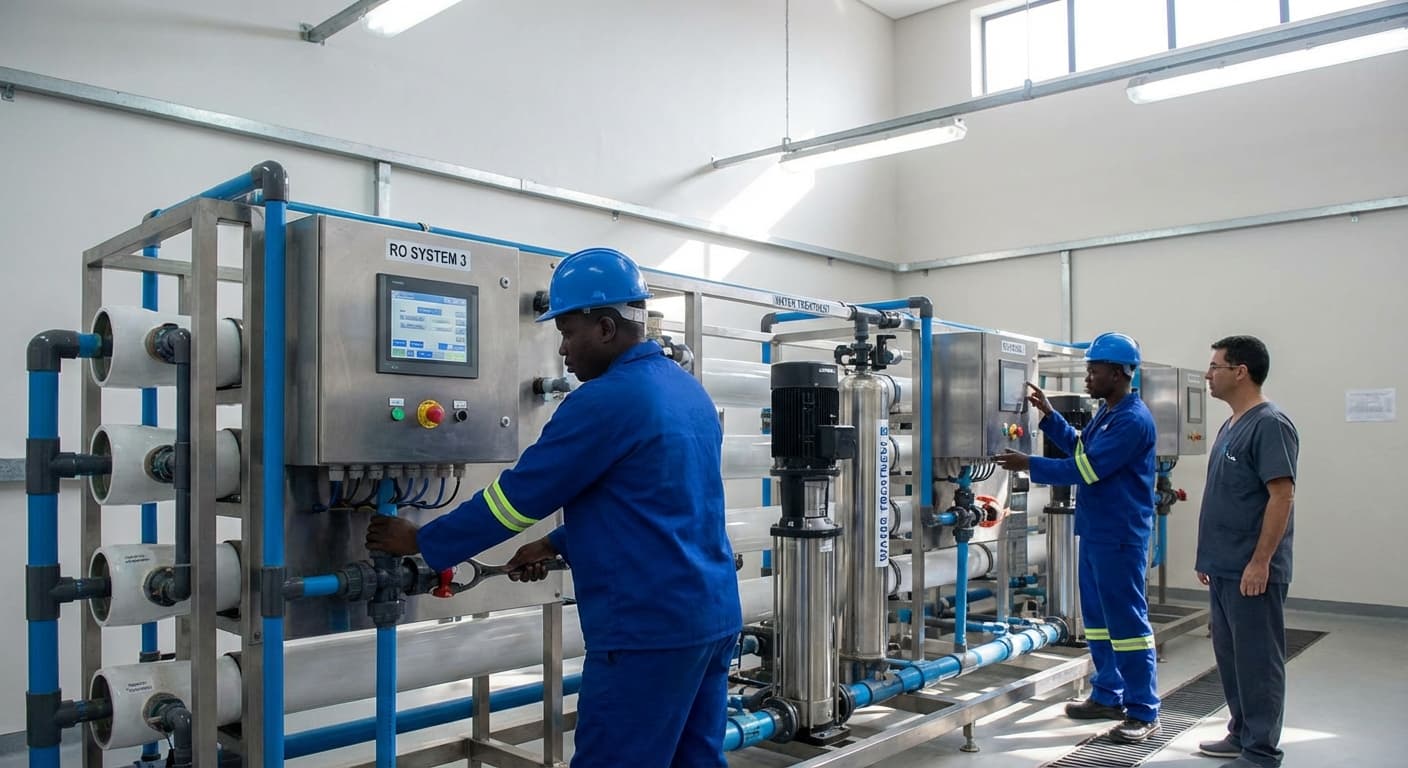
Dialysis RO/Water Treatment Plant Installation Service in Eritrea
Engineering Excellence & Technical Support
Dialysis RO/Water Treatment Plant Installation Service High-standard technical execution following OEM protocols and local regulatory frameworks.
Advanced RO & Ultrafiltration Systems
We specialize in the design and installation of cutting-edge Reverse Osmosis (RO) and Ultrafiltration (UF) systems, engineered for optimal purity and reliability in dialysis water treatment. Our solutions ensure compliance with stringent international standards for medical-grade water, safeguarding patient health and maximizing equipment lifespan.
Robust & Sustainable Water Infrastructure
Our installation services focus on building robust and sustainable water treatment infrastructure. We integrate advanced monitoring and control systems, ensuring efficient operation and minimal environmental impact. From initial site assessment to final system commissioning, our expert engineers deliver comprehensive and enduring solutions for Eritrea's healthcare facilities.
Quality Assurance & Compliance
Dedicated to uncompromising quality, our installation process adheres to rigorous testing and validation protocols. We guarantee that every dialysis water treatment plant we install meets and exceeds all relevant Eritrean and international quality standards, providing a secure and dependable water supply for critical medical procedures.
What Is Dialysis Ro/water Treatment Plant Installation Service In Eritrea?
Dialysis RO/Water Treatment Plant Installation Service in Eritrea refers to the specialized engineering and construction process of establishing facilities designed to produce ultra-pure water required for hemodialysis procedures. This service encompasses the design, procurement, assembly, commissioning, and validation of reverse osmosis (RO) and associated water purification systems, ensuring compliance with stringent international medical water standards.
| Who Needs It | Typical Use Cases | ||
|---|---|---|---|
| Dialysis Centers/Clinics: The primary recipients, requiring a continuous supply of purified water for their hemodialysis machines. | Hospitals with Nephrology Departments: Facilities offering hemodialysis as part of their comprehensive medical services. | Government Healthcare Initiatives: Public health organizations or ministries of health establishing or upgrading dialysis facilities to improve access to renal care. | Non-Governmental Organizations (NGOs) and Charities: Organizations focused on providing medical aid and support, including renal replacement therapy, in resource-limited settings. |
| Hemodialysis Treatment: The direct application of purified water in hemodialysis machines to prepare dialysate. | Peritoneal Dialysis Fluid Preparation: In some cases, the purified water may also be used in the preparation of solutions for peritoneal dialysis. | Medical Device Sterilization (indirectly): While not the primary use, ultra-pure water can be a component in the processes for sterilizing certain medical equipment, though dedicated sterilization systems are usually employed. | Research and Development in Renal Medicine: Laboratories within medical institutions might require purified water for experimental purposes related to kidney disease and dialysis. |
Service Components
- System Design and Engineering: Tailoring the RO system to meet specific flow rates, purity requirements, and local water quality parameters. This includes selecting appropriate membrane technologies, pre-treatment stages (e.g., multimedia filtration, activated carbon filtration), post-treatment stages (e.g., UV sterilization, ultrafiltration), and distribution loops.
- Equipment Procurement: Sourcing and acquiring all necessary components, including RO membranes, pumps, filters, tanks, piping, control systems, and monitoring instruments.
- On-site Installation and Assembly: The physical installation of all equipment and the construction of the water treatment plant infrastructure.
- Piping and Electrical Work: Connecting all components with food-grade, medical-grade piping and integrating the system with the facility's electrical infrastructure, including control panels and safety features.
- System Commissioning: The initial startup and testing of the plant to ensure all components function as designed and the water quality meets specified parameters.
- Validation and Qualification: A critical phase involving rigorous testing to demonstrate that the installed system consistently produces water of the required purity and is fit for its intended purpose (hemodialysis). This includes Performance Qualification (PQ) and Operational Qualification (OQ).
- Operator Training: Providing comprehensive training to the facility's staff on the operation, maintenance, and troubleshooting of the water treatment system.
- Documentation and Certification: Preparing all necessary technical documentation, schematics, operating manuals, and certificates of compliance.
Who Needs Dialysis Ro/water Treatment Plant Installation Service In Eritrea?
Dialysis patients require high-purity water for their treatments, as impurities can lead to serious health complications. Therefore, facilities that provide dialysis services are the primary users of dialysis RO/water treatment plant installation services in Eritrea. This includes both public and private healthcare institutions.
| Customer Type | Primary Department/Users | Key Needs/Considerations |
|---|---|---|
| Hospitals (Public) | Nephrology Department, Dialysis Unit, Facilities Management | Reliable water supply for critical life-support treatments, compliance with health regulations, cost-effectiveness, robust maintenance support. |
| Hospitals (Private) | Nephrology Department, Dialysis Unit, Hospital Administration | High-quality water for patient safety and comfort, efficient and modern technology, potential for service level agreements, aesthetic and space considerations. |
| Dedicated Dialysis Centers | Clinical Operations, Technical Maintenance Team, Center Management | Specialized expertise in dialysis water purification, focus on continuous operation, minimal downtime, integration with existing dialysis equipment, training for staff. |
| Specialty Clinics (Renal Care) | Medical Staff, Technical Support | Ensuring water purity for outpatient dialysis, scalability to meet patient demand, adherence to stringent quality standards. |
| Government Health Ministries/Departments | Public Health Infrastructure Division, Procurement Department | Developing and upgrading national dialysis capabilities, ensuring equitable access to safe dialysis, long-term planning, budget allocation, establishing national water quality standards. |
Target Customers and Departments for Dialysis RO/Water Treatment Plant Installation Service in Eritrea
- Hospitals (Public and Private)
- Dialysis Centers
- Specialty Clinics offering Renal Care
- Government Health Ministries/Departments
Dialysis Ro/water Treatment Plant Installation Service Process In Eritrea
This document outlines the typical workflow for a Dialysis Reverse Osmosis (RO) / Water Treatment Plant Installation Service in Eritrea, from initial client inquiry to the final execution and handover. The process is designed to ensure a smooth, efficient, and compliant installation, meeting the specific needs of healthcare facilities.
| Stage | Description | Key Activities | Deliverables/Outcomes | ||||
|---|---|---|---|---|---|---|---|
| The client (healthcare facility) contacts the service provider to express interest in installing a dialysis water treatment plant. | Receive and acknowledge inquiry, schedule initial meeting, discuss general requirements and expectations. | Understanding of client's basic needs, initial point of contact established. | ||||
| A thorough evaluation of the client's facility is conducted to understand specific site conditions and technical requirements. | Site visit, assessment of available space, water source analysis (quality and quantity), power supply assessment, existing infrastructure review, detailed requirement documentation. | Detailed site survey report, confirmed technical specifications, bill of materials. |
| Based on the site assessment, a comprehensive proposal and detailed quotation are prepared. | Design of appropriate RO/water treatment system, preparation of technical proposal, cost estimation, development of project timeline. | Comprehensive proposal including system design, specifications, pricing, and project schedule. |
| Once the proposal is accepted, a formal contract is drawn up and signed by both parties. | Review and negotiation of contract terms, finalization of scope of work, payment schedule, and warranty information, signing of the service agreement. | Signed service contract, mutually agreed-upon terms and conditions. | ||||
| All necessary equipment and materials are procured and transported to Eritrea. | Ordering of RO membranes, filters, pumps, piping, control panels, and other components, management of import procedures and customs clearance, arrangement of transportation to the client's site. | Procured equipment and materials, cleared through customs, ready for delivery. | ||||
| The site is prepared to receive the new water treatment plant. | Ensuring adequate space, power, and plumbing connections are available, site preparation for installation (e.g., flooring, wall modifications if necessary). | Ready installation site. | ||||
| The RO/water treatment plant is physically installed and set up at the facility. | Assembly and installation of all components, connection to water source and distribution points, initial system setup and configuration. | Physically installed and assembled water treatment plant. | ||||
| The newly installed system undergoes rigorous testing to ensure it meets performance and quality standards. | Operational testing of all components, water quality testing (TDS, conductivity, microbial counts), performance validation against design specifications, calibration of sensors and controls. | Validated water quality meeting dialysis standards, operational test reports. | ||||
| The client's staff are trained on the operation and basic maintenance of the system, and the plant is formally handed over. | Conducting comprehensive training sessions for facility technicians and nurses, providing operation and maintenance manuals, formal handover of the operational system. | Trained personnel, complete set of documentation, officially handed over operational plant. | ||||
| Ongoing support and maintenance services are provided to ensure the long-term optimal performance of the plant. | Scheduled preventive maintenance visits, on-call technical support, troubleshooting and repairs, supply of spare parts and consumables. | Ongoing operational efficiency, reduced downtime, extended plant lifespan. |
Key Stages of Dialysis RO/Water Treatment Plant Installation Service
- Inquiry and Initial Consultation
- Site Assessment and Requirement Gathering
- Proposal and Quotation Development
- Contracting and Agreement
- Procurement and Logistics
- Pre-Installation Preparation
- On-site Installation and Commissioning
- Testing and Validation
- Training and Handover
- Post-Installation Support and Maintenance
Dialysis Ro/water Treatment Plant Installation Service Cost In Eritrea
Installing a Reverse Osmosis (RO) and Water Treatment Plant for dialysis in Eritrea is a critical undertaking, requiring specialized equipment and expertise. The cost of such an installation is not a fixed figure but rather a dynamic sum influenced by several key factors. These factors can broadly be categorized into equipment procurement, civil works, installation and commissioning, ongoing maintenance, and regulatory considerations. Understanding these elements is crucial for accurate budgeting and planning.
| Cost Component | Estimated Price Range (Eritrean Nakfa - ERN) | Notes |
|---|---|---|
| Small-Scale System (e.g., for a small clinic, <1000 L/day) | 150,000 - 400,000 ERN | Includes basic RO, pretreatment, and installation. Excludes extensive civil works. Prices can fluctuate significantly based on brand and supplier. |
| Medium-Scale System (e.g., for a moderate dialysis center, 1000 - 5000 L/day) | 400,000 - 1,500,000 ERN | Higher capacity RO, more sophisticated pretreatment, potentially automated controls. Civil works and logistics become more prominent. |
| Large-Scale System (e.g., for a major hospital or regional center, >5000 L/day) | 1,500,000 - 5,000,000+ ERN | Double-pass RO, advanced monitoring, redundant systems, significant civil works, and comprehensive logistics. Costs can escalate rapidly. |
| Equipment Procurement (RO Unit, Membranes, Pumps, Filters) | 60% - 75% of total cost | This is typically the largest single cost category. |
| Civil Works (Plant Room, Plumbing, Electrical) | 10% - 20% of total cost | Highly variable based on existing infrastructure. May be lower if a suitable room is available. |
| **Installation, Commissioning & Training | 15% - 25% of total cost | Includes skilled labor, travel, and on-site setup. |
| **Logistics, Shipping, Customs & Import Duties | 5% - 15% of total cost | Can be a significant burden depending on origin and import complexities. |
Key Pricing Factors for Dialysis RO/Water Treatment Plant Installation in Eritrea
- 1. Scale and Capacity of the Plant:
- The volume of purified water the plant needs to produce daily directly impacts the size and complexity of the RO membranes, pumps, filters, and storage tanks required. Larger capacities translate to higher equipment costs.
- 2. Water Source Quality:
- The existing quality of the raw water source (e.g., well water, municipal supply) significantly influences the pretreatment stages. Water with high levels of suspended solids, dissolved minerals, or biological contaminants will necessitate more robust and potentially expensive pretreatment systems (e.g., sand filters, activated carbon filters, UV sterilizers).
- 3. Type and Quality of Equipment:
- Reputable brands known for their durability and efficiency in RO and water treatment systems will generally command higher prices. The choice between single-pass RO, double-pass RO, or other advanced purification technologies will also affect cost. The inclusion of advanced monitoring and control systems will add to the overall expense.
- 4. Civil Works and Infrastructure:
- This includes site preparation, construction of a dedicated plant room (if not existing), plumbing, electrical connections, drainage, and potentially water storage tanks. The extent of civil works required will vary greatly depending on the existing infrastructure at the dialysis facility.
- 5. Installation and Commissioning Services:
- The fees charged by experienced technicians and engineers for the physical installation, calibration, and testing of the entire system are a significant component. This often includes training for local staff to operate and maintain the plant.
- 6. Delivery and Logistics:
- Transportation of the equipment from the point of origin to Eritrea, including customs duties, import taxes, and local transportation, can be a substantial cost, especially given Eritrea's geographical location and potential import regulations.
- 7. Warranty and After-Sales Support:
- The duration and scope of the warranty offered by the supplier, as well as the availability and cost of ongoing technical support and spare parts, will be factored into the initial investment.
- 8. Local Regulations and Permitting:
- Obtaining necessary permits and adhering to local health and safety regulations for water treatment facilities might involve fees and administrative costs.
- 9. Supplier and Contractor Markup:
- As with any service, the profit margins of the equipment supplier, installation contractor, and any intermediaries will contribute to the final price.
Affordable Dialysis Ro/water Treatment Plant Installation Service Options
Finding affordable Dialysis RO/Water Treatment Plant installation services is crucial for healthcare facilities aiming to provide safe and effective dialysis treatments without compromising on quality or breaking the bank. This guide explores various installation service options, emphasizing value bundles and cost-saving strategies.
| Service Option | Description | Value Proposition | Cost-Saving Strategies |
|---|---|---|---|
| Standard Installation | Basic installation of the RO/Water Treatment plant, including plumbing, electrical connections, and initial setup. | Cost-effective for facilities with established infrastructure and internal technical expertise. Provides essential functionality. | Leverage existing plumbing and electrical infrastructure. Source components from reputable but competitively priced suppliers. Negotiate bulk discounts if purchasing multiple units. |
| Value-Added Installation Bundle | Includes standard installation plus initial system commissioning, basic operator training, and a short-term maintenance contract. | Offers a more comprehensive solution, ensuring proper operation and basic staff competency from the outset. Reduces initial learning curve. | Opt for bundles that offer discounts on combined services. Inquire about extended warranty options that might be more economical than separate service calls. Compare bundle prices from different providers. |
| Turnkey Installation & Maintenance Package | Comprehensive service from site assessment, plant design, installation, full operator training, and an ongoing multi-year maintenance and service agreement. | Provides complete peace of mind, ensuring optimal system performance and compliance with minimal in-house effort. Predictable operational costs. | Negotiate long-term contracts for better rates. Consider preventative maintenance packages to avoid costly emergency repairs. Explore financing options that might include installation and maintenance for a fixed monthly cost. |
| Modular/Scalable System Installation | Installation of a system designed for easy expansion, allowing for additional treatment capacity to be added as needed without complete system overhaul. | Ideal for growing facilities or those with uncertain future demand. Reduces the need for major upgrades later. | Plan for future expansion during the initial installation to minimize future modification costs. Choose manufacturers known for modular designs and readily available expansion components. |
| Refurbished/Certified Pre-Owned System Installation | Installation of a pre-owned RO/Water Treatment plant that has been professionally refurbished and certified by the manufacturer or a reputable third party. | Significant cost savings on the capital expenditure of the equipment itself, while still offering a reliable solution. | Thoroughly vet the certification process and warranty provided. Factor in potential for slightly higher maintenance costs compared to new systems. Seek installations from experienced technicians familiar with refurbished units. |
Understanding Dialysis Water Treatment Needs
- High Purity Water: Dialysis requires ultrapure water to prevent patient complications. The RO/Water Treatment plant must meet strict standards.
- Reliability: Consistent and uninterrupted water supply is paramount during dialysis sessions.
- Compliance: Adherence to medical device regulations and water quality standards is non-negotiable.
- Scalability: The system should accommodate potential increases in patient load or facility expansion.
- Maintenance: Ongoing maintenance is vital for system longevity and water purity.
Verified Providers In Eritrea
In Eritrea, ensuring access to quality healthcare is paramount. The 'Verified Providers' initiative aims to distinguish healthcare professionals and institutions that meet stringent criteria for competence, ethical practice, and patient safety. Among these, Franance Health stands out as a leading example, embodying the highest standards and representing the best choice for individuals seeking reliable and expert medical care. Their commitment to continuous professional development, state-of-the-art facilities, and patient-centric approach positions them as a trusted pillar of healthcare in the nation.
| Credentialing Aspect | Franance Health's Commitment |
|---|---|
| Medical Education & Training | All practitioners possess accredited medical degrees and specialized training, verified through official documentation and recognized institutions. |
| Licensure & Registration | Current and valid medical licenses are maintained with the Eritrean Ministry of Health, with regular audits of compliance. |
| Professional Experience | A minimum number of years of practical experience is required, with a focus on proven track records of successful patient care. |
| Continuing Medical Education (CME) | Mandatory participation in recognized CME programs to stay updated on the latest medical knowledge and techniques. |
| Ethical Conduct & Patient Feedback | Strict adherence to a code of ethics, with mechanisms for patient feedback and rigorous investigation of any concerns. |
| Facility Standards | Compliance with all health and safety regulations for medical facilities, including sanitation, equipment maintenance, and emergency preparedness. |
Why Franance Health Represents the Best Choice for Verified Providers in Eritrea:
- Rigorous Credentialing and Verification: Franance Health undergoes a comprehensive and ongoing verification process, ensuring all practitioners meet and exceed national and international standards for medical education, training, and licensure.
- Commitment to Clinical Excellence: Their medical team comprises highly qualified and experienced professionals dedicated to evidence-based practice and delivering superior patient outcomes.
- Advanced Medical Technology and Infrastructure: Franance Health invests in modern medical equipment and maintains a well-equipped facility, enabling accurate diagnosis and effective treatment for a wide range of conditions.
- Patient-Centered Care Philosophy: The organization prioritizes patient comfort, clear communication, and ethical treatment, fostering trust and ensuring individuals feel empowered and well-cared for throughout their healthcare journey.
- Adherence to Ethical Guidelines and Regulations: Franance Health strictly adheres to all relevant ethical codes and regulatory frameworks governing healthcare in Eritrea, guaranteeing a safe and trustworthy environment.
- Continuous Professional Development: They actively promote and support ongoing education and training for their staff, ensuring they remain at the forefront of medical advancements and best practices.
Scope Of Work For Dialysis Ro/water Treatment Plant Installation Service
This Scope of Work (SOW) outlines the requirements for the installation of a Dialysis Reverse Osmosis (RO) / Water Treatment Plant. The service includes all necessary activities from site preparation to commissioning and handover, ensuring the plant meets all technical specifications and regulatory standards for reliable and safe dialysis water production.
| Technical Deliverable | Description | Standard Specification/Reference |
|---|---|---|
| Detailed Design Drawings | Comprehensive set of drawings including P&IDs, layout, electrical schematics, and structural details. | Client approved or to relevant international standards (e.g., ASME, ANSI, IEC). |
| Equipment Installation Report | Documentation of all installed equipment, including serial numbers, manufacturer details, and location. | Internal Quality Control checklists, manufacturer installation manuals. |
| Piping and Welding Quality Report | Certification of all piping materials, welding procedures, and non-destructive testing (NDT) results. | ASME B31.3, AWS D1.1, relevant ISO standards, and client-specific NDT requirements. |
| Electrical Wiring and Continuity Report | Verification of all electrical connections, grounding, and continuity tests. | IEC 60364, NFPA 70 (NEC), and client electrical standards. |
| Water Quality Analysis Reports | Pre-treatment, RO permeate, and final treated water quality analysis at various stages. | ASDI (Association for the Advancement of Medical Instrumentation) standards for dialysis water, ISO 13485 compliant testing. |
| Performance Test Reports | Documentation of flow rates, pressure drops, RO rejection rates, and energy consumption during operational testing. | Manufacturer's performance specifications, client acceptance criteria. |
| Commissioning Protocol and Report | Detailed step-by-step procedure for plant startup and validation, with results recorded. | Client approved commissioning plan, industry best practices for water treatment systems. |
| As-Built Drawings | Final set of drawings reflecting the exact installed configuration of the plant. | Client approved drawing format, to scale. |
| Operation and Maintenance (O&M) Manuals | Comprehensive manuals covering plant operation, troubleshooting, routine maintenance, and spare parts. | Manufacturer's original manuals, adapted for the specific installation. |
| Training Manuals and Attendance Records | Materials used for training site personnel and records of attendees. | Client specified training modules, attendance logs. |
| Material Safety Data Sheets (MSDS)/Safety Data Sheets (SDS) | Documentation for all chemicals used in the treatment process. | Globally Harmonized System (GHS) standards, local regulatory requirements. |
| Compliance Certificates | Certifications proving adherence to relevant safety, environmental, and health regulations. | Local environmental agency permits, occupational safety standards (e.g., OSHA). |
Key Project Stages
- Site Assessment and Survey
- Design and Engineering Review
- Procurement and Material Management
- Site Preparation and Civil Works
- Equipment Installation and Assembly
- Piping and Electrical Connections
- Testing and Pre-Commissioning
- Commissioning and Performance Validation
- Training and Handover
- Documentation and As-Built Drawings
Service Level Agreement For Dialysis Ro/water Treatment Plant Installation Service
This Service Level Agreement (SLA) outlines the guaranteed response times and uptime for the installation services of a Dialysis Reverse Osmosis (RO) / Water Treatment Plant. It ensures timely intervention and reliable operation of the installed system to minimize disruption to patient care.
| Service Category | Response Time Target | Uptime Guarantee | Notes |
|---|---|---|---|
| Critical System Failure (e.g., complete plant shutdown, severe water quality deviation) | Within 2 hours | 99.5% | Service personnel dispatched immediately. Continuous monitoring and communication. |
| Major System Malfunction (e.g., reduced water production, significant alarm) | Within 4 hours | 99.0% | Remote diagnosis attempted first, followed by on-site visit if necessary. |
| Minor System Issue (e.g., non-critical alarm, minor performance degradation) | Within 8 business hours | 98.0% | Troubleshooting and resolution as per service schedule, prioritizing urgent cases. |
| Scheduled Preventative Maintenance Visits | As per agreed schedule | N/A | To be conducted during off-peak hours where possible, with prior notification to the client. |
Key Performance Indicators (KPIs)
- Response Time: The maximum time allowed for the service provider to acknowledge and begin addressing a reported issue after notification.
- Uptime Guarantee: The minimum percentage of time the Dialysis RO/Water Treatment Plant is expected to be operational and functioning as per its specifications.
- Resolution Time: The maximum time allowed for the service provider to resolve a reported issue and restore the system to full operational status.
- Scheduled Maintenance: Planned periods for preventative maintenance to ensure optimal performance and longevity of the system.
Frequently Asked Questions

Ready when you are
Let's scope your Dialysis RO/Water Treatment Plant Installation Service in Eritrea project in Eritrea.

Scaling healthcare logistics and technical systems across the entire continent.