
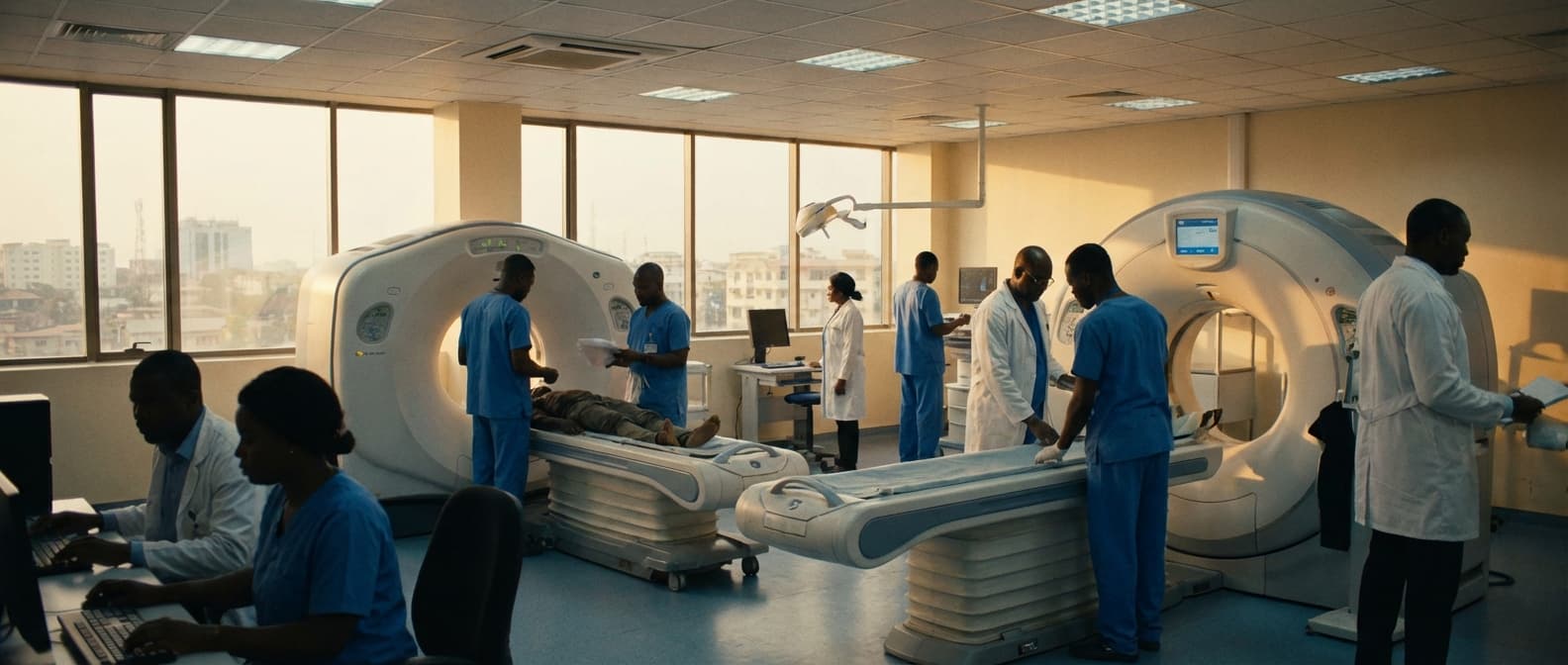
Imaging Acceptance Testing & QA in Eritrea
Engineering Excellence & Technical Support
Commissioning and periodic QA for CT/MRI/X‑ray/US/Mammo. High-standard technical execution following OEM protocols and local regulatory frameworks.
Ensuring Diagnostic Clarity
Implementing rigorous imaging acceptance testing for new X-ray, Ultrasound, and CT scanner installations across Eritrea. This includes verifying image resolution, contrast, signal-to-noise ratio, and artifact suppression to guarantee diagnostic quality and patient safety.
Standardizing Quality Assurance Protocols
Developing and deploying standardized QA protocols for all imaging modalities within Eritrean healthcare facilities. This involves regular equipment calibration, performance monitoring, and adherence to international imaging standards to maintain consistent and reliable diagnostic outputs.
Optimizing Image Acquisition Parameters
Conducting detailed acceptance testing of image acquisition parameters and workflow integration for PACS and RIS systems. This ensures seamless data transfer, efficient image retrieval, and accurate digital record-keeping, minimizing data loss and enhancing radiologist productivity.
What Is Imaging Acceptance Testing & Qa In Eritrea?
Imaging Acceptance Testing (IAT) and Quality Assurance (QA) in Eritrea, within a technical context, refers to the rigorous validation processes employed to ensure that digital imaging systems and their associated software components function as intended, meet defined specifications, and produce data of acceptable quality. This involves verifying the integrity, accuracy, and performance of the entire imaging pipeline, from image acquisition to data storage and retrieval. The objective is to mitigate risks, ensure compliance with relevant standards, and guarantee the reliability and usability of imaging technologies deployed within Eritrean organizations. IAT focuses on confirming that the system meets user requirements and business needs, while QA encompasses broader processes to prevent defects and maintain quality throughout the development and deployment lifecycle.
| Who Needs Imaging Acceptance Testing & QA in Eritrea? | Typical Use Cases | |||
|---|---|---|---|---|
| Healthcare Institutions (Hospitals, Clinics, Diagnostic Centers): For medical imaging systems (X-ray, CT, MRI, Ultrasound, etc.) to ensure diagnostic accuracy and patient safety. | Medical imaging system procurement and deployment. | Validation of new imaging software or hardware upgrades. | Ensuring compliance with national health regulations. | Assessing the quality of diagnostic images for interpretation and archiving. |
| Industrial and Manufacturing Companies: For quality control, non-destructive testing (NDT), and process monitoring using imaging technologies (e.g., machine vision, thermal imaging). | Automated inspection systems for product defect detection. | Process control and optimization through real-time image analysis. | Ensuring the reliability of security and surveillance imaging systems. | Validation of industrial sensor data integrity. |
| Government Agencies and Public Services: For applications such as border control, traffic management, environmental monitoring, and cadastral mapping using satellite, aerial, or ground-based imaging. | Validation of surveillance and security camera networks. | Ensuring the accuracy and reliability of mapping and geographic information systems (GIS) data. | Testing image analysis systems for remote sensing and environmental monitoring. | Verification of traffic management and monitoring camera performance. |
| Research and Development (R&D) Organizations: For testing and validating novel imaging techniques, algorithms, and systems. | Performance evaluation of new image processing algorithms. | Validation of prototypes for advanced imaging applications. | Ensuring the quality of experimental imaging data. | |
| Telecommunications and IT Providers: For systems involving image transmission, storage, and management. | Testing content delivery networks (CDNs) for image streaming. | Validating cloud-based image storage solutions. | Ensuring the integrity of transmitted image data. |
Key Components of Imaging Acceptance Testing & QA in Eritrea
- Image Acquisition Integrity Verification: Ensuring sensors, cameras, and other acquisition hardware capture data accurately and without artifacts.
- Image Processing Algorithm Validation: Testing the performance and output of image enhancement, reconstruction, segmentation, and analysis algorithms against ground truth or known benchmarks.
- Data Storage and Retrieval Reliability: Confirming the successful and secure storage of image data and its efficient retrieval, adhering to defined formats and access protocols.
- System Performance Benchmarking: Evaluating processing speeds, throughput, and resource utilization under various operational loads.
- User Interface (UI) and User Experience (UX) Evaluation: Assessing the intuitiveness, usability, and error handling capabilities of the imaging software interfaces.
- Regulatory Compliance and Standards Adherence: Verifying that imaging systems and data management practices comply with Eritrean national regulations and relevant international standards (e.g., DICOM, HIPAA where applicable for medical imaging).
- Security and Access Control Validation: Testing authentication, authorization, and data encryption mechanisms to protect sensitive imaging data.
- Interoperability Testing: Ensuring seamless data exchange and compatibility with other systems and platforms.
Who Needs Imaging Acceptance Testing & Qa In Eritrea?
Imaging Acceptance Testing & QA (Quality Assurance) are crucial for any organization in Eritrea that relies on digital imaging for critical operations, data integrity, and compliance. While the immediate thought might be large-scale medical institutions, the need extends far beyond. These processes ensure that imaging equipment, software, and workflows are functioning correctly, producing accurate and reliable results, and meeting defined standards. Without proper testing and QA, organizations risk misdiagnosis, operational inefficiencies, compliance violations, and significant financial losses.
| Customer/Department | Specific Needs for Imaging Acceptance Testing & QA | Examples of Imaging Modalities/Applications |
|---|---|---|
| Hospitals and Clinics (Radiology, Cardiology, Pathology, etc.) | Ensuring diagnostic accuracy of X-rays, CT scans, MRIs, ultrasounds. Verifying image quality, radiation dose compliance, and integration with PACS (Picture Archiving and Communication System) and RIS (Radiology Information System). Testing of digital pathology scanners and microscopy imaging. | X-ray, CT, MRI, Ultrasound, Mammography, Digital Pathology, Endoscopy Imaging, Nuclear Medicine Imaging |
| Diagnostic Imaging Centers | Maintaining high standards for all imaging modalities to attract and retain patients. Ensuring equipment calibration, image resolution, and consistent reporting. | CT, MRI, Ultrasound, Mammography, Fluoroscopy, X-ray |
| Government Agencies (Land Registry, Ministry of Transport, Customs) | Validating the accuracy and integrity of scanned documents, maps, and identification images. Ensuring compliance with archiving and retrieval standards. Testing scanners for large-format documents and facial recognition systems. | Document Scanning, Aerial Photography, Satellite Imagery, ID Card Imaging, Vehicle Registration Plates |
| Research Institutions (Medical, Scientific, Engineering) | Verifying the reliability and reproducibility of imaging data for research studies. Ensuring proper functioning of specialized imaging equipment for scientific analysis. | Microscopy (Confocal, Electron), Spectroscopy Imaging, High-Resolution CT/MRI for research, Astronomical Imaging |
| Industrial and Manufacturing Facilities (Quality Control, Non-Destructive Testing) | Ensuring the accuracy of industrial X-ray, ultrasonic, and thermal imaging for defect detection and material analysis. Verifying image quality for process control and product inspection. | Industrial X-ray, Ultrasonic Testing, Thermal Imaging, Machine Vision Systems |
| Educational Institutions (Medical Schools, Engineering Departments) | Testing imaging equipment used for student training and research. Ensuring that the imaging systems provide accurate and representative data for educational purposes. | Medical Imaging Simulators, Diagnostic Imaging Equipment (for teaching), Industrial Inspection Systems (for engineering) |
Target Customers & Departments in Eritrea
- Hospitals and Clinics
- Diagnostic Imaging Centers
- Government Agencies (e.g., Land Registry, Border Control)
- Research Institutions
- Industrial and Manufacturing Facilities
- Educational Institutions (for training and research)
Imaging Acceptance Testing & Qa Process In Eritrea
The Imaging Acceptance Testing & QA (Quality Assurance) Process in Eritrea outlines the systematic procedures to ensure that imaging equipment meets predefined standards and functions correctly before full deployment and utilization. This process is crucial for maintaining diagnostic accuracy, patient safety, and operational efficiency within healthcare facilities. The workflow spans from the initial inquiry about the equipment to the final execution of acceptance tests and quality assurance checks.
| Phase | Key Steps & Activities | Responsible Parties | Deliverables/Outcomes |
|---|---|---|---|
|
|
|
|
|
|
|
|
|
|
|
|
|
|
|
|
|
|
|
|
|
|
|
|
Imaging Acceptance Testing & QA Process Workflow in Eritrea
- Phase 1: Inquiry & Procurement Preparation
- Phase 2: Pre-Installation Verification
- Phase 3: Installation & Site Readiness
- Phase 4: Acceptance Testing (On-Site)
- Phase 5: Quality Assurance (Post-Acceptance)
- Phase 6: Documentation & Handover
Imaging Acceptance Testing & Qa Cost In Eritrea
In Eritrea, the cost of imaging acceptance testing and Quality Assurance (QA) is influenced by several factors, making it challenging to provide precise fixed ranges. The primary drivers of these costs include the complexity and type of imaging equipment being tested, the required scope of the QA process, the experience and specialization of the testing personnel, and the geographic location within Eritrea. Small, routine checks on basic imaging devices will naturally incur lower costs than comprehensive validation of advanced medical imaging systems. Furthermore, the availability of specialized QA equipment and software can also impact pricing. Due to the limited availability of standardized pricing structures and the potential for bespoke service agreements, specific quotes are typically negotiated directly with service providers.
| Testing Service | Estimated Pricing Factor | Potential Local Currency (ER Nfa) Range (Illustrative) |
|---|---|---|
| Basic Functional Testing (e.g., X-ray, Ultrasound - individual checks) | Per Device / Per Test Module | 200 - 1,000 Nfa |
| Comprehensive Acceptance Testing (e.g., MRI, CT Scanner - full suite of tests) | Per System / Per Project | 1,500 - 10,000+ Nfa |
| Routine QA Checks (e.g., monthly or quarterly calibration) | Per Visit / Per Equipment Type | 300 - 1,500 Nfa |
| Specialized Image Quality Assessment | Per Image Set / Per Protocol | 400 - 2,000 Nfa |
| Consultation and Report Generation | Hourly / Per Report | 150 - 600 Nfa (Hourly) |
Key Factors Influencing Imaging Acceptance Testing & QA Costs in Eritrea
- Complexity and Type of Imaging Equipment
- Scope of QA Procedures (e.g., basic functionality vs. full performance validation)
- Experience and Specialization of QA Personnel
- Geographic Location within Eritrea
- Need for Specialized QA Equipment or Software
- Service Provider's Overhead and Profit Margins
- Duration and Frequency of Testing
- Contractual Terms and Service Level Agreements (SLAs)
Affordable Imaging Acceptance Testing & Qa Options
Ensuring the accuracy and reliability of medical imaging equipment is paramount for patient safety and effective diagnosis. Acceptance testing and Quality Assurance (QA) are crucial processes for this. This document explores affordable imaging acceptance testing and QA options, focusing on value bundles and cost-saving strategies. By understanding these options, healthcare facilities can optimize their QA programs without compromising quality.
| Strategy | Description | Cost-Saving Benefit | Value Proposition |
|---|---|---|---|
| Value Bundling: | Purchasing a package of acceptance testing and ongoing QA services from a single vendor. | Reduced per-service cost, simplified vendor management, potential for volume discounts. | Comprehensive coverage, consistent methodology, streamlined scheduling, potential for integrated reporting. |
| Tiered Service Plans: | Vendors offering different levels of service (e.g., basic, standard, premium) with varying scopes and frequencies of testing. | Flexibility to choose services based on budget and specific needs, avoiding overspending on unnecessary services. | Customizable solutions, scalable QA programs, ability to adapt to changing requirements. |
| Remote QA Monitoring & Support: | Utilizing remote technologies for data collection, analysis, and troubleshooting of imaging equipment. | Reduced travel costs for technicians, faster issue resolution, increased efficiency. | Proactive problem identification, minimized equipment downtime, continuous performance monitoring. |
| Internal Staff Training & Certification: | Investing in training and certifying internal staff to perform certain QA tasks. | Reduced reliance on external vendors for routine checks, increased control over QA processes. | Enhanced in-house expertise, faster response times for basic issues, greater staff engagement. |
| Preventive Maintenance Integration: | Bundling QA services with preventive maintenance contracts. | Early detection of potential issues through QA, leading to fewer costly repairs, optimized equipment lifespan. | Holistic equipment care, reduced unexpected breakdowns, improved overall system performance. |
| Utilizing Vendor-Provided Tools/Software: | Leveraging any complimentary QA software or tools offered by imaging equipment manufacturers or third-party vendors. | Reduced need for purchasing separate QA software licenses, streamlined data collection and analysis. | Enhanced data accuracy, improved reporting capabilities, standardized testing procedures. |
Key Considerations for Affordable Imaging Acceptance Testing & QA
- Regulatory Compliance: Understanding and meeting relevant regulatory body requirements (e.g., FDA, ACR, Joint Commission) is non-negotiable. Affordable solutions must still ensure full compliance.
- Scope of Testing: Clearly define the essential tests required for your specific imaging modalities. Avoid unnecessary or redundant testing.
- Frequency of Testing: Determine the optimal frequency for routine QA based on modality, usage, and regulatory guidelines to balance cost and safety.
- Internal vs. External Resources: Evaluate the cost-effectiveness of performing testing internally versus outsourcing to specialized vendors.
- Technology and Automation: Leverage technology and automation where possible to streamline processes and reduce manual labor costs.
- Long-Term Partnerships: Building relationships with trusted vendors can lead to volume discounts and more predictable pricing.
- Data Management: Efficient data management and reporting are crucial for tracking performance and identifying trends, which can prevent costly future issues.
Verified Providers In Eritrea
In Eritrea, ensuring access to reliable and high-quality healthcare services is paramount. When seeking medical assistance, particularly for specialized or sensitive procedures, it is crucial to engage with verified providers. These entities have undergone rigorous vetting processes, guaranteeing their adherence to stringent standards of care, ethical practices, and patient safety. Franance Health stands out as a leading example of such a verified provider in Eritrea. Their commitment to excellence, combined with a comprehensive approach to healthcare, positions them as the best choice for individuals and families prioritizing their well-being.
| Franance Health Offering | Key Features & Benefits | Why it's the Best Choice |
|---|---|---|
| Comprehensive Medical Consultations | Access to general practitioners and specialists for accurate diagnosis and personalized treatment plans. Includes thorough medical history taking and physical examinations. | Ensures you receive expert advice tailored to your specific health concerns, leading to more effective treatment outcomes. |
| Advanced Diagnostic Services | Utilizes cutting-edge laboratory equipment and imaging technologies (e.g., X-ray, ultrasound) for precise identification of medical conditions. | Provides rapid and accurate diagnostic results, allowing for timely intervention and reducing the risk of complications. |
| Specialized Treatment Programs | Offers specialized care for a wide array of medical fields, including but not limited to, cardiology, dermatology, obstetrics, and pediatrics. Focuses on evidence-based treatment protocols. | Delivers expert care for complex conditions, improving patient prognosis and quality of life. |
| Surgical Interventions | Performs a range of surgical procedures with a focus on patient safety, minimal invasiveness where possible, and post-operative care. | Ensures that surgical needs are met with the highest level of skill and care, promoting swift recovery and minimal discomfort. |
| Preventative Healthcare & Wellness | Provides services such as regular health check-ups, vaccinations, and health education to promote long-term well-being. | Empowers individuals to proactively manage their health, preventing the onset of diseases and maintaining a healthier lifestyle. |
Why Franance Health Represents the Best Choice for Verified Healthcare in Eritrea:
- Unwavering commitment to international quality standards in all medical procedures.
- Highly qualified and experienced medical professionals with specialized expertise.
- State-of-the-art facilities and advanced medical technology.
- Patient-centric approach prioritizing comfort, dignity, and privacy.
- Transparent and ethical pricing structures.
- Comprehensive range of services catering to diverse healthcare needs.
- Dedicated focus on continuous improvement and professional development.
Scope Of Work For Imaging Acceptance Testing & Qa
This Scope of Work (SOW) outlines the requirements for Imaging Acceptance Testing and Quality Assurance (QA) to ensure that the imaging system meets all defined technical specifications and functional requirements before full deployment. The primary objective is to verify the system's performance, reliability, and accuracy in capturing, processing, storing, and retrieving medical images.
| Category | Technical Deliverables | Standard Specifications | Acceptance Criteria |
|---|---|---|---|
| Image Acquisition | Raw image data files (e.g., DICOM), Acquisition logs | DICOM Part 3 (Information Object Definitions), DICOM Part 14 (Grayscale Standard Display Function), Manufacturer's specified resolution, SNR, CNR, scan times. | All acquired images meet or exceed manufacturer's specified resolution, SNR, CNR. Acquisition times are within acceptable limits for clinical workflow. Data integrity is maintained (no corruption). |
| Image Processing & Reconstruction | Processed images, Reconstruction parameters logs | DICOM Part 10 (Media Storage and File Format), Manufacturer's specified processing algorithms and parameters. | Processed images exhibit expected visual quality and quantitative metrics. Reconstruction parameters are consistently applied. Artifacts are minimized and within acceptable levels. |
| Image Storage & Retrieval | DICOM images stored in PACS, Query/Retrieve logs | DICOM Part 10, DICOM Part 11 (Media Application Profile), PACS vendor specifications. | Images are correctly stored with all metadata. Query and retrieval operations are successful, accurate, and performant. Data remains accessible and uncorrupted. |
| Image Display & Viewing | Image display tests, Calibration reports | DICOM Part 14 (Grayscale Standard Display Function), DICOM Part 11, Medical display monitor specifications (e.g., luminance, contrast ratio). | Images are displayed accurately and consistently across all configured viewing stations. Color accuracy and grayscale rendition meet standards. Windowing/leveling functions operate correctly. |
| System Integration | Integration test reports, HL7 messages (if applicable) | DICOM network communication protocols, HL7 standards, Interoperability profiles (e.g., IHE profiles). | Successful and error-free data exchange with connected systems (PACS, RIS, EMR). Workflow automation is achieved as specified. |
| Performance & Load Testing | Performance test results, System logs | Manufacturer's specified throughput, latency, and uptime. | System maintains performance within specified limits under simulated peak and average loads. No significant degradation in response times or availability. |
| Security | Security audit logs, Access control test results | HIPAA, GDPR, local data privacy regulations, DICOM security standards. | All access to images and system functions is appropriately logged and audited. User access controls are correctly implemented and enforced. |
| User Interface & Usability | User feedback reports, Task completion times | Usability heuristics, Manufacturer's UI design specifications. | The user interface is intuitive and efficient. Users can complete primary tasks with minimal training and within expected timeframes. |
Key Objectives of Imaging Acceptance Testing & QA
- Validate that the imaging system adheres to all specified technical parameters (e.g., image resolution, contrast, noise levels, acquisition times).
- Verify the accuracy and completeness of image data acquisition and reconstruction.
- Ensure the integrity and security of stored image data.
- Confirm the seamless integration with other relevant systems (e.g., PACS, RIS, EMR).
- Assess the system's user interface for usability and efficiency.
- Evaluate system performance under various load conditions.
- Verify adherence to relevant industry standards and regulatory requirements.
Service Level Agreement For Imaging Acceptance Testing & Qa
This Service Level Agreement (SLA) outlines the response times and uptime guarantees for Imaging Acceptance Testing and Quality Assurance (QA) services provided by [Your Company Name]. This SLA aims to ensure the reliability and efficiency of the imaging testing process, minimizing disruptions and maximizing the quality of the delivered imaging data.
| KPI | Target | Measurement Metric | Definition | Escalation Procedure |
|---|---|---|---|---|
| Response Time for Critical Issues | 2 Business Hours | Time from ticket submission to initial acknowledgment and assessment | A critical issue is defined as a complete system failure or a major defect that prevents the execution of core imaging tests or significantly impacts the QA process, rendering it unusable. | For critical issues, a dedicated support engineer will be assigned, and regular updates will be provided every 4 business hours until resolution or workaround is implemented. |
| Response Time for Non-Critical Issues | 8 Business Hours | Time from ticket submission to initial acknowledgment and assessment | A non-critical issue is defined as a minor defect, a performance degradation that does not halt testing, or a request for clarification that does not impede ongoing QA activities. | For non-critical issues, the assigned support engineer will provide an update within the response time and schedule a resolution or further investigation. |
| Uptime Guarantee for Testing Environment | 99.5% Monthly | Percentage of time the imaging testing environment is available during scheduled testing windows | The testing environment includes all hardware, software, and network infrastructure required for conducting imaging acceptance tests. | Downtime exceeding the guaranteed percentage will be communicated proactively. Root cause analysis will be provided, and corrective actions implemented. Credits may be applied as per the Remediation section. |
| Uptime Guarantee for QA Reporting Platform | 99.8% Monthly | Percentage of time the QA reporting platform is accessible | The QA reporting platform is the system used for submitting, tracking, and reviewing imaging test results and defects. | Downtime exceeding the guaranteed percentage will be communicated proactively. Root cause analysis will be provided, and corrective actions implemented. Credits may be applied as per the Remediation section. |
Key Performance Indicators (KPIs)
- Response Time for Critical Issues
- Response Time for Non-Critical Issues
- Uptime Guarantee for Testing Environment
- Uptime Guarantee for QA Reporting Platform
Frequently Asked Questions

Ready when you are
Let's scope your Imaging Acceptance Testing & QA in Eritrea project in Eritrea.

Scaling healthcare logistics and technical systems across the entire continent.