
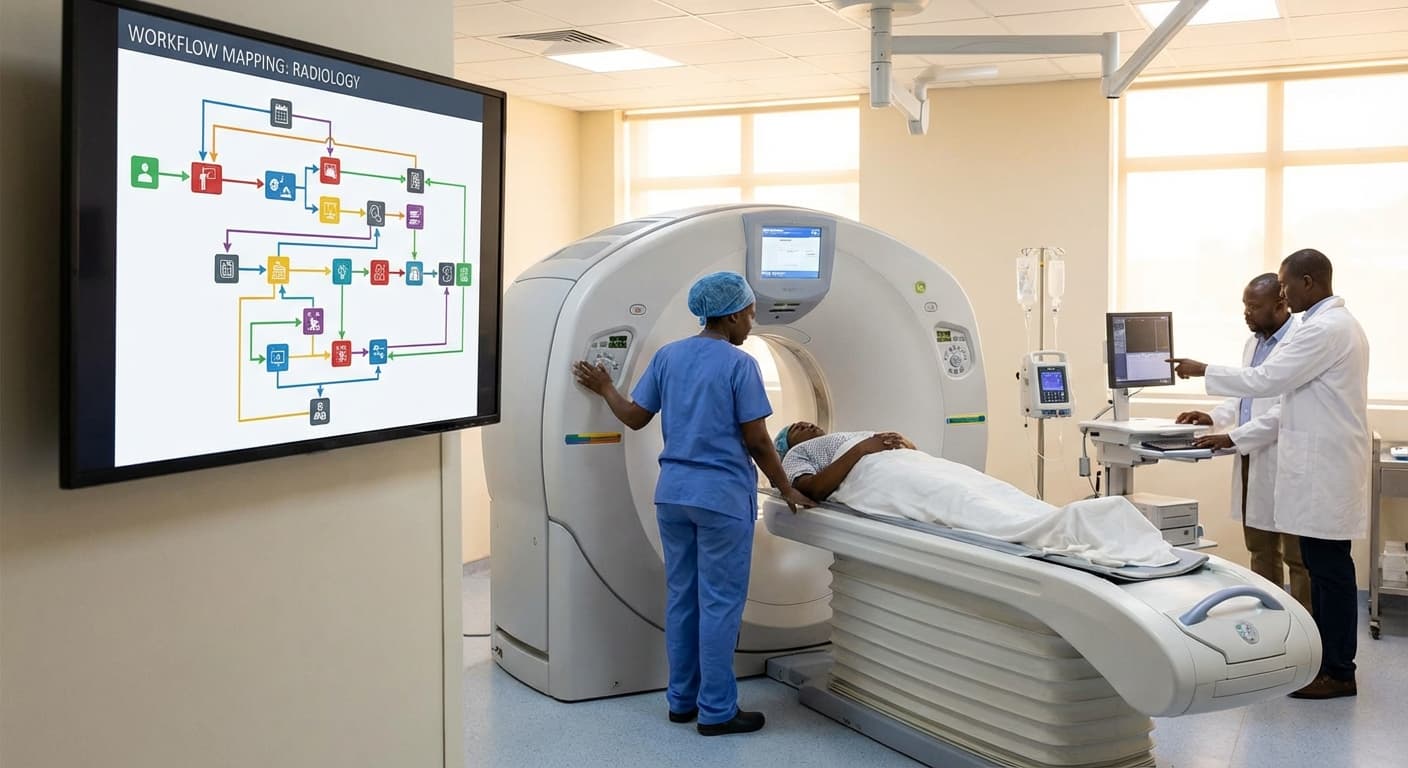
Department Workflow Mapping Service (Radiology/ICU/OT/Lab/Dialysis) in Eritrea
Engineering Excellence & Technical Support
Department Workflow Mapping Service (Radiology/ICU/OT/Lab/Dialysis) High-standard technical execution following OEM protocols and local regulatory frameworks.
Streamlined Patient Pathways
Visualizing and optimizing patient flow through departments like ICU and Radiology ensures timely diagnostics and interventions, reducing wait times and improving patient outcomes in Eritrean healthcare facilities.
Enhanced Lab Throughput
Mapping critical laboratory workflows, from sample collection to result reporting, identifies bottlenecks and opportunities for efficiency, accelerating turnaround times for vital diagnostic tests in Eritrean hospitals and clinics.
Optimized Operating Theatre Utilization
Detailed mapping of OT scheduling and resource allocation processes minimizes downtime and maximizes surgical capacity, ensuring efficient use of valuable resources and timely surgical interventions for patients across Eritrea.
What Is Department Workflow Mapping Service (Radiology/icu/ot/lab/dialysis) In Eritrea?
Department Workflow Mapping Service (Radiology/ICU/OT/Lab/Dialysis) in Eritrea refers to a systematic process of documenting, analyzing, and optimizing the operational procedures and patient pathways within critical hospital departments. This service aims to identify inefficiencies, bottlenecks, and areas for improvement to enhance patient care quality, resource utilization, and overall departmental performance. It involves a comprehensive examination of all steps, from patient arrival and initial assessment to diagnostic procedures, treatment delivery, and discharge or transfer, as well as the underlying administrative and logistical processes supporting these activities. The service is vital for departments characterized by high patient acuity, complex interdependencies, and critical time-sensitive interventions.
| Department | Who Needs the Service? | Typical Use Cases |
|---|---|---|
| Radiology | Radiology departments in public and private healthcare facilities; Ministry of Health for oversight and standardization. | Reducing patient waiting times for imaging studies; optimizing radiologist and technologist workload; improving report turnaround times; standardizing image acquisition protocols; integrating PACS/RIS systems. |
| Intensive Care Unit (ICU) | ICU directors and management; hospital administration; critical care nursing staff; physicians specializing in critical care. | Improving patient handover processes between shifts; optimizing bed allocation and patient flow; reducing length of stay without compromising care; standardizing critical care protocols; enhancing communication between multidisciplinary teams. |
| Operating Theatre (OT) | OT managers; surgical department heads; anesthesiologists; surgical nurses; hospital administrators. | Optimizing surgical scheduling and room utilization; reducing procedure delays; improving instrument and equipment management; streamlining pre-operative patient preparation and post-operative recovery workflows; enhancing sterile processing efficiency. |
| Laboratory | Laboratory directors and managers; clinical pathologists; laboratory technologists; hospital quality assurance departments. | Improving sample accessioning and processing times; optimizing test turnaround times; enhancing quality control procedures; reducing specimen rejection rates; integrating laboratory information systems (LIS) with EMRs. |
| Dialysis | Nephrology department heads; dialysis unit managers; nephrologists; dialysis nurses; hospital administrators. | Optimizing patient scheduling for dialysis sessions; improving patient throughput per machine; ensuring adequate supply chain management for consumables; standardizing dialysis treatment protocols; enhancing patient safety during treatment. |
Key Components of Department Workflow Mapping Service:
- Process Identification: Defining all granular activities and their sequence within a specific department.
- Data Collection: Gathering quantitative and qualitative data on task durations, patient flow patterns, resource allocation, and potential delays.
- Stakeholder Consultation: Engaging with clinical staff (physicians, nurses, technicians), administrative personnel, and management to gain comprehensive insights.
- Visual Representation: Developing process maps (e.g., flowcharts, swimlane diagrams) to visually depict the current state workflow.
- Bottleneck Analysis: Identifying points of congestion, redundancy, or inefficiency within the mapped processes.
- Root Cause Analysis: Investigating the underlying reasons for observed inefficiencies and delays.
- Optimization Strategies: Proposing actionable recommendations for streamlining processes, improving resource allocation, and enhancing patient throughput.
- Technology Integration Assessment: Evaluating opportunities for leveraging information technology to support and improve workflows.
- Performance Metric Definition: Establishing key performance indicators (KPIs) to measure the impact of implemented changes.
- Training and Implementation Support: Assisting in the rollout of revised workflows and providing necessary training to staff.
Who Needs Department Workflow Mapping Service (Radiology/icu/ot/lab/dialysis) In Eritrea?
In Eritrea, a Department Workflow Mapping Service for specialized medical units like Radiology, Intensive Care Units (ICU), Operating Theaters (OT), Laboratories, and Dialysis is crucial for enhancing efficiency, patient safety, and resource utilization. These departments are critical to the delivery of advanced healthcare services, and optimizing their operational flow can significantly impact patient outcomes and the overall effectiveness of healthcare institutions. This service aims to identify bottlenecks, streamline processes, and implement best practices tailored to the specific needs and context of Eritrean healthcare facilities. By visually representing the current workflows, potential issues become apparent, allowing for targeted improvements. This leads to reduced waiting times, minimized errors, better communication between staff, and ultimately, a higher standard of care. The service is particularly relevant for both public and private healthcare providers looking to modernize their operations and achieve greater operational excellence in these high-demand departments.
| Department | Target Customers | Key Benefits of Workflow Mapping |
|---|---|---|
| Radiology | Hospitals with imaging departments, diagnostic centers | Reduced patient wait times for scans, improved image interpretation turnaround, optimized equipment utilization, enhanced radiologist-clinician communication. |
| Intensive Care Unit (ICU) | Critical care units in hospitals, intensive care facilities | Improved patient monitoring efficiency, streamlined admission/discharge processes, enhanced interdisciplinary team communication, reduced medication errors, better resource allocation (staff, equipment). |
| Operating Theater (OT) | Surgical departments in hospitals, surgical centers | Optimized scheduling of surgeries, reduced downtime between procedures, improved sterile processing workflows, enhanced surgeon-anesthesiologist-nurse coordination, minimized risks of surgical site infections. |
| Laboratory | Hospital laboratories, standalone diagnostic labs, public health labs | Faster turnaround times for test results, improved sample handling and tracking, reduced errors in testing and reporting, optimized reagent and equipment management, enhanced quality control procedures. |
| Dialysis | Nephrology departments, dedicated dialysis centers | Streamlined patient scheduling and treatment flow, improved dialysis machine utilization, enhanced infection control protocols, better management of patient care plans, optimized supply chain for consumables. |
Who Needs Department Workflow Mapping Service in Eritrea?
- Public Hospitals and Healthcare Centers
- Private Hospitals and Clinics
- Specialized Medical Centers
- Government Health Ministries and Agencies
- International NGOs focused on healthcare in Eritrea
- Healthcare Training Institutions
Department Workflow Mapping Service (Radiology/icu/ot/lab/dialysis) Process In Eritrea
This document outlines the standard workflow for the Department Workflow Mapping Service (DWMS) in Eritrea, specifically for the Radiology, Intensive Care Unit (ICU), Operating Theater (OT), Laboratory, and Dialysis departments. The service aims to document, analyze, and optimize existing departmental processes to enhance efficiency, reduce errors, and improve patient care. The workflow commences with an initial inquiry and progresses through detailed process mapping, analysis, recommendations, implementation, and finally, ongoing monitoring and refinement.
| Stage | Description | Key Activities | Responsible Party(ies) | Deliverables/Outcomes |
|---|---|---|---|---|
| Inquiry and Initial Consultation | The process begins when a department or hospital administration expresses interest in the DWMS. | Formal request submission, introductory meeting, understanding of general objectives. | Requesting Department/Administration, DWMS Team Lead | Initial understanding of need, agreement to proceed with assessment. |
| Needs Assessment and Scope Definition | A detailed understanding of the specific department's challenges and the desired outcomes of the mapping. | Interviews with department heads, observation of current practices, defining the scope and boundaries of the mapping project (e.g., specific patient pathways, administrative tasks). | DWMS Team Lead, Department Head, Key Department Staff | Defined project scope, clear objectives, identified key stakeholders, agreement on the timeframe and resources. |
| Data Collection and Process Documentation | Gathering comprehensive information about the current state of the department's workflow. | Shadowing staff, conducting interviews, reviewing existing Standard Operating Procedures (SOPs), collecting data on process times, error rates, and resource utilization. Creating visual representations (flowcharts, diagrams) of the current processes. | DWMS Process Analysts, Department Staff | Detailed process maps (e.g., As-Is workflows), collected raw data, documented step-by-step procedures, identified pain points and inefficiencies. |
| Process Analysis and Bottleneck Identification | Analyzing the documented processes to identify inefficiencies, redundancies, and areas for improvement. | Root cause analysis, identifying bottlenecks, evaluating resource allocation, assessing compliance with protocols, identifying potential risks. | DWMS Analysts, DWMS Team Lead | List of identified bottlenecks and inefficiencies, quantified impact of identified issues, preliminary areas for improvement. |
| Recommendation Development | Formulating actionable recommendations to address the identified issues and optimize the workflow. | Brainstorming solutions, developing proposed 'To-Be' workflows, outlining changes to procedures, technology, or staffing. Considering best practices and relevant national guidelines. | DWMS Team Lead, DWMS Analysts, Department Head (for input) | Documented recommendations, proposed 'To-Be' workflow diagrams, justification for proposed changes, preliminary cost-benefit analysis. |
| Implementation Planning | Creating a detailed plan for the execution of the approved recommendations. | Defining implementation phases, assigning responsibilities, establishing timelines, developing training materials, creating communication plans, risk mitigation strategies. | DWMS Team Lead, Department Head, Relevant Department Staff | Detailed implementation plan, training schedule, communication strategy, assigned roles and responsibilities. |
| Execution and Change Management | Putting the approved recommendations into practice and managing the transition. | Implementing new procedures, conducting training sessions, deploying new technologies (if applicable), providing ongoing support to staff, addressing resistance to change. | Department Staff, Department Head, DWMS Support Team | Successful adoption of new workflows, staff competency in new processes, initial stabilization of the revised processes. |
| Monitoring and Evaluation | Continuously tracking the performance of the implemented changes and assessing their effectiveness. | Collecting data on key performance indicators (KPIs), conducting regular audits, gathering feedback from staff and patients, identifying any new issues or unintended consequences. | Department Head, DWMS Analysts | Performance reports against KPIs, identification of areas requiring further adjustment, ongoing improvement opportunities. |
| Reporting and Finalization | Documenting the entire process, its outcomes, and providing a final report. | Compiling all data, analysis, recommendations, and implementation results into a comprehensive report. Presenting findings and outcomes to stakeholders. Formal handover of optimized processes to the department. | DWMS Team Lead, DWMS Analysts | Final DWMS report, presentation of findings, confirmation of project closure, potential plan for future reviews. |
Key Stages of the Department Workflow Mapping Service
- Inquiry and Initial Consultation
- Needs Assessment and Scope Definition
- Data Collection and Process Documentation
- Process Analysis and Bottleneck Identification
- Recommendation Development
- Implementation Planning
- Execution and Change Management
- Monitoring and Evaluation
- Reporting and Finalization
Department Workflow Mapping Service (Radiology/icu/ot/lab/dialysis) Cost In Eritrea
Eritrea's healthcare system, like many developing nations, faces unique challenges in the widespread adoption and implementation of advanced departmental workflow mapping services. These services are crucial for optimizing efficiency, patient safety, and resource allocation in high-demand departments such as Radiology, Intensive Care Units (ICUs), Operating Theatres (OTs), Laboratories, and Dialysis Units. The cost of such services in Eritrea is not standardized and is heavily influenced by a confluence of local economic conditions, the specific scope of the project, and the provider's expertise. While detailed public pricing data is scarce, we can extrapolate potential cost factors and ranges based on the general economic landscape and the nature of workflow analysis services. The local currency is the Eritrean Nakfa (ERN).
| Service Type | Estimated Cost Range (ERN) | Notes on Range |
|---|---|---|
| Basic Workflow Documentation (Single Department) | 5,000 - 20,000 | Covers simple process mapping, interviews for 1-2 days, and a basic report. Assumes limited complexity and staff. |
| Comprehensive Workflow Analysis (Single Department - Radiology/Lab) | 20,000 - 50,000 | Includes detailed observation, multiple interviews, analysis of technology integration, and a detailed report with recommendations. Suitable for departments with moderate complexity. |
| Advanced Workflow Optimization (ICU/OT/Dialysis - Single Department) | 50,000 - 150,000+ | Addresses highly complex, critical workflows. Requires extensive observation, stakeholder engagement, data analysis, and detailed implementation strategies. May involve multiple phases. |
| Multi-Departmental Workflow Mapping (e.g., Radiology & Lab) | 40,000 - 120,000+ | Cost is cumulative based on the number and complexity of departments mapped. Focuses on inter-departmental dependencies. |
| Consultant Daily Rate (Local) | 500 - 2,500 | This is a general estimate for a skilled local consultant. International consultants would be significantly higher. |
Key Pricing Factors for Departmental Workflow Mapping Services in Eritrea:
- {"title":"Scope and Complexity of Workflow:","description":"Mapping a simple, linear process will be less expensive than mapping a complex, multi-stage workflow with numerous decision points and interdependencies, such as in an ICU or OT."}
- {"title":"Department Size and Staff Numbers:","description":"Larger departments with more staff require more observation time, interviews, and analysis, directly impacting the cost."}
- {"title":"Technology Integration Level:","description":"If the workflow involves complex IT systems (e.g., PACS in Radiology, LIS in Labs), assessing and mapping their integration points will add to the cost."}
- {"title":"Data Collection Methods:","description":"The choice between direct observation, staff interviews, surveys, and review of existing documentation will influence the time and resources required."}
- {"title":"Provider's Expertise and Reputation:","description":"Local consultants or firms with proven experience in healthcare workflow analysis will likely command higher fees than less experienced providers."}
- {"title":"Reporting and Deliverables:","description":"The depth and format of the final report, including recommendations, process flow diagrams, and implementation roadmaps, will affect pricing."}
- {"title":"Training and Implementation Support:","description":"If the service includes training staff on new workflows or providing ongoing support for implementation, this will be an additional cost."}
- {"title":"Geographic Location within Eritrea:","description":"Travel and accommodation costs for consultants if the facility is located outside major urban centers like Asmara."}
- {"title":"Government Regulations and Bureaucracy:","description":"Navigating local administrative processes for approvals and contracts can add indirect costs and time."}
Affordable Department Workflow Mapping Service (Radiology/icu/ot/lab/dialysis) Options
Our Affordable Department Workflow Mapping Service provides comprehensive analysis and optimization for critical hospital departments including Radiology, ICU, Operating Theatre (OT), Laboratory, and Dialysis. We specialize in identifying bottlenecks, inefficiencies, and areas for improvement within your existing workflows to enhance patient care, reduce costs, and boost operational efficiency. Our service is designed to be cost-effective, offering flexible value bundles and implementing smart cost-saving strategies tailored to your department's unique needs.
| Cost-Saving Strategy | Description | Departmental Application Examples |
|---|---|---|
| Process Streamlining & Automation | Identifying and eliminating redundant steps, manual tasks, and opportunities for automation through software or technology. This reduces labor costs and errors. | Radiology: Automating image retrieval and reporting. ICU: Streamlining patient admission/discharge processes. OT: Optimizing surgical scheduling and instrument preparation. Lab: Automating sample tracking and reporting. Dialysis: Automating patient scheduling and vital sign monitoring. |
| Resource Optimization & Allocation | Analyzing equipment utilization, staff rostering, and inventory management to ensure resources are used efficiently and effectively, minimizing downtime and waste. | Radiology: Maximizing MRI/CT scanner uptime. ICU: Optimizing nurse-to-patient ratios. OT: Efficient scheduling to minimize OR idle time. Lab: Centralizing reagent inventory. Dialysis: Optimizing dialysis machine allocation. |
| Reduced Lead Times & Turnaround | Shortening the time it takes to complete critical processes (e.g., diagnostic test results, patient transfers, procedure completion), leading to better patient outcomes and potentially reduced length of stay. | Radiology: Faster report turnaround. ICU: Quicker patient stabilization and transfer. OT: Reduced pre-op and post-op wait times. Lab: Rapid critical test results. Dialysis: Efficient patient throughput. |
| Error Reduction & Rework Minimization | Implementing standardized procedures and checks to decrease errors, which reduces the need for costly rework, investigations, and potential patient harm. | Radiology: Accurate patient ID and scan protocols. ICU: Medication administration checks. OT: Surgical safety checklists. Lab: Specimen integrity checks. Dialysis: Dialysis prescription accuracy. |
| Improved Staff Productivity & Morale | By reducing frustration from inefficient processes, staff can focus on core duties, leading to higher productivity, better job satisfaction, and reduced staff turnover. | All departments benefit from clear, efficient workflows that reduce administrative burden and allow for greater focus on patient care. |
Value Bundles
- {"title":"Essential Mapping Package","description":"Includes a foundational analysis of one department's primary workflow, identification of 3-5 key inefficiencies, and a report with actionable recommendations. Ideal for smaller departments or initial process review."}
- {"title":"Comprehensive Workflow Optimization","description":"Encompasses detailed mapping of multiple core workflows within a department, in-depth bottleneck analysis, root cause identification, and development of optimized process flows. Includes presentation of findings and a detailed implementation roadmap. Suitable for departments requiring significant workflow redesign."}
- {"title":"Interdepartmental Synergy Bundle","description":"Focuses on mapping and optimizing workflows that involve collaboration between two selected departments (e.g., Radiology and ICU, or OT and Lab). Aims to improve communication, handoffs, and resource utilization across departmental boundaries. Includes cross-departmental process mapping and integrated recommendations."}
- {"title":"Technology Integration Readiness","description":"Analyzes existing workflows to identify opportunities for technology adoption (e.g., EMR integration, automation, specialized software) and maps out the workflow adjustments required for seamless integration. Includes a cost-benefit analysis of potential technology solutions."}
- {"title":"Custom Departmental Solution","description":"A fully tailored package designed to address the specific needs and complexities of your chosen department(s). We work with you to define the scope, deliverables, and timeline."}
Verified Providers In Eritrea
In the challenging landscape of healthcare provision in Eritrea, identifying genuinely qualified and ethical providers is paramount for individuals seeking reliable medical services. This document aims to shed light on "Verified Providers" and specifically address the credentials of "Franance Health," outlining why they stand out as a premier choice for healthcare in Eritrea.
| Credential/Aspect | Franance Health's Standing | Why it Matters for Patients |
|---|---|---|
| Ministry of Health Accreditation | Fully accredited and compliant with all Ministry of Health regulations. | Guarantees that Franance Health meets the minimum standards set by the national health authority, ensuring a baseline level of safety and competence. |
| Specialized Medical Expertise | Employs a team of highly qualified and experienced specialists across various medical disciplines (e.g., cardiology, pediatrics, surgery, diagnostics). | Ensures patients receive care from professionals with deep knowledge and practical experience in their specific health needs, leading to more accurate diagnoses and effective treatments. |
| Advanced Diagnostic Capabilities | Utilizes state-of-the-art diagnostic equipment for precise and timely assessments. | Enables faster and more accurate identification of medical conditions, crucial for initiating appropriate treatment promptly and improving patient outcomes. |
| Commitment to Patient Care & Ethics | Prioritizes patient well-being, privacy, and informed consent, adhering to a strict ethical code. | Provides a safe and trustworthy environment where patients feel respected, informed, and confident in the care they receive, fostering a strong doctor-patient relationship. |
| Continuous Professional Development (CPD) | Invests in ongoing training and education for its medical staff to stay abreast of the latest medical advancements. | Ensures that patients benefit from the most current and evidence-based medical practices, leading to superior treatment strategies and outcomes. |
| Integrated Healthcare Approach | Offers a comprehensive range of services, often facilitating seamless referrals and coordination between different departments or specialists. | Streamlines the patient journey, reducing the need for multiple appointments and ensuring a coordinated approach to complex health issues. |
Key Factors for Identifying Verified Providers in Eritrea:
- Legitimate Licensing and Accreditation: Verified providers possess the necessary certifications and licenses from the Eritrean Ministry of Health and relevant professional bodies.
- Experienced and Qualified Medical Professionals: This includes a track record of continuous professional development and a demonstrable history of successful patient care.
- Adherence to Ethical Standards: Verified providers operate with transparency, patient-centricity, and a commitment to the highest ethical principles in medical practice.
- Positive Patient Testimonials and Reputation: A strong reputation built on consistently positive feedback from patients is a crucial indicator of quality.
- Investment in Modern Equipment and Facilities: Access to up-to-date medical technology and well-maintained facilities ensures accurate diagnosis and effective treatment.
Scope Of Work For Department Workflow Mapping Service (Radiology/icu/ot/lab/dialysis)
This Scope of Work (SOW) outlines the services to be provided for a comprehensive workflow mapping project across key hospital departments. The objective is to document, analyze, and optimize existing processes within the Radiology, Intensive Care Unit (ICU), Operating Theatre (OT), Laboratory, and Dialysis departments to improve efficiency, reduce errors, enhance patient care, and facilitate future technology integration. This SOW details the project objectives, scope, deliverables, and technical specifications.
| Department | Key Processes to Map | Expected Outcomes/Deliverables per Department |
|---|---|---|
| Radiology | Patient registration & scheduling, Image acquisition (X-ray, CT, MRI, Ultrasound), Image interpretation & reporting, PACS integration, Billing & coding, Equipment maintenance, Staff scheduling. | Detailed 'As-Is' workflow diagrams, Identified pain points & recommendations, 'To-Be' optimized workflow diagrams, Process matrices, Key Performance Indicator (KPI) baseline data. |
| Intensive Care Unit (ICU) | Patient admission & triage, Patient monitoring & vital signs tracking, Medication administration, Ventilator management, Nursing care protocols, Physician rounds, Discharge planning, Equipment utilization & maintenance, Communication protocols (staff, family). | Detailed 'As-Is' workflow diagrams, Identified pain points & recommendations, 'To-Be' optimized workflow diagrams, Critical care pathway maps, Communication flowcharts, Staffing model analysis. |
| Operating Theatre (OT) | Pre-operative patient preparation, Surgical scheduling & room allocation, Surgical team roles & responsibilities, Anesthesia procedures, Surgical procedure steps, Intra-operative monitoring, Post-operative care (immediate), Sterilization & instrument management, Inventory management, Waste management. | Detailed 'As-Is' workflow diagrams, Identified pain points & recommendations, 'To-Be' optimized workflow diagrams, Surgical safety checklist mapping, Instrument turnaround time analysis, Room utilization optimization reports. |
| Laboratory | Sample collection & accessioning, Sample processing & testing (various disciplines), Quality control procedures, Result validation & reporting, LIMS integration, Reagent & supply management, Equipment calibration & maintenance, Staff training & competency. | Detailed 'As-Is' workflow diagrams, Identified pain points & recommendations, 'To-Be' optimized workflow diagrams, Turnaround time analysis (TAT) for key tests, Specimen rejection rate analysis, Quality assurance protocol mapping. |
| Dialysis | Patient scheduling & preparation, Pre-dialysis assessment, Dialysis treatment procedures (hemodialysis, peritoneal dialysis), Post-dialysis monitoring, Medication administration, Fluid management, Equipment setup & sterilization, Staff roles & responsibilities, Patient education, Waste disposal. | Detailed 'As-Is' workflow diagrams, Identified pain points & recommendations, 'To-Be' optimized workflow diagrams, Patient journey mapping, Machine utilization reports, Infection control protocol mapping, Staff-patient ratio analysis. |
Technical Deliverables and Standard Specifications
- {"name":"As-Is Workflow Documentation","description":"Detailed graphical representations of current processes. Includes all steps, decision points, roles, systems involved, and time estimates.","standardSpecifications":"Utilize industry-standard notation (e.g., BPMN 2.0 - Business Process Model and Notation). Diagrams to be interactive where possible, allowing for drill-down into sub-processes. Delivered in digital formats (e.g., PDF, Visio, Lucidchart). Each diagram should include a legend and version control."}
- {"name":"To-Be Workflow Recommendations & Documentation","description":"Proposed optimized workflows based on analysis of 'As-Is' processes. Includes rationale for changes and expected benefits.","standardSpecifications":"BPMN 2.0 compliant diagrams, clearly indicating changes from 'As-Is'. Highlighted areas for automation, standardization, or process redesign. Accompanying narrative report detailing proposed changes, justification, and anticipated improvements. Similar digital delivery formats as 'As-Is'."}
- {"name":"Process Matrices/Analysis Reports","description":"Tabular summaries of identified bottlenecks, inefficiencies, risks, and proposed solutions.","standardSpecifications":"Standardized template for each department, including columns for: Process Step, Identified Issue, Impact (e.g., time, cost, quality), Proposed Solution, Responsible Party, Estimated Effort/Cost, Expected Benefit. Delivered as Excel or CSV files."}
- {"name":"Inter-Departmental Dependency Maps","description":"Visualizations illustrating the flow of information, patients, and resources between departments.","standardSpecifications":"Flowcharts or swimlane diagrams highlighting critical handoffs and communication points. Delivered in digital format (e.g., PDF, Visio)."}
- {"name":"Key Performance Indicator (KPI) Baseline Report","description":"Documented baseline metrics for critical process indicators.","standardSpecifications":"Report outlining current performance levels for selected KPIs (e.g., average turnaround time for lab tests, patient wait times, staff utilization). Data collection methodology to be clearly defined. Delivered as a PDF or Word document."}
- {"name":"Final Project Report","description":"Comprehensive document summarizing the entire project, findings, recommendations, and future roadmap.","standardSpecifications":"Executive summary, detailed methodology, findings per department, consolidated recommendations, roadmap for implementation, and appendices including all detailed diagrams and reports. Delivered in PDF format."}
- {"name":"Workshop Materials & Minutes","description":"Documentation from stakeholder workshops and interviews.","standardSpecifications":"Agendas, attendee lists, presentation slides (if any), and detailed minutes capturing discussions, decisions, and action items. Delivered in PDF format."}
Service Level Agreement For Department Workflow Mapping Service (Radiology/icu/ot/lab/dialysis)
This Service Level Agreement (SLA) outlines the performance standards for the Department Workflow Mapping Service provided to the Radiology, Intensive Care Unit (ICU), Operating Theatre (OT), Laboratory, and Dialysis departments. This SLA defines response times for incidents and availability (uptime) guarantees for the workflow mapping platform and its associated support.
| Service Component | Response Time Target (Business Hours) | Resolution Time Target (Business Hours) | Uptime Guarantee |
|---|---|---|---|
| Workflow Mapping Platform Availability | N/A | N/A | 99.5% |
| Critical Incident (System Outage, Major Functionality Failure) | 1 Hour | 4 Business Hours | N/A |
| High Priority Incident (Significant performance degradation, Partial functionality loss) | 2 Business Hours | 8 Business Hours | N/A |
| Medium Priority Incident (Minor functional issues, Informational requests) | 4 Business Hours | 2 Business Days | N/A |
| Low Priority Incident (General inquiries, Feature suggestions) | 1 Business Day | 5 Business Days | N/A |
| New Workflow Mapping Request (Initial Consultation) | 3 Business Days | N/A | N/A |
| Workflow Map Update Request (Content Change) | 5 Business Days | N/A | N/A |
Scope of Service
- Provision and maintenance of the workflow mapping platform.
- Initial consultation and needs assessment for workflow mapping.
- Development and delivery of documented workflow maps.
- Regular review and update of workflow maps (as per agreed schedule).
- Technical support for the workflow mapping platform.
- Assistance with understanding and interpreting workflow maps.
Frequently Asked Questions

Ready when you are
Let's scope your Department Workflow Mapping Service (Radiology/ICU/OT/Lab/Dialysis) in Eritrea project in Eritrea.

Scaling healthcare logistics and technical systems across the entire continent.