
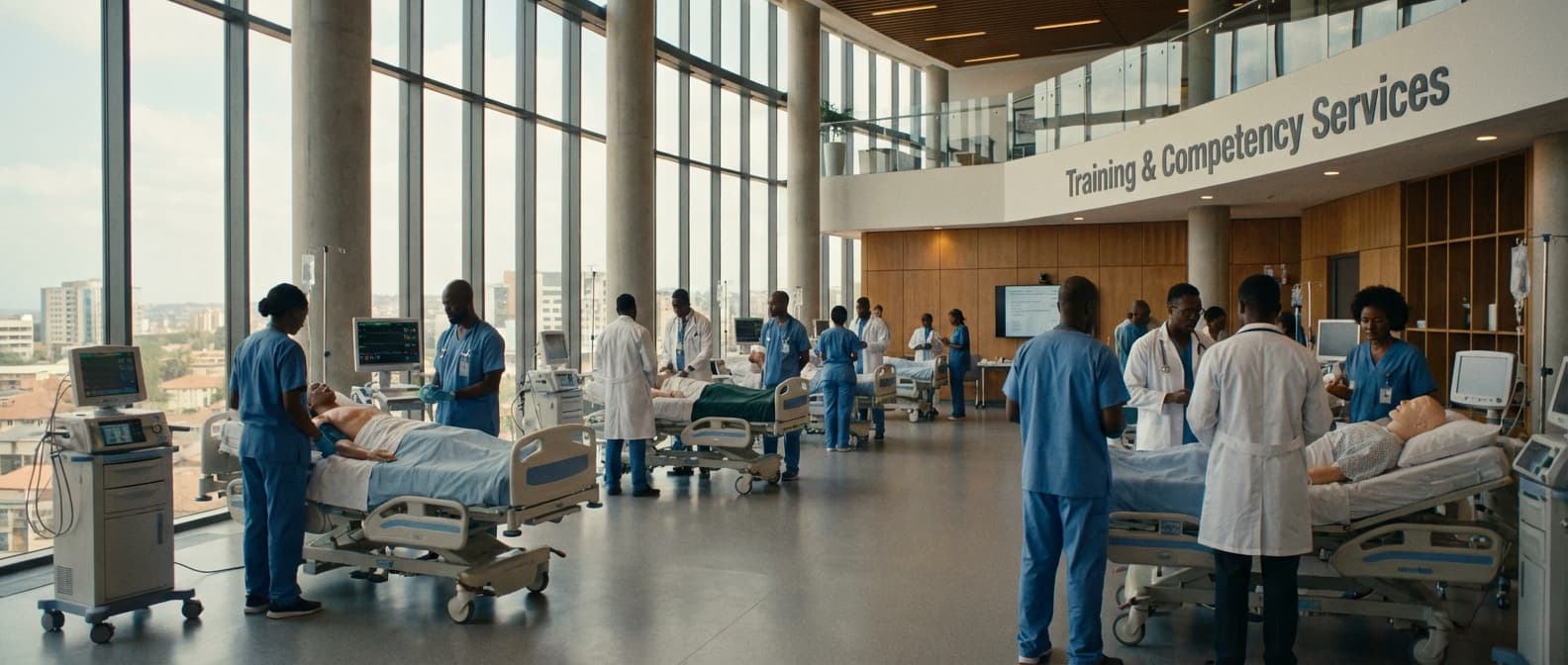
MRI Operator Training Service (Radiographers) in Equatorial Guinea
Engineering Excellence & Technical Support
MRI Operator Training Service (Radiographers) High-standard technical execution following OEM protocols and local regulatory frameworks.
Certified MRI Safety Protocols
Comprehensive training covering all essential MRI safety protocols specific to Equatorial Guinea's regulatory framework, ensuring radiographers are equipped to prevent incidents and maintain a secure scanning environment.
Advanced Image Acquisition Techniques
Master advanced MRI pulse sequences and optimization strategies to achieve superior diagnostic image quality for a wide range of pathologies, enhancing diagnostic accuracy in local healthcare settings.
Equipment Calibration & Troubleshooting
Hands-on training in routine MRI equipment calibration, quality control procedures, and fundamental troubleshooting techniques, empowering radiographers to maintain optimal scanner performance and minimize downtime.
What Is Mri Operator Training Service (Radiographers) In Equatorial Guinea?
MRI Operator Training Service (Radiographers) in Equatorial Guinea refers to specialized educational programs designed to equip radiographers with the knowledge and practical skills necessary to safely and effectively operate Magnetic Resonance Imaging (MRI) scanners. This training is crucial for ensuring high-quality diagnostic imaging and patient safety within the healthcare infrastructure of Equatorial Guinea.
| Component | Description | Target Audience in Equatorial Guinea | Outcome/Benefit |
|---|---|---|---|
| MRI Physics and Principles | Understanding the fundamental concepts of nuclear magnetic resonance, radiofrequency pulses, magnetic gradients, and signal generation. | Radiographers, Technologists, Medical Physicists. | Informed operational decision-making, optimized scan parameter selection. |
| Image Acquisition Protocols | Learning various pulse sequences (e.g., spin echo, gradient echo), contrast weighting (T1, T2, PD), and spatial resolution techniques. | Radiographers operating MRI scanners. | Generation of diagnostically relevant MR images. |
| Patient Care and Safety | Screening for contraindications (implants, pacemakers), patient preparation, sedation protocols, and emergency procedures. | All MRI operational staff, including radiographers and support personnel. | Minimization of patient risks, enhancement of patient comfort and trust. |
| Magnetic Field Safety | Understanding the static magnetic field (B0) and its implications for ferromagnetic materials and personnel. | Radiographers, hospital administration, security personnel overseeing MRI suites. | Prevention of projectile accidents and direct biological effects. |
| Image Quality Assurance (QA) | Implementing procedures for regular equipment checks, artifact identification, and troubleshooting. | Radiographers and diagnostic imaging managers. | Consistent production of high-diagnostic-quality images, extended equipment lifespan. |
What is MRI Operator Training Service (Radiographers)?
- {"title":"Definition and Scope","description":"This service encompasses a comprehensive curriculum covering the principles of MRI physics, image acquisition techniques, patient preparation and positioning, contraindication assessment, safety protocols (including magnetic field safety and radiofrequency/gradient coil considerations), image post-processing, quality assurance, and basic troubleshooting. Training can be delivered through various modalities, including theoretical lectures, simulated environments, and hands-on practice with operational MRI equipment."}
- {"title":"Who Needs This Service?","description":"The primary recipients are licensed radiographers, diagnostic imaging technologists, and medical physicists working or intending to work in healthcare facilities in Equatorial Guinea that utilize or plan to implement MRI technology. This includes public and private hospitals, diagnostic imaging centers, and specialized medical institutions. Radiographers with existing experience in other imaging modalities (e.g., X-ray, CT) who are transitioning to MRI operation are also key beneficiaries."}
- {"title":"Typical Use Cases","description":"Common use cases for this training service include:\n\n* Onboarding New Personnel: Training newly hired radiographers to operate existing MRI scanners.\n* Introduction of New MRI Technology: Training radiographers when a healthcare facility acquires new MRI equipment or upgrades existing systems.\n* Continuing Professional Development (CPD): Enabling radiographers to enhance their skills, stay abreast of technological advancements, and maintain their professional competency.\n* Enhancing Diagnostic Accuracy: Improving the quality of MRI scans through proficient operation, leading to more accurate diagnoses.\n* Ensuring Patient Safety: Mitigating risks associated with MRI procedures, such as ferromagnetic object incidents and contrast agent adverse reactions, through rigorous safety training.\n* Compliance with Standards: Meeting national and international standards for medical imaging practice and radiation safety."}
Who Needs Mri Operator Training Service (Radiographers) In Equatorial Guinea?
MRI operator training services are crucial for enhancing the diagnostic capabilities and patient care within Equatorial Guinea's healthcare sector. As the country invests in advanced medical imaging technology, a skilled workforce is paramount to effectively utilize and maintain MRI equipment. This ensures accurate diagnoses, improved treatment planning, and a higher standard of healthcare delivery. The training is designed to equip radiographers with the theoretical knowledge and practical skills necessary to safely and efficiently operate MRI scanners, interpret images, and manage patient workflows in accordance with international best practices.
| Target Customer/Department | Description | Key Needs Addressed by Training |
|---|---|---|
| Radiology Departments (in Hospitals) | The core department responsible for all medical imaging, including MRI. | Safe and effective operation of MRI scanners, image acquisition protocols, patient positioning, contrast administration, and quality control. |
| Diagnostic Imaging Departments (in Diagnostic Centers) | Specialized units focused on providing a range of imaging services. | Proficiency in diverse MRI sequences, troubleshooting technical issues, and efficient patient throughput. |
| Radiography Training Programs (in Medical Schools) | Educational institutions developing future radiographers. | Curriculum enhancement, faculty development in MRI, and providing practical training opportunities for students. |
| Central Medical Stores/Procurement Departments (Ministry of Health) | Entities involved in acquiring and managing medical equipment. | Understanding the operational requirements of MRI technology to inform procurement decisions and ensure adequate staffing for newly acquired equipment. |
| Quality Assurance & Patient Safety Committees | Groups focused on upholding high healthcare standards. | Ensuring radiographers adhere to safety protocols, radiation protection guidelines (though MRI is non-ionizing, there are other safety considerations), and quality imaging standards. |
Target Customers and Departments for MRI Operator Training Service (Radiographers) in Equatorial Guinea
- Hospitals (Public and Private): Facilities that currently possess or plan to acquire MRI scanners are the primary target. This includes both government-funded hospitals and private healthcare institutions catering to a broader patient demographic.
- Diagnostic Imaging Centers: Standalone centers specializing in medical imaging services that include MRI will benefit from trained radiographers to offer advanced diagnostic options.
- Ministry of Health & Public Health Institutions: Government bodies responsible for public healthcare infrastructure and planning will be key stakeholders, potentially sponsoring or mandating training for their personnel.
- Tertiary Care Centers & Referral Hospitals: These institutions, often equipped with more advanced technology and serving complex cases, will require highly skilled MRI operators.
- Medical Schools & Training Institutions: Universities and colleges offering radiology or medical imaging programs can integrate specialized MRI operator training into their curriculum to produce graduates ready for the job market.
Mri Operator Training Service (Radiographers) Process In Equatorial Guinea
The MRI Operator Training Service (Radiographers) process in Equatorial Guinea outlines the steps involved in providing specialized training to radiographers for the operation of Magnetic Resonance Imaging (MRI) machines. This workflow ensures that qualified personnel are available to deliver essential diagnostic imaging services, adhering to international standards and local regulations. The process begins with an initial inquiry from a healthcare institution or government body seeking to train their radiographers. This is followed by a detailed needs assessment, proposal development, contract negotiation, and the actual execution of the training program, which includes theoretical and practical components. Post-training evaluation and ongoing support are crucial for ensuring long-term competency and satisfaction.
| Stage | Description | Key Activities | Responsible Parties | Deliverables | Timeline (Estimated) |
|---|---|---|---|---|---|
| The process begins when a potential client expresses interest in MRI operator training. | Receive and acknowledge inquiry, schedule initial discussion. | Client (Healthcare Institution/Government), Training Provider | Acknowledgment of Inquiry, Initial Meeting Scheduled | 1-3 Business Days |
| Understand the client's specific requirements, existing radiographer skill levels, and available MRI equipment. | Conduct site visits (if feasible), interview key personnel, review existing training materials, identify specific training needs and learning objectives. | Training Provider, Client Representatives (e.g., Head of Radiology, HR) | Needs Assessment Report, Defined Training Objectives | 1-2 Weeks |
| Develop a comprehensive proposal outlining the training program, curriculum, methodology, duration, costs, and expected outcomes. | Draft proposal based on needs assessment, include trainer profiles, venue requirements, and logistical arrangements. Submit proposal to client. | Training Provider | Detailed Training Proposal | 1-2 Weeks |
| Discuss and finalize the terms and conditions of the training service agreement. | Review proposal, negotiate pricing, payment terms, service level agreements (SLAs), and contract duration. Sign the agreement. | Training Provider, Client | Signed Service Agreement/Contract | 1-3 Weeks |
| Identify and select radiographers who will undergo the training. | Client selects candidates based on established criteria. Training provider may offer pre-screening assessments to gauge existing knowledge. | Client, Training Provider (for pre-screening) | List of Selected Participants, Pre-screening Results (if applicable) | 1 Week |
| Tailor the training curriculum to address the specific MRI equipment and clinical applications relevant to the client's facility. | Develop or adapt modules covering MRI physics, safety protocols, imaging techniques, image acquisition, post-processing, and quality control. Finalize training schedule. | Training Provider | Customized Training Curriculum, Detailed Training Schedule | 1-2 Weeks |
| Deliver the training program through a combination of lectures, demonstrations, hands-on practice, and case studies. | Conduct theoretical sessions at a designated training venue. Provide practical sessions on actual MRI scanners (on-site or simulation). Include supervised practice and troubleshooting exercises. | Training Provider (Instructors/Trainers), Participants | Delivered Training Modules, Practical Skill Development | Duration varies based on program scope (e.g., 2-6 Weeks) |
| Measure the participants' understanding and proficiency in operating the MRI scanner. | Conduct theoretical assessments (quizzes, exams) and practical evaluations (observed scanning, case analysis). Gather participant feedback on the training. | Training Provider, Participants | Assessment Scores, Practical Competency Evaluations, Participant Feedback Forms | End of Training Program |
| Issue certificates of completion to successful participants and provide comprehensive documentation. | Award certificates to radiographers who have met the required competency standards. Provide reports on individual and group performance to the client. | Training Provider | Certificates of Completion, Training Performance Reports | 1 Week (post-assessment) |
| Offer ongoing support to reinforce learning and address any challenges encountered in the workplace. | Provide remote or on-site technical assistance, refresher sessions, or mentorship. Conduct follow-up visits to assess continued competency. | Training Provider, Client | Technical Support, Refresher Session Schedules, Follow-up Visit Reports | Ongoing (e.g., 3-6 Months post-training) |
| Gather feedback from both participants and the client to improve future training programs. | Conduct post-training review meetings. Analyze feedback to identify areas for enhancement in curriculum, delivery, and support. | Training Provider, Client, Participants | Program Improvement Recommendations, Updated Training Methodologies | Ongoing |
MRI Operator Training Service Workflow for Radiographers in Equatorial Guinea
- Inquiry and Initial Contact
- Needs Assessment and Consultation
- Proposal Development and Submission
- Contract Negotiation and Agreement
- Participant Selection and Pre-screening
- Curriculum Design and Customization
- Training Program Execution (Theoretical & Practical)
- Assessment and Evaluation
- Certification and Documentation
- Post-Training Support and Follow-up
- Feedback and Continuous Improvement
Mri Operator Training Service (Radiographers) Cost In Equatorial Guinea
The cost of MRI operator training for radiographers in Equatorial Guinea can vary significantly based on several factors. These include the specific training provider, the duration and intensity of the program, the curriculum's depth, the use of specialized equipment for practical training, and whether the training is conducted on-site or at a dedicated facility. The local economic conditions and the demand for such specialized training also play a role in pricing. Generally, more comprehensive and hands-on training programs will command higher fees.
Given the limited availability of highly specialized medical training centers in Equatorial Guinea, external providers or specialized local institutions may be the primary sources. Costs are typically quoted in the local currency, the Central African CFA franc (XAF). However, due to the nascent stage of advanced medical imaging training infrastructure, some providers might also quote in USD, which would then be converted to XAF at the prevailing exchange rate.
| Training Level/Type | Estimated Cost Range (XAF) |
|---|---|
| Basic MRI Operation & Safety (e.g., 1-2 weeks) | 150,000 - 400,000 |
| Comprehensive MRI Operator Training (e.g., 4-8 weeks, including practicals) | 400,000 - 1,200,000 |
| Advanced MRI Techniques & Protocols (e.g., specialized sequences, post-processing) | 800,000 - 2,000,000+ |
| On-site Training (per session/week, exclusive of travel) | 200,000 - 600,000 |
Key Pricing Factors for MRI Operator Training in Equatorial Guinea
- Training Provider Reputation and Expertise
- Program Duration and Intensity (e.g., weeks, months)
- Curriculum Scope (e.g., basic operation, advanced protocols, troubleshooting)
- Practical Training Components (e.g., simulator use, supervised on-site practice)
- Instructor-to-Trainee Ratio
- Location of Training (on-site vs. dedicated facility)
- Included Resources (e.g., study materials, certification exams)
- Geographical Accessibility and Travel Costs (if applicable)
- Local Economic Conditions and Demand
Affordable Mri Operator Training Service (Radiographers) Options
Providing accessible and affordable MRI operator training for radiographers is crucial for expanding access to vital diagnostic imaging. This service focuses on delivering high-quality education through flexible and cost-effective avenues, empowering radiographers to gain the necessary skills to operate MRI scanners safely and efficiently. Our approach emphasizes maximizing value for institutions and individuals by offering bundled services and strategic cost-saving measures.
| Value Bundle | Inclusions | Cost-Saving Strategies Applied | Target Audience | Estimated Price Range (USD) |
|---|---|---|---|---|
| Basic Certification Package | Online core curriculum, virtual simulations, online assessment, basic certification. | Leveraging e-learning for reduced instructor travel and facility costs, group discounts for institutions. | Radiographers new to MRI, seeking foundational knowledge and certification. | $800 - $1,500 per individual |
| Advanced Skills Bundle | Basic package + specialized modules (e.g., neuro, MSK, cardiac), in-person practical session (optional), advanced assessment. | Bundling specialized modules at a discounted rate, optimizing in-person session scheduling for maximum group participation. | Radiographers with existing MRI experience looking to specialize or enhance their skill set. | $1,800 - $3,000 per individual |
| Institutional Training Solution | Customizable curriculum, on-site training delivery (if required), dedicated account management, bulk certification discounts, simulator access. | Economies of scale through group enrollment, reduced administrative overhead for the institution, potential for trainer travel cost sharing. | Hospitals, imaging centers, and healthcare systems requiring training for multiple radiographers. | Customized quotes based on number of trainees and services required (e.g., $500 - $1,200 per individual on average) |
| Remote Learning Accelerator | Full online curriculum, comprehensive virtual labs, remote proctored exams, ongoing online support. | Eliminates travel and accommodation costs, allows for asynchronous learning to fit busy schedules, scalable to large numbers. | Radiographers in remote locations or those with significant time constraints. | $1,000 - $1,800 per individual |
Key Components of Affordable MRI Operator Training
- Comprehensive Curriculum: Covering MRI physics, safety protocols, image acquisition techniques, and quality control.
- Flexible Learning Modalities: Including online modules, in-person workshops, and blended learning options.
- Hands-on Practice: Opportunities for supervised practical experience on actual MRI scanners (where feasible).
- Assessment and Certification: Rigorous evaluation to ensure competency and provide recognized certification.
- Continuing Education Credits: Facilitating ongoing professional development for radiographers.
Verified Providers In Equatorial Guinea
Finding verified healthcare providers in Equatorial Guinea can be a challenge, but for those seeking reliable and high-quality medical services, Franance Health stands out. Their commitment to excellence, stringent credentialing process, and patient-centric approach make them a trusted partner in your healthcare journey. This document outlines why Franance Health's verified providers are the optimal choice for your medical needs in Equatorial Guinea.
| Provider Type | Specialties Offered (Examples) | Franance Health Verification Criteria |
|---|---|---|
| General Practitioners | Routine check-ups, minor illnesses, preventative care | Valid medical license, proof of continuous medical education, malpractice insurance |
| Specialist Physicians | Cardiology, Neurology, Pediatrics, Dermatology, Ophthalmology, etc. | Board certification in specialty, minimum years of experience, peer reviews, hospital affiliations |
| Surgeons | General Surgery, Orthopedic Surgery, etc. | Extensive surgical experience, documented successful procedures, adherence to sterile protocols |
| Dentists | General Dentistry, Orthodontics, Periodontics | Dental license, specialized training certifications, adherence to dental health standards |
| Diagnostic Imaging Specialists | Radiology, Sonography | Certification in imaging techniques, proficiency with advanced equipment |
Why Choose Franance Health Verified Providers:
- Rigorous Credentialing & Verification: Franance Health employs a comprehensive vetting process for all their affiliated healthcare professionals. This includes verifying medical licenses, certifications, educational backgrounds, and professional experience.
- Commitment to Quality Standards: Providers associated with Franance Health adhere to international best practices and quality standards in healthcare delivery.
- Multilingual Staff & Cultural Competency: Understanding the diverse population, Franance Health prioritizes providers who can communicate effectively in multiple languages and demonstrate cultural sensitivity.
- Access to Specialized Care: Franance Health facilitates access to a wide range of medical specialties, ensuring you can find the right expert for your specific condition.
- Patient-Centric Approach: The focus is on providing compassionate and personalized care, with an emphasis on patient comfort and well-being.
- Seamless Appointment Booking: Franance Health streamlines the process of scheduling appointments, making healthcare more accessible.
- Trust and Reliability: By choosing Franance Health, you gain peace of mind knowing you are being treated by qualified and trustworthy medical professionals.
Scope Of Work For Mri Operator Training Service (Radiographers)
This Scope of Work (SOW) outlines the requirements for providing comprehensive MRI Operator Training services specifically designed for Radiographers. The training will cover theoretical knowledge, practical application, safety protocols, and quality assurance related to MRI operations. The objective is to equip radiographers with the necessary skills and expertise to perform MRI scans independently and safely, adhering to international standards and best practices.
| Deliverable | Description | Standard Specification |
|---|---|---|
| Training Curriculum | Detailed syllabus covering all training modules, learning objectives, and assessment methods. | Curriculum must align with current ACR/ESR guidelines and national radiographer certification standards. Must be provided in digital format (PDF/Word). |
| Training Materials | Presentations, handouts, case studies, and reference guides for each module. | Materials to be comprehensive, visually engaging, and easily accessible. Must include both theoretical and practical elements. Available in digital format. |
| Practical Training Sessions | Hands-on experience on a functional MRI scanner under the supervision of certified trainers. | Minimum of 80 hours of supervised practical training per trainee. Trainees must demonstrate proficiency in scanning at least 10 different common protocols. |
| Assessment and Evaluation | Written examinations, practical assessments, and competency evaluations. | Written exams to assess theoretical knowledge (passing score 80%). Practical assessments to evaluate scanning proficiency and safety adherence. Competency evaluation checklist signed by both trainer and trainee upon successful completion. |
| Certificate of Completion | Official document acknowledging successful completion of the MRI Operator Training. | Certificate to be issued to each trainee upon successful completion of all training modules and assessments. Must include trainee's name, course details, duration, and trainer's signature. |
| Post-Training Support | Limited access to trainers for follow-up questions and guidance. | Provision for 3 months of email/phone support for trainees to address specific queries or challenges encountered in practice. |
| Trainer Qualifications | Experienced and certified MRI technologists or radiographers with extensive clinical and teaching experience. | Trainers must possess a minimum of 5 years of experience in MRI operation and at least 2 years of experience in adult education or training. Evidence of certifications and relevant qualifications to be provided. |
Key Training Modules and Objectives
- {"title":"Module 1: Principles of MRI","objectives":["Explain the basic principles of MRI physics.","Identify the key components of an MRI scanner and their functions.","Describe the process of image formation.","Understand the concepts of T1, T2, and proton density weighting."],"description":"Understanding the fundamental physics of Magnetic Resonance Imaging, including RF pulses, gradient coils, signal generation, and image reconstruction."}
- {"title":"Module 2: MRI Safety Protocols","objectives":["Implement effective patient and staff screening for MRI safety.","Identify and manage ferromagnetic materials in the MRI environment.","Understand and respond to cryogen-related emergencies.","Develop and practice emergency response procedures."],"description":"Comprehensive training on patient and staff safety, including screening procedures, contraindications, ferromagnetic detection, cryogen safety, and emergency protocols."}
- {"title":"Module 3: MRI Imaging Techniques and Protocols","objectives":["Select appropriate pulse sequences for specific diagnostic tasks.","Administer and monitor MRI contrast agents safely and effectively.","Perform standard MRI examinations for head, spine, abdomen, pelvis, and extremities.","Understand the principles of advanced MRI techniques (e.g., fMRI, DTI, Spectroscopy)."],"description":"Covers various pulse sequences, contrast agents, and common clinical protocols for different anatomical regions."}
- {"title":"Module 4: Image Quality Assurance and Optimization","objectives":["Identify common MRI artifacts and their causes.","Implement strategies to minimize and correct artifacts.","Optimize imaging parameters for diagnostic image quality.","Perform routine quality control checks on the MRI scanner."],"description":"Focuses on techniques to achieve optimal image quality, artifact recognition, and troubleshooting."}
- {"title":"Module 5: Patient Care and Communication","objectives":["Establish effective communication with MRI patients.","Implement strategies to alleviate patient anxiety and claustrophobia.","Ensure patient comfort and safety throughout the examination.","Provide appropriate post-scan instructions to patients."],"description":"Training on patient comfort, communication strategies, managing claustrophobia, and post-scan procedures."}
Service Level Agreement For Mri Operator Training Service (Radiographers)
This Service Level Agreement (SLA) outlines the guaranteed response times and uptime for the MRI Operator Training Service (Radiographers) provided by [Your Company Name] (hereinafter referred to as 'Service Provider') to [Client Company Name] (hereinafter referred to as 'Client'). This SLA is an integral part of the Master Service Agreement between the Service Provider and the Client.
| Service Component | Uptime Guarantee | Response Time (Support) | Resolution Time (Target) | Notes |
|---|---|---|---|---|
| Online Training Platform Availability | 99.5% Uptime (excluding scheduled maintenance) | N/A | N/A | Scheduled maintenance will be communicated at least 48 hours in advance. |
| Email Support for Training Queries | N/A | Within 4 Business Hours | Within 24 Business Hours (for non-complex issues) | Business Hours are Monday to Friday, 9:00 AM to 5:00 PM [Client's Time Zone]. |
| Phone Support for Urgent Training Issues | N/A | Within 1 Business Hour | Within 8 Business Hours (for critical issues) | Critical issues are defined as those preventing the commencement or continuation of scheduled MRI scans directly attributable to training gaps or platform failures. |
| Access to Training Materials (Online Portal) | 99.8% Uptime (excluding scheduled maintenance) | N/A | N/A | Service Provider will strive to minimize disruption during maintenance. |
Scope of Service
- The MRI Operator Training Service includes but is not limited to: initial radiographer training on MRI equipment, refresher courses, specialized MRI technique training, troubleshooting support for training-related queries, and access to training materials.
- The Service Provider will deliver training sessions either on-site at the Client's facility or remotely via virtual platforms, as agreed upon in separate training session bookings.
- This SLA specifically covers the availability and responsiveness of the Service Provider's support channels and the uptime of any online training platforms provided.
Frequently Asked Questions

Ready when you are
Let's scope your MRI Operator Training Service (Radiographers) in Equatorial Guinea project in Equatorial Guinea.

Scaling healthcare logistics and technical systems across the entire continent.