
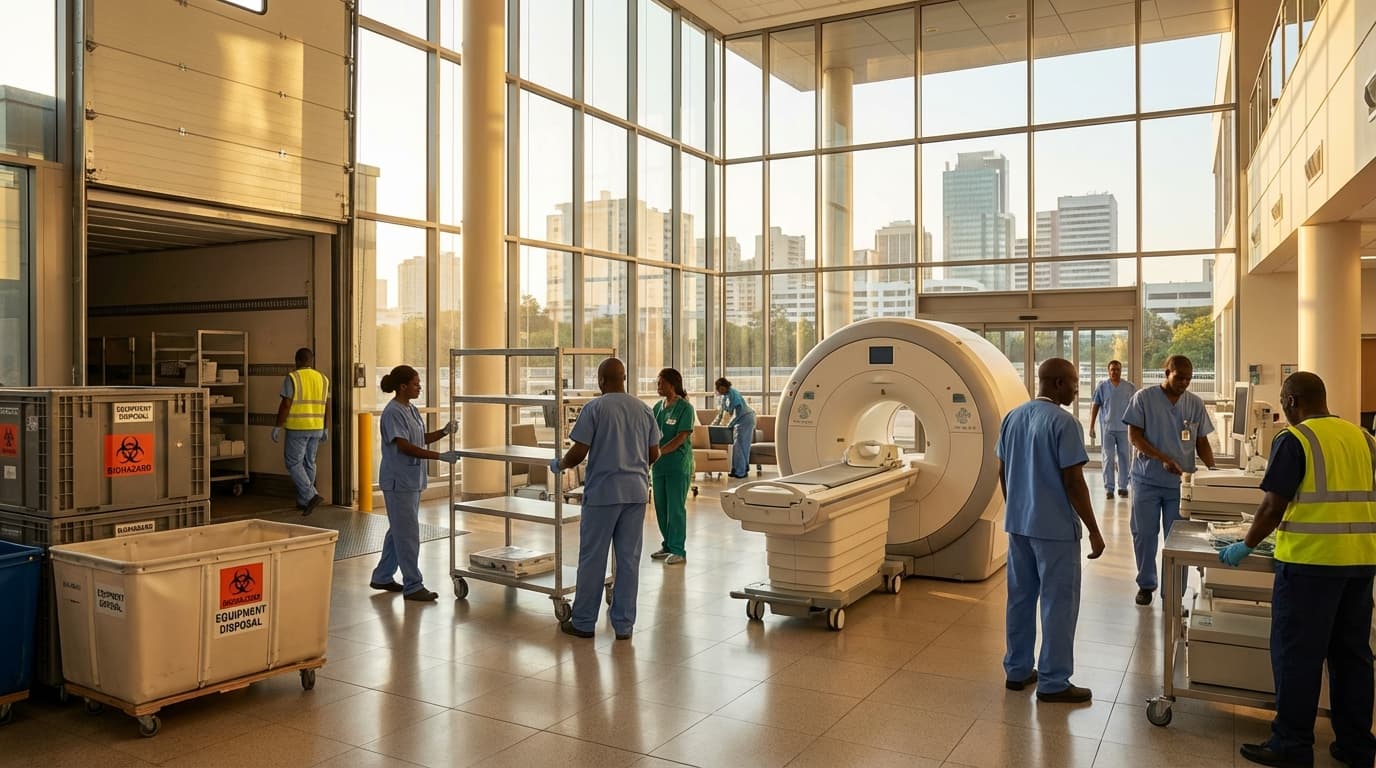
Heavy Medical Equipment De-Installation Service (MRI/CT/Cath Lab) in Equatorial Guinea
Engineering Excellence & Technical Support
Heavy Medical Equipment De-Installation Service (MRI/CT/Cath Lab) High-standard technical execution following OEM protocols and local regulatory frameworks.
Expert MRI/CT De-Installation
Specialized team with certified expertise in safely and efficiently dismantling complex imaging equipment like MRI and CT scanners, ensuring compliance with all safety and regulatory standards in Equatorial Guinea.
Cath Lab Decommissioning & Relocation
Comprehensive services for the complete de-installation and preparation for relocation or disposal of sophisticated Cath Lab systems, minimizing downtime and maximizing equipment integrity.
Secure & Compliant Medical Equipment Transport
End-to-end logistics management for the secure handling, packaging, and transportation of de-installed heavy medical equipment across Equatorial Guinea, adhering to all local and international transport regulations.
What Is Heavy Medical Equipment De-installation Service (Mri/ct/cath Lab) In Equatorial Guinea?
Heavy Medical Equipment De-Installation Service (MRI/CT/Cath Lab) in Equatorial Guinea refers to the specialized process of safely and meticulously dismantling, disconnecting, and preparing complex, high-value medical imaging and interventional systems for relocation, storage, or disposal. This service is critical for healthcare facilities when upgrading technology, relocating to new premises, or decommissioning existing infrastructure. It requires a highly skilled, multidisciplinary team with expertise in biomedical engineering, electrical engineering, structural considerations, and logistics, ensuring compliance with safety regulations and manufacturer specifications. The process involves detailed planning, rigorous risk assessment, and the use of specialized tools and lifting equipment to manage the significant weight and delicate nature of MRI, CT, and Cath Lab systems.
| Who Needs This Service | Typical Use Cases | Equipment Involved | ||
|---|---|---|---|---|
| Hospitals and Diagnostic Imaging Centers in Equatorial Guinea | Upgrading to newer MRI, CT, or Cath Lab technology. | Magnetic Resonance Imaging (MRI) scanners (e.g., 1.5T, 3T systems). | Computed Tomography (CT) scanners (e.g., multi-slice, dual-energy systems). | Cardiac Catheterization Laboratory (Cath Lab) systems (e.g., angiography suites). |
| Medical Device Manufacturers and Service Providers | Relocation of equipment between facilities or to different geographical locations within or outside Equatorial Guinea. | See 'Equipment Involved'. | ||
| Government Health Ministries and Public Health Facilities | Decommissioning of older or non-functional equipment to make space for new installations or for disposal. | See 'Equipment Involved'. | ||
| Private Healthcare Investors and Developers | Setting up new healthcare facilities requiring the transfer of existing advanced medical equipment. | See 'Equipment Involved'. | ||
| Facilities undergoing major renovations or construction | Temporary removal of equipment to allow for structural modifications to the imaging suite. | See 'Equipment Involved'. |
Key Components of Heavy Medical Equipment De-Installation:
- Site assessment and planning: Evaluation of the existing installation, access routes, and potential challenges.
- De-energization and disconnection: Safe isolation of power, cooling, and data connections.
- Component dismantling: Systematic disassembly of the equipment into manageable sections, adhering to manufacturer protocols.
- Shielding removal: For MRI and CT scanners, removal of radiation shielding (e.g., lead lining).
- Structural support removal: Disassembly of any specialized mounting structures or platforms.
- Packaging and protection: Secure wrapping and crating of dismantled components to prevent damage during transit.
- Logistics coordination: Planning for transport, including specialized vehicles and hoisting equipment.
- Documentation: Comprehensive records of the de-installation process, including photographic evidence and inventory lists.
Who Needs Heavy Medical Equipment De-installation Service (Mri/ct/cath Lab) In Equatorial Guinea?
Hospitals and specialized medical imaging centers in Equatorial Guinea facing the complex task of removing, relocating, or decommissioning large-scale medical equipment like MRI scanners, CT scanners, and Cath Labs require professional de-installation services. This specialized service ensures the safe, efficient, and compliant dismantling, packaging, and transportation of these high-value, sensitive, and often geographically challenging assets.
| Target Customer/Department | Specific Needs/Reasons for De-installation |
|---|---|
| Major Hospitals (e.g., Hospitals in Malabo, Bata) | Renovations, upgrades to newer technology, capacity expansion, departmental consolidation, equipment obsolescence. |
| Specialized Diagnostic Imaging Centers | Relocation of facilities, acquisition of new equipment, retirement of older units, space optimization. |
| Ministry of Health / Public Health Facilities | National healthcare infrastructure upgrades, replacement of aging equipment in public hospitals, consolidation of services. |
| Private Medical Clinics with Imaging Services | Facility expansion, technological upgrades, sale or closure of specific imaging departments. |
| International Medical Aid Organizations / NGOs (operating in EG) | Deployment or retrieval of donated or leased heavy medical equipment as part of humanitarian projects. |
| Medical Equipment Manufacturers/Vendors (with presence or servicing in EG) | De-installation for equipment resale, lease returns, or as part of a larger project management service. |
| Biomedical Engineering Departments | Coordinating and managing the logistical and technical aspects of de-installation, ensuring compliance with safety and regulatory standards. |
| Facilities Management Departments | Planning and overseeing the physical removal and logistics of de-installed equipment, ensuring minimal disruption to hospital operations. |
Who Needs Heavy Medical Equipment De-Installation Service (MRI/CT/Cath Lab) in Equatorial Guinea?
- Hospitals undergoing renovations or expansions that necessitate the temporary or permanent removal of existing imaging equipment.
- Healthcare facilities upgrading to newer, more advanced MRI, CT, or Cath Lab systems and needing to de-install their current units.
- Medical centers relocating to new premises and requiring the expert dismantling and transport of their heavy imaging machinery.
- Manufacturers or distributors of medical equipment requiring de-installation as part of a sale, lease return, or end-of-life management process.
- Third-party service providers or maintenance companies contracted for equipment removal and relocation.
- Government health ministries or agencies overseeing public health infrastructure projects involving equipment decommissioning or replacement.
Heavy Medical Equipment De-installation Service (Mri/ct/cath Lab) Process In Equatorial Guinea
This document outlines the comprehensive workflow for the heavy medical equipment de-installation service (MRI/CT/Cath Lab) in Equatorial Guinea, from initial client inquiry to the successful completion of the de-installation process. We aim to provide a clear and efficient service, ensuring minimal disruption and adherence to all safety and regulatory standards.
| Phase | Key Activities | Description | Key Stakeholders | Deliverables/Outcomes |
|---|---|---|---|---|
| Receive client request, discuss project scope, equipment type, location, and desired timeline. | Understanding the client's immediate needs and initial requirements for de-installing MRI, CT, or Cath Lab equipment. | Client (Hospital/Clinic Management), Service Provider (Project Manager) | Initial understanding of project scope, identification of key equipment, preliminary timeline discussion. |
| On-site visit by technical team to evaluate access, power, structural integrity, environmental conditions, and identify any potential challenges. | Detailed assessment of the physical space, existing infrastructure, and equipment condition to determine the feasibility and complexity of the de-installation. This includes checking for necessary clearances, load-bearing capacities, and any modifications required. | Service Provider (Technical Lead, Engineers), Client (Facility Manager, Biomedical Engineers) | Detailed site report, identification of potential risks and challenges, preliminary equipment removal route planning. |
| Development of a comprehensive proposal outlining the scope of work, methodology, timeline, required resources, safety protocols, and a detailed cost breakdown. | Presenting a transparent and detailed plan to the client, ensuring all aspects of the de-installation are covered, including costs for labor, specialized tools, transportation, and any required permits. | Service Provider (Project Manager, Sales Team), Client (Procurement Department, Management) | Formal proposal document, itemized quotation, preliminary project schedule. |
| Negotiation and signing of a formal service contract, defining terms, conditions, responsibilities, payment schedules, and liability. | Legally binding agreement that formalizes the engagement, protecting both the client and the service provider and ensuring clarity on all project parameters. | Service Provider (Legal Department, Management), Client (Legal Department, Management) | Signed service contract, purchase order. |
| Detailed planning of the de-installation process, including scheduling, resource allocation (personnel, specialized equipment), transportation arrangements, and obtaining necessary permits. | Meticulous preparation for the actual de-installation, ensuring all necessary approvals are in place and that the movement of heavy equipment is planned efficiently and safely, considering Equatorial Guinea's specific logistical challenges. | Service Provider (Project Manager, Logistics Coordinator, Technical Team), Client (Facility Management) | Detailed de-installation plan, logistics schedule, permit applications, crew mobilization plan. |
| On-site preparation, including disconnection of utilities, securing the work area, setting up safety measures, and final checks of all equipment and tools. | Ensuring the site is ready for the de-installation, minimizing risks to personnel and the facility. This involves coordinating with the client's internal teams. | Service Provider (Technical Team, Site Supervisor), Client (Biomedical Department, Facility Management) | Prepared work zone, safety signage in place, final equipment readiness check. |
| Careful and systematic de-installation of the medical equipment by trained technicians, following approved procedures and safety guidelines. | The core of the service. This involves the physical dismantling of the MRI, CT scanner, or Cath Lab system by experienced professionals, adhering strictly to manufacturer specifications and safety protocols. | Service Provider (De-installation Crew, Technical Supervisors), Client (Observer/Representative) | Dismantled equipment components, safely secured for transport. |
| Securing de-installed components, thorough cleaning of the work area, and a formal handover of the site and equipment documentation to the client. | Ensuring the client's facility is left in a satisfactory condition and that all responsibilities are formally transferred. This may include providing a certificate of de-installation. | Service Provider (Project Manager, Site Supervisor), Client (Facility Manager, Biomedical Engineers) | Cleaned work area, returned facility, signed handover document, certificate of de-installation. |
| Compilation of a comprehensive project report, including details of the de-installation process, any issues encountered, and final sign-off. | Providing the client with a complete record of the service performed, serving as a reference for future operations and ensuring project closure. | Service Provider (Project Manager), Client (Management) | Final project report, invoicing, project closure. |
De-Installation Service Workflow for Heavy Medical Equipment in Equatorial Guinea
- Inquiry & Initial Consultation
- Site Assessment & Feasibility Study
- Proposal & Quotation
- Contractual Agreement
- Planning & Logistics
- Pre-De-installation Preparations
- De-installation Execution
- Post-De-installation & Handover
- Documentation & Reporting
Heavy Medical Equipment De-installation Service (Mri/ct/cath Lab) Cost In Equatorial Guinea
De-installing heavy medical equipment such as MRI, CT scanners, and Cath Labs in Equatorial Guinea is a specialized and complex process requiring significant expertise, specialized tools, and adherence to strict safety protocols. The cost of this service is not a fixed figure and is influenced by a variety of factors, making it essential to obtain detailed quotes from qualified service providers. These factors directly impact the overall expense, from the initial assessment to the final handover of de-installed components.
| Equipment Type | Estimated De-Installation Cost Range (USD) | Notes on Factors Influencing Range |
|---|---|---|
| MRI Scanner | $15,000 - $40,000+ | Higher end for larger, more complex systems, superconducting magnet handling, and extensive dismantling. Cryogen management is a critical factor. |
| CT Scanner | $10,000 - $30,000+ | Costs vary based on gantry size, power requirements, and if specialized shielding needs to be addressed. Imaging components are delicate. |
| Cath Lab (Angiography System) | $20,000 - $50,000+ | Generally the most complex due to a high number of integrated components, including X-ray generators, imaging detectors, robotic arms, and console systems. Requires meticulous cable management and system coordination. |
| Specialized X-ray / Imaging Systems (e.g., Linear Accelerators) | $25,000 - $60,000+ | These often involve radiation shielding, complex power infrastructure, and precise calibration for safe dismantling. Higher end reflects advanced radiation therapy equipment. |
Key Pricing Factors for Heavy Medical Equipment De-Installation in Equatorial Guinea
- Equipment Type and Complexity: The size, model, and intricate nature of the equipment (e.g., superconducting magnets in MRI, high-power X-ray tubes in CT, complex angiography systems in Cath Labs) dictate the labor, time, and specialized tools required.
- Dismantling Scope: Whether the de-installation involves complete removal of all components, partial disassembly, or simply preparing for transport (e.g., disconnecting power, removing external parts).
- Site Accessibility and Logistics: Ease of access to the installation location, presence of elevators or cranes, narrow corridors, and the distance to the next destination or storage facility all add to the complexity and cost.
- Required Tools and Equipment: Specialized lifting gear, anti-static measures, cryogen handling equipment (for MRI), and specific diagnostic tools are often necessary.
- Labor and Expertise: The number of technicians, engineers, and project managers required, their skill levels, and the duration of the project are significant cost drivers. Experienced professionals command higher rates.
- Safety and Regulatory Compliance: Adherence to local health and safety regulations, environmental protection measures, and any specific protocols for handling hazardous materials (e.g., refrigerants) can add to the cost.
- Time Constraints and Urgency: Rush jobs or de-installations requiring work outside standard business hours will typically incur premium charges.
- Ancillary Services: This can include packaging, crating, temporary storage, transportation to a new site or port, and disposal of non-reusable components.
- Geographic Location within Equatorial Guinea: While major cities like Malabo and Bata will have a broader range of service providers, costs might vary slightly due to travel and logistics for more remote areas.
- Service Provider's Overhead and Reputation: Established companies with a strong track record and comprehensive insurance may have higher pricing, reflecting their reliability and expertise.
Affordable Heavy Medical Equipment De-installation Service (Mri/ct/cath Lab) Options
When it comes to de-installing large, complex medical equipment like MRI, CT scanners, and Cath Labs, affordability and efficiency are paramount. Hospitals and imaging centers often face significant costs and logistical challenges associated with these projects. This guide explores affordable heavy medical equipment de-installation service options, focusing on value bundles and cost-saving strategies to help you manage your budget effectively.
| Service Component | Potential Cost Drivers | Cost-Saving Opportunities |
|---|---|---|
| Skilled Technicians & Project Management | High hourly rates for specialized expertise, extended project timelines | Bundle services with the vendor, explore phased de-installation, negotiate fixed-price contracts for predictable budgeting. |
| Specialized Tools & Equipment Rental | High rental fees for cranes, specialized lifting devices, and transportation | Inquire about bundled pricing with the service provider, consider equipment sharing arrangements if applicable. |
| Site Preparation & Restoration | Extensive structural modifications, complex electrical work, and cosmetic repairs | Plan de-installation during facility renovations to integrate costs, explore vendors with in-house restoration capabilities. |
| Logistics & Transportation | Long distances, specialized transport requirements (e.g., climate-controlled), expedited shipping | Coordinate de-installation with equipment relocation or disposal needs to optimize transport routes, explore regional service providers. |
| Permitting & Regulatory Compliance | Complex permit applications, potential delays due to compliance issues | Work with experienced vendors familiar with local regulations, ensure all documentation is prepared accurately and in advance. |
Understanding De-Installation Costs
- Labor Costs: Skilled technicians, project managers, and support staff are essential. Experience and specialized training are crucial for safe and efficient de-installation.
- Specialized Tools & Equipment: Heavy lifting gear, specialized tools for intricate components, and transportation vehicles contribute to the overall cost.
- Site Preparation & Restoration: Depending on the equipment and location, modifications to the site (e.g., power, cooling, structural changes) and subsequent restoration may be required.
- Logistics & Transportation: Moving large, heavy, and often sensitive equipment requires specialized transport and careful planning.
- Permitting & Regulatory Compliance: Ensuring all local, state, and federal regulations are met is vital and can incur costs.
- Project Management: Effective oversight ensures the project stays on track, within budget, and meets all safety standards.
Verified Providers In Equatorial Guinea
When seeking healthcare services in Equatorial Guinea, particularly for specialized or urgent needs, identifying verified providers is paramount. This ensures you receive competent care from qualified professionals. Franance Health stands out as a leading entity in facilitating access to such verified medical services within the country. Their rigorous credentialing process and commitment to patient well-being make them the optimal choice for individuals and organizations requiring reliable healthcare solutions.
| Provider Type | Franance Health Verification Benefits | Key Considerations |
|---|---|---|
| Doctors & Specialists | Confirms medical licenses, certifications, and experience. | Ensures they practice within their scope of expertise. |
| Hospitals & Clinics | Assesses compliance with health regulations, equipment standards, and hygiene protocols. | Verifies operational licenses and emergency service capabilities. |
| Emergency Services | Confirms availability of trained personnel and appropriate medical equipment for critical care. | Checks response times and pre-hospital care protocols. |
| Diagnostic Laboratories | Verifies accreditation, quality control measures, and accuracy of testing procedures. | Ensures reliable and timely diagnostic results. |
Why Franance Health is the Best Choice:
- Extensive Network of Verified Professionals: Franance Health partners with a meticulously vetted network of doctors, specialists, and healthcare facilities across Equatorial Guinea.
- Rigorous Credentialing Process: Each provider undergoes a thorough background check, verification of licenses, certifications, and professional history, ensuring only the most qualified individuals are part of their network.
- Focus on Patient Safety and Quality Care: Their primary objective is to connect patients with providers who adhere to the highest standards of medical ethics and patient care.
- Streamlined Access to Services: Franance Health simplifies the process of finding and booking appointments with specialized medical professionals, saving valuable time and reducing stress.
- Diverse Range of Specialties: Whether you need a general practitioner, a surgeon, a pediatrician, or a specialist in a niche field, Franance Health can connect you with the right expert.
- Commitment to Transparency: They provide clear information about their network providers, allowing patients to make informed decisions about their healthcare.
Scope Of Work For Heavy Medical Equipment De-installation Service (Mri/ct/cath Lab)
This Scope of Work (SOW) outlines the requirements for the de-installation of heavy medical equipment, specifically Magnetic Resonance Imaging (MRI) machines, Computed Tomography (CT) scanners, and Cardiac Catheterization (Cath Lab) systems. This service is critical for equipment relocation, disposal, or upgrade projects. The de-installation process must adhere to strict safety protocols, manufacturer guidelines, and relevant industry standards to ensure the integrity of the equipment and the safety of personnel and facilities. The service provider will be responsible for all aspects of the de-installation, from initial site assessment to final equipment disassembly and preparation for transport.
| Technical Deliverable | Standard Specifications / Requirements |
|---|---|
| Pre-De-installation Site Assessment Report | Detailed report including: Site accessibility for equipment removal, identification of all services (power, cooling, RF shielding, etc.) connected to the equipment, structural considerations for equipment movement, measurement of doorways, corridors, and elevator access, identification of potential hazards, proposed de-installation sequence and timeline. |
| Equipment De-energization and Safety Verification | Confirmation of complete power disconnection from all sources. Verification of zero voltage across power terminals. Procedures must comply with local electrical safety codes and manufacturer specifications. Lock-out/Tag-out (LOTO) procedures must be implemented. |
| Cooling System Disconnection and Drainage | Safe and complete disconnection of all cooling lines (e.g., helium lines for MRI, water cooling for CT/Cath Lab). Drainage of any residual fluids in a manner compliant with environmental regulations. Proper disposal of any drained fluids. |
| RF Shielding and Magnetic Field Containment (MRI) | Safe disconnection of RF shielding components. Procedures for managing residual magnetic fields during de-installation. Compliance with safety standards for personnel working near strong magnetic fields. |
| Component Disassembly and Labeling | Systematic disassembly of the equipment into manageable and transportable modules. Each component must be clearly labeled with its identity, connection points, and orientation for re-installation. All cables and connectors must be secured and protected. |
| Packaging and Protection Materials | Use of appropriate, high-quality packaging materials (e.g., custom crates, foam padding, anti-static bags, shrink wrap) to prevent damage during handling and transport. Materials must be sufficient to protect against shock, vibration, moisture, and dust. |
| De-installation Tooling and Equipment | Provider must possess and utilize all necessary specialized tools and equipment for safe and efficient de-installation, including lifting devices, dollies, specialized wrenches, torque tools, and diagnostic equipment. |
| Manufacturer's De-installation Manuals | All de-installation procedures must strictly follow the relevant de-installation manuals provided by the equipment manufacturer. Any deviation requires written manufacturer approval. |
| Personnel Qualifications | All technicians involved in the de-installation must be trained, certified (where applicable), and experienced in handling heavy medical equipment and working with high-voltage and specialized systems. Documentation of personnel qualifications should be available upon request. |
| Waste Disposal and Environmental Compliance | Proper and environmentally compliant disposal of any materials removed from the equipment (e.g., refrigerants, lubricants, packaging waste). Adherence to all local, state, and federal environmental regulations. |
| Final De-installation Report | Comprehensive report detailing the de-installation process, including: photos of disassembled components, list of all removed parts, confirmation of utility disconnections, any issues encountered and their resolution, and confirmation of site cleanup. |
Key Service Components
- Pre-De-installation Site Assessment and Planning
- Equipment Shutdown and De-energization
- Disconnection of All Utilities and Ancillary Systems
- Component Disassembly and Labeling
- Packaging and Protection of Equipment Components
- Documentation and Reporting
Service Level Agreement For Heavy Medical Equipment De-installation Service (Mri/ct/cath Lab)
This Service Level Agreement (SLA) outlines the terms and conditions for the de-installation of heavy medical equipment, specifically Magnetic Resonance Imaging (MRI), Computed Tomography (CT) scanners, and Cardiac Catheterization (Cath Lab) systems. It defines the expected response times for critical issues and establishes uptime guarantees where applicable during the de-installation process. This SLA is intended to ensure minimal disruption and timely completion of de-installation services.
| Service Element | Priority Level | Response Time Guarantee | Resolution Time Target | Uptime Guarantee |
|---|---|---|---|---|
| Critical Issue (e.g., immediate safety hazard, inability to proceed with de-installation due to unforeseen technical failure) | High | Within 2 hours of notification | Within 8 business hours (initial assessment and plan) | N/A (Focus on safe halt/resolution) |
| Significant De-installation Delay (e.g., equipment malfunction causing more than 4-hour halt) | Medium | Within 4 hours of notification | Within 24 business hours (diagnostic and corrective action) | N/A (Focus on resuming progress) |
| Minor De-installation Obstruction (e.g., minor tooling issue, access problem) | Low | Within 8 business hours of notification | Within 48 business hours (resolution or mitigation) | N/A (Focus on maintaining schedule) |
| Scheduled De-installation Activity Commencement | N/A | As per agreed project timeline | N/A | 100% availability of de-installation team during scheduled work hours |
Scope of Service
- De-installation of MRI scanners (including magnet removal and associated cryogen management).
- De-installation of CT scanners (including gantry, table, and console removal).
- De-installation of Cath Lab systems (including imaging equipment, tables, and consoles).
- Disconnection of all associated power, data, and cooling systems.
- Secure packaging and preparation for transport (as per client requirements and industry standards).
Frequently Asked Questions

Ready when you are
Let's scope your Heavy Medical Equipment De-Installation Service (MRI/CT/Cath Lab) in Equatorial Guinea project in Equatorial Guinea.

Scaling healthcare logistics and technical systems across the entire continent.