
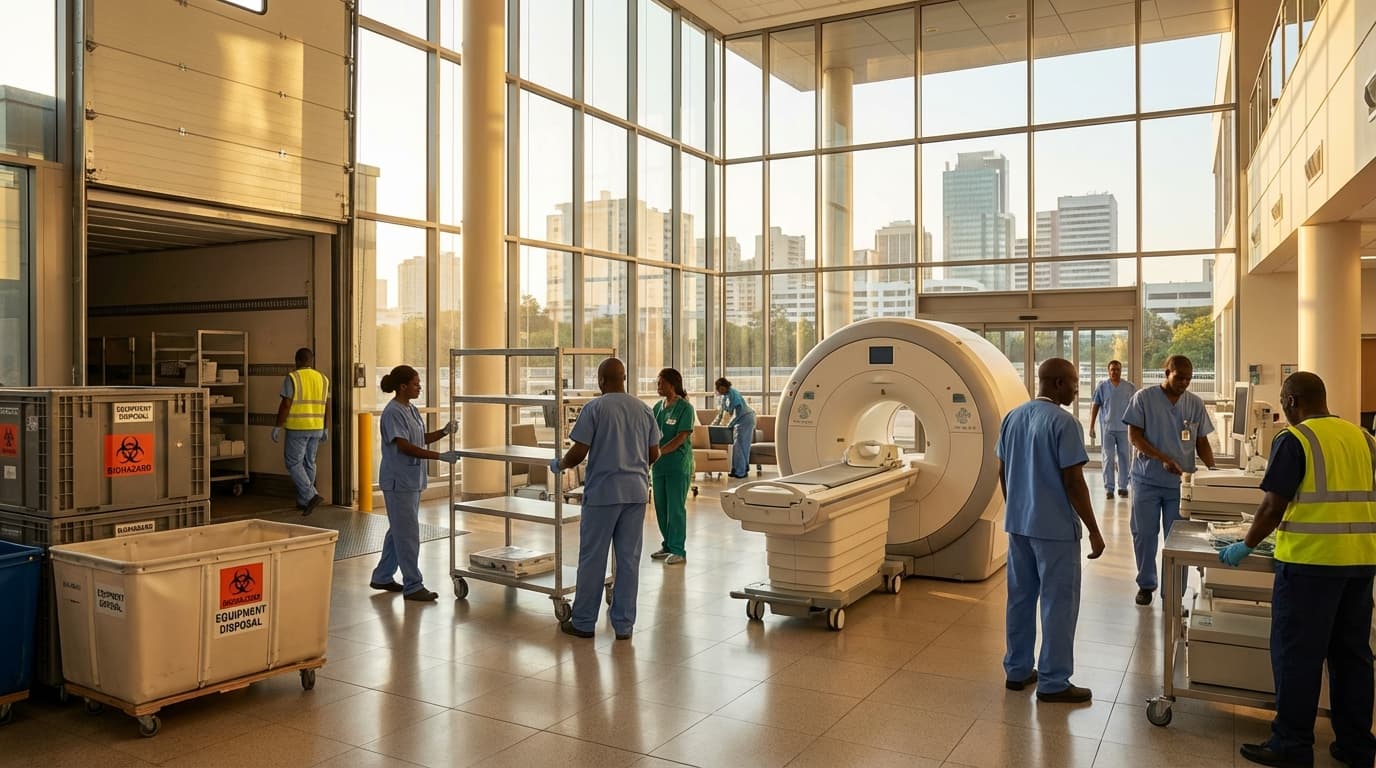
Decommissioning Service for Medical Devices in Equatorial Guinea
Engineering Excellence & Technical Support
Decommissioning Service for Medical Devices High-standard technical execution following OEM protocols and local regulatory frameworks.
Compliant Medical Waste Disposal
Ensuring environmentally sound and legally compliant disposal of decommissioned medical devices, adhering to both national regulations in Equatorial Guinea and international best practices for biohazardous and electronic waste.
Secure Data Sanitization
Implementing robust data sanitization protocols for medical devices containing sensitive patient information, guaranteeing the permanent erasure of all data to maintain confidentiality and prevent unauthorized access.
Streamlined Logistics & Asset Tracking
Providing end-to-end logistical management for the collection, transportation, and secure processing of decommissioned medical devices across Equatorial Guinea, with comprehensive asset tracking throughout the entire chain of custody.
What Is Decommissioning Service For Medical Devices In Equatorial Guinea?
Decommissioning service for medical devices in Equatorial Guinea refers to the systematic process of safely and responsibly retiring a medical device from active use. This involves a comprehensive set of procedures designed to ensure the device is no longer functional, its data is securely erased or destroyed, and its disposal complies with relevant environmental and health regulations. The service is crucial for maintaining patient safety, protecting sensitive medical information, and adhering to national and international standards governing healthcare technology lifecycle management.
| Who Needs Decommissioning Service | Typical Use Cases | |||||
|---|---|---|---|---|---|---|
| Healthcare Facilities: Hospitals, clinics, diagnostic centers, and laboratories in Equatorial Guinea that utilize medical devices. | End-of-Life Devices: Medical equipment that has reached its operational lifespan, is no longer supported by the manufacturer, or is deemed obsolete. | Damaged or Malfunctioning Devices: Equipment that is beyond economical repair or poses a safety risk. | Technology Upgrades: When a facility replaces older medical devices with newer models. | Regulatory Compliance Audits: Facilities undergoing inspections that require demonstration of proper device lifecycle management. | Mergers or Closures: Healthcare entities that are consolidating operations or ceasing to function. | Leased Equipment Returns: When leased medical devices are returned to the lessor at the end of the contract term, often requiring proof of secure data erasure. |
| Manufacturers and Distributors: Companies that place medical devices on the Equatorial Guinean market may offer or require decommissioning services for their products, particularly for end-of-life management and warranty obligations. | Government Health Agencies: Public health bodies responsible for overseeing healthcare infrastructure and ensuring compliance with safety and environmental standards. | Third-Party Service Providers: Specialized companies that offer comprehensive medical device lifecycle management, including decommissioning. | Research Institutions and Universities: Facilities that use medical devices for research and educational purposes and need to manage their disposal. | Medical Device Leasing Companies: Entities that finance and lease medical equipment to healthcare providers. |
Key Components of Medical Device Decommissioning Services:
- Secure Data Erasure/Destruction: Rendering all patient data, operational logs, and configuration settings irretrievable. This can involve overwriting data multiple times or physical destruction of storage media.
- Functional Neutralization: Ensuring the device is rendered inoperable to prevent accidental reuse or misidentification as a functional unit.
- Asset Tracking and Documentation: Maintaining a clear audit trail of the device's status change from operational to decommissioned, including verification of destruction or disposal.
- Environmental Compliance: Managing the disposal of components (e.g., batteries, refrigerants) in accordance with Equatorial Guinean environmental protection laws and international hazardous waste directives.
- Regulatory Adherence: Ensuring all decommissioning activities comply with the regulations set forth by the Ministry of Health and Public Hygiene (Ministerio de Sanidad y Bienestar Social) and any applicable international standards for medical waste management.
- Safe Transportation and Disposal: Arranging for the secure transport of the device to an authorized disposal facility.
- Certification of Destruction/Disposal: Providing official documentation confirming the successful and compliant decommissioning of the device.
Who Needs Decommissioning Service For Medical Devices In Equatorial Guinea?
Decommissioning services for medical devices are crucial in Equatorial Guinea for entities that possess and operate medical equipment which has reached the end of its operational life, is no longer compliant with regulations, or is being replaced. These services ensure the safe, secure, and environmentally responsible disposal or repurposing of medical devices, safeguarding patient data, preventing environmental contamination, and adhering to national and international standards.
| Customer Type | Typical Departments Requiring Decommissioning Services | Reasons for Decommissioning |
|---|---|---|
| Hospitals (Public and Private) | Biomedical Engineering/Biomedical Services, Radiology/Imaging, Laboratory Services, Operating Theaters, Central Sterile Supply Department (CSSD), IT/Information Management (for data-containing devices), Facilities Management | End-of-life equipment, technological obsolescence, equipment failure/damage, replacement with newer models, space optimization, regulatory non-compliance, data security breach prevention |
| Clinics and Health Centers | Clinical Operations, Administration, Facility Management | Similar to hospitals but on a smaller scale: outdated equipment, low utilization, space constraints, upgrade initiatives |
| Diagnostic Laboratories | Laboratory Management, Quality Assurance, IT | Aging analytical equipment, replacement of outdated diagnostic platforms, software obsolescence, disposal of hazardous materials associated with devices |
| Research Institutions and Universities | Research Departments (e.g., Medical Sciences, Biology), IT Departments, Procurement/Operations | Completion of research projects, obsolescence of specialized research equipment, data sanitization from research devices, disposal of prototypes or experimental apparatus |
| Government Health Ministries and Agencies | Procurement and Logistics, Public Health Programs, Regulatory Compliance, IT | Stockpiles of obsolete or unserviceable equipment, managing national health infrastructure upgrades, ensuring regulatory compliance across public health facilities, data destruction from central IT systems |
| Medical Device Distributors/Manufacturers | Quality Control, Logistics, Field Service, Regulatory Affairs | Management of recalled products, disposal of expired stock, return of damaged or non-compliant units from the market, end-of-life management for demo or rental units |
| NGOs in Healthcare | Program Management, Logistics, Field Operations | Donated or acquired equipment that is no longer functional or needed, project completion requiring asset disposal, ensuring responsible end-of-life management for aid-funded equipment |
Target Customers and Departments for Medical Device Decommissioning Services in Equatorial Guinea:
- Hospitals (Public and Private)
- Clinics and Health Centers
- Diagnostic Laboratories
- Research Institutions and Universities with Medical Programs
- Government Health Ministries and Agencies
- Pharmaceutical and Medical Device Distributors/Manufacturers (for product recalls or expired stock)
- Non-Governmental Organizations (NGOs) involved in healthcare delivery
Decommissioning Service For Medical Devices Process In Equatorial Guinea
This document outlines the decommissioning service process for medical devices in Equatorial Guinea, detailing the workflow from initial inquiry to the final execution of the service. The process is designed to ensure compliance with local regulations, environmental protection, and data security during the disposal of obsolete or non-functional medical equipment. Each stage involves specific steps and documentation to maintain a transparent and auditable record.
| Phase | Key Activities | Responsible Party | Documentation Required | Notes/Considerations |
|---|---|---|---|---|
| Client contacts service provider with request for medical device decommissioning. Provider gathers information on the type, quantity, location, and condition of devices. Initial risk assessment and regulatory compliance check. | Client, Service Provider | Inquiry form/email, preliminary device list, facility details. | Understanding client needs, device inventory accuracy, potential regulatory hurdles. |
| Service provider develops a detailed proposal including scope of work, methodology, timeline, cost estimate, and safety/environmental protocols. Client reviews and approves the proposal. Contract/Service Level Agreement (SLA) is signed. | Service Provider, Client | Formal proposal document, signed SLA/contract, insurance certificates. | Clarity on deliverables, pricing, and liability is crucial. Ensure compliance with Equatorial Guinean procurement laws if applicable. |
| Detailed site survey and risk assessment. Development of a specific decommissioning plan, including safe handling procedures, waste management strategy, and data sanitization protocols. Obtaining necessary permits or authorizations from local authorities (e.g., Ministry of Health, Ministry of Environment). Scheduling of the decommissioning activities. | Service Provider, Client (for site access and approvals) | Decommissioning plan, risk assessment report, permit applications/approvals, security protocols. | Collaboration with local authorities is paramount. Consider potential export/import regulations if devices are to be moved across borders for disposal. |
| Safe disconnection and removal of medical devices. Data sanitization of devices with storage (e.g., hard drives, memory cards) in accordance with relevant standards (e.g., HIPAA, GDPR – principles apply). Dismantling of devices for component segregation. Packaging of devices/components for safe transport. Adherence to all safety and environmental protocols. | Service Provider | On-site activity log, data sanitization certificates (if applicable), photos/videos of the process, waste manifest. | Prioritize safety of personnel and the environment. Ensure secure handling of any potentially hazardous materials. |
| Secure transportation of decommissioned devices/components to an authorized disposal or recycling facility. Verifying the credentials of the chosen facility. Disposal or recycling of devices in an environmentally responsible manner, adhering to local regulations. Tracking of waste streams. | Service Provider, Authorized Disposal/Recycling Facility | Transportation manifests, waste disposal certificates, recycling reports. | Partner with reputable and licensed facilities. Maintain chain of custody for all materials. |
| Service provider issues a comprehensive final report detailing all decommissioning activities, including device inventory, data sanitization confirmation, disposal/recycling methods, and environmental compliance. Issuance of a decommissioning certificate to the client. Final invoicing and project closure. | Service Provider, Client | Final decommissioning report, decommissioning certificate, final invoice. | The report serves as proof of responsible disposal and regulatory compliance. Client should retain these documents for their records. |
Decommissioning Service Workflow for Medical Devices in Equatorial Guinea
- Inquiry and Initial Assessment
- Proposal and Agreement
- Pre-Decommissioning Planning
- On-site Execution of Decommissioning
- Transportation and Disposal/Recycling
- Final Reporting and Certification
Decommissioning Service For Medical Devices Cost In Equatorial Guinea
Decommissioning medical devices in Equatorial Guinea involves a complex process with varying costs influenced by several factors. These factors determine the overall expense, ranging from simple disposal fees to more intricate procedures requiring specialized handling. The local currency, the Central African CFA franc (XAF), is used for all pricing, and it's important to note that costs can fluctuate based on market conditions and the specific service provider.
Key Pricing Factors:
- Device Type and Complexity: Larger, more complex devices (e.g., MRI machines, CT scanners) with hazardous materials (like refrigerants or radioactive components) will incur higher decommissioning costs than smaller, simpler equipment (e.g., basic examination tables, stethoscopes). The presence of these hazardous materials necessitates specialized removal and disposal protocols, adhering to environmental regulations.
- Condition and Age of the Device: Devices requiring extensive disassembly or those that have been in service for a long time might present more challenges and thus higher labor costs. Obsolete or heavily damaged equipment might also require more effort to safely dismantle and transport.
- Regulatory Compliance and Documentation: Equatorial Guinea, like many nations, has regulations governing the disposal of medical equipment. Ensuring compliance, including proper waste segregation, handling of potentially infectious materials, and obtaining necessary disposal certificates, adds to the overall cost. Service providers must invest in training and infrastructure to meet these standards.
- Disposal Method: The chosen disposal method significantly impacts cost. Options can include:
* **Recycling:** Preferred for its environmental benefits, but may require specialized facilities and sorting processes.
* **Incineration:** Often used for infectious waste, requiring controlled high-temperature burning.
* **Landfill:** The least preferred and often the most regulated option, especially for hazardous materials. Specific landfills designed for medical waste will have higher fees.
- Transportation and Logistics: The distance from the healthcare facility to the disposal site, as well as the need for specialized transport vehicles (e.g., for large or hazardous items), will contribute to the final cost. Accessibility to remote areas can further increase logistics expenses.
- Service Provider Expertise and Reputation: Experienced and reputable decommissioning service providers in Equatorial Guinea may command higher prices due to their established processes, trained personnel, and adherence to safety and environmental standards. Less experienced providers might offer lower quotes, but it's crucial to vet their capabilities thoroughly.
- Volume of Decommissioning: For healthcare institutions decommissioning multiple devices simultaneously, service providers might offer volume discounts. Conversely, a single, small device decommissioning might have a higher per-unit cost due to fixed logistical and administrative expenses.
- Emergency or Rush Services: Requests for urgent decommissioning outside of standard operating hours or with short notice will typically incur premium charges.
Estimated Cost Ranges (in Central African CFA Franc - XAF):
It is challenging to provide exact figures without specific device details and service provider quotes. However, based on general industry practices and the factors mentioned above, the following ranges can be considered as a rough guide for decommissioning medical devices in Equatorial Guinea:
- Small, Non-Hazardous Devices (e.g., office equipment, non-electronic furniture, basic diagnostic tools): XAF 50,000 - XAF 200,000 per item. This primarily covers collection, transportation, and general waste disposal.
- Medium-Sized, Standard Medical Equipment (e.g., patient monitors, ultrasound machines, centrifuges, basic lab equipment): XAF 150,000 - XAF 750,000 per item. This range accounts for more careful disassembly, potential data sanitization (for electronic devices), and specialized disposal methods.
- Large, Complex, or Potentially Hazardous Medical Equipment (e.g., X-ray machines, CT scanners, MRI machines, anesthesia machines, refrigerators containing refrigerants): XAF 500,000 - XAF 3,000,000+ per item. These costs reflect the significant expertise, specialized handling, transportation requirements, and strict regulatory compliance needed for safe and environmentally sound decommissioning.
Important Considerations:
- Obtain Multiple Quotes: Always solicit detailed quotes from several reputable decommissioning service providers in Equatorial Guinea. This will allow for comparison and ensure competitive pricing.
- Clarify Inclusions: Ensure the quote clearly outlines all services included, such as labor, transportation, disposal fees, and documentation. Avoid hidden charges.
- Environmental and Safety Standards: Prioritize service providers who demonstrate a strong commitment to environmental protection and safety protocols.
- Local Regulations: Consult with relevant local authorities to understand specific regulations and permit requirements for medical device decommissioning in Equatorial Guinea.
| Device Category | Estimated Cost Range (XAF) |
|---|---|
| Small, Non-Hazardous Devices | 50,000 - 200,000 |
| Medium-Sized, Standard Medical Equipment | 150,000 - 750,000 |
| Large, Complex, or Potentially Hazardous Medical Equipment | 500,000 - 3,000,000+ |
Factors Influencing Medical Device Decommissioning Costs in Equatorial Guinea
- Device Type and Complexity
- Condition and Age of the Device
- Regulatory Compliance and Documentation
- Disposal Method
- Transportation and Logistics
- Service Provider Expertise and Reputation
- Volume of Decommissioning
- Emergency or Rush Services
Affordable Decommissioning Service For Medical Devices Options
Decommissioning medical devices involves securely and compliantly removing them from service. This can include data sanitization, physical destruction, and proper disposal. Securing an affordable service is crucial for healthcare facilities managing tight budgets. Value bundles and strategic cost-saving measures can significantly reduce the overall expense while ensuring compliance and data security.
| Cost-Saving Strategy | Description | Potential Savings Impact |
|---|---|---|
| Bulk Decommissioning | Scheduling the decommissioning of multiple devices at once, rather than on an ad-hoc basis. This optimizes logistics and labor costs. | Significant savings through reduced travel, setup, and labor per device. |
| Long-Term Contracts | Committing to a service provider for an extended period, often with pre-negotiated rates for a certain volume of devices. | Lower per-unit costs due to provider commitment and predictable revenue. |
| Tiered Service Levels | Selecting service packages based on the actual sensitivity and value of the devices, rather than opting for the highest security for every item. | Avoids overpaying for services not required for lower-risk devices. |
| Partnering with Certified Vendors | Choosing providers with established certifications (e.g., R2, e-Stewards) which often indicate efficient processes and adherence to compliance standards, reducing potential risks and associated costs. | Minimizes risk of fines or data breaches, leading to indirect cost savings. |
| Negotiating Volume Discounts | Leveraging a facility's total device count to negotiate better pricing with service providers. | Direct reduction in per-device decommissioning costs. |
| Exploring Refurbishment/Resale Options | For devices that are still functional and have market value, negotiating with the service provider for options to refurbish and resell them, offsetting decommissioning costs. | Generates revenue or reduces net cost of disposal. |
Key Value Bundles in Medical Device Decommissioning
- {"title":"Standard Decommissioning Package","description":"Includes basic data sanitization (e.g., wiping to NIST 800-88 standards), asset tracking, and environmentally responsible disposal of non-sensitive components."}
- {"title":"Enhanced Security Bundle","description":"Adds physical destruction options for devices containing highly sensitive data, certificate of destruction, and enhanced reporting on data sanitization methods used."}
- {"title":"Full Lifecycle Management","description":"Covers not just decommissioning but also includes asset tracking, inventory management, and potential refurbishment or resale of functional devices, maximizing asset value."}
- {"title":"Compliance & Auditing Focus","description":"Includes comprehensive documentation, audit-ready reports, and verification of compliance with relevant regulations (e.g., HIPAA, GDPR, FDA). This is ideal for facilities facing strict regulatory scrutiny."}
Verified Providers In Equatorial Guinea
In Equatorial Guinea's evolving healthcare landscape, identifying verified and reputable healthcare providers is paramount. Franance Health stands out as a leading organization, distinguished by its rigorous credentialing process and unwavering commitment to quality patient care. This commitment ensures that patients seeking medical services can have confidence in the expertise and ethical standards of the providers affiliated with Franance Health. Their comprehensive approach to verification extends beyond basic licensing, encompassing a thorough evaluation of qualifications, experience, and adherence to best practices. This meticulous attention to detail is what positions Franance Health-credentialed providers as the superior choice for healthcare in Equatorial Guinea, offering a level of assurance that is unmatched.
| Category | Franance Health Advantage | Benefit to Patients |
|---|---|---|
| Provider Qualification | Thorough academic and practical experience assessment. | Access to highly skilled and experienced medical professionals. |
| Specialized Services | Validation of expertise in various medical fields. | Receiving tailored care for specific health concerns. |
| Ethical Standards | Confirmation of adherence to medical ethics and patient rights. | Confidence in receiving respectful, transparent, and honest medical treatment. |
| Quality of Care | Ensuring providers follow evidence-based practices and maintain high standards. | Benefit from up-to-date and effective medical interventions. |
| Accessibility | Facilitating connection with verified providers across Equatorial Guinea. | Easier navigation of the healthcare system and reduced uncertainty. |
Why Franance Health Credentials Matter:
- Rigorous Verification Process: Franance Health employs a multi-faceted vetting system that scrutinizes educational background, professional experience, and continuous professional development.
- Adherence to International Standards: Their credentialing often aligns with recognized international healthcare quality benchmarks, ensuring a global perspective on patient care.
- Commitment to Ethical Practice: Providers are assessed for their dedication to patient well-being, ethical conduct, and transparent communication.
- Focus on Specialized Expertise: Franance Health identifies and validates providers with specialized skills and advanced training, catering to diverse medical needs.
- Enhanced Patient Trust and Safety: The Franance Health credential serves as a mark of trust, assuring patients of the provider's competence and reliability.
Scope Of Work For Decommissioning Service For Medical Devices
This Scope of Work (SOW) outlines the requirements and deliverables for the decommissioning of medical devices. The service aims to ensure safe, compliant, and environmentally responsible removal and disposal of medical equipment. This document specifies technical deliverables, standard specifications, and the overall process.
| Phase | Description | Technical Deliverables | Standard Specifications / Requirements | Key Activities |
|---|---|---|---|---|
| Initial evaluation of devices to be decommissioned, identification of risks, and development of a detailed plan. | Decommissioning Plan, Risk Assessment Report, Asset Inventory List. | Device criticality assessment, regulatory compliance check, data security protocols, environmental impact assessment, site survey. | Review of device inventory, site walkthrough, stakeholder consultation, risk identification and mitigation strategy development, schedule creation. |
| Securely erasing all Protected Health Information (PHI) and sensitive data from devices. | Data Sanitization Certificates (per device), Data Destruction Report. | Compliance with NIST SP 800-88 guidelines or equivalent standards, verification of data erasure. | Execution of data wiping (multiple passes), physical destruction of storage media (if required), verification and validation of data erasure. |
| Safe and proper disconnection, disassembly, and removal of medical devices. | Decommissioning Report (per device), Equipment Removal Logs. | Adherence to manufacturer's instructions for safe disconnection, proper handling of hazardous materials, electrical safety protocols, controlled environment procedures. | Systematic disconnection of power and data cables, disassembly of components, careful removal from facility, labeling of components for disposal. |
| Secure and compliant transportation of decommissioned devices to the designated disposal or recycling facility. | Transportation Manifests, Chain of Custody Documentation. | Compliance with DOT regulations for hazardous materials transport (if applicable), secure packaging, insured transport, temperature-controlled transport (if required). | Coordination of pickup schedule, appropriate packaging and labeling, vehicle selection, route planning, real-time tracking (optional). |
| Environmentally responsible disposal or recycling of devices and their components. | Certificates of Disposal/Recycling (per device or batch), Waste Manifests. | Compliance with EPA regulations, ISO 14001 standards, use of certified recyclers/disposal facilities, waste minimization strategies. | Segregation of materials (e.g., metals, plastics, electronics), processing at authorized facilities, documentation of waste streams. |
| Comprehensive documentation of the entire decommissioning process for auditing and record-keeping purposes. | Final Decommissioning Report (consolidated), Asset Decommissioning Summary, Invoice. | Clear, concise, and auditable documentation, inclusion of all certificates and logs, retention of records for specified periods. | Compilation of all deliverables, review and verification of documentation, submission of final reports to client. |
Key Objectives of Decommissioning Service
- Ensure patient safety during and after the decommissioning process.
- Comply with all relevant regulatory requirements (e.g., FDA, HIPAA, environmental regulations).
- Securely and permanently erase all patient data from devices.
- Facilitate proper environmental disposal or recycling of devices and their components.
- Minimize disruption to ongoing healthcare operations.
- Provide accurate and complete documentation of the decommissioning process.
Service Level Agreement For Decommissioning Service For Medical Devices
This Service Level Agreement (SLA) outlines the response times and uptime guarantees for the Decommissioning Service for Medical Devices. This service ensures secure, compliant, and efficient removal of medical devices from service and data sanitization.
| Service Component | Response Time (during business hours) | Response Time (outside business hours/emergency) | Uptime Guarantee |
|---|---|---|---|
| Service Request Initiation and Confirmation | Within 4 business hours | Within 2 business hours | N/A (Service is on-demand) |
| On-site Decommissioning Execution (per device) | Scheduled within 5 business days of confirmation (subject to device availability and location) | Expedited scheduling within 2 business days (additional charges may apply) | N/A (Service is on-demand) |
| Data Sanitization Verification and Certification | Provided within 2 business days of decommissioning completion | Provided within 1 business day of decommissioning completion | N/A (Service is on-demand) |
| Reporting and Documentation Submission | Provided within 3 business days of decommissioning completion | Provided within 1 business day of decommissioning completion | N/A (Service is on-demand) |
| Technical Support (for service-related queries) | Within 2 business hours | Within 1 business hour | 99.5% availability for support channels during business hours |
Key Service Components
- On-site decommissioning of specified medical devices.
- Secure data sanitization and erasure of all stored patient data.
- Proper disposal or recycling of decommissioned devices in accordance with regulations.
- Certification of decommissioning and data sanitization.
Frequently Asked Questions

Ready when you are
Let's scope your Decommissioning Service for Medical Devices in Equatorial Guinea project in Equatorial Guinea.

Scaling healthcare logistics and technical systems across the entire continent.