
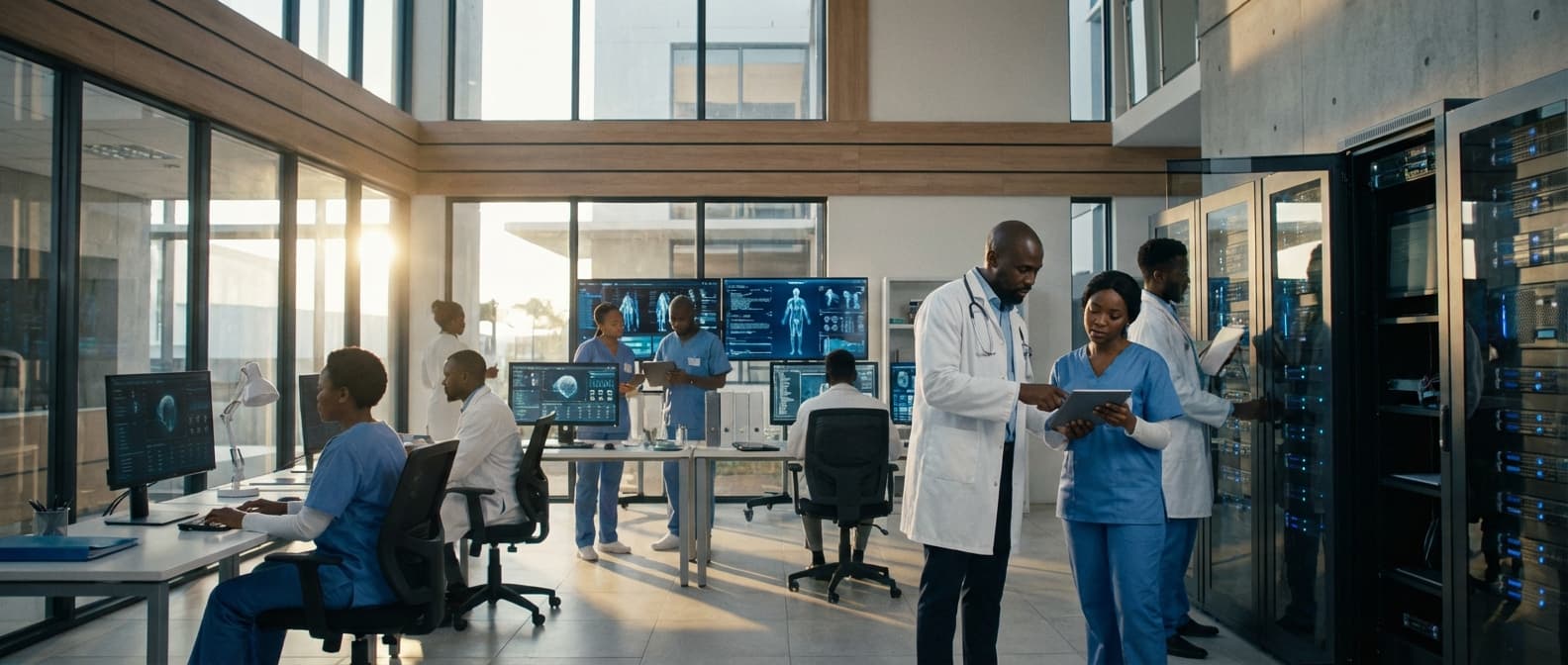
Tele-Radiology in Equatorial Guinea
Engineering Excellence & Technical Support
24/7 access to certified radiologists providing rapid, accurate remote interpretation of diagnostic imaging studies. High-standard technical execution following OEM protocols and local regulatory frameworks.
Bridging the Distance: Remote Access for Advanced Diagnostics
Enabling expert radiologists in remote locations to access and interpret medical images from clinics across Equatorial Guinea. This facilitates timely diagnoses and treatment initiation, overcoming geographical barriers and improving patient outcomes in underserved areas.
Expert Collaboration & Subspecialty Care
Connecting local healthcare providers with a global network of subspecialist radiologists. This ensures patients receive high-quality interpretations for complex cases, from neuroimaging to oncological scans, without the need for physical travel or the scarcity of local specialists.
Secure Data Transmission & Archiving
Implementing robust, encrypted platforms for the secure transmission and storage of sensitive patient imaging data. This ensures compliance with international data protection standards, safeguarding patient privacy while enabling seamless image sharing and long-term record keeping.
What Is Tele-radiology In Equatorial Guinea?
Tele-radiology in Equatorial Guinea refers to the remote transmission and interpretation of radiological images (such as X-rays, CT scans, and MRIs) by qualified radiologists. This service bridges geographical distances, allowing medical facilities in Equatorial Guinea to access specialized radiological expertise that may not be locally available. It involves the secure digital transfer of imaging data from a primary healthcare provider to a remote radiologist for analysis and reporting. The radiologist then provides a diagnostic report back to the referring physician, facilitating timely and accurate patient care. This technology is particularly crucial in regions with limited access to specialist radiologists, enabling enhanced diagnostic capabilities and improving patient outcomes.
| Who Needs Tele-Radiology? | Typical Use Cases | ||||||
|---|---|---|---|---|---|---|---|
| Hospitals and Clinics in Remote or Underserved Areas: Facilities lacking on-site radiologists or subspecialist expertise. | Emergency Department Consultations: Rapid interpretation of critical imaging studies (e.g., stroke imaging, trauma scans) to expedite treatment decisions. | Primary Healthcare Providers: General practitioners and other specialists requiring expert radiological opinion for diagnosis and management of various conditions. | Specialized Imaging Modalities: Access to interpretation of advanced imaging techniques like MRI or specialized CT protocols that require dedicated subspecialist knowledge (e.g., neuro-radiology, pediatric radiology). | Second Opinions: Providing an independent radiological assessment to confirm or clarify diagnoses. | Screening Programs: Interpretation of images for public health screening initiatives (e.g., tuberculosis screening with chest X-rays). | Post-operative Assessment: Review of imaging to monitor patient recovery and detect complications. | Rural Health Centers: Enabling access to advanced diagnostic capabilities that would otherwise necessitate patient transfer to larger urban centers. |
Key Components of Tele-Radiology in Equatorial Guinea
- Image Acquisition: Generation of radiological images at a local healthcare facility using standard imaging equipment (e.g., X-ray machines, CT scanners, MRI scanners).
- Digital Archiving and Communication System (PACS): A system for storing, retrieving, and transmitting medical images and associated data. In a tele-radiology context, this system facilitates secure image transfer.
- Teleradiology Platform/Software: Specialized software used for the secure transmission, viewing, and annotation of medical images. This platform connects the referring physician with the remote radiologist.
- High-Speed Internet Connectivity: Reliable and secure internet access is essential for the efficient and timely transfer of large image files.
- Remote Radiologist: A board-certified radiologist located off-site who interprets the transmitted images and generates diagnostic reports.
- Reporting System: A mechanism for the remote radiologist to generate and securely transmit diagnostic reports back to the referring physician.
- Secure Data Transmission Protocols: Encryption and other security measures to ensure patient data confidentiality and integrity during transmission.
Who Needs Tele-radiology In Equatorial Guinea?
Tele-radiology, the practice of interpreting medical images remotely, is a growing field with the potential to significantly improve healthcare access and quality. In a nation like Equatorial Guinea, with its unique geographical and infrastructural challenges, tele-radiology can bridge critical gaps in diagnostic imaging services. This service is particularly valuable in regions where specialist radiologists are scarce or access to advanced imaging equipment is limited. By connecting local healthcare providers with remote radiologists, Equatorial Guinea can ensure that patients receive timely and accurate diagnoses, leading to better treatment outcomes. The target customers for tele-radiology in Equatorial Guinea are diverse, encompassing both public and private healthcare sectors, as well as outreach programs aiming to serve underserved populations. The benefits extend to various departments within these institutions, from emergency rooms to specialized surgical units, all of which rely on prompt and accurate radiological interpretations for effective patient care.
| Department | Primary Need for Tele-Radiology | Specific Use Cases |
|---|---|---|
| Emergency Department (ED) | Rapid diagnosis for acute conditions | Interpreting X-rays for trauma (fractures, dislocations), CT scans for stroke, head injuries, and abdominal emergencies. Expedited interpretation for life-threatening conditions. |
| Internal Medicine | Diagnosis and monitoring of chronic and acute illnesses | Interpreting chest X-rays for pneumonia and tuberculosis, CT scans for organ-specific issues, and MRI scans for complex diagnostic challenges. |
| Surgery | Pre-operative assessment and post-operative monitoring | Evaluating surgical sites for complications, imaging for injury assessment prior to surgery, and confirming the success of surgical interventions. |
| Pediatrics | Diagnosing and managing childhood illnesses and injuries | Interpreting pediatric X-rays for fractures, developmental abnormalities, and respiratory infections. Ensuring accurate diagnoses for young patients who may have difficulty communicating symptoms. |
| Obstetrics and Gynecology (OB/GYN) | Prenatal screening and diagnosis of gynecological conditions | Interpreting ultrasound scans for fetal development, identifying potential complications, and diagnosing gynecological abnormalities. |
| Oncology | Cancer diagnosis, staging, and treatment monitoring | Interpreting CT, MRI, and PET scans for tumor detection, assessing tumor size and spread, and monitoring response to chemotherapy or radiation. |
| Infectious Disease Control | Diagnosis and tracking of endemic and epidemic diseases | Interpreting X-rays and CT scans for pulmonary tuberculosis, malaria-related complications, and other infectious diseases requiring imaging assessment. |
| Rehabilitation Services | Assessing injuries and monitoring recovery | Interpreting X-rays and other imaging to guide physical therapy and track progress in recovery from musculoskeletal injuries. |
Target Customers for Tele-Radiology in Equatorial Guinea
- Public Hospitals and Clinics
- Private Hospitals and Clinics
- Maternity and Pediatric Centers
- Rural Health Posts and Outreach Programs
- Military and Government Healthcare Facilities
- Non-Governmental Organizations (NGOs) with Healthcare Initiatives
Tele-radiology Process In Equatorial Guinea
Tele-radiology in Equatorial Guinea is a crucial service for improving access to diagnostic imaging expertise in a region facing geographical and resource challenges. The workflow encompasses a series of steps, starting from the initial inquiry for a radiological interpretation to the final delivery of the report to the referring physician. This process is designed to bridge the gap between local healthcare facilities lacking specialist radiologists and external or remote radiology services equipped to provide interpretations.
| Stage | Description | Key Actors | Technology/Tools | Challenges & Considerations |
|---|---|---|---|---|
| Inquiry & Patient Referral | A local healthcare facility identifies a need for radiological interpretation for a patient. The referring physician completes a referral form, outlining clinical history and the specific imaging study required. | Referring Physician (Local Clinic/Hospital), Patient | Paper Referral Forms, Secure Email (for initial inquiry if platform not used) | Ensuring clear and complete clinical information is provided. Language barriers may exist. |
| Image Acquisition & Transmission | The patient undergoes the X-ray, CT, MRI, or Ultrasound scan at the local facility. The DICOM images are then securely transmitted to the teleradiology service. | Radiographer/Technologist (Local Facility), IT Support (Local/Remote) | Digital Imaging and Communications in Medicine (DICOM) compliant imaging equipment, Secure File Transfer Protocol (SFTP), Virtual Private Network (VPN), Cloud-based storage | Reliable internet connectivity is paramount. Image quality needs to be consistently high. Data security and privacy are critical. |
| Teleradiology Platform Integration | The transmitted images are received and organized within a teleradiology platform. This platform acts as a central hub for managing cases, assigning them to radiologists, and storing reports. | Teleradiology Platform Administrator, IT Support | Teleradiology PACS (Picture Archiving and Communication System), Web-based portals | Platform stability and user-friendliness. Integration with local PACS if available. Bandwidth requirements for platform access. |
| Radiologist Assignment & Review | A radiologist with the appropriate subspecialty is assigned the case. They access the images and patient information remotely and perform the interpretation. | Teleradiologist (Remote Specialist), Teleradiology Platform | High-resolution diagnostic monitors, PACS viewing software, Secure remote access | Availability of specialist radiologists for specific modalities/conditions. Time zone differences affecting turnaround times. |
| Report Generation & Quality Assurance | The radiologist dictates or writes a detailed diagnostic report. This report undergoes a quality assurance check before being finalized. | Teleradiologist, QA Radiologist (if applicable) | Voice recognition software, Report generation templates, QA checklists | Standardization of reporting formats. Ensuring accuracy and completeness of findings and recommendations. |
| Report Delivery & Communication | The finalized report is securely transmitted back to the referring physician and the local healthcare facility, often through the teleradiology platform or secure email. | Teleradiology Platform, Referring Physician, Local Facility | Teleradiology platform portal, Secure email, Fax (less common) | Timely delivery of reports. Clear communication channels for clarification or urgent findings. Ensuring the referring physician understands the report. |
| Billing & Record Keeping | Invoicing for the service is processed, and both imaging data and reports are archived for future reference and medical-legal purposes. | Teleradiology Service Provider, Local Facility (for payment) | Billing software, Electronic Health Records (EHR) systems, PACS archiving | Clear contractual agreements for billing. Compliance with data retention policies. Secure and long-term storage of records. |
Tele-Radiology Workflow in Equatorial Guinea
- Inquiry & Patient Referral
- Image Acquisition & Transmission
- Teleradiology Platform Integration
- Radiologist Assignment & Review
- Report Generation & Quality Assurance
- Report Delivery & Communication
- Billing & Record Keeping
Tele-radiology Cost In Equatorial Guinea
Tele-radiology services in Equatorial Guinea are a relatively new but growing area, aimed at improving access to diagnostic imaging expertise in a country where specialist radiologists are scarce. The cost of these services can fluctuate based on several factors, including the complexity of the imaging study, the turnaround time required, the specific tele-radiology provider, and the type of reporting needed (e.g., preliminary read vs. final report by a sub-specialist).
| Imaging Modality | Typical Pricing Range (XAF) - Per Study | Notes |
|---|---|---|
| X-ray | 25,000 - 60,000 XAF | Standard chest, bone, or abdominal X-rays. More complex views or multiple images may increase cost. |
| CT Scan | 75,000 - 250,000 XAF | Ranges from basic head CTs to more complex body CTs. Contrast administration, multi-slice protocols, and specific body regions will impact price. |
| MRI Scan | 100,000 - 350,000 XAF | Generally the most expensive modality due to equipment and expertise required. Brain, spine, and joint MRIs are common. |
| Ultrasound | 30,000 - 90,000 XAF | Abdominal, obstetric, cardiac, or musculoskeletal ultrasounds. Specialized scans or Doppler may increase the cost. |
| Urgent/STAT Reporting | Add 20% - 50% to base cost | For studies requiring immediate interpretation (e.g., stroke, trauma). |
| Sub-specialty Reporting | Add 15% - 30% to base cost | For specialized reads (e.g., pediatric radiology, neuroradiology) not covered by general radiologists. |
Key Pricing Factors for Tele-Radiology in Equatorial Guinea
- Type of Imaging Modality: Costs will vary significantly between X-rays, CT scans, MRI scans, and ultrasounds. More complex modalities generally command higher fees.
- Complexity of the Study: Routine scans with straightforward interpretations will be less expensive than studies requiring detailed analysis of intricate anatomical structures or suspected pathologies.
- Turnaround Time (TAT): Standard reporting times are typically longer and less expensive than urgent or STAT (immediate) reporting, which incurs a premium.
- Radiologist Sub-specialty: Reports from sub-specialists (e.g., neuroradiologists, pediatric radiologists) often cost more due to their niche expertise and demand.
- Provider Reputation and Infrastructure: Established tele-radiology providers with robust IT infrastructure, quality assurance processes, and experienced radiologists may charge more.
- Volume and Contractual Agreements: Hospitals or clinics that contract for a high volume of tele-radiology services may negotiate bulk discounts.
- Reporting Format and Detail: The level of detail and specific format required for the report can influence pricing.
- Ancillary Services: Some providers may offer additional services like peer review, consultations, or integration with existing Picture Archiving and Communication Systems (PACS), which can add to the overall cost.
Affordable Tele-radiology Options
Tele-radiology has revolutionized medical imaging by allowing remote interpretation of scans, offering significant advantages in accessibility and cost-effectiveness. For healthcare providers seeking to manage their radiology budgets, exploring affordable tele-radiology options is crucial. These options often involve understanding value bundles, which package a range of services for a predictable cost, and implementing various cost-saving strategies to maximize efficiency and minimize expenditure.
| Cost-Saving Strategy | Description | Impact on Affordability |
|---|---|---|
| Negotiate Transparent Pricing | Clearly understand all fees, including base interpretation costs, platform fees, and potential surcharges for urgent reads or subspecialty reports. Seek out providers who offer transparent, all-inclusive pricing. | Reduces unexpected expenses and allows for accurate budget forecasting. |
| Optimize Workflow Integration | Seamless integration with existing PACS and EMR systems minimizes manual data entry and image handling, reducing administrative overhead and potential errors. | Improves efficiency, leading to faster turnaround times and lower operational costs. |
| Leverage Technology for Efficiency | Utilize AI-powered tools for preliminary reads, image enhancement, or workflow prioritization. This can help radiologists focus on complex cases and improve overall throughput. | Increases radiologist productivity, potentially lowering the per-study cost. |
| Choose Appropriate Service Levels | Match the service level (e.g., turnaround time guarantees, subspecialty coverage) to the actual clinical need. Not all studies require immediate subspecialty interpretation. | Avoids paying for premium services when standard options suffice, leading to direct cost savings. |
| Consolidate Vendors | Partnering with a single tele-radiology provider for multiple needs (e.g., general radiology and subspecialties) can often lead to volume discounts and simplified contract management. | Leverages purchasing power for better rates and reduces administrative complexity. |
| Analyze Usage Patterns | Regularly review interpretation volumes and types to ensure the chosen pricing model remains the most cost-effective. Renegotiate contracts as needs evolve. | Ensures continuous optimization of expenditure and prevents overpayment. |
Key Tele-Radiology Value Bundles
- {"title":"Per-Study Pricing","description":"A straightforward model where healthcare providers pay a fixed fee for each individual radiology study interpreted. This is ideal for facilities with variable caseloads or those initiating tele-radiology services."}
- {"title":"Volume-Based Tiers","description":"Pricing is structured to decrease per-study cost as the volume of interpretations increases. This incentivizes higher usage and provides greater savings for larger practices or hospitals."}
- {"title":"On-Demand & Dedicated Radiologist Services","description":"Offers flexibility. On-demand provides access to radiologists as needed, while dedicated services ensure a consistent, pre-allocated radiologist for a set period or volume, guaranteeing turnaround times."}
- {"title":"Subspecialty Bundles","description":"Packages specifically tailored for interpretations within certain subspecialties (e.g., neuro-radiology, musculoskeletal radiology), ensuring access to highly specialized expertise at a bundled rate."}
- {"title":"Comprehensive Imaging Workflow Solutions","description":"Includes not only the interpretation but also integration with PACS (Picture Archiving and Communication System), reporting tools, and potentially AI-powered preliminary reads, offering a holistic solution."}
Verified Providers In Equatorial Guinea
In Equatorial Guinea's healthcare landscape, identifying verified providers is crucial for ensuring quality and trustworthy medical services. Franance Health stands out as a leading example of a credentialed and reliable healthcare entity. Their commitment to stringent standards and patient-centric care makes them a distinguished choice for individuals seeking comprehensive medical solutions.
| Verification Aspect | Franance Health's Compliance | Benefit to Patients |
|---|---|---|
| Medical Licenses & Certifications | All practitioners hold valid and recognized medical licenses and certifications. | Ensures competence and legality of medical services received. |
| Facility Accreditations | Facilities meet or exceed national and international healthcare facility standards. | Guarantees a safe, clean, and well-equipped environment for treatment. |
| Continuous Professional Development | Ongoing training and education for all medical staff. | Access to the latest medical knowledge, techniques, and treatments. |
| Patient Safety Protocols | Strict adherence to patient safety guidelines and infection control measures. | Minimizes risks and ensures a secure healthcare experience. |
| Quality Assurance Systems | Robust internal systems for monitoring and improving service quality. | Consistent delivery of high-quality medical care and continuous improvement. |
Why Franance Health is the Best Choice:
- Rigorous Credentialing and Accreditation: Franance Health adheres to internationally recognized standards for healthcare providers. This ensures that their facilities, medical professionals, and operational procedures meet a high benchmark for safety, efficacy, and quality of care.
- Experienced and Specialized Medical Professionals: The organization boasts a team of highly qualified and experienced doctors, nurses, and support staff. Their expertise spans various medical disciplines, offering patients access to specialized treatment and personalized care plans.
- State-of-the-Art Facilities and Technology: Franance Health invests in modern medical equipment and advanced diagnostic tools. This commitment to technology enables accurate diagnoses, effective treatments, and improved patient outcomes.
- Patient-Centered Approach: A core principle of Franance Health is prioritizing the patient's well-being. They emphasize clear communication, empathetic care, and a supportive environment, ensuring that patients feel informed, comfortable, and respected throughout their healthcare journey.
- Comprehensive Service Offerings: From general health check-ups to specialized consultations and treatments, Franance Health provides a wide spectrum of medical services. This integrated approach caters to diverse healthcare needs, offering convenience and continuity of care.
- Commitment to Ethical Practices: Franance Health operates with a strong ethical framework, upholding patient confidentiality, medical integrity, and transparent billing practices. This builds trust and fosters long-term relationships with their patients.
- Contribution to Local Healthcare: Beyond direct patient care, Franance Health actively contributes to the advancement of healthcare in Equatorial Guinea through training initiatives, knowledge sharing, and potentially public health programs.
Scope Of Work For Tele-radiology
This Scope of Work (SOW) outlines the technical deliverables and standard specifications for the implementation and operation of a Tele-Radiology service. The objective is to provide remote interpretation of medical imaging studies by qualified radiologists, enhancing accessibility and efficiency of diagnostic services.
| Component | Technical Deliverable | Standard Specifications | Key Considerations |
|---|---|---|---|
| Image Acquisition & Transmission | DICOM-compliant imaging modalities (e.g., CT, MRI, X-ray, Ultrasound) | High-speed, secure network connectivity (e.g., VPN, dedicated lines). DICOM protocol adherence. Data compression standards (e.g., JPEG 2000 for lossless/lossy compression). | Interoperability with existing hospital equipment. Bandwidth requirements. Data integrity during transmission. |
| PACS | Centralized image storage and retrieval system. | Scalable storage capacity. DICOM conformance. HL7 integration for RIS/HIS connectivity. Redundant storage solutions for disaster recovery. Robust search and retrieval capabilities. | Long-term archiving needs. Data retention policies. Vendor support and upgrade path. |
| Radiologist Workstation | High-resolution diagnostic monitors (e.g., 3MP, 5MP). | Ergonomic design. Fast image loading and manipulation tools. Loupe functionality. Image registration and fusion capabilities. Customizable user interface. DICOM viewer software. | Radiologist comfort and productivity. Calibration requirements for monitors. Multi-monitor support. |
| Network Infrastructure | Secure and reliable data transfer network. | Sufficient bandwidth to handle image volumes and real-time access. Encryption (e.g., TLS/SSL) for data in transit. Network redundancy. Firewall and intrusion detection systems. | Latency requirements. Geographical distribution of sites. Cost of bandwidth. Network security policies. |
| Security and Compliance | HIPAA/GDPR compliant system. | Access control and audit trails. Data encryption at rest and in transit. Regular security audits and vulnerability assessments. User authentication (e.g., multi-factor authentication). | Patient data privacy. Regulatory compliance. Data breach prevention and response plan. |
| Reporting & Dictation | Integrated or standalone dictation and reporting solution. | Speech recognition capabilities (optional). Structured reporting templates. HL7 integration for report transmission to RIS/HIS. Electronic signature capabilities. | Radiologist workflow efficiency. Integration with EMR/EHR. Turnaround time for reports. |
| Quality Assurance (QA) | Tools for peer review and case audits. | Automated QA metrics (e.g., turnaround time, report accuracy). Functionality for marking and tracking critical findings. Performance monitoring dashboards. | Continuous improvement of radiologist performance. Identification of training needs. Feedback mechanisms. |
| Support and Maintenance | Technical support and system maintenance plan. | Service Level Agreements (SLAs) with defined response and resolution times. Remote and on-site support capabilities. Software updates and patch management. Hardware maintenance. | System uptime guarantees. Cost of support contracts. Training for local IT staff. |
Key Tele-Radiology Components
- Image Acquisition & Transmission Systems
- Picture Archiving and Communication System (PACS)
- Radiologist Workstation(s)
- Network Infrastructure
- Security and Compliance Measures
- Reporting and Dictation System
- Quality Assurance (QA) and Audit Tools
- Support and Maintenance Services
Service Level Agreement For Tele-radiology
This Service Level Agreement (SLA) outlines the performance standards and guarantees for the Tele-Radiology services provided by [Your Company Name] to [Client Name]. It defines the responsibilities of both parties concerning response times, system uptime, and outage management.
| Service Component | Service Level Target | Measurement Method | Reporting Period | Remedy for Breach |
|---|---|---|---|---|
| Routine Study Report Turnaround Time (RTT) | 95% of reports issued within 48 business hours. | Calculated from the timestamp of study availability in PACS/RIS to the timestamp of report finalization in the reporting system. | Monthly | A credit of 5% of the monthly service fee for routine studies if the target is not met. |
| STAT Study Report Turnaround Time (RTT) | 98% of STAT reports issued within 4 business hours. | Calculated from the timestamp of study availability in PACS/RIS to the timestamp of report finalization in the reporting system. | Monthly | A credit of 10% of the monthly service fee for STAT studies if the target is not met. |
| Critical Study Notification Time | 99% of critical findings notified within 30 minutes of radiologist identification. | Timestamp of radiologist marking a finding as critical and documented communication to the designated clinical contact. | Monthly | A credit of 15% of the monthly service fee for studies with critical findings if the target is not met. |
| Platform Uptime | 99.9% uptime of the Tele-Radiology platform and PACS/RIS viewing capabilities. | System monitoring tools measuring availability from the server infrastructure to the client access points. | Monthly | A credit of 10% of the monthly service fee if uptime falls below 99.9% but is above 99.0%. |
| Platform Uptime (Extended Outage) | 99.5% uptime of the Tele-Radiology platform and PACS/RIS viewing capabilities. | System monitoring tools measuring availability from the server infrastructure to the client access points. | Monthly | A credit of 20% of the monthly service fee if uptime falls below 99.0%. |
Key Performance Indicators (KPIs)
- Report Turnaround Time (RTT): The time from when a study is uploaded to the PACS/RIS system and becomes available for interpretation until the final report is signed and available to the client.
- System Uptime: The percentage of time the Tele-Radiology platform and associated services are available and operational.
- Critical Study Notification Time: The time from when a critical finding is identified by the radiologist until it is communicated to the designated clinical contact at the client institution.
Frequently Asked Questions

Ready when you are
Let's scope your Tele-Radiology in Equatorial Guinea project in Equatorial Guinea.

Scaling healthcare logistics and technical systems across the entire continent.