
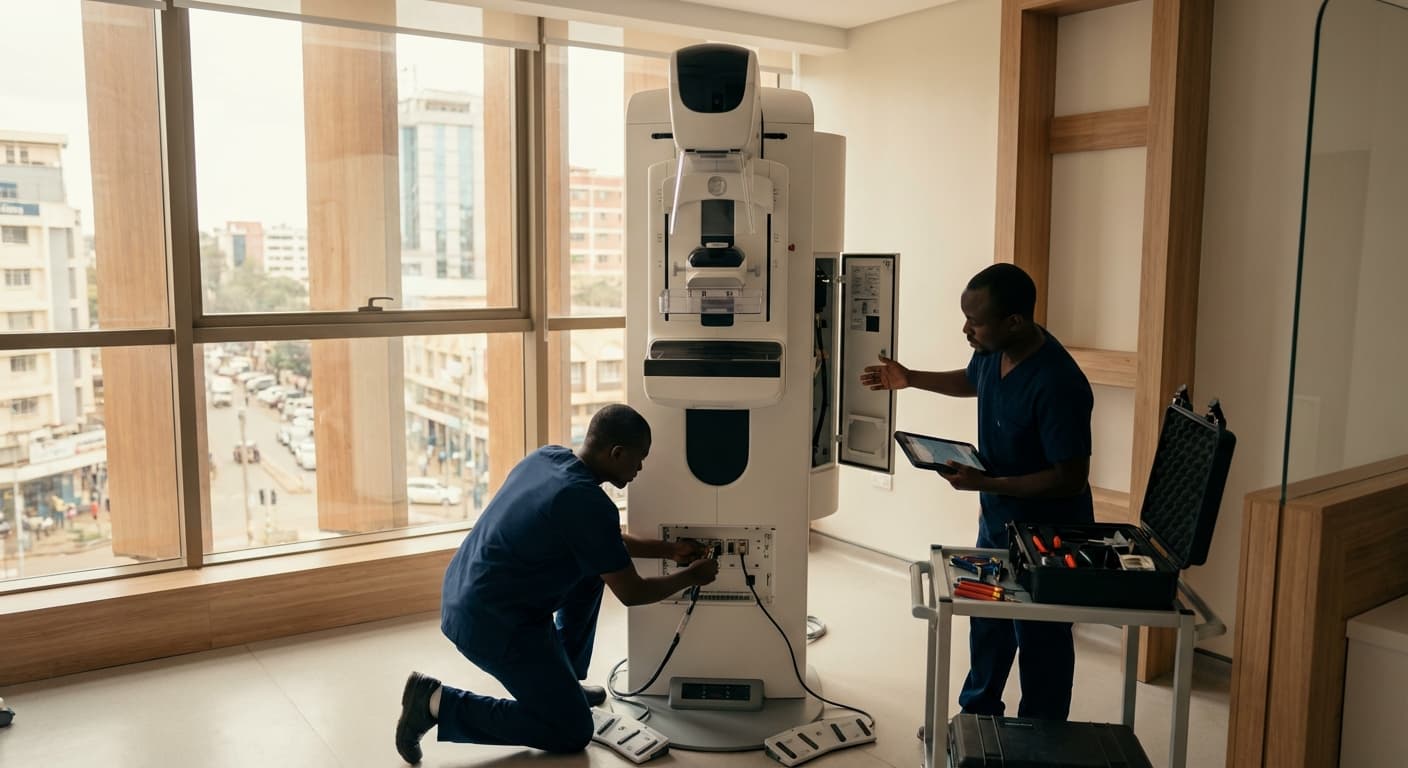
Mammography Installation Service in Equatorial Guinea
Engineering Excellence & Technical Support
Mammography Installation Service High-standard technical execution following OEM protocols and local regulatory frameworks.
Expert Imaging Calibration for Equatorial Guinea's Climate
Our installation service ensures mammography equipment is meticulously calibrated to compensate for Equatorial Guinea's high humidity and temperature, guaranteeing optimal image quality and diagnostic accuracy for all patients.
Localized Training & Support for Medical Professionals
We provide comprehensive, hands-on training tailored to local medical staff in Equatorial Guinea, empowering them with the skills to operate and maintain advanced mammography systems efficiently, ensuring seamless integration into their clinical workflow.
Robust Power Stability Solutions for Reliable Operations
Addressing potential power fluctuations, our installations incorporate specialized voltage stabilizers and surge protectors, ensuring consistent and reliable operation of sensitive mammography equipment throughout Equatorial Guinea, minimizing downtime and maximizing patient throughput.
What Is Mammography Installation Service In Equatorial Guinea?
Mammography Installation Service in Equatorial Guinea refers to the specialized process of setting up, configuring, and validating mammography equipment within healthcare facilities in the nation. This service is critical for ensuring that these advanced imaging systems are operational, safe, and capable of producing diagnostically accurate mammograms. It encompasses a comprehensive set of procedures, from initial site preparation and physical installation to the integration of software, calibration of detectors, and comprehensive testing. The service ensures adherence to international safety standards and local regulatory requirements, facilitating the establishment of robust breast imaging capabilities. The primary objective is to provide healthcare providers with reliable and effective tools for early detection and diagnosis of breast diseases, particularly breast cancer. This service is crucial for advancing diagnostic imaging infrastructure in Equatorial Guinea's healthcare sector.
| Who Needs Mammography Installation Service? | Typical Use Cases & Benefits | |||
|---|---|---|---|---|
| Hospitals and Clinics: Public and private healthcare institutions in Equatorial Guinea requiring new or upgraded mammography units. | Establishment of Dedicated Breast Imaging Centers: Facilitating the creation of specialized facilities for mammography screening and diagnostics. | Expansion of Diagnostic Imaging Services: Enhancing the breadth of diagnostic capabilities offered by healthcare providers. | Replacing Outdated Equipment: Upgrading to modern, digital mammography systems for improved accuracy and efficiency. | Government Healthcare Initiatives: Supporting national programs focused on early cancer detection and women's health. |
| Radiology Departments: Essential for departments aiming to provide comprehensive breast imaging services. | Early Detection of Breast Cancer: Enabling timely identification of suspicious lesions and calcifications, crucial for improved patient outcomes. | Diagnostic Workup: Supporting the investigation of abnormal findings identified through screening or symptoms. | Monitoring of High-Risk Patients: Facilitating regular screening for individuals with a family history or genetic predisposition to breast cancer. | Improved Diagnostic Accuracy: Modern digital mammography systems offer enhanced image quality, reducing false positives and negatives. |
Key Components of Mammography Installation Service:
- Site Assessment and Preparation: Evaluating the physical space for power requirements, shielding, ventilation, and accessibility.
- Equipment Delivery and Unpacking: Secure transportation and careful unpacking of sensitive mammography units and associated components.
- Physical Installation and Mounting: Precise placement and secure mounting of the mammography system, including the X-ray tube, detector, and control console.
- Electrical and Network Connectivity: Establishing stable power supply and integrating the system with hospital IT infrastructure (PACS/RIS).
- Software Installation and Configuration: Deploying and configuring specialized mammography software for image acquisition, processing, and storage.
- Calibration and Quality Assurance: Rigorous calibration of all components to ensure optimal image quality and adherence to diagnostic standards, including phantom testing.
- Shielding Verification: Confirming the adequacy of radiation shielding to protect patients and staff.
- Staff Training and Handover: Comprehensive training for radiographers and technologists on system operation, maintenance, and troubleshooting.
- Documentation and Certification: Providing detailed installation reports, calibration certificates, and ensuring compliance with regulatory standards.
Who Needs Mammography Installation Service In Equatorial Guinea?
Mammography installation services are crucial for healthcare facilities in Equatorial Guinea aiming to enhance diagnostic capabilities for breast cancer screening and detection. These services ensure that advanced imaging equipment is set up correctly, calibrated, and ready for clinical use, thereby improving patient care and health outcomes. The demand for such specialized services is driven by the growing recognition of the importance of early breast cancer detection and the ongoing efforts to modernize healthcare infrastructure in the country.
| Customer Type | Key Departments Involved | Specific Needs Addressed |
|---|---|---|
| Government Hospitals and Clinics | Radiology Department, Diagnostic Imaging Unit, Oncology Department, Women's Health Clinics | Establishing or upgrading national breast cancer screening programs, ensuring equitable access to diagnostic tools, training local technicians. |
| Private Hospitals and Diagnostic Centers | Radiology Department, Breast Imaging Unit, Preventive Health Services, Surgical Oncology | Offering state-of-the-art diagnostic services, attracting patients seeking comprehensive care, maintaining a competitive edge in the private healthcare sector. |
| Non-Governmental Organizations (NGOs) focused on Women's Health | Screening Program Management, Mobile Health Units, Community Outreach Programs, Clinical Services | Deploying diagnostic equipment in underserved areas, supporting mobile screening initiatives, facilitating early detection for vulnerable populations. |
| International Health Organizations' Facilities | Radiology and Imaging Services, Public Health Projects, Research Facilities | Implementing international standards for cancer diagnostics, supporting national health initiatives, conducting epidemiological studies and research. |
Target Customers & Departments for Mammography Installation Services in Equatorial Guinea
- Government Hospitals and Clinics
- Private Hospitals and Diagnostic Centers
- Non-Governmental Organizations (NGOs) focused on Women's Health
- International Health Organizations' Facilities
Mammography Installation Service Process In Equatorial Guinea
This document outlines the comprehensive workflow for mammography installation services in Equatorial Guinea, from the initial client inquiry to the successful execution and handover of the installed equipment. The process is designed to be transparent, efficient, and compliant with local regulations and international standards.
| Phase | Key Activities | Responsible Parties | Deliverables/Outcomes |
|---|---|---|---|
| Receive client request, understand project scope, discuss equipment needs, clarify timelines and budget constraints. | Client, Service Provider Sales Team | Initial understanding of client requirements, preliminary project scope definition. |
| On-site visit to evaluate the installation location, assess space requirements, power supply, environmental conditions (temperature, humidity), and safety regulations. Develop a detailed installation plan. | Service Provider Technical Team, Client Facilities Manager | Detailed site survey report, revised installation plan, identification of any site modifications needed. |
| Prepare a comprehensive quotation including equipment, installation labor, materials, training, and any applicable taxes/duties. Negotiate terms and conditions. Finalize and sign the service contract. | Service Provider Sales/Contracts Team, Client Procurement Department | Formal quotation, signed service contract, agreed-upon payment schedule. |
| Order the mammography equipment and necessary accessories. Arrange for international and local transportation, customs clearance, and insurance for the shipment to Equatorial Guinea. | Service Provider Procurement & Logistics Team, Shipping Agents, Customs Brokers | Confirmation of equipment order, shipment tracking information, clearance of customs documentation. |
| Prepare the installation site as per the approved plan (e.g., structural modifications, electrical work, HVAC adjustments). Ensure all necessary tools and safety equipment are on-site. | Client Facilities Team, Approved Local Contractors (if required), Service Provider Project Manager | Ready installation environment, availability of required utilities and infrastructure. |
| Receive the mammography equipment at the designated site. Carefully unpack and inspect for any damages during transit. Inventory all components. | Service Provider Installation Team, Client Representative | Equipment received and visually inspected, damage report (if any), complete inventory of delivered items. |
| Assemble and install the mammography unit according to manufacturer specifications and the approved installation plan. Connect power, networking, and other necessary systems. Calibrate the equipment to ensure optimal performance and image quality. | Service Provider Certified Installation Engineers, Manufacturer Representatives (if applicable) | Fully installed mammography unit, initial calibration report. |
| Perform comprehensive diagnostic tests, phantom testing, and image quality assessments to verify proper functionality and adherence to international standards (e.g., IEC, ACR). Conduct a final site inspection. | Service Provider Technical Team, Client Radiologist/Technologist, Quality Assurance Officer | Successful test results, QA report, list of any minor adjustments made. |
| Provide comprehensive training to the client's medical and technical staff on the operation, basic maintenance, and troubleshooting of the mammography system. Officially hand over the installed equipment and associated documentation. | Service Provider Application Specialist/Trainer, Client Medical and Technical Staff | Trained personnel, training completion certificates, system operation manuals, warranty information. |
| Provide initial post-installation support. Compile and deliver all final project documentation, including as-built drawings, test reports, and maintenance schedules. Close out the project. | Service Provider Project Manager, Client Representative | Project completion report, final documentation package, commencement of warranty period. |
Mammography Installation Service Workflow
- Inquiry and Initial Consultation
- Site Assessment and Planning
- Quotation and Contract Negotiation
- Procurement and Logistics
- Pre-Installation Preparations
- Equipment Delivery and Unpacking
- Installation and Calibration
- Testing and Quality Assurance
- Training and Handover
- Post-Installation Support and Documentation
Mammography Installation Service Cost In Equatorial Guinea
The cost of mammography installation services in Equatorial Guinea is subject to a variety of factors, influencing the overall price. These factors range from the specific type and model of mammography equipment being installed to the complexity of the site preparation required. Labor costs, often influenced by the availability of specialized technicians and their experience, also play a significant role. Furthermore, logistical challenges such as transportation of equipment to remote areas and any necessary customs duties can add to the final expense. The scope of the installation, including whether it involves initial setup of a new unit or relocation and reinstallation of an existing one, will also impact pricing. Additional services like calibration, testing, and initial training for medical staff are often bundled into the installation cost or offered as separate but essential components. Due to these variables, a precise, universally applicable price is difficult to state. However, by understanding these influencing factors, healthcare providers can better estimate and budget for mammography installation services.
| Service Component | Estimated Price Range (XAF - Central African CFA franc) | Notes |
|---|---|---|
| Basic Mammography Unit Installation (Standard Model) | 1,500,000 - 3,500,000 XAF | Covers standard equipment setup, basic electrical connections, and initial testing. Excludes complex site modifications. |
| Advanced/Digital Mammography Unit Installation | 2,500,000 - 6,000,000 XAF | Includes more intricate setup for digital systems, integration with PACS (Picture Archiving and Communication System) if required, and potentially more rigorous calibration. |
| Site Preparation (Minor Modifications) | 300,000 - 1,000,000 XAF | Basic electrical upgrades, minor wall reinforcement. Does not include extensive radiation shielding. |
| Site Preparation (Major Modifications / Radiation Shielding) | 1,000,000 - 5,000,000+ XAF | Requires specialized construction, lead lining, and compliance with radiation safety regulations. Costs vary significantly based on existing infrastructure. |
| Equipment Transportation (Domestic) | 100,000 - 500,000 XAF | Varies by distance and accessibility. Costs can be higher for remote or difficult-to-reach locations. |
| Calibration and Performance Testing | 200,000 - 600,000 XAF | Essential for ensuring diagnostic accuracy and compliance. Often performed by manufacturer-certified technicians. |
| Initial Staff Training (Basic Operation) | 150,000 - 400,000 XAF | Focuses on day-to-day operation, basic troubleshooting, and image acquisition. Duration and depth of training influence cost. |
| Customs Duties and Import Fees | Variable (typically 10-30% of equipment CIF value) | Subject to Equatorial Guinean import regulations. Can significantly impact the total cost. |
Key Pricing Factors for Mammography Installation in Equatorial Guinea:
- Type and Model of Mammography Equipment
- Complexity of Site Preparation (electrical, structural, radiation shielding)
- Labor Costs (specialized technicians, experience, availability)
- Logistical Challenges (transportation, accessibility, remote locations)
- Customs Duties and Import Regulations
- Scope of Installation (new setup vs. relocation)
- Calibration and Testing Services
- Initial Staff Training
Affordable Mammography Installation Service Options
Installing a mammography unit is a significant investment for any healthcare facility. Beyond the initial purchase price of the equipment, crucial considerations include installation costs, which can vary widely. This guide explores affordable mammography installation service options, emphasizing value bundles and practical cost-saving strategies to help you make an informed decision without compromising quality or patient care.
| Cost-Saving Strategy | Description | Potential Savings |
|---|---|---|
| Value Bundling (Manufacturer Packages) | Negotiate with the manufacturer to include installation, training, and possibly initial maintenance in a comprehensive package. This can offer a bundled discount compared to purchasing services separately. | Moderate to Significant (depending on package inclusions) |
| Early Planning & Site Preparation | Proactive planning and ensuring the installation site meets all specifications (power, radiation shielding, HVAC, space) before the installation team arrives minimizes delays and potential rework, which are costly. | Moderate |
| Competitive Bidding (Third-Party Specialists) | Obtain multiple quotes from reputable third-party installation specialists. Compare not only price but also their experience, references, and the scope of their services. | Significant |
| Negotiate Installation Fees | Don't be afraid to negotiate the installation fees, especially if you are purchasing multiple pieces of equipment or have a long-standing relationship with a vendor. Ask about potential discounts for early payment or volume. | Moderate |
| Phased Installation | In some cases, if budget is a major constraint, discuss the possibility of phasing the installation. This might involve completing essential setup now and deferring some non-critical elements to a later date, though this requires careful planning. | Moderate (requires careful project management) |
| Leverage Existing Infrastructure | If upgrading from an older system, investigate if any existing infrastructure (e.g., power, cabling, radiation shielding) can be repurposed, reducing the need for new installations. | Moderate to Significant |
| Extended Warranty & Maintenance Negotiation | While not strictly installation, negotiating favorable terms for post-installation warranty and maintenance contracts can be bundled into the overall cost discussion and lead to long-term savings. | Significant (over the equipment's lifecycle) |
Understanding Mammography Installation Service Options
- {"title":"Manufacturer Installation","description":"The most common option, where the equipment manufacturer provides the installation services. This often includes site preparation guidance, equipment setup, calibration, and initial training. While convenient, it can sometimes be the most expensive option."}
- {"title":"Third-Party Installation Specialists","description":"Independent companies specializing in medical equipment installation. They may offer more competitive pricing and greater flexibility. It's crucial to vet these specialists thoroughly for experience and certifications."}
- {"title":"In-House Installation (with External Support)","description":"For facilities with experienced in-house biomedical engineering teams, some components of the installation might be handled internally. However, specialized tasks like X-ray shielding or complex electrical work often still require external expertise."}
Verified Providers In Equatorial Guinea
Navigating healthcare in Equatorial Guinea requires trust and reliability. Franance Health stands out as a beacon of quality and integrity, offering a robust network of verified healthcare providers. Understanding their credentials and the stringent vetting process reveals why they represent the best choice for your health needs.
| Provider Type | Franance Health Verification Includes | Why it Matters for You |
|---|---|---|
| Doctors (General Practitioners & Specialists) | Medical License, Board Certification, Diplomas, Work History, Malpractice History Check | Ensures you are treated by qualified and experienced medical professionals with the right expertise. |
| Hospitals & Clinics | Accreditation Status, Licensing, Equipment Standards, Infection Control Protocols, Staff Qualifications | Guarantees access to safe, well-equipped facilities with a commitment to high-quality patient care. |
| Laboratories & Diagnostic Centers | Accreditation, Equipment Calibration Records, Quality Control Procedures, Staff Competency | Provides confidence in the accuracy and reliability of your diagnostic test results. |
| Pharmacies | Pharmacy License, Drug Sourcing Verification, Storage Protocols, Pharmacist Registration | Ensures you receive legitimate, safely stored medications from licensed professionals. |
Franance Health's Commitment to Excellence:
- Rigorous Provider Vetting: Franance Health employs a multi-faceted approach to credentialing, ensuring that all listed providers meet the highest professional standards.
- Verification of Licenses and Certifications: Every medical professional and facility undergoes a thorough check of their official licenses, certifications, and accreditations.
- Experience and Specialization Confirmation: Franance Health verifies the practical experience and specialized training of their providers to match patients with the most suitable care.
- Reputation and Peer Review: Beyond formal qualifications, Franance Health considers the professional reputation and, where applicable, peer reviews of their network members.
- Commitment to Patient Safety: The core of Franance Health's mission is to ensure patient safety through only partnering with providers who adhere to best practices and ethical conduct.
Scope Of Work For Mammography Installation Service
This Scope of Work (SOW) outlines the requirements for the installation of a new mammography system at [Client Facility Name], located at [Client Facility Address]. The objective is to ensure a seamless, compliant, and fully operational mammography unit is integrated into the existing clinical workflow.
| Section | Description | Deliverables | Standard Specifications / Requirements |
|---|---|---|---|
| Overall coordination, planning, and communication for the installation project. | Project plan, weekly progress reports, risk assessment and mitigation plan, final project report. | Adherence to client's project management methodologies. Clear communication channels. Defined escalation procedures. Minimum 2 weeks' notice for scheduling key milestones. |
| Ensuring the installation site meets all technical and environmental requirements. | Confirmation of site readiness, delivery coordination, equipment unpacking and staging. | Compliance with manufacturer's site preparation guide (e.g., power, HVAC, shielding, network). Minimum room dimensions as per manufacturer's specifications. Secure delivery route and access planning. |
| Physical installation of the mammography unit, including all components and accessories. | Fully assembled and connected mammography system, including X-ray generator, detector, workstation, console, and associated cabling. | Installation by manufacturer-certified technicians. Adherence to manufacturer's installation manual. Compliance with local building codes and electrical safety standards. |
| Integration of the mammography system with existing hospital IT infrastructure. | Successful DICOM connectivity to PACS for image transmission, RIS integration for patient data management. | Verification of image transfer speeds and accuracy. Successful HL7 messaging for patient demographics and exam scheduling. Network security protocols must be maintained. |
| Comprehensive testing and calibration to ensure optimal performance and safety. | System performance tests, image quality tests, safety checks (e.g., radiation output), calibration report. | Compliance with ACR (American College of Radiology) standards, MQSA (Mammography Quality Standards Act) requirements, and local regulatory bodies. All tests to be performed using approved phantoms and test tools. |
| Training for designated personnel on the operation and basic maintenance of the new system. | On-site training sessions for radiographers, technologists, and IT support staff. Training materials (user manuals, quick guides). | Minimum 2 days of comprehensive training. Training content to cover system operation, quality control procedures, basic troubleshooting, and PACS/RIS interaction. Competency assessment for trainees. |
| Provision of all relevant documentation and formal handover of the installed system. | System manuals, warranty information, calibration certificates, service records, training completion certificates, final acceptance form. | All documentation to be provided in English and in electronic format (PDF). Formal acceptance sign-off by the client representative upon successful completion of all deliverables. |
Key Objectives
- Successful physical installation of the mammography system.
- Integration with existing PACS/RIS systems.
- Comprehensive testing and calibration to meet all regulatory standards.
- Training of designated clinical and technical staff.
- Handover of all necessary documentation.
Service Level Agreement For Mammography Installation Service
This Service Level Agreement (SLA) outlines the response times and uptime guarantees for the Mammography Installation Service provided by [Your Company Name] (hereinafter referred to as 'Provider') to [Client Name] (hereinafter referred to as 'Client'). This SLA is an addendum to the Master Service Agreement (MSA) dated [MSA Date].
| Issue Severity | Response Time Target | Resolution Time Target | Uptime Guarantee |
|---|---|---|---|
| Emergency | 1 Hour (during Service Hours) | 4 Business Hours | 99.9% per month |
| Urgent Issue | 2 Business Hours | 8 Business Hours | 99.8% per month |
| Standard Issue | 4 Business Hours | 2 Business Days | 99.5% per month |
Definitions
- Service Hours: Monday to Friday, 8:00 AM to 6:00 PM [Client's Time Zone], excluding public holidays.
- Emergency: Any failure of the Mammography equipment that renders it completely inoperable and poses an immediate risk to patient care or safety.
- Urgent Issue: Any issue that significantly degrades the performance of the Mammography equipment, impacts a large number of patients, or creates a potential risk to patient care.
- Standard Issue: Any issue that affects the performance of the Mammography equipment but does not pose an immediate risk to patient care or a large number of patients.
- Response Time: The maximum time allowed for the Provider to acknowledge a service request and begin diagnosing the issue.
- Resolution Time: The maximum time allowed for the Provider to resolve the reported issue.
- Downtime: The cumulative period during which the Mammography equipment is unavailable for use due to a service issue, excluding scheduled maintenance.
- Uptime Guarantee: The minimum percentage of time the Mammography equipment is expected to be operational and available for use.
Frequently Asked Questions

Ready when you are
Let's scope your Mammography Installation Service in Equatorial Guinea project in Equatorial Guinea.

Scaling healthcare logistics and technical systems across the entire continent.