
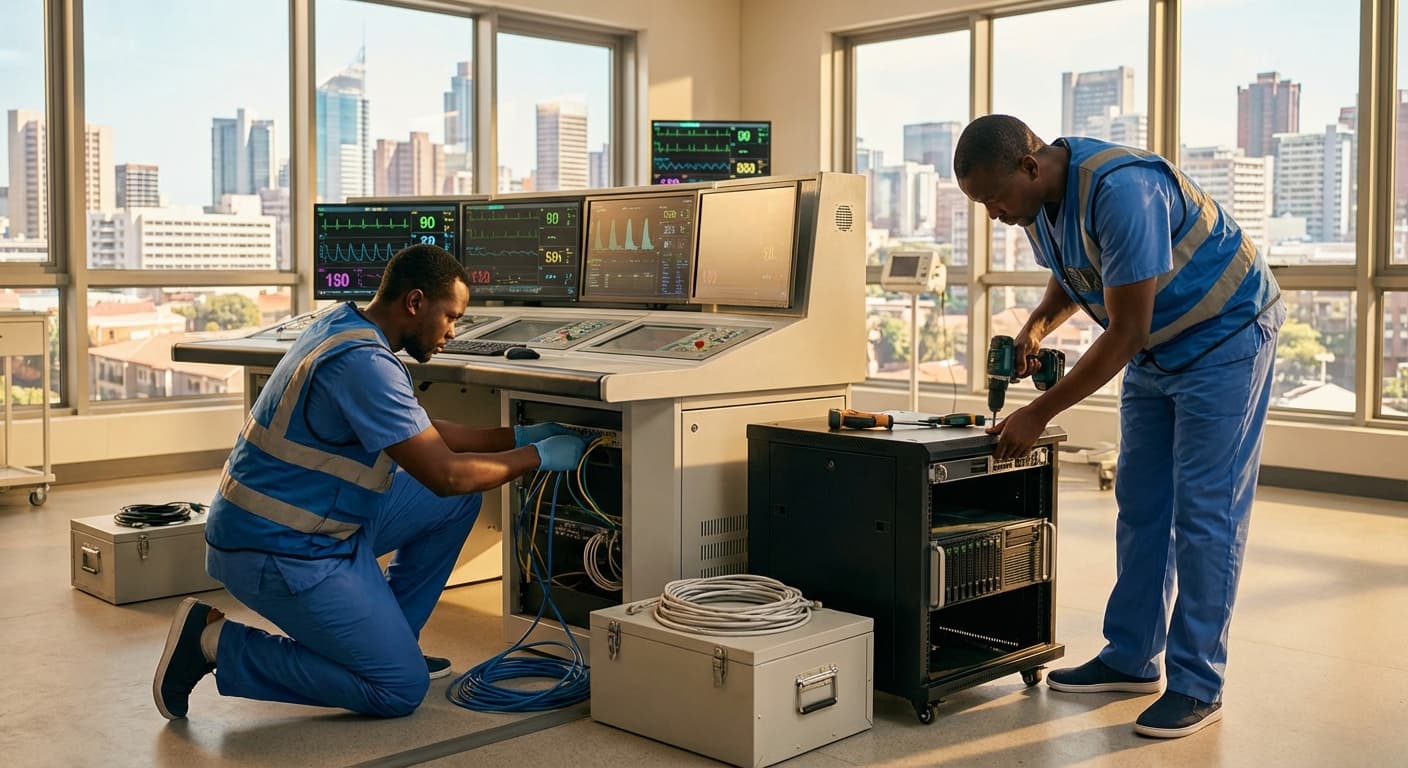
ICU Central Monitoring Station Installation Service in Equatorial Guinea
Engineering Excellence & Technical Support
ICU Central Monitoring Station Installation Service High-standard technical execution following OEM protocols and local regulatory frameworks.
Robust Network Infrastructure & Scalability
We design and implement resilient, high-bandwidth network architectures specifically for Equatorial Guinea's climate and infrastructure, ensuring seamless data transmission and future scalability for your ICU monitoring needs. Our installations prioritize redundancy and failover mechanisms for uninterrupted patient data flow.
Secure, HIPAA-Compliant Data Management
Our expert technicians ensure all patient data transmitted and stored within your Central Monitoring Station meets strict international security and privacy standards, including HIPAA compliance. We implement advanced encryption, access controls, and audit trails tailored to the local regulatory landscape.
Reliable Power Solutions & Environmental Resilience
Addressing Equatorial Guinea's unique power challenges, we integrate robust Uninterruptible Power Supply (UPS) systems and backup generator solutions. Our installations also consider environmental factors like humidity and temperature to guarantee optimal performance and longevity of your critical monitoring equipment.
What Is Icu Central Monitoring Station Installation Service In Equatorial Guinea?
ICU Central Monitoring Station Installation Service in Equatorial Guinea refers to the comprehensive process of setting up and commissioning a centralized system for continuous, real-time patient monitoring within an Intensive Care Unit (ICU). This service encompasses the physical installation of monitoring hardware, network configuration, software integration, and initial system calibration, ensuring that all connected patient monitoring devices transmit data to a central console for review by critical care physicians and nursing staff. The objective is to enhance patient safety and optimize clinical decision-making through immediate access to vital physiological data.
| Stakeholder/Entity | Need for Service | Typical Use Cases |
|---|---|---|
| **Hospitals and Healthcare Facilities in Equatorial Guinea (Public and Private) | To establish or upgrade critical care infrastructure for improved patient outcomes. Essential for facilities aiming to meet international standards of critical care delivery. | • Continuous observation of multiple critically ill patients simultaneously. • Real-time detection and immediate response to patient deterioration via alarms. • Facilitating efficient workflow for nursing staff by consolidating patient data. • Supporting remote consultation and data review by specialists. • Enabling research and data analysis for quality improvement initiatives. |
| **ICUs and Critical Care Departments | To enhance patient safety, reduce medical errors, and improve the efficiency of critical care teams. | • Monitoring patients with severe respiratory distress, cardiovascular instability, sepsis, or neurological compromise. • Tracking trends in vital signs for early intervention. • Managing high patient-to-nurse ratios effectively. • Providing a unified view of patient status during medical emergencies or resuscitations. |
| **Biomedical Engineering Departments | To ensure proper installation, integration, and maintenance of complex medical technology, adhering to safety and performance standards. | • Initial setup and validation of the central monitoring system's compliance with manufacturer specifications and hospital protocols. • Ongoing system calibration, troubleshooting, and preventive maintenance. • Integration with hospital IT infrastructure and cybersecurity measures. |
| **Government Health Ministries and Regulatory Bodies | To ensure the availability of advanced critical care capabilities and adherence to healthcare infrastructure standards within the nation. | • Facilitating the development of national critical care networks. • Setting benchmarks for ICU technology adoption. • Oversight of healthcare infrastructure investments. |
Key Components and Stages of ICU Central Monitoring Station Installation Service:
- Site Assessment and Planning: Evaluating the existing ICU infrastructure, including power, networking, and space requirements, to design an optimal central monitoring station layout.
- Hardware Installation: Physically mounting and connecting central monitoring consoles, display units, workstations, and associated servers.
- Network Integration: Establishing secure and reliable network connectivity between patient bedside monitors (e.g., ECG, SpO2, NIBP, invasive pressures, respiratory parameters) and the central monitoring station. This often involves IP-based networking and adherence to healthcare network security protocols.
- Software Configuration and Deployment: Installing and configuring the central monitoring software platform, including user interface customization, alarm management parameters, data archiving, and integration with Electronic Health Records (EHR) systems.
- Device Integration and Calibration: Connecting and verifying the functionality of individual patient monitors with the central station, ensuring accurate data acquisition and transmission. This includes calibration of sensors and alarms.
- System Testing and Validation: Conducting rigorous testing to confirm system performance, data integrity, alarm functionality, and network stability under simulated and real-world conditions.
- Training and Handover: Providing comprehensive training to clinical staff (physicians, nurses, biomedical engineers) on the operation, maintenance, and troubleshooting of the central monitoring system.
- Post-Installation Support: Offering ongoing technical support, maintenance, and potential upgrades to ensure continued optimal performance.
Who Needs Icu Central Monitoring Station Installation Service In Equatorial Guinea?
ICU Central Monitoring Station Installation services are crucial for healthcare facilities in Equatorial Guinea that are looking to enhance their critical care capabilities. These services involve the setup and integration of sophisticated systems that allow for the remote, centralized monitoring of multiple Intensive Care Unit (ICU) patients. This not only improves patient safety by enabling early detection of vital sign abnormalities but also optimizes resource allocation for nursing staff. As Equatorial Guinea continues to develop its healthcare infrastructure, the demand for advanced medical technologies, including ICU central monitoring, is on the rise.
| Department | Role in Central Monitoring | Key Needs |
|---|---|---|
| Intensive Care Unit (ICU) | Primary patient care area, generating vital sign data. | Real-time patient data display, alarm management, waveform analysis, integration with bedside monitors. |
| Nursing Administration/Management | Oversees nursing staff, patient flow, and resource allocation. | Improved staff efficiency, reduced response times to critical events, enhanced oversight of patient conditions across multiple beds. |
| Medical Directors/Department Heads | Responsible for clinical quality, patient outcomes, and departmental efficiency. | Data for performance improvement, identification of trends, effective management of critical patients, support for clinical decision-making. |
| Biomedical Engineering Department | Responsible for the maintenance and integration of medical equipment. | System setup, calibration, troubleshooting, integration with existing hospital IT infrastructure, ongoing technical support. |
| IT Department | Manages hospital information systems and network infrastructure. | Secure data transmission, network compatibility, data storage and retrieval, cybersecurity, integration with Electronic Health Records (EHR). |
Target Customers for ICU Central Monitoring Station Installation Services in Equatorial Guinea
- Major Public Hospitals
- Private Hospitals and Clinics
- University Teaching Hospitals
- Specialized Cardiac and Neurological Centers
- Newly constructed or expanding healthcare facilities
- Government health initiatives focused on critical care
Icu Central Monitoring Station Installation Service Process In Equatorial Guinea
This document outlines the comprehensive workflow for the Installation Service of an ICU Central Monitoring Station in Equatorial Guinea, from the initial customer inquiry to the successful execution and handover of the system. Our process is designed to ensure a seamless, efficient, and compliant installation, meeting the specific needs and regulatory requirements of healthcare facilities in the region.
| Phase | Key Activities | Deliverables/Outcomes | Responsible Parties | Timeline (Est.) |
|---|---|---|---|---|
| Phase 1: Initial Inquiry & Consultation | Customer contacts us with requirements for an ICU Central Monitoring Station. Initial discussions to understand scope, objectives, and existing infrastructure. Preliminary needs analysis and identification of potential challenges. | Understanding of client needs. Identification of key stakeholders. Basic project scope defined. | Client, Sales Representative, Technical Consultant | 1-3 Business Days |
| Phase 2: Site Assessment & Planning | On-site visit to the ICU in Equatorial Guinea. Detailed assessment of the installation location (space, power, networking, environmental factors). Verification of existing infrastructure and compatibility. Identification of specific local regulations and requirements. | Comprehensive Site Survey Report. Detailed technical specifications. Identification of any site-specific risks or constraints. Accurate project scope and resource estimation. | Project Manager, Field Engineers, Client IT/Facilities Team | 3-7 Business Days (includes travel) |
| Phase 3: Proposal & Agreement | Development of a detailed proposal outlining scope of work, system design, equipment, software, installation plan, timeline, and cost. Review and negotiation of the proposal with the client. Formalization of contract and service agreement. | Formal Project Proposal. Signed Contract and Service Agreement. Payment schedule defined. | Sales Representative, Project Manager, Legal Department, Client | 5-10 Business Days |
| Phase 4: Procurement & Logistics | Procurement of all necessary hardware, software, and accessories. Coordination of international shipping and customs clearance for Equatorial Guinea. Management of local transportation to the installation site. | All required equipment and software secured. Successful import and customs clearance. Equipment ready for delivery to site. | Procurement Team, Logistics Coordinator, Project Manager | 2-6 Weeks (dependent on lead times and customs) |
| Phase 5: Pre-installation Preparation | Preparation of the installation site as per assessment (e.g., network cabling, power outlet installation, environmental controls). Pre-configuration of software and hardware where possible. Coordination of access and work permits for installation team. | Site ready for installation. Pre-configured components. Access and permits secured. | Client Facilities Team, Project Manager, Installation Technicians | 1-2 Weeks (overlaps with logistics) |
| Phase 6: Installation & Configuration | Physical installation of the central monitoring station hardware (servers, workstations, displays). Deployment and configuration of monitoring software. Connection and integration of patient monitors and other bedside devices. Network configuration and secure connectivity setup. | Installed and configured central monitoring hardware and software. Integrated bedside devices. Operational network connectivity. | Field Engineers, Installation Technicians, Network Specialists, Client IT Team | 1-3 Weeks (dependent on complexity and number of beds) |
| Phase 7: Testing & Commissioning | Comprehensive testing of all system functionalities. Simulation of various clinical scenarios to ensure accuracy and reliability. Performance testing and optimization. Verification against project specifications and client requirements. | Fully commissioned and functional ICU Central Monitoring System. Test reports and validation documentation. System performance validated. | Field Engineers, Quality Assurance Team, Client Biomedical Engineers | 3-7 Business Days |
| Phase 8: Training & Handover | Training for clinical staff (doctors, nurses) on system operation, data interpretation, and alarm management. Training for IT and biomedical staff on system maintenance and troubleshooting. Formal handover of the system with all documentation. | Trained clinical and technical staff. Complete system documentation (manuals, as-built drawings, warranty information). Formal project completion and acceptance. | Technical Trainers, Project Manager, Client Stakeholders | 2-5 Business Days |
| Phase 9: Post-installation Support & Maintenance | Provision of warranty services. Remote and on-site technical support. Scheduled preventative maintenance visits. Software updates and patches deployment. | Ongoing system reliability and performance. Minimised downtime. Long-term operational efficiency. | Support Team, Field Engineers, Client Biomedical Department | Ongoing (as per service agreement) |
ICU Central Monitoring Station Installation Service Process
- Phase 1: Initial Inquiry & Consultation
- Phase 2: Site Assessment & Planning
- Phase 3: Proposal & Agreement
- Phase 4: Procurement & Logistics
- Phase 5: Pre-installation Preparation
- Phase 6: Installation & Configuration
- Phase 7: Testing & Commissioning
- Phase 8: Training & Handover
- Phase 9: Post-installation Support & Maintenance
Icu Central Monitoring Station Installation Service Cost In Equatorial Guinea
The cost of installing an ICU Central Monitoring Station (CMS) in Equatorial Guinea is a complex figure influenced by a multitude of factors. These systems are critical for providing real-time patient data and alerts to nursing staff, enabling faster response times and improved patient outcomes. The overall investment will vary significantly based on the specific needs of the healthcare facility, the chosen technology, and the complexity of the installation.
| Cost Component | Estimated Range (XAF) | Notes |
|---|---|---|
| Small ICU (4-6 beds) | 15,000,000 - 30,000,000 | Basic monitoring, fewer features, minimal integration |
| Medium ICU (7-12 beds) | 30,000,000 - 60,000,000 | Standard features, moderate integration, higher quality hardware |
| Large ICU (13+ beds) | 60,000,000 - 150,000,000+ | Advanced features, complex integration, top-tier hardware and software |
| Hardware (Monitors, Servers, Workstations) | 5,000,000 - 30,000,000 | Depends on number and quality of units |
| Software & Licensing (Initial) | 3,000,000 - 20,000,000 | Varies by vendor and features |
| Installation & Configuration | 2,000,000 - 10,000,000 | Complexity, technician travel, duration |
| Training | 1,000,000 - 5,000,000 | Number of staff, training modules |
| Integration Services | 2,000,000 - 15,000,000 | Depends on existing system complexity |
| Annual Software Maintenance & Support | 1,000,000 - 7,000,000+ | Typically 10-20% of software cost |
Key Pricing Factors for ICU Central Monitoring Station Installation in Equatorial Guinea:
- {"title":"System Size and Scope","description":"The number of ICU beds requiring monitoring is the primary driver of cost. A larger ICU will necessitate more monitoring units and a more robust central station, increasing both hardware and software expenses."}
- {"title":"Technology and Brand Selection","description":"Different manufacturers offer varying levels of technology, features, and sophistication. High-end systems with advanced analytics, AI integration, and extensive connectivity options will naturally command higher prices than more basic setups. Brand reputation and perceived reliability also play a role."}
- {"title":"Hardware Components","description":"This includes the central monitoring server(s), display monitors (number and size), workstations for nurses, patient bedside monitors (if not already existing or if upgrades are needed), and necessary networking equipment (switches, cables, routers)."}
- {"title":"Software and Licensing","description":"The cost of the CMS software, including its operating system, database, and any specialized modules (e.g., EMR integration, predictive analytics), is a significant component. Annual software maintenance and support fees are also a recurring expense."}
- {"title":"Installation and Configuration Services","description":"Professional installation by certified technicians is crucial for ensuring proper setup, calibration, and integration. This includes site preparation, cabling, hardware mounting, software installation, and initial system configuration."}
- {"title":"Integration with Existing Systems","description":"If the CMS needs to interface with existing hospital information systems (HIS) or electronic medical records (EMR), this will add complexity and cost due to the need for custom development or integration modules."}
- {"title":"Training","description":"Comprehensive training for clinical staff (nurses, doctors) and IT personnel on operating and maintaining the new system is essential. The duration and depth of training will impact the overall cost."}
- {"title":"Warranty and Support","description":"The length and scope of the warranty, as well as ongoing technical support services (e.g., 24/7 availability, response times), will influence the initial purchase price and ongoing operational costs."}
- {"title":"Site Surveys and Project Management","description":"Initial site surveys to assess infrastructure, network readiness, and power requirements are often necessary. Effective project management throughout the installation process also contributes to the overall cost."}
- {"title":"Logistics and Import Duties","description":"Shipping costs to Equatorial Guinea, potential import duties, and local taxes can add to the final price of imported equipment and services."}
- {"title":"Local Labor and Expertise","description":"While specialized installation might require international technicians, the availability and cost of local IT support and maintenance staff will also be a factor in long-term operational expenses."}
Affordable Icu Central Monitoring Station Installation Service Options
Setting up an Intensive Care Unit (ICU) central monitoring station is crucial for patient safety and efficient care delivery. This guide explores affordable installation service options, focusing on value bundles and cost-saving strategies. A well-designed central monitoring station allows healthcare professionals to continuously track vital signs of multiple patients from a central location, enabling rapid response to critical changes and improved patient outcomes. We'll break down the key components and discuss how to achieve cost-effectiveness without compromising on essential functionality.
| Value Bundle Option | Description | Cost-Saving Strategies Incorporated |
|---|---|---|
| Basic Essentials Bundle | Includes essential patient monitors, a reliable central workstation, and standard networking. Focuses on core monitoring functions. | Bulk purchasing of monitors: Negotiating discounts for larger quantities. Refurbished equipment: Considering certified refurbished patient monitors for significant savings. Standardized networking components: Using widely available and cost-effective networking hardware. |
| Enhanced Connectivity Bundle | Builds upon the basic bundle with advanced networking for seamless integration with existing hospital IT systems, including EMR/EHR. | Open-source monitoring software: Exploring cost-effective or subscription-based software solutions. Phased rollout: Installing core functionality first and expanding as budget allows. Energy-efficient hardware: Selecting monitors and workstations with lower power consumption to reduce operational costs. |
| Comprehensive Care Bundle | The most complete package, offering advanced patient monitors with integrated diagnostic capabilities, sophisticated alarm management, and long-term data archiving solutions. | Leasing options: Exploring equipment leasing to spread costs over time and avoid large upfront capital expenditures. Cloud-based data storage: Potentially reducing the need for on-premise server infrastructure. Negotiated service contracts: Securing favorable terms for installation, training, and ongoing maintenance. |
Key Components of an ICU Central Monitoring Station:
- Patient Monitors: Devices placed at the bedside to measure vital signs (ECG, SpO2, NIBP, respiration, temperature, etc.).
- Central Workstation: The core of the system, where data from patient monitors is aggregated and displayed.
- Networking Infrastructure: Cables, switches, and network cards to connect patient monitors to the central workstation.
- Software: Operating system and specialized monitoring software for data visualization, alarm management, and data storage.
- Display Screens: High-resolution monitors for clear visualization of patient data.
- Alarm System: Audible and visual alerts for critical patient events.
- Data Storage and Archiving: Solutions for storing historical patient data for analysis and review.
Verified Providers In Equatorial Guinea
In Equatorial Guinea, ensuring access to quality healthcare is paramount. When seeking medical services, understanding the credentials of healthcare providers is crucial. Franance Health stands out as a leading organization dedicated to delivering verified and high-standard healthcare solutions. Their rigorous vetting process and commitment to excellence make them a reliable partner for individuals and organizations seeking medical care in the region.
| Provider Type | Verification Criteria | Franance Health Assurance |
|---|---|---|
| Doctors & Specialists | Medical License, Board Certification, Verifiable Experience, Background Checks | Franance Health verifies all qualifications and maintains a database of accredited professionals. |
| Hospitals & Clinics | Accreditation Status, Equipment Standards, Hygiene Protocols, Staff Training | Franance Health conducts site visits and audits to ensure compliance with quality benchmarks. |
| Ancillary Services (Labs, Imaging) | Equipment Calibration, Quality Control Measures, Staff Expertise | Franance Health partners with certified and reputable diagnostic centers. |
| Emergency Medical Services | Response Times, Staff Training in Emergency Care, Availability of Equipment | Franance Health ensures rapid access to accredited emergency services. |
Why Franance Health Credentials Matter:
- Rigorous Vetting Process: Franance Health employs a comprehensive evaluation of all healthcare professionals and facilities, ensuring they meet stringent international and local standards.
- Qualified Medical Professionals: They partner exclusively with licensed and board-certified doctors, nurses, and specialists with proven experience and expertise.
- State-of-the-Art Facilities: Franance Health collaborates with clinics and hospitals equipped with modern medical technology and adhering to strict hygiene and safety protocols.
- Patient-Centric Approach: Their focus is on providing compassionate, ethical, and effective care, prioritizing patient well-being and satisfaction.
- Cultural Competency: Franance Health understands the local context and ensures that healthcare services are delivered with cultural sensitivity.
- Transparency and Accountability: They maintain clear communication regarding provider credentials and treatment options, fostering trust and accountability.
- Emergency and Specialized Care Access: Franance Health facilitates access to a wide range of medical services, from routine check-ups to complex surgical procedures and emergency interventions.
Scope Of Work For Icu Central Monitoring Station Installation Service
This Scope of Work (SOW) outlines the requirements for the installation service of an Intensive Care Unit (ICU) Central Monitoring Station (CMS). The service includes the complete setup, configuration, testing, and commissioning of the CMS hardware and software, ensuring seamless integration with existing ICU patient monitoring devices and hospital IT infrastructure. The goal is to provide a reliable and efficient system for continuous patient vital sign monitoring and data management within the ICU.
| Technical Deliverable | Description | Standard Specification | |
|---|---|---|---|
| Central Monitoring Station Server(s) | Installation and configuration of dedicated server(s) to host the CMS software and database. This includes rack mounting, power, and network connectivity. | Server specifications (CPU, RAM, Storage), operating system (e.g., Windows Server, Linux), virtualization support (if applicable), and adherence to hospital IT security policies. | |
| Workstations/Consoles | Installation and setup of multiple workstations at designated locations within the ICU for clinicians to view patient data and manage alerts. | High-resolution monitors, ergonomic keyboards and mice, sufficient processing power for real-time data display, and network connectivity. Compliance with ergonomic standards. | |
| Network Infrastructure | Installation and configuration of necessary network switches, cabling (fiber optic or Ethernet), and IP addresses to connect the CMS server(s), workstations, and bedside monitors. | Adherence to hospital IT network standards, including VLAN configuration, QoS settings for real-time data, and appropriate bandwidth allocation. CAT6a or higher Ethernet cabling and/or single-mode fiber optic cabling as per hospital standards. | |
| Software Suite Installation | Deployment and configuration of the CMS software, including patient data management modules, alert management systems, historical data storage, and reporting tools. | Installation of licensed CMS software version specified by the hospital. Configuration of user roles and permissions, alert thresholds, data archiving policies, and integration with Electronic Health Records (EHR) systems (if applicable). | |
| Interface Modules/Gateways | Installation and configuration of any required interface modules or gateways to translate data from various bedside monitoring devices into a format compatible with the CMS. | Compatibility with a wide range of bedside monitor brands and models (e.g., Philips, GE Healthcare, Nihon Kohden). Secure data transmission protocols (e.g., HL7, DICOM). | IEEE 802.3af/at Power over Ethernet (PoE) compliant network switches where applicable. |
| Alarm and Notification System | Configuration and testing of the audible and visual alarm system, including central alarm silencing, escalation protocols, and potential integration with pagers or mobile devices. | Configurable alarm tones and levels, adjustable volume controls, visual indicators for different alarm types, and adherence to patient safety standards for alarm management. | |
| System Backups and Disaster Recovery | Implementation of a robust backup strategy for CMS data and configuration, and establishment of basic disaster recovery procedures. | Regular automated backups (daily/weekly), offsite storage of backups, and documented recovery procedures. Compliance with hospital data retention policies. | |
| Integration with Hospital IT Infrastructure | Seamless integration of the CMS with existing hospital IT systems, including Active Directory for user authentication, EHR for patient data exchange, and PACS for image integration (if applicable). | Use of standard integration protocols (e.g., HL7 v2.x, FHIR). Secure data exchange mechanisms and adherence to hospital's IT security and privacy policies. | |
| Comprehensive System Testing | Thorough testing of all CMS functionalities, including data acquisition, display accuracy, alarm generation and management, data retrieval, and system stability under simulated load conditions. | Functional testing, performance testing, stress testing, and user acceptance testing (UAT) with predefined test cases. Test results documented and signed off by hospital representatives. | |
| User Training Materials and Sessions | Development of comprehensive training materials and delivery of hands-on training sessions for ICU clinicians and IT support staff. | Training manuals, user guides, quick reference guides, and tailored training sessions covering system operation, troubleshooting, and best practices. Training effectiveness evaluated. | |
| As-Built Documentation | Provision of detailed as-built documentation, including network diagrams, server configurations, software settings, and cabling schematics. | Detailed documentation in both hard copy and electronic formats (e.g., PDF, CAD drawings). Documentation reflecting the final installed system configuration. | |
| Post-Installation Support Plan | Outline of the support services provided after system handover, including warranty period, escalation procedures, and availability of technical support. | Defined warranty period (e.g., 12-24 months), response times for critical issues, and procedures for reporting and resolving technical problems. Availability of remote and on-site support. |
Key Activities
- Site Assessment and Planning
- Hardware Installation and Cabling
- Software Installation and Configuration
- System Integration and Testing
- User Training
- Documentation and Handover
- Post-Installation Support
Service Level Agreement For Icu Central Monitoring Station Installation Service
This Service Level Agreement (SLA) outlines the response times and uptime guarantees for the installation of the ICU Central Monitoring Station (CMS) service provided by [Your Company Name] to [Client Name]. This SLA is an addendum to the Master Services Agreement (MSA) dated [MSA Date].
| Issue Severity | Response Time | Resolution Time Target |
|---|---|---|
| Critical Issue | 1 Hour (within Business Hours) | 4 Hours (within Business Hours) |
| Major Issue | 2 Hours (within Business Hours) | 8 Business Hours |
| Minor Issue | 4 Business Hours | 2 Business Days |
Definitions
- Installation Service: The complete process of setting up and configuring the ICU Central Monitoring Station hardware and software at the client's premises, including initial testing and client training.
- CMS: Central Monitoring Station, a system designed to continuously monitor and display vital patient data from multiple ICU beds.
- Critical Issue: An event that renders the CMS completely inoperable, preventing the monitoring of any ICU beds, or a significant failure impacting the core functionality of the CMS, leading to immediate patient safety risks.
- Major Issue: An event that degrades the performance of the CMS, affecting the monitoring of a subset of ICU beds, or causing intermittent failures, but not completely inoperable.
- Minor Issue: An issue that causes inconvenience or affects non-critical functionalities of the CMS, such as reporting or user interface elements, but does not impact real-time patient monitoring.
- Business Hours: [Specify Business Hours, e.g., Monday to Friday, 9:00 AM to 5:00 PM Local Time, excluding public holidays].
Frequently Asked Questions

Ready when you are
Let's scope your ICU Central Monitoring Station Installation Service in Equatorial Guinea project in Equatorial Guinea.

Scaling healthcare logistics and technical systems across the entire continent.