
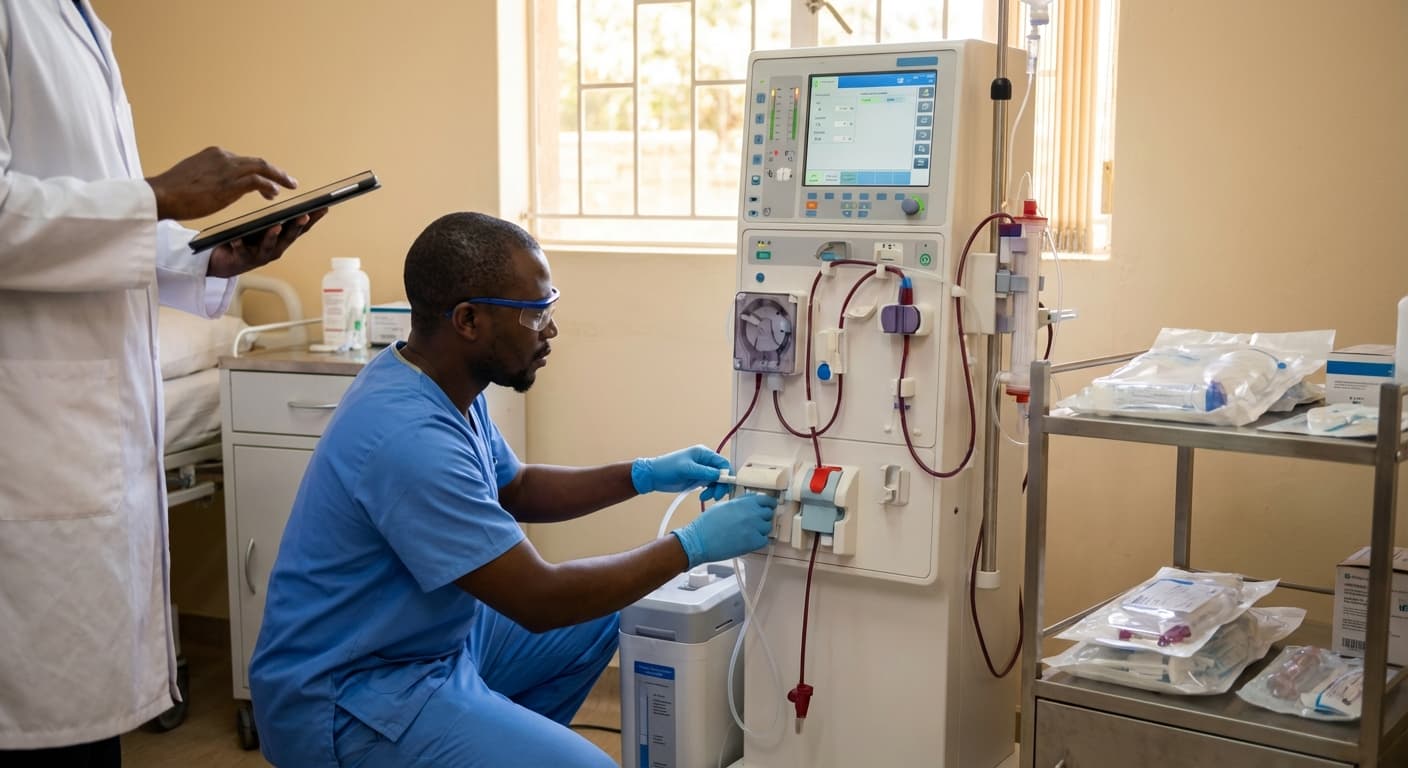
Hemodialysis Machine Installation Service in Equatorial Guinea
Engineering Excellence & Technical Support
Hemodialysis Machine Installation Service High-standard technical execution following OEM protocols and local regulatory frameworks.
Optimized Network Integration for Remote Monitoring
Our installation service ensures seamless integration of your hemodialysis machines with robust local and potentially cloud-based networks. This facilitates real-time data transmission for enhanced remote monitoring, predictive maintenance, and improved patient care management across Equatorial Guinea's unique logistical landscape.
Resilient Power & Water Purification System Setup
We specialize in designing and implementing resilient power supply solutions, including UPS integration and backup generator compatibility, tailored to Equatorial Guinea's infrastructure. Coupled with advanced, site-specific water purification system installation, we guarantee consistent and safe dialysate delivery for uninterrupted patient treatment.
Comprehensive On-Site Technical Training & Commissioning
Beyond physical installation, our service includes comprehensive, hands-on technical training for your biomedical engineering and nursing staff. We conduct thorough commissioning and validation protocols on-site, ensuring your team is fully proficient in operating, maintaining, and troubleshooting the hemodialysis machines for optimal performance and longevity.
What Is Hemodialysis Machine Installation Service In Equatorial Guinea?
Hemodialysis Machine Installation Service in Equatorial Guinea refers to the specialized process of setting up, calibrating, and integrating hemodialysis machines within healthcare facilities in the nation. This service ensures that the equipment is correctly installed, meets regulatory standards, and is ready for clinical operation. The primary objective is to provide a functional and safe environment for renal replacement therapy.
| Need For Service | Target Beneficiaries | Typical Use Cases | ||||||
|---|---|---|---|---|---|---|---|---|
| Establishment of new dialysis centers or expansion of existing ones. | Hospitals (public and private) | Setting up units in regions with limited access to renal care. | Hospitals requiring upgrades or replacements of outdated hemodialysis equipment. | Clinics and medical facilities offering specialized nephrology services. | Installation in remote or underserved areas of Equatorial Guinea. | Introduction of new hemodialysis machine models with advanced functionalities. | Government health initiatives aimed at increasing dialysis capacity. | Emergency preparedness and response for healthcare infrastructure development. |
Service Components
- Site Assessment and Preparation: Evaluating the intended installation location for power, water, drainage, and ventilation requirements. This includes ensuring adherence to biomedical engineering standards for safe and efficient operation.
- Machine Unpacking and Placement: Carefully unpacking the hemodialysis unit and positioning it according to the facility's layout and ergonomic considerations.
- Electrical and Plumbing Connections: Connecting the machine to appropriate, dedicated power outlets and a reliable water supply and drainage system. This often involves the installation of water treatment systems (e.g., reverse osmosis units) and specialized plumbing to ensure ultrapure dialysate.
- System Calibration and Testing: Performing initial system checks, including priming, flow rate calibration, pressure testing, and conductivity verification. This ensures the machine operates within manufacturer specifications and safety parameters.
- Integration with Ancillary Equipment: Connecting and testing any associated equipment, such as patient monitors, dialysate delivery systems, and waste management units.
- Initial Functional Verification: Conducting a series of simulated dialysis treatments to confirm the machine's performance and accuracy.
- Documentation and Handover: Providing comprehensive documentation, including installation reports, calibration certificates, and user manuals. This also involves formally handing over the operational equipment to the facility's biomedical engineering or nursing staff.
- Basic Operator Training (Optional/Included): In some instances, basic operational training for the clinical staff may be part of the service package, focusing on machine startup, shutdown, and routine operation.
Who Needs Hemodialysis Machine Installation Service In Equatorial Guinea?
Hemodialysis machine installation services are crucial for healthcare facilities in Equatorial Guinea looking to establish or expand their renal replacement therapy capabilities. These services ensure that life-saving dialysis equipment is set up correctly, calibrated, and ready for patient use, adhering to all safety and operational standards. The demand for these services is driven by the increasing prevalence of kidney disease and the growing need for accessible dialysis treatment within the country.
| Target Customer Type | Relevant Departments/Roles |
|---|---|
| Hospitals (Governmental & Private) | Nephrology Department, Biomedical Engineering Department, Procurement Department, Facility Management |
| Dialysis Centers | Center Management, Clinical Director, Biomedical Technician, Head Nurse |
| Clinics with Nephrology Departments | Clinic Administrator, Lead Nephrologist, Technical Staff |
| Medical Equipment Suppliers & Distributors | Installation & Technical Support Teams, Sales Representatives, Project Managers |
| Non-Governmental Organizations (NGOs) | Project Managers, Healthcare Coordinators, Technical Advisors |
Target Customers and Departments for Hemodialysis Machine Installation Service in Equatorial Guinea
- Hospitals (Governmental & Private)
- Dialysis Centers (Standalone or Hospital-affiliated)
- Clinics with Nephrology Departments
- Medical Equipment Suppliers & Distributors (as partners or end-users)
- Non-Governmental Organizations (NGOs) focused on healthcare
Hemodialysis Machine Installation Service Process In Equatorial Guinea
This document outlines the typical workflow for a Hemodialysis Machine Installation Service Process in Equatorial Guinea, from initial inquiry to the final execution and handover. The process is designed to ensure efficient and compliant installation, minimizing disruption and maximizing the operational readiness of the equipment.
| Phase | Key Activities | Responsible Parties | Deliverables | Timeline (Indicative) |
|---|---|---|---|---|
| Receive initial inquiry from client (hospital, clinic, government health agency). Discuss client's specific needs, machine model(s), quantity, and desired timeline. Provide preliminary information on service offerings and capabilities. | Service Provider Sales/Technical Team, Client Representative | Understanding of client requirements, initial proposal overview. | 1-3 Business Days |
| Conduct a thorough site survey of the intended installation location. Assess power, water, drainage, ventilation, and space requirements. Identify any potential logistical challenges (e.g., accessibility, import procedures). Develop a detailed installation plan, including resource allocation and scheduling. | Service Provider Technical Team, Client's Facility Manager/Biomedical Engineer | Site assessment report, preliminary installation plan, identification of site-specific requirements. | 3-7 Business Days |
| Prepare a detailed quotation based on site assessment and client requirements. Include costs for equipment, installation, training, and any necessary accessories. Negotiate terms and conditions. Finalize and sign a service contract. | Service Provider Sales/Contracts Team, Client Representative | Formal quotation, signed service contract. | 2-5 Business Days |
| Source and procure the specified hemodialysis machines and accessories. Manage import procedures, customs clearance, and transportation to Equatorial Guinea. Coordinate delivery to the client's site. | Service Provider Logistics Team, Vendor/Manufacturer, Client's Procurement Department | Delivered hemodialysis machines and accessories at the client's facility. | Variable (depends on sourcing and import timelines, potentially weeks to months) |
| Ensure the installation site meets all specified requirements (power, water, etc.). Prepare the area for the machines. Confirm availability of necessary tools and materials. | Client's Facility Management, Service Provider Technical Team | Ready and compliant installation site. | 1-3 Business Days (prior to installation) |
| Unpack and meticulously install the hemodialysis machines according to manufacturer specifications and local regulations. Connect machines to power, water, and drainage systems. Install any required accessories or peripherals. | Service Provider Certified Technicians | Installed hemodialysis machines. | 1-3 Days per machine (depending on complexity) |
| Perform comprehensive functional tests of each machine. Calibrate machines to ensure accuracy and optimal performance. Conduct quality assurance checks. | Service Provider Certified Technicians | Fully functional and calibrated hemodialysis machines, test reports. | 1-2 Days per machine |
| Provide comprehensive training to the client's medical and technical staff on the operation, maintenance, and basic troubleshooting of the hemodialysis machines. Training materials provided. | Service Provider Technical Trainers, Client's Medical and Technical Staff | Trained personnel, training certificates (if applicable). | 1-3 Days per training session |
| Compile all relevant documentation, including installation reports, test results, calibration certificates, and user manuals. Formally hand over the installed machines and documentation to the client. Obtain client sign-off. | Service Provider Project Manager/Lead Technician, Client Representative | Complete installation documentation package, client sign-off. | 1-2 Business Days |
| Provide a warranty period for the installed equipment and service. Offer ongoing technical support, spare parts, and preventive maintenance services as per contract. | Service Provider Technical Support Team, Client's Biomedical Department | Operational hemodialysis service, ongoing support. | Ongoing (as per contract) |
Hemodialysis Machine Installation Service Process Workflow
- Inquiry and Initial Consultation
- Site Assessment and Planning
- Quotation and Contract Agreement
- Logistics and Equipment Procurement
- Pre-Installation Preparation
- On-site Installation and Setup
- Testing and Calibration
- User Training
- Documentation and Handover
- Post-Installation Support
Hemodialysis Machine Installation Service Cost In Equatorial Guinea
The cost of installing a hemodialysis machine in Equatorial Guinea can vary significantly due to several key factors. These include the complexity of the installation itself, the specific model and brand of the hemodialysis machine, the required infrastructure upgrades at the healthcare facility, and the service provider's expertise and location. When seeking this service, it's crucial to obtain detailed quotes that outline all associated charges. Local currency pricing will be influenced by prevailing market rates for specialized medical equipment services, transportation of technicians and equipment, and the overall economic conditions within Equatorial Guinea.
| Cost Component | Estimated Range (XAF - Central African CFA Franc) |
|---|---|
| Basic Installation (excluding infrastructure) | 250,000 - 750,000 XAF |
| Installation with Basic Water Purification Integration | 500,000 - 1,500,000 XAF |
| Comprehensive Installation (including minor infrastructure adjustments) | 1,000,000 - 3,000,000 XAF |
| Advanced/Complex Installations (significant infrastructure work, specialized training) | 2,000,000 - 6,000,000+ XAF |
| On-site Technician Travel & Accommodation (if applicable, per trip) | 100,000 - 500,000 XAF |
| Water Purification System (RO) Installation (separate or integrated) | 300,000 - 1,200,000 XAF |
Key Pricing Factors for Hemodialysis Machine Installation in Equatorial Guinea:
- Type and Model of Hemodialysis Machine: High-end, advanced machines often require more complex integration and specialized training, impacting installation costs.
- Infrastructure Requirements: This can include electrical supply, water purification systems (RO systems), plumbing modifications, ventilation, and dedicated space, all of which add to the overall expense.
- Site Assessment and Preparation: Initial visits to evaluate the facility and any necessary preparatory work before installation.
- Technician Expertise and Travel: The cost of qualified biomedical engineers or technicians, including their travel and accommodation if they are not local.
- Logistics and Transportation: Moving the hemodialysis machine and any associated equipment to the installation site.
- Warranty and After-Sales Support: Some installation packages include initial warranty periods or basic support, which can affect the upfront cost.
- Geographic Location within Equatorial Guinea: Installation costs might differ slightly between major cities like Malabo and Bata, and more remote areas due to transportation challenges.
- Service Provider's Overhead and Profit Margin: Different companies will have varying operational costs and pricing strategies.
Affordable Hemodialysis Machine Installation Service Options
Access to reliable and affordable hemodialysis machine installation is crucial for healthcare facilities and individuals. This service ensures that essential life-saving equipment is set up correctly, efficiently, and within budget. We explore value bundles and cost-saving strategies to make this process more accessible.
| Service Offering | Description | Typical Cost Range (USD) | Value & Cost-Saving Notes |
|---|---|---|---|
| Basic Installation | Covers essential setup, calibration, and initial testing. Operator training may be limited or separate. | $1,500 - $3,000 | Most budget-friendly. Focuses on core functionality. Consider group training for cost reduction. |
| Standard Installation Bundle | Includes basic installation plus comprehensive operator training and basic post-installation support for a defined period. | $2,500 - $4,500 | Offers a good balance of service and cost. Bundling training significantly reduces individual training expenses. Extended support can be negotiated. |
| Premium Installation Package | Comprehensive setup, advanced operator training, extended warranty, dedicated technical support, and potentially site preparation consultation. | $4,000 - $7,000+ | Maximizes operational efficiency and minimizes future unforeseen costs. Offers peace of mind. Look for package deals on machines and installation together. |
| On-Demand/Ad-Hoc Service | Installation requested as needed, without a pre-defined package. Costs can be higher due to less predictable scheduling. | Variable (often hourly rates apply) | Can be more expensive per incident. Best for urgent situations or very infrequent needs. Compare quotes from multiple providers. |
Key Components of Hemodialysis Machine Installation
- Site assessment and preparation (water purification, electrical, plumbing).
- Machine delivery and unboxing.
- Technical setup and calibration of the hemodialysis machine.
- Initial testing and operational checks.
- Operator training and familiarization.
- Post-installation support and troubleshooting.
Verified Providers In Equatorial Guinea
Ensuring access to quality healthcare is paramount, especially in regions like Equatorial Guinea where the availability of verified and reputable medical providers can be a challenge. Franance Health stands out as a leading organization dedicated to connecting individuals and organizations with trusted healthcare professionals and facilities within the country. Their rigorous credentialing process and commitment to excellence make them the optimal choice for anyone seeking reliable medical services in Equatorial Guinea.
| Why Franance Health is the Best Choice | Key Differentiators |
|---|---|
| Unparalleled Access to Verified Providers | Franance Health has cultivated a comprehensive network of pre-vetted doctors, specialists, and healthcare facilities across Equatorial Guinea, eliminating the uncertainty often associated with finding quality care. |
| Commitment to International Standards | All Franance Health-affiliated providers are held to high standards of medical practice, ensuring that patients receive care that is safe, effective, and ethically sound. |
| Streamlined Healthcare Navigation | Franance Health simplifies the process of accessing healthcare, offering assistance with appointments, referrals, and understanding available medical options. |
| Focus on Patient Well-being | Beyond just connecting patients with providers, Franance Health prioritizes patient satisfaction and positive health outcomes through continuous quality improvement initiatives. |
| Expertise in the Local Context | With a deep understanding of Equatorial Guinea's healthcare landscape, Franance Health provides tailored solutions that meet the specific needs of individuals and businesses operating in the region. |
Franance Health's Rigorous Credentialing Process
- Verification of medical licenses and certifications.
- Thorough background checks and reference reviews.
- Assessment of clinical experience and specialization.
- Evaluation of adherence to international healthcare standards.
- Ongoing monitoring of provider performance and patient feedback.
Scope Of Work For Hemodialysis Machine Installation Service
This Scope of Work (SOW) outlines the services required for the successful installation of hemodialysis machines at the designated healthcare facility. It details the technical deliverables, standard specifications, and the responsibilities of both the service provider and the client to ensure a safe, efficient, and compliant operational setup.
| Category | Description | Standard Specifications / Deliverables | Acceptance Criteria |
|---|---|---|---|
| Site Preparation & Assessment | Evaluation of the installation site to ensure it meets the technical and environmental requirements for hemodialysis machines. | <ul><li>Pre-installation site survey report detailing power, water, drainage, ventilation, and space requirements.</li><li>Confirmation of adherence to facility blueprints and architectural plans for the installation area.</li><li>Identification and mitigation of any site-specific risks.</li></ul> | Signed site assessment report by both parties, confirming the site's readiness for installation. |
| Machine Delivery & Unpacking | Secure transportation, receipt, and careful unpacking of hemodialysis machines and associated accessories. | <ul><li>Proof of delivery documenting the condition of the machines upon arrival.</li><li>Inspection for any physical damage during transit.</li><li>Verification of all included components against the delivery manifest.</li></ul> | Visual inspection report confirming no damage and completeness of delivered items. |
| Installation & Setup | Physical installation and connection of hemodialysis machines to utility services. | <ul><li>Mounting and securing of machines as per manufacturer specifications.</li><li>Connection to purified water supply (RO/DI system) and drainage.</li><li>Electrical connection to dedicated, grounded, and surge-protected power outlets.</li><li>Integration with any specified network infrastructure for data logging or monitoring.</li></ul> | Successful connection to all required utilities without leaks or electrical faults. Machine status indicators showing 'Ready' or equivalent. |
| System Testing & Calibration | Comprehensive testing to verify the operational integrity and accuracy of each hemodialysis machine. | <ul><li>Functional tests of all machine modes (e.g., dialysis, rinse, disinfection).</li><li>Calibration of critical parameters (e.g., blood flow, dialysate composition, pressure sensors) against traceable standards.</li><li>Performance testing under simulated patient conditions.</li><li>Leak testing of all fluid pathways.</li></ul> | Test reports with documented readings for all parameters, within manufacturer-specified tolerances. Successful completion of all automated diagnostic tests. |
| Disinfection & Sterilization | Performing initial disinfection and sterilization procedures before the machine is used for patient treatment. | <ul><li>Execution of recommended disinfection cycles using approved agents.</li><li>Verification of disinfection effectiveness (if applicable via testing).</li></ul> | Log of completed disinfection cycles, confirming process completion as per manufacturer instructions. |
| Documentation & Reporting | Provision of all necessary documentation related to the installation and initial setup. | <ul><li>Detailed installation report outlining the process, date, and personnel involved.</li><li>Calibration certificates for all tested parameters.</li><li>User manuals and service manuals for each machine model.</li><li>As-built drawings or diagrams of the installation setup (if required).</li></ul> | Submission of all required documents in a clear and organized format. |
| Staff Training | Training for designated clinical and biomedical engineering staff on the operation, basic troubleshooting, and preventive maintenance of the installed machines. | <ul><li>Hands-on training sessions covering daily operation, alarm management, and basic maintenance procedures.</li><li>Training materials (e.g., presentations, handouts) provided.</li><li>Competency assessment of trained personnel (optional, based on agreement).</li></ul> | Attendance records for training sessions. Signed acknowledgment of training receipt by facility staff. Successful demonstration of basic operational tasks by trainees. |
| Post-Installation Support | Provision of limited post-installation support to address any immediate issues. | <ul><li>Defined period of on-site support for initial operational queries.</li><li>Contact information for technical support and emergency assistance.</li></ul> | Resolution of any reported critical issues within the defined support period. Establishment of clear escalation procedures. |
Key Objectives
- To ensure the safe and proper installation of hemodialysis machines according to manufacturer guidelines and industry best practices.
- To verify and document the functionality and performance of each installed machine.
- To provide necessary training to designated facility staff on the operation and basic maintenance of the installed machines.
- To ensure all installations meet relevant regulatory and accreditation standards.
- To minimize disruption to existing clinical operations during the installation process.
Service Level Agreement For Hemodialysis Machine Installation Service
This Service Level Agreement (SLA) outlines the performance standards and guarantees for the installation of Hemodialysis Machines provided by [Your Company Name] to [Client Name]. It defines the expected response times for service requests and the guaranteed uptime for the installed equipment.
| Service Component | Response Time Target | Uptime Guarantee |
|---|---|---|
| Installation Completion | Within [Number] business days of site readiness confirmation. | N/A (This pertains to the initial installation process, not ongoing operation). |
| Urgent Service Request (Critical Failure) | Within [Number] business hours (e.g., 4 business hours) of notification. | 98% Uptime (excluding scheduled maintenance) |
| Standard Service Request (Non-Critical Issue) | Within [Number] business days (e.g., 1 business day) of notification. | 98% Uptime (excluding scheduled maintenance) |
| Preventive Maintenance | Scheduled in advance with Client, with notification at least [Number] days prior. | Integral to maintaining uptime; duration and impact to be communicated during scheduling. |
Key Definitions
- Service Request: Any notification from the Client to [Your Company Name] regarding a malfunction, operational issue, or need for assistance with the installed Hemodialysis Machine.
- Installation: The complete process of setting up, configuring, and testing a Hemodialysis Machine at the Client's facility, ensuring it is ready for clinical use.
- Downtime: The period during which the Hemodialysis Machine is unavailable for use due to a malfunction, failure, or required maintenance initiated by [Your Company Name]. Planned maintenance is excluded.
- Response Time: The maximum allowable time between [Your Company Name] receiving a Service Request and initiating troubleshooting or dispatching a technician.
- Uptime Guarantee: The percentage of time the Hemodialysis Machine is expected to be operational and available for use.
Frequently Asked Questions

Ready when you are
Let's scope your Hemodialysis Machine Installation Service in Equatorial Guinea project in Equatorial Guinea.

Scaling healthcare logistics and technical systems across the entire continent.