
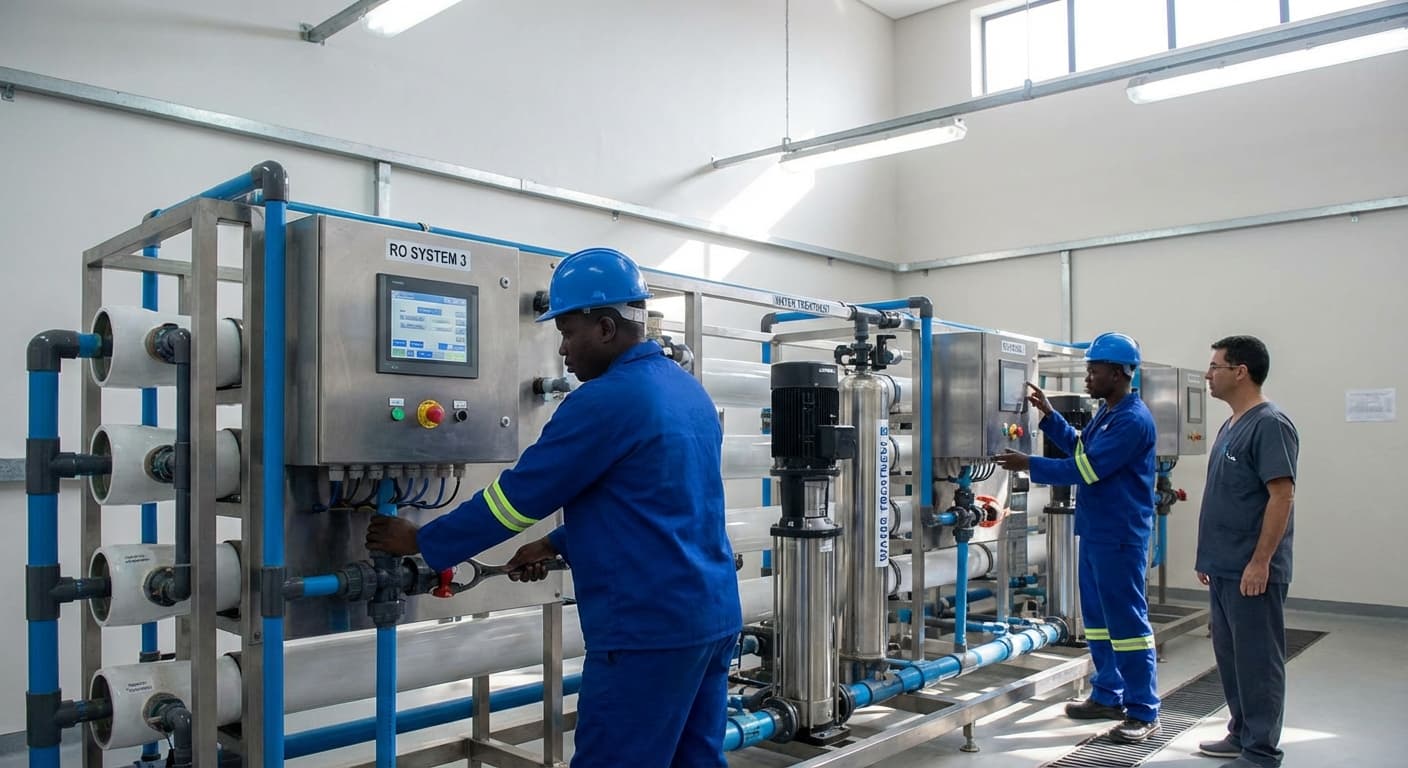
Dialysis RO/Water Treatment Plant Installation Service in Equatorial Guinea
Engineering Excellence & Technical Support
Dialysis RO/Water Treatment Plant Installation Service High-standard technical execution following OEM protocols and local regulatory frameworks.
Advanced RO Membrane Technology
We implement cutting-edge Reverse Osmosis (RO) membrane systems specifically chosen for the unique water quality challenges in Equatorial Guinea. This ensures the highest purity water for dialysis, minimizing mineral buildup and enhancing membrane lifespan even with challenging source water.
Robust & Climate-Resilient Design
Our installations are engineered for the tropical climate of Equatorial Guinea, featuring corrosion-resistant materials, enhanced ventilation, and secure enclosures to protect sensitive equipment from humidity, heat, and potential environmental factors, guaranteeing sustained operational reliability.
Turnkey Project Management & Commissioning
From initial site assessment and system design to full installation, rigorous testing, and final commissioning, we provide end-to-end project management. Our expert engineers ensure seamless integration with existing infrastructure and provide comprehensive training for local operational staff.
What Is Dialysis Ro/water Treatment Plant Installation Service In Equatorial Guinea?
Dialysis RO/Water Treatment Plant Installation Service in Equatorial Guinea refers to the comprehensive process of designing, supplying, and commissioning Reverse Osmosis (RO) and associated water purification systems specifically for dialysis facilities. These systems are critical for producing ultrapure water, essential for hemodialysis procedures. The service ensures that the installed plant meets stringent international standards for water quality, patient safety, and regulatory compliance within Equatorial Guinea's healthcare infrastructure. This includes site assessment, system design tailored to local water sources and dialysis patient volume, procurement of specialized equipment, installation, rigorous testing, and initial operational training.
| Who Needs It? | Typical Use Cases | ||
|---|---|---|---|
| Dialysis Centers (Public and Private): Facilities performing hemodialysis for patients with renal failure. | Hospitals with Nephrology Departments: In-house dialysis units within larger medical institutions. | Government Health Ministries: For establishing or upgrading national dialysis infrastructure. | Non-Governmental Organizations (NGOs): Involved in healthcare provision and infrastructure development in the region. |
| Routine Hemodialysis: Production of ultrapure water for regular dialysis treatments. | New Facility Construction: Installation of a complete water treatment system for a newly built dialysis center. | Existing Facility Upgrades: Replacement or enhancement of aging or inadequate water treatment systems. | Emergency or Disaster Relief: Provision of mobile or temporary dialysis water treatment solutions. |
Key Components of Dialysis RO/Water Treatment Plant Installation Service:
- Water Source Assessment: Characterizing the incoming raw water (e.g., municipal supply, well water) for parameters such as total dissolved solids (TDS), hardness, microbial load, and specific contaminants.
- System Design & Engineering: Developing a bespoke treatment train including pre-treatment (filtration, softening), RO membranes, post-treatment (deionization, UV sterilization, loop sanitization), and distribution networks.
- Equipment Procurement & Logistics: Sourcing and transporting specialized RO units, pumps, tanks, piping, instrumentation, and control systems compliant with medical-grade specifications.
- On-site Installation & Integration: Assembling and connecting all system components, including electrical wiring, plumbing, and control panel integration.
- Commissioning & Validation: Performing comprehensive testing to verify system performance against predefined water quality parameters (e.g., AAMI standards), including microbial and endotoxin testing.
- Training & Handover: Providing operational and maintenance training to facility personnel for effective system management and troubleshooting.
- Regulatory Compliance Support: Ensuring the installation adheres to any relevant local health and environmental regulations in Equatorial Guinea.
Who Needs Dialysis Ro/water Treatment Plant Installation Service In Equatorial Guinea?
Access to clean and reliable water is paramount for numerous industries and institutions. In Equatorial Guinea, the need for Dialysis RO/Water Treatment Plant Installation Services is growing, driven by advancements in healthcare, industrial development, and the critical importance of purified water for specific applications. These services are essential for ensuring the safety, efficiency, and regulatory compliance of operations that depend on high-purity water.
| Customer Type | Primary Need for Dialysis RO/Water Treatment | Relevant Departments within Customer Organization |
|---|---|---|
| Public Hospitals | Essential for life-saving dialysis treatments; ensuring patient safety and preventing infections. | Hospital Administration, Biomedical Engineering, Procurement, Nursing Administration (for direct impact) |
| Private Hospitals/Clinics | Meeting international quality standards for specialized medical services, including dialysis; patient satisfaction and reputation. | Hospital Management, Procurement, Operations, Quality Assurance |
| Research Institutions | Achieving accurate and reproducible scientific results; preventing contamination in experiments. | Lab Management, Research Directors, Procurement, Facilities Management |
| Pharmaceutical Manufacturers | Ensuring purity in drug production processes; meeting regulatory compliance. | Production Management, Quality Control, Engineering, Procurement |
| Government Health Agencies | Establishing and equipping public healthcare facilities to provide essential services; setting water quality standards. | Policy Makers, Project Managers, Technical Advisors, Procurement Officers |
Target Customers and Departments for Dialysis RO/Water Treatment Plant Installation Services in Equatorial Guinea
- {"title":"Healthcare Sector","description":"The primary and most critical sector requiring dialysis RO/water treatment. Dialysis requires ultra-pure water to prevent complications and ensure patient safety. As healthcare infrastructure develops and access to specialized medical treatments like dialysis expands, the demand for these plants will surge."}
- {"title":"Government & Public Health Institutions","description":"Government-run hospitals, clinics, and public health departments responsible for providing healthcare services, especially those offering dialysis treatment. They are often responsible for investing in and maintaining essential medical infrastructure."}
- {"title":"Private Hospitals and Clinics","description":"Emerging private healthcare providers focusing on specialized treatments, including dialysis, will require state-of-the-art water purification systems to meet international standards and attract patients."}
- {"title":"Research and Development Laboratories","description":"Laboratories involved in medical research, pharmaceutical development, and scientific studies often require highly purified water for experiments and analyses. Contaminated water can invalidate research findings."}
- {"title":"Industrial Manufacturing (Specific Industries)","description":"While not directly for dialysis, certain manufacturing processes require purified water. This can include sectors like food and beverage production, pharmaceuticals manufacturing (beyond R&D), and electronics assembly where water quality is critical for product integrity and process efficiency."}
- {"title":"Hospital Administration & Procurement Departments","description":"These departments are responsible for budgeting, sourcing, and acquiring essential medical equipment and infrastructure, including water treatment systems. They will be the decision-makers and procurement point for such services."}
- {"title":"Facility Management & Engineering Departments","description":"Responsible for the operational upkeep, maintenance, and functionality of hospital and institutional facilities. They will oversee the installation and ongoing operation of the water treatment plants."}
- {"title":"Ministry of Health & Social Welfare","description":"The governmental body overseeing healthcare policy, standards, and infrastructure development. They may drive large-scale projects for public health facilities and set regulations for water quality in medical settings."}
- {"title":"Ministry of Energy and Water Resources","description":"While focused on general water resources, this ministry may be involved in projects that require significant water treatment infrastructure, especially if they are supporting critical public service facilities like hospitals."}
Dialysis Ro/water Treatment Plant Installation Service Process In Equatorial Guinea
This document outlines the comprehensive service process for the installation of Dialysis Reverse Osmosis (RO) and Water Treatment Plants in Equatorial Guinea, from the initial client inquiry to the final handover and ongoing support. Our aim is to ensure a seamless and efficient deployment that meets the highest standards of water purity for dialysis.
| Phase | Key Activities | Description | Deliverables | Timeline (Indicative) |
|---|---|---|---|---|
| Initial Contact, Needs Assessment, Preliminary Discussion | Client expresses interest. We gather preliminary information on their requirements, existing infrastructure, and desired system capacity. A preliminary discussion of our services and capabilities is conducted. | Initial meeting notes, understanding of client needs. | 1-3 business days |
| Site Visit, Water Quality Analysis, System Design | Our technical team visits the site in Equatorial Guinea to conduct a thorough assessment of the available space, power supply, plumbing, and local water source. Water samples are collected for detailed quality analysis. Based on these findings, a customized RO/Water Treatment Plant design is developed, including system specifications and layout. | Site assessment report, water analysis report, preliminary system design proposal. | 3-7 business days (post-site visit) |
| Detailed Quotation, Technical Proposal, Contract Agreement | A comprehensive proposal is submitted to the client, detailing the system design, technical specifications, equipment list, installation plan, project timeline, warranty, and all associated costs. Upon agreement, a formal contract is signed. | Formal proposal, detailed quotation, signed contract. | 2-5 business days |
| Equipment Sourcing, Manufacturing/Assembly, Shipping, Importation | We procure all necessary components and equipment from trusted suppliers. The RO/Water Treatment Plant may be manufactured or assembled to client specifications. We manage all aspects of shipping, customs clearance, and importation to Equatorial Guinea, ensuring compliance with local regulations. | Equipment manifests, shipping documents, customs clearance approvals. | 4-12 weeks (depending on equipment lead times) |
| Site Preparation, Equipment Installation, System Testing, Water Quality Verification | Our experienced engineers and technicians travel to the site to prepare the installation area and meticulously install the RO/Water Treatment Plant. This includes plumbing, electrical connections, and system integration. Rigorous testing and commissioning are performed to ensure optimal performance and compliance with strict water purity standards for dialysis. | Installed RO/Water Treatment Plant, commissioning report, initial water quality test results. | 2-6 weeks (depending on system complexity) |
| Operator Training, System Manuals, Final Inspection, Project Handover | Comprehensive training is provided to the client's designated personnel on the operation, routine maintenance, and troubleshooting of the RO/Water Treatment Plant. All relevant system manuals and documentation are handed over. A final inspection is conducted before the formal project handover. | Trained personnel, operation and maintenance manuals, project completion certificate. | 3-7 business days |
| Warranty Support, Preventive Maintenance, Troubleshooting, Spare Parts | We offer ongoing support services, including warranty coverage, scheduled preventive maintenance to ensure longevity and optimal performance, prompt troubleshooting, and readily available spare parts. This phase ensures the continuous reliable operation of the dialysis water treatment system. | Service level agreements (SLAs), maintenance schedules, support contact information. | Ongoing (as per contract) |
Dialysis RO/Water Treatment Plant Installation Service Process
- Phase 1: Inquiry and Consultation
- Phase 2: Site Assessment and Design
- Phase 3: Proposal and Contract
- Phase 4: Procurement and Logistics
- Phase 5: Installation and Commissioning
- Phase 6: Training and Handover
- Phase 7: Post-Installation Support and Maintenance
Dialysis Ro/water Treatment Plant Installation Service Cost In Equatorial Guinea
The cost of installing a Reverse Osmosis (RO) and Water Treatment Plant for dialysis in Equatorial Guinea is influenced by several critical factors, leading to a wide range of potential expenses. These factors encompass the scale and complexity of the system, the quality and brand of equipment chosen, site-specific preparation needs, installation labor, ongoing maintenance, and regulatory compliance. Given the developing infrastructure and logistical challenges in Equatorial Guinea, pricing can be significantly higher compared to more established markets. Local currency, the West African CFA franc (XOF), is used for all transactions. It's crucial for healthcare facilities to obtain detailed quotes from reputable suppliers and installers familiar with the Equatorial Guinean market to ensure accurate budgeting and successful project execution.
| System Size/Complexity | Estimated Cost Range (XOF) | Notes |
|---|---|---|
| Small-scale (e.g., 1-2 dialysis stations) | 15,000,000 - 30,000,000 | Basic pre-treatment, single-pass RO, minimal automation. Assumes relatively straightforward site prep. |
| Medium-scale (e.g., 3-6 dialysis stations) | 30,000,000 - 60,000,000 | Enhanced pre-treatment, potentially double-pass RO or more advanced membrane technology, basic automation, and monitoring. Higher potential for specialized site work. |
| Large-scale (e.g., 7+ dialysis stations or a dedicated dialysis center) | 60,000,000 - 150,000,000+ | Sophisticated multi-stage treatment, high-capacity RO, advanced automation, comprehensive monitoring systems, robust safety features, significant site infrastructure development. Can include redundancy for critical systems. |
| Add-ons (e.g., advanced automation, remote monitoring, specialized disinfection) | 5,000,000 - 20,000,000+ | These are incremental costs on top of the base system price, depending on the specific features chosen. |
Key Pricing Factors for Dialysis RO/Water Treatment Plant Installation in Equatorial Guinea:
- Plant Capacity and Design: The required output volume (liters per hour/day) for dialysis treatments directly impacts the size and complexity of the RO and water treatment system. Larger capacities necessitate bigger membranes, more robust pre-treatment, and potentially advanced purification stages, thus increasing costs.
- Equipment Quality and Brand: High-end, internationally recognized brands often come with a premium price tag but may offer superior reliability, longevity, and performance. Local or less established brands might be more affordable but could compromise on quality or long-term support.
- Scope of Treatment Stages: The level of water purification required is paramount. This includes the number and type of filters (sediment, carbon), RO membranes, UV sterilization, and potentially post-treatment systems to achieve the stringent purity standards for dialysis. Each additional stage adds to the overall cost.
- Site Preparation and Infrastructure: This can be a significant cost driver in Equatorial Guinea. It may involve civil works, electrical upgrades to support the plant's power demands, plumbing modifications, water source assessment and improvement, and secure housing for the equipment. Remote or challenging locations can exacerbate these costs due to transportation and specialized labor requirements.
- Installation Labor and Expertise: The availability of skilled technicians experienced in RO and water treatment plant installation is crucial. Specialized international expertise might be required, which comes with higher professional fees and travel expenses. Local labor costs, while potentially lower, might require additional training or supervision.
- Ancillary Equipment and Consumables: This includes storage tanks, pumps, piping, instrumentation, water quality monitoring devices, and the initial set of consumables (filters, membranes) required for operation. Their quantity and quality will affect the initial investment.
- Logistics and Transportation: Importing specialized equipment into Equatorial Guinea can involve substantial shipping costs, import duties, and taxes, especially for larger or heavier components. Navigating customs and local logistics can also add to the overall expense.
- Warranty and After-Sales Service: The duration and scope of the warranty offered by the supplier, as well as the availability of local after-sales service and technical support, are important considerations that can influence the initial price.
- Regulatory Compliance and Permitting: Obtaining necessary permits and ensuring the installation meets local health and safety regulations can incur administrative fees and may require specific modifications to the plant design or installation process.
Affordable Dialysis Ro/water Treatment Plant Installation Service Options
Access to clean and reliable water is paramount for dialysis patients. A well-functioning Reverse Osmosis (RO) or water treatment plant ensures the safety and efficacy of dialysis treatments by removing impurities that could harm patients. Finding affordable installation services for these critical systems is essential for healthcare facilities and clinics. This guide explores various installation service options, highlights the benefits of value bundles, and outlines cost-saving strategies to help you secure high-quality dialysis water treatment solutions without breaking the bank.
| Value Bundle Component | Description | Cost-Saving Benefit |
|---|---|---|
| Comprehensive Installation & Commissioning: | Includes site assessment, equipment delivery, plumbing, electrical connections, system startup, and initial water quality testing. | Bundling installation with commissioning ensures a seamless transition and can be priced more competitively than separate services. Reduces the risk of unexpected costs during startup. |
| Installation & Extended Warranty: | Combines the initial installation service with an extended warranty on the RO system and associated components. | Provides peace of mind and protection against unexpected repair costs beyond the standard warranty period, effectively a form of long-term cost management. |
| Installation & Initial Maintenance Package: | Includes the installation service along with a predetermined number of initial maintenance visits (e.g., filter replacements, system checks). | Proactive maintenance prevents costly breakdowns and ensures optimal system performance, leading to fewer emergency repairs and extending equipment life. |
| Installation & Water Quality Monitoring Services: | Integrates installation with a service that includes ongoing water quality testing and reporting. | Ensures continuous compliance with stringent dialysis water standards and allows for early detection of any issues, preventing potentially serious consequences and associated remediation costs. |
| Bulk Installation Discounts: | If a facility is setting up multiple dialysis units or clinics, negotiating a bulk installation package for all systems. | Leverages economies of scale to secure a lower per-unit installation cost. |
Affordable Dialysis RO/Water Treatment Plant Installation Service Options
- Independent Installers & Small Businesses: Often offer competitive pricing due to lower overhead. Look for specialists with proven experience in healthcare settings and dialysis water systems. Thoroughly vet their credentials, certifications, and past client reviews.
- Manufacturer's Recommended Installers: While sometimes perceived as more expensive, these installers are factory-trained and ensure warranty compliance. They often have a deep understanding of the specific equipment, potentially leading to more efficient and effective installations.
- Regional Water Treatment Specialists: Companies that focus on water treatment across a specific geographic area might offer more tailored services and potentially better pricing compared to national chains. Their local presence can also be beneficial for ongoing maintenance and support.
- DIY Installation (with expert consultation): For facilities with in-house technical expertise, a DIY approach combined with professional consultation for critical stages (e.g., system design, final connections, water quality testing) can be a significant cost saver. Caution is advised: Incorrect installation can lead to system failure, patient harm, and costly repairs. This option requires extreme diligence and adherence to all regulations.
- Service Agreements & Long-Term Contracts: Negotiating a comprehensive service agreement that includes installation can sometimes lead to bundled discounts and predictable maintenance costs over time, saving money in the long run.
Verified Providers In Equatorial Guinea
Navigating healthcare in a foreign country can be challenging. In Equatorial Guinea, ensuring you receive quality and reliable medical services is paramount. This is where verified providers, such as those accredited by Franance Health, become indispensable. Franance Health's rigorous credentialing process ensures that healthcare facilities and professionals meet stringent international standards for patient care, safety, and ethical practice. Choosing providers with Franance Health credentials offers peace of mind, guaranteeing access to competent medical expertise and a commitment to patient well-being.
| Area of Healthcare | Franance Health Verified Providers Offer | Benefits for Patients |
|---|---|---|
| General Practice & Primary Care | Experienced general practitioners, comprehensive health screenings, routine check-ups. | Early detection of illnesses, ongoing management of chronic conditions, personalized health plans. |
| Specialist Medical Services (e.g., Cardiology, Dermatology, Pediatrics) | Board-certified specialists, advanced diagnostic equipment, tailored treatment plans. | Expert diagnosis and treatment for specific health concerns, access to sub-specialty care. |
| Surgical Procedures | Qualified surgeons, state-of-the-art operating theaters, adherence to sterile protocols. | Safe and effective surgical interventions, minimized post-operative complications, faster recovery. |
| Emergency Services | 24/7 availability, trained emergency medical teams, rapid response capabilities. | Immediate life-saving care, prompt stabilization, efficient transfer if needed. |
| Diagnostic Imaging (X-ray, Ultrasound, CT Scans) | Modern imaging technology, skilled radiographers and radiologists, accurate interpretation. | Precise identification of internal conditions, aiding in accurate diagnosis and treatment planning. |
| Laboratory Services | Accredited laboratories, a wide range of diagnostic tests, quick and reliable results. | Essential for diagnosis, monitoring treatment effectiveness, and identifying potential health risks. |
Why Franance Health Credentials Matter in Equatorial Guinea:
- Uncompromising Quality Standards: Franance Health meticulously vets facilities and practitioners, ensuring adherence to global best practices in healthcare delivery.
- Patient Safety First: Credentials indicate a commitment to robust safety protocols, minimizing risks and prioritizing patient well-being.
- Ethical Practice Assurance: Franance Health verifies that providers operate with the highest ethical standards, fostering trust and transparency.
- Access to Competent Professionals: Certified providers have demonstrated their expertise and qualifications, ensuring you receive care from skilled medical personnel.
- International Recognition: Franance Health accreditation signifies a level of quality recognized internationally, offering a benchmark for excellence.
- Reduced Risk of Misinformation: In areas where healthcare information might be scarce, accredited providers offer a reliable source of dependable medical services.
- Enhanced Patient Confidence: Knowing your provider is verified by a reputable organization like Franance Health significantly boosts confidence in the care received.
Scope Of Work For Dialysis Ro/water Treatment Plant Installation Service
This Scope of Work (SOW) outlines the requirements for the installation services of a Dialysis Reverse Osmosis (RO) / Water Treatment Plant. It covers all aspects from site preparation and equipment installation to commissioning and handover, ensuring compliance with industry best practices and relevant standards. The objective is to deliver a fully functional and compliant water treatment system for dialysis applications, meeting stringent quality and safety requirements.
| Phase | Description | Technical Deliverables | Standard Specifications/Compliance |
|---|---|---|---|
| Assessing site conditions, ensuring availability of utilities (power, water, drainage), and preparing the installation area. This includes necessary civil works, structural modifications, and electrical/plumbing provisions. | Site survey report, detailed site preparation plan, confirmation of utility connections, minor civil works completion report. | Adherence to facility design drawings, local building codes, electrical safety standards (e.g., NEC), plumbing codes, and infection control guidelines. |
| Receiving, inspecting, and safely storing all components of the RO/Water Treatment Plant at the designated site. | Equipment receiving checklist, damage inspection reports, secure storage plan. | Manufacturer's recommendations for storage, protection from environmental factors (dust, moisture, temperature). |
| Installation of the RO membranes, pre-treatment filters, post-treatment units, pumps, tanks, and associated piping and electrical connections. | Physically installed and secured major plant components, completed piping runs, electrical wiring and connections. | Manufacturer's installation manuals, ASME B31.3 for process piping, relevant electrical installation standards, material compatibility guidelines (e.g., NSF certified materials for potable water). |
| Connecting all water inlet/outlet, drain lines, and connecting the plant to the main electrical supply, including control panel wiring. | Completed and pressure-tested water lines (inlet, outlet, drain), correctly wired electrical panels and components, functional control system. | NSF/ANSI 61 for materials in contact with drinking water, AWWA standards for piping, electrical safety regulations, local electrical codes. |
| Performing initial hydrostatic testing, flushing, and calibration of all sensors, flow meters, and control systems. | Hydrostatic test reports, flushing logs, calibration certificates for all instruments. | Manufacturer's testing procedures, relevant ISO standards for instrumentation and control. |
| Operating the plant under simulated load conditions, verifying water quality parameters (TDS, conductivity, microbial counts, etc.), and ensuring efficient operation. | Commissioning report, detailed performance test results, water quality analysis reports (at various stages), troubleshooting logs. | ASME PTC 24 (Performance Test Codes for Water Treatment Equipment), AAMI standards for dialysis water quality, manufacturer's performance specifications, EN 1717/ISO 1717 for backflow prevention. |
| Providing comprehensive training to the client's designated personnel on system operation, routine maintenance, troubleshooting, and basic repair. | Training materials (manuals, presentations), attendance records, post-training assessment results. | Manufacturer's training protocols, client's operational requirements. |
| Finalizing all installation work, conducting a final inspection, and providing all necessary documentation including as-built drawings, operation and maintenance manuals, and warranties. | As-built drawings, final acceptance certificate, complete O&M manuals, warranty certificates, spare parts list. | Client's standard documentation requirements, manufacturer's documentation package. |
Key Objectives
- To successfully install and commission a Dialysis RO/Water Treatment Plant as per the provided design and specifications.
- To ensure all work is performed safely and in accordance with local regulations and industry standards.
- To provide comprehensive training to the client's personnel on the operation and maintenance of the system.
- To achieve successful system validation and handover, meeting all performance and quality criteria.
- To minimize disruption to ongoing hospital operations during the installation process.
Service Level Agreement For Dialysis Ro/water Treatment Plant Installation Service
This Service Level Agreement (SLA) outlines the response times and uptime guarantees for the installation service of Dialysis Reverse Osmosis (RO) / Water Treatment Plants provided by [Your Company Name] to [Client Company Name]. This SLA is effective from the date of installation completion and shall remain in effect for the duration specified in the Service Contract.
| Service Element | Service Level Objective (SLO) | Measurement Method | Remedy/Service Credit |
|---|---|---|---|
| Initial Response Time (for critical issues) | Within 4 business hours of reported issue. | Timestamp of issue report via designated support channel. | 2% service credit on monthly service fee for each instance of exceeding response time. |
| On-site Technician Arrival (for critical issues) | Within 24 business hours of initial response. | Timestamp of technician arrival at client site. | 4% service credit on monthly service fee for each instance of exceeding arrival time. |
| Initial Response Time (for non-critical issues) | Within 8 business hours of reported issue. | Timestamp of issue report via designated support channel. | 1% service credit on monthly service fee for each instance of exceeding response time. |
| System Uptime Guarantee | 99.5% uptime during scheduled operating hours. | Monthly system uptime monitoring reports, excluding scheduled maintenance. | For every 0.5% downtime below the guarantee, a service credit of 5% of the monthly service fee will be applied. |
| Scheduled Maintenance Notification | Minimum 7 days' advance notice. | Email confirmation of scheduled maintenance dates. | No direct service credit, but client has the right to reschedule without penalty. |
Scope of Service
- Installation of new Dialysis RO/Water Treatment Plants.
- Initial setup and commissioning of the installed systems.
- Basic operator training on system operation and maintenance.
- On-site troubleshooting and repair services during the warranty period.
Frequently Asked Questions

Ready when you are
Let's scope your Dialysis RO/Water Treatment Plant Installation Service in Equatorial Guinea project in Equatorial Guinea.

Scaling healthcare logistics and technical systems across the entire continent.