
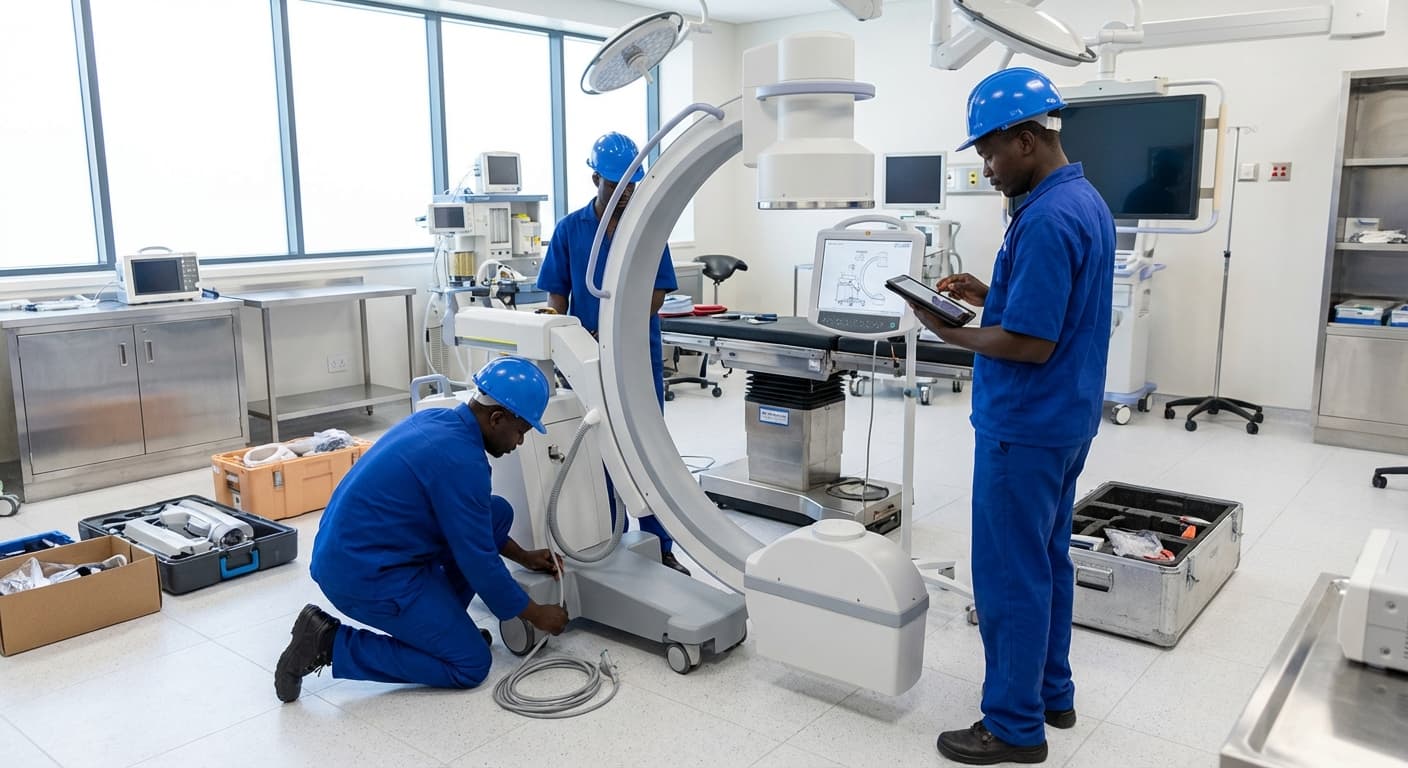
C-Arm Installation Service in Equatorial Guinea
Engineering Excellence & Technical Support
C-Arm Installation Service High-standard technical execution following OEM protocols and local regulatory frameworks.
Global Expertise, Local Impact: Seamless C-Arm Deployment in Equatorial Guinea
Leveraging extensive international experience, our team ensures a flawless C-arm installation and commissioning process tailored to the unique logistical and environmental conditions of Equatorial Guinea. We provide end-to-end support, from site readiness assessment to full operational integration, guaranteeing optimal performance and adherence to all local regulations.
Advanced Connectivity & Integration: Powering Modern Healthcare Infrastructure
Our C-arm installation services go beyond hardware setup. We specialize in integrating your new C-arm system with existing hospital networks and PACS (Picture Archiving and Communication System), ensuring efficient data flow and interoperability. Our certified technicians are adept at configuring secure network connections and troubleshooting any connectivity challenges specific to Equatorial Guinea's infrastructure.
Certified Technicians & Comprehensive Training: Empowering Your Medical Staff
Rest assured, your C-arm installation in Equatorial Guinea will be handled by highly skilled and certified technicians with a proven track record. We provide comprehensive, hands-on training for your radiology and clinical staff, ensuring they can operate the C-arm safely and effectively from day one. Our commitment extends to ongoing support and optimization for sustained clinical excellence.
What Is C-arm Installation Service In Equatorial Guinea?
C-Arm installation service in Equatorial Guinea refers to the professional process of setting up, calibrating, and integrating a C-arm imaging system within a healthcare facility in the country. This service encompasses the physical placement, electrical and network connectivity, radiation safety compliance, and initial operational testing of the C-arm device. It ensures the system is ready for clinical use, adhering to both manufacturer specifications and local regulatory requirements. The service is typically provided by specialized biomedical engineering firms or authorized distributors of C-arm equipment. It plays a critical role in enabling advanced diagnostic and interventional procedures within the nation's healthcare infrastructure.
| Who Needs C-Arm Installation Service? | Typical Use Cases | |||||||
|---|---|---|---|---|---|---|---|---|
| Hospitals and large medical centers in Equatorial Guinea requiring advanced fluoroscopic imaging capabilities. | Orthopedic surgery (fracture fixation, arthroscopy, spinal procedures). | Cardiology (angiography, angioplasty, pacemaker implantation). | Pain management (injections, nerve blocks). | Urology (stone removal, stent placement). | Gastroenterology (ERCP procedures). | Emergency departments for rapid diagnostic imaging during trauma cases. | Surgical centers and specialty clinics utilizing intraoperative imaging. | Research and educational institutions integrating C-arm technology for academic purposes. |
Key Components of C-Arm Installation Service:
- Site assessment and preparation (e.g., power, ventilation, shielding requirements).
- Physical placement and mounting of the C-arm unit, image intensifier/detector, and workstation.
- Electrical connection and grounding according to safety standards.
- Network configuration for PACS (Picture Archiving and Communication System) and HIS (Hospital Information System) integration.
- Radiation safety checks, shielding verification, and compliance with local regulations.
- System initialization, software loading, and configuration.
- Calibration and performance testing to ensure image quality and accuracy.
- Basic user training for operation and maintenance.
- Documentation and handover of the installed system.
Who Needs C-arm Installation Service In Equatorial Guinea?
C-arm installation services are crucial for healthcare facilities in Equatorial Guinea aiming to enhance their diagnostic imaging capabilities. These specialized services ensure that advanced X-ray imaging systems, commonly known as C-arms, are correctly set up, calibrated, and integrated into existing hospital infrastructure. This leads to improved patient care, more accurate diagnoses, and efficient surgical procedures.
| Department | Key Requirements/Uses of C-Arm | Benefits of Professional Installation |
|---|---|---|
| Orthopedics | Intraoperative imaging for fracture reduction, implant placement, and spinal surgery. | Ensures accurate alignment and positioning, minimizing revision surgeries. |
| Cardiology/Interventional Cardiology | Fluoroscopic guidance for procedures like angiography, angioplasty, and stent placement. | Precise catheter and guidewire navigation, reducing procedure time and complications. |
| Pain Management | Image-guided injections for nerve blocks, epidural steroid injections, and facet joint injections. | Accurate needle placement for optimal therapeutic outcomes and patient comfort. |
| General Surgery | Intraoperative localization of foreign bodies, stent placement in biliary/urinary tracts, and verification of surgical techniques. | Improved surgical precision and confirmation of procedural success. |
| Emergency Department | Rapid diagnostic imaging for trauma cases, fracture assessment, and foreign body localization. | Faster patient throughput and timely decision-making in critical situations. |
| Radiology | Specialized fluoroscopic examinations and interventional radiology procedures. | Ensures optimal image quality and adherence to radiation safety protocols. |
Target Customers & Departments for C-Arm Installation Service in Equatorial Guinea
- {"title":"Hospitals (Public and Private)","description":"The primary consumers of C-arm installation services are hospitals, ranging from large public institutions to smaller private clinics. These facilities often invest in C-arms for their surgical suites, emergency departments, and imaging centers."}
- {"title":"Surgical Centers","description":"Dedicated surgical centers, whether standalone or part of a larger hospital, require C-arms for real-time imaging during orthopedic, cardiovascular, pain management, and general surgical procedures."}
- {"title":"Diagnostic Imaging Centers","description":"Specialized diagnostic imaging centers that offer a broad range of X-ray based services can benefit from C-arm installations for specific diagnostic applications."}
- {"title":"Government Health Ministries/Agencies","description":"Government bodies responsible for public health infrastructure and equipment procurement may oversee or mandate the installation of C-arms in public hospitals to improve healthcare access and quality across the nation."}
- {"title":"International Aid Organizations & NGOs","description":"Organizations involved in medical aid and development in Equatorial Guinea often fund and facilitate the installation of advanced medical equipment, including C-arms, in underserved areas or for specific health initiatives."}
C-arm Installation Service Process In Equatorial Guinea
This document outlines the comprehensive service process for C-Arm installation in Equatorial Guinea, from initial client inquiry to successful execution and handover. The process is designed to ensure a smooth, efficient, and compliant installation, minimizing downtime and maximizing system performance.
| Phase | Key Activities | Deliverables | Responsible Party |
|---|---|---|---|
| Inquiry & Consultation | Initial contact, needs assessment, scope discussion | Understanding of client requirements, preliminary proposal | Client, Service Provider |
| Site Assessment & Planning | On-site survey, feasibility study, detailed plan development | Site survey report, installation plan, client approval | Service Provider |
| Logistics & Procurement | Equipment sourcing, transportation, customs clearance | Delivered C-Arm and accessories, import documentation | Service Provider, Client (for site prep) |
| Installation & Configuration | Mechanical/electrical setup, network integration, software config | Fully installed and configured C-Arm system | Service Provider |
| Testing & Calibration | Image quality tests, performance calibration, safety checks | Calibration reports, test results, safety compliance documentation | Service Provider |
| Training & Handover | User training, documentation delivery, final sign-off | Trained staff, complete documentation package, client acceptance | Service Provider, Client |
| Post-Installation Support | Ongoing maintenance, repairs, technical assistance | Service agreements, uptime reports, timely support | Service Provider |
C-Arm Installation Service Process Workflow
- 1. Initial Inquiry & Consultation:
- Client contacts us with a request for C-Arm installation.
- Initial consultation to understand client needs, specific C-Arm model, and site requirements.
- Discussion of project scope, timeline expectations, and budget.
- 2. Site Assessment & Planning:
- Pre-installation Site Survey: Our technical team visits the client's facility in Equatorial Guinea to assess:
- **Space Requirements:** Dimensions, ceiling height, room layout.- **Power Supply:** Voltage, amperage, availability of stable power, grounding.- **Environmental Conditions:** Temperature, humidity, dust levels.- **Structural Integrity:** Wall and floor load-bearing capacity for potential mounting.- **Network Connectivity:** For imaging systems and PACS integration.- **Access & Logistics:** For equipment delivery and personnel movement.- Technical Feasibility Study: Based on the survey, we confirm the feasibility of installation and identify any potential challenges.
- Detailed Installation Plan: Development of a comprehensive plan outlining:
- Equipment staging and uncrating procedures.- Installation steps and sequence.- Required tools and materials.- Safety protocols.- Decommissioning plan for existing equipment (if applicable).- Client Approval: Submission of the installation plan to the client for review and approval.
- 3. Logistics & Procurement:
- Equipment Procurement: Sourcing of the specified C-Arm and any necessary accessories, ensuring compliance with local regulations.
- Transportation & Importation: Arranging secure and compliant transportation of the C-Arm to Equatorial Guinea, managing customs clearance and import duties.
- Site Preparation: Client to undertake any necessary structural modifications, electrical upgrades, or network infrastructure work as per our recommendations.
- 4. Installation & Configuration:
- On-site Delivery & Staging: Careful delivery and staging of the C-Arm and associated components at the designated installation site.
- Mechanical Installation: Professional mounting of the C-Arm gantry, tube, detector, and other mechanical parts according to manufacturer specifications and safety standards.
- Electrical Connection: Connecting the C-Arm to the approved power supply, ensuring proper grounding and surge protection.
- Network Integration: Configuring network settings for connectivity with PACS, RIS, and other hospital IT systems.
- Software Installation & Configuration: Installing and configuring the C-Arm's operating system, imaging software, and any specialized applications.
- Initial System Power-Up & Diagnostics: Performing initial system checks and running diagnostic tests to ensure all components are functioning correctly.
- 5. Testing & Calibration:
- Image Quality Testing: Performing extensive image quality tests using phantoms to ensure optimal contrast, resolution, and noise levels.
- Performance Calibration: Calibrating the C-Arm's various functions, including fluoroscopy, radiography, and dose control, to meet clinical requirements.
- Radiation Safety Checks: Verifying radiation shielding and dose management systems to comply with national and international safety standards.
- Functional Testing: Testing all operational modes and features of the C-Arm in simulated clinical scenarios.
- 6. Training & Handover:
- User Training: Providing comprehensive hands-on training to clinical staff (radiologists, technicians) on the operation, maintenance, and basic troubleshooting of the C-Arm.
- Documentation Handover: Providing all necessary user manuals, service records, warranty information, and regulatory compliance documents.
- Final Inspection & Sign-off: Conducting a final walk-through with the client to ensure all installation and testing requirements have been met. Client provides formal sign-off.
- 7. Post-Installation Support:
- Warranty & Service Agreements: Offering ongoing technical support, maintenance, and repair services as per agreed service level agreements.
- Remote Diagnostics: Providing remote monitoring and troubleshooting capabilities where possible.
- Spare Parts Management: Ensuring availability of critical spare parts for timely repairs.
C-arm Installation Service Cost In Equatorial Guinea
The cost of C-arm installation services in Equatorial Guinea can vary significantly due to several key pricing factors. These include the complexity of the installation, the specific type and model of the C-arm, the existing infrastructure at the healthcare facility, the required vendor support, and geographical location within the country. Obtaining precise, up-to-the-minute pricing requires direct consultation with specialized medical equipment installers and vendors operating in Equatorial Guinea. However, understanding these influencing factors can provide a framework for budgeting and negotiation.
| Service Component | Estimated Range (XAF - Central African CFA Franc) |
|---|---|
| Site Survey and Consultation | 50,000 - 150,000 |
| Basic C-Arm Installation & Setup (per unit) | 300,000 - 800,000 |
| Complex Installation (e.g., advanced features, multiple rooms) | 700,000 - 2,000,000+ |
| Infrastructure Modifications (variable, per job) | 100,000 - 1,000,000+ |
| Initial Operator Training (basic, per session) | 50,000 - 150,000 |
| Extended Warranty/Support (optional, annual) | 200,000 - 600,000+ |
| Total Estimated Range (excluding C-Arm Purchase) | 400,000 - 3,000,000+ XAF |
Key Pricing Factors for C-Arm Installation in Equatorial Guinea
- C-Arm Model and Complexity: High-end, advanced C-arm systems with intricate functionalities often require more specialized installation expertise and time, thus increasing costs. Older or simpler models may be less expensive to install.
- Infrastructure Assessment and Preparation: This includes evaluating the existing electrical supply, structural integrity of the room, potential need for radiation shielding, ventilation systems, and network connectivity. Significant upgrades or modifications will add to the overall expense.
- Installation Labor and Expertise: The number of technicians, their skill level, and the duration of the installation directly impact the cost. Specialized knowledge of medical imaging equipment is crucial.
- Vendor Support and Training: Many installation services include initial setup, calibration, and basic operator training. The extent and duration of this support can be a pricing variable.
- Geographical Location: Installations in remote or less accessible areas of Equatorial Guinea might incur higher costs due to increased travel expenses for the installation team and potential logistical challenges.
- Site Survey and Planning: An initial site visit and detailed planning phase are often necessary. The cost of this preparatory work can be bundled into the installation fee or charged separately.
- Ancillary Equipment and Accessories: If the installation requires specific mounting systems, additional power conditioners, or other accessories, these will contribute to the total cost.
- Permits and Regulatory Compliance: Depending on local regulations, certain permits or inspections might be required, adding to the administrative and associated costs.
Affordable C-arm Installation Service Options
Acquiring and installing a C-arm is a significant investment for any medical facility. While the technology itself is invaluable for real-time imaging in various surgical and diagnostic procedures, the installation process can also incur substantial costs. Fortunately, there are ways to manage these expenses effectively through affordable C-arm installation service options. Understanding value bundles and implementing cost-saving strategies can make this crucial upgrade more attainable.
| Strategy/Bundle Component | Description | Potential Cost Savings |
|---|---|---|
| Pre-Installation Site Survey & Planning Bundle | Includes an in-depth assessment of your facility's existing infrastructure (power, space, shielding, network) and professional recommendations for optimal C-arm placement and integration. This proactive approach prevents costly on-site changes later. | Avoids expensive rework, potential delays, and unexpected material purchases. |
| Basic Installation & Connectivity Bundle | Covers the physical setup of the C-arm, including power connections, initial calibration, and basic network integration for PACS (Picture Archiving and Communication System) or EMR (Electronic Medical Record) connectivity. | Streamlined process, potentially lower labor costs compared to piecemeal services. |
| Comprehensive Installation & Training Bundle | Includes all elements of the basic bundle plus user training for your medical staff on the C-arm's operation, image acquisition, and basic troubleshooting. May also include initial software updates and system verification. | Ensures staff proficiency from day one, reducing training-related downtime and external training costs. |
| Negotiate Package Deals | When purchasing a new C-arm, inquire about bundled installation services from the vendor. Often, they can offer a more competitive price when installation is part of the overall equipment purchase. | Can leverage bulk discounts and reduce vendor management overhead. |
| Compare Multiple Quotes | Obtain detailed installation quotes from several reputable third-party installation companies. Compare not only the price but also the scope of services included. | Ensures you're getting the best market price and a service tailored to your needs. |
| Phased Installation | If budget is a major constraint, consider a phased approach. Start with essential installation and connectivity, and then schedule advanced features or extensive training at a later date. | Spreads the cost over time, making it more manageable for cash flow. |
| Utilize Existing Infrastructure | Work with installers to maximize the use of your current electrical, networking, and radiation shielding infrastructure. Avoid unnecessary upgrades or new installations where possible. | Minimizes the need for new construction or extensive modifications. |
| Long-Term Service Contracts | While not an upfront installation cost-saver, negotiating favorable terms for long-term maintenance and service contracts can provide cost predictability and potentially discounts on future service needs. | Provides budget certainty and potential discounts on support. |
| Remote Support Options | Inquire about the availability of remote diagnostic and troubleshooting services. This can sometimes resolve minor issues without the need for an expensive on-site visit. | Reduces costs associated with emergency on-site call-outs. |
Understanding Value Bundles and Cost-Saving Strategies for C-Arm Installation
- Value Bundles: These are pre-packaged service offerings that combine multiple essential elements of C-arm installation at a potentially discounted rate compared to purchasing services individually. Bundles often include:
- Cost-Saving Strategies: Beyond bundles, several strategic approaches can reduce overall installation costs:
- Key Components of Value Bundles:
- Effective Cost-Saving Strategies:
Verified Providers In Equatorial Guinea
Navigating the healthcare landscape in Equatorial Guinea requires trust and assurance. Verified providers offer a crucial layer of security, ensuring you receive quality care from legitimate and qualified professionals. Franance Health stands out as a leading entity in this regard, holding a distinguished position within Equatorial Guinea's healthcare ecosystem. Their commitment to excellence, stringent credentialing processes, and dedication to patient well-being make them a standout choice.
| Provider Credential | Verification Process | Services Offered | Patient Benefits |
|---|---|---|---|
| Franance Health - Accredited Medical Partners | Comprehensive background checks, license verification, peer reviews, and ongoing performance evaluations. | Primary care, specialist consultations (e.g., cardiology, pediatrics, surgery), diagnostic services, emergency care, and preventative health programs. | Assurance of receiving care from highly qualified and ethical practitioners, reduced risk of medical errors, access to advanced treatments, and improved health outcomes. |
| Other Potential Providers (Unverified) | May lack transparent or consistent verification processes, potentially leading to unqualified practitioners. | Varies widely, may include limited services or lack specialized expertise. | Increased risk of encountering unqualified professionals, potential for misdiagnosis or inadequate treatment, and uncertainty regarding the legitimacy of services. |
Why Franance Health is the Best Choice:
- Unwavering commitment to ethical medical practices.
- Rigorous vetting and verification of all healthcare professionals.
- Access to a comprehensive network of specialized medical services.
- Focus on patient-centric care and transparency.
- Adherence to international healthcare standards and best practices.
Scope Of Work For C-arm Installation Service
This Scope of Work (SOW) outlines the services required for the installation of a C-Arm imaging system. It details the technical deliverables, standard specifications, and responsibilities of all parties involved to ensure a successful and compliant installation.
| Technical Deliverable | Description | Standard Specification / Requirement | Acceptance Criteria |
|---|---|---|---|
| Site Readiness Report | Document confirming the installation site meets all prerequisites. | Includes verification of power outlets, network connectivity, environmental conditions (temperature, humidity), and physical space. | Signed report by site representative and installation technician. |
| Physical Installation of C-Arm Unit | Unpacking, assembly (if applicable), and precise positioning of the C-Arm system and associated components (workstation, monitor, etc.). | Adherence to manufacturer's installation manual and ergonomic best practices. Ensure no physical damage during transit or placement. | Visual inspection of all components for damage. C-Arm movement and positioning verified. |
| Electrical Connection and Grounding | Connecting the C-Arm system to the designated power source and ensuring proper grounding. | Compliance with local electrical codes and manufacturer's specifications. Use of surge protectors and dedicated circuits as required. | Electrical continuity and grounding tests performed and documented. |
| Network Connectivity | Connecting the C-Arm system to the hospital's Picture Archiving and Communication System (PACS) and/or other network resources. | Configuration of IP addresses, subnet masks, and other network parameters as per IT department's guidelines. Secure data transmission protocols (e.g., DICOM over TCP/IP). | Successful data transfer to PACS verified. Network connectivity ping tests passed. |
| System Software Configuration | Installation and configuration of the C-Arm's operating system and imaging software. | Setting up patient registration, imaging protocols, and user profiles according to clinical requirements. | All pre-defined imaging protocols loaded and functional. User accounts created and accessible. |
| Calibration and Quality Assurance | Performing necessary calibrations to ensure accurate image acquisition and consistent performance. | Including but not limited to X-ray tube calibration, detector calibration, and image quality tests. | All QA tests passed according to manufacturer's specifications and regulatory requirements. Image quality assessment performed. |
| System Testing and Performance Verification | Comprehensive testing of all C-Arm functionalities and imaging modes. | Testing of X-ray generation, image display, fluoroscopy modes, image processing, and storage. | All specified imaging modes and functions perform as expected. Image artifacts are within acceptable limits. |
| User Training Session | Providing hands-on training to designated clinical and technical staff on the operation of the C-Arm system. | Covering basic operation, image acquisition, protocol selection, troubleshooting, and safety procedures. | Attendees demonstrate proficiency in basic C-Arm operation and protocol selection. Training attendance sheet completed. |
| Installation Report and Sign-off | Formal documentation detailing the entire installation process, including any encountered issues and resolutions. | Includes all test results, calibration reports, and user training records. Requires formal sign-off from the client. | Client representative formally accepts the installation and the system's operational readiness. |
| Post-Installation Support (if applicable) | Period of technical support following the handover to address any immediate operational issues. | Defined period (e.g., 30 days) for addressing minor bugs or user queries related to the installation. | Resolution of any critical issues reported within the support period. |
Key Stages of C-Arm Installation
- Site Preparation and Verification
- Unpacking and Physical Placement
- Electrical and Data Connectivity
- System Configuration and Calibration
- Testing and Validation
- User Training
- Documentation and Handover
Service Level Agreement For C-arm Installation Service
This Service Level Agreement (SLA) outlines the response times and uptime guarantees for C-Arm Installation Services provided by [Your Company Name] to [Client Name]. This SLA is an integral part of the Master Service Agreement (MSA) between the parties.
| Service Level | Priority Level | Response Time (from ticket creation/issue notification) | Resolution Target | Uptime Guarantee (post-successful installation) | Service Credits |
|---|---|---|---|---|---|
| C-Arm Installation & Configuration | Critical (Installation Blocked / Major Functionality Impaired) | 1 Hour | 4 Business Hours | N/A (Focus is on successful initial installation) | 10% discount on next service if resolution exceeds target |
| C-Arm Installation & Configuration | High (Minor Functionality Impaired / Delayed Completion) | 2 Business Hours | 8 Business Hours | N/A | 5% discount on next service if resolution exceeds target |
| C-Arm Installation & Configuration | Medium (Information Request / Minor Adjustments) | 4 Business Hours | 2 Business Days | N/A | No service credits |
| Post-Installation Verification & Support | Critical (System Unusable Post-Install) | 1 Hour | 4 Business Hours | 99.5% (for the first 30 days post-sign-off) | 10% of monthly recurring charges if uptime falls below guarantee |
| Post-Installation Verification & Support | High (Significant Performance Degradation Post-Install) | 2 Business Hours | 8 Business Hours | 99.8% (for the first 30 days post-sign-off) | 5% of monthly recurring charges if uptime falls below guarantee |
| Post-Installation Verification & Support | Medium (Minor Performance Issues / Consultative Support) | 4 Business Hours | 2 Business Days | 99.9% (for the first 30 days post-sign-off) | No service credits |
Key Definitions
- Service Request: Any formal request for C-Arm installation services submitted by the Client, including initial consultation, scheduling, site preparation guidance, installation, and post-installation verification.
- Installation Window: The agreed-upon timeframe for the physical installation of the C-Arm system, as detailed in the Project Plan.
- Downtime: Any period during which the C-Arm system is unavailable for use due to issues directly related to the installation process or a defect in the installed components as verified by the Client and [Your Company Name]. This excludes scheduled maintenance, Client-induced issues, or external factors beyond the control of [Your Company Name].
- Response Time: The maximum time allowed for [Your Company Name] to acknowledge and begin addressing a reported Service Request or issue.
- Resolution Time: The maximum time allowed for [Your Company Name] to resolve a reported Service Request or issue, bringing the C-Arm system back to operational status within the agreed-upon scope of installation.
Frequently Asked Questions

Ready when you are
Let's scope your C-Arm Installation Service in Equatorial Guinea project in Equatorial Guinea.

Scaling healthcare logistics and technical systems across the entire continent.