
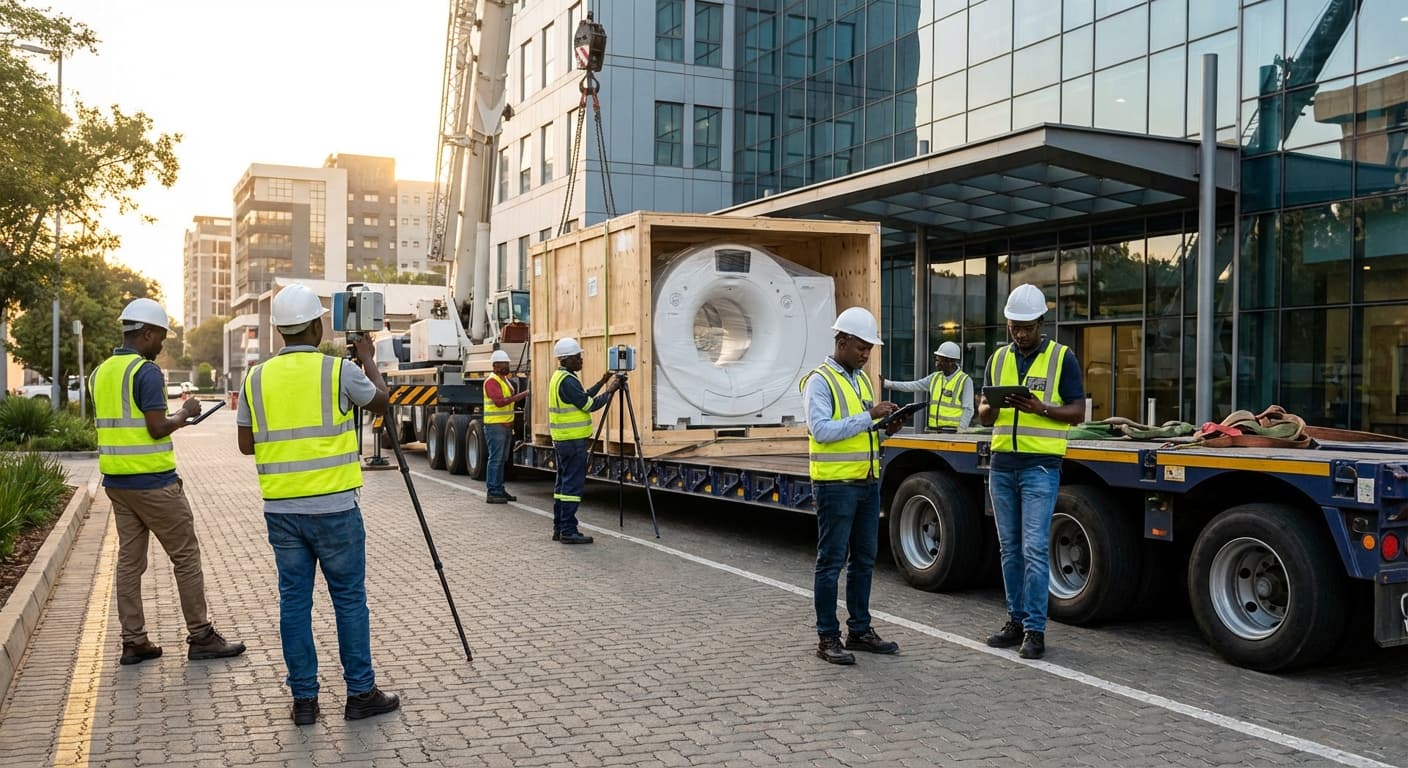
Route Survey & Rigging Plan Service for Heavy Medical Equipment in Equatorial Guinea
Engineering Excellence & Technical Support
Route Survey & Rigging Plan Service for Heavy Medical Equipment High-standard technical execution following OEM protocols and local regulatory frameworks.
Precision Route Survey & Obstacle Mitigation
Leveraging advanced GPS and LiDAR technology, our route surveys meticulously map optimal transport paths for heavy medical equipment in Equatorial Guinea's varied terrain. We identify and proactively mitigate potential obstacles, including low clearances, uneven surfaces, and infrastructure limitations, ensuring a safe and efficient transit from port to installation site.
Specialized Rigging & Load Securing
Our certified rigging teams employ bespoke lifting and lashing strategies tailored to the unique weight, dimensions, and fragility of high-value medical equipment. We utilize specialized heavy-lift cranes, modular transporters, and custom-engineered securing systems to guarantee stability and prevent damage during complex multi-modal transport operations in challenging equatorial environments.
Risk Assessment & Environmental Compliance
Comprehensive risk assessments are integral to our service, identifying and mitigating potential hazards from weather, seismic activity, and local infrastructure. We ensure strict adherence to Equatorial Guinean regulations and international best practices for heavy transport, guaranteeing the integrity of your medical equipment and the safety of personnel and public throughout the entire project lifecycle.
What Is Route Survey & Rigging Plan Service For Heavy Medical Equipment In Equatorial Guinea?
The Route Survey & Rigging Plan Service for Heavy Medical Equipment in Equatorial Guinea is a specialized logistical and engineering service designed to ensure the safe, efficient, and compliant transportation, installation, and commissioning of large-scale, high-value medical apparatus within Equatorial Guinea. This comprehensive service addresses the unique challenges posed by the country's infrastructure, climate, and regulatory environment. It encompasses detailed site assessments, the development of intricate rigging and lifting strategies, and the execution of these plans, minimizing risks associated with damage, personnel injury, and operational delays.
| Who Needs This Service? | Typical Use Cases | ||||
|---|---|---|---|---|---|
| Hospitals and Healthcare Facilities: Both public and private medical institutions, particularly those undergoing expansion, renovation, or the acquisition of new, advanced medical technologies. | Medical Equipment Manufacturers and Suppliers: Companies requiring reliable and expert logistical support for the delivery and installation of their products to end-users in Equatorial Guinea. | Government Health Ministries and Agencies: Entities responsible for national healthcare infrastructure development and the procurement of large-scale medical equipment. | Construction and Engineering Firms: Companies involved in building or upgrading healthcare facilities that require specialized heavy lift and installation expertise. | Project Management Consultants: Overseeing major healthcare projects and requiring specialized services to ensure the successful integration of medical equipment. | |
| Installation of MRI (Magnetic Resonance Imaging) Scanners: Requiring specialized shielding and precise positioning. | Deployment of CT (Computed Tomography) Scanners: Involving heavy components and precise alignment. | Setup of Linear Accelerators for Radiotherapy: Extremely heavy and requiring precise placement for patient safety and efficacy. | Installation of Large-Scale X-ray Machines and Angiography Suites: Often requiring significant structural considerations. | Placement of Sterilization Autoclaves and Large Laboratory Equipment: Requiring careful handling and integration into existing workflows. | Relocation or Upgrade of Existing Heavy Medical Equipment: Ensuring minimal disruption to healthcare services. |
Key Components of the Service:
- Route Feasibility Study: Analyzing proposed transportation routes from port of entry (e.g., Port of Bata, Port of Malabo) to the final installation site. This includes assessing road conditions, bridge load capacities, overhead obstructions (power lines, trees, buildings), turning radii, and potential ingress/egress challenges at the destination.
- Site Survey and Assessment: Detailed examination of the installation location to identify structural integrity of floors and walls, ceiling heights, access points (doorways, elevator dimensions), utility availability (power, water, HVAC), and any necessary modifications or reinforcements.
- Risk Assessment and Mitigation: Identification of potential hazards during transportation and installation (e.g., weather, seismic activity, equipment failure, human error) and the development of strategies to mitigate these risks.
- Rigging and Lifting Plan Development: Engineering of precise lifting and positioning methodologies using appropriate cranes, forklifts, hydraulic jacks, gantries, and specialized lifting gear. This includes load calculations, center of gravity determination, sling angle analysis, and attachment point verification.
- Transportation and Logistics Management: Coordination of specialized transport vehicles, permits, escorts (if required), and transit scheduling to ensure timely and secure movement of the equipment.
- Installation and Commissioning Support: On-site supervision of the rigging, lifting, and positioning process, followed by support for the initial installation and integration with existing medical infrastructure.
- Compliance and Documentation: Ensuring adherence to local regulations, international standards (e.g., ISO, ASME), and providing comprehensive documentation including survey reports, engineering drawings, lift plans, and safety protocols.
Who Needs Route Survey & Rigging Plan Service For Heavy Medical Equipment In Equatorial Guinea?
In Equatorial Guinea, the successful and safe installation of heavy medical equipment hinges on specialized Route Survey & Rigging Plan Services. These services are crucial for identifying optimal transport paths, assessing structural integrity, and developing meticulous plans to move and position large, sensitive, and often extremely heavy medical machinery. Without proper planning, the risks of damage to the equipment, infrastructure, and personnel are significantly elevated, leading to costly delays and potential failures.
| Target Customer Group | Specific Departments/Roles | Reasons for Needing the Service |
|---|---|---|
| Hospitals and Clinics (Public & Private) | Facilities Management, Biomedical Engineering Department, Procurement Department, Hospital Administration | Ensuring safe delivery and installation of critical imaging systems (MRI, CT scanners), surgical robots, linear accelerators, and other large medical devices; minimizing disruption to hospital operations; protecting existing hospital infrastructure during installation. |
| Medical Equipment Manufacturers & Suppliers | Logistics Department, Project Management, Technical Installation Teams | Fulfilling contractual obligations for delivery and installation; mitigating risks of damage during transit and on-site maneuvering; ensuring timely and successful project completion for their clients. |
| Logistics & Freight Forwarding Companies | Project Cargo Specialists, Operations Managers, Heavy Lift Supervisors | Providing specialized services for oversized and overweight cargo; accurately assessing route feasibility and load-bearing capacities; developing safe and compliant rigging and transportation plans; managing insurance and liability. |
| Construction & Infrastructure Development Companies | Project Managers, Site Engineers, Logistics Coordinators | Integrating the installation of heavy medical equipment into new hospital construction or renovation projects; coordinating with medical equipment specialists; ensuring structural readiness and access for equipment. |
| Government Health Ministries & Agencies | Procurement and Logistics Divisions, Public Health Project Managers | Overseeing the acquisition and deployment of medical equipment for public health initiatives; ensuring compliance with safety standards; managing large-scale equipment installations across multiple facilities. |
| International Aid Organizations & NGOs | Project Directors, Logistics Managers, Medical Procurement Officers | Delivering and installing vital medical equipment in remote or challenging locations as part of development projects; ensuring the safe and efficient use of donated or purchased equipment; overcoming logistical hurdles in less-developed areas. |
Who Needs Route Survey & Rigging Plan Service for Heavy Medical Equipment in Equatorial Guinea?
- Hospitals and Clinics (Public & Private)
- Medical Equipment Manufacturers & Suppliers
- Logistics & Freight Forwarding Companies
- Construction & Infrastructure Development Companies
- Government Health Ministries & Agencies
- International Aid Organizations & NGOs
Route Survey & Rigging Plan Service For Heavy Medical Equipment Process In Equatorial Guinea
This document outlines the workflow for our Route Survey & Rigging Plan Service for the process of delivering and installing heavy medical equipment in Equatorial Guinea. Our comprehensive service ensures the safe, efficient, and compliant transport and placement of critical medical machinery.
| Stage | Key Activities | Deliverables | Timeline (Indicative) |
|---|---|---|---|
| Client submits inquiry detailing equipment type, dimensions, weight, origin, destination, and project timeline. Our team conducts an initial consultation to understand project scope, identify potential challenges, and discuss service inclusions. | Project Scope Definition Preliminary Risk Assessment Service Proposal & Quotation | 1-3 Business Days |
| Detailed assessment of the proposed delivery route, including road conditions, bridge capacities, overhead clearances, turning radii, and any potential obstructions. Identification and validation of the optimal transport path from port/airport to the final installation site. | Route Survey Report with Maps & Photos Identification of Critical Path Segments Potential Road Modification Recommendations | 5-10 Business Days (depending on complexity & location) |
| Based on equipment specifications and site survey data, a detailed rigging plan is developed. This includes selecting appropriate lifting equipment (cranes, forklifts), rigging gear (slings, shackles), determining lifting points, calculating load distribution, and defining safe working procedures. | Comprehensive Rigging Plan Document (including CAD drawings) Load Charts & Stability Analysis Safety Procedures & Exclusion Zones | 3-7 Business Days |
| Coordination with local authorities for necessary permits (transport, road closures, special movement). Securing escorts, traffic management plans, and necessary specialized personnel. | All Required Permits & Approvals Finalized Traffic Management Plan Escort & Security Arrangements | 7-15 Business Days (highly dependent on local bureaucracy) |
| Mobilization of all required lifting equipment, rigging gear, and personnel to Equatorial Guinea. A final on-site survey is conducted just prior to execution to confirm conditions haven't changed and to finalize placement details. | Mobilized Equipment & Personnel Checklist Final On-Site Confirmation Report | 3-7 Business Days (depending on mobilization logistics) |
| Safe and precise execution of the rigging plan. This involves lifting, maneuvering, and positioning the heavy medical equipment at its designated location. Continuous monitoring of safety parameters and adherence to the plan. | Successful Equipment Placement Daily Progress Reports Incident-Free Execution | 1-3 Days (per major lift/placement) |
| Demobilization of equipment and personnel. Final review of the operation with the client, handover of all relevant documentation, and confirmation of client satisfaction. | Post-Execution Report As-Built Rigging Documentation Client Sign-off & Final Invoice | 1-2 Business Days |
Workflow Stages
- Inquiry & Initial Consultation
- Site Assessment & Route Survey
- Rigging Plan Development
- Pre-Execution Planning & Permitting
- Equipment Mobilization & On-Site Survey
- Rigging Execution
- Post-Execution & Handover
Route Survey & Rigging Plan Service For Heavy Medical Equipment Cost In Equatorial Guinea
The cost of a Route Survey & Rigging Plan Service for Heavy Medical Equipment in Equatorial Guinea is influenced by a multitude of factors, making it challenging to provide a single fixed price. These services are highly specialized and require experienced professionals to ensure the safe and efficient transport and installation of critical medical machinery. The complexity of the route, the weight and dimensions of the equipment, accessibility to the destination, and the required level of detail in the planning documentation all play a significant role in the final quotation. Local currency pricing will be provided in Equatorial Guinean Franc (XAF).
| Service Component | Estimated Cost Range (XAF) | Notes |
|---|---|---|
| Initial Consultation & Site Assessment | 500,000 - 1,500,000 | Preliminary evaluation of equipment and general route. |
| Detailed Route Survey (per km or per segment) | 750,000 - 2,500,000 | Includes mapping, obstacle identification, and basic measurements. Varies significantly with terrain. |
| Obstacle Mitigation & Structural Assessment | 1,000,000 - 5,000,000+ | If modifications or specialized assessments (e.g., bridge load capacity) are needed. |
| Rigging Plan Development (Basic) | 1,500,000 - 4,000,000 | Standard plan for moderately complex lifts/moves. |
| Rigging Plan Development (Complex) | 3,000,000 - 10,000,000+ | For exceptionally heavy, oversized, or difficult-to-access equipment. |
| Specialized Surveys (e.g., drone, laser scanning) | 1,000,000 - 3,000,000 | When high-precision data is required. |
| Permit Facilitation Fees | 250,000 - 2,000,000+ | Covers administrative costs and potential official fees. |
| Contingency Planning & Risk Assessment | 500,000 - 2,000,000 | Essential for high-risk operations. |
| Project Management & Coordination | 10-15% of total service cost | Overseeing the entire process. |
Key Pricing Factors:
- Equipment Specifications: The weight, dimensions (height, width, length), and fragility of the medical equipment are paramount. Heavier and larger items require more robust planning, specialized rigging gear, and potentially more personnel.
- Route Complexity: This includes the distance to be covered, the type of terrain (urban, rural, rough), the presence of obstacles (bridges, low underpasses, tight turns, power lines), road conditions, and any necessary road modifications or permits.
- Destination Accessibility: The ease of access to the final installation site is crucial. This involves considering the condition of the access roads, potential for off-road movement, and the availability of space for maneuvering large equipment.
- Rigging Requirements: The complexity of the rigging operation itself (e.g., vertical lift, horizontal movement, placement within a building) and the type of specialized equipment needed (cranes, forklifts, jacks, dollies, custom-built supports) will impact costs.
- Survey Scope and Detail: The extent of the route survey, including detailed mapping, obstacle identification, structural assessments of potential load-bearing points, and video documentation, influences the time and expertise required.
- Planning and Documentation: The level of detail in the rigging plan, including CAD drawings, risk assessments, method statements, and contingency plans, is a significant cost driver.
- Personnel Expertise and Size: The number of experienced surveyors, rigging engineers, and technicians involved, along with their specialized skills, contributes to the overall cost.
- Time Constraints and Urgency: Expedited services or projects requiring work during off-peak hours or holidays may incur premium charges.
- Permits and Approvals: Obtaining necessary permits from local authorities for road closures, oversized transport, or specialized lifting operations can add to the cost and time.
- Insurance and Risk Management: Comprehensive insurance coverage for the equipment and personnel, along with the cost of implementing robust risk management strategies, are factored in.
- Logistical Support: Costs associated with site preparation, temporary infrastructure, security, and traffic management.
- Reporting and Deliverables: The format and comprehensiveness of the final survey report and rigging plan documentation.
Affordable Route Survey & Rigging Plan Service For Heavy Medical Equipment Options
Navigating the complex logistics of transporting and installing heavy medical equipment requires specialized expertise. Our Affordable Route Survey & Rigging Plan Service offers a comprehensive solution, ensuring safe, efficient, and cost-effective delivery. We understand the unique challenges associated with medical machinery and provide meticulous planning to mitigate risks and minimize downtime. Our value bundles are designed to cater to diverse needs, offering layered solutions with increasing levels of support and specialized services. We also implement strategic cost-saving measures throughout the process, from initial survey to final rigging, to provide you with the most economical yet high-quality service.
| Cost-Saving Strategy | Description | Benefit |
|---|---|---|
| Early Engagement | Involving our team in the planning stages as early as possible. | Allows for proactive identification of potential route obstructions and rigging challenges, preventing costly last-minute changes or delays. |
| Detailed Pre-Surveys | Thorough and accurate route surveys conducted prior to equipment movement. | Minimizes the risk of unforeseen obstacles, specialized equipment needs, or route deviations, all of which can significantly increase costs. |
| Standardized Rigging Methodologies | Utilizing established and proven rigging techniques where applicable. | Reduces the need for bespoke or experimental solutions, leading to more efficient use of resources and labor. |
| Optimized Equipment Selection | Careful consideration of the most appropriate and cost-effective rigging and transport equipment for the specific load. | Avoids over-speccing or under-speccing equipment, ensuring optimal performance without unnecessary rental or purchase costs. |
| Clear Communication & Documentation | Maintaining transparent communication and comprehensive documentation throughout the planning process. | Prevents misunderstandings, scope creep, and rework, all of which can lead to increased expenses. |
| Bundle Discounts | Opting for our pre-defined value bundles. | Offers a reduced overall price compared to selecting individual services, providing a more predictable and economical solution. |
| Volume/Repeat Business Discounts | For clients with multiple projects or ongoing needs. | Recognition of loyalty and volume, resulting in preferential pricing for continued partnerships. |
Value Bundles for Route Survey & Rigging Plan Service
- {"title":"Essential Bundle","description":"Our foundational package, perfect for straightforward installations. Includes core route survey and basic rigging plan development."}
- {"title":"Standard Bundle","description":"Enhanced protection and planning for moderately complex equipment. Includes an expanded route survey, detailed rigging plan with equipment specifications, and preliminary risk assessment."}
- {"title":"Premium Bundle","description":"Our most comprehensive offering for high-value or intricate medical equipment. Features an in-depth route survey, a detailed rigging plan with multiple scenario analyses, advanced risk mitigation strategies, on-site consultation during the planning phase, and final plan sign-off."}
- {"title":"Custom Solutions","description":"Tailored packages for unique project requirements. We can mix and match services from different bundles to create a plan that perfectly fits your specific needs and budget."}
Verified Providers In Equatorial Guinea
Ensuring access to reliable and qualified healthcare providers is paramount, especially in regions like Equatorial Guinea. This document outlines the verified credentials of Franance Health, highlighting why they stand out as the premier choice for healthcare services in the nation. Franance Health is committed to upholding the highest standards of medical practice, patient care, and ethical conduct, making them a trusted partner for individuals and organizations seeking exceptional healthcare solutions.
| Credential Type | Verification Process | Franance Health Assurance |
|---|---|---|
| Medical Licenses & Certifications | Thorough examination of official medical board registrations and specialty certifications from recognized institutions. | All Franance Health providers possess valid, up-to-date licenses and certifications relevant to their practice areas. |
| Educational Background | Verification of medical degrees and postgraduate training from accredited universities and medical schools. | We confirm the academic credentials and the institutions from which our healthcare professionals graduated. |
| Professional Experience | Detailed review of past employment records, references, and clinical experience. | Franance Health vets the practical experience and demonstrated competence of our medical staff. |
| Specialty Training & Fellowships | Confirmation of specialized training and fellowships undertaken by physicians in their respective fields. | We ensure our specialists have completed advanced training to offer expert care. |
| Continuous Professional Development (CPD) | Monitoring of ongoing training, workshops, and participation in medical conferences to stay abreast of the latest advancements. | Franance Health mandates and supports continuous learning for all its practitioners. |
| Criminal Background Checks | Standardized background checks to ensure the safety and trustworthiness of all personnel. | We prioritize the well-being of our patients through stringent background verification. |
Why Franance Health is the Best Choice:
- Comprehensive Network of Verified Medical Professionals
- Rigorous Credentialing and Verification Process
- Commitment to International Standards of Care
- Patient-Centric Approach and Advanced Technology
- Ethical Practices and Unwavering Integrity
- Tailored Healthcare Solutions for Diverse Needs
Scope Of Work For Route Survey & Rigging Plan Service For Heavy Medical Equipment
This Scope of Work (SOW) outlines the services required for comprehensive route survey and detailed rigging plan development for the safe and efficient transportation and installation of heavy medical equipment. The objective is to identify potential challenges, mitigate risks, and ensure all logistical and technical requirements are met throughout the entire process, from initial movement to final positioning and commissioning.
| Section | Description | Technical Deliverables | Standard Specifications & Considerations |
|---|---|---|---|
| Comprehensive assessment of the proposed transportation route from point of origin to point of final installation. This includes physical surveys and desktop analysis. | Detailed route maps and diagrams (digital and hard copy). Site photos and videos of critical points. Identification of potential obstructions (e.g., low bridges, narrow passages, weight-restricted areas, tight turns). Analysis of road conditions, gradients, and surface integrity. Identification of required permits and permissions. Traffic management assessment (if applicable). Risk assessment report for the chosen route. | ASCE 7 (Minimum Design Loads and Associated Criteria for Buildings and Other Structures) for load considerations. Relevant local traffic regulations and road authority guidelines. National and international transport regulations. Consideration of weather conditions and their impact. Standard surveying practices and equipment. Detailed GPS data logging. On-site measurements using calibrated tools. |
| Creation of a detailed plan for lifting, moving, and positioning the heavy medical equipment at both origin and destination. This includes all lifting, lashing, securing, and movement procedures. | Detailed rigging diagrams and schematics. Load calculations and analysis. Selection and specification of appropriate lifting and rigging gear (cranes, hoists, slings, shackles, etc.). Method statements for lifting, lowering, and positioning operations. Identification of lifting points on the equipment. Contingency plans for unforeseen events. Personnel requirements and roles. Risk assessment for rigging operations. | ASME B30 (Safety Standards for Cableways, Cranes, Derricks, Hoists, Hooks, Blocks, Portables, and Load Measuring Devices) series. Cranes and Rigging Association (CRA) best practices. Manufacturer's guidelines for equipment handling. Load charts and operational limits of lifting equipment. Engineering calculations for stress and strain. Certified rigging personnel qualifications. Pre-use inspection checklists for all rigging gear. Communication protocols for lifting operations. |
| Submission of all findings, plans, and reports in a clear, concise, and organized manner. | Final Route Survey Report. Final Rigging Plan document. Pre-operation checklists. Post-operation reports. All supporting documentation (permits, certifications, etc.). | Professional formatting and layout. Clear, unambiguous language. Version control for all documents. Archiving of all project-related documentation. |
| On-site visits to assess routes, potential rigging locations, and consultation with relevant stakeholders. | Site visit reports. Minutes of meetings with stakeholders. Photographic evidence of site conditions. | Coordination with site managers, facility engineers, and equipment manufacturers. On-site hazard identification and reporting. |
Key Objectives
- To ensure the safe, secure, and timely transportation of heavy medical equipment.
- To identify and assess all potential route constraints and hazards.
- To develop a detailed, practical, and technically sound rigging and lifting plan.
- To minimize damage to the equipment, surrounding infrastructure, and personnel.
- To comply with all relevant safety regulations, standards, and best practices.
- To provide clear documentation for all phases of the survey and planning.
Service Level Agreement For Route Survey & Rigging Plan Service For Heavy Medical Equipment
This Service Level Agreement (SLA) outlines the response times and uptime guarantees for the Route Survey & Rigging Plan Service specifically for the installation of heavy medical equipment. This service is critical to ensuring the safe and efficient delivery and placement of specialized medical devices, requiring prompt and reliable support.
| Service Component | Description | Uptime Guarantee | Response Time (Initial Acknowledgment) | Response Time (On-site Survey Commencement) |
|---|---|---|---|---|
| Route Survey & Rigging Plan Service Initiation | The process of requesting and scheduling a route survey and rigging plan for heavy medical equipment. | N/A (Service Availability) | Within 2 business hours of request submission. | Within 1 business day of plan approval. |
| On-site Route Survey Execution | The physical inspection and assessment of the delivery route and installation site by trained personnel. | 98% Availability of Survey Teams during scheduled working hours. | Within 4 business hours of confirmed site access. | As per agreed-upon schedule, typically within 3-5 business days of survey confirmation (dependent on equipment size, complexity, and site accessibility). |
| Rigging Plan Development | The creation of a detailed plan outlining lifting, maneuvering, and securing procedures for the heavy medical equipment. | N/A (Service Delivery) | Within 8 business hours of completion of the on-site route survey. | Within 2 business days of survey completion. |
| Plan Review and Approval Support | Assistance provided to the client for reviewing and approving the developed rigging plan. | 99% Availability of Technical Support for Plan Clarifications. | Within 4 business hours during business hours. | N/A |
| Emergency Plan Revisions | Revisions to the rigging plan necessitated by unforeseen circumstances or site condition changes. | N/A (Service Delivery) | Within 2 business hours of notification for critical revisions; within 8 business hours for non-critical revisions. | Within 1 business day of plan revision approval for revised on-site commencement. |
Key Service Level Objectives
- 1. Response Times: Defines the maximum allowable time for the service provider to acknowledge and initiate action upon a service request.
- 2. Uptime Guarantees: Specifies the expected availability of the service provider's personnel and resources required to deliver the survey and planning services.
Frequently Asked Questions

Ready when you are
Let's scope your Route Survey & Rigging Plan Service for Heavy Medical Equipment in Equatorial Guinea project in Equatorial Guinea.

Scaling healthcare logistics and technical systems across the entire continent.