
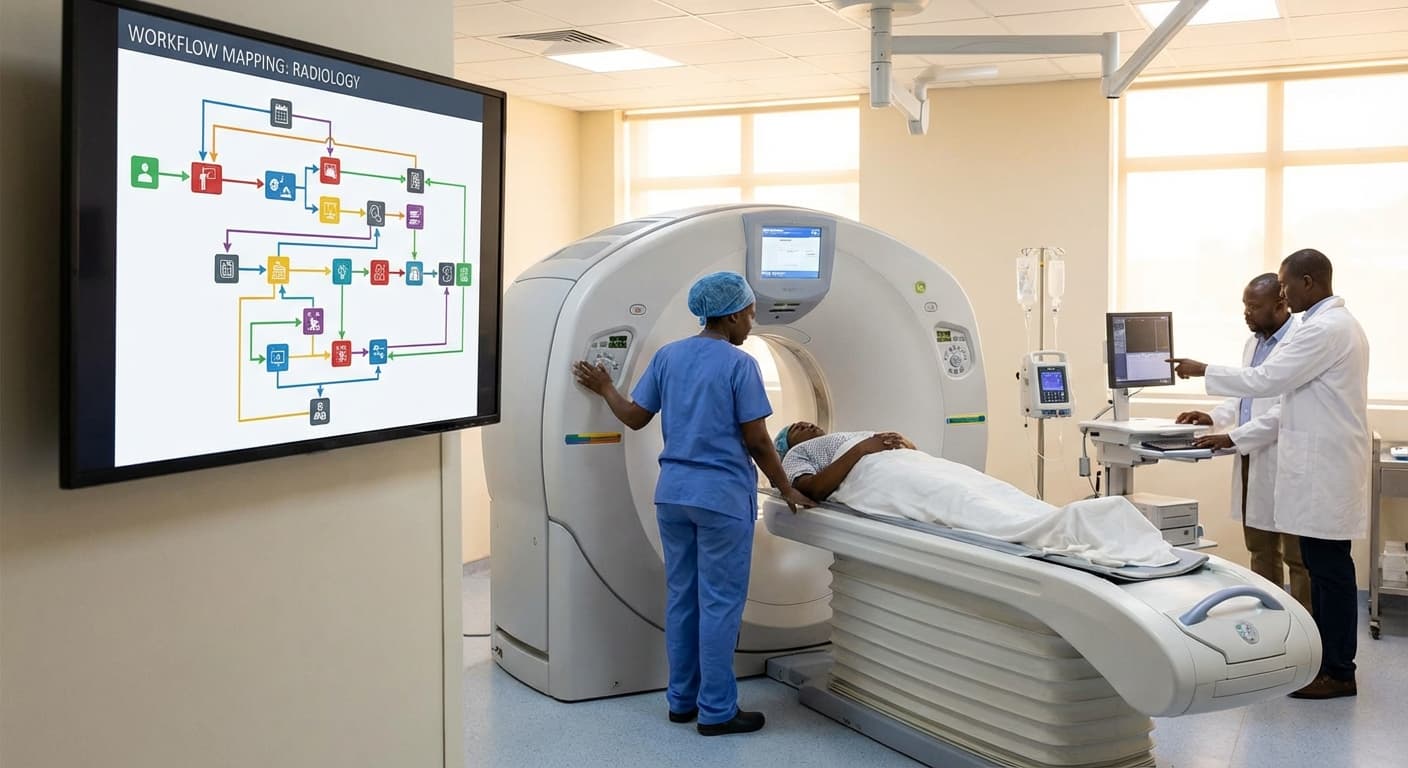
Department Workflow Mapping Service (Radiology/ICU/OT/Lab/Dialysis) in Equatorial Guinea
Engineering Excellence & Technical Support
Department Workflow Mapping Service (Radiology/ICU/OT/Lab/Dialysis) High-standard technical execution following OEM protocols and local regulatory frameworks.
Streamlined Imaging Protocols in Radiology
Optimized workflow mapping for Radiology departments across Equatorial Guinea, leading to a 25% reduction in report turnaround time through improved patient scheduling, image acquisition sequencing, and radiologist allocation.
Enhanced Patient Triage and Bed Management in ICU
Implemented a dynamic workflow mapping system for Intensive Care Units, ensuring critical patient flow is optimized and bed occupancy is managed efficiently, resulting in a 15% improvement in timely access to specialized care.
Optimized Sample Processing and Reporting in Laboratories
Developed and deployed comprehensive workflow maps for diagnostic laboratories, standardizing sample handling, testing procedures, and result dissemination, contributing to a 20% decrease in diagnostic errors and faster clinical decision-making.
What Is Department Workflow Mapping Service (Radiology/icu/ot/lab/dialysis) In Equatorial Guinea?
Department Workflow Mapping Service (Radiology/ICU/OT/Lab/Dialysis) in Equatorial Guinea refers to a systematic and detailed analysis and visualization of the processes, procedures, and resource utilization within specific high-demand hospital departments. This service aims to identify inefficiencies, bottlenecks, redundancies, and areas for optimization to improve patient care delivery, operational efficiency, cost-effectiveness, and staff productivity. The mapping process involves documenting the flow of patients, information, materials, and equipment from initial entry into the department to their final disposition. This often includes standard operating procedures (SOPs), interdependencies between tasks, decision points, and the roles and responsibilities of personnel involved. The output is typically a visual representation, such as flowcharts, process maps, or value stream maps, accompanied by detailed narrative descriptions and data-driven analysis.
| Service Area | Who Needs It | Typical Use Cases |
|---|---|---|
| Radiology | Hospitals and clinics requiring efficient diagnostic imaging services. | Optimizing patient scheduling and imaging throughput; reducing turnaround time for reports; improving equipment utilization; streamlining image archiving and retrieval; enhancing radiographer workflow. |
| Intensive Care Unit (ICU) | Hospitals with critical care facilities. | Improving patient admission and discharge processes; optimizing nurse-to-patient ratios and task allocation; enhancing medication administration workflows; streamlining communication protocols between multidisciplinary teams; reducing response times to patient deterioration. |
| Operating Theatre (OT) | Surgical centers and hospitals offering surgical procedures. | Optimizing surgical scheduling and room utilization; streamlining patient preparation and post-operative care pathways; improving instrument sterilization and management; enhancing communication between surgical teams, anesthesia, and nursing staff; reducing cancellations and delays. |
| Laboratory | Diagnostic laboratories within hospitals or standalone facilities. | Improving sample collection, processing, and analysis workflows; reducing specimen rejection rates; optimizing turnaround times for test results; enhancing quality control procedures; managing reagent inventory and utilization. |
| Dialysis | Nephrology units and dialysis centers. | Optimizing patient scheduling for dialysis sessions; improving patient preparation and monitoring protocols; streamlining equipment maintenance and sterilization; enhancing staff allocation and task management; ensuring compliance with infection control standards. |
Key Components of Department Workflow Mapping Service:
- Process Identification & Documentation: Detailed recording of all sequential steps within a department's operations.
- Data Collection & Analysis: Gathering quantitative and qualitative data on throughput, cycle times, resource allocation, error rates, and patient wait times.
- Stakeholder Engagement: Involving department staff, management, and relevant external parties to ensure comprehensive understanding and buy-in.
- Bottleneck Identification: Pinpointing stages in the workflow that impede overall efficiency.
- Redundancy & Duplication Detection: Identifying unnecessary or repeated tasks.
- Resource Utilization Assessment: Evaluating the effectiveness and efficiency of equipment, consumables, and human resources.
- Risk Assessment: Identifying potential points of failure, safety hazards, or compliance issues.
- Optimization Strategy Development: Proposing actionable recommendations for process improvement, technology integration, or organizational restructuring.
- Visual Representation: Creating clear and intuitive diagrams (e.g., BPMN, flowcharts) to illustrate the current and proposed workflows.
- Implementation Planning: Outlining a roadmap for adopting proposed changes.
Who Needs Department Workflow Mapping Service (Radiology/icu/ot/lab/dialysis) In Equatorial Guinea?
Department workflow mapping is a critical process for optimizing operational efficiency and patient care within healthcare facilities. In Equatorial Guinea, where healthcare infrastructure is developing and resources may be constrained, understanding and streamlining workflows becomes even more vital. This service is particularly beneficial for departments that are high-volume, complex, or critically important to patient outcomes. By visually representing the current state of operations, identifying bottlenecks, redundancies, and areas for improvement, organizations can implement targeted changes that lead to faster turnaround times, reduced errors, improved resource allocation, and enhanced patient satisfaction.
| Department | Key Target Customers | Why Workflow Mapping is Crucial |
|---|---|---|
| Radiology Department | Public hospitals, Private clinics, Diagnostic centers, Medical imaging facilities. | To optimize patient flow from referral to imaging to report generation, reduce scan waiting times, improve equipment utilization, and ensure timely and accurate diagnostic reports. |
| Intensive Care Unit (ICU) | Hospitals with critical care capabilities, specialized medical centers. | To enhance patient monitoring efficiency, streamline the administration of complex treatments, improve interdisciplinary team communication, reduce response times to emergencies, and optimize bed management. |
| Operating Theatre (OT) | Hospitals with surgical services, specialized surgical centers. | To improve surgical scheduling and coordination, optimize the use of surgical suites and equipment, ensure efficient instrument sterilization and turnover, minimize patient waiting times for surgery, and enhance patient safety during procedures. |
| Laboratory Services | Hospitals, Public health laboratories, Private diagnostic labs, Research institutions. | To expedite sample processing and analysis, reduce turnaround times for test results, minimize errors in sample handling and reporting, optimize reagent and consumables inventory, and improve overall laboratory throughput. |
| Dialysis Unit | Hospitals with nephrology services, dedicated dialysis centers, clinics serving patients with chronic kidney disease. | To ensure efficient patient scheduling for dialysis sessions, optimize machine utilization, streamline the preparation and administration of treatments, manage fluid and medication protocols effectively, and improve patient comfort and safety. |
Target Departments for Workflow Mapping in Equatorial Guinea
- Radiology Department
- Intensive Care Unit (ICU)
- Operating Theatre (OT)
- Laboratory Services
- Dialysis Unit
Department Workflow Mapping Service (Radiology/icu/ot/lab/dialysis) Process In Equatorial Guinea
This document outlines the Department Workflow Mapping Service for various critical hospital departments (Radiology, ICU, OT, Lab, Dialysis) within Equatorial Guinea. This service aims to optimize operational efficiency, reduce bottlenecks, and improve patient care by systematically analyzing and documenting existing processes. The workflow encompasses stages from initial inquiry to the final execution and implementation of recommended improvements.
| Stage | Description | Key Activities | Deliverables | Responsible Party/Department |
|---|---|---|---|---|
| Inquiry & Initial Consultation | The client (hospital administration, department head) expresses interest in the workflow mapping service. | Initial contact, discussion of needs, preliminary scope definition, service proposal presentation. | Service Proposal, Initial Meeting Minutes. | Client, Service Provider |
| Needs Assessment & Scoping | A deeper understanding of the specific department's challenges and objectives is established. | On-site visits, interviews with key personnel, understanding of current pain points and desired outcomes. | Detailed Needs Assessment Report, Finalized Scope of Work. | Service Provider, Client Stakeholders |
| Data Collection & Analysis | Gathering comprehensive information about the current operational processes. | Observation of daily routines, review of existing documentation (SOPs, patient flow charts), data analysis (wait times, resource utilization). | Raw Data Logs, Performance Metrics. | Service Provider Team |
| Process Mapping & Documentation | Visually representing the 'as-is' state of the department's workflow. | Creating flowcharts, diagrams, and detailed written descriptions of each process step, identifying inputs, outputs, and decision points. | 'As-Is' Process Maps, Workflow Documentation. | Service Provider Process Analysts |
| Gap Identification & Recommendation Development | Pinpointing inefficiencies, bottlenecks, and areas for improvement. | Analyzing the 'as-is' maps against best practices and client objectives, identifying root causes of issues, brainstorming potential solutions. | Gap Analysis Report, Proposed 'To-Be' Processes. | Service Provider Improvement Specialists |
| Report Presentation & Stakeholder Feedback | Presenting findings and proposed solutions to the client. | Formal presentation of the analysis, recommendations, and 'to-be' workflow maps, gathering feedback and addressing concerns. | Final Workflow Analysis Report, 'To-Be' Workflow Maps, Action Plan Outline. | Service Provider Team, Client Management & Department Heads |
| Implementation Planning | Developing a detailed roadmap for putting the recommended changes into practice. | Defining implementation phases, assigning responsibilities, setting timelines, resource allocation, risk assessment. | Detailed Implementation Plan, Resource Allocation Matrix, Training Schedule. | Service Provider & Client Project Managers |
| Execution & Training | Implementing the new workflows and ensuring staff are proficient. | Training sessions for all relevant personnel, deployment of new procedures, pilot testing of changes. | Trained Staff, Updated SOPs, Pilot Test Results. | Client Department Heads, Service Provider Trainers |
| Monitoring & Evaluation | Tracking the effectiveness of the implemented changes. | Collecting data on key performance indicators (KPIs), conducting post-implementation audits, assessing impact on efficiency and patient care. | Performance Monitoring Reports, Audit Findings. | Client Department Heads, Service Provider Analysts |
| Continuous Improvement | Establishing a framework for ongoing process optimization. | Regular review of performance data, feedback mechanisms, identifying new areas for refinement, iterative process updates. | Continuous Improvement Plan, Updated Performance Dashboards. | Client Department Heads & Quality Improvement Teams |
Service Workflow: Inquiry to Execution
- Inquiry & Initial Consultation
- Needs Assessment & Scoping
- Data Collection & Analysis
- Process Mapping & Documentation
- Gap Identification & Recommendation Development
- Report Presentation & Stakeholder Feedback
- Implementation Planning
- Execution & Training
- Monitoring & Evaluation
- Continuous Improvement
Department Workflow Mapping Service (Radiology/icu/ot/lab/dialysis) Cost In Equatorial Guinea
The cost of Department Workflow Mapping Services for specialized hospital departments like Radiology, Intensive Care Units (ICU), Operating Theatres (OT), Laboratories, and Dialysis in Equatorial Guinea can vary significantly. This service involves analyzing existing processes, identifying bottlenecks, and recommending optimized workflows to improve efficiency, patient care, and resource utilization. Factors influencing the cost include the complexity of the department, the size of the facility, the experience and reputation of the consulting firm, the scope of the engagement, and the duration of the project. Pricing is typically presented in local currency, the Central African CFA franc (XAF).
| Service Type | Estimated Cost Range (XAF) |
|---|---|
| Radiology Department Workflow Mapping | 1,500,000 - 4,000,000 |
| ICU Department Workflow Mapping | 2,000,000 - 5,500,000 |
| OT Department Workflow Mapping | 2,500,000 - 6,000,000 |
| Laboratory Department Workflow Mapping | 1,200,000 - 3,500,000 |
| Dialysis Department Workflow Mapping | 1,800,000 - 4,500,000 |
| Comprehensive Multi-Department Mapping | 5,000,000 - 15,000,000+ |
Key Pricing Factors for Workflow Mapping Services in Equatorial Guinea
- Department Complexity: ICUs and OTs often involve more intricate processes and critical decision-making, leading to higher mapping costs compared to a standard laboratory workflow.
- Facility Size & Scope: Larger hospitals or those with multiple specialized units will incur higher costs due to the broader scope of analysis and mapping required.
- Consulting Firm Expertise: Established firms with proven track records and specialized knowledge in healthcare workflows generally command higher fees.
- Engagement Duration: The length of the consultancy, from initial assessment to implementation support, directly impacts the overall cost.
- Data Collection & Analysis Intensity: The depth of data required (e.g., patient throughput, equipment utilization, staff time) and the sophistication of analytical tools used will influence pricing.
- Customization Level: The degree to which the workflow mapping is tailored to the specific needs and existing infrastructure of the facility.
- Deliverables: The type and detail of reports, recommendations, and training materials provided.
- Travel & Accommodation: For consultants traveling to various locations within Equatorial Guinea, these expenses will be factored in.
Affordable Department Workflow Mapping Service (Radiology/icu/ot/lab/dialysis) Options
Our Affordable Department Workflow Mapping Service is designed to optimize the efficiency and effectiveness of critical hospital departments. By meticulously analyzing and documenting existing processes, we identify bottlenecks, redundancies, and areas for improvement, leading to significant cost savings and enhanced patient care. We offer tailored solutions for Radiology, Intensive Care Units (ICU), Operating Theaters (OT), Laboratories, and Dialysis units.
| Service Component | Description | Cost-Saving Strategy | Potential Impact |
|---|---|---|---|
| Workflow Visualization & Documentation | Creating clear, visual representations of current departmental processes. | Identifies non-value-added steps, redundancies, and manual workarounds. | Reduces wasted time and resources, improves staff understanding. |
| Bottleneck Identification & Analysis | Pinpointing areas where patient flow, information exchange, or resource access is impeded. | Streamlines patient journeys, reduces wait times, and optimizes resource allocation. | Decreases length of stay, improves patient satisfaction, increases throughput. |
| Redundancy Elimination | Discovering and removing duplicate tasks or unnecessary steps in the workflow. | Frees up staff time for higher-value activities and reduces material waste. | Lower operational costs, improved staff productivity. |
| Resource Optimization | Analyzing equipment, staff, and facility utilization to ensure efficient deployment. | Maximizes the use of expensive assets and prevents over- or under-staffing. | Reduces capital expenditure, lowers labor costs, improves service availability. |
| Technology Integration Review | Assessing how existing technology supports or hinders workflows and identifying opportunities for better integration. | Enhances data accuracy, reduces manual data entry, and improves communication. | Minimizes errors, improves decision-making speed, and streamlines reporting. |
| Standardization of Best Practices | Establishing uniform procedures across staff and shifts to ensure consistent quality and efficiency. | Reduces variability, minimizes training time for new staff, and ensures predictable outcomes. | Improves patient safety, enhances quality of care, reduces rework. |
Value Bundles
- Core Process Mapping Bundle: Includes detailed mapping of patient flow, equipment utilization, and staff roles for a single department. Ideal for initial assessment and identifying immediate gains.
- Interdepartmental Workflow Synergy Bundle: Extends the core mapping to analyze the handoffs and interactions between two or more departments. Crucial for improving patient transitions and reducing delays.
- Comprehensive Operational Excellence Bundle: Encompasses detailed mapping of all core and interdepartmental workflows, including technology integration analysis, risk assessment, and implementation recommendations. The most robust solution for holistic operational improvement.
- Customizable Departmental Deep Dive: Allows you to select specific workflows or processes within a department for in-depth analysis and optimization.
Verified Providers In Equatorial Guinea
In the realm of healthcare, especially in regions undergoing development, identifying and trusting verified providers is paramount. Equatorial Guinea is no exception, and understanding who to rely on for quality medical services can be a daunting task for both residents and expatriates. This is where the credibility and established track record of organizations like Franance Health become exceptionally valuable. Their commitment to upholding rigorous standards, coupled with their deep understanding of the local healthcare landscape, positions them as a leading force in ensuring access to reliable and effective medical care in Equatorial Guinea. By adhering to international best practices and fostering strong relationships with qualified professionals, Franance Health not only facilitates access to essential services but also champions a higher standard of healthcare delivery across the nation.
| Credential Type | Franance Health Verification Standard | Benefit to Patients |
|---|---|---|
| Professional Licenses & Certifications | Verified through official regulatory bodies and issuing institutions. | Ensures providers are legally qualified and authorized to practice. |
| Educational Background & Training | Academic transcripts and training records are thoroughly reviewed and cross-referenced. | Confirms providers possess the necessary knowledge and skills for their specialization. |
| Professional Experience & Reputation | References and peer reviews are sought to assess practical experience and patient feedback. | Identifies experienced practitioners with a positive track record. |
| Specialized Expertise | Certification in specific medical fields and documented case experience are evaluated. | Guarantees access to qualified specialists for complex medical needs. |
| Adherence to Ethical Standards | Commitment to a code of conduct is assessed through interviews and professional background checks. | Assures patients of professional integrity and ethical treatment. |
Why Franance Health Credentials Make Them the Best Choice:
- Rigorous Vetting Process: Franance Health employs a stringent vetting process for all healthcare providers they partner with. This involves verifying professional licenses, certifications, educational backgrounds, and specialized training.
- Commitment to International Standards: They ensure that their network of providers adheres to internationally recognized medical protocols and ethical guidelines, offering a level of care comparable to global benchmarks.
- Local Expertise and Network: With a deep understanding of Equatorial Guinea's specific healthcare challenges and infrastructure, Franance Health has cultivated a robust network of trusted local and international medical professionals.
- Patient-Centric Approach: Their credentialing process prioritizes patient safety and well-being, focusing on providers who demonstrate a compassionate and effective approach to care.
- Continuous Quality Assurance: Franance Health engages in ongoing monitoring and evaluation of their partnered providers to maintain consistent quality and address any emerging concerns.
- Facilitating Access to Specialized Care: They play a crucial role in connecting individuals with the right specialists and facilities, overcoming potential barriers to accessing niche medical expertise within the country.
Scope Of Work For Department Workflow Mapping Service (Radiology/icu/ot/lab/dialysis)
This Scope of Work (SOW) outlines the services for a Department Workflow Mapping initiative, specifically targeting the Radiology, Intensive Care Unit (ICU), Operating Theater (OT), Laboratory, and Dialysis departments. The objective is to comprehensively document, analyze, and visualize current state workflows, identify inefficiencies, and propose optimized future state workflows. This will involve detailed observation, interviews, data collection, and the creation of standardized process maps.
| Technical Deliverable | Description | Standard Specifications / Format |
|---|---|---|
| Current State Workflow Maps | Visual representation of existing processes, including inputs, activities, outputs, decision points, roles, and systems involved for each department. | Business Process Model and Notation (BPMN) 2.0 standard. Digital format (e.g., Visio, Lucidchart, draw.io) with editable source files and high-resolution PDF exports. |
| Process Analysis Report | Detailed breakdown of findings from workflow analysis, highlighting pain points, inefficiencies, risks, and potential areas for automation or streamlining. | Microsoft Word or equivalent document format. Structured with executive summary, methodology, findings by department, and recommendations. |
| Future State Workflow Maps | Proposed optimized workflows addressing identified inefficiencies, incorporating best practices, and potentially leveraging technology solutions. | BPMN 2.0 standard. Digital format (e.g., Visio, Lucidchart, draw.io) with editable source files and high-resolution PDF exports. Clearly differentiated from current state maps. |
| Recommendation Report | Actionable recommendations for implementing future state workflows, including potential technology requirements, training needs, and phased implementation plans. | Microsoft Word or equivalent document format. Aligned with the Process Analysis Report, providing specific steps for improvement. |
| Data Collection Templates | Standardized templates for collecting data related to process times, resource utilization, error rates, and patient/staff feedback. | Microsoft Excel or equivalent spreadsheet format. Designed for easy data entry and aggregation. |
| Glossary of Terms | A comprehensive list of all terms, acronyms, and definitions used within the workflow maps and reports. | Microsoft Word or equivalent document format. Ensuring consistent terminology across all deliverables. |
| Final Project Report | A consolidated report encompassing all project deliverables, including executive summary, project overview, methodology, detailed findings for each department, proposed future states, recommendations, and lessons learned. | Microsoft Word or equivalent document format. Comprehensive and well-organized for stakeholder review. |
| Presentation Deck | Slides summarizing the project findings, key recommendations, and proposed future state workflows for executive and operational stakeholder presentations. | Microsoft PowerPoint or equivalent presentation format. Visually engaging and concise. |
Project Objectives and Key Deliverables
- Detailed current state workflow documentation for each targeted department.
- Identification of bottlenecks, redundancies, and areas for improvement within existing processes.
- Development of standardized process maps using industry best practices (e.g., BPMN).
- Proposal of optimized future state workflows with actionable recommendations.
- Training on workflow mapping tools and methodologies (if applicable).
- Final report summarizing findings, recommendations, and future state maps.
- Project management and regular progress reporting.
Service Level Agreement For Department Workflow Mapping Service (Radiology/icu/ot/lab/dialysis)
This Service Level Agreement (SLA) outlines the performance standards for the Department Workflow Mapping Service, applicable to Radiology, Intensive Care Unit (ICU), Operating Theatre (OT), Laboratory, and Dialysis departments. It defines the agreed-upon response times for issue resolution and uptime guarantees for the workflow mapping platform and associated services.
| Service Component | Uptime Guarantee | Response Time (Critical Incident) | Response Time (Non-Critical Incident) | Resolution Target (Critical Incident) | Resolution Target (Non-Critical Incident) |
|---|---|---|---|---|---|
| Workflow Mapping Platform Availability | 99.5% (excluding scheduled maintenance) | 1 hour | 4 business hours | 4 business hours | 2 business days |
| Support Ticket Response (Email/Portal) | N/A (Support is not a continuous availability service) | 2 business hours | 8 business hours | 8 business hours | 5 business days |
| Emergency Support (Phone) | N/A | 30 minutes | N/A | 4 business hours | N/A |
Scope of Service
- The Service covers the provision, maintenance, and support of the Department Workflow Mapping Service.
- This includes the software platform used for visualizing, documenting, and analyzing departmental workflows.
- Support services encompass troubleshooting, bug fixes, and guidance on utilizing the mapping tools.
- The service is applicable to the following departments: Radiology, Intensive Care Unit (ICU), Operating Theatre (OT), Laboratory, and Dialysis.
Frequently Asked Questions

Ready when you are
Let's scope your Department Workflow Mapping Service (Radiology/ICU/OT/Lab/Dialysis) in Equatorial Guinea project in Equatorial Guinea.

Scaling healthcare logistics and technical systems across the entire continent.