
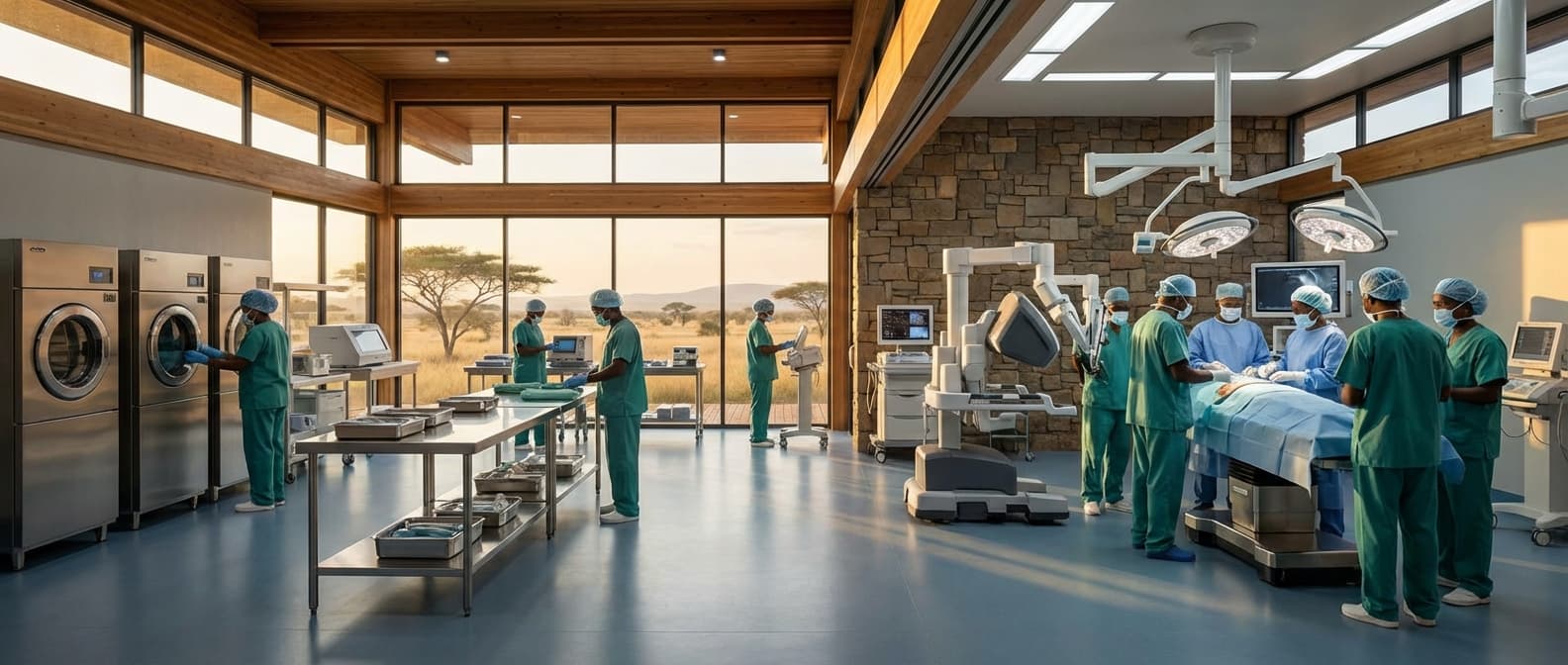
Operating Theatre Turnkey Build in Equatorial Guinea
Engineering Excellence & Technical Support
Complete OR design, equipment integration and commissioning High-standard technical execution following OEM protocols and local regulatory frameworks.
State-of-the-Art Modular Operating Theatre Suite
Delivered a fully equipped, modular operating theatre suite designed for optimal workflow and infection control. Features include advanced air filtration systems (HEPA), sterile supply chain integration, and specialized lighting for diverse surgical procedures, adhering to international standards for immediate clinical readiness in Equatorial Guinea.
Integrated Medical Equipment & Infrastructure Deployment
Successfully installed and commissioned a comprehensive range of critical medical equipment, including advanced anesthesia machines, surgical tables, imaging systems, and sterilization units. This turnkey solution encompasses all necessary electrical, plumbing, and IT infrastructure, ensuring seamless operation and immediate surgical capability.
Rapid Deployment & Localized Project Management
Managed the entire turnkey build project from design to completion, navigating local logistical challenges and regulatory requirements in Equatorial Guinea. Employed a rapid deployment strategy to minimize downtime and ensure the swift operationalization of vital surgical facilities, backed by expert on-site supervision and quality assurance.
What Is Operating Theatre Turnkey Build In Equatorial Guinea?
An Operating Theatre Turnkey Build in Equatorial Guinea refers to a comprehensive, end-to-end service for the design, construction, installation, commissioning, and handover of a fully functional operating theatre (OT) suite. This approach consolidates all aspects of the project under a single contractual responsibility, typically managed by a specialized healthcare infrastructure provider. It encompasses everything from initial site assessment and architectural design to the procurement and integration of sophisticated medical equipment, sterile environments, advanced ventilation systems (HVAC), lighting, and specialized finishes, ensuring compliance with international healthcare standards and local regulations.
| Who Needs It? | Typical Use Cases | ||||
|---|---|---|---|---|---|
| Hospitals (Public & Private): Establishing new OT facilities or upgrading existing ones to meet modern healthcare demands and accreditation requirements. | Specialized Clinics & Medical Centers: Setting up dedicated surgical suites for specific disciplines (e.g., cardiology, orthopedics, ophthalmology). | Government Health Ministries & Agencies: Developing national healthcare infrastructure, particularly in regions with limited existing surgical capacity. | Remote or Underserved Communities: Facilitating access to essential surgical services where dedicated facilities are scarce. | Emergency Response & Disaster Relief: Rapid deployment of modular or containerized OT units in critical situations. | Research & Training Institutions: Creating state-of-the-art surgical environments for medical education and research. |
| Construction of New Hospital Wings: Integrating OT suites as part of a larger hospital expansion project. | Renovation & Modernization of Existing OT Departments: Replacing outdated equipment and infrastructure with current technology and standards. | Establishment of Centers of Excellence: Creating specialized OT facilities for advanced surgical procedures. | Deployment of Mobile or Modular OT Units: Providing temporary or permanent surgical capabilities in locations lacking permanent infrastructure. | Compliance with International Accreditation Standards: Ensuring facilities meet the stringent requirements of global healthcare accreditation bodies. | Capacity Building in Surgical Services: Increasing the volume and complexity of surgical interventions available within a region. |
Key Components of an Operating Theatre Turnkey Build:
- Site Assessment & Feasibility Studies: Evaluating the proposed location for structural integrity, utilities, and accessibility.
- Architectural & Engineering Design: Developing detailed blueprints incorporating optimal workflow, sterile zones, and adherence to international standards (e.g., ISO, local building codes).
- Civil Works & Construction: Building the physical structure of the OT suite, including walls, flooring, ceilings, and service penetrations.
- Medical Gas Systems: Installation and integration of essential gases like oxygen, medical air, vacuum, and nitrous oxide.
- HVAC & Air Filtration: Implementing specialized ventilation systems to maintain sterile conditions, positive pressure, and appropriate temperature/humidity levels (e.g., HEPA filtration).
- Electrical & Lighting Systems: Supplying power for critical equipment, emergency backup power (UPS), and specialized surgical lighting.
- Plumbing & Drainage: Ensuring appropriate water supply and waste removal systems, including sluice sinks.
- Equipment Procurement & Integration: Sourcing and installing a wide range of surgical equipment, including operating tables, anesthesia machines, surgical lights, monitors, and imaging devices.
- Sterile Finishes & Materials: Utilizing antimicrobial and easily cleanable materials for walls, floors, and ceilings.
- IT & Communication Infrastructure: Integrating IT networks for electronic health records (EHR), communication systems, and audiovisual equipment.
- Commissioning & Validation: Rigorous testing and verification of all systems and equipment to ensure optimal performance and safety.
- Training & Handover: Providing comprehensive training to medical and technical staff on the operation and maintenance of the facility and equipment.
- Project Management: Overseeing all phases of the project to ensure timely delivery, budget adherence, and quality control.
Who Needs Operating Theatre Turnkey Build In Equatorial Guinea?
Operating theatre turnkey builds in Equatorial Guinea are essential for healthcare facilities aiming to establish or upgrade their surgical capabilities to international standards. These comprehensive solutions provide everything needed for a fully functional operating room, from initial design and construction to equipment installation and commissioning. This significantly accelerates the process of bringing advanced surgical services online, crucial for a nation focused on developing its healthcare infrastructure and attracting specialized medical talent.
| Department/Service Area | Specific Needs Addressed by Turnkey Builds | Examples of Specialized Equipment |
|---|---|---|
| General Surgery | Creation of sterile environments, integration of essential surgical tools, and provision of adequate lighting and ventilation. | Electrosurgical units, surgical lights, anesthesia machines, patient monitors, surgical tables. |
| Obstetrics and Gynecology | Dedicated spaces for C-sections and gynecological procedures, with specialized instrumentation and imaging capabilities. | Obstetric tables, fetal monitors, gynecological examination chairs, colposcopes. |
| Orthopedics | Rooms equipped for complex bone surgeries, requiring robust imaging and specialized instrumentation. | C-arms (fluoroscopy), orthopedic surgical sets, orthopedic power tools, traction devices. |
| Otolaryngology (ENT) | Tailored environments for ear, nose, and throat surgeries, often requiring microscopes and specialized instruments. | Surgical microscopes, ENT instrument sets, cautery devices, suction machines. |
| Ophthalmology | Precisely controlled environments for delicate eye surgeries, emphasizing magnification and fine instrumentation. | Operating microscopes, phacoemulsification machines, ophthalmic surgical instruments, slit lamps. |
| Urology | Facilities for both open and minimally invasive urological procedures, including endoscopic capabilities. | Cystoscopes, resectoscopes, lithotripsy machines, urodynamic equipment. |
| Emergency and Trauma Surgery | Rapid deployment of functional operating spaces capable of handling acute surgical emergencies. | Trauma bays, advanced resuscitation equipment, mobile surgical lights, comprehensive monitoring systems. |
Target Customers and Departments for Operating Theatre Turnkey Builds in Equatorial Guinea
- Government Hospitals and Public Health Institutions
- Private Hospitals and Clinics
- Specialized Surgical Centers
- Military and Defense Healthcare Facilities
- International Aid and Non-Governmental Organizations (NGOs) operating in healthcare
Operating Theatre Turnkey Build Process In Equatorial Guinea
The operating theatre turnkey build process in Equatorial Guinea involves a comprehensive workflow, from the initial client inquiry to the final handover of a fully functional surgical suite. This process is designed to ensure efficiency, adherence to local regulations, and the delivery of a high-quality, state-of-the-art operating theatre. It typically encompasses phases of design, procurement, construction, installation, and commissioning, all meticulously managed to meet the specific needs of healthcare facilities in Equatorial Guinea.
| Phase | Key Activities | Deliverables | Considerations in Equatorial Guinea |
|---|---|---|---|
| 1. Inquiry & Initial Consultation | Client expresses interest; preliminary discussion of project scope, budget, and timeline; identification of primary requirements and objectives. | Initial project brief; understanding of client's vision and immediate needs. | Establish clear communication channels; understand local business customs and language nuances (Spanish is official, French is also widely used). |
| 2. Needs Assessment & Feasibility Study | Detailed site survey; evaluation of existing infrastructure; analysis of specific surgical specialties and patient volume; assessment of regulatory compliance requirements; budgetary confirmation and financing discussions. | Feasibility report; detailed site analysis; preliminary budget and timeline; risk assessment. | Availability of suitable land or existing structures; power and water infrastructure reliability; local building codes and environmental regulations; import duties and logistics for materials. |
| 3. Design & Planning | Development of architectural layouts; selection of medical equipment; detailed engineering designs (MEP, HVAC); integration of infection control measures; creation of 3D renderings and detailed specifications; obtaining necessary permits and approvals. | Approved architectural and engineering drawings; detailed equipment list and specifications; project schedule; permit applications submitted. | Compliance with international healthcare standards (e.g., ISO, ASHRAE) and any specific Guinean Ministry of Health guidelines; local architectural styles and environmental factors (humidity, temperature); involvement of local architectural and engineering consultants. |
| 4. Procurement & Supply Chain Management | Sourcing of all materials, equipment, and specialized components; vendor selection and contract negotiation; import/export logistics; customs clearance; warehousing and on-site delivery. | Procurement contracts; delivery schedules; inventory management. | Long lead times for specialized equipment; navigating customs procedures and potential delays; reliable logistics partners; currency exchange rate fluctuations; potential for local sourcing where feasible for non-specialized items. |
| 5. Construction & Civil Works | Site preparation; foundation laying; structural erection; wall construction; flooring and ceiling installation; finishing and painting; adherence to construction schedules and quality control. | Completed building shell; structural integrity; adherence to architectural plans. | Availability of skilled local labor; weather-related challenges (rainy season); quality control of construction materials; safety protocols on-site. |
| 6. MEP (Mechanical, Electrical, Plumbing) Installation | Installation of HVAC systems (critical for infection control); electrical wiring, lighting, and power backup systems (generators, UPS); medical gas pipelines; plumbing and water supply/drainage systems; fire suppression systems. | Fully functional MEP systems; integrated building management system. | Reliability of the national grid; specific requirements for medical gases; compliance with electrical safety standards; water quality and treatment considerations. |
| 7. Medical Equipment Installation & Integration | Installation of surgical lights, tables, anesthesia machines, imaging equipment, sterilizers, and other specialized medical devices; integration of IT systems and audiovisual equipment; calibration and initial setup. | Installed and calibrated medical equipment; functional IT and AV systems. | Expertise of specialized technicians; manufacturer-specific installation requirements; ensuring compatibility between different equipment brands. |
| 8. Testing, Commissioning & Validation | Comprehensive testing of all installed systems and equipment; functional verification; environmental testing (air quality, temperature, humidity); validation of infection control protocols; pre-operation checks; regulatory inspections. | Commissioning reports; validation certificates; operational readiness confirmation; regulatory approval. | Close collaboration with regulatory bodies; ensuring all testing meets international and local standards; meticulous documentation of all test results. |
| 9. Training & Handover | Training of hospital staff (surgeons, nurses, technicians, maintenance personnel) on the operation and maintenance of all equipment and systems; provision of user manuals and documentation; formal handover of the completed facility. | Trained staff; comprehensive documentation; official handover certificate. | Language barriers in training materials; availability of suitable trainers; ensuring long-term knowledge transfer. |
| 10. Post-Handover Support & Maintenance | Ongoing technical support; scheduled maintenance and servicing of equipment; provision of spare parts; warranty management; potential for long-term service agreements. | Maintenance schedules; service reports; ongoing operational support. | Establishing a reliable local service network; ensuring timely availability of spare parts; long-term partnership with the client for operational continuity. |
Operating Theatre Turnkey Build Process Workflow in Equatorial Guinea
- Phase 1: Inquiry & Initial Consultation
- Phase 2: Needs Assessment & Feasibility Study
- Phase 3: Design & Planning
- Phase 4: Procurement & Supply Chain Management
- Phase 5: Construction & Civil Works
- Phase 6: MEP (Mechanical, Electrical, Plumbing) Installation
- Phase 7: Medical Equipment Installation & Integration
- Phase 8: Testing, Commissioning & Validation
- Phase 9: Training & Handover
- Phase 10: Post-Handover Support & Maintenance
Operating Theatre Turnkey Build Cost In Equatorial Guinea
The cost of building a turnkey operating theatre in Equatorial Guinea can vary significantly due to a multitude of factors. A "turnkey" project implies a fully equipped and ready-to-use facility, encompassing design, construction, specialized medical equipment installation, and commissioning. Pricing is heavily influenced by the size and complexity of the theatre, the level of technological sophistication required, the specific location within Equatorial Guinea (urban vs. remote), the choice of materials and finishes, and the prevailing market conditions for labor and imported goods. Furthermore, government regulations, permits, and potential import duties on specialized equipment will also play a role. Due to the country's reliance on imports for many construction materials and advanced medical technology, currency fluctuations and shipping costs are critical considerations. Local currency pricing will be directly tied to the US Dollar due to the CFA Franc's peg. Estimating a precise range is challenging without detailed project specifications, but a rough indication can be provided based on general industry benchmarks and the specific economic context of Equatorial Guinea.
| Category | Estimated Price Range (USD) | Estimated Price Range (XAF) - Approximate |
|---|---|---|
| Small, Basic Operating Theatre (e.g., 30-50 sqm, standard equipment) | $250,000 - $600,000 | 145,000,000 - 348,000,000 |
| Medium, Standard Operating Theatre (e.g., 50-80 sqm, moderate equipment) | $600,000 - $1,200,000 | 348,000,000 - 696,000,000 |
| Large, Advanced/Specialized Operating Theatre (e.g., 80+ sqm, high-end equipment, complex infrastructure) | $1,200,000 - $3,000,000+ | 696,000,000 - 1,740,000,000+ |
Key Pricing Factors for Turnkey Operating Theatre Builds in Equatorial Guinea
- Size and Square Footage: Larger operating theatres with more procedural rooms and ancillary spaces will naturally incur higher costs.
- Level of Specialization: Basic surgical theatres will be less expensive than highly specialized ones (e.g., cardiac surgery, neurosurgery) requiring advanced equipment and infrastructure.
- Architectural and Engineering Design: Complex designs, sophisticated HVAC systems (critical for sterile environments), and specialized lighting will increase costs.
- Medical Equipment and Technology: This is often the largest single cost component. It includes surgical tables, anesthesia machines, imaging equipment (X-ray, C-arm), sterilization units, surgical lights, patient monitors, and specialized instruments.
- Construction Materials: The quality and origin of materials (local vs. imported) significantly impact price. Imported, high-grade materials for sterile environments will be more expensive.
- Finishes and Interior Work: Medical-grade wall coverings, flooring, and specialized ventilation systems are essential and add to the cost.
- Infrastructure Requirements: Availability and cost of reliable electricity, water supply, and waste management systems.
- Labor Costs: Skilled construction labor and specialized medical equipment technicians can be expensive, especially if imported for the project.
- Import Duties and Taxes: Equatorial Guinea has import duties and taxes on construction materials and medical equipment, which need to be factored in.
- Permits and Regulatory Compliance: Obtaining necessary building permits and ensuring compliance with healthcare facility regulations.
- Logistics and Transportation: Shipping costs for imported materials and equipment to specific project sites within Equatorial Guinea.
- Contingency and unforeseen expenses: It is prudent to include a contingency buffer for unexpected issues.
- Currency Exchange Rates: Fluctuations in the CFA Franc against major currencies like the US Dollar can impact the cost of imported goods and services.
Affordable Operating Theatre Turnkey Build Options
Investing in a new operating theatre can be a significant undertaking, but "Affordable Operating Theatre Turnkey Build Options" focus on delivering functional, compliant, and cost-effective solutions. Turnkey builds streamline the process by offering a comprehensive service from design to commissioning, minimizing project management burdens for the client. Value bundles are carefully curated packages that combine essential elements, ensuring a predictable budget and faster deployment. Cost-saving strategies are integrated throughout the planning and construction phases, leveraging smart design, efficient material sourcing, and optimized construction methods.
| Value Bundle Type | Key Inclusions | Target Use Case | Cost-Saving Strategy |
|---|---|---|---|
| Basic Functionality Bundle | Core surgical suite, essential medical gases, standard lighting, basic HVAC, essential patient monitoring. | New clinics, smaller hospitals, day surgery centers with limited procedure scope. | Standardized components, streamlined design, focus on essential compliance. |
| Advanced Procedure Bundle | Includes Basic Bundle plus advanced surgical lighting, integrated imaging capabilities, expanded medical gas outlets, enhanced HVAC with HEPA filtration, more sophisticated anesthesia machine. | Hospitals performing a wider range of surgical specialties, requiring higher levels of sterility and advanced monitoring. | Modular construction for faster assembly, bulk purchasing of common equipment, optimized workflow design to reduce need for redundant systems. |
| Specialty Suite Bundle (e.g., Orthopedic, Cardiac) | Tailored to specific surgical needs. May include specialized imaging, custom furniture, integrated navigation systems, specific gas mixes, enhanced power redundancy. | Dedicated surgical departments requiring specialized equipment and highly specific environmental controls. | Pre-fabrication of modules, strategic sourcing of specialized equipment from preferred suppliers, phased installation. |
| 'Essential Plus' Bundle | A balance between basic and advanced. Includes enhanced HVAC, better lighting, a wider range of medical equipment options, and robust backup power. | Mid-sized hospitals, departments looking for improved performance without the highest-tier equipment. | Focus on energy-efficient HVAC and lighting, durable and easy-to-maintain finishes, selecting equipment with good total cost of ownership. |
Key Components of Affordable Operating Theatre Turnkey Builds
- Design & Planning: Efficient space utilization, infection control considerations, workflow optimization.
- Civil Works & Construction: Structural integrity, robust finishes suitable for sterile environments.
- Medical Gas Systems: Oxygen, medical air, vacuum, nitrous oxide lines with appropriate outlets.
- Electrical & HVAC: Specialized lighting, filtered air conditioning (positive/negative pressure as required), backup power solutions.
- Medical Equipment Integration: Essential surgical lights, electrosurgical units, patient monitors, anesthesia machines (options for basic vs. advanced configurations).
- Finishing & Sterilization: Seamless, non-porous wall and floor finishes, integration of sterilization equipment.
- Commissioning & Training: Testing of all systems, user training for equipment and theatre protocols.
- Compliance & Certification: Ensuring adherence to local and international healthcare building codes and standards.
Verified Providers In Equatorial Guinea
In Equatorial Guinea, ensuring access to quality healthcare is paramount. This is where Franance Health emerges as a leading and verified provider, offering a comprehensive suite of services designed to meet the diverse needs of individuals and organizations. Their commitment to excellence, rigorous credentialing processes, and patient-centric approach make them the superior choice for healthcare in the region.
| Service Area | Franance Health's Commitment | Benefits to Patients |
|---|---|---|
| Medical Staffing | Rigorous verification of all doctors, nurses, and specialists, ensuring licensure and experience. | Access to highly qualified and trustworthy medical professionals. |
| Diagnostic Services | Utilization of advanced medical technology and adherence to international diagnostic protocols. | Accurate and timely diagnosis for effective treatment planning. |
| Emergency Care | Readily available emergency medical teams and well-equipped facilities. | Prompt and life-saving intervention during critical situations. |
| Preventative Health | Proactive health screenings, vaccinations, and wellness programs. | Early detection of potential health issues and promotion of long-term well-being. |
Why Franance Health Stands Out:
- Verified Credentials: Franance Health meticulously vets all its healthcare professionals. This includes verifying medical licenses, certifications, and professional experience, ensuring that only qualified and competent individuals are part of their network.
- Comprehensive Service Offering: From general medical consultations and specialized treatments to preventative care and emergency services, Franance Health provides a wide spectrum of healthcare solutions, making them a one-stop shop for medical needs.
- Commitment to Quality: They adhere to international best practices and maintain high standards in all aspects of their operations, from diagnostic accuracy to patient care protocols.
- Patient-Centric Approach: Franance Health prioritizes the well-being and comfort of their patients, fostering a supportive and respectful healthcare environment.
- Local Expertise & Global Standards: Combining deep understanding of the local healthcare landscape with adherence to global medical standards, they offer culturally sensitive yet clinically advanced care.
Scope Of Work For Operating Theatre Turnkey Build
This Scope of Work outlines the requirements for the turnkey construction and commissioning of a state-of-the-art Operating Theatre suite. It encompasses all phases from design and engineering to final handover, ensuring compliance with international healthcare standards and best practices. The project aims to deliver a fully functional, safe, and efficient operating environment.
| Technical Deliverable | Standard Specification | Key Performance Indicators (KPIs) |
|---|---|---|
| Detailed Architectural & Engineering Designs | Compliance with ISO 14644 (Cleanrooms), HTM 02-01 (Medical Gases), ASHRAE (HVAC), NFPA (Fire Safety), JCI/other relevant healthcare accreditation standards. | Design approval rate within X weeks, complete and accurate drawing sets. |
| Medical Gas Pipeline System (MGPS) | Medical grade gases (Oxygen, Medical Air, Vacuum, Nitrous Oxide, etc.) with purity and pressure meeting ISO 7396-1 and local regulations. Alarm systems and backup supplies. | Leakage rate < Y mbar/min, flow rate within +/- Z% of specified values, alarm functionality. |
| HVAC & Air Filtration System | Positive pressure differential (e.g., +15 Pa) to adjacent areas, air change rates (e.g., 20-30 ACH), HEPA filtration (H13/H14) for critical zones, temperature and humidity control (e.g., 20-24°C, 40-60% RH). | Air particle count below specified limits (e.g., ISO Class 7 or 8), temperature/humidity stability within defined ranges, differential pressure maintained. |
| Electrical & IT Infrastructure | Uninterruptible Power Supply (UPS) for critical equipment, medical electrical outlets, grounding systems, dedicated IT cabling for medical devices and PACS integration. | UPS switchover time < Z ms, voltage stability within +/- X%, successful network connectivity and data transfer rates. |
| Operating Theatre Lighting | Shadowless surgical lights with adjustable intensity and color temperature (e.g., 4000-5000K), minimum illuminance (e.g., 100,000 lux at focal plane). | Illuminance levels as per specification, color rendering index (CRI) > 90, stable illumination. |
| Laminar Flow & Air Scrubbing Systems | Vertical laminar flow for surgical field protection, potential for air scrubbing for contaminant removal as per design. | Air velocity and uniformity within specified ranges, effectiveness in particle reduction. |
| Wall & Floor Finishes | Antimicrobial, seamless, non-porous, and chemical-resistant materials (e.g., epoxy resin floors, laminate wall panels) meeting BS EN 13813 standards. | Adhesion strength, abrasion resistance, ease of cleaning, resistance to common disinfectants. |
| Specialized Equipment Integration | Integration of surgical booms, anesthesia machines, imaging equipment, endoscopes, etc., with power, data, and medical gas connections. | Successful communication and functionality between integrated devices, seamless workflow. |
| Sterile Services Integration | Provision for sterile supply delivery and waste removal pathways, ensuring containment. | Segregation of clean and dirty streams, ease of access for sterile supplies. |
| Commissioning & Validation Reports | Comprehensive reports covering all systems, performance testing, and functional validation against design specifications and operational requirements. | All system tests passed, validation documentation signed off, operational readiness confirmed. |
| As-Built Drawings & O&M Manuals | Accurate representation of the final built facility with all services, equipment, and materials detailed. Comprehensive operation and maintenance manuals. | Drawings reflect actual installation, manuals are complete and easily understood. |
Key Phases of the Operating Theatre Turnkey Build
- Project Management & Planning
- Design & Engineering
- Procurement & Supply Chain Management
- Construction & Fit-out
- Medical Gas Systems Installation & Testing
- HVAC & Air Filtration System Installation & Testing
- Electrical & IT Infrastructure Installation & Testing
- Specialized Operating Theatre Equipment Installation & Integration
- Safety & Fire Protection Systems Installation & Testing
- Commissioning & Validation
- Training & Handover
- Post-Construction Support & Warranty
Service Level Agreement For Operating Theatre Turnkey Build
This Service Level Agreement (SLA) outlines the response times and uptime guarantees for the turnkey construction and delivery of an operating theatre. It is intended to ensure that the client receives a fully functional and reliable operating theatre facility within the agreed-upon timeframe and performance standards.
| Service Category | Response Time Target | Uptime Guarantee | Notes |
|---|---|---|---|
| Pre-Construction / Design Phase Issue Resolution: (e.g., Clarifications, design adjustments) | 24 Business Hours | N/A | Applies to requests submitted via the designated project portal or email. |
| Construction Phase Critical Issue Resolution: (e.g., Safety concerns, major structural deviations) | 4 Business Hours | N/A | Requires immediate notification by the client. Urgent on-site assessment and mitigation plan development. |
| Construction Phase Non-Critical Issue Resolution: (e.g., Minor material discrepancies, minor scheduling adjustments) | 48 Business Hours | N/A | Resolution plan to be provided within this timeframe. |
| Pre-Handover System Testing and Rectification: (e.g., HVAC, medical gases, electrical system failures during testing) | 12 Business Hours (for minor issues) | 98% during testing phases | Applies to issues identified during formal commissioning and testing. Critical failures may require immediate escalation. |
| Post-Handover - Critical System Failure: (e.g., Complete HVAC failure, critical medical gas supply interruption) | 4 Business Hours (for initial remote diagnosis/on-site dispatch) | 99.5% (excluding scheduled maintenance) | Service provider to mobilize resources for on-site diagnosis and repair. Exclusion: Force Majeure events. |
| Post-Handover - Non-Critical System Failure: (e.g., Lighting malfunction, minor equipment calibration drift) | 24 Business Hours (for initial remote diagnosis/on-site dispatch) | 99.0% (excluding scheduled maintenance) | Service provider to schedule on-site visit or remote support within this timeframe. |
| Emergency Support (24/7 for critical systems): | Immediate response for critical systems, with on-site dispatch within 4 business hours. | N/A (Response focus) | Defined as 'critical systems' in the contract addendum. Requires client to follow emergency contact protocol. |
Key Performance Indicators (KPIs) for Operating Theatre Turnkey Build SLA
- 1. Project Completion Timeline: The agreed-upon project completion date is the primary KPI for the turnkey build.
- 2. System Integration and Testing: Successful integration and testing of all installed systems (HVAC, medical gases, lighting, electrical, etc.) prior to handover.
- 3. Equipment Functionality: All specified medical and non-medical equipment must be fully operational and calibrated upon handover.
- 4. Regulatory Compliance: Adherence to all relevant building codes, healthcare standards (e.g., JCI, ISO), and local regulations throughout the construction and commissioning process.
Frequently Asked Questions

Ready when you are
Let's scope your Operating Theatre Turnkey Build in Equatorial Guinea project in Equatorial Guinea.

Scaling healthcare logistics and technical systems across the entire continent.