
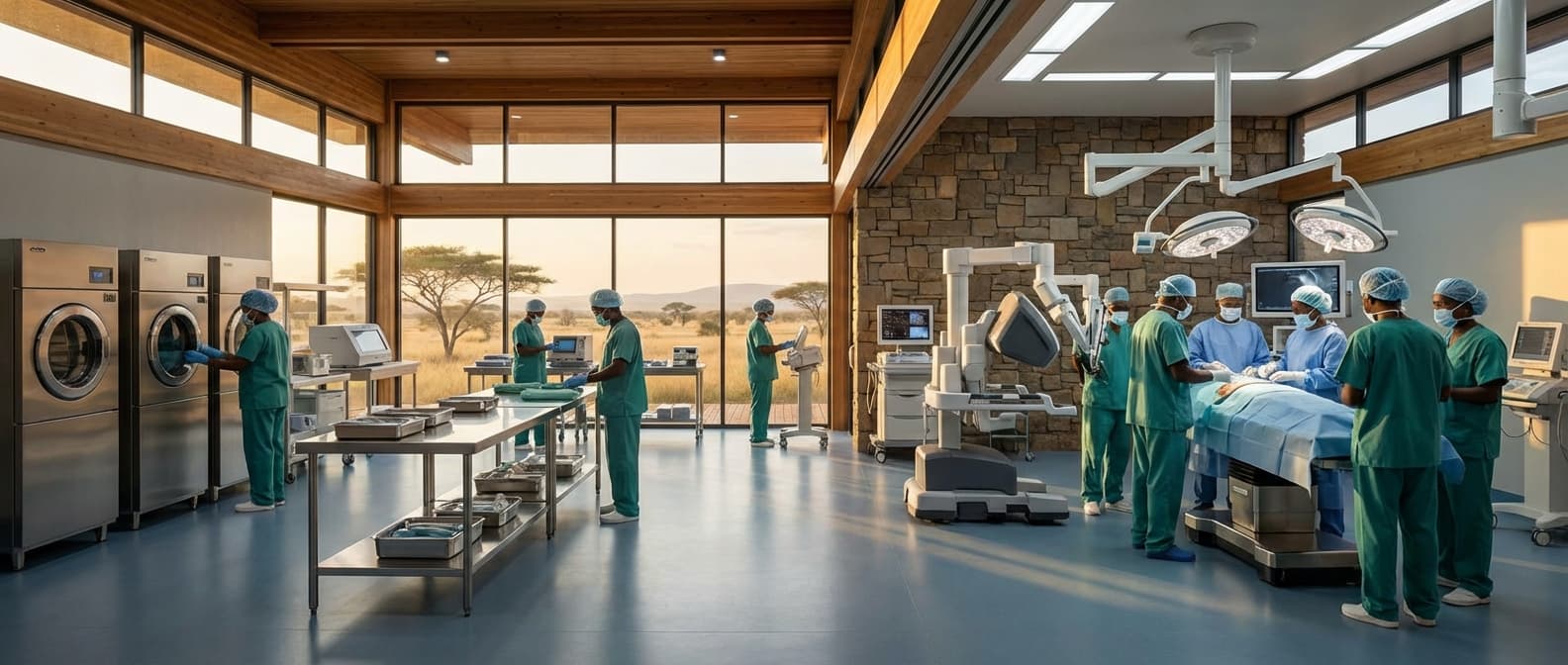
CSSD Design & Validation in Equatorial Guinea
Engineering Excellence & Technical Support
CSSD workflow design, validation and process development High-standard technical execution following OEM protocols and local regulatory frameworks.
Advanced Sterilization Process Validation
Implementing rigorous validation protocols for steam, low-temperature plasma, and ethylene oxide sterilization cycles, ensuring compliance with international standards (ISO 13485, AAMI ST55) and optimal bioburden reduction for critical medical devices within Equatorial Guinea's healthcare facilities.
Optimized CSSD Workflow Design & Airflow Dynamics
Designing state-of-the-art Central Sterile Supply Departments (CSSDs) with optimized workflows for decontamination, preparation, packaging, and sterilization, incorporating precise airflow dynamics and pressure differentials to maintain sterile barriers and prevent cross-contamination in humid equatorial climates.
Instrument Traceability & Quality Assurance Systems
Establishing robust instrument traceability systems, including barcode scanning and digital record-keeping, to ensure comprehensive quality assurance throughout the sterilization lifecycle, minimizing the risk of reprocessed instrument failure and enhancing patient safety in Equatorial Guinea's unique healthcare environment.
What Is Cssd Design & Validation In Equatorial Guinea?
Central Sterile Supply Department (CSSD) design and validation in Equatorial Guinea, as in any healthcare setting, refers to the systematic process of planning, engineering, and verifying the functionality and compliance of a CSSD facility and its associated workflows. This encompasses the architectural layout, equipment selection and placement, material flow, environmental controls, and the rigorous testing and documentation required to ensure the department can effectively and safely sterilize medical devices. Validation specifically confirms that the designed processes and systems consistently achieve the intended outcomes, particularly the elimination of microbial contamination to meet stringent healthcare standards and regulatory requirements pertinent to Equatorial Guinea's Ministry of Health and relevant international guidelines. The objective is to create a sterile, efficient, and compliant environment that safeguards patient safety by preventing healthcare-associated infections (HAIs) originating from improperly processed instruments.
| Who Needs CSSD Design & Validation? | Typical Use Cases |
|---|---|
| Hospitals (Public and Private): Operating theaters, intensive care units, emergency departments, and general wards generate a continuous demand for sterile surgical instruments and medical devices. | New Hospital Construction or Renovation: When establishing a new healthcare facility or significantly upgrading an existing one, a dedicated and compliant CSSD is a critical component. |
| Surgical Centers and Clinics: Facilities performing surgical procedures require a robust system for processing reusable surgical instruments. | Expansion of Services: As a healthcare facility expands its surgical capabilities or introduces new medical specialties, the CSSD's capacity and capabilities may need to be re-evaluated and redesigned. |
| Centralized Sterilization Services: Larger healthcare networks may opt for a centralized CSSD to serve multiple smaller facilities within Equatorial Guinea. | Implementation of New Sterilization Technologies: Introducing advanced or novel sterilization methods necessitates a thorough design and validation process to ensure efficacy and safety. |
| Healthcare Institutions Facing Infection Control Challenges: Facilities with a history of HAIs may require a CSSD audit and redesign to identify and rectify process deficiencies. | Compliance Audits and Regulatory Inspections: Regular validation ensures ongoing compliance with national healthcare regulations and prepares facilities for potential inspections by the Ministry of Health or other oversight bodies. |
| Medical Device Manufacturers (for reprocessing services): If private entities offer reprocessing services for reusable medical devices in Equatorial Guinea, their facilities will require design and validation. | Establishment of Best Practices: To elevate the standard of sterile processing and patient safety across the nation. |
Key Components of CSSD Design & Validation in Equatorial Guinea
- Facility Layout and Workflow Optimization: Designing distinct and unidirectional zones (decontamination, packing, sterilization, sterile storage) to prevent cross-contamination.
- Equipment Specification and Integration: Selecting appropriate sterilization technologies (e.g., autoclaves, low-temperature sterilizers) and ancillary equipment (e.g., washer-disinfectors, drying cabinets) based on the healthcare facility's needs and device types.
- Environmental Control Systems: Specifying and validating HVAC systems for appropriate air changes, filtration (HEPA), temperature, and humidity control in different zones.
- Material Handling and Storage: Designing efficient systems for receiving soiled items, transporting clean items, and storing sterile supplies.
- Process Definition and Standard Operating Procedures (SOPs): Developing detailed SOPs for all CSSD activities, from instrument receipt to sterile dispatch.
- Validation Protocols: Establishing IQ (Installation Qualification), OQ (Operational Qualification), and PQ (Performance Qualification) protocols for all equipment and processes.
- Documentation and Training: Implementing comprehensive documentation systems for all validation activities and ensuring staff are adequately trained on SOPs and equipment operation.
- Regulatory Compliance: Ensuring adherence to national (Equatorial Guinean Ministry of Health) and international standards (e.g., ISO, AAMI, WHO guidelines) for sterile processing.
Who Needs Cssd Design & Validation In Equatorial Guinea?
In Equatorial Guinea, as healthcare infrastructure develops and the demand for safe medical practices grows, the critical importance of Central Sterile Services Department (CSSD) design and validation becomes paramount. A well-designed and validated CSSD is not just about compliance; it's about ensuring patient safety, preventing healthcare-associated infections (HAIs), and optimizing the efficiency of surgical and medical procedures. This service is essential for facilities that handle reusable medical instruments and equipment, requiring rigorous sterilization and disinfection processes.
| Target Customer Segment | Key Departments / Stakeholders Involved | Specific Needs & Challenges |
|---|---|---|
| Public Hospitals | Operating Theatres (OT), Intensive Care Units (ICU), Outpatient Departments (OPD), Infection Control Committee, Engineering/Maintenance Department, Administration | Limited existing CSSD infrastructure, need for modernization, budget constraints, staff training requirements, ensuring compliance with national health standards, high patient volume. |
| Private Hospitals & Clinics | Surgical Suites, Endoscopy Units, Sterilization Units, Quality Assurance Department, Biomedical Engineering, Management | Focus on patient outcomes and reputation, need for state-of-the-art facilities, adoption of international best practices, efficient workflow design, investment in advanced equipment, regulatory compliance for accreditation. |
| Surgical Centers | Operating Rooms, Post-Anesthesia Care Units (PACU), Sterile Processing Area, Clinical Staff | Streamlined workflow for high turnover, ensuring sterility for a range of surgical instruments, efficient turnaround times, potential for specialized procedures requiring specific sterilization methods. |
| Specialty Clinics (e.g., Dentistry, Ophthalmology, Endoscopy) | Procedure Rooms, Sterilization Area, Dentists/Ophthalmologists/Gastroenterologists, Nurses | Handling of delicate and specific instruments, ensuring complete disinfection and sterilization for procedures involving mucous membranes or sterile sites, compliance with specific guidelines for each specialty, space optimization for smaller facilities. |
| Ministry of Health / Regulatory Bodies (Indirect) | Public Health Department, Hospital Inspectorate, Standards & Quality Assurance Units | Setting and enforcing standards for sterile processing, ensuring patient safety across the healthcare system, promoting the adoption of validated CSSD practices. |
Target Customers and Departments for CSSD Design & Validation in Equatorial Guinea
- Hospitals (Public and Private)
- Surgical Centers
- Clinics with significant surgical or procedural components
- Specialty Clinics (e.g., Dentistry, Ophthalmology, Endoscopy)
Cssd Design & Validation Process In Equatorial Guinea
The design and validation process for a Central Sterile Supply Department (CSSD) in Equatorial Guinea, like any complex healthcare infrastructure project, follows a structured workflow. This workflow ensures that the CSSD meets international standards, is tailored to local conditions, and functions efficiently for optimal patient safety and infection control. The process typically involves several key stages, from initial client engagement to final operational handover.
| Stage | Description | Key Activities & Deliverables | Key Stakeholders |
|---|---|---|---|
| Inquiry & Needs Assessment | Initial contact and understanding of the client's requirements and objectives for the CSSD. | Site visit, stakeholder interviews, definition of scope, capacity estimation, regulatory review (local and international standards). | Hospital Administration, Medical Staff, Project Management Team, Government Health Officials (Ministry of Health). |
| Feasibility Study & Site Evaluation | Assessing the viability of the project, including technical, economic, and operational aspects, and evaluating the proposed site. | Site surveys, analysis of existing infrastructure (water, power, waste disposal), risk assessment, preliminary budget development, zoning and land use checks. | Project Management Team, Architects, Engineers, Hospital Administration. |
| Conceptual Design & Planning | Developing the initial layout and functional concept for the CSSD. | Floor plan sketches, zoning of sterile, clean, and dirty areas, workflow diagrams, preliminary equipment list, cost estimations. | Design Team (Architects, CSSD Consultants), Hospital Administration, Infection Control Team. |
| Detailed Design & Engineering | Producing comprehensive technical drawings and specifications for construction and equipment. | Architectural drawings, mechanical, electrical, and plumbing (MEP) designs, ventilation systems (HVAC), structural engineering, material specifications, detailed equipment specifications. | Architects, Engineers (MEP, Structural), CSSD Consultants, Equipment Manufacturers (technical liaisons). |
| Procurement & Equipment Selection | Sourcing and acquiring all necessary equipment, materials, and services. | Tender documentation, vendor selection based on quality, price, and service, purchase orders, contract negotiation, logistics planning for importation. | Procurement Department, Project Management Team, Hospital Administration, Legal Department, Ministry of Health (for import regulations). |
| Construction & Installation | Building the CSSD facility and installing all equipment. | Site preparation, construction of walls, floors, ceilings, installation of plumbing, electrical, and HVAC systems, installation of decontamination, sterilization, and packaging equipment. | Construction Contractors, MEP Engineers, Equipment Installers, Project Management Team, Quality Control Inspectors. |
| Commissioning & Validation | Testing and verifying that all systems and equipment function as intended and meet regulatory requirements. | System functional testing (IQ - Installation Qualification, OQ - Operational Qualification), performance qualification (PQ), validation of sterilization cycles, documentation of all test results, calibration of equipment. | Validation Engineers, Equipment Manufacturers, CSSD Staff, Quality Assurance Team, Infection Control Team, Ministry of Health Inspectors. |
| Training & Handover | Educating CSSD staff on operational procedures and officially transferring the facility and equipment to the hospital. | On-site and off-site training programs for staff (operation, maintenance, infection control protocols), development of standard operating procedures (SOPs), handover of all documentation (manuals, warranties, validation reports), final inspection and acceptance. | CSSD Staff, Trainers (Manufacturers/Consultants), Project Management Team, Hospital Administration. |
| Ongoing Monitoring & Maintenance | Ensuring the continued efficient and safe operation of the CSSD. | Regular preventative maintenance of equipment, scheduled validation checks, quality control monitoring, continuous staff training, audits, and performance reviews. | CSSD Staff, Biomedical Engineers, Maintenance Department, Infection Control Team, Hospital Administration. |
CSSD Design & Validation Process Workflow in Equatorial Guinea
- Inquiry & Needs Assessment
- Feasibility Study & Site Evaluation
- Conceptual Design & Planning
- Detailed Design & Engineering
- Procurement & Equipment Selection
- Construction & Installation
- Commissioning & Validation
- Training & Handover
- Ongoing Monitoring & Maintenance
Cssd Design & Validation Cost In Equatorial Guinea
Designing and validating a Central Sterile Supply Department (CSSD) in Equatorial Guinea involves a range of costs influenced by several key factors. These costs are typically presented in the local currency, the Central African CFA franc (XAF). The complexity of the design, the scale of the facility, the chosen equipment, the level of technological integration, and the specific validation protocols all contribute to the overall pricing. Furthermore, factors like the remoteness of the location within Equatorial Guinea, the availability of local skilled labor and materials, and prevailing import duties and taxes will impact the final figures. Engaging with experienced CSSD designers and validation specialists familiar with the region is crucial for accurate cost estimation and project success. The pricing ranges provided below are estimates and can vary significantly based on specific project requirements and market conditions.
| Service Component | Estimated Cost Range (XAF) |
|---|---|
| CSSD Design Fees (Consultancy) | 15,000,000 - 50,000,000 XAF |
| Equipment Sourcing & Procurement Support | 2% - 5% of equipment cost |
| Validation Services (IQ, OQ, PQ) | 10,000,000 - 30,000,000 XAF |
| Project Management (Design & Validation Oversight) | 5,000,000 - 20,000,000 XAF |
| Training & Commissioning Support | 3,000,000 - 10,000,000 XAF |
Key Pricing Factors for CSSD Design & Validation in Equatorial Guinea
- Scope of Design: Includes architectural, mechanical, electrical, and plumbing (MEP) design, as well as workflow planning and space allocation.
- Facility Size & Capacity: Larger CSSDs with higher throughput will naturally incur higher design and validation costs.
- Equipment Selection: The type, brand, and quantity of sterilization equipment (autoclaves, washer-disinfectors), sterile storage solutions, and ancillary equipment significantly influence costs.
- Technological Integration: Advanced automation, tracking systems (e.g., RFID), and integrated software solutions will increase upfront design and validation expenses.
- Validation Protocols: The rigor and scope of validation required (e.g., Installation Qualification (IQ), Operational Qualification (OQ), Performance Qualification (PQ)) will affect the validation service fees.
- Consultancy Fees: Rates charged by CSSD design consultants, engineers, and validation specialists.
- Project Management: Costs associated with overseeing the design and validation process.
- Regulatory Compliance: Ensuring adherence to local and international standards and guidelines can add to design complexity and validation requirements.
- Site Conditions & Infrastructure: Accessibility of the site, availability of utilities, and the need for any modifications to existing infrastructure.
- Import Duties & Taxes: For imported equipment and materials, these can be substantial.
- Local Labor & Material Costs: Availability and cost of skilled construction labor and building materials within Equatorial Guinea.
- Contingency: It is advisable to include a contingency for unforeseen expenses.
Affordable Cssd Design & Validation Options
Designing and validating a Central Sterile Supply Department (CSSD) is crucial for patient safety and operational efficiency. While comprehensive, state-of-the-art facilities can be expensive, there are numerous affordable options and cost-saving strategies available. This guide explores value bundles and practical approaches to help healthcare facilities implement and validate effective CSSD operations without breaking the budget.
| Value Bundle Category | Description | Cost-Saving Strategies | Example Components |
|---|---|---|---|
| Basic Sterilization & Decontamination Bundle | Focuses on fundamental requirements for safe instrument processing. | Utilize efficient, single-chamber autoclaves; manual cleaning stations; basic washer-disinfectors; essential testing supplies. | Autoclave (Class S), Manual Cleaning Sinks, PPE Kits, Biological Indicators (BIs), Chemical Indicators (CIs). |
| Intermediate Workflow Optimization Bundle | Enhances efficiency and reduces turnaround times with slightly more automated solutions. | Invest in automated washer-disinfectors; improved tray management systems; basic tracking software; entry-level ultrasonic cleaners. | Automated Washer-Disinfector, Ultrasonic Cleaner, Instrument Trays, Basic Barcode Scanner, Workflow Management Software (entry-level). |
| Comprehensive Validation & Quality Assurance Bundle | Ensures compliance and ongoing quality control with robust testing and documentation. | Full range of biological and chemical indicators; periodic equipment calibration contracts; digital record-keeping software; staff competency training modules. | Full Spectrum BIs & CIs, Calibration Services, Digital Logbooks, Online Training Platform, Process Challenge Devices (PCDs). |
| Modular Space & Equipment Bundle | Offers flexibility for phased build-outs and future expansion. | Pre-fabricated cleanroom modules; adaptable shelving and workstations; multi-functional equipment. | Modular Wall Systems, Adjustable Shelving, Multi-Purpose Workstations, Stackable Sterilizers (where applicable). |
| Technology Integration Bundle (Entry-Level) | Introduces essential digital tools for improved tracking and data management. | Basic instrument tracking software; barcode scanners; digital temperature/humidity monitoring. | Barcode Scanners, Basic Tracking Software, Digital Environment Monitors, Tablet Devices for data entry. |
Key Considerations for Affordable CSSD Design & Validation
- Phased Implementation: Start with essential functions and expand as budget allows. Prioritize high-risk sterilization needs first.
- Modular Design: Utilize modular components and flexible layouts that can be reconfigured or expanded over time.
- Standardized Equipment: Opt for reliable, standardized equipment rather than highly specialized or custom-built units. Bulk purchasing can also reduce costs.
- Efficient Workflow Planning: Optimize the physical layout to minimize cross-contamination and maximize staff efficiency. This reduces the need for larger spaces and specialized ventilation.
- Lean Principles: Apply lean manufacturing principles to eliminate waste in processes, reduce unnecessary steps, and improve throughput.
- Outsourcing Non-Core Functions: Consider outsourcing certain tasks like laundry services or specialized equipment maintenance if it proves more cost-effective.
- Focus on Validation Essentials: Prioritize validation activities that are legally mandated and critical for patient safety. Leverage in-house expertise where possible.
- Digital Documentation: Implement digital documentation and record-keeping systems to reduce paper costs, improve accessibility, and streamline validation processes.
- Staff Training and Cross-Training: Invest in robust training for existing staff to handle multiple roles and ensure proper operation and maintenance of equipment.
Verified Providers In Equatorial Guinea
Navigating healthcare in Equatorial Guinea can present challenges, and ensuring you're accessing reliable and competent medical services is paramount. Verified providers offer peace of mind, guaranteeing adherence to quality standards and ethical practices. Among these, Franance Health stands out due to its rigorous credentialing process and commitment to excellence. This document outlines why Franance Health's verified providers represent the best choice for your healthcare needs in Equatorial Guinea.
| Criteria | Franance Health Verified Providers | General Providers (Unverified) |
|---|---|---|
| Licensing and Certification | Mandatory verification of all current and valid medical licenses and certifications. | May vary; verification is not guaranteed. |
| Professional Experience | Thorough review of documented professional experience and areas of specialization. | Information may be self-reported and unverified. |
| Reputation and Background Checks | Includes checks for any disciplinary actions or malpractice claims. | Not typically conducted or publicly available. |
| Adherence to Ethical Standards | Providers must agree to and uphold Franance Health's code of ethical conduct. | May be inconsistent or unknown. |
| Continuous Professional Development | Encouraged and often monitored to ensure up-to-date knowledge and skills. | Not a standardized requirement. |
| Patient Feedback Mechanism | Franance Health actively collects and reviews patient feedback for continuous improvement. | Limited or no structured feedback system. |
Why Choose Franance Health Verified Providers?
- Rigorous Credentialing Process: Franance Health meticulously vets all its affiliated healthcare providers, ensuring they meet strict criteria for qualifications, experience, and ethical conduct.
- Commitment to Quality Care: By partnering only with verified providers, Franance Health guarantees a high standard of medical expertise and patient care.
- Enhanced Patient Safety: Verification signifies that providers adhere to established safety protocols and best practices, minimizing risks for patients.
- Access to Specialized Services: Franance Health's network includes a diverse range of specialists, ensuring comprehensive healthcare solutions.
- Trust and Transparency: The "verified" status provides a clear indication of a provider's legitimacy and competence, fostering trust and transparency in the healthcare system.
Scope Of Work For Cssd Design & Validation
This document outlines the Scope of Work (SOW) for the design and validation of a Central Sterile Supply Department (CSSD), including detailed technical deliverables and adherence to standard specifications. The objective is to establish a fully functional, compliant, and efficient CSSD that meets all relevant healthcare standards and regulations for infection control and instrument reprocessing.
| Phase | Key Activities | Technical Deliverables | Standard Specifications/References |
|---|---|---|---|
| Needs assessment, site evaluation, workflow analysis, preliminary layout development. | CSSD Concept Report, Preliminary Layout Drawings, Equipment List (initial). | ISO 13485 (Quality Management for Medical Devices), Facility Guidelines for Healthcare Establishments. |
| Final layout design, architectural and MEP (Mechanical, Electrical, Plumbing) drawings, equipment specification, material selection. | Detailed Architectural Drawings, MEP Drawings, Equipment Specifications (detailed), Material & Finish Specifications, Room Data Sheets. | AS/NZS 4187 (Reprocessing of reusable medical devices in health services), AAMI ST46 (Good Hospital Practice: Steam Sterilization and Sterility Assurance in Healthcare Facilities), Local Building Codes, Fire Safety Regulations. |
| Equipment procurement, site preparation, equipment installation, utility connections. | Procurement Documentation, Installation Reports, Commissioning Plans. | Manufacturer's Installation Manuals, Equipment Performance Standards. |
| Pre-functional checks, functional testing, performance qualification (PQ), process validation (sterilization cycles), microbial challenge testing. | Commissioning Reports, Installation Qualification (IQ) Reports, Operational Qualification (OQ) Reports, Performance Qualification (PQ) Reports, Sterilization Cycle Validation Reports, Biological Indicator (BI) challenge test results. | AAMI ST79 (Comprehensive guide to steam sterilization and sterility assurance in health care facilities), ISO 11135 (Sterilization of health care products - Ethylene oxide), ISO 17665 (Sterilization of health care products - Moist heat). |
| Development of SOPs, staff training, documentation finalization. | CSSD Operations Manual (including SOPs), Training Records, As-Built Drawings, Handover Documentation. | Facility-specific SOPs, Manufacturer's Operating Manuals, Infection Control Guidelines. |
| Initial operational support, establishment of routine monitoring and auditing procedures. | Routine Monitoring Reports, Audit Reports (internal/external), Corrective Action Reports. | Continuous Quality Improvement (CQI) principles, Regulatory inspection requirements. |
Key Objectives of CSSD Design & Validation
- To design a CSSD layout optimized for workflow, preventing cross-contamination and ensuring efficient instrument processing.
- To specify and procure appropriate CSSD equipment that meets performance, capacity, and regulatory requirements.
- To develop comprehensive Standard Operating Procedures (SOPs) for all CSSD functions.
- To validate all equipment and processes to ensure consistent and effective sterilization.
- To ensure compliance with national and international standards and guidelines (e.g., ISO, AAMI, local health authority regulations).
- To train CSSD staff on equipment operation, SOPs, and best practices.
- To establish robust quality control and monitoring systems for ongoing performance verification.
Service Level Agreement For Cssd Design & Validation
This Service Level Agreement (SLA) outlines the guaranteed response times and uptime for the CSSD (Central Sterile Supply Department) Design & Validation services. This SLA ensures the reliability and availability of our services to support your critical operational needs.
| Service Component | Response Time Guarantee | Uptime Guarantee |
|---|---|---|
| Initial Consultation/Requirement Gathering | 2 Business Days | N/A (Project-based) |
| Design Review & Feedback | 3 Business Days | N/A (Project-based) |
| Validation Protocol Development | 5 Business Days | N/A (Project-based) |
| Validation Execution Support (On-site/Remote) | 4 Business Hours (for critical issues during execution) | 99.5% Availability (for remote access/support tools) |
| Validation Report Generation & Review | 7 Business Days | N/A (Project-based) |
| Technical Support & Troubleshooting (Post-Validation) | 8 Business Hours (for critical issues) | 99.0% Availability (for remote support channels) |
Key Service Components
- CSSD Design Consultation & Review
- CSSD Workflow Optimization
- Equipment Selection & Validation Support
- Sterilization Process Validation
- Regulatory Compliance Assistance
- Staff Training & Competency Assessment
Frequently Asked Questions

Ready when you are
Let's scope your CSSD Design & Validation in Equatorial Guinea project in Equatorial Guinea.

Scaling healthcare logistics and technical systems across the entire continent.