
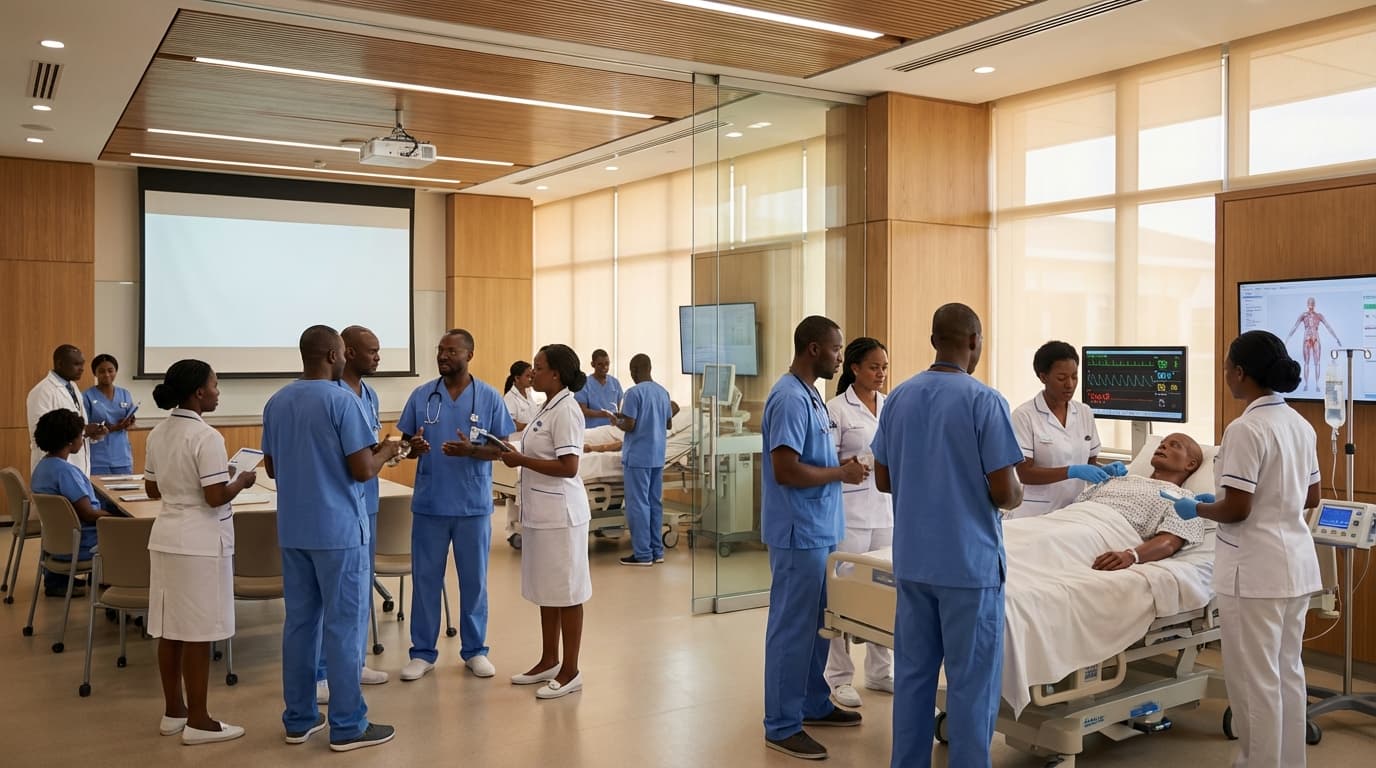
Equipment Training & Education in Egypt
Engineering Excellence & Technical Support
Comprehensive equipment training and certification programs High-standard technical execution following OEM protocols and local regulatory frameworks.
Advanced Simulator Training for Heavy Machinery
Implementing cutting-edge simulation technology for operators in construction and mining sectors, enhancing safety and proficiency with realistic virtual environments and scenario-based learning. This reduces on-the-job risk and accelerates skill acquisition for critical equipment like excavators, loaders, and drills.
Digital Twin Integration for Industrial Equipment Maintenance
Leveraging digital twin technology to create virtual replicas of industrial equipment. This enables predictive maintenance training, remote diagnostics, and real-time performance monitoring, empowering Egyptian technicians to optimize uptime and minimize costly breakdowns in manufacturing and processing plants.
AR-Powered On-Demand Technical Support & Assembly Guidance
Deploying Augmented Reality (AR) solutions for on-demand technical support and complex assembly training. Technicians can access interactive, step-by-step instructions overlaid onto real equipment, dramatically improving accuracy and efficiency for maintenance, repair, and new equipment installation across various industries.
What Is Equipment Training & Education In Egypt?
Equipment Training & Education in Egypt refers to structured programs designed to impart theoretical knowledge and practical skills necessary for the safe, efficient, and effective operation, maintenance, and repair of various types of equipment. This service is crucial in a diverse industrial and commercial landscape, ensuring personnel competency and adherence to operational standards. It encompasses a broad spectrum of learning methodologies, from classroom lectures and simulator-based training to hands-on workshops and on-the-job coaching. The objective is to bridge the knowledge gap, mitigate risks associated with improper equipment handling, optimize performance, and extend equipment lifespan. This training is not a monolithic offering but rather a tailored approach addressing specific equipment types and industry requirements prevalent in Egypt.
| Who Needs Equipment Training & Education? | Typical Use Cases in Egypt |
|---|---|
| Industrial Operators & Technicians: Personnel directly responsible for operating and maintaining machinery in manufacturing, construction, and processing plants. | Construction Site Personnel: Operators of heavy machinery (excavators, cranes, bulldozers), scaffolding erectors, and site supervisors requiring safety and operational training. |
| Healthcare Professionals: Technicians and medical staff operating specialized medical equipment (e.g., MRI machines, ventilators, diagnostic tools) requiring precision and safety protocols. | Oil & Gas Sector Workers: Engineers, technicians, and field operators requiring training on drilling equipment, refinery machinery, and safety systems. |
| Agricultural Workers: Operators of tractors, harvesters, and irrigation systems, particularly with the adoption of modern farming technologies. | Logistics & Warehouse Personnel: Forklift operators, automated guided vehicle (AGV) operators, and warehouse management system users. |
| IT & Telecommunications Staff: Technicians responsible for installing, configuring, and maintaining network equipment, servers, and telecommunications infrastructure. | Automotive Technicians: Mechanics and service personnel requiring training on diagnostic equipment, specialized tools, and vehicle systems. |
| Power Generation & Utility Workers: Engineers and technicians operating turbines, control systems, and maintenance equipment in power plants and utility infrastructure. | Educational Institutions: Vocational schools and universities providing practical training components for engineering, technical, and vocational diplomas and degrees. |
| Newly Hired Employees: To ensure immediate compliance and competency with job-specific equipment requirements. | Experienced Personnel: For upskilling, re-skilling, and training on new equipment models or updated operational procedures. |
Key Components of Equipment Training & Education in Egypt
- Theoretical Instruction: Covering equipment principles, operational manuals, safety protocols, and relevant regulatory frameworks (e.g., Egyptian labor law, specific industry standards).
- Practical Skills Development: Hands-on experience with equipment operation, calibration, routine checks, troubleshooting, and basic maintenance procedures.
- Safety & Hazard Awareness: Emphasis on identifying and mitigating potential risks, understanding emergency procedures, and proper use of Personal Protective Equipment (PPE).
- Maintenance & Troubleshooting: Training on preventive maintenance schedules, diagnostic techniques, and common repair methodologies.
- Regulatory Compliance: Ensuring trainees are aware of and adhere to national and international safety and operational regulations.
- Performance Optimization: Educating operators on best practices to maximize efficiency, reduce energy consumption, and minimize downtime.
- Certification & Assessment: Formal evaluation of competency through written exams, practical demonstrations, and on-site observations, often leading to certification.
Who Needs Equipment Training & Education In Egypt?
Equipment training and education are crucial for a wide range of individuals and organizations across various sectors in Egypt. Proper training ensures safe, efficient, and effective operation and maintenance of equipment, leading to increased productivity, reduced downtime, enhanced safety, and compliance with industry standards. This is particularly vital in a developing economy like Egypt, where industrial growth and infrastructure development are key priorities.
| Sector | Target Customers/Departments | Specific Equipment Examples | Benefits of Training |
|---|---|---|---|
| Manufacturing & Industrial | Production Line Operators, Maintenance Technicians, Quality Control Staff, Plant Managers | CNC Machines, Industrial Robots, Lathes, Milling Machines, Assembly Lines, Welding Equipment | Increased production output, reduced defects, improved safety, minimized equipment failure, enhanced product quality |
| Construction & Infrastructure | Equipment Operators (heavy machinery), Site Supervisors, Maintenance Engineers, Project Managers | Excavators, Bulldozers, Cranes, Concrete Mixers, Paving Machines, Tunnel Boring Machines | Safer site operations, efficient project completion, reduced wear and tear on machinery, compliance with building codes |
| Oil & Gas | Drilling Rig Operators, Refinery Technicians, Pipeline Maintenance Crews, Safety Officers | Drilling Rigs, Pumps, Compressors, Refining Units, Pipeline Inspection Tools, Safety Equipment | Enhanced operational safety, prevention of accidents and environmental damage, improved efficiency in extraction and processing |
| Healthcare | Medical Technicians, Biomedical Engineers, Radiologists, Laboratory Staff | MRI Machines, CT Scanners, X-ray Machines, Laboratory Analyzers, Surgical Equipment | Accurate diagnoses, safe operation of sensitive medical devices, reduced risk of equipment malfunction, improved patient care |
| Transportation & Logistics | Warehouse Staff, Forklift Operators, Truck Drivers, Fleet Managers, Airport Ground Staff | Forklifts, Cranes, Automated Storage Systems, Loading Dock Equipment, Aircraft Ground Support Equipment | Efficient material handling, reduced damage to goods, improved safety in logistics operations, optimized fleet management |
| Agriculture | Farm Operators, Agricultural Engineers, Equipment Maintenance Personnel | Tractors, Harvesters, Irrigation Systems, Pesticide Sprayers, Drones | Increased crop yields, efficient resource utilization, reduced maintenance costs, improved farm productivity |
| Energy & Utilities | Power Plant Operators, Technicians (electrical, mechanical), Water Treatment Plant Staff, Renewable Energy Technicians | Turbines (steam, gas, wind), Generators, Transformers, Water Filtration Systems, Solar Panels | Reliable energy generation and distribution, efficient operation of utility infrastructure, adherence to safety regulations |
| Information Technology & Telecommunications | IT Technicians, Network Engineers, Data Center Staff, Telecommunications Technicians | Servers, Routers, Switches, Fiber Optic Equipment, Data Storage Systems | Stable network performance, efficient data management, troubleshooting of complex IT systems, cybersecurity best practices |
Target Customers & Departments for Equipment Training & Education in Egypt
- Individuals seeking career advancement in technical fields.
- Companies looking to upskill their workforce and improve operational efficiency.
- Government agencies responsible for infrastructure maintenance and public services.
- Educational institutions developing technical and vocational training programs.
Equipment Training & Education Process In Egypt
The equipment training and education process in Egypt, from initial inquiry to successful execution, involves a structured workflow designed to ensure clients receive the necessary skills and knowledge for safe and effective equipment operation. This process typically begins with a client expressing interest in training and concludes with the successful completion of the program, evaluation, and certification.
| Stage | Description | Key Activities | Responsible Parties | Deliverables |
|---|---|---|---|---|
| Inquiry & Needs Assessment | The initial contact where a client expresses interest in equipment training and their specific requirements are identified. | Client contacts training provider, discusses training needs, identifies specific equipment, target audience, desired outcomes, and any pre-existing knowledge. | Client, Training Provider Sales/Inquiry Team | Understanding of client's training needs, list of required equipment, participant profile, desired learning objectives. |
| Proposal & Quotation | Based on the needs assessment, the training provider develops a tailored proposal and provides a cost estimate. | Training provider prepares a detailed proposal outlining the training scope, curriculum, methodology, duration, trainers, location, and cost. Includes a formal quotation. | Training Provider (Sales, Technical Team) | Formal Training Proposal, Detailed Quotation, Training Schedule Outline. |
| Agreement & Scheduling | Formalizing the training agreement and setting the specific dates and times for the training. | Client reviews and accepts the proposal/quotation. Both parties sign a training agreement. Specific training dates, times, and venue are confirmed. | Client, Training Provider (Contracts, Administration) | Signed Training Agreement, Confirmed Training Schedule, Venue Booking Confirmation. |
| Curriculum Development & Customization | Tailoring the training content to meet the specific equipment and client requirements. | Reviewing standard training modules, customizing content with client-specific operational procedures, safety protocols, and incorporating practical exercises relevant to the client's environment. | Training Provider (Curriculum Developers, Subject Matter Experts) | Customized Training Manuals, Presentation Slides, Practical Exercise Scenarios. |
| Logistics & Preparations | Ensuring all resources and arrangements are in place for a smooth training delivery. | Booking training venue, arranging for equipment (if not client-provided), preparing training materials, confirming trainer availability, communicating pre-training instructions to participants, arranging for catering/accommodation if needed. | Training Provider (Administration, Logistics), Client (Equipment Availability, Participant Access) | Secured Training Venue, Prepared Training Materials, Confirmed Trainer, Pre-training Communication to Participants. |
| Training Delivery | The actual execution of the training program for the participants. | Theoretical instruction (lectures, presentations), practical demonstrations, hands-on exercises, simulations, Q&A sessions, and on-site supervision. | Training Provider (Certified Trainers), Client Participants | Completed Training Sessions, Participant Engagement, Practical Skill Application. |
| Assessment & Evaluation | Measuring the participants' understanding and proficiency in using the equipment. | Conducting theoretical tests (quizzes, exams), practical assessments (demonstrations of competence), observation of skills, and gathering feedback from participants and trainers. | Training Provider (Trainers, Assessors), Client Participants | Assessment Scores, Practical Competency Ratings, Training Feedback Forms. |
| Certification & Follow-up | Formalizing the successful completion of the training and providing ongoing support. | Issuing certificates of completion to successful participants, providing reports on training outcomes, offering post-training support (e.g., troubleshooting, refresher courses), and conducting post-training evaluations. | Training Provider (Administration, Quality Assurance), Client | Certificates of Completion, Training Summary Report, Post-Training Support Plan. |
Key Stages in the Equipment Training & Education Process
- Inquiry & Needs Assessment
- Proposal & Quotation
- Agreement & Scheduling
- Curriculum Development & Customization
- Logistics & Preparations
- Training Delivery
- Assessment & Evaluation
- Certification & Follow-up
Equipment Training & Education Cost In Egypt
Equipment training and education costs in Egypt can vary significantly based on several factors. These include the type and complexity of the equipment, the duration of the training, the qualifications of the instructors, the training location (on-site vs. off-site), and the provider's reputation. The currency used is the Egyptian Pound (EGP).
| Training Category | Estimated Price Range (EGP per person, per day/course) | Notes |
|---|---|---|
| Basic Industrial Machinery Operation (e.g., forklifts, basic manufacturing) | 800 - 2,500 EGP | Typically includes basic safety and operation. May be a half-day or full-day course. |
| Advanced Manufacturing Equipment (e.g., CNC machines, automation) | 1,500 - 4,000 EGP | Requires specialized knowledge, often multi-day programs. |
| Construction Equipment Operation (e.g., excavators, cranes) | 1,000 - 3,000 EGP | Focus on safety, operation, and basic maintenance. May include certification. |
| Medical Equipment Training (e.g., diagnostic machines, surgical tools) | 2,000 - 6,000+ EGP | Highly specialized, often requiring certified medical trainers. Costs can escalate significantly for complex devices. |
| IT Hardware & Software Training (e.g., server management, enterprise software) | 1,200 - 5,000 EGP | Varies by software complexity and vendor certification requirements. |
| Safety & Compliance Training (e.g., electrical safety, hazardous materials) | 700 - 2,000 EGP | Focus on regulatory requirements and safe practices. |
| Customized Corporate Training Programs | Negotiable (often per project/package) | Tailored to specific company needs, can be a significant investment. |
Key Pricing Factors for Equipment Training & Education in Egypt
- Equipment Type & Complexity: Basic machinery training will be less expensive than specialized industrial equipment or advanced medical devices.
- Training Duration: Shorter, introductory courses will cost less than comprehensive, multi-day programs.
- Instructor Expertise: Highly experienced and certified instructors command higher fees.
- Training Location: On-site training at the client's facility may involve additional travel and accommodation costs for the trainer, impacting the overall price. Off-site training at a dedicated training center might have its own fixed facility fees.
- Provider's Reputation & Accreditation: Established training providers with strong industry recognition and accredited programs often charge a premium.
- Customization Needs: Tailoring the training content to specific organizational needs can increase costs.
- Number of Participants: While per-person rates might decrease with larger groups, the total cost will rise.
- Materials & Certification: Inclusion of training materials, manuals, and official certifications will affect the final price.
- Level of Training: Basic operation, maintenance, troubleshooting, or advanced programming all have different pricing tiers.
Affordable Equipment Training & Education Options
Investing in proper equipment training and education is crucial for safety, efficiency, and longevity of your machinery. Fortunately, there are numerous affordable options available. Understanding value bundles and implementing cost-saving strategies can significantly reduce the overall expenditure on training and development for your team.
| Strategy/Concept | Description | Cost-Saving Benefit |
|---|---|---|
| Value Bundles | Combining multiple training modules, courses, or services into a single package often at a discounted rate compared to purchasing them individually. This can include online access, in-person sessions, and supplementary materials. | Reduces per-unit training cost, encourages comprehensive skill development, provides a predictable training budget. |
| Bulk Discounts | Negotiating lower per-participant costs when enrolling a larger group of employees in a training program. Many providers offer tiered pricing based on the number of attendees. | Direct reduction in training fees for organizations with multiple employees needing the same training. |
| Early Bird Registration | Registering for courses or workshops well in advance of the start date often unlocks discounted pricing. | Saves money on individual course fees by planning ahead. |
| Leveraging Existing Staff | Utilizing experienced and qualified in-house personnel to conduct training sessions. This can be formal or informal mentorship. | Eliminates external training fees, builds internal expertise, fosters a culture of knowledge sharing. |
| Online & On-Demand Learning | Opting for online courses, webinars, and e-learning modules that can be accessed at the employee's convenience. This reduces travel and accommodation costs. | Minimizes expenses related to travel, accommodation, and lost productivity due to extended time away from work. |
| Cross-Training Employees | Training employees on multiple pieces of equipment, making them more versatile and reducing the need for specialized training for every task. | Optimizes training investment by increasing employee skill breadth and reducing the number of separate training sessions required. |
| Subscription-Based Training Platforms | Accessing a library of online courses and resources for a recurring fee. This is cost-effective for ongoing training needs or a wide variety of equipment. | Provides continuous learning opportunities at a potentially lower annual cost than individual course purchases. |
| Seeking Grants & Subsidies | Researching and applying for government programs, industry association grants, or non-profit initiatives that provide funding for workforce development and training. | Significantly reduces or eliminates out-of-pocket training expenses. |
| Utilizing Free Resources | Taking advantage of free training materials, webinars, or basic introductory courses offered by manufacturers or industry bodies. | Provides foundational knowledge at no cost, reducing the need for paid introductory training. |
Affordable Equipment Training & Education Options
- Online Courses & Webinars
- Manufacturer-Provided Training (often included or discounted with purchase)
- Industry Association Workshops
- Community College & Vocational School Programs
- In-House Training Programs (leveraging experienced staff)
- Train-the-Trainer Programs
- Government & Non-Profit Grants/Subsidies (where applicable)
- Mentorship & Apprenticeship Programs
- E-learning Modules & Interactive Simulators
- Certification Programs
Verified Providers In Egypt
In Egypt's evolving healthcare landscape, identifying trustworthy and qualified medical professionals is paramount for ensuring quality care. Verified Providers, especially those credentialed by reputable organizations like Franance Health, stand out as the optimal choice for patients seeking reliable and competent medical services. Franance Health's rigorous vetting process and commitment to high standards mean that their accredited providers have met stringent criteria, assuring patients of their expertise, ethical practice, and dedication to patient well-being. Choosing a Franance Health-verified provider offers peace of mind, knowing you are in the hands of a healthcare professional who has undergone thorough scrutiny and is committed to delivering the best possible outcomes.
| Verification Aspect | Franance Health Standard | Patient Benefit |
|---|---|---|
| Medical Qualifications | Thorough validation of degrees, certifications, and licenses from recognized institutions. | Ensures providers possess the foundational knowledge and legal authority to practice medicine. |
| Clinical Experience | Verification of years of practice and performance in relevant medical settings. | Confirms practical application of knowledge and proven track record of successful patient care. |
| Professional References | Contact with peers and supervisors to assess performance and ethical conduct. | Provides independent validation of a provider's skills, reputation, and character. |
| Background Checks | Screening for any disciplinary actions, malpractice claims, or criminal history. | Protects patients by ensuring providers have a clean professional record and are trustworthy. |
| Specialty Competence | Assessment of specialized training and board certifications in specific medical fields. | Guarantees that patients are treated by experts in their area of need, leading to better diagnostic accuracy and treatment effectiveness. |
| Commitment to Continuing Education | Requirement for ongoing professional development and knowledge updates. | Ensures providers are up-to-date with the latest medical research, technologies, and treatment protocols. |
Why Franance Health Verified Providers in Egypt are the Best Choice:
- Rigorous Credentialing: Franance Health employs a comprehensive and multi-faceted verification process, ensuring providers meet and exceed established standards of medical competence and ethical practice.
- Expertise and Specialization: Verified providers have demonstrated specialized knowledge and proven experience in their respective fields, guaranteeing access to high-quality care tailored to specific medical needs.
- Commitment to Patient Safety: The credentialing process prioritizes patient safety through background checks, review of qualifications, and adherence to best practices, minimizing risks and ensuring a secure healthcare experience.
- Ethical Standards and Professionalism: Franance Health-verified providers are held to high ethical codes, ensuring compassionate, respectful, and transparent patient interactions.
- Continuous Professional Development: The verification often includes requirements for ongoing education and training, ensuring providers stay abreast of the latest medical advancements and techniques.
- Enhanced Trust and Reliability: A Franance Health credential serves as a strong indicator of a provider's reliability and commitment to excellence, fostering greater patient confidence.
- Streamlined Healthcare Access: By identifying verified providers, patients can more efficiently find qualified healthcare professionals, saving time and reducing the stress associated with seeking medical care.
Scope Of Work For Equipment Training & Education
This document outlines the Scope of Work (SOW) for providing comprehensive training and educational services for the [Specify Equipment Name/System] at [Specify Location/Client Name]. The objective is to ensure that designated personnel possess the necessary knowledge and skills to effectively operate, maintain, and troubleshoot the equipment, thereby maximizing its operational efficiency and lifespan. The training program will encompass theoretical understanding, practical application, and safety protocols. Standard specifications for technical deliverables will be adhered to throughout the project.
| Deliverable | Description | Format/Standard | Quantity/Frequency | Responsible Party |
|---|---|---|---|---|
| Training Manuals | Detailed guides covering all training modules, including diagrams, illustrations, and glossary. | PDF and printed copies. Content aligned with [Relevant Industry Standards, e.g., ISO 9001, ANSI]. | As per participant number + archival copy. | Training Provider |
| Practical Training Sessions | Hands-on sessions conducted on the actual [Equipment Name/System] or a fully functional simulator. | Live demonstrations, supervised practice, scenario-based exercises. | Minimum [Number] hours per module/participant, adjusted based on complexity. | Training Provider & Client Supervisors |
| Assessment & Evaluation Reports | Documentation of participant comprehension and skill acquisition through tests, practical evaluations, and feedback. | Written reports per participant, including scores and areas for improvement. Standardized assessment criteria. | Post-module/Post-training. | Training Provider |
| Certification of Completion | Formal certificates issued to participants who successfully complete the training program and meet evaluation criteria. | Printed certificates with unique identifiers. Aligned with [Relevant Certification Bodies, if applicable]. | Per successful participant. | Training Provider |
| Post-Training Support Plan | Outline of ongoing support mechanisms, including Q&A sessions, access to online resources, and escalation procedures. | Documented plan, including contact information and response times. | One-time document, support duration to be specified. | Training Provider |
| Trainer Qualifications Dossier | Documentation of the trainers' expertise, experience, and relevant certifications. | CVs, training certificates, proof of experience in [Equipment Type]. | One per trainer. | Training Provider |
Key Training Modules
- Introduction to [Equipment Name/System]: Overview, purpose, and components.
- Operational Procedures: Step-by-step guides for normal operation, startup, and shutdown.
- Maintenance Fundamentals: Routine checks, lubrication, cleaning, and preventive maintenance schedules.
- Troubleshooting & Fault Diagnosis: Common issues, diagnostic techniques, and corrective actions.
- Safety Procedures & Protocols: Emergency shutdown, hazard identification, personal protective equipment (PPE), and regulatory compliance.
- Advanced Features & Optimization: Utilization of specialized functions and performance enhancement techniques.
- Documentation & Record Keeping: Logbooks, maintenance reports, and spare parts management.
Service Level Agreement For Equipment Training & Education
This Service Level Agreement (SLA) outlines the guaranteed response times for technical support and the uptime for our online training platform, specifically for equipment-related training and educational services. This SLA applies to all clients with an active training subscription or service contract.
| Service Component | Uptime Guarantee | Response Time (Business Hours) | Response Time (24/7 Support - if applicable) | Target Resolution Time (Critical Issue) | Target Resolution Time (Non-Critical Issue) |
|---|---|---|---|---|---|
| Online Training Platform Availability | 99.8% | N/A | N/A | 4 Business Hours | 2 Business Days |
| Technical Support - Platform Access/Login Issues | N/A | 1 Business Hour | 2 Business Hours | 2 Business Hours | 1 Business Day |
| Technical Support - Content Access/Playback Issues | N/A | 2 Business Hours | 4 Business Hours | 4 Business Hours | 2 Business Days |
| Technical Support - Simulation/Interactive Module Issues | N/A | 2 Business Hours | 4 Business Hours | 6 Business Hours | 3 Business Days |
| Technical Support - Reporting/Progress Tracking Issues | N/A | 4 Business Hours | 8 Business Hours | 1 Business Day | 3 Business Days |
| Live Training Session Support (Technical) | N/A | 30 Minutes Prior to Session Start | N/A | Immediately (during session) | N/A |
Key Service Commitments
- Scope: This SLA covers all aspects of the online equipment training platform, including access to course materials, interactive simulations, video content, and access to live training sessions. It also covers the provision of technical support related to the training platform and its functionalities.
- Definitions:
- Uptime: The percentage of time the online training platform is available and operational for users.
- Downtime: The percentage of time the online training platform is unavailable or not operational.
- Response Time: The maximum time allowed to acknowledge a support request.
- Resolution Time: The target time to resolve a reported issue. (Note: Actual resolution may vary based on complexity and third-party dependencies).
- Business Hours: Monday to Friday, 9:00 AM to 5:00 PM (Local Time Zone of Service Provider), excluding public holidays.
- Critical Issue: An issue that prevents users from accessing the training platform entirely, or prevents a significant portion of users from completing core training modules.
Frequently Asked Questions

Ready when you are
Let's scope your Equipment Training & Education in Egypt project in Egypt.

Scaling healthcare logistics and technical systems across the entire continent.