
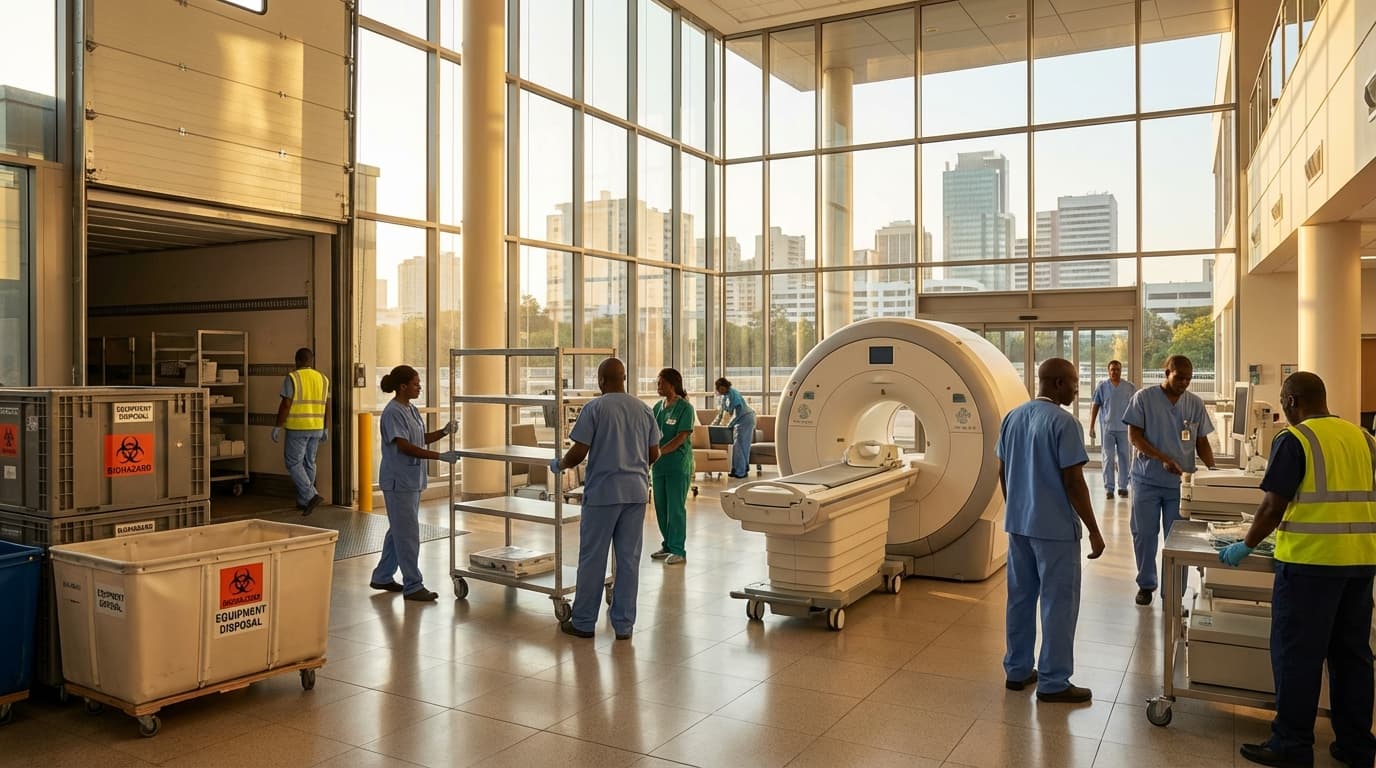
Heavy Medical Equipment De-Installation Service (MRI/CT/Cath Lab) in Egypt
Engineering Excellence & Technical Support
Heavy Medical Equipment De-Installation Service (MRI/CT/Cath Lab) High-standard technical execution following OEM protocols and local regulatory frameworks.
Shielded De-Installation for Radiation Safety
Our certified technicians are experts in safely dismantling and shielding medical equipment like MRI and CT scanners. We adhere to strict international safety protocols, minimizing radiation exposure risks during the de-installation process and ensuring compliance with Egyptian environmental and health regulations.
Precision Engineering for Complex Systems
We leverage advanced tools and techniques for the meticulous de-installation of intricate Cath Lab and MRI systems. Our team possesses a deep understanding of the complex interdependencies of these high-precision medical devices, guaranteeing a secure and efficient disassembly process with zero damage to critical components.
Logistics Mastery for Secure Transportation
Beyond de-installation, we offer comprehensive logistics solutions for the secure and compliant transportation of heavy medical equipment throughout Egypt. Our expertise ensures proper packaging, handling, and documentation, guaranteeing the integrity of your valuable assets from your site to their destination.
What Is Heavy Medical Equipment De-installation Service (Mri/ct/cath Lab) In Egypt?
Heavy Medical Equipment De-Installation Service (MRI/CT/Cath Lab) in Egypt refers to the specialized process of safely and systematically dismantling, disconnecting, and preparing large-scale, high-value medical imaging and interventional equipment for relocation, decommissioning, or storage. This service is crucial for maintaining equipment integrity, ensuring regulatory compliance, and facilitating efficient logistical operations within healthcare facilities. It encompasses the complete physical disconnection of the equipment from all supporting infrastructure, including power, cooling, data networks, and structural anchors, followed by secure packaging and preparation for transport. The process is executed by highly trained technicians possessing expertise in the specific modalities being handled, adhering to manufacturer guidelines and industry best practices.
| Who Needs This Service | Typical Use Cases | Key Considerations | |||
|---|---|---|---|---|---|
| Hospitals and Healthcare Facilities undergoing upgrades or renovations. | Relocation of equipment within a facility or to a new campus. | Equipment decommissioning due to obsolescence or end-of-life. | Sale or transfer of used medical equipment. | Preparation for replacement with newer imaging technologies. | |
| MRI (Magnetic Resonance Imaging) Scanners | CT (Computed Tomography) Scanners | Cath Lab (Cardiac Catheterization Laboratory) Systems | Linear Accelerators (Radiotherapy) | High-Field Magnet Systems | |
| Specialized trained personnel (field service engineers, riggers). | Manufacturer-specific de-installation procedures. | Compliance with safety regulations (electrical, mechanical, radiation). | Insurance and liability coverage. | Environmental considerations and waste disposal. | Project management and coordination. |
Key Components of Heavy Medical Equipment De-Installation
- Site assessment and planning
- Hazardous material identification and abatement (if applicable)
- Electrical disconnection and isolation
- Cooling system disconnection and draining/purging
- Data and network cable disconnection
- Structural component disconnection (e.g., gantry mounting, magnet support)
- Mechanical disassembly and component segregation
- Secure packaging and crating of individual components
- Weight and dimension documentation for transport
- Decontamination protocols (where necessary)
- Coordination with logistics and transport providers
- Final site clearance and documentation
Who Needs Heavy Medical Equipment De-installation Service (Mri/ct/cath Lab) In Egypt?
Heavy medical equipment like MRI scanners, CT scanners, and Cath Labs are complex, high-value assets requiring specialized expertise for de-installation. This isn't a DIY job. When facilities in Egypt are looking to relocate, upgrade, decommission, or reconfigure their imaging and interventional suites, they absolutely need professional de-installation services. This ensures safety, minimizes damage to sensitive components, and facilitates efficient handling for subsequent transport or disposal.
| Customer Type | Relevant Departments | Reasons for De-Installation |
|---|---|---|
| Hospitals (Public & Private) | Radiology Department, Cardiology Department, Interventional Radiology, Operating Rooms, Biomedical Engineering Department | Equipment upgrades, relocation within the hospital, decommissioning of old units, expansion projects, facility renovations, end-of-lease returns. |
| Specialized Medical Centers | Cardiology Clinics, Neurology Centers, Oncology Departments, Diagnostic Imaging Clinics | Similar to hospitals, focusing on their specific areas of expertise. May also include consolidation of services or relocation to a new facility. |
| Diagnostic Imaging Centers | Radiology and Imaging Management | Technology upgrades to newer models, expansion of services, relocation of the center, or closure of specific branches. |
| University Medical Schools & Teaching Hospitals | Radiology, Cardiology, Biomedical Engineering, Research Departments | Integration of new research equipment, decommissioning of older teaching models, relocation for curriculum changes, or facility modernization. |
| Government Health Facilities | Ministry of Health & Population facilities, Public Hospitals, Health Directorates | National healthcare infrastructure upgrades, replacement of outdated equipment, distribution of assets to different regions, or budget-driven decommissioning. |
| Medical Equipment Manufacturers & Distributors | Field Service, Logistics, Sales Support | De-installation for repair or refurbishment, relocation of demonstration units, returns under warranty or service agreements, and logistics for new installations. |
| Asset Management & Liquidation Companies | Procurement, Asset Recovery, Decommissioning Specialists | Managing the disposal and resale of used medical equipment on behalf of healthcare providers, requiring professional de-installation to prepare for auction or resale. |
Target Customers and Departments in Egypt Requiring Heavy Medical Equipment De-Installation:
- Hospitals (Public and Private)
- Specialized Medical Centers
- Diagnostic Imaging Centers
- University Medical Schools & Teaching Hospitals
- Government Health Facilities
- Medical Equipment Manufacturers & Distributors (for relocation or returns)
- Asset Management & Liquidation Companies
Heavy Medical Equipment De-installation Service (Mri/ct/cath Lab) Process In Egypt
This document outlines the typical workflow for a heavy medical equipment de-installation service (MRI, CT, Cath Lab) in Egypt, from the initial client inquiry to the successful completion of the de-installation process. This specialized service requires meticulous planning, adherence to safety protocols, and expert technical execution to ensure the integrity of the equipment and the safety of personnel and the facility. The process is designed to be efficient, minimize downtime for the client where possible, and meet all regulatory requirements.
| Phase | Key Activities | Responsible Parties | Deliverables/Outcomes |
|---|---|---|---|
| Client contacts the service provider with a request for de-installation. Initial discussion regarding the type of equipment, location, and general timeline. Understanding client's needs and expectations. | Client, Service Provider Sales/Consultant | Understanding of client's requirements, preliminary feasibility assessment. |
| On-site visit by a technical team to assess the installation environment. Detailed inspection of the equipment, its location, power requirements, accessibility, and existing infrastructure (e.g., room dimensions, ceiling height, door sizes, power supply). Identification of any potential logistical challenges. | Service Provider Technical Team, Client Facility Management | Detailed site report, identification of risks and challenges, confirmation of equipment specifications. |
| Development of a comprehensive proposal outlining the scope of work, methodology, safety protocols, timeline, required resources (personnel, specialized tools, transport), and a detailed cost quotation. Includes any specific permits or licenses required. | Service Provider Technical Team, Project Manager, Sales Department | Formal proposal, detailed quotation, understanding of scope and cost. |
| Client reviews and approves the proposal. Negotiation and signing of the service contract. Formal scheduling of the de-installation date and time, coordinating with the client's operational needs and any facility restrictions. | Client, Service Provider Project Manager, Legal Department | Signed service contract, confirmed de-installation schedule. |
| Detailed project planning by the service provider's project manager. Allocation of resources, procurement of specialized tools and materials (e.g., lifting equipment, protective coverings, packing materials). Development of a detailed de-installation sequence. Obtaining any necessary permits from local authorities (if applicable). Communicating the de-installation plan to all involved parties. | Service Provider Project Manager, Technical Team Lead, Logistics Team | Detailed de-installation plan, confirmed resource availability, necessary permits obtained, clear communication to stakeholders. |
| The specialized technical team arrives on-site. Power down and safety checks of the equipment. Disconnection of all utilities and ancillary systems. Careful dismantling of the equipment according to the pre-defined plan and manufacturer specifications. Safe removal of components from the facility, utilizing appropriate lifting and handling equipment. Ensuring no damage to the facility or surrounding areas. Strict adherence to all safety regulations and protocols. | Service Provider Technical Team (Engineers, Technicians), Safety Officer | Dismantled equipment components, safely removed from the facility, compliance with safety standards. |
| Thorough inspection of the de-installation area to ensure it is left in a safe and clean condition. Verification that all removed equipment components are accounted for. Packaging and securing of all dismantled equipment for transport. Coordination of transportation logistics to the designated destination (e.g., storage facility, new installation site, disposal). | Service Provider Technical Team, Logistics Team, Project Manager | Cleaned and secured de-installation site, packed equipment ready for transport, confirmed transportation arrangements. |
| Formal handover of the de-installed equipment and associated documentation to the client or their designated representative. This includes completion certificates, de-installation reports, inventory lists, and any relevant safety sign-offs. Final invoicing and payment processing. | Service Provider Project Manager, Client Representative | Signed handover documents, final reports, completed project, final payment. |
Heavy Medical Equipment De-Installation Service Workflow in Egypt
- Inquiry and Initial Consultation
- Site Assessment and Survey
- Proposal and Quotation
- Contract Finalization and Scheduling
- Pre-De-Installation Planning and Preparation
- Equipment De-Installation Execution
- Post-De-Installation Procedures
- Handover and Documentation
Heavy Medical Equipment De-installation Service (Mri/ct/cath Lab) Cost In Egypt
De-installing heavy medical equipment like MRI, CT scanners, and Cath Labs is a complex and specialized process requiring skilled technicians, proper lifting equipment, and adherence to strict safety protocols. The cost of these services in Egypt can vary significantly based on several factors, making it crucial for healthcare facilities to obtain detailed quotes. This guide outlines the key pricing influencers and provides estimated cost ranges in Egyptian Pounds (EGP).
| Equipment Type | Estimated De-installation Cost Range (EGP) | Notes |
|---|---|---|
| Small to Medium CT Scanner | 50,000 - 150,000 | Includes standard dismantling, disconnection, and basic preparation for relocation/storage. |
| Large/High-Slice CT Scanner | 100,000 - 250,000 | May involve more complex dismantling, extensive cabling, and specialized power requirements. |
| Open MRI | 80,000 - 200,000 | Generally simpler than closed MRI but still requires careful handling of magnets. |
| Low-Field Closed MRI (0.2T - 0.5T) | 150,000 - 350,000 | Involves managing helium coolant, specialized shielding, and intricate magnetic field considerations. |
| High-Field Closed MRI (1.5T - 3T+) | 250,000 - 700,000+ | Highest complexity, significant safety protocols, helium management, and substantial weight considerations. |
| Cardiac Catheterization (Cath) Lab | 120,000 - 300,000 | Includes de-installation of X-ray C-arm, table, control consoles, and associated peripherals. May involve significant electrical and plumbing disconnections. |
| X-Ray Machines (e.g., Ceiling Mounted) | 30,000 - 70,000 | Relatively simpler, but ceiling mounting can add complexity and require specialized rigging. |
Key Pricing Factors for Heavy Medical Equipment De-installation in Egypt
- Type and Size of Equipment: Larger and more complex machines (e.g., high-field MRI with superconducting magnets, advanced multi-slice CT scanners) will naturally incur higher de-installation costs due to increased handling time, specialized tools, and potential for hazardous materials.
- Location and Accessibility: The ease of access to the equipment within the facility plays a significant role. De-installation in a confined space, on an upper floor without adequate elevators, or requiring extensive disassembly of building structures will add to the labor and equipment rental costs.
- De-installation Complexity: This includes factors like the number of components to be disconnected, the need for specialized cooling systems to be drained (especially for MRI), and any required decontamination procedures.
- Transportation Requirements: While de-installation itself is the primary focus, the service provider may also offer or factor in the cost of internal relocation or preparation for external transport, which influences the overall pricing.
- Dismantling and Packaging: The extent to which the equipment needs to be dismantled and then carefully packaged for protection during subsequent stages (storage, relocation, or disposal) will affect labor and material costs.
- Technical Expertise and Certification: The experience and qualifications of the de-installation team are paramount. Certified technicians with specific training for each equipment type command higher rates.
- Safety and Environmental Regulations: Adhering to Egyptian safety standards and environmental regulations (e.g., proper handling of refrigerants, disposal of hazardous materials) is non-negotiable and contributes to the overall cost.
- Urgency and Timeline: Rush jobs or tight deadlines may incur premium charges due to the need for expedited scheduling and potentially overtime labor.
- Service Provider Reputation and Included Services: Established companies with a proven track record, comprehensive insurance, and a full suite of services (including disposal consultation or logistics support) may have higher base rates but offer greater peace of mind.
Affordable Heavy Medical Equipment De-installation Service (Mri/ct/cath Lab) Options
Moving or decommissioning large medical equipment like MRI, CT scanners, or Cath Labs is a complex and expensive undertaking. This service focuses on providing affordable de-installation options, ensuring your valuable assets are handled professionally and cost-effectively. We understand the critical nature of these procedures and offer solutions that minimize downtime and budget impact. Our approach prioritizes safety, compliance, and efficiency, making us a trusted partner for healthcare facilities seeking to reduce the financial burden associated with equipment relocation or disposal. We offer flexible service packages and strategic cost-saving measures tailored to your specific needs.
| Value Bundle | Inclusions | Estimated Price Range (USD) | Cost-Saving Strategies |
|---|---|---|---|
| Basic De-Installation | Professional disconnection of power and data cables, mechanical disassembly (where required), and securing components for transport. | $5,000 - $15,000 | Utilize existing facility staff for minor assistance (e.g., clearing pathways). Schedule de-installation during off-peak hours to avoid overtime charges. |
| Standard De-Installation & Prep | Includes Basic De-Installation plus comprehensive cleaning, protective crating of sensitive components, and basic structural support preparation for lift operations. | $8,000 - $20,000 | Bundle with other services like site readiness assessment. Bulk discounts for multiple de-installations within the same facility or campus. |
| Comprehensive De-Installation & Project Management | Includes Standard De-Installation & Prep plus full project management, site survey, detailed planning, risk assessment, and coordination with third-party riggers/movers. | $12,000 - $30,000+ | Early bird booking discounts. Long-term contracts for regular de-installation needs. Negotiate equipment resale or trade-in options before de-installation to offset costs. |
| Advanced De-Installation (with minor relocation support) | Includes Comprehensive De-Installation & Project Management plus initial guidance and support for equipment placement at the new site (pre-transport). | $18,000 - $40,000+ | Partner with relocation companies for integrated pricing. Consider decommissioning for parts if equipment is obsolete, reducing salvage costs. |
Key Benefits of Our Affordable De-Installation Service:
- Expert de-installation by certified technicians.
- Specialized tools and equipment for safe handling.
- Compliance with all relevant safety and environmental regulations.
- Reduced risk of damage to valuable medical equipment.
- Minimized downtime during the de-installation process.
- Transparent pricing and detailed cost breakdowns.
- Flexible scheduling to accommodate your operational needs.
- Secure transport coordination (optional add-on).
Verified Providers In Egypt
In Egypt's rapidly evolving healthcare landscape, ensuring the quality and reliability of medical services is paramount. Patients and medical professionals alike are seeking assurance that they are engaging with legitimate and competent healthcare providers. This is where the importance of verified providers comes into play. Franance Health stands as a leading platform dedicated to credentialing and showcasing verified healthcare providers across Egypt, offering a crucial layer of trust and transparency.
| Verification Category | What it Entails | Benefits for Patients |
|---|---|---|
| Medical Licenses & Certifications | Confirmation of valid and up-to-date professional licenses and specialized certifications issued by recognized Egyptian authorities. | Assurance that the provider is legally authorized to practice and possesses the necessary qualifications for their specialty. |
| Educational Background & Training | Verification of academic degrees, postgraduate training, and specialized fellowships from accredited institutions. | Confidence in the provider's foundational knowledge and advanced expertise. |
| Professional Experience | Review of practice history, employment records, and potentially peer reviews to assess the extent and quality of clinical experience. | Access to practitioners with proven track records and practical experience in managing various health conditions. |
| Compliance with Ethical Standards | Adherence to a code of professional conduct and ethical guidelines set forth by medical boards and regulatory bodies. | Trust that the provider will act in the patient's best interest with integrity and respect. |
| Facility Accreditation (if applicable) | For clinics and hospitals, verification of accreditation from relevant health authorities, ensuring adherence to safety and quality standards. | Access to healthcare facilities that meet stringent operational and patient care requirements. |
Why Franance Health Credentials Matter:
- Enhanced Patient Safety: Franance Health's rigorous verification process confirms that providers meet established professional standards, minimizing risks associated with unqualified practitioners.
- Improved Healthcare Accessibility: By identifying verified providers, patients can navigate the healthcare system with greater confidence, leading to more efficient and effective treatment.
- Promotion of Professional Excellence: The credentialing process encourages healthcare professionals to maintain high standards of practice, continuing education, and ethical conduct.
- Building Trust and Confidence: Franance Health's seal of verification acts as a beacon of trust, assuring individuals that they are accessing reputable medical services.
- Streamlined Healthcare Navigation: For both patients and medical institutions, a clear identification of verified providers simplifies the process of finding and engaging with qualified professionals.
Scope Of Work For Heavy Medical Equipment De-installation Service (Mri/ct/cath Lab)
This Scope of Work outlines the requirements for the professional de-installation of heavy medical imaging equipment, specifically MRI, CT, and Cath Lab systems. The service encompasses all necessary technical procedures, safety protocols, and logistical considerations to ensure the safe and efficient removal of these complex systems from their current operational locations. The objective is to prepare the equipment for transportation, storage, or relocation while minimizing disruption to facility operations and ensuring the integrity of the equipment.
| Activity | Description | Technical Deliverables | Standard Specifications/Requirements |
|---|---|---|---|
| Site Survey and Planning | Conduct a thorough on-site assessment to understand the equipment's configuration, surrounding environment, access routes, and power requirements. | Detailed site survey report including floor plans, access route assessment, required tools and personnel, and proposed de-installation sequence. | Compliance with manufacturer's site preparation guidelines. Identification of potential hazards and mitigation strategies. Coordination with facility management for access and scheduling. |
| De-energization and Power Down | Safely disconnect and isolate power to all components of the medical equipment according to manufacturer specifications and electrical safety standards. | Confirmation of zero energy state through testing. Documentation of power down sequence. | Adherence to ANSI/NFPA 70E (Standard for Electrical Safety in the Workplace) and manufacturer's specific de-energization procedures. Use of certified electricians. |
| System Component Disassembly | Carefully disassemble the medical equipment into manageable components. This includes the gantry, patient table, control consoles, RF coils, X-ray tubes (for CT), detectors, and associated cabling. | Labeled components for reassembly. Secure packaging of delicate parts. Photographic or video documentation of disassembly process. | Follow manufacturer's de-installation manuals strictly. Use of appropriate tools and lifting equipment to prevent damage. Segregation of different component types. |
| Cryogen Management (MRI) | Safely vent and manage helium (and potentially nitrogen) in MRI systems. This is a critical safety procedure. | Documentation of cryogen venting process and residual levels. Compliance with environmental regulations. | Adherence to vendor-specific cryogen handling procedures. Use of certified cryogen handlers. Provision of adequate ventilation. Monitoring of gas levels. |
| Cooling System Drainage and Flushing | Drain and flush any coolant systems associated with CT or Cath Lab equipment to prevent leaks and contamination. | Disposal of coolant in accordance with environmental regulations. Documentation of drainage and flushing. | Use of appropriate coolant recovery and disposal methods. Adherence to waste management protocols. Manufacturer's recommended flushing agents. |
| Cable Management and Labeling | Carefully disconnect, label, and bundle all cables and conduits associated with the equipment. | Clearly labeled cables corresponding to their original connection points. Organized bundling for efficient reinstallation. | Prevention of cable damage during disconnection and removal. Use of cable ties and protective sleeves. Detailed cable mapping. |
| Component Handling and Lifting | Utilize appropriate lifting equipment and techniques to safely move heavy components from their location to the designated staging or loading area. | Secure transportation of components within the facility. Damage-free movement of all parts. | Use of certified cranes, forklifts, or specialized lifting devices. Adherence to weight limits and load balancing principles. Certified riggers and equipment operators. |
| Site Restoration (Basic) | Minor cosmetic repairs to the immediate area where the equipment was located, if required and agreed upon. | Cleaned work area. Minor patching or repainting of wall surfaces. | Restoration to a pre-de-installation state, excluding significant structural modifications. Agreement on the scope of restoration prior to commencement. |
| Documentation and Handover | Provide comprehensive documentation of the entire de-installation process. | Final de-installation report, including photographic evidence, component manifest, and any encountered issues. Certificate of de-installation. | All documentation to be provided in digital and/or hard copy format as required. Secure handover of all removed components and associated documentation to the client or designated party. |
Key Service Objectives
- Safe and compliant de-installation of MRI, CT, and Cath Lab systems.
- Preservation of equipment integrity and functionality.
- Minimization of site disruption.
- Adherence to all relevant safety regulations and industry standards.
- Provision of detailed technical documentation.
- Efficient and organized execution of de-installation tasks.
Service Level Agreement For Heavy Medical Equipment De-installation Service (Mri/ct/cath Lab)
This Service Level Agreement (SLA) outlines the guaranteed response times and uptime for the De-Installation Service of Heavy Medical Equipment, specifically MRI, CT, and Cath Lab systems. This agreement ensures prompt and efficient service to minimize disruption to healthcare operations.
| Service Category | Response Time (Acknowledgement & Dispatch/Remote Diagnostics) | Uptime Guarantee (during scheduled Service Window) | Escalation Protocol | Notes |
|---|---|---|---|---|
| Critical De-Installation (MRI/CT/Cath Lab) | Within 2 business hours | 99.5% | Immediate escalation to senior management upon exceeding response time. | Applicable for urgent de-installations due to facility closure, critical upgrades, or imminent equipment failure impacting patient care. |
| Standard De-Installation (MRI/CT/Cath Lab) | Within 4 business hours | 98.0% | Escalation to senior management upon exceeding response time by 2 business hours. | Applicable for routine de-installations, planned relocations, or decommissioning. |
| Routine Maintenance/Support for De-Installation Equipment | Within 8 business hours | N/A (Scheduled maintenance is excluded from uptime guarantees) | Standard support ticket escalation procedures. | Covers troubleshooting and maintenance of the specialized tools and vehicles used for de-installation. |
Key Definitions
- Service Request: A formal request submitted by the Client to initiate the de-installation process for designated heavy medical equipment.
- Scheduled Maintenance: Planned preventative maintenance or upgrades on the de-installation equipment performed by the Service Provider.
- Downtime: The period during which the de-installation equipment is unavailable for use due to unscheduled issues or maintenance, excluding scheduled maintenance periods.
- Response Time: The maximum time allowed for the Service Provider to acknowledge a Service Request and dispatch a technician or initiate remote diagnostics.
- Resolution Time: The maximum time allowed to resolve the issue that caused the Downtime, leading to the equipment's availability for de-installation.
- Service Window: The pre-agreed timeframe during which de-installation services are scheduled and expected to occur.
- Force Majeure: Events beyond the reasonable control of either party, including but not limited to natural disasters, acts of war, or widespread pandemics.
Frequently Asked Questions

Ready when you are
Let's scope your Heavy Medical Equipment De-Installation Service (MRI/CT/Cath Lab) in Egypt project in Egypt.

Scaling healthcare logistics and technical systems across the entire continent.