
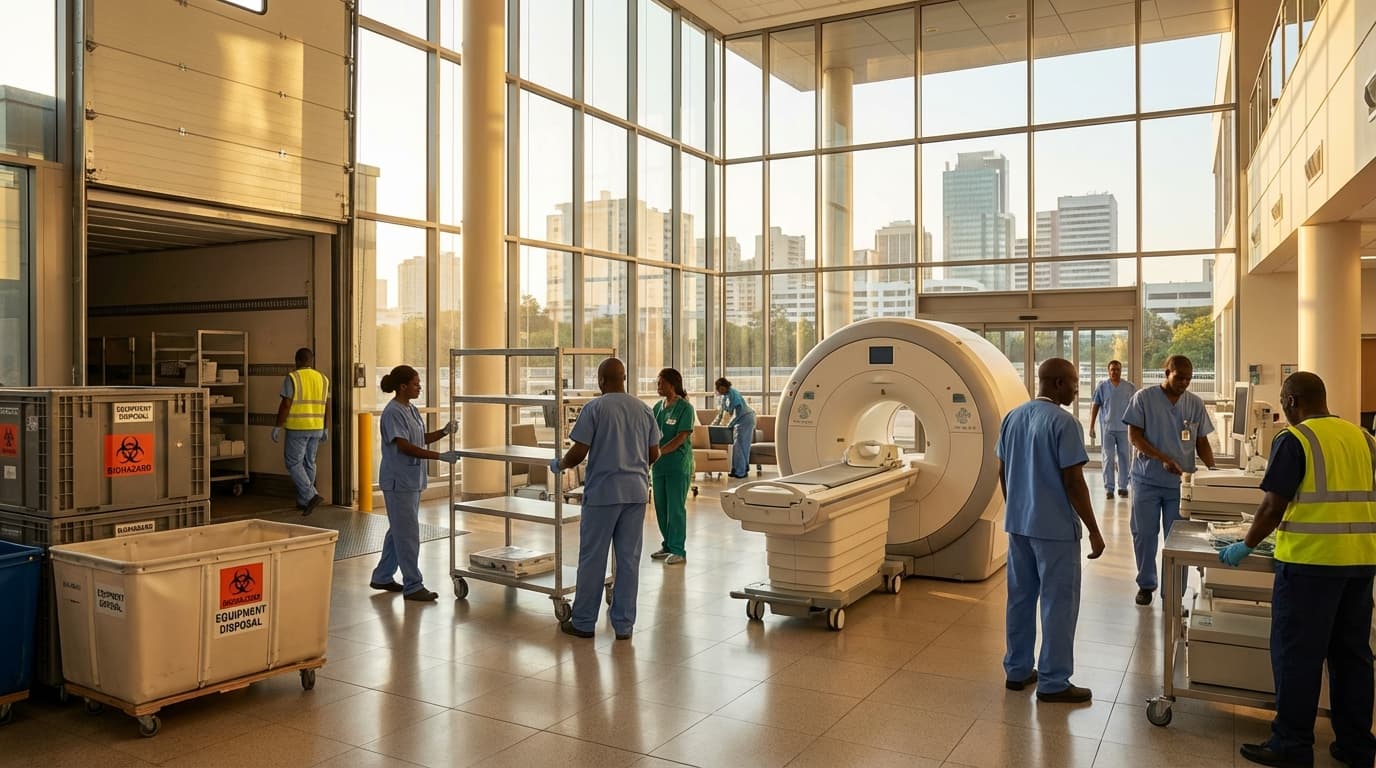
Decommissioning Service for Medical Devices in Egypt
Engineering Excellence & Technical Support
Decommissioning Service for Medical Devices High-standard technical execution following OEM protocols and local regulatory frameworks.
Certified Data Sanitization & Destruction
Ensuring complete and irreversible erasure of all sensitive patient data from medical devices, adhering to stringent Egyptian data privacy regulations (e.g., PDPL) and international standards, protecting confidentiality and preventing breaches.
Environmentally Responsible Disposal & Recycling
Implementing eco-friendly decommissioning processes that comply with Egyptian environmental laws and international best practices. This includes safe dismantling, hazardous material management, and maximizing the recycling of components to minimize environmental impact.
Comprehensive Regulatory Compliance & Documentation
Providing detailed and auditable documentation for every stage of the decommissioning process, ensuring full compliance with Egyptian Ministry of Health and Population (MOHP) regulations, CE marking requirements (if applicable), and international standards for medical device lifecycle management.
What Is Decommissioning Service For Medical Devices In Egypt?
Decommissioning Service for Medical Devices in Egypt refers to the systematic and controlled process of retiring a medical device from active clinical use. This involves a series of technical and administrative procedures designed to ensure the device is no longer functional, its data is securely managed, and its disposal or repurposing complies with all relevant Egyptian regulations and standards. The service aims to mitigate risks associated with legacy equipment, such as patient safety hazards, data breaches, and environmental contamination. It encompasses the entire lifecycle of the device from the point of obsolescence or end-of-life until its final disposition.
| Who Needs Decommissioning Service | Typical Use Cases | Relevant Egyptian Regulatory Bodies/Considerations | |||||||||||||||
|---|---|---|---|---|---|---|---|---|---|---|---|---|---|---|---|---|---|
| Hospitals and Healthcare Facilities: Public and private hospitals, clinics, diagnostic centers, and laboratories that operate medical equipment. | End-of-life replacement of imaging equipment (X-ray, MRI, CT scanners). | Obsolescence of diagnostic instrumentation (e.g., older laboratory analyzers). | Upgrades to surgical or therapeutic devices (e.g., anesthetic machines, ventilators). | Closure or relocation of healthcare facilities. | Manufacturers and Distributors: Companies that supply medical devices to the Egyptian market. | Recalling or retiring entire product lines due to design flaws or market obsolescence. | Managing returned devices that cannot be refurbished or resold. | Research and Educational Institutions: Universities and research centers utilizing medical equipment for studies. | Decommissioning outdated research equipment. | Government and Military Healthcare Services: Public health initiatives and military medical branches. | Managing a large inventory of diverse medical equipment. | Regulatory Bodies: While not directly needing the service, they set the standards and oversee compliance. | Ensuring that healthcare providers are adhering to decommissioning protocols. | MOHP (Ministry of Health and Population): Sets standards for medical device registration, import, and use, and implicitly for their safe retirement. | Environmental Affairs Agency (EEAA): Oversees waste management and environmental protection, crucial for the disposal phase. | Egyptian Standards (ES): Relevant standards for electrical safety, waste management, and potentially medical device specific requirements. | Data Protection Laws: Compliance with any specific Egyptian regulations pertaining to the erasure and protection of health data. |
Key Components of Medical Device Decommissioning Services in Egypt
- Inventory and Assessment: Cataloging all relevant medical devices, assessing their current operational status, identifying their criticality, and determining their decommissioning requirements.
- Data Security and Erasure: Implementing protocols for secure data backup, anonymization, and irreversible erasure of all sensitive patient and operational data stored on the device, in compliance with Egyptian data protection laws.
- Electrical and Mechanical Disassembly: Safely disconnecting power sources, disassembling components, and ensuring proper handling of potentially hazardous materials (e.g., mercury, radioactive isotopes, batteries).
- Functional Disabling: Rendering the device permanently non-functional to prevent unauthorized reactivation or use, often involving physical destruction of critical components or firmware.
- Regulatory Compliance Documentation: Generating comprehensive documentation for all decommissioning activities, including certificates of destruction, disposal manifests, and compliance reports required by Egyptian health authorities (e.g., Ministry of Health and Population - MOHP) and environmental agencies.
- Environmental Disposal/Recycling: Managing the environmentally sound disposal or recycling of the device and its components, adhering to Egypt's waste management regulations, particularly for electronic and medical waste.
- Logistical Management: Coordinating the secure transportation of devices to designated decommissioning facilities or recycling centers.
- Service Provider Certification: Engaging licensed and accredited service providers with demonstrated expertise in medical device decommissioning within Egypt.
Who Needs Decommissioning Service For Medical Devices In Egypt?
Decommissioning medical devices in Egypt is a critical and regulated process. It involves the safe and proper retirement of medical equipment, ensuring data privacy, environmental compliance, and the prevention of unauthorized use or resale of outdated or malfunctioning devices. This service is essential for a wide range of organizations and departments within the Egyptian healthcare ecosystem.
| Customer Type | Key Departments Involved | Primary Needs for Decommissioning | Examples of Devices | ||||
|---|---|---|---|---|---|---|---|
| Hospitals (Public & Private) | Biomedical Engineering Department, IT Department, Facilities Management, Procurement Department, Infection Control | Data security (patient records), compliance with Ministry of Health regulations, safe disposal of hazardous materials, asset management, space optimization, preventing reuse of faulty equipment | MRI machines, CT scanners, X-ray machines, ventilators, patient monitors, surgical robots, anesthesia machines | ||||
| Clinics and Specialized Medical Centers | Clinic Management, Clinical Staff, IT Support | HIPAA/GDPR equivalent data privacy, cost-effective disposal, compliance with local health regulations, ensuring operational efficiency | Ultrasound machines, ECG machines, audiometers, dental chairs, endoscopes | Diagnostic Laboratories and Imaging Centers | Laboratory Management, Radiologists, Technicians, IT Department | Data sanitization of imaging systems, proper disposal of reagents and biological waste, regulatory adherence for diagnostic equipment | Laboratory analyzers, PCR machines, digital radiography systems, mammography units |
| Research Institutions & Universities | Research Departments, IT Security, Facilities Management, Ethics Committees | Secure erasure of research data, responsible disposal of specialized research equipment, compliance with academic and ethical guidelines | Electron microscopes, specialized centrifuges, gene sequencers, biosafety cabinets | ||||
| Government Health Authorities | Regulatory Compliance Departments, Public Health Divisions, Procurement Units | Oversight of decommissioning practices across public health facilities, ensuring national standards are met, data security across government-operated systems | All types of medical equipment used in public healthcare settings | ||||
| Medical Device Manufacturers/Distributors | Service & Support, Asset Management, Compliance Departments | Managing end-of-life programs for their own equipment, ensuring responsible disposal of demonstration or returned units, maintaining brand reputation | Any device within their product portfolio |
Target Customers and Departments for Medical Device Decommissioning Services in Egypt
- Hospitals (Public and Private)
- Clinics and Specialized Medical Centers
- Diagnostic Laboratories and Imaging Centers
- Research Institutions and Universities with Medical Programs
- Government Health Authorities and Ministries
- Medical Device Manufacturers and Distributors (for their own internal equipment or end-of-life support)
- Third-Party Service Providers and Biomedical Engineering Departments
- Insurance Companies (managing leased or financed equipment)
Decommissioning Service For Medical Devices Process In Egypt
This document outlines the typical workflow for decommissioning medical devices in Egypt, from initial inquiry to final execution. The process involves several key stages to ensure compliance with national regulations and responsible disposal.
| Stage | Description | Key Activities | Responsible Party |
|---|---|---|---|
| Client expresses interest in decommissioning services. | Contacting service provider, initial request for information. | Medical Facility/Client |
| Provider evaluates the scope and provides pricing. | Device inventory, condition assessment, cost estimation. | Decommissioning Service Provider |
| Formal agreement is established. | Negotiation, signing of contract, defining terms and conditions. | Both Parties |
| Detailed operational plan is developed. | Scheduling, site survey, permit acquisition (if needed). | Decommissioning Service Provider |
| Devices are safely moved from the client's site. | Secure packaging, loading, transportation to decommissioning facility. | Decommissioning Service Provider |
| Devices are identified and data is removed. | Inventory check, data wiping/destruction (for electronic devices). | Decommissioning Service Provider |
| Devices are broken down and sorted. | Manual or automated dismantling, material separation. | Decommissioning Service Provider |
| Materials are processed responsibly. | Recycling, hazardous waste disposal, shredding/incineration. | Decommissioning Service Provider (and certified third parties) |
| Confirmation of disposal and documentation. | Issuance of decommissioning certificate, record keeping. | Decommissioning Service Provider |
Decommissioning Service for Medical Devices Process in Egypt
- Inquiry and Consultation: The process begins with a medical facility or individual inquiring about decommissioning services for their medical devices.
- Initial Assessment and Quotation: The service provider assesses the devices to be decommissioned, considering type, quantity, condition, and any specific disposal requirements. A detailed quotation is then provided.
- Contract and Agreement: Upon acceptance of the quotation, a formal contract is established, outlining the scope of work, timelines, responsibilities, and cost.
- Pre-Decommissioning Planning: This stage involves detailed planning, including scheduling, site visits (if necessary), and confirmation of necessary permits or documentation.
- Secure Collection and Transportation: Trained personnel securely collect the devices from the facility. Appropriate packaging and transportation methods are employed to prevent damage and ensure safety.
- Inventory and Verification: Upon arrival at the decommissioning facility, devices are inventoried and verified against the agreed-upon list.
- Data Sanitization (if applicable): For devices containing sensitive patient data, secure data sanitization or destruction is performed in accordance with privacy regulations.
- Dismantling and Segregation: Devices are carefully dismantled into their component parts. Materials are segregated based on their type (e.g., metals, plastics, hazardous waste, electronic components).
- Environmentally Responsible Disposal/Recycling: Components are processed according to their classification. This may involve recycling of valuable materials, safe disposal of hazardous waste at authorized facilities, or proper destruction of non-recyclable parts.
- Certificate of Decommissioning: Upon successful completion of the decommissioning process, a certificate is issued to the client, confirming the responsible disposal of the medical devices.
- Record Keeping and Auditing: Comprehensive records of the entire decommissioning process are maintained for future reference and potential audits.
Decommissioning Service For Medical Devices Cost In Egypt
Decommissioning medical devices in Egypt involves a multifaceted service that requires specialized knowledge, adherence to safety regulations, and proper disposal protocols. The cost of this service is influenced by several key pricing factors. These factors determine the overall price range, which can vary significantly depending on the complexity and nature of the devices being decommissioned. Understanding these elements is crucial for healthcare facilities in Egypt to budget effectively for this essential service. The process typically includes data sanitization, physical dismantling, environmentally responsible disposal, and the provision of documentation to confirm compliance with regulations.
| Device Category | Estimated Cost Range (EGP) | Notes |
|---|---|---|
| Small Diagnostic/Laboratory Equipment (e.g., centrifuges, microscopes, basic blood analyzers) | 1,000 - 5,000 EGP | Relatively straightforward dismantling and disposal. Data sanitization usually not a concern. |
| Medium Imaging Equipment (e.g., portable X-ray machines, ultrasound devices) | 5,000 - 15,000 EGP | May involve some hazardous materials (e.g., lead shielding) and moderate data security needs. Transportation can be a factor. |
| Large Imaging Equipment (e.g., MRI, CT scanners, digital X-ray rooms) | 20,000 - 100,000+ EGP | Complex disassembly, significant data security, potential for hazardous materials, and substantial transportation/logistical challenges. Often requires specialized dismantling teams. |
| Surgical Equipment (e.g., electrosurgical units, surgical robots) | 7,000 - 30,000+ EGP | Data sanitization is critical for networked surgical systems. May involve specialized components and waste streams. |
| Patient Monitoring Systems (e.g., ECG monitors, ventilators) | 3,000 - 10,000 EGP | Data sanitization is usually required. Simpler to dismantle than imaging equipment. |
| General Hospital Furniture & Non-Electronic Equipment (e.g., beds, carts, cabinets) | 200 - 1,000 EGP per item | Primarily focused on removal and waste disposal. Costs are usually per item or bulk rate. |
Key Pricing Factors for Medical Device Decommissioning Services in Egypt
- Device Type and Complexity: The more intricate and specialized a medical device, the higher the decommissioning cost will be. This includes devices with advanced imaging capabilities, surgical robots, or complex diagnostic equipment. Simple devices like basic examination tables or non-electronic diagnostic tools will generally be less expensive.
- Number of Devices: A bulk decommissioning service for a large number of devices often results in a lower per-unit cost due to economies of scale. Conversely, decommissioning a single high-value device will have a higher individual cost.
- Data Security and Sanitization Requirements: For devices containing sensitive patient data (e.g., MRI machines, EMR systems), rigorous data sanitization or destruction is paramount. This specialized service adds to the overall cost.
- Disposal and Recycling Methods: The method of disposal significantly impacts cost. Environmentally friendly recycling or specialized hazardous waste disposal for certain components (like those containing mercury or radioactive materials) will incur higher fees than standard landfill disposal.
- Transportation and Logistics: The distance from the facility to the disposal or recycling center, as well as the size and weight of the devices, will affect transportation costs.
- Regulatory Compliance and Documentation: Ensuring all decommissioning activities comply with Egyptian environmental, health, and safety regulations is non-negotiable. The service provider's expertise in navigating these regulations and providing comprehensive documentation (certificates of destruction, disposal manifests) contributes to the pricing.
- Service Provider's Expertise and Reputation: Established companies with a proven track record, skilled technicians, and specialized equipment may command higher prices due to their reliability and adherence to best practices.
- Location within Egypt: Costs might vary slightly based on the region within Egypt, with major urban centers potentially having different pricing structures compared to more remote areas due to logistical considerations and local operational costs.
Affordable Decommissioning Service For Medical Devices Options
Decommissioning medical devices is a crucial but often overlooked aspect of healthcare operations. It involves the safe and compliant removal, disposal, or repurposing of equipment that is no longer in use, has reached the end of its lifecycle, or is being replaced. This process ensures data security, environmental responsibility, and regulatory compliance. When seeking affordable decommissioning services, understanding value bundles and implementing cost-saving strategies is paramount.
| Service Component | Potential Cost-Saving Benefit | Example Scenario |
|---|---|---|
| Data Sanitization & Destruction | Bundling with other services can reduce per-device cost. Proper execution avoids potential fines. | A hospital bundles data wiping and physical destruction for 100 imaging machines, receiving a volume discount. |
| Logistical Management | Optimized routes and scheduled pickups for multiple sites reduce transportation expenses. | A clinic chain contracts for a quarterly pickup of all retired equipment from its five locations in one coordinated trip. |
| Environmental Disposal/Recycling | Partnerships with specialized recyclers can yield rebates or reduced fees for valuable materials. | A hospital works with a certified e-waste recycler that salvages precious metals from discarded monitors, offsetting disposal costs. |
| Repair & Refurbishment | Extracting value from functional equipment reduces the net cost of decommissioning. | A medical center sells refurbished surgical lights to a smaller clinic through their decommissioning partner, recouping a portion of the original purchase price. |
| Certification & Documentation | Streamlined reporting processes within a bundle save administrative time and ensure compliance. | A provider offers a single, comprehensive report for all decommissioned assets, eliminating the need for separate documentation efforts. |
Understanding Value Bundles and Cost-Saving Strategies
- Value Bundles: Service providers often offer bundled packages that combine multiple decommissioning tasks into a single, more cost-effective solution. These can include a combination of:
- Data Sanitization & Destruction: Securely erasing sensitive patient data from devices to meet HIPAA and other privacy regulations.
- Logistical Management: Arranging for transportation, pickup, and delivery of devices.
- Environmental Disposal/Recycling: Ensuring devices are disposed of in an environmentally responsible manner, including proper handling of hazardous materials.
- Certification & Documentation: Providing detailed reports and certificates of destruction or recycling for compliance purposes.
- Asset Tracking & Reporting: Maintaining an inventory of decommissioned devices and their disposal methods.
- Repair & Refurbishment: For devices with remaining value, services may include assessment for repair and subsequent resale or donation.
- Cost-Saving Strategies: Beyond choosing the right bundle, several strategies can significantly reduce decommissioning costs:
- Early Planning: Integrating decommissioning into the initial procurement process for new equipment can lead to better disposal options and potentially trade-in values.
- Bulk Services: Consolidating decommissioning needs for multiple devices or across different departments can often secure better pricing.
- Negotiation: Don't hesitate to negotiate with service providers, especially for larger contracts or long-term partnerships.
- Internal Assessment: Before outsourcing, assess which tasks can be handled internally (e.g., basic data wiping if staff are trained) to reduce the scope of external services.
- Prioritize Asset Value: Identify devices that may have resale or donation value. Partnering with recyclers who can extract usable parts or refurbish functional equipment can offset costs.
- Long-Term Contracts: For healthcare facilities with ongoing decommissioning needs, securing a long-term contract can provide price stability and volume discounts.
- Compliance Expertise: Choosing a provider with proven compliance expertise can prevent costly fines or penalties associated with improper disposal.
- Focus on Security: Prioritize data security. The cost of a data breach far outweighs the expense of secure decommissioning.
- Eco-Friendly Options: While not always the cheapest upfront, environmentally responsible recycling can sometimes qualify for tax incentives or avoid future environmental penalties.
- Request Multiple Quotes: Always obtain quotes from several reputable decommissioning service providers to compare offerings and pricing.
Verified Providers In Egypt
Navigating the healthcare landscape in Egypt can be challenging. For those seeking high-quality, trustworthy medical services, the concept of 'Verified Providers' is paramount. This means partnering with entities that have undergone rigorous scrutiny, demonstrating adherence to international standards of care, ethical practices, and patient safety. In this context, Franance Health stands out as a leading example of a verified provider, offering a comprehensive suite of services backed by exceptional credentials.
| Credential Type | Franance Health's Commitment/Demonstration | Patient Benefit |
|---|---|---|
| Accreditation Bodies | Adherence to standards set by internationally recognized bodies (e.g., JCI, ISO, specific national health authorities). | Assurance of quality, safety, and consistent medical practices. |
| Medical Staff Qualifications | Strict vetting process for all medical professionals, ensuring board certifications, extensive experience, and continuous professional development. | Access to highly skilled and experienced doctors and specialists. |
| Patient Safety Protocols | Implementation of robust protocols for infection control, medication management, patient identification, and surgical safety. | Minimized risk of medical errors and complications. |
| Quality Management Systems | Establishment of comprehensive quality management systems to monitor and improve all aspects of healthcare delivery. | Continuous enhancement of service quality and patient outcomes. |
| Ethical Guidelines and Compliance | Strict adherence to medical ethics and all relevant local and international regulations. | Protection of patient rights and privacy, ensuring fair and honest treatment. |
| Technology and Infrastructure | Investment in modern medical equipment and well-maintained facilities that meet international standards. | Accurate diagnostics, effective treatments, and a comfortable healing environment. |
Why Franance Health is the Best Choice for Verified Healthcare in Egypt:
- Commitment to International Standards: Franance Health aligns its operations with globally recognized healthcare benchmarks, ensuring that patients receive care comparable to the best in the world.
- Rigorous Accreditation and Certifications: The organization has obtained and maintains critical accreditations and certifications, a testament to its unwavering dedication to quality and safety.
- Exceptional Medical Expertise: Franance Health boasts a network of highly qualified and experienced healthcare professionals, including specialists across a wide range of disciplines.
- Patient-Centric Approach: The focus is always on the individual patient's needs, providing personalized care plans and a supportive environment throughout their medical journey.
- Advanced Technology and Facilities: Utilizing state-of-the-art medical technology and modern facilities, Franance Health ensures accurate diagnoses and effective treatments.
- Ethical Practice and Transparency: Upholding the highest ethical standards, Franance Health prioritizes transparency in all its dealings, fostering trust and confidence with its clients.
- Comprehensive Service Portfolio: From routine check-ups to complex medical procedures, Franance Health offers a complete spectrum of healthcare services.
- Streamlined Patient Experience: The organization is dedicated to making the healthcare process as smooth and stress-free as possible for both local and international patients.
Scope Of Work For Decommissioning Service For Medical Devices
This Scope of Work (SOW) outlines the requirements and deliverables for a comprehensive decommissioning service for medical devices. The objective is to ensure that medical devices are safely, securely, and compliantly rendered inoperable and disposed of, adhering to all relevant regulations and industry best practices. This includes physical removal, data sanitization, environmental disposal, and detailed documentation.
| Deliverable | Description | Standard Specification/Requirement | Format | Frequency/Timing |
|---|---|---|---|---|
| Asset Inventory Report | A detailed list of all medical devices scheduled for decommissioning. | Include device name, manufacturer, model number, serial number, asset tag (if applicable), current location, and condition (e.g., functional, non-functional, requires repair). | Excel Spreadsheet or CSV file | Prior to commencement of decommissioning activities. |
| Data Sanitization Certificate | A formal certification confirming that all PHI and sensitive data has been securely erased or destroyed. | Must specify the sanitization method used (e.g., NIST 800-88, DoD 5220.22-M), the specific device identifier (serial number/asset tag), and the date of sanitization. For physical destruction, details of the method (e.g., shredding, pulverization) should be included. | PDF Document, signed and dated | Upon completion of data sanitization for each device or batch. |
| Certificate of Destruction/Recycling | A document verifying that the device has been disposed of or recycled in an environmentally compliant manner. | Must include device identifier, method of disposal/recycling, compliance with relevant environmental regulations (e.g., R2, e-Stewards if applicable), and contact information of the disposal facility. May include weight/volume metrics for recycled materials. | PDF Document, signed and dated | Upon completion of device disposal/recycling for each device or batch. |
| Chain of Custody Records | Documentation tracking the movement of devices from their original location to their final disposition. | Includes pickup date/time, responsible personnel, destination, and timestamps at key transfer points. Essential for audit trails. | Digital log or scanned documents | Maintained throughout the entire decommissioning process. |
| Final Decommissioning Report | A comprehensive summary of all decommissioning activities performed. | Includes total number of devices decommissioned, breakdown by device type, summary of data sanitization methods used, confirmation of environmental compliance, and any exceptions or challenges encountered. May include a summary of assets returned to vendor or donated. | PDF Document | Upon completion of all decommissioning activities. |
| Waste Manifests (if applicable) | Documentation required for the transport of hazardous waste. | Generated by the licensed disposal facility for any hazardous components removed from devices, in accordance with EPA regulations. | Official government-issued manifests | As required by regulations for specific device components. |
Key Decommissioning Phases
- Asset Inventory and Verification: Comprehensive cataloging of all devices to be decommissioned, including serial numbers, model numbers, and location.
- Data Sanitization: Secure erasure or destruction of all Protected Health Information (PHI) and other sensitive data residing on the devices, in accordance with HIPAA and other applicable data privacy regulations.
- Physical Decommissioning and Removal: Safe disconnection, dismantling (if necessary), and physical removal of devices from the premises.
- Environmental Disposal/Recycling: Proper disposal or recycling of devices and their components in an environmentally responsible manner, complying with all local, state, and federal regulations (e.g., EPA, R2, e-Stewards).
- Documentation and Certification: Provision of detailed records for each decommissioned device, including certificates of destruction and data sanitization.
- Reporting: Summary reports detailing the overall decommissioning process, including asset disposition and environmental compliance.
Service Level Agreement For Decommissioning Service For Medical Devices
This Service Level Agreement (SLA) outlines the response times and uptime guarantees for the Decommissioning Service for Medical Devices provided by [Your Company Name] (hereinafter referred to as "Provider") to [Client Company Name] (hereinafter referred to as "Client"). This SLA is an integral part of the master service agreement between the Provider and the Client.
| Service Component | Service Level Objective (SLO) | Measurement Method | Acknowledgement & Response Time (during Business Hours) | Acknowledgement & Response Time (outside Business Hours / 24x7x365) | Escalation Procedure |
|---|---|---|---|---|---|
| Scheduled Decommissioning Request Acknowledgment | 99.5% of requests acknowledged within 4 business hours. | Tracking of all submitted decommissioning requests via the Provider's ticketing system. | Within 4 business hours | Within 8 business hours (for requests submitted outside Business Hours) | If acknowledgment is not received within the SLO, the Client may escalate via email to [Escalation Email Address]. |
| Scheduled Decommissioning Planning & Initiation | Initiate planning and scheduling for 95% of approved requests within 2 business days of acknowledgment. | Tracking of decommissioning project initiation dates in the Provider's project management system. | Within 2 business days of acknowledgment. | Within 3 business days of acknowledgment. | If planning is not initiated within the SLO, the Client may escalate via phone to [Escalation Phone Number]. |
| Emergency Decommissioning Request Acknowledgment | 100% acknowledgment within 1 business hour. | Immediate notification via the Provider's emergency dispatch system. | Within 1 business hour | Within 1 business hour (24x7x365) | If acknowledgment is not received within the SLO, the Client should contact the emergency hotline at [Emergency Hotline Number]. |
| Emergency Decommissioning On-Site Deployment (Travel Time) | Commence travel to Client site for emergency decommissioning within 4 business hours of acknowledgment, depending on location and device criticality. | Provider's dispatch logs and GPS tracking (if applicable). | Within 4 business hours of acknowledgment. | Within 4 business hours of acknowledgment. | Continuous monitoring by the Provider's incident manager. Further escalation if significant delays are anticipated. |
| Decommissioning Service Availability (Personnel & Tools) | 99.9% availability of qualified decommissioning technicians and required tools during agreed-upon service windows for scheduled and emergency tasks. | Provider's internal resource allocation and equipment readiness logs. Excludes force majeure events and Client-caused delays. | N/A (Service is performed during scheduled/emergency windows) | N/A (Service is performed during scheduled/emergency windows) | If availability issues are identified impacting scheduled/emergency work, the Provider will proactively communicate alternatives and revised timelines. |
| Data Sanitization Verification | Provide data sanitization verification reports within 2 business days of completion of the sanitization process. | Provider's internal quality control and reporting system. | Within 2 business days of completion. | Within 3 business days of completion. | If reports are delayed, the Client may request an update via email to [Reporting Email Address]. |
| Documentation Submission | Submit all required decommissioning documentation within 5 business days of project completion. | Provider's document management system. | Within 5 business days of completion. | Within 7 business days of completion. | If documentation is delayed, the Client may inquire via the ticketing system. |
Key Definitions
- Decommissioning Service: The process of securely and compliantly retiring medical devices from service, including data sanitization, physical destruction, and documentation.
- Critical Device Failure: A malfunction of a medical device that renders it inoperable and significantly impacts patient care or regulatory compliance, requiring immediate attention for decommissioning.
- Scheduled Decommissioning: Decommissioning activities that are planned and agreed upon in advance by both the Client and the Provider.
- Emergency Decommissioning: Decommissioning activities required due to unforeseen circumstances, such as device failure, end-of-life, or regulatory mandates, necessitating immediate action.
- Response Time: The maximum time allowed for the Provider to acknowledge and initiate corrective action for a reported issue or request.
- Uptime Guarantee: The guaranteed availability of the Provider's personnel, tools, and processes necessary to perform the Decommissioning Service within agreed-upon parameters. Note: Uptime for medical devices themselves is outside the scope of this SLA.
- Business Hours: [Specify your standard business hours, e.g., Monday to Friday, 9:00 AM to 5:00 PM Local Time, excluding public holidays].
- 24x7x365: Availability during all hours, every day of the year.
Frequently Asked Questions

Ready when you are
Let's scope your Decommissioning Service for Medical Devices in Egypt project in Egypt.

Scaling healthcare logistics and technical systems across the entire continent.