
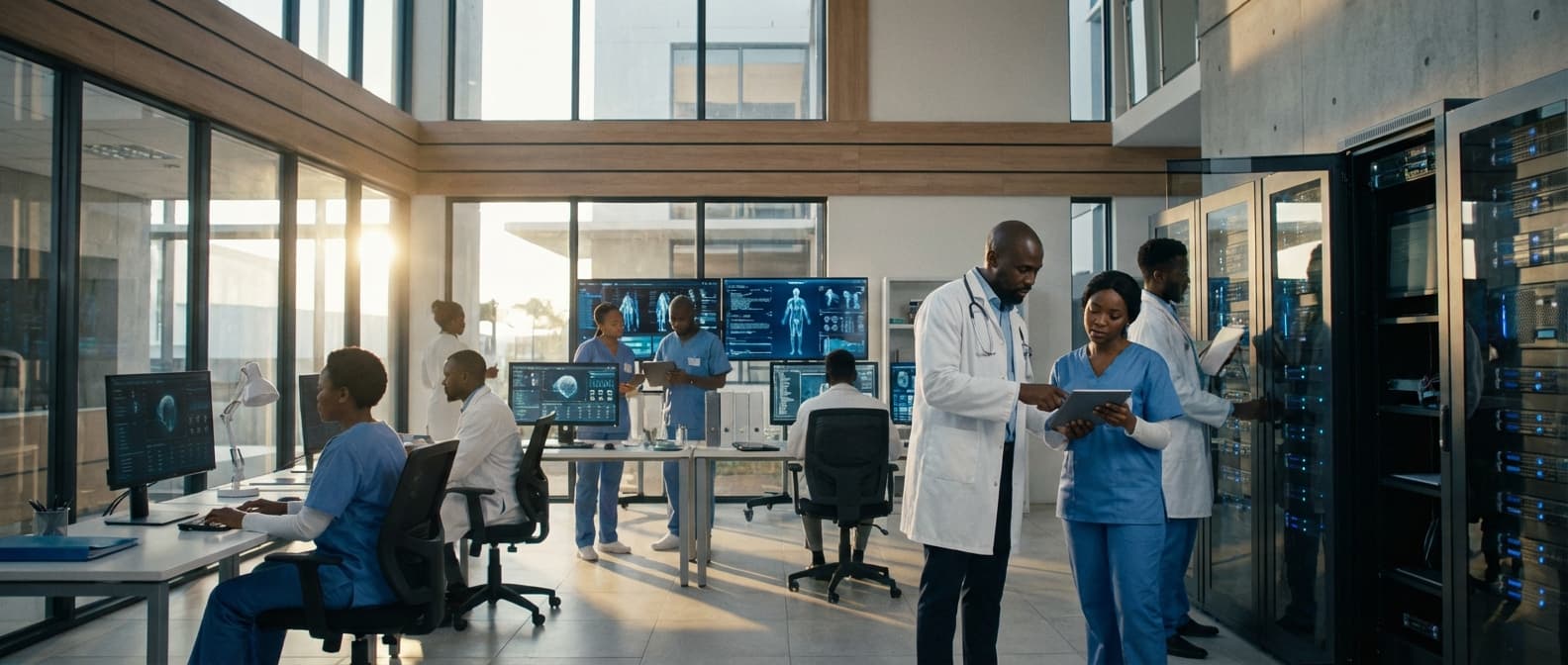
Medical IT Consultation in Egypt
Engineering Excellence & Technical Support
Strategic technology consulting to optimize healthcare operations, streamline workflows, and integrate cutting-edge medical information systems. High-standard technical execution following OEM protocols and local regulatory frameworks.
Digital Transformation for Healthcare Providers
We empower Egyptian healthcare institutions with cutting-edge IT solutions, from EMR/EHR implementation and optimization to telehealth platform integration, streamlining patient care and operational efficiency.
Data Security & Regulatory Compliance
Ensuring robust data protection and adherence to Egypt's evolving healthcare data privacy regulations (e.g., PDPL), safeguarding sensitive patient information and building trust.
Cloud-Based Healthcare Infrastructure
Leveraging secure and scalable cloud solutions to enhance accessibility, collaboration, and disaster recovery for Egyptian hospitals and clinics, reducing IT overhead and improving agility.
What Is Medical It Consultation In Egypt?
Medical IT Consultation in Egypt refers to specialized advisory services focused on the strategic planning, implementation, optimization, and management of information technology systems within healthcare organizations operating in Egypt. This encompasses a broad spectrum of IT domains critical for modern healthcare delivery, including electronic health records (EHR/EMR), picture archiving and communication systems (PACS), hospital information systems (HIS), telehealth platforms, cybersecurity for medical data, regulatory compliance (such as data privacy laws), cloud computing integration, and the adoption of emerging technologies like AI and IoT in healthcare. The objective is to enhance operational efficiency, improve patient care outcomes, ensure data security and privacy, and support research and development through the effective leverage of technology.
| Who Needs Medical IT Consultation in Egypt? | Typical Use Cases | ||
|---|---|---|---|
| Hospitals (Public & Private): Seeking to upgrade or implement EHR/HIS, improve network infrastructure, or enhance cybersecurity. | Implementing a new Hospital Information System (HIS) to streamline patient registration, billing, and inventory management. | Deploying a Picture Archiving and Communication System (PACS) for efficient medical imaging storage and retrieval. | Enhancing cybersecurity protocols to meet data protection regulations and prevent ransomware attacks. |
| Clinics & Polyclinics: Aiming to digitize patient records, adopt appointment scheduling software, or integrate basic IT solutions. | Transitioning from paper-based patient records to a digital Electronic Medical Record (EMR) system for improved accessibility and reduced errors. | Implementing a cloud-based practice management system for scheduling, billing, and patient communication. | |
| Diagnostic Laboratories & Imaging Centers: Requiring specialized IT systems for managing tests, reporting results, and integrating with other healthcare providers. | Integrating a Laboratory Information System (LIS) with diagnostic equipment and hospital EHRs for automated data entry and reporting. | Setting up a PACS for radiology departments to manage and share diagnostic images. | |
| Healthcare IT Vendors & Solution Providers: Seeking guidance on market entry, compliance, or tailoring solutions for the Egyptian healthcare landscape. | Localizing a global EHR solution to comply with Egyptian medical coding standards and data privacy laws. | Developing a go-to-market strategy for a new telehealth platform in the Egyptian market. | |
| Government Health Agencies & Ministries: Focused on national health IT infrastructure, data standardization, and public health initiatives. | Developing a national strategy for EHR interoperability across public and private healthcare sectors. | Implementing a public health surveillance system leveraging data analytics. | |
| Medical Research Institutions: Needing secure data management solutions and analytical tools for research purposes. | Establishing a secure, compliant data repository for clinical trial data. | Implementing data analytics platforms for epidemiological research. | |
| Pharmaceutical Companies: Requiring IT support for clinical trials, pharmacovigilance, and data management. | Implementing systems for managing electronic data capture (EDC) in clinical trials. | Ensuring compliance with data integrity and security for pharmacovigilance reporting. |
Key Aspects of Medical IT Consultation in Egypt
- Strategic IT Planning & Roadmapping: Developing comprehensive IT strategies aligned with organizational goals, considering current infrastructure and future scalability.
- System Selection & Implementation: Guiding the procurement and deployment of healthcare IT solutions (EHR, HIS, PACS, LIS, etc.), ensuring interoperability and integration.
- Infrastructure Assessment & Optimization: Evaluating existing hardware, software, and network capabilities and recommending improvements for performance, reliability, and cost-effectiveness.
- Cybersecurity & Data Privacy: Implementing robust security measures to protect sensitive patient data (PHI/ePHI) against breaches and ensuring compliance with Egyptian data protection regulations and international standards.
- Regulatory Compliance Assistance: Advising on adherence to local and international healthcare IT regulations, including data governance and patient consent management.
- Telehealth & Remote Patient Monitoring Solutions: Designing and implementing platforms to facilitate remote consultations, diagnostics, and patient monitoring.
- Cloud Strategy & Migration: Developing strategies for adopting cloud-based healthcare solutions, considering security, scalability, and cost implications.
- Interoperability & Data Exchange: Facilitating seamless data flow between different healthcare systems and providers, crucial for coordinated care.
- Digital Transformation Initiatives: Leading the adoption of new technologies and digital workflows to modernize healthcare services.
- IT Governance & Policy Development: Establishing frameworks for IT management, risk assessment, and policy creation.
- Vendor Management & Technology Sourcing: Assisting in evaluating and managing relationships with IT vendors.
Who Needs Medical It Consultation In Egypt?
Egypt's healthcare sector is undergoing significant digital transformation, creating a growing demand for specialized Medical IT consultation. This expertise is crucial for optimizing operations, enhancing patient care, and ensuring compliance with evolving regulations. Numerous organizations and departments within Egypt's healthcare ecosystem can benefit immensely from professional medical IT guidance.
| Customer Type | Key Departments/Areas Needing Consultation | Specific Needs/Challenges |
|---|---|---|
| Hospitals (Public and Private) | IT Department, Administration, Clinical Departments (e.g., Cardiology, Radiology, Oncology), Pharmacy, Patient Services, Compliance Officer | EHR/EMR implementation & optimization, PACS integration, Cybersecurity, Data management and analytics, Telemedicine solutions, Network infrastructure, Hardware procurement & management, Compliance with Egyptian health data regulations, Digital transformation strategy. |
| Clinics and Specialized Medical Centers | Practice Management, IT Staff (if any), Physicians, Administrative Staff | Clinic management software selection & implementation, Patient portal development, Appointment scheduling systems, Data security, Interoperability with larger systems, Basic IT infrastructure setup. |
| Diagnostic Laboratories | Laboratory Information System (LIS) Management, IT Department, Lab Technicians, Quality Control | LIS integration with HIS/EMR, Automated reporting, Data integrity and security, Barcode tracking systems, Equipment integration, Cloud migration for LIS. |
| Radiology Centers | Radiology Information System (RIS) Management, PACS Administrators, Radiologists, IT Support | RIS/PACS implementation & upgrades, DICOM standardization, Image archiving and retrieval, Integration with EMR, AI-powered diagnostic tools integration, Cybersecurity for medical imaging data. |
| Pharmacies (Chain and Independent) | Pharmacy Management, IT, Inventory Management, Customer Service | Pharmacy management software, Inventory control systems, Prescription management, Integration with e-prescriptions, Data analytics for sales and inventory, Compliance with drug regulations. |
| Healthcare Technology Vendors | Product Development, Sales, Implementation Teams, Client Support | Understanding Egyptian healthcare market needs, Compliance with local regulations for health tech, Integration strategies with existing Egyptian healthcare IT infrastructure, Cybersecurity best practices for their solutions. |
| Government Health Agencies | Health Information Systems (HIS) Departments, Policy Makers, National Health Registries | National E-health strategy development, Data standardization and interoperability across the country, Public health surveillance systems, Cybersecurity for national health data, Digitalization of health records, E-prescription infrastructure. |
| Medical Research Institutions | Research IT, Data Management, Principal Investigators | Secure data storage and sharing for research, Bioinformatics tools and infrastructure, Compliance with research data privacy laws, High-performance computing for analysis, Integration with clinical data. |
| Healthcare Insurance Providers | IT Department, Claims Processing, Data Analytics | Secure data exchange with providers, Claims management systems, Fraud detection systems, Data analytics for risk assessment and pricing, Interoperability for patient data access. |
| Start-ups in the HealthTech sector | Founders, Technical Leads, Product Managers | Navigating regulatory landscape, Market entry strategies, Technical architecture design, Scalability planning, Data security and privacy by design, Integration with existing healthcare systems. |
Target Customers for Medical IT Consultation in Egypt
- Hospitals (Public and Private)
- Clinics and Specialized Medical Centers
- Diagnostic Laboratories
- Radiology Centers
- Pharmacies (Chain and Independent)
- Healthcare Technology Vendors
- Government Health Agencies
- Medical Research Institutions
- Healthcare Insurance Providers
- Start-ups in the HealthTech sector
Medical It Consultation Process In Egypt
The Medical IT consultation process in Egypt follows a structured workflow designed to understand client needs, propose solutions, and implement them effectively. This process ensures that medical organizations receive tailored IT strategies that align with their operational goals and regulatory requirements. The workflow typically begins with an initial inquiry and culminates in the successful execution and ongoing support of the implemented IT solutions.
| Stage | Description | Key Activities | Deliverables | Egyptian Context/Considerations |
|---|---|---|---|---|
| Inquiry and Initial Contact | The first point of interaction where a medical organization expresses interest in IT consultation services. | Receiving inquiries via phone, email, or website. Initial brief discussion to understand the general scope of need. | Acknowledgement of inquiry, preliminary meeting schedule. | Establishing trust and understanding the organization's immediate pain points. Potential for direct contact through professional networks or industry events. |
| Needs Assessment and Requirement Gathering | A detailed exploration of the client's current IT infrastructure, operational challenges, and future objectives. | On-site visits, stakeholder interviews (doctors, administrators, IT staff), system audits, workflow analysis, identification of regulatory compliance needs (e.g., Ministry of Health regulations). | Detailed requirements document, gap analysis report, risk assessment. | Understanding the specific challenges faced by Egyptian healthcare providers (e.g., legacy systems, budget constraints, digital literacy levels). Emphasis on compliance with local data privacy laws and MoH directives. |
| Solution Proposal and Design | Developing tailored IT solutions based on the gathered requirements and presenting them to the client. | Designing system architecture, selecting appropriate hardware/software, outlining integration strategies, cost estimation, presenting multiple solution options. | Formal proposal document (including technical specifications, timeline, budget), solution design diagrams. | Proposing solutions that are scalable, cost-effective, and can be integrated with existing infrastructure. Consideration of readily available technologies and local vendor support. |
| Contracting and Agreement | Formalizing the engagement and outlining the terms of service. | Negotiating contract terms, defining scope of work, service level agreements (SLAs), payment schedules, intellectual property rights. | Signed contract/Service Level Agreement (SLA). | Clear contractual agreements to manage expectations. Ensuring all clauses are legally compliant within Egyptian law. Clarity on data ownership and security. |
| Implementation and Deployment | Putting the proposed IT solutions into action. | Hardware installation, software configuration and customization, network setup, system integration, data migration. | Installed and configured IT systems, integrated platforms. | Phased rollout strategies to minimize disruption to patient care. Utilizing local technical resources for on-ground support. |
| Testing and Quality Assurance | Verifying that the implemented solutions function as intended and meet all requirements. | Unit testing, integration testing, user acceptance testing (UAT), performance testing, security testing. | Test reports, UAT sign-off. | Ensuring systems are robust and reliable, especially in critical healthcare environments. UAT involving key clinical staff to confirm usability. |
| Training and User Adoption | Educating end-users on how to effectively utilize the new IT systems. | Developing training materials, conducting training sessions (on-site or remote), providing user guides, post-training support. | Trained personnel, user manuals, knowledge transfer documentation. | Tailoring training programs to suit the digital literacy of different user groups within Egyptian hospitals and clinics. Addressing potential language barriers. |
| Go-Live and Monitoring | Launching the new IT systems into the live environment and closely observing their performance. | System launch, real-time performance monitoring, immediate issue resolution, user support during the initial phase. | Live operational systems, initial performance reports. | Careful planning for 'go-live' to avoid disruption to patient services. Establishing a dedicated support team during this critical period. |
| Post-Implementation Support and Maintenance | Providing ongoing technical assistance and ensuring the continued optimal performance of the IT systems. | Regular system updates and patching, troubleshooting, help desk support, system performance optimization, preventative maintenance, long-term strategic IT planning. | Ongoing support, maintenance reports, system upgrade plans. | Establishing long-term partnerships for continuous improvement and support. Adapting to evolving healthcare needs and technological advancements in Egypt. |
Medical IT Consultation Process Workflow in Egypt
- Inquiry and Initial Contact
- Needs Assessment and Requirement Gathering
- Solution Proposal and Design
- Contracting and Agreement
- Implementation and Deployment
- Testing and Quality Assurance
- Training and User Adoption
- Go-Live and Monitoring
- Post-Implementation Support and Maintenance
Medical It Consultation Cost In Egypt
Medical IT consultation costs in Egypt can vary significantly depending on several key factors. These consultations are crucial for healthcare providers looking to optimize their technology infrastructure, implement new systems (like Electronic Health Records - EHRs), enhance cybersecurity, or improve overall operational efficiency through digital solutions. The pricing is generally influenced by the complexity of the project, the expertise and reputation of the consulting firm or individual, the duration of the engagement, and the specific services required. Small clinics might have simpler needs addressed by smaller firms or independent consultants, while large hospital networks will require more comprehensive and potentially longer-term engagements with established IT companies.
| Service Type/Project Scope | Estimated Price Range (EGP) | Notes |
|---|---|---|
| Initial IT Assessment/Audit (Small Practice) | 5,000 - 15,000 EGP | Basic overview of current IT infrastructure, identification of immediate issues. |
| EHR System Needs Analysis & Vendor Selection (Medium Clinic) | 10,000 - 30,000 EGP | Detailed requirements gathering, feature analysis, vendor shortlisting. |
| EHR Implementation Consultation (Large Hospital) | 50,000 - 250,000+ EGP | Includes planning, workflow analysis, configuration, integration, and training strategy. This is highly variable based on hospital size and system complexity. |
| Cybersecurity Assessment & Strategy (Hospital/Clinic Chain) | 15,000 - 75,000 EGP | Vulnerability assessment, risk analysis, policy development, and remediation planning. |
| Data Migration Strategy & Oversight | 10,000 - 50,000 EGP | Planning for secure and efficient transfer of patient data. Cost depends on data volume and complexity. |
| IT Strategy & Digital Transformation Roadmap | 20,000 - 100,000+ EGP | Long-term vision, technology investment planning, and phased implementation for a healthcare organization. |
| Hourly Consultation Rate (Expert) | 500 - 2,000+ EGP per hour | For ad-hoc advice, problem-solving, or specific technical guidance. Varies greatly by consultant's seniority. |
| Daily Rate (Consulting Firm) | 4,000 - 15,000+ EGP per day | For dedicated project work by a team or senior consultant. |
Key Factors Influencing Medical IT Consultation Costs in Egypt
- Scope and Complexity of the Project: Larger projects, such as full EHR implementation, network overhauls, or comprehensive cybersecurity audits, naturally incur higher costs than smaller, more focused consultations (e.g., advising on a specific software purchase or optimizing a single IT process).
- Consultant's Experience and Reputation: Highly experienced consultants or reputable IT firms with a proven track record in the healthcare sector in Egypt will command higher fees due to their expertise, reliability, and the assurance of quality service.
- Duration of the Engagement: The length of the consultation is a direct cost driver. Project-based fees are common for well-defined tasks, while hourly or daily rates are used for ongoing support or less defined scopes.
- Specific Services Required: The nature of the services is critical. This can range from strategic IT planning, system selection and procurement, implementation and integration, data migration, cybersecurity assessment and remediation, IT policy development, compliance (e.g., with local data privacy regulations), training, and ongoing IT support strategy.
- Technology Stack: The complexity of the existing or proposed technology stack can influence costs. Integrating legacy systems with new technologies, or implementing highly specialized medical software, may require more specialized expertise.
- Geographic Location (within Egypt): While less of a factor for remote consultations, on-site consultations might have minor variations based on travel and logistical considerations, though this is usually absorbed into the overall project fee.
Affordable Medical It Consultation Options
Navigating the complexities of Medical IT can be daunting, especially for practices seeking cost-effective solutions. Affordable medical IT consultation options focus on delivering essential expertise without breaking the bank. This involves understanding value bundles that package services for greater efficiency and implementing strategic cost-saving measures throughout the IT lifecycle.
| Service Category | Typical Value Bundle Components | Cost-Saving Strategy Examples | Potential Benefits |
|---|---|---|---|
| Network Management | Proactive monitoring, security patching, remote troubleshooting, firewall management | Utilizing cloud-based network management tools, optimizing bandwidth usage | Reduced downtime, enhanced security, predictable operational costs |
| EHR/EMR Support | System updates, user training, data migration assistance, troubleshooting | Choosing a cloud-hosted EHR, negotiating multi-year contracts | Improved patient care, compliance adherence, efficient workflows |
| Cybersecurity | Vulnerability assessments, antivirus management, security policy development, incident response planning | Implementing multi-factor authentication, regular security audits | Protection against data breaches, regulatory compliance, patient trust |
| Data Backup & Disaster Recovery | Automated backups, off-site storage, recovery testing | Cloud-based backup solutions, deduplication technologies | Business continuity, minimal data loss, regulatory compliance |
| Hardware & Software Procurement | Needs assessment, vendor evaluation, competitive bidding guidance | Leveraging refurbished equipment where appropriate, bulk purchasing discounts | Reduced capital expenditure, optimized hardware lifecycle |
Key Affordable Medical IT Consultation Strategies
- {"title":"Value Bundles: Maximizing ROI","description":"Value bundles are pre-packaged sets of IT services designed to address common medical practice needs at a reduced overall cost compared to individual service procurement. They offer predictable expenses and ensure a comprehensive approach to IT management."}
- {"title":"On-Demand & Project-Based Consultations","description":"Instead of retaining a full-time IT consultant, opt for on-demand support for immediate issues or project-based engagements for specific upgrades, implementations, or security assessments. This limits expenses to actual needs."}
- {"title":"Remote & Cloud-Based Solutions","description":"Leveraging remote IT support and cloud-based infrastructure (EHRs, data storage, communication tools) significantly reduces the need for on-site hardware and dedicated IT staff, leading to substantial cost savings."}
- {"title":"Managed IT Services (Tiered Options)","description":"Many IT providers offer tiered managed services. Lower tiers often focus on essential maintenance, monitoring, and basic support, providing a cost-effective way to ensure system stability and security."}
- {"title":"Strategic Vendor Negotiation","description":"Consultants can assist in negotiating favorable terms with IT vendors for hardware, software, and cloud services, ensuring you get the best value for your investment."}
- {"title":"IT Infrastructure Optimization","description":"Expert consultation can identify inefficiencies in your current IT infrastructure, recommending cost-effective upgrades or consolidation to improve performance and reduce operational expenses."}
- {"title":"Cybersecurity Awareness Training","description":"Investing in staff training to prevent cyber threats is far more cost-effective than dealing with the aftermath of a breach. Consultants can help implement and deliver tailored training programs."}
- {"title":"Open-Source Software Exploration","description":"For certain applications, open-source alternatives can offer significant cost savings without compromising functionality, especially when guided by an experienced IT consultant."}
Verified Providers In Egypt
In the pursuit of reliable healthcare in Egypt, identifying verified providers is paramount. Franance Health stands out as a trusted entity, offering a rigorous credentialing process that ensures patients access the highest quality of medical care. Their commitment to excellence not only elevates the standard of healthcare but also provides patients with peace of mind, knowing they are in capable hands. This focus on verified providers is crucial for building confidence in the healthcare system and empowering individuals to make informed decisions about their well-being.
| Credentialing Aspect | Franance Health's Approach | Benefit to Patients |
|---|---|---|
| Licensing and Certification | Confirms all relevant medical licenses and board certifications are current and valid. | Ensures providers meet foundational professional requirements. |
| Professional Experience | Evaluates the breadth and depth of a provider's clinical experience in their specialty. | Connects patients with experienced and skilled practitioners. |
| Education and Training | Verifies completion of accredited medical education programs and specialized training. | Guarantees a strong educational foundation and specialized knowledge. |
| Peer Review and Reputation | May include checks on professional reputation and peer endorsements. | Provides an indication of a provider's standing within the medical community. |
| Adherence to Ethical Standards | Assesses commitment to patient rights, confidentiality, and professional ethics. | Ensures compassionate and respectful medical treatment. |
| Continuing Medical Education (CME) | Confirms ongoing participation in CME to stay updated with medical advancements. | Ensures patients receive care based on the latest medical knowledge. |
Why Franance Health Credentials Represent the Best Choice:
- Rigorous Verification Process: Franance Health employs a multi-faceted approach to vetting its network of healthcare providers, going beyond basic licensing to ensure a comprehensive standard of competence and ethical practice.
- Emphasis on Specialization and Expertise: Providers are assessed for their specific areas of expertise and ongoing professional development, guaranteeing access to specialists with the most relevant skills for diverse medical needs.
- Commitment to Patient Safety and Quality: The credentialing process prioritizes providers who demonstrate a strong track record in patient safety, adherence to best practices, and a commitment to continuous quality improvement.
- Patient-Centric Approach: Franance Health credentials reflect providers who are dedicated to patient-centered care, emphasizing clear communication, empathy, and shared decision-making.
- Transparency and Trust: The clear and transparent nature of Franance Health's credentialing provides patients with an added layer of trust and confidence in the healthcare professionals they choose.
- Access to a Network of Excellence: By choosing a Franance Health verified provider, patients gain access to a curated network of healthcare professionals who have met stringent criteria, ensuring a higher standard of care.
- Proactive Risk Management: Franance Health's verification process helps to mitigate risks by identifying and selecting providers who adhere to established professional and ethical guidelines.
Scope Of Work For Medical It Consultation
This Scope of Work (SOW) outlines the services to be provided by [Consultant Name/Company] (hereinafter referred to as the "Consultant") to [Client Name/Organization] (hereinafter referred to as the "Client") for Medical IT Consultation. The primary objective is to assess, recommend, and assist in the implementation of IT solutions to enhance [Client's specific goals, e.g., patient care, operational efficiency, data security, regulatory compliance].
| Technical Deliverable | Description | Standard Specifications/Format | Key Performance Indicators (KPIs) |
|---|---|---|---|
| Current State IT Infrastructure Assessment Report | Comprehensive review of existing hardware, software, networks, security measures, and EMR/EHR systems. | PDF format. Includes diagrams, inventory lists, and risk assessments. | Completeness of assessment, accuracy of inventory, identification of critical vulnerabilities. |
| Gap Analysis Report | Identifies discrepancies between current IT capabilities and desired future state or regulatory requirements. | PDF format. Quantifies gaps in functionality, security, and compliance. | Clarity of identified gaps, actionable recommendations for bridging gaps. |
| Recommended IT Solution Architecture | Detailed proposed architecture for new or upgraded IT systems, including hardware, software, and network components. | Visio diagrams, detailed component specifications (vendor-agnostic where possible), and logical flowcharts. | Scalability of the proposed architecture, alignment with business objectives, cost-effectiveness. |
| Vendor/Product Evaluation Matrix | Comparison of potential IT solutions/vendors based on predefined criteria such as functionality, security, cost, support, and integration capabilities. | Excel or CSV format. Includes weighted scoring and detailed pros/cons. | Objectivity of evaluation criteria, thoroughness of vendor assessment, clear justification for recommendations. |
| Implementation Roadmap & Project Plan | Phased plan for implementing recommended IT solutions, including timelines, resource allocation, milestones, and risk mitigation strategies. | Microsoft Project or equivalent format. Gantt charts, WBS (Work Breakdown Structure), and resource loading. | Realism of timelines, clarity of dependencies, robustness of risk management. |
| Security Policy & Procedure Recommendations | Guidelines for data security, access control, incident response, and disaster recovery tailored to the healthcare environment. | Document format (e.g., Word). Aligned with HIPAA, HITECH, and other relevant regulations. | Comprehensiveness of policies, alignment with regulatory requirements, practicality of procedures. |
| Data Migration Strategy | Plan for the secure and efficient transfer of data from legacy systems to new platforms. | Document format (e.g., Word). Includes data mapping, validation procedures, and rollback plans. | Minimization of data loss, data integrity verification, security during migration. |
| Training Materials Outline/Draft | Framework for user training on new systems and workflows. | Document format (e.g., Word). Includes learning objectives, module breakdown, and assessment methods. | Relevance of training topics, clarity of learning objectives, potential for user adoption. |
| Post-Implementation Review Report | Assessment of the implemented solution against initial objectives, identifying areas for further optimization. | PDF format. Includes performance metrics, user feedback analysis, and recommendations for continuous improvement. | Achievement of project KPIs, identification of improvement opportunities, user satisfaction. |
Key Project Phases and Objectives
- Phase 1: Needs Assessment & Gap Analysis
- Phase 2: Solution Design & Recommendation
- Phase 3: Implementation Planning & Support
- Phase 4: Post-Implementation Review & Optimization
Service Level Agreement For Medical It Consultation
This Service Level Agreement (SLA) outlines the commitment of [Your Company Name] (hereinafter referred to as 'Provider') to [Client Name] (hereinafter referred to as 'Client') for IT consultation services specifically tailored for the medical industry. This SLA defines the expected response times for support requests and the guaranteed uptime for critical IT systems and services as agreed upon in the main service contract.
| Service Category | Response Time Guarantee (Business Hours) | Uptime Guarantee | Definition/Escalation |
|---|---|---|---|
| Critical System Outage (e.g., EHR unavailable, patient data inaccessible) | 15 minutes to acknowledge, 1 hour to initiate active troubleshooting | 99.9% (monthly) | System interruption directly impacting patient care. Escalation to Tier 2/3 support within 2 hours. |
| Urgent Issue (e.g., network down affecting multiple users, critical software malfunctioning) | 30 minutes to acknowledge, 2 hours to initiate active troubleshooting | 99.5% (monthly) | Significant disruption to operations, but not directly impacting immediate patient care. Escalation to Tier 2 support within 4 hours. |
| High Priority Issue (e.g., single user unable to access essential application, minor network degradation) | 1 hour to acknowledge, 4 hours to initiate active troubleshooting | 99.0% (monthly) | Interference with workflow, but workarounds may exist. Escalation to Tier 2 support within 8 business hours. |
| Routine Request/Consultation (e.g., software update request, general IT advice, non-urgent hardware issue) | 4 business hours to acknowledge, 24-48 business hours for resolution/initial advice | N/A (Best Effort) | Requests that do not impede critical operations. Resolution time depends on complexity and resource availability. |
| Provider's Managed Infrastructure (e.g., hosted servers, cloud services managed by Provider) | 15 minutes to acknowledge, 1 hour to initiate active troubleshooting | 99.95% (monthly) | Downtime of Provider-managed infrastructure. Uptime measured excluding scheduled maintenance with advance notice. |
Scope of Services Covered
- On-site and remote IT support for medical facilities.
- Consultation on Electronic Health Record (EHR) systems, Picture Archiving and Communication Systems (PACS), and other healthcare-specific software.
- Network infrastructure management and optimization for medical environments.
- Cybersecurity consultation and implementation for HIPAA compliance.
- Cloud migration and management for healthcare data.
- IT strategy and planning for medical organizations.
Frequently Asked Questions

Ready when you are
Let's scope your Medical IT Consultation in Egypt project in Egypt.

Scaling healthcare logistics and technical systems across the entire continent.