
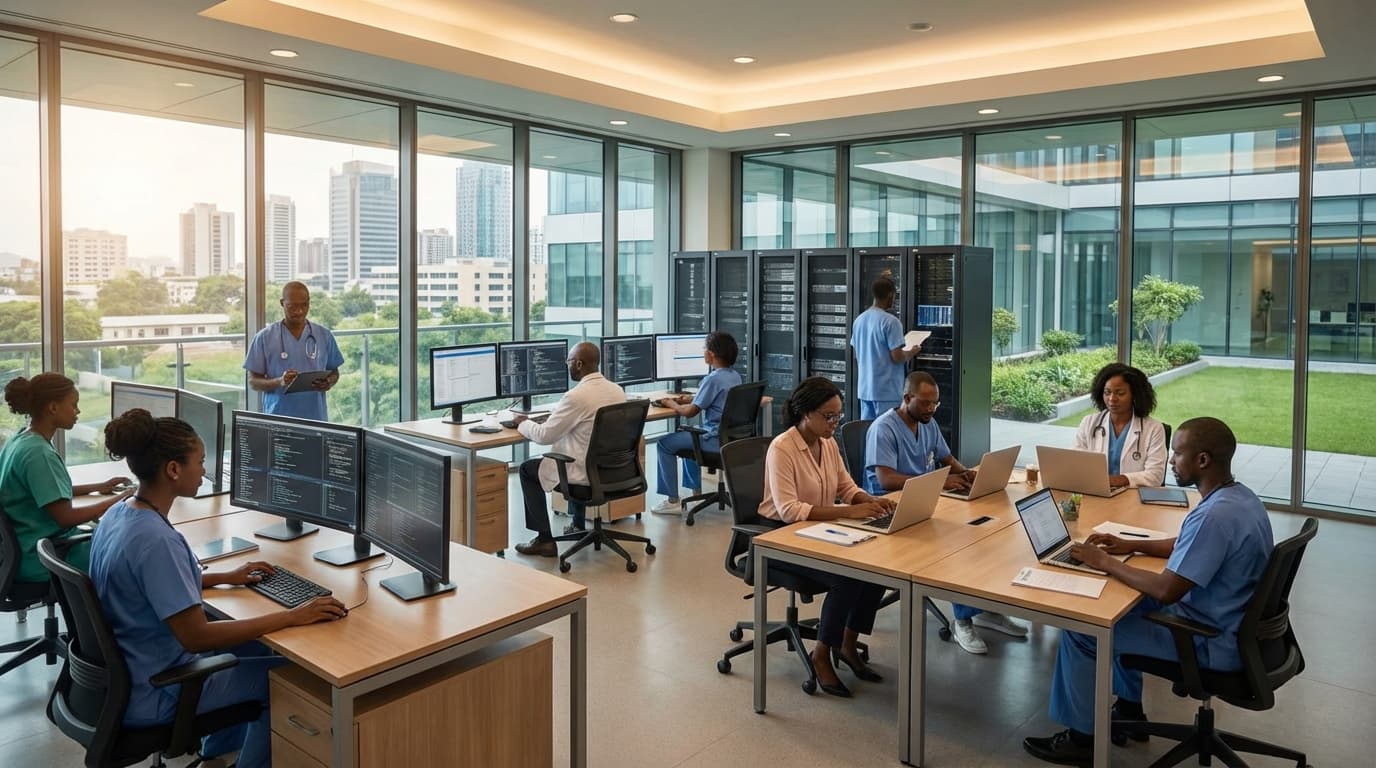
Radiology Reader & Reporting Support in Egypt
Engineering Excellence & Technical Support
Remote radiology reading and reporting services High-standard technical execution following OEM protocols and local regulatory frameworks.
AI-Powered Diagnostic Assistance
Leverage cutting-edge AI algorithms trained on diverse Egyptian medical imaging datasets to flag potential abnormalities, prioritize urgent cases, and improve diagnostic accuracy in radiology reporting.
Localized Workflow Integration & Language Support
Seamlessly integrate with existing PACS and RIS systems, offering intuitive interfaces and comprehensive Arabic and English language support for radiologists and reporting staff across Egypt.
Automated Report Generation & Standardization
Streamline the reporting process with intelligent auto-generation of preliminary reports, standardized templates, and integrated tools for efficient dictation and finalization, ensuring consistency and reducing turnaround times in Egyptian healthcare facilities.
What Is Radiology Reader & Reporting Support In Egypt?
Radiology Reader & Reporting Support in Egypt refers to the provision of specialized services that assist radiologists and healthcare facilities in the interpretation of medical imaging studies and the generation of comprehensive diagnostic reports. This service leverages advanced technologies, including Artificial Intelligence (AI) and potentially remote expert radiologist services, to enhance diagnostic accuracy, efficiency, and turnaround times within the Egyptian healthcare landscape. It addresses the growing demand for sophisticated diagnostic imaging interpretation, particularly in regions facing radiologist shortages or seeking to optimize existing workflows. The core objective is to augment the capabilities of local radiologists, thereby improving patient care outcomes and the overall quality of radiological services.
| Use Case | Description | Impact & Benefits |
|---|---|---|
| Early Detection of Critical Findings (e.g., Stroke, Pulmonary Embolism) | AI algorithms analyze scans in real-time, flagging potential critical findings for immediate radiologist review. This is particularly valuable in emergency settings where rapid diagnosis is crucial. | Reduced time to diagnosis, faster initiation of treatment, improved patient prognosis, and reduced mortality rates. |
| Screening Programs (e.g., Mammography, Lung Cancer Screening) | AI tools assist in identifying subtle abnormalities in screening images, augmenting the radiologist's detection capabilities and potentially reducing false negatives. | Increased sensitivity of screening programs, earlier detection of malignancies, improved cancer survival rates. |
| Management of High Imaging Volume Workloads | Automated preliminary readings and report structuring by AI can significantly reduce the time radiologists spend on routine tasks, allowing them to focus on complex cases. | Increased radiologist productivity, reduced report turnaround time (RTT), improved patient satisfaction due to faster results. |
| Subspecialty Interpretation Support for General Radiologists | Remote access to subspecialty radiologists for complex cases (e.g., neuroimaging, musculoskeletal MRI, interventional radiology) via teleradiology platforms. | Enhanced diagnostic accuracy for specialized examinations, access to expertise not locally available, improved patient management for complex conditions. |
| Quality Improvement and Standardization | Utilizing AI-driven quality checks and standardized reporting templates to ensure consistency and adherence to best practices across all reports. | Reduced inter-reader variability, improved report clarity and completeness, facilitated audits and accreditation processes. |
| Training and Education for Radiologists | AI tools can serve as educational aids by highlighting learning points on images and providing feedback on preliminary interpretations, aiding in the development of junior radiologists. | Accelerated learning curve for new radiologists, improved competency development, enhanced knowledge transfer. |
Key Components and Beneficiaries of Radiology Reader & Reporting Support
- Service Components:
- AI-Powered Image Analysis: Utilizing algorithms trained on vast datasets to detect anomalies, measure structures, and flag critical findings in various imaging modalities (X-ray, CT, MRI, Ultrasound).
- Second Opinion & Expert Consultation: Providing access to subspecialty radiologists for complex cases or when a second opinion is required, either through remote teleradiology or case-based consultations.
- Automated Report Generation: Employing Natural Language Processing (NLP) to pre-populate reports with quantitative data, standard measurements, and preliminary interpretations, reducing manual data entry for radiologists.
- Quality Assurance & Audit Tools: Implementing systems for tracking reporting consistency, identifying potential errors, and facilitating peer review processes.
- Workflow Optimization: Streamlining the imaging interpretation process, from image acquisition to final report delivery, by integrating with PACS/RIS systems and prioritizing urgent cases.
- Who Needs It:
- Radiology Departments in Hospitals (Public & Private): Seeking to enhance efficiency, accuracy, and capacity, especially in understaffed departments.
- Imaging Centers & Diagnostic Clinics: Aiming to provide advanced interpretation services and expand their diagnostic capabilities.
- Teleradiology Providers: Leveraging AI and remote expert support to scale operations and manage higher volumes of studies.
- Remote or Underserved Areas in Egypt: Where access to specialized radiologists may be limited, providing critical diagnostic support.
- Healthcare Systems: Looking to standardize reporting quality and improve patient outcomes across multiple facilities.
Who Needs Radiology Reader & Reporting Support In Egypt?
Radiology Reader & Reporting Support services are essential for a wide range of healthcare providers in Egypt seeking to enhance diagnostic accuracy, streamline workflows, and improve patient care. These services leverage specialized radiologists and advanced AI tools to provide expert second opinions, preliminary interpretations, and comprehensive reports, especially in areas with a shortage of subspecialist radiologists or when facing high caseloads.
| Customer Type | Relevant Departments | Specific Needs Addressed |
|---|---|---|
| Hospitals (Public & Private) | Radiology Department, Emergency Department, Oncology, Cardiology, Neurology, Orthopedics, Pediatrics, Surgery | Reducing radiologist burnout, ensuring subspecialist reads for complex cases, improving report turnaround times, providing coverage for vacations/leave, second opinion for critical findings, training junior radiologists. |
| Diagnostic Imaging Centers | Radiology Department | Increasing throughput, improving diagnostic accuracy, offering specialized reads (e.g., neuroimaging, musculoskeletal), competitive advantage through faster and more accurate reports, managing peak demand. |
| Polyclinics and Clinics with Imaging Capabilities | Radiology Department (if present), General Practice, Specialists (e.g., Orthopedics, Internal Medicine) | Access to expert interpretation without in-house subspecialists, timely reports for patient management, supporting general practitioners with complex imaging needs, cost-effective diagnostic solutions. |
| Specialized Medical Centers | Radiology Department, Department of the Specialty (e.g., Oncology for PET/CT, Cardiology for Cardiac MRI) | Highly specialized interpretations tailored to specific disease protocols, integration of imaging findings with clinical data, research support, advanced imaging analysis. |
| Healthcare Networks and Groups | Centralized Radiology Services, Individual Facility Radiology Departments | Standardizing reporting quality across multiple sites, centralizing expertise, improving operational efficiency, remote reading capabilities for underserved locations within the network. |
| Medical Schools and Teaching Hospitals | Radiology Department, Postgraduate Training Programs | Providing a pool of diverse cases for training, supervised reporting for residents, access to subspecialist expertise for educational purposes, research collaborations. |
Target Customers and Departments in Egypt
- Hospitals (Public and Private)
- Diagnostic Imaging Centers
- Polyclinics and Clinics with Imaging Capabilities
- Specialized Medical Centers (e.g., Oncology, Cardiology, Neurology)
- Healthcare Networks and Groups
- Medical Schools and Teaching Hospitals
Radiology Reader & Reporting Support Process In Egypt
This document outlines the typical workflow for Radiology Reader & Reporting Support processes within Egypt, covering the journey from initial inquiry to the final execution and delivery of reports. This process is designed to ensure efficient and accurate interpretation of radiological images and the timely generation of diagnostic reports.
| Stage | Description | Key Actors | Typical Technologies/Tools | Potential Challenges | Egyptian Context Notes |
|---|---|---|---|---|---|
| Inquiry & Case Registration | The process begins with a request for radiological interpretation, often from a referring physician or healthcare facility. Patient demographics, clinical history, and imaging modality are collected and registered in the system. | Referring Physician, Reception Staff, Radiographer | Hospital Information System (HIS), Picture Archiving and Communication System (PACS) interface, Electronic Health Record (EHR) | Incomplete or inaccurate patient data, delays in receiving clinical history, communication breakdowns. | Often managed through direct communication with hospital departments or through dedicated administrative staff at radiology centers. |
| Image Upload & Transmission | Radiological images (X-ray, CT, MRI, Ultrasound, etc.) are acquired and then securely transmitted to the PACS or a dedicated reporting system. | Radiographer, PACS Administrator | PACS, DICOM (Digital Imaging and Communications in Medicine) standard, Secure network connections (VPNs, encrypted transfers) | Network connectivity issues, large file sizes causing delays, data corruption, cybersecurity threats. | Internet infrastructure reliability can be a factor. Secure transfer protocols are crucial, especially with increasing digital adoption. |
| Worklist Assignment | Registered cases are added to a worklist, which is then assigned to available radiologists based on specialty, workload, and availability. This can be manual or automated. | Radiology Department Manager, PACS Administrator, Reporting Software | PACS Worklist, RIS (Radiology Information System), AI-powered worklist management tools | Improper workload distribution, skill mismatches, delays in assignment, lack of real-time visibility. | Worklists might be managed across different shifts and locations, requiring clear communication channels. Outsourced reporting services often have their own worklist management. |
| Image Interpretation & Reading | The assigned radiologist reviews the images, analyzes the findings, and correlates them with the clinical information. This is the core diagnostic phase. | Radiologist | PACS Workstation, High-resolution monitors, DICOM viewers, AI-assisted diagnostic tools | Radiologist fatigue, complex cases requiring second opinions, diagnostic errors, time constraints. | The quality and availability of radiologists are critical. Demand often outstrips supply, leading to increased reliance on efficient reading protocols and potentially remote reading models. |
| Report Generation | The radiologist dictates or types a comprehensive report detailing the findings, interpretation, and conclusions. This may involve using templates or structured reporting formats. | Radiologist, Medical Scribe/Transcriptionist (if applicable) | Voice recognition software, Reporting templates, Structured reporting software, EHR/RIS integration | Transcription errors, unclear dictation, inconsistencies in reporting style, delays in transcription. | Voice recognition is increasingly adopted, but traditional transcription services are still common. Standardized reporting templates are encouraged for consistency. |
| Report Review & Approval | In some cases, a senior radiologist or a specialist may review and approve the report before it is finalized and released. This ensures quality control. | Senior Radiologist, Department Head | Reporting software, PACS, Electronic signature systems | Bottlenecks in the review process, disagreements on findings, subjective review criteria. | This stage is essential for critical cases and for training junior radiologists. Formal quality assurance protocols are often in place. |
| Report Dispatch & Archiving | The finalized report is sent to the referring physician/facility and archived within the HIS/PACS/EHR for future reference. This can be via secure electronic transfer or printout. | Administrative Staff, IT Department | HIS/RIS/EHR, Secure email, Fax (less common now), Patient portals | Delivery failures, data breaches during transmission, difficulties in accessing archived reports. | Secure electronic delivery is the preferred method. Ensuring accessibility of archived reports for legal and clinical purposes is paramount. |
| Billing & Follow-up | Billing information is processed based on the performed service, and any necessary follow-up appointments or further investigations are scheduled. | Billing Department, Administrative Staff | HIS, Billing software, Insurance portals | Discrepancies in billing, insurance claim rejections, lack of clear communication regarding follow-up. | This is a crucial administrative step that links the clinical service to financial management. Navigating insurance procedures is a key aspect. |
Key Stages in the Radiology Reader & Reporting Support Process
- Inquiry & Case Registration
- Image Upload & Transmission
- Worklist Assignment
- Image Interpretation & Reading
- Report Generation
- Report Review & Approval
- Report Dispatch & Archiving
- Billing & Follow-up
Radiology Reader & Reporting Support Cost In Egypt
The cost of radiology reader and reporting support services in Egypt is influenced by several key factors, leading to a range of pricing. These services are crucial for hospitals, clinics, and radiology practices seeking to enhance their diagnostic capabilities, manage workload, and improve turnaround times for patient reports. The primary drivers of cost include the volume of cases, the complexity of the radiological studies, the required turnaround time for reports, the qualifications and experience of the radiologists providing the service, and the technological infrastructure involved. Subspecialty interpretations, such as neuroradiology, musculoskeletal radiology, or interventional radiology, typically command higher rates due to the specialized expertise required. Furthermore, the level of integration with existing PACS (Picture Archiving and Communication System) and RIS (Radiology Information System) can impact implementation costs and ongoing service fees. While exact figures can vary significantly, a general understanding of the pricing structure is essential for budgeting and service procurement.
| Service Type | Estimated Price Range (EGP) | Notes |
|---|---|---|
| Standard Radiology Interpretation (per study) | 100 - 400 EGP | Covers common modalities like X-ray, basic CT/MRI scans. TAT typically 24-48 hours. |
| Complex/Subspecialty Interpretation (per study) | 250 - 800+ EGP | Includes MRI brain, spine, musculoskeletal, advanced CT, mammography, ultrasound. Higher TAT or urgent options available. |
| STAT/Urgent Reporting (per study) | 150 - 600+ EGP | Premium for rapid turnaround (e.g., within 1-3 hours). Dependent on complexity. |
| Block/Volume Contracts (monthly/annual) | Negotiable per-study rate, significant discounts | For high-volume providers, often based on guaranteed minimums and tiered pricing. |
| Teleradiology Platform Integration & Support | One-time setup fee: 5,000 - 50,000+ EGP | Ongoing subscription/maintenance fees may apply, varying by vendor. |
| Dedicated Radiologist (part-time/full-time equivalent) | 15,000 - 40,000+ EGP per month | For larger institutions requiring consistent on-site or remote dedicated coverage. |
Key Pricing Factors for Radiology Reader & Reporting Support in Egypt
- Volume of Cases: The number of studies requiring interpretation is a major determinant of cost, often leading to per-case or tiered pricing models.
- Study Complexity: Simple X-rays may have a lower cost per study compared to complex MRI or CT scans requiring detailed analysis.
- Turnaround Time (TAT): Urgent or stat readings with very short turnaround times (e.g., within an hour) will incur higher fees than standard reporting times.
- Radiologist Expertise & Subspecialty: Highly specialized radiologists (e.g., pediatric radiologists, interventional radiologists) command higher rates.
- Level of Service: Basic interpretation versus comprehensive reporting with detailed findings, recommendations, and follow-up suggestions.
- Technology Integration: Costs associated with integrating with existing PACS/RIS systems or utilizing a vendor's proprietary platform.
- Coverage Hours: Services provided 24/7 or during off-hours will generally be more expensive than standard business hour coverage.
- Reporting Format & Standards: Adherence to specific reporting templates or regulatory requirements.
- Anonymization & Data Security: Measures taken to ensure patient data privacy and compliance.
- Provider Reputation & Experience: Well-established and reputable teleradiology providers may charge a premium.
Affordable Radiology Reader & Reporting Support Options
Accessing high-quality radiology interpretation and reporting can be a significant operational cost for healthcare providers. Fortunately, a range of affordable solutions exists, from flexible per-study pricing to comprehensive value bundles designed to optimize cost-effectiveness. By understanding these options and employing strategic approaches, practices can reduce expenditure without compromising diagnostic accuracy or turnaround times.
| Value Bundle Type | Features Included | Cost-Saving Strategy | Ideal For |
|---|---|---|---|
| Volume-Based Bundles | Fixed per-study pricing for a pre-defined volume range (e.g., 100-500 studies/month). Often includes standard reporting and communication tools. | Tiered pricing reduces per-study cost as volume increases. Predictable budgeting. | Practices with consistent but moderate imaging volumes. |
| Subspecialty Bundles | Access to a pool of subspecialists for specific modalities or body parts. Includes dedicated communication channels for complex cases. | Avoids the high cost of employing full-time subspecialists. Ensures expert interpretation for niche areas. | Practices requiring specialized reads but not enough for in-house hires. |
| Comprehensive PACS Integration Bundles | Includes teleradiology reading, reporting, and often integration with PACS/RIS systems. May include QC and audit services. | Streamlines workflow, reduces manual data entry, and minimizes IT overhead for integration. 'Turnkey' solution. | Practices seeking a fully integrated and managed radiology reading solution. |
| AI-Assisted Reporting Bundles | Combines teleradiology reading with AI tools that assist in report generation or abnormality flagging. Focuses on improving radiologist efficiency. | Reduces radiologist interpretation time, potentially allowing for higher study throughput. Lower risk of missed findings. | Practices looking to leverage technology for efficiency gains and improved accuracy. |
Key Affordable Radiology Reader & Reporting Options
- {"title":"On-Demand Teleradiology Services","description":"Pay-per-read models are ideal for fluctuating workloads, allowing practices to scale their radiology support without fixed overheads. This is particularly beneficial for smaller practices or those experiencing seasonal variations in imaging volume."}
- {"title":"Dedicated Radiologist Contracts","description":"For consistent, high-volume needs, a dedicated radiologist contract can offer better per-study rates than on-demand services. This provides a predictable cost structure and ensures consistent availability of expertise."}
- {"title":"Subspecialty Reading Services","description":"Accessing subspecialty expertise (e.g., neuroradiology, musculoskeletal) on an as-needed basis through teleradiology can be more cost-effective than employing full-time subspecialists. This ensures high-quality interpretations for complex cases."}
- {"title":"AI-Powered Workflow Tools","description":"Integrating AI tools for preliminary reads, abnormality detection, or report generation can enhance radiologist efficiency, potentially reducing the number of reads needed per case or speeding up the reporting process, leading to indirect cost savings."}
- {"title":"Reporting Template Optimization","description":"Standardizing and optimizing reporting templates can streamline the dictation and editing process, reducing report turnaround time and associated radiologist effort. This can also improve report consistency and clarity."}
Verified Providers In Egypt
In the dynamic landscape of healthcare in Egypt, identifying trustworthy and qualified providers is paramount for individuals seeking reliable medical services. Franance Health has emerged as a leader, meticulously vetting and credentialing healthcare professionals and facilities across the nation. This dedication to quality assurance ensures that patients receive the highest standard of care. Franance Health's rigorous verification process goes beyond basic licensing, encompassing in-depth assessments of clinical expertise, patient safety protocols, and ethical practices. This comprehensive approach makes Franance Health credentials a strong indicator of a provider's commitment to excellence and patient well-being, positioning them as the best choice for healthcare needs in Egypt.
| Provider Type | Franance Health Credentials Signify | Why This is the Best Choice |
|---|---|---|
| Doctors | Board Certification, Proven Experience, Clean Disciplinary Record | Ensures highly skilled and ethical medical professionals dedicated to patient outcomes. |
| Hospitals & Clinics | Accreditation in Quality & Safety, Advanced Technology, Patient Satisfaction Scores | Guarantees access to well-equipped facilities with a strong emphasis on patient comfort and medical efficacy. |
| Specialized Centers (e.g., Cardiology, Oncology) | Sub-specialty Fellowships, Research Contributions, State-of-the-Art Equipment | Confirms access to leading-edge treatments and specialized care delivered by top-tier experts. |
| Diagnostic Laboratories | Accreditation by National/International Bodies, Advanced Instrumentation, Quality Control Measures | Ensures accurate and reliable diagnostic results crucial for effective treatment planning. |
Key Aspects of Franance Health Verification:
- Clinical Expertise Assessment
- Patient Safety Protocol Review
- Ethical Practice Evaluation
- Facility Standards Compliance
- Continuous Quality Monitoring
Scope Of Work For Radiology Reader & Reporting Support
This Scope of Work (SOW) outlines the requirements for Radiology Reader & Reporting Support services. The objective is to provide qualified radiologists to interpret medical images and generate comprehensive diagnostic reports, ensuring timely and accurate patient care. This document details the technical deliverables and standard specifications expected from the service provider.
| Deliverable/Service | Standard Specification/Requirement | Measurement/Verification Method | Acceptance Criteria |
|---|---|---|---|
| Image Interpretation Accuracy | Radiologists must be board-certified or eligible, with specific subspecialty qualifications where required. Interpretation must be consistent with current medical literature and best practices. | Retrospective review of reports against subsequent clinical outcomes, comparison with peer review findings. | Report accuracy rate of >98% based on independent review or clinical correlation. |
| Report Clarity and Completeness | Reports must be structured with clear findings, impression, and relevant clinical history. Use of standardized templates and controlled terminology is required. | Review of sample reports by a designated quality manager or client representative. | All reports meet predefined template requirements and are free of grammatical errors and ambiguities. |
| Turnaround Time (TAT) Compliance | Routine: Within 24 hours. Urgent: Within 4 hours. STAT: Within 1 hour of image availability and complete clinical information. | Automated tracking within the RIS/PACS system, audit logs. | Average TAT compliance of >95% for each category, with no more than 5% deviation from individual report TATs. |
| Critical Finding Notification | Established protocols for identifying and immediately communicating critical findings (e.g., acute intracranial hemorrhage, pneumothorax, pulmonary embolism) to the appropriate clinical personnel. | Auditing of communication logs, confirmation of notification by clinical staff. | 100% compliance with critical finding notification protocols. |
| Data Security and HIPAA Compliance | All interpretations and communications must be conducted within a secure, HIPAA-compliant environment. Strict adherence to data access and disclosure policies. | Regular security audits, review of access logs, provider attestation of compliance. | Zero breaches of patient data confidentiality. Full adherence to all applicable privacy regulations. |
| Subspecialty Coverage | Availability of radiologists with expertise in specific subspecialties (e.g., Neuroradiology, Musculoskeletal, Pediatric Radiology, Breast Imaging) as per agreed coverage schedule. | Verification of credentials and subspecialty certifications. Provider to maintain a roster of qualified subspecialists. | On-demand access to required subspecialty expertise within agreed response times. |
Key Responsibilities and Deliverables
- Image Interpretation: Perform high-quality interpretation of various radiology modalities (X-ray, CT, MRI, Ultrasound, Nuclear Medicine, Mammography, etc.).
- Report Generation: Generate clear, concise, and accurate diagnostic reports in accordance with established medical standards and client-specific templates.
- Communication: Proactively communicate critical findings to referring physicians or designated clinical staff as per agreed protocols.
- Quality Assurance: Participate in peer review and quality assurance activities to ensure consistent high-quality reporting.
- Turnaround Times (TAT): Adhere to agreed-upon turnaround times for routine, urgent, and STAT interpretations.
- Technical Support: Provide ongoing technical support for the PACS and RIS systems utilized for image viewing and reporting.
- Data Security & Privacy: Comply with all HIPAA and other relevant data privacy regulations.
Service Level Agreement For Radiology Reader & Reporting Support
This Service Level Agreement (SLA) outlines the performance standards and guarantees for the Radiology Reader & Reporting Support services provided. It covers response times for urgent and routine requests, as well as uptime guarantees for the reporting platform and associated systems.
| Service Component | Definition | Target Response Time / Uptime | Measurement Method | Escalation Procedure |
|---|---|---|---|---|
| Urgent Request Response Time | Initial acknowledgement and triage of critical reporting issues or requests requiring immediate attention (e.g., critical findings for patient care). | Within 15 minutes | Automated system tracking of ticket submission and acknowledgment. | If target not met, automatic notification to Tier 2 support and Service Manager. |
| Routine Request Response Time | Initial acknowledgement and triage of non-critical reporting or reader support requests (e.g., general inquiries, minor system issues). | Within 4 business hours | Automated system tracking of ticket submission and acknowledgment. | If target not met, automatic notification to Tier 2 support. |
| Platform Uptime Guarantee | The availability of the radiology reporting platform (e.g., PACS viewer, reporting interface, dictation tools). | 99.9% measured monthly | System monitoring tools, excluding scheduled maintenance windows. | Any unscheduled downtime exceeding 1 hour will be reported to the client and a root cause analysis provided. |
| Reporting System Uptime Guarantee | The availability of the backend systems that store and manage radiology reports. | 99.95% measured monthly | System monitoring tools, excluding scheduled maintenance windows. | Any unscheduled downtime exceeding 30 minutes will be reported to the client and a root cause analysis provided. |
| Data Security and Confidentiality | Adherence to all relevant data privacy regulations (e.g., HIPAA, GDPR) and organizational security policies for patient data and reporting information. | 100% compliance | Regular security audits, penetration testing, and review of access logs. | Any identified breaches or non-compliance issues will be immediately reported to the client and a remediation plan implemented. |
Key Service Components
- Urgent Request Response Time
- Routine Request Response Time
- Platform Uptime Guarantee
- Reporting System Uptime Guarantee
- Data Security and Confidentiality
Frequently Asked Questions

Ready when you are
Let's scope your Radiology Reader & Reporting Support in Egypt project in Egypt.

Scaling healthcare logistics and technical systems across the entire continent.