
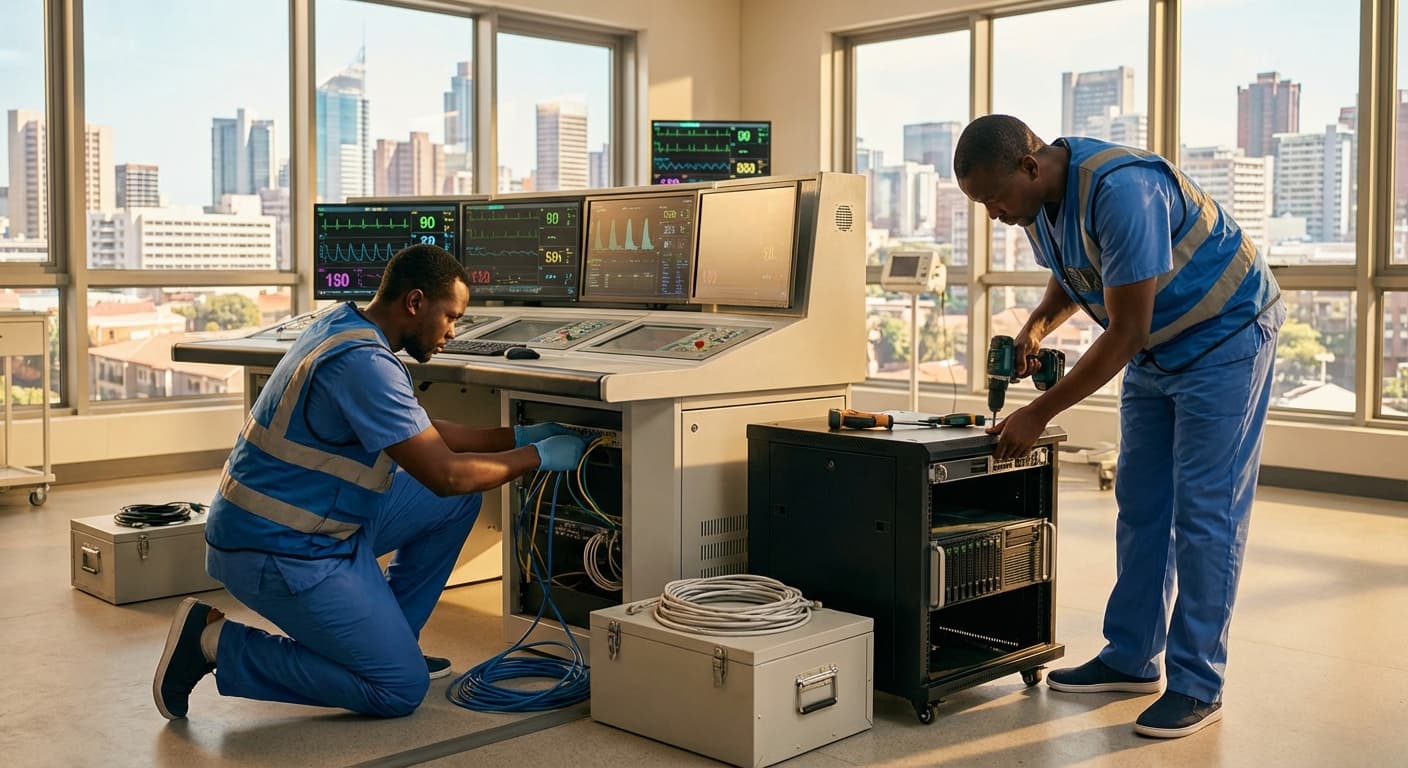
ICU Central Monitoring Station Installation Service in Egypt
Engineering Excellence & Technical Support
ICU Central Monitoring Station Installation Service High-standard technical execution following OEM protocols and local regulatory frameworks.
Seamless Network Integration & Configuration
Our expert technicians ensure robust, secure, and high-bandwidth network infrastructure specifically designed for critical ICU data transmission. We meticulously configure routers, switches, and firewalls to guarantee uninterrupted data flow and minimal latency for your real-time patient monitoring needs.
High-Availability & Redundant Systems Design
We implement advanced redundancy solutions for power, data, and communication pathways, ensuring continuous operation even in the event of hardware failures or utility outages. This critical feature guarantees that your ICU monitoring remains operational 24/7, safeguarding patient lives.
HIPAA & Local Regulatory Compliance Assurance
Our installation services adhere strictly to HIPAA standards and all relevant Egyptian healthcare regulations for data privacy and security. We provide comprehensive documentation and system configurations that meet and exceed compliance requirements, giving you peace of mind.
What Is Icu Central Monitoring Station Installation Service In Egypt?
ICU Central Monitoring Station Installation Service in Egypt refers to the comprehensive process of establishing and configuring a centralized system for real-time patient monitoring within an Intensive Care Unit (ICU) setting. This service encompasses the installation, integration, and calibration of specialized hardware and software designed to collect, display, and analyze vital patient data from multiple bedside monitoring devices. The objective is to provide clinicians with a unified, accessible platform for continuous observation, trend analysis, and timely intervention, thereby enhancing patient safety and optimizing clinical decision-making in critical care environments. This service is crucial for modern ICUs aiming to achieve higher standards of patient care through advanced technological integration and efficient data management.
| Beneficiary Group | Primary Need | Typical Use Cases |
|---|---|---|
| Hospitals and Healthcare Facilities in Egypt | To establish a robust and integrated patient monitoring infrastructure within their ICUs. | Real-time continuous surveillance of multiple critically ill patients from a single location. Early detection of patient deterioration through advanced alarm systems and trend analysis. Improved workflow efficiency for nursing staff by reducing the need for constant bedside rounds for routine checks. Facilitation of multidisciplinary team communication and collaborative care. Enhanced data for clinical research and quality improvement initiatives. Compliance with international standards for critical care patient monitoring. |
| ICU Departments | To improve patient safety, optimize clinical response times, and enhance the overall quality of critical care delivery. | Monitoring of hemodynamics (e.g., ECG, invasive/non-invasive blood pressure, SpO2, EtCO2). Respiratory monitoring (e.g., ventilator parameters, oxygen saturation). Neurological monitoring (e.g., ICP, EEG). Continuous assessment of multiple physiological parameters for early warning scores. Centralized management of patient alarms, reducing alarm fatigue while ensuring critical alerts are addressed promptly. |
| Medical Equipment Vendors and Integrators | To provide a complete and functional solution that meets the specific demands of Egyptian healthcare institutions. | Implementation of new ICU facilities. Upgrading existing ICU monitoring systems. Integration of disparate monitoring devices into a cohesive network. Offering bundled solutions that include hardware, software, installation, and ongoing support. |
Key Components and Stages of ICU Central Monitoring Station Installation Service
- System Design and Planning: Site assessment, network infrastructure evaluation, hardware/software selection based on ICU requirements and budget, and development of a detailed installation plan.
- Hardware Installation: Physical setup of central workstations, servers, network switches, cabling, and integration of bedside monitors with the central station via wired or wireless protocols.
- Software Configuration and Integration: Installation and configuration of the central monitoring software, including patient data management systems (PDMS), alarm management modules, and historical data archiving solutions. Integration with existing hospital information systems (HIS) and electronic health records (EHRs) is often a critical component.
- Network Setup and Security: Establishment of a secure and reliable network for data transmission, ensuring compliance with healthcare data privacy regulations (e.g., HIPAA equivalent). This includes IP addressing, firewall configuration, and access control.
- Calibration and Testing: Thorough testing of all installed components to ensure accurate data acquisition, transmission, and display. Calibration of alarms, vital sign readings, and data integrity checks.
- User Training and Support: Comprehensive training for clinical staff (physicians, nurses, technicians) on the operation, utilization, and troubleshooting of the central monitoring system. Provision of ongoing technical support and maintenance agreements.
- Documentation and Handover: Provision of detailed system documentation, including network diagrams, configuration settings, user manuals, and maintenance procedures, followed by formal system handover.
Who Needs Icu Central Monitoring Station Installation Service In Egypt?
ICU Central Monitoring Station installation services in Egypt are crucial for ensuring the highest level of patient care in critical environments. These systems are designed to consolidate vital signs data from multiple bedside monitors into a central hub, allowing a dedicated team to continuously observe, analyze, and respond to patient conditions with unparalleled efficiency. This advanced setup is indispensable for institutions prioritizing patient safety, early intervention, and optimized resource allocation within their Intensive Care Units.
| Department/Unit | Primary Need for Central Monitoring | Key Benefits |
|---|---|---|
| Intensive Care Unit (ICU) | Continuous, real-time monitoring of multiple critical patients, immediate alert for deteriorating conditions, efficient nurse-to-patient ratio management. | Improved patient outcomes, reduced response times to emergencies, enhanced staff efficiency, better data for clinical decision-making. |
| Coronary Care Unit (CCU) | Close observation of cardiac patients, detection of arrhythmias and hemodynamic changes, rapid intervention in cardiac emergencies. | Prevention of cardiac events, timely treatment of critical cardiac conditions, specialized cardiac patient management. |
| High Dependency Unit (HDU) / Step-Down Unit | Proactive monitoring for patients transitioning from ICU, early detection of potential complications before they become critical. | Smoother patient recovery, reduced risk of re-admission to ICU, optimized bed utilization. |
| Emergency Department (ED) - Resuscitation Bays | Monitoring of critically ill or injured patients awaiting transfer to ICU or definitive treatment, immediate data access for rapid assessment. | Expedited critical care, improved patient triage and management in high-stress situations. |
| Neonatal Intensive Care Unit (NICU) | Precise monitoring of premature infants and newborns with critical conditions, detection of subtle physiological changes. | Enhanced survival rates for vulnerable neonates, precise management of infant vital functions. |
| Post-Anesthesia Care Unit (PACU) / Recovery Room | Monitoring of patients immediately after surgery for vital sign stability, pain management, and recovery from anesthesia. | Safe emergence from anesthesia, early identification of post-operative complications, efficient patient flow. |
Target Customers for ICU Central Monitoring Station Installation in Egypt
- Government Hospitals: National and regional government-run hospitals that serve a large patient population and are committed to providing advanced medical care.
- Private Hospitals & Healthcare Groups: Leading private medical facilities and hospital chains aiming to offer premium critical care services and maintain a competitive edge.
- Teaching Hospitals & Medical Universities: Institutions focused on medical education and research, requiring state-of-the-art technology for training future clinicians and conducting advanced studies.
- Specialized Medical Centers: Facilities dedicated to specific critical care specialties such as cardiac surgery, neurosurgery, or trauma care, where continuous monitoring is paramount.
- Developing Healthcare Infrastructure Projects: New hospital constructions or major expansion projects that are incorporating advanced technology from the outset to meet international standards.
Icu Central Monitoring Station Installation Service Process In Egypt
This document outlines the comprehensive workflow for the ICU Central Monitoring Station Installation Service Process in Egypt, from the initial client inquiry to the final execution and handover. It details each stage, responsibilities, and key activities involved in ensuring a successful and efficient installation.
| Phase | Stage Name | Key Activities | Responsible Parties | Deliverables/Outcomes | Estimated Timeline (Varies) |
|---|---|---|---|---|---|
| 1 | Inquiry & Pre-Assessment | Client contacts service provider with requirements. Initial discussion to understand scope, needs, and hospital infrastructure. Gather preliminary information about the ICU size, number of beds, existing systems, and budget. | Client (Hospital Administration/IT/Biomedical Dept.), Service Provider (Sales/Technical Team) | Understanding of project scope, initial feasibility assessment, identification of key stakeholders. | 1-3 Business Days |
| 2 | Site Survey & Design | On-site visit by technical engineers to assess the ICU environment. Detailed assessment of network infrastructure (cabling, Wi-Fi), power supply, physical space, and existing medical equipment. Development of a detailed technical design, including network topology, hardware placement, and software configuration plan. This phase may involve collaboration with hospital IT and biomedical departments. | Service Provider (Field Engineers, Network Specialists, Project Manager), Client (IT Dept., Biomedical Dept.) | Detailed site assessment report, comprehensive system design document, Bill of Materials (BOM). | 3-7 Business Days |
| 3 | Quotation & Contract | Based on the site survey and design, a detailed quotation is prepared, outlining all equipment, labor, installation fees, and any applicable taxes. Negotiation of terms and conditions. Finalization and signing of the service contract and Service Level Agreement (SLA). | Service Provider (Sales Department, Legal Department), Client (Procurement Department, Administration) | Formal quotation, signed contract, payment schedule. | 5-10 Business Days |
| 4 | Procurement & Logistics | Ordering of all necessary hardware (servers, workstations, network devices, cables, etc.) and software licenses. Coordination of delivery to the client's site in Egypt. Management of customs clearance and logistics. | Service Provider (Procurement Department, Logistics Team) | All required equipment and software delivered to the site. | 2-6 Weeks (depending on equipment availability and lead times) |
| 5 | Installation & Configuration | On-site installation of hardware (servers, workstations, network switches). Installation and configuration of the central monitoring software. Network cabling and integration with existing patient monitors (if applicable). Setting up user accounts and access controls. Basic system configuration. | Service Provider (Installation Engineers, Network Engineers, Software Specialists), Client (Biomedical Dept. for equipment integration) | Installed hardware and software, basic network connectivity established. | 1-3 Weeks |
| 6 | Testing & Commissioning | Thorough testing of all system functionalities. Simulated patient scenarios to verify data acquisition, display, and alarm management. Integration testing with other hospital systems (e.g., EMR). Performance testing and optimization. Final system validation against the design specifications. | Service Provider (Testing Engineers, Project Manager), Client (Biomedical Dept., Nursing Staff) | Test reports, system validation report, functional and performance verification. | 1-2 Weeks |
| 7 | Training & Handover | Comprehensive training for hospital staff (nurses, physicians, biomedical engineers) on the operation, maintenance, and troubleshooting of the central monitoring system. Provision of user manuals and technical documentation. Formal handover of the system to the client. | Service Provider (Training Specialists, Project Manager), Client (End-users, Biomedical Dept.) | Trained personnel, comprehensive documentation, signed handover certificate. | 3-5 Business Days |
| 8 | Post-Installation Support | Provision of ongoing technical support as per the SLA. Remote monitoring of system performance. Software updates and patches. On-site or remote troubleshooting of any issues. Scheduled maintenance visits (if applicable). | Service Provider (Support Team, Technical Specialists), Client (Biomedical Dept.) | System stability and optimal performance, resolution of reported issues, ongoing system maintenance. | Ongoing (as per SLA) |
ICU Central Monitoring Station Installation Service Workflow
- Phase 1: Inquiry & Pre-Assessment
- Phase 2: Site Survey & Design
- Phase 3: Quotation & Contract
- Phase 4: Procurement & Logistics
- Phase 5: Installation & Configuration
- Phase 6: Testing & Commissioning
- Phase 7: Training & Handover
- Phase 8: Post-Installation Support
Icu Central Monitoring Station Installation Service Cost In Egypt
The cost of installing an ICU Central Monitoring Station (CMS) in Egypt can vary significantly based on several factors. These include the scale and complexity of the ICU, the specific features and capabilities of the chosen CMS hardware and software, the vendor selected, the extent of integration with existing hospital systems, and the required level of customization. Factors like the number of patient beds to be monitored, the type of monitoring equipment (e.g., standard vital signs vs. advanced hemodynamic monitoring), the need for remote access and data archiving, and the training provided to hospital staff all contribute to the overall price. Installation and commissioning services by specialized technicians, often involving site surveys, network configuration, system testing, and user training, are also a significant component of the cost. Ongoing maintenance and support contracts further add to the long-term investment.
| Service Component | Estimated Cost Range (EGP) |
|---|---|
| Basic CMS Hardware (per bed module) | 30,000 - 75,000 EGP |
| Central Monitoring Station Console (Display, CPU, Software) | 150,000 - 400,000 EGP |
| Installation & Commissioning Services | 50,000 - 150,000 EGP |
| Software Licensing (if separate from hardware) | 20,000 - 100,000 EGP (initial/annual) |
| Integration with EMR/HIS | 30,000 - 120,000 EGP |
| User Training (per session/group) | 10,000 - 30,000 EGP |
| Annual Maintenance & Support Contract | 10% - 20% of initial system cost |
Key Pricing Factors for ICU Central Monitoring Station Installation in Egypt:
- Number of monitored patient beds
- Complexity and features of the CMS hardware (e.g., display size, processing power, connectivity options)
- Software capabilities (e.g., data analysis, trend reporting, alarm management, EMR integration)
- Brand and vendor reputation/tier
- Level of integration with existing hospital IT infrastructure (e.g., HIS, EMR)
- Need for advanced features (e.g., wireless monitoring, telemetry integration)
- Site survey and preparation requirements
- Installation and commissioning labor costs
- Technical support and maintenance contracts
- On-site user training for medical and IT staff
- Warranty period for hardware and software
Affordable Icu Central Monitoring Station Installation Service Options
Installing an Intensive Care Unit (ICU) Central Monitoring Station (CMS) is a critical investment for any healthcare facility. This system allows for real-time observation of vital patient data from multiple beds, enabling faster response to critical events and improved patient outcomes. While the initial cost can seem substantial, various affordable installation service options, value bundles, and cost-saving strategies can make this essential technology more accessible.
| Strategy | Description | Potential Cost Savings | Considerations |
|---|---|---|---|
| Refurbished Equipment | Purchasing certified pre-owned bedside monitors and central station components. | 20-40% on hardware | Ensure warranty, certification, and compatibility. Best for non-critical redundancy or initial deployment. |
| Phased Installation | Implementing the CMS in stages across different ICU zones or over an extended period. | Spreads upfront capital expenditure, allows for budget planning | Requires careful planning for interim functionality and phased training. |
| Bundled Services & Equipment | Purchasing installation, hardware, software, and training as a package deal. | 5-15% on combined services/equipment | Ensure the bundle meets all specific facility needs; compare with à la carte pricing. |
| Leveraging Internal Resources | Utilizing in-house IT and biomedical engineering teams for installation tasks. | Significant reduction in labor costs | Requires skilled personnel, proper project management, and clear scope of work. |
| Leasing Equipment | Acquiring the CMS hardware through a leasing agreement instead of outright purchase. | Lower upfront capital, predictable operational expense | Total cost over the lease term might be higher than purchase; understand lease end options. |
| Network Infrastructure Audit | Thoroughly assessing existing network cabling and hardware before upgrades. | Avoids unnecessary expenses on new cabling or network switches | Requires accurate network documentation and a qualified network engineer. |
Affordable ICU Central Monitoring Station Installation Service Options & Strategies
- Understanding ICU CMS Components: A CMS typically includes bedside monitors, a central workstation (server and display), network infrastructure, and software for data aggregation and analysis.
- Service Models to Consider:
- Turnkey Installation: Comprehensive service including consultation, design, equipment sourcing, installation, configuration, testing, and training. Often the most expensive but ensures a seamless process.
- Phased Installation: Breaking down the installation into manageable stages, allowing for budget allocation over time. This can be particularly useful for older facilities undergoing renovations.
- Partial Installation/Integration: Utilizing existing compatible equipment and integrating new components with the existing infrastructure. This can significantly reduce hardware costs.
- Consultation & Design Only: For facilities with in-house IT and biomedical engineering teams, a service provider can offer expertise in system design and planning, allowing the internal team to handle the physical installation.
- Value Bundles Explained:
- Value bundles are packages offered by service providers that combine multiple services and/or equipment at a discounted rate compared to purchasing each component individually. These often include:
- Hardware & Software Bundles: Pre-selected compatible bedside monitors, central station, and necessary software licenses.
- Installation & Training Packages: Bundling the physical installation with comprehensive user and administrator training.
- Maintenance & Support Contracts: Offering discounted ongoing maintenance and technical support when bundled with the initial installation.
- Customizable Bundles: Many providers allow you to tailor bundles to your specific needs and budget, selecting the components and services most relevant to your facility.
- Cost-Saving Strategies:
- Equipment Sourcing:
* **Refurbished Equipment:** Opting for certified refurbished bedside monitors and central station components can offer significant savings without compromising quality, especially for non-critical functions or as backups.* **Negotiate Bulk Discounts:** If purchasing multiple units, negotiate volume discounts with vendors.* **Explore Open-Source Software Options:** Investigate if any open-source or more affordable, yet compliant, software solutions can integrate with your hardware.- Installation Planning:
* **Optimize Network Infrastructure:** Reusing existing, well-maintained network cabling and infrastructure where possible. Conduct a thorough audit to avoid unnecessary upgrades.* **Phased Rollout:** Implement the CMS in stages, perhaps one unit at a time or by section of the ICU, spreading the cost and allowing for incremental training.* **Leverage Internal Resources:** If your facility has competent IT and biomedical engineering staff, involve them in the installation process to reduce reliance on external technicians.- Financing & Grants:
* **Leasing Options:** Explore equipment leasing programs which can offer lower upfront costs and predictable monthly payments.* **Government Grants & Subsidies:** Research available healthcare technology grants or subsidies from government bodies or non-profit organizations.* **Flexible Payment Plans:** Negotiate extended payment terms with the installation service provider.- Long-Term Considerations:
* **Scalability:** Choose a system that can be easily scaled up as your ICU grows, avoiding costly replacements later.* **Interoperability:** Ensure the CMS can integrate with your existing Electronic Health Record (EHR) system to streamline data flow and reduce manual entry.* **Energy Efficiency:** Consider energy-efficient monitors and workstations to reduce long-term operational costs.
Verified Providers In Egypt
In the dynamic landscape of healthcare, ensuring access to trusted and competent medical services is paramount. In Egypt, as across the globe, the verification of healthcare providers plays a crucial role in patient safety and overall well-being. This document outlines the significance of verified providers and specifically highlights the credentials of Franance Health, positioning them as a premier choice for healthcare solutions in Egypt.
| Franance Health Credentials | Significance for Patients in Egypt |
|---|---|
| Accreditation by Reputable Health Organizations | Demonstrates adherence to international quality and safety standards, assuring patients of high-level care. |
| Certified Medical Professionals | Ensures doctors, nurses, and specialists possess the necessary licenses, education, and ongoing training to provide expert medical services. |
| Stringent Quality Assurance Protocols | Indicates a commitment to maintaining consistently high standards in all aspects of healthcare delivery, from diagnosis to treatment and patient follow-up. |
| Focus on Patient-Centric Care | Highlights a dedication to understanding and meeting individual patient needs, fostering a positive and supportive healthcare experience. |
| Advanced Technological Integration | Suggests access to modern medical equipment and innovative treatment methods, potentially leading to more accurate diagnoses and effective therapies. |
| Transparent and Ethical Practices | Guarantees that patients will receive clear communication, informed consent, and fair treatment throughout their healthcare journey. |
Why Verified Providers Matter in Egypt
- Patient Safety: Verification processes rigorously assess qualifications, licensing, and adherence to ethical standards, minimizing risks to patients.
- Quality of Care: Verified providers typically demonstrate a commitment to continuous improvement and employ evidence-based practices, leading to better health outcomes.
- Trust and Confidence: Knowing a provider has undergone a thorough vetting process instills confidence and reduces anxiety for individuals seeking medical assistance.
- Regulatory Compliance: Verification ensures providers meet national and international healthcare regulations, protecting both patients and the healthcare system.
- Access to Reliable Information: Verified provider directories offer a reliable source for individuals to find qualified professionals and facilities.
Scope Of Work For Icu Central Monitoring Station Installation Service
This Scope of Work (SOW) outlines the requirements for the installation of an Intensive Care Unit (ICU) Central Monitoring Station (CMS) service. The service includes the complete installation, configuration, testing, and commissioning of the CMS hardware and software, ensuring seamless integration with existing and future ICU monitoring devices. The objective is to provide a robust and reliable central surveillance system for critical patient data, enabling enhanced clinical decision-making and improved patient care.
| Technical Deliverable | Description | Standard Specifications/Requirements | Verification Method |
|---|---|---|---|
| Central Monitoring Workstation(s) | Dedicated computer(s) for viewing and managing patient data from the CMS. | High-performance CPUs, ample RAM (min. 16GB), SSD storage (min. 512GB), dual high-resolution displays (min. 24-inch each), medical-grade keyboard and mouse, UPS backup. | Visual inspection, system configuration check, performance benchmarks. |
| Central Monitoring Server | The core server managing data aggregation, storage, and distribution for the CMS. | Redundant power supplies, enterprise-grade storage (RAID configuration), robust network interface cards (min. 1Gbps), adequate processing power, and RAM for concurrent data streams. Operates on a secure, HIPAA-compliant operating system. | Hardware inspection, RAID configuration verification, network throughput testing, OS security audit. |
| Network Infrastructure | Installation and configuration of network cabling and switches to support data flow from bedside monitors to the CMS. | High-speed, reliable network cabling (e.g., Cat6a or higher), managed network switches with Quality of Service (QoS) capabilities, secure network segmentation (VLANs), adherence to hospital IT security policies. | Cable testing (e.g., Fluke testing), switch configuration review, network traffic analysis, security policy compliance check. |
| CMS Software Suite | Installation and configuration of the software for data acquisition, display, alarm management, and reporting. | Latest stable version of the vendor-specified CMS software, licensed appropriately. Configured with user roles, alarm parameters, patient demographics, and data retention policies as per hospital requirements. | Software installation verification, functional testing of all modules, user role validation, alarm simulation. |
| Bedside Monitor Integration Modules | Software or hardware modules to interface bedside monitoring devices with the CMS. | Compatibility with all current and planned ICU bedside monitors. Secure, reliable data transfer protocols (e.g., HL7, DICOM, proprietary vendor protocols). | Device compatibility verification, data transfer protocol testing, data integrity checks. |
| Alarm Management System | Configuration of the alarm system for critical patient parameters. | Configurable alarm thresholds, audible and visual alarm notifications, prioritization of alarms, integration with existing hospital notification systems (if applicable). | Alarm simulation testing for all critical parameters, verification of notification delivery, alarm log review. |
| Data Archiving and Retrieval | Setup of the system for long-term storage and retrieval of patient monitoring data. | Sufficient storage capacity for at least 7 years of data (or as per regulatory requirements), automated backup procedures, robust data retrieval functionality. | Storage capacity verification, backup schedule testing, data retrieval performance testing. |
| System Documentation | Comprehensive documentation of the installed CMS. | Installation guides, configuration manuals, user manuals, troubleshooting guides, network diagrams, and as-built drawings. | Review and approval of all documentation by hospital IT and clinical engineering. |
| User Training Materials | Development and delivery of training materials for end-users. | Role-based training modules covering system operation, alarm management, data review, and basic troubleshooting. Available in both digital and print formats. | Review of training materials, assessment of user comprehension post-training. |
Key Stages of the Installation Service
- Project Planning and Design
- Site Preparation and Infrastructure Setup
- Hardware Installation and Cabling
- Software Installation and Configuration
- Integration with Existing Devices
- System Testing and Validation
- User Training and Handover
- Post-Installation Support
Service Level Agreement For Icu Central Monitoring Station Installation Service
This Service Level Agreement (SLA) outlines the response times and uptime guarantees for the installation of the ICU Central Monitoring Station service. This SLA is an addendum to the primary service contract between [Your Company Name] and [Client Name].
| Service Component | Response Time Target | Uptime Guarantee | Notes/Exclusions |
|---|---|---|---|
| Full CMS Installation & Commissioning | Within [e.g., 2] business days of project commencement. | N/A (Initial installation is a project-based deliverable) | Applies to the initial agreed-upon installation timeline. Delays due to site readiness or client-provided resources are not included. |
| Post-Installation Critical Incident (within first [e.g., 30] days) | Within [e.g., 4] hours of confirmed critical incident report. | 99.5% uptime during the warranty period. | Excludes scheduled maintenance, planned upgrades, and issues caused by third-party equipment not part of the original installation. |
| Routine System Checks & Calibration (scheduled) | As per agreed-upon schedule (e.g., monthly, quarterly). | N/A (Scheduled maintenance is planned downtime) | Client will be notified at least [e.g., 48] hours in advance of scheduled maintenance. |
| Software Updates & Patches (scheduled) | As per [Your Company Name]'s release schedule and client agreement. | N/A (Planned downtime) | Client will be notified of upcoming updates and potential downtime. |
Key Definitions
- Installation Service: Refers to the complete process of setting up, configuring, testing, and commissioning the ICU Central Monitoring Station, including hardware, software, and network integration.
- Central Monitoring Station (CMS): The dedicated facility or system responsible for receiving, processing, and displaying patient vital sign data from multiple ICU beds.
- Critical Incident: An event that renders the CMS inoperable or significantly impairs its core functionality, preventing real-time monitoring of patient data.
- Service Hours: [Specify the operational hours for support, e.g., 24/7/365, Business Hours (9 AM - 5 PM, Mon-Fri)].
- Downtime: The period during which the CMS is not operational or performing its core monitoring functions due to an incident.
- Response Time: The maximum time allowed from the reporting of an incident to the initiation of troubleshooting and support activities by [Your Company Name].
- Resolution Time: The maximum time allowed to resolve an incident and restore the CMS to full operational status.
Frequently Asked Questions

Ready when you are
Let's scope your ICU Central Monitoring Station Installation Service in Egypt project in Egypt.

Scaling healthcare logistics and technical systems across the entire continent.