
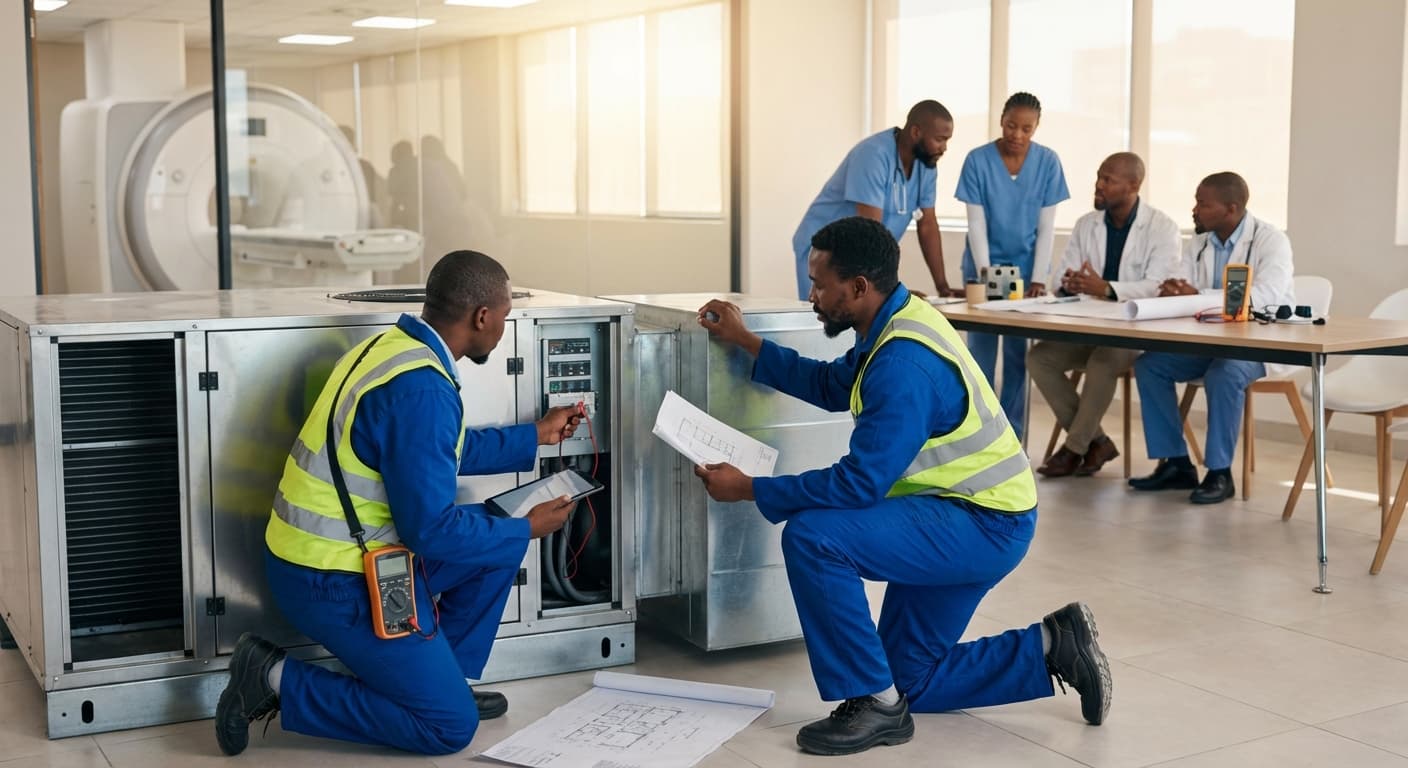
Site Readiness Assessment Service (Space/Access/HVAC/Power/Shielding) in Egypt
Engineering Excellence & Technical Support
Site Readiness Assessment Service (Space/Access/HVAC/Power/Shielding) High-standard technical execution following OEM protocols and local regulatory frameworks.
Optimized Site Selection for Satellite Ground Stations in Egypt
Our comprehensive Site Readiness Assessment meticulously evaluates electromagnetic interference (EMI) levels, optimal line-of-sight to geostationary satellites, and robust power/cooling infrastructure to ensure the highest performance and reliability for your satellite ground station operations across Egypt's diverse geographical landscape.
Secure & Scalable Data Center Infrastructure Planning in Egypt's Emerging Tech Hubs
Leveraging our expertise in power grid stability, advanced HVAC solutions, and stringent shielding protocols (including seismic and electromagnetic), we provide a detailed Site Readiness Assessment to de-risk the deployment of your high-density data centers, guaranteeing operational continuity and future scalability in Egypt's rapidly growing technology sectors.
Advanced Facility Assessment for Industrial & Logistics Expansion in Egypt
We deliver a critical Site Readiness Assessment that precisely gauges access routes for heavy transport, available industrial-grade power capacity, HVAC suitability for sensitive equipment, and robust shielding requirements (e.g., for cleanrooms or secure storage), empowering your industrial and logistics ventures to thrive in Egypt's strategic economic zones.
What Is Site Readiness Assessment Service (Space/access/hvac/power/shielding) In Egypt?
The Site Readiness Assessment Service (Space/Access/HVAC/Power/Shielding) in Egypt is a comprehensive technical evaluation conducted to determine the suitability and compliance of a proposed or existing physical location for the installation and operation of critical infrastructure, such as data centers, telecommunications hubs, industrial facilities, or specialized research environments. This service quantifies the infrastructure's capacity and condition against predefined project requirements and relevant Egyptian national and international standards. It focuses on key physical and environmental parameters crucial for the reliable and efficient functioning of the intended equipment and systems.
| Who Needs This Service? | Typical Use Cases | |||||||
|---|---|---|---|---|---|---|---|---|
| Telecommunications Providers: For new cell tower sites, data center build-outs, and network expansion projects. | Data Center Operators: Evaluating new colocation facilities, expanding existing ones, or assessing disaster recovery sites. | Cloud Service Providers: Identifying and preparing locations for server farms and network infrastructure. | Financial Institutions: Securing and ensuring the reliability of trading floors, data processing centers, and critical IT infrastructure. | Government Agencies: For national security infrastructure, communication networks, and data repositories. | Industrial Manufacturers: Assessing factory floor readiness for new automated machinery or control systems. | Research and Development Institutions: Preparing laboratories and testing facilities requiring specialized environmental controls and shielding. | Enterprises with Significant IT Footprints: Planning for upgrades, consolidations, or the implementation of new technologies requiring dedicated space and robust infrastructure. | Real Estate Developers: Assessing the suitability of properties for leasing to tenants requiring specialized infrastructure. |
| Deployment of new server racks and network equipment. | Establishing new telecommunication base stations or upgrading existing ones. | Building or expanding data center facilities (colocation, enterprise, hyperscale). | Implementing mission-critical IT systems with stringent uptime requirements. | Setting up specialized laboratory environments requiring precise environmental control. | Deploying sensitive electronic equipment susceptible to EMI/RFI. | Assessing the feasibility of retrofitting existing buildings for high-density IT loads. | Planning for business continuity and disaster recovery sites. | Ensuring compliance with Egyptian building codes, electrical safety standards, and environmental regulations. |
Key Components of the Site Readiness Assessment Service:
- Space Assessment: Evaluating available physical dimensions, floor loading capacity, ceiling height, and layout configurations to ensure sufficient room for equipment, cabling, cooling infrastructure, and personnel access. This includes assessing expansion potential.
- Access Assessment: Determining the feasibility of transporting equipment and materials to and within the site. This involves evaluating entry points, pathway clearances (including vertical and horizontal), elevator capacity, and security protocols.
- HVAC (Heating, Ventilation, and Air Conditioning) Assessment: Analyzing the existing or planned HVAC system's capacity, redundancy, and control mechanisms to maintain optimal temperature and humidity levels required for equipment longevity and performance. This includes evaluating air filtration and airflow management.
- Power Assessment: Verifying the availability, capacity, and quality of electrical power. This involves assessing the main power feed, existing electrical infrastructure (substations, transformers, distribution panels), UPS (Uninterruptible Power Supply) capabilities, generator capacity and fuel reserves, and grounding systems. Compliance with Egyptian Electricity Holding Company (EEHC) regulations is paramount.
- Shielding Assessment: Evaluating the site's susceptibility to or generation of electromagnetic interference (EMI) and radio frequency interference (RFI). This may involve assessing the need for and feasibility of RF shielding, acoustic shielding, or other protective measures to ensure signal integrity and equipment protection.
Who Needs Site Readiness Assessment Service (Space/access/hvac/power/shielding) In Egypt?
Site readiness assessment is a critical step for any organization planning to establish or upgrade its infrastructure in Egypt, particularly for facilities with demanding technical requirements. This service ensures that a proposed location can adequately support the necessary equipment and operations, minimizing risks and maximizing efficiency. Key areas of assessment include ensuring sufficient physical space, unobstructed access for equipment and personnel, reliable and appropriately scaled HVAC systems for environmental control, robust and scalable power infrastructure, and effective electromagnetic shielding where required. The Egyptian market presents unique opportunities and challenges, making a thorough site readiness assessment indispensable for successful project implementation.
| Industry Sector | Target Customers (Examples) | Relevant Departments | Specific Needs (Space/Access/HVAC/Power/Shielding) |
|---|---|---|---|
| Information Technology & Telecommunications | Cloud Service Providers, Telecom Operators, Enterprise IT Departments | IT Operations, Network Engineering, Facilities Management, Security | Large server room space, secure access, precise climate control (HVAC), high-density power, EMI/RFI shielding for sensitive equipment. |
| Manufacturing & Industrial | Automotive, Electronics, Pharmaceuticals, Advanced Materials Manufacturers | Operations, Engineering, Production, Facilities Management, Quality Control | Adequate floor space for machinery, robust access for heavy equipment, industrial-grade HVAC, significant power capacity, potentially specialized shielding for precision manufacturing. |
| Healthcare | Hospitals, Diagnostic Centers, Medical Research Facilities | Radiology, Biomedical Engineering, IT, Facilities Management, Patient Services | Dedicated space for imaging machines (MRI, CT), cleanroom HVAC, stable and redundant power, radiation and EMI shielding for patient safety and equipment accuracy. |
| Research & Development / Education | Universities, Research Institutes, Corporate R&D Labs | Lab Management, Facilities Engineering, IT, Principal Investigators, Department Heads | Specialized lab space, secure access to sensitive equipment, precise environmental control (HVAC), variable power needs, electromagnetic shielding for sensitive experiments. |
| Finance & Security | Banks, Financial Institutions, Data Security Companies | IT Infrastructure, Security Operations, Facilities Management, Compliance | Secure, climate-controlled server rooms, stringent access control, reliable power, potential EMP shielding for critical data centers. |
| Government & Defense | Ministry of Communications, Ministry of Defense, National Projects | Infrastructure Development, IT Departments, Project Management Offices, Security Agencies | Large-scale secure facilities, specialized access protocols, robust HVAC for extended operations, high-capacity power, comprehensive shielding for sensitive communications and defense systems. |
Target Customers and Departments for Site Readiness Assessment in Egypt
- Companies establishing new data centers or expanding existing ones.
- Organizations deploying advanced manufacturing or R&D facilities.
- Telecommunications providers building new network hubs or upgrading infrastructure.
- Healthcare institutions installing sensitive medical imaging and treatment equipment.
- Government agencies with critical national infrastructure projects.
- Research institutions and universities requiring specialized laboratory environments.
- Companies involved in high-tech manufacturing or assembly.
- Financial institutions with secure server room requirements.
- Defense and aerospace contractors needing specialized facilities.
Site Readiness Assessment Service (Space/access/hvac/power/shielding) Process In Egypt
This document outlines the typical workflow for a Site Readiness Assessment Service focusing on Space, Access, HVAC, Power, and Shielding within Egypt. This service is crucial for businesses planning to establish or expand operations that require specific infrastructure, such as data centers, manufacturing facilities, or sensitive research labs. The process is designed to be comprehensive and iterative, ensuring all critical aspects of the site are evaluated against project requirements.
| Phase | Stage | Key Activities | Deliverables | Key Stakeholders | Duration (Estimated) |
|---|---|---|---|---|---|
| Phase 1: Inquiry & Scoping | Initial Contact & Requirements Gathering | Client submits an inquiry detailing their project needs and intended site(s) in Egypt. Discussion to understand specific requirements for Space (size, layout), Access (physical, network), HVAC (capacity, redundancy), Power (capacity, reliability, UPS, generator needs), and Shielding (EMI, RF, radiation). Potential site visits for preliminary overview. | Project Scope Document, Initial Requirements Matrix. | Client (Project Manager, Technical Leads), Service Provider (Business Development Manager, Lead Assessor). | 1-3 Business Days |
| Phase 1: Inquiry & Scoping | Proposal Development & Agreement | Service provider develops a detailed proposal outlining the assessment methodology, scope, timeline, and costs. Contract negotiation and signing. | Formal Proposal, Service Agreement. | Client (Procurement, Legal), Service Provider (Sales, Legal). | 3-7 Business Days |
| Phase 2: Initial Assessment & Data Collection | Site Survey & Data Gathering | On-site visit(s) to the proposed location(s) in Egypt. Physical inspection of available space, access points, existing HVAC and power infrastructure. Collection of architectural drawings, utility bills, equipment specifications, and any relevant permits or existing reports. Interviews with building management or facilities staff. | Site Survey Report (initial findings), Raw Data Collection Logs (photos, measurements, utility data). | Client (Facilities Manager, Technical Staff), Service Provider (Assessors - Space, HVAC, Power, Shielding Specialists), Building Management. | 5-15 Business Days (depending on site complexity and number of locations) |
| Phase 2: Initial Assessment & Data Collection | Documentation Review | Thorough review of all collected documents, including architectural plans, electrical schematics, HVAC system details, and any existing environmental reports. Cross-referencing with client's specific requirements. | Annotated Documents, Initial Gap Analysis (preliminary). | Client (Technical Staff), Service Provider (Assessors). | 3-7 Business Days |
| Phase 3: Detailed Analysis & Reporting | Technical Analysis | In-depth analysis of each readiness area: Space (layout efficiency, expansion potential), Access (physical security, ingress/egress), HVAC (capacity calculations, redundancy, environmental control), Power (load calculations, availability, quality, UPS/generator feasibility), Shielding (assessment of environmental interference and mitigation needs). Modeling and simulation where required. | Detailed Technical Assessment Reports (for each discipline: Space, HVAC, Power, Shielding). | Service Provider (Assessors). | 7-20 Business Days (depending on complexity and analysis depth) |
| Phase 3: Detailed Analysis & Reporting | Consolidated Reporting & Recommendations | Compilation of all detailed technical reports into a comprehensive Site Readiness Assessment Report. Identification of any gaps, risks, and non-compliance issues against client requirements. Development of specific, actionable recommendations for remediation or mitigation. | Comprehensive Site Readiness Assessment Report with Gap Analysis, Risk Assessment, and Recommendations. | Service Provider (Lead Assessor, Project Manager). | 5-10 Business Days |
| Phase 4: Remediation Planning & Execution Support | Client Review & Feedback | Presentation of the final report to the client. Discussion of findings, recommendations, and potential remediation strategies. Client provides feedback and prioritizes remediation efforts. | Meeting Minutes, Updated Recommendations (if necessary). | Client (Project Manager, Technical Leads, Management), Service Provider (Lead Assessor, Project Manager). | 2-5 Business Days |
| Phase 4: Remediation Planning & Execution Support | Remediation Plan Development | Development of a detailed remediation plan, including scope of work, estimated costs, timelines, and responsible parties for each recommended action. This may involve identifying suitable local vendors and contractors in Egypt. | Remediation Plan. | Service Provider (Lead Assessor, Project Manager), Client (Procurement, Technical Staff). | 5-10 Business Days |
| Phase 4: Remediation Planning & Execution Support | Vendor/Contractor Engagement Support (Optional) | Assistance in identifying, evaluating, and engaging local Egyptian vendors or contractors for remediation work. This can include reviewing bids and providing technical oversight during the execution phase. | Vendor Shortlist, Bid Analysis, Technical Oversight Reports (during execution). | Service Provider (Project Manager, Technical Specialists), Client (Procurement, Project Team), Local Vendors/Contractors. | Ongoing, as per remediation timeline |
| Phase 5: Final Verification & Sign-off | Verification of Remediation | Post-remediation site visit(s) to verify that all identified issues have been addressed according to the remediation plan and to the satisfaction of the client. | Verification Report. | Service Provider (Assessors). | 3-7 Business Days |
| Phase 5: Final Verification & Sign-off | Final Sign-off & Project Closure | Final confirmation from the client that the site meets readiness requirements based on the assessment and subsequent remediation. Formal project closure and handover of all documentation. | Final Site Readiness Certificate/Sign-off Document, Project Closure Report. | Client (Project Manager, Management), Service Provider (Project Manager). | 1-2 Business Days |
Site Readiness Assessment Service Workflow (Egypt)
- Phase 1: Inquiry & Scoping
- Phase 2: Initial Assessment & Data Collection
- Phase 3: Detailed Analysis & Reporting
- Phase 4: Remediation Planning & Execution Support
- Phase 5: Final Verification & Sign-off
Site Readiness Assessment Service (Space/access/hvac/power/shielding) Cost In Egypt
Assessing site readiness for projects, particularly those involving specialized infrastructure like data centers, laboratories, or advanced manufacturing facilities, is a critical first step. This assessment typically covers key areas: Space (physical footprint and layout), Access (for equipment, personnel, and utilities), HVAC (Heating, Ventilation, and Air Conditioning), Power (availability, capacity, and distribution), and Shielding (electromagnetic, RF, or radiation shielding, depending on the application). The cost of such a service in Egypt can vary significantly based on several factors. These factors influence the complexity, duration, and expertise required for the assessment. Understanding these elements is crucial for budgeting and planning.
| Assessment Area | Typical Cost Range (EGP) | Factors Influencing Range |
|---|---|---|
| Space Assessment | 5,000 - 20,000 EGP | Site size, layout complexity, existing infrastructure audit, structural survey requirements. |
| Access Assessment | 3,000 - 15,000 EGP | Ease of entry for equipment and personnel, existing road infrastructure, loading dock availability, security considerations. |
| HVAC Assessment | 10,000 - 50,000 EGP | System complexity (e.g., precision cooling for data centers), current system condition, load calculations, energy efficiency recommendations, specialized ventilation needs. |
| Power Assessment | 15,000 - 75,000 EGP+ | Power grid capacity, existing electrical infrastructure, load requirements, redundancy needs (e.g., UPS, generators), distribution network analysis, safety compliance. |
| Shielding Assessment (EM/RF/Radiation) | 20,000 - 100,000 EGP+ | Type of shielding required (EMC, RF, radiation), required attenuation levels, site construction materials, specialized testing equipment needed, regulatory compliance. |
| Full Site Readiness Assessment (Bundle) | 50,000 - 250,000 EGP+ | Combination of all the above, project scale, provider's experience, comprehensive reporting and recommendations. |
Key Pricing Factors for Site Readiness Assessments in Egypt
- Scope and Complexity of the Project: Larger, more complex projects with unique technical requirements will naturally incur higher assessment costs. For instance, a data center requiring extensive power redundancy and precise environmental controls will be more expensive to assess than a simple office space upgrade.
- Size and Scale of the Site: The physical area of the site under assessment directly impacts the time and resources needed. Larger facilities require more extensive surveying and analysis.
- Required Expertise and Specializations: If the assessment demands highly specialized knowledge, such as advanced RF shielding design or specific industrial HVAC certifications, the cost will increase due to the rarity of such expertise.
- Number of Assessment Disciplines: The more areas that need to be thoroughly evaluated (e.g., detailed power audits, structural integrity checks for heavy equipment, comprehensive HVAC load calculations), the higher the overall cost.
- Geographic Location within Egypt: While less impactful than other factors, accessibility to remote or less developed areas might slightly influence travel and logistics costs for the assessment team.
- Urgency of the Assessment: Rush projects often come with premium pricing to compensate for expedited scheduling and resource allocation.
- Deliverables Required: The level of detail and format of the final report (e.g., basic report vs. detailed engineering plans, feasibility studies) will impact the cost.
Provider's Reputation and Experience: Established firms with a strong track record and experienced professionals typically command higher fees. - Sub-contracting: If the main provider sub-contracts specific expertise (e.g., a specialized environmental consultant), these costs will be factored in.
Affordable Site Readiness Assessment Service (Space/access/hvac/power/shielding) Options
Our Affordable Site Readiness Assessment Service provides a comprehensive evaluation of your facility's suitability for new equipment or operations. We meticulously examine critical infrastructure components including Space, Access, HVAC (Heating, Ventilation, and Air Conditioning), Power, and Shielding (if applicable). Our goal is to identify potential bottlenecks and ensure your site is optimized for performance, reliability, and safety, all while offering cost-effective solutions.
| Value Bundle Name | Included Assessments | Key Benefits | Estimated Starting Price (USD) |
|---|---|---|---|
| Essential Site Readiness | Space, Access, Basic Power | Identifies fundamental infrastructure suitability, preventing major space or access conflicts. Ensures basic power availability. | $750 |
| Performance & Reliability | Space, Access, HVAC, Power (Capacity & Stability) | Optimizes for equipment performance and uptime by ensuring adequate environmental controls and stable power. | $1,200 |
| Comprehensive Infrastructure | Space, Access, HVAC, Power (Full Scope), Basic Shielding Review | A thorough evaluation of all core infrastructure, including initial assessment of electromagnetic environments. | $1,800 |
| Advanced & Specialized | Space, Access, HVAC, Power (Redundancy & Load Balancing), Full Shielding Analysis | Designed for critical operations requiring high uptime, precise environmental control, robust power redundancy, and comprehensive interference mitigation. | $2,500+ |
Key Areas Assessed:
- Space: Adequacy of physical footprint, layout efficiency, and potential for expansion.
- Access: Ease of entry/exit for equipment, personnel, and emergency services, including loading docks and pathways.
- HVAC: Capacity, redundancy, temperature/humidity control, and air quality for optimal equipment operation and personnel comfort.
- Power: Availability, capacity, reliability, redundancy, voltage stability, and electrical panel distribution.
- Shielding: Assessment of electromagnetic interference (EMI) and radio frequency interference (RFI) shielding requirements and existing capabilities.
Verified Providers In Egypt
In the competitive landscape of healthcare services in Egypt, identifying genuinely qualified and trustworthy providers is paramount. "Verified Providers" signifies a crucial standard, ensuring that healthcare professionals and facilities meet rigorous criteria for competence, safety, and ethical practice. Franance Health stands out as a leading entity committed to upholding these verified standards. Their dedication to credentialing and stringent vetting processes makes them the premier choice for individuals seeking reliable and high-quality healthcare in Egypt. This commitment translates to patient confidence, improved health outcomes, and a more transparent healthcare ecosystem.
| Feature | Franance Health's Approach | Benefit for Patients |
|---|---|---|
| Credential Verification | In-depth review of licenses, certifications, educational background, and professional history. | Ensures providers possess the necessary expertise and are legally authorized to practice. |
| Background Checks | Thorough checks for any disciplinary actions or malpractice claims. | Guarantees a higher level of safety and reduces risk for patients. |
| Quality Assurance | Regular assessments of clinical outcomes, patient satisfaction, and adherence to best practices. | Promotes consistently high-quality care and positive patient experiences. |
| Specialty Accreditation | Verification of any specialized accreditations held by facilities or individual practitioners. | Confirms expertise in specific medical fields and advanced treatment capabilities. |
| Patient Feedback Integration | Actively collects and analyzes patient feedback to inform ongoing verification and improvement. | Empowers patients and ensures providers are responsive to their needs. |
Why Franance Health is the Best Choice for Verified Providers in Egypt:
- Rigorous Credentialing Process: Franance Health employs a multi-faceted approach to verify the qualifications, experience, and licensing of all its affiliated healthcare professionals and institutions.
- Focus on Patient Safety and Quality: Every verified provider associated with Franance Health is committed to adhering to the highest standards of patient care, safety protocols, and ethical conduct.
- Comprehensive Network: Franance Health offers access to a wide array of specialized medical services and facilities, all meticulously vetted for excellence.
- Transparency and Trust: Their verification system provides patients with the assurance that they are receiving care from legitimate and competent healthcare providers.
- Continuous Monitoring and Improvement: Franance Health actively monitors the performance of its network to ensure ongoing adherence to quality standards and to facilitate continuous improvement in healthcare delivery.
Scope Of Work For Site Readiness Assessment Service (Space/access/hvac/power/shielding)
This Scope of Work (SOW) outlines the services to be provided for a comprehensive Site Readiness Assessment for a proposed installation. The assessment will evaluate the existing site conditions against the technical requirements for the successful deployment and operation of specific equipment. This includes assessing space availability and suitability, physical access for equipment delivery and personnel, existing HVAC capacity and performance, power infrastructure adequacy and reliability, and the presence and effectiveness of any required shielding. The objective is to identify any gaps or deficiencies that need to be addressed prior to or during the installation phase, ensuring minimal disruption and optimal performance.
| Technical Deliverable | Description | Standard Specification Reference |
|---|---|---|
| Site Readiness Assessment Report | A comprehensive document detailing the assessment findings for space, access, HVAC, power, and shielding. Includes a gap analysis, risk assessment, and prioritized recommendations for remediation. | Industry best practices for site assessment reporting, client-specific templates (if provided). |
| Space Suitability Checklist | A checklist confirming that the allocated space meets the physical dimensions, environmental controls, and clearance requirements for the equipment. | Equipment manufacturer's installation manual and spatial requirements; ASHRAE standards for data center environments. |
| Access Path Verification Report | Documentation of validated routes for equipment and personnel entry, including dimensions, weight limits, and any required temporary modifications. | Project-specific logistics plan; standard building code requirements for accessibility. |
| HVAC Capacity and Performance Report | Analysis of existing HVAC system's ability to maintain required temperature and humidity levels under expected load conditions, including air exchange rates. | Equipment manufacturer's environmental specifications; ASHRAE thermal guidelines for electronic equipment. |
| Power Infrastructure Assessment | Detailed evaluation of available electrical power, including capacity, voltage, current, frequency, surge protection, and grounding, to ensure it meets the equipment's demands. | NEC (National Electrical Code) standards; equipment manufacturer's power consumption specifications; UPS/generator specifications (if applicable). |
| Shielding Effectiveness Report | Verification of existing shielding (if applicable) and its ability to meet the specified attenuation levels for the intended purpose (e.g., RF isolation, EMI reduction). | IEEE standards for electromagnetic compatibility; specific shielding vendor specifications or project requirements. |
| Remediation Action Plan | A prioritized list of recommended actions to address any identified site readiness deficiencies, including estimated costs and timelines. | Project management best practices; client procurement processes. |
Scope of Work Details
- Assessment of physical space dimensions, layout, and environmental conditions (temperature, humidity).
- Evaluation of ingress/egress routes, door sizes, elevator capacity, and pathway clearances for equipment and personnel.
- Analysis of current HVAC system capacity, airflow, temperature control capabilities, and redundancy measures.
- Verification of available power capacity, distribution, circuit breaker ratings, and grounding systems.
- Inspection of existing shielding (e.g., RF, EMI, radiation) for adequacy and compliance with proposed equipment requirements.
- Identification of any site-specific risks or challenges.
- Provision of a detailed report summarizing findings and recommendations.
- Development of an action plan for addressing identified deficiencies.
Service Level Agreement For Site Readiness Assessment Service (Space/access/hvac/power/shielding)
This Service Level Agreement (SLA) outlines the guaranteed response times and uptime for the Site Readiness Assessment Service. This service encompasses the evaluation of Space, Access, HVAC, Power, and Shielding requirements for a given site. The objective is to ensure the client's site meets the necessary technical and physical specifications for the intended deployment.
1. Service Description:
The Site Readiness Assessment Service involves a detailed review and analysis of the following critical site components:
- Space: Assessment of physical dimensions, layout, and suitability for equipment and personnel.
- Access: Evaluation of entry points, pathways, and security measures for personnel and equipment.
- HVAC (Heating, Ventilation, and Air Conditioning): Verification of temperature, humidity, and air filtration capabilities to meet environmental requirements.
- Power: Assessment of electrical capacity, redundancy, distribution, and grounding systems.
- Shielding: Evaluation of electromagnetic interference (EMI) and radiofrequency interference (RFI) shielding requirements and existing mitigation strategies.
2. Service Commitment:
2.1 Response Times:
The following response times are guaranteed for support requests related to the Site Readiness Assessment Service. Response time is defined as the time from when a support request is logged by the client in the designated system to the time a service representative acknowledges the request and begins active investigation.
2.2 Uptime Guarantees:
This SLA does not guarantee uptime in the traditional sense of continuously available services, as the Site Readiness Assessment is a project-based service. Instead, it focuses on the availability of the assessment team and the delivery of scheduled milestones. The guarantee pertains to the adherence to the agreed-upon assessment schedule and the availability of the assessment team during scheduled engagement periods.
| Priority Level | Response Time Guarantee | Uptime Guarantee (for scheduled assessment activities) |
|---|---|---|
| Critical Issue | 2 Business Hours | N/A (focus is on response to issue impacting schedule) |
| High Priority Issue | 4 Business Hours | N/A (focus is on response to issue impacting schedule) |
| Medium Priority Issue | 1 Business Day | N/A (focus is on response to issue impacting schedule) |
| Low Priority Issue | 2 Business Days | N/A (focus is on response to issue impacting schedule) |
Key Service Metrics and Guarantees
- Response Time Definitions:
- Critical Issue: An issue that prevents the Site Readiness Assessment from proceeding or significantly hinders progress. Examples include unavailability of key assessment personnel during scheduled times, or complete inability to access necessary site documentation.
- High Priority Issue: An issue that is likely to cause delays in the assessment schedule or impact the accuracy of the assessment. Examples include delays in receiving requested site information, or minor technical difficulties preventing the use of assessment tools.
- Medium Priority Issue: An issue that is not immediately critical but requires attention to maintain project momentum. Examples include requests for clarification on assessment findings or minor scheduling conflicts.
- Low Priority Issue: General inquiries or requests for information that do not impact the immediate progress of the assessment. Examples include follow-up questions after a report has been delivered.
- Uptime Guarantee Interpretation: The guarantee ensures that the assessment team will be available and actively working on the project during the agreed-upon scheduled assessment windows. It also ensures that agreed-upon deliverables (e.g., draft reports, final reports) will be provided within the agreed timelines.
Frequently Asked Questions

Ready when you are
Let's scope your Site Readiness Assessment Service (Space/Access/HVAC/Power/Shielding) in Egypt project in Egypt.

Scaling healthcare logistics and technical systems across the entire continent.