
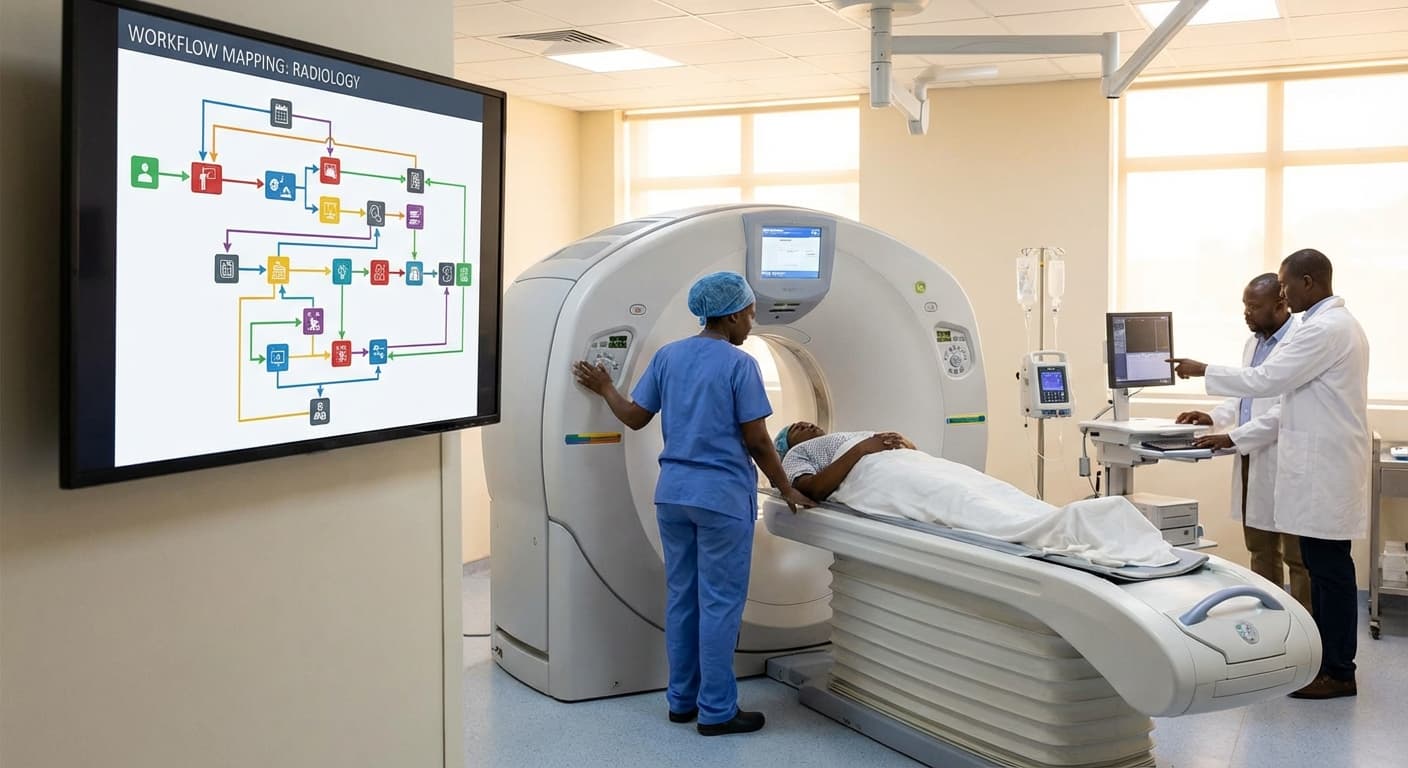
Department Workflow Mapping Service (Radiology/ICU/OT/Lab/Dialysis) in Egypt
Engineering Excellence & Technical Support
Department Workflow Mapping Service (Radiology/ICU/OT/Lab/Dialysis) High-standard technical execution following OEM protocols and local regulatory frameworks.
Streamlined Patient Flow & Resource Allocation
Visualize and optimize patient journeys across Radiology, ICU, OT, Lab, and Dialysis in Egyptian hospitals. Our service identifies bottlenecks, minimizes wait times, and ensures efficient resource utilization for improved patient care and reduced operational costs.
Enhanced Interdepartmental Collaboration & Communication
Break down silos between critical departments like Radiology, ICU, OT, Lab, and Dialysis. We map communication pathways and dependencies, facilitating seamless information exchange and coordinated care delivery within Egyptian healthcare institutions.
Standardized Protocols & Quality Assurance
Implement and enforce standardized operational protocols across key departments in Egyptian hospitals. Our workflow mapping service helps identify deviations, promote best practices, and ensure consistent, high-quality patient care in Radiology, ICU, OT, Lab, and Dialysis.
What Is Department Workflow Mapping Service (Radiology/icu/ot/lab/dialysis) In Egypt?
Department Workflow Mapping Service (Radiology/ICU/OT/Lab/Dialysis) in Egypt refers to a systematic and analytical process of documenting, visualizing, and optimizing the sequence of operations, tasks, information flow, and resource utilization within specific high-throughput medical departments in Egyptian healthcare facilities. This service aims to enhance efficiency, reduce errors, improve patient outcomes, and optimize resource allocation by providing a clear, granular understanding of how work is currently performed and identifying opportunities for improvement.
| Department | Who Needs It | Typical Use Cases |
|---|---|---|
| Radiology | Hospital administration, Radiology department heads, IT departments, Quality improvement teams. | Reducing patient waiting times for imaging studies and results. Optimizing radiologist workload and reporting turnaround time. Improving equipment utilization and preventive maintenance scheduling. Streamlining image archiving and retrieval. Integrating new PACS/RIS systems. |
| Intensive Care Unit (ICU) | Hospital administration, ICU directors, Nursing supervisors, Anesthesiology departments, Clinical engineering. | Improving patient handover processes between shifts and departments. Optimizing medication administration and monitoring protocols. Enhancing response times to critical events. Streamlining patient flow from admission to discharge or transfer. Ensuring efficient use of specialized equipment (ventilators, monitors). |
| Operating Theatre (OT) | Hospital administration, Surgical department heads, Anesthesiology departments, Nursing supervisors, Sterilization units. | Minimizing operating room turnaround times between cases. Optimizing surgical team scheduling and resource allocation. Streamlining instrument sterilization and inventory management. Improving patient pre-operative and post-operative care coordination. Enhancing surgical safety checklists adherence. |
| Laboratory | Hospital administration, Laboratory directors, Pathologists, Lab technicians, IT departments. | Reducing sample processing and turnaround times for diagnostic tests. Optimizing laboratory equipment calibration and maintenance. Streamlining specimen collection, labeling, and transport. Improving quality control and assurance processes. Integrating laboratory information systems (LIS) with EMRs. |
| Dialysis (Renal Unit) | Hospital administration, Nephrology department heads, Dialysis unit managers, Nursing supervisors, Biomedical engineers. | Optimizing patient scheduling for dialysis sessions. Streamlining pre- and post-dialysis procedures. Ensuring efficient use of dialysis machines and water treatment systems. Improving medication management for dialysis patients. Enhancing patient safety and infection control protocols. |
Key Components of the Service
- As-Is Process Documentation: Comprehensive data collection and recording of all steps involved in existing departmental workflows, including patient journeys, staff activities, equipment usage, and data management.
- Process Visualization: Creation of visual representations (e.g., flowcharts, swimlane diagrams, BPMN models) to depict the documented workflows, highlighting interdependencies and potential bottlenecks.
- Bottleneck Identification & Analysis: Utilizing the mapped workflows to pinpoint inefficiencies, redundancies, delays, and areas of excessive resource consumption.
- Root Cause Analysis: Investigating the underlying reasons for identified bottlenecks and inefficiencies through structured problem-solving techniques.
- To-Be Process Design: Developing optimized, streamlined, and standardized workflows based on best practices, technological advancements, and the specific needs of the Egyptian healthcare context.
- Technology Integration Assessment: Evaluating opportunities for incorporating new technologies (e.g., PACS, LIS, EMR integration, AI-driven diagnostics, automated equipment) to support and enhance the 'To-Be' workflows.
- Key Performance Indicator (KPI) Definition: Establishing measurable metrics to track the performance and impact of implemented workflow changes.
- Implementation Strategy & Support: Developing a phased plan for adopting the new workflows, including training, change management, and ongoing monitoring.
- Standard Operating Procedure (SOP) Development/Refinement: Creating or updating SOPs to align with the optimized workflows, ensuring consistency and adherence.
Who Needs Department Workflow Mapping Service (Radiology/icu/ot/lab/dialysis) In Egypt?
A Department Workflow Mapping Service is crucial for healthcare facilities in Egypt aiming to optimize efficiency, reduce errors, improve patient care, and enhance resource utilization within specialized departments. This service meticulously documents and analyzes the current processes, identifying bottlenecks, redundancies, and areas for improvement. By visualizing and understanding the flow of information, materials, and patient movement, organizations can implement targeted strategies for greater operational effectiveness.
| Target Customer Segment | Key Departments Benefiting | Specific Needs Addressed |
|---|---|---|
| Public Hospitals (Ministry of Health) | Radiology, ICU, Operating Theaters (OT), Laboratories, Dialysis Centers | Improving patient throughput, standardizing protocols, managing high patient loads, optimizing equipment utilization, ensuring consistent quality of care across multiple facilities. |
| Private Hospitals & Medical Centers | Radiology, ICU, OT, Laboratories, Dialysis Centers | Enhancing patient experience, differentiating services through efficiency, reducing turnaround times, cost optimization, competitive advantage through streamlined operations. |
| University Hospitals & Teaching Institutions | Radiology, ICU, OT, Laboratories, Dialysis Centers | Streamlining clinical workflows for education and research, integrating new technologies, standardizing best practices for trainees, ensuring efficient patient management in complex cases. |
| Specialized Clinics (e.g., Cardiac, Oncology, Renal) | Radiology, Laboratories, ICU (for critical interventions), OT (for procedures) | Optimizing patient journeys for specific conditions, ensuring timely diagnostics and treatment, improving communication between specialized teams, managing complex treatment pathways. |
| Medical Tourism Providers | Radiology, ICU, OT, Laboratories, Dialysis Centers | Ensuring seamless and efficient patient experience for international patients, rapid turnaround times for diagnostics and procedures, clear communication and coordination across multiple touchpoints. |
| New Healthcare Facility Developments | Radiology, ICU, OT, Laboratories, Dialysis Centers | Designing and implementing optimized workflows from the ground up, avoiding common inefficiencies, establishing robust operational frameworks before launch. |
Who Needs Department Workflow Mapping Service in Egypt?
- Hospitals seeking to standardize and improve the efficiency of their diagnostic and treatment processes.
- Healthcare institutions facing increasing patient volumes and aiming to manage resources more effectively.
- Facilities looking to reduce operational costs and minimize waste.
- Organizations prioritizing patient safety and aiming to eliminate potential errors in critical care pathways.
- Healthcare providers preparing for accreditation or seeking to achieve higher quality standards.
- Institutions implementing new technologies or digital solutions and needing to integrate them seamlessly into existing workflows.
- Departments experiencing communication breakdowns or delays in information sharing.
- Management teams needing data-driven insights to make informed decisions about process improvements.
Department Workflow Mapping Service (Radiology/icu/ot/lab/dialysis) Process In Egypt
This document outlines the typical workflow for a Department Workflow Mapping Service (Radiology/ICU/OT/Lab/Dialysis) specifically within the Egyptian healthcare context. The service aims to analyze, document, and optimize operational processes within these critical hospital departments to improve efficiency, reduce errors, and enhance patient care. The process typically begins with an initial inquiry from a healthcare facility and concludes with the delivery of a comprehensive workflow map and recommendations.
| Phase | Description | Key Activities | Deliverables |
|---|---|---|---|
| The healthcare facility expresses interest in the workflow mapping service and initiates contact with the service provider. | Understanding the facility's needs and challenges, scope definition, initial site visit (optional), proposal generation. | Service proposal, preliminary scope of work, estimated timeline and cost. |
| Formal commencement of the project with the designated client team. | Introductions, detailed project plan review, stakeholder identification, interview scheduling, observation setup, collection of existing documentation (SOPs, forms, reports). | Signed project charter, detailed project plan, list of interviewed personnel, initial data repository. |
| Detailed documentation and analysis of the existing departmental workflows. | Conducting interviews with staff at all levels, direct observation of processes, shadowing key personnel, analyzing data flow, identifying bottlenecks, inefficiencies, and pain points. | Detailed current-state workflow diagrams (e.g., using BPMN), identified risks and inefficiencies, preliminary findings report. |
| Developing proposed improvements and designing optimized future workflows. | Brainstorming solutions with stakeholders, designing streamlined workflows, incorporating best practices, leveraging technology where applicable, defining new roles/responsibilities if needed. | Proposed future-state workflow diagrams, documented best practice recommendations, identified opportunities for improvement. |
| Presenting proposed changes to the client and incorporating feedback. | Presenting current and future state maps to stakeholders, conducting workshops for feedback, revising workflows based on input, gaining consensus. | Validated future-state workflow diagrams, stakeholder sign-off on proposed changes. |
| Formalizing the findings and recommendations into comprehensive reports. | Creating a final comprehensive report detailing current state, proposed future state, identified risks, benefits of proposed changes, implementation roadmap, and key performance indicators (KPIs) for monitoring. | Final workflow mapping report, implementation roadmap, presentation of findings to senior management. |
| Providing assistance during the implementation phase of the optimized workflows. | Training staff on new processes, providing ongoing support, monitoring initial implementation, troubleshooting issues. | Training materials, post-implementation support documentation, progress reports. |
| Assessing the impact of the implemented changes and establishing a framework for ongoing optimization. | Measuring KPIs, gathering feedback on implemented changes, identifying areas for further refinement, developing a continuous improvement plan. | Post-implementation review report, recommendations for ongoing optimization. |
Key Departments Covered
- Radiology Department
- Intensive Care Unit (ICU)
- Operating Theatre (OT)
- Laboratory Services
- Dialysis Unit
Department Workflow Mapping Service (Radiology/icu/ot/lab/dialysis) Cost In Egypt
The cost of Department Workflow Mapping Services for specialized medical departments like Radiology, ICU, OT (Operating Theatre), Lab (Laboratory), and Dialysis in Egypt can vary significantly. This service involves analyzing and documenting existing workflows, identifying inefficiencies, and proposing optimized processes to improve patient care, resource utilization, and operational efficiency. The pricing is influenced by several key factors, leading to a range of costs within the local currency, EGP.
| Department Type | Estimated Cost Range (EGP) | Notes |
|---|---|---|
| Radiology | 25,000 - 80,000 EGP | Varies based on imaging modalities, patient throughput, and reporting processes. |
| ICU (Intensive Care Unit) | 40,000 - 120,000 EGP | High complexity due to critical patient care, multidisciplinary teams, and rapid response needs. |
| OT (Operating Theatre) | 35,000 - 100,000 EGP | Involves scheduling, surgical teams, equipment management, sterilization, and patient flow. |
| Lab (Laboratory) | 20,000 - 70,000 EGP | Depends on the types of tests, sample handling, automation, and reporting turnaround times. |
| Dialysis | 30,000 - 90,000 EGP | Focuses on patient scheduling, machine utilization, water treatment, and patient care protocols. |
| Cross-Departmental / Facility-Wide | 100,000+ EGP | For mapping workflows across multiple departments or the entire hospital, costs can significantly increase. |
Key Pricing Factors:
- Scope and Complexity of the Department: A larger department with more intricate processes (e.g., a busy ICU with multiple patient streams) will generally cost more to map than a smaller, more straightforward one (e.g., a specific lab section).
- Number of Workflows to be Mapped: Mapping numerous distinct workflows within a department increases the overall time and effort required.
- Level of Detail Required: The depth of analysis and documentation needed impacts the cost. Basic flowcharts are less expensive than detailed process maps with data points, resource allocation, and potential bottleneck identification.
- Consultant Expertise and Experience: Highly experienced consultants with a proven track record in healthcare workflow optimization will command higher fees.
- Duration of the Engagement: Longer projects involving extensive data collection, analysis, and implementation support will naturally incur higher costs.
- Data Collection Methods: The methods employed for data collection (e.g., direct observation, interviews, time-motion studies, surveys) influence the time and resources needed.
- Reporting and Deliverables: The format and comprehensiveness of the final reports, including recommendations, visual aids, and training materials, affect the cost.
- Geographic Location and Accessibility: While less of a primary driver for internal Egyptian consultants, travel and accommodation costs might be factored in if consultants are brought in from other regions within Egypt or internationally.
- Technology Used (if any): If the service involves the use of specialized workflow mapping software or analytical tools, this might add to the cost.
- Reputation and Size of the Consulting Firm: Larger, well-established consulting firms often have higher overheads and may charge more than smaller, independent consultants or specialized boutique firms.
Affordable Department Workflow Mapping Service (Radiology/icu/ot/lab/dialysis) Options
Our Affordable Department Workflow Mapping Service offers comprehensive solutions for Radiology, ICU, OT, Lab, and Dialysis departments. We streamline your operations, identify inefficiencies, and implement cost-saving strategies through detailed workflow analysis and optimization. Our service is designed to be accessible to all departments, regardless of budget, providing tangible returns on investment by reducing waste, improving turnaround times, and enhancing patient care.
| Service Level | Description | Key Cost-Saving Strategies Included | Indicative Price Range (Illustrative) |
|---|---|---|---|
| Essential Mapping | Basic analysis of current workflows, identification of 2-3 major inefficiencies. | Elimination of redundant steps, reduction in process cycle times, improved communication protocols. | $1,500 - $3,000 per department |
| Standard Optimization | Detailed workflow mapping, bottleneck analysis, proposed solutions for 5-7 inefficiencies, basic staff training. | Resource reallocation, optimized equipment utilization, reduced waste (materials & time), enhanced inter-departmental coordination. | $3,500 - $7,000 per department |
| Premium Excellence | Full workflow mapping, advanced optimization, technology adoption recommendations, comprehensive staff training, initial ROI analysis, and 3-month post-implementation support. | Significant reduction in operational costs, improved throughput, enhanced patient satisfaction, minimized errors, justification for technology investments based on clear ROI. | $8,000 - $15,000+ per department (depending on complexity and scope) |
| Add-on: Technology Integration Assessment | Evaluation of existing or potential technology solutions to support optimized workflows. | Streamlined data capture, automated reporting, reduced manual intervention, improved accuracy. | Starting from $1,000 |
| Add-on: Staff Training & Change Management | Customized training programs to ensure successful adoption of new workflows. | Increased staff efficiency, reduced resistance to change, improved morale, faster implementation of improvements. | Starting from $1,200 |
Value Bundles & Cost-Saving Strategies
- Core Workflow Mapping: In-depth analysis of current processes, identification of bottlenecks, and initial recommendations.
- Efficiency Optimization Package: Builds upon the Core Mapping with targeted process redesign, technology integration assessment, and staff training modules.
- Strategic Operational Excellence Bundle: Comprehensive solution including Core Mapping, Efficiency Optimization, and ongoing performance monitoring & continuous improvement initiatives. This bundle often includes recommendations for capital expenditure justifications based on projected ROI.
- Data-Driven Insights & Reporting: Automated dashboards and regular reports highlighting key performance indicators (KPIs) and areas for further improvement.
- Customizable Solutions: Tailored packages to meet the specific needs and budget constraints of each department.
Verified Providers In Egypt
Finding reliable healthcare providers is paramount, especially when navigating a new system or seeking specialized care. In Egypt, Franance Health has established itself as a trusted name, distinguishing itself through rigorous credential verification and a commitment to patient well-being. This dedication makes Franance Health the superior choice for accessing quality medical services in Egypt. Their robust credentialing process ensures that all affiliated healthcare professionals meet the highest standards of expertise, ethical practice, and regulatory compliance. This not only safeguards patients but also streamlines their healthcare journey, offering peace of mind and confidence in the care they receive.
| Franance Health Verification Component | Description of Component | Benefit to Patients |
|---|---|---|
| Licensure and Certification Checks | Verifying that medical professionals hold valid and up-to-date licenses and specialty certifications issued by recognized Egyptian authorities. | Ensures providers are legally qualified to practice and possess the necessary expertise in their chosen field. |
| Educational Background Review | Confirming the authenticity and quality of medical degrees and postgraduate training from accredited institutions. | Guarantees that providers have received a solid foundation of medical knowledge and training. |
| Professional Experience Validation | Cross-referencing and confirming past employment and practice history with previous institutions or employers. | Provides insight into the provider's practical experience and track record in patient care. |
| Background and Reference Checks | Conducting discreet inquiries and reference checks to assess professional conduct and reputation. | Helps identify any potential red flags and assures a commitment to ethical and professional behavior. |
| Continuous Professional Development (CPD) Monitoring | Ensuring providers actively engage in ongoing learning and training to stay abreast of medical advancements. | Confirms that patients are receiving care from up-to-date and skilled medical professionals. |
Why Franance Health Stands Out in Egypt:
- Rigorous Credential Verification: Franance Health employs a multi-faceted approach to verify the qualifications, licenses, and experience of every provider. This includes checking educational background, specialty certifications, and professional history.
- Commitment to Excellence: Beyond basic qualifications, Franance Health assesses providers for their dedication to ongoing professional development, patient-centered care, and adherence to ethical guidelines.
- Comprehensive Network: Franance Health offers access to a diverse network of specialists and general practitioners across various medical disciplines, ensuring that patients can find the right care for their specific needs.
- Streamlined Patient Experience: By pre-vetting providers, Franance Health simplifies the process of finding and booking appointments, reducing the burden on patients to independently vet their healthcare options.
- Enhanced Patient Safety and Trust: The meticulous credentialing process directly translates to enhanced patient safety and fosters a higher level of trust in the Egyptian healthcare system for its users.
Scope Of Work For Department Workflow Mapping Service (Radiology/icu/ot/lab/dialysis)
This Scope of Work (SOW) outlines the services for a comprehensive workflow mapping initiative across critical hospital departments including Radiology, Intensive Care Unit (ICU), Operating Theatre (OT), Laboratory, and Dialysis. The objective is to meticulously document, analyze, and visualize current state workflows, identify bottlenecks and inefficiencies, and propose optimized future state workflows. The deliverables will include detailed process maps, analysis reports, and recommendations for improvement, adhering to industry best practices and technical specifications.
| Deliverable Category | Specific Deliverable | Description | Standard Specifications / Format | ||||
|---|---|---|---|---|---|---|---|
| Documentation & Analysis | Current State Workflow Maps | Visual representations of existing processes, including all steps, decision points, roles, and systems involved for each department. | Format: BPMN 2.0 (Business Process Model and Notation) compliant diagrams. Software: Draw.io, Lucidchart, Visio, or equivalent. Resolution: High-resolution, printable (e.g., PDF, PNG). Standard notation and color-coding will be used and documented. | ||||
| Documentation & Analysis | Process Narratives | Detailed textual descriptions accompanying each workflow map, explaining the rationale, inputs, outputs, and potential deviations. | Format: Word documents or equivalent. Consistent templating for each process narrative. | ||||
| Documentation & Analysis | Bottleneck & Inefficiency Analysis Report | Identification and detailed description of identified bottlenecks, redundancies, delays, and areas of non-value-added activity within current workflows. | Format: Word document or PDF. Includes quantitative and qualitative data supporting the findings. Prioritization of identified issues. | ||||
| Recommendations & Future State | Future State Workflow Recommendations | Proposed optimized workflows designed to address identified inefficiencies and improve operational effectiveness, patient flow, and resource utilization. | Format: BPMN 2.0 compliant diagrams, similar to current state maps, clearly indicating proposed changes. Accompanying narrative explaining the rationale for each proposed change. | ||||
| Recommendations & Future State | Gap Analysis Report | Analysis highlighting the differences between current and future state workflows, identifying changes required in technology, training, policies, and procedures. | Format: Word document or PDF. Structured comparison of current vs. future state. | ||||
| Recommendations & Future State | Implementation Roadmap (High-Level) | A strategic outline of key phases, activities, and estimated timelines for implementing the recommended future state workflows. | Format: Gantt chart or similar project management visualization. Word document for detailed explanation. | ||||
| Project Management & Reporting | Project Kick-off Meeting Presentation | Presentation to formally initiate the project, outline objectives, scope, timeline, roles, and communication plan. | Format: PowerPoint or equivalent. Shared electronically. | ||||
| Project Management & Reporting | Weekly Status Reports | Regular updates on project progress, key achievements, upcoming activities, risks, and issues. | Format: Standardized email template or Word document. Consistent reporting frequency (e.g., weekly). | Project Management & Reporting | Final Project Report | Comprehensive summary of the project, including all deliverables, findings, recommendations, and lessons learned. | Format: Word document or PDF. Includes executive summary and detailed appendices. |
| Technical Specifications | Data Collection Tools | Methods and tools used for gathering information (e.g., interviews, observation, document review, system logs). | Standardized interview guides and observation checklists. Data anonymization protocols where necessary. | ||||
| Technical Specifications | Mapping Software | The specific software used for creating workflow diagrams. | Agreement on primary mapping software and version. Ensure compatibility for file sharing and collaborative editing. | ||||
| Technical Specifications | File Naming Conventions | Consistent and logical naming structure for all project files. | Example: DeptName_ProcessName_State_Version_Date.ext (e.g., Radiology_MRI_Scan_Current_v1.0_20231027.bpmn) | ||||
| Technical Specifications | Version Control | Systematic management of changes and revisions to all project documents and diagrams. | Utilize version numbering (e.g., v1.0, v1.1, v2.0). Maintain a change log for major revisions. | ||||
| Technical Specifications | Security & Confidentiality | Protocols for handling sensitive patient and operational data. | Adherence to HIPAA or relevant local data privacy regulations. Secure file storage and transfer methods. |
Key Departments Covered
- Radiology (Diagnostic Imaging, Interventional Radiology)
- Intensive Care Unit (ICU) (Medical, Surgical, Cardiac)
- Operating Theatre (OT) (Pre-operative, Intra-operative, Post-operative)
- Laboratory (Pathology, Microbiology, Biochemistry, Hematology)
- Dialysis (In-center hemodialysis, Peritoneal dialysis)
Service Level Agreement For Department Workflow Mapping Service (Radiology/icu/ot/lab/dialysis)
This Service Level Agreement (SLA) outlines the guaranteed response times and uptime for the Department Workflow Mapping Service. This service is critical for optimizing operations within the Radiology, Intensive Care Unit (ICU), Operating Theatre (OT), Laboratory, and Dialysis departments. Failure to meet these standards will result in defined remediation actions.
| Service Component | Response Time Guarantee (Business Hours) | Uptime Guarantee |
|---|---|---|
| New Workflow Mapping Request (Initial Acknowledgment) | 2 Business Hours | N/A |
| Workflow Mapping Analysis Report Delivery (Standard Complexity) | 5 Business Days | N/A |
| Workflow Mapping Analysis Report Delivery (High Complexity) | 10 Business Days | N/A |
| Urgent Workflow Issue Support (Critical Impact) | 1 Business Hour | N/A |
| Workflow Mapping Service Availability | N/A | 99.5% |
Scope of Service
- Workflow mapping documentation and analysis for Radiology department.
- Workflow mapping documentation and analysis for Intensive Care Unit (ICU).
- Workflow mapping documentation and analysis for Operating Theatre (OT).
- Workflow mapping documentation and analysis for Laboratory.
- Workflow mapping documentation and analysis for Dialysis unit.
Frequently Asked Questions

Ready when you are
Let's scope your Department Workflow Mapping Service (Radiology/ICU/OT/Lab/Dialysis) in Egypt project in Egypt.

Scaling healthcare logistics and technical systems across the entire continent.