
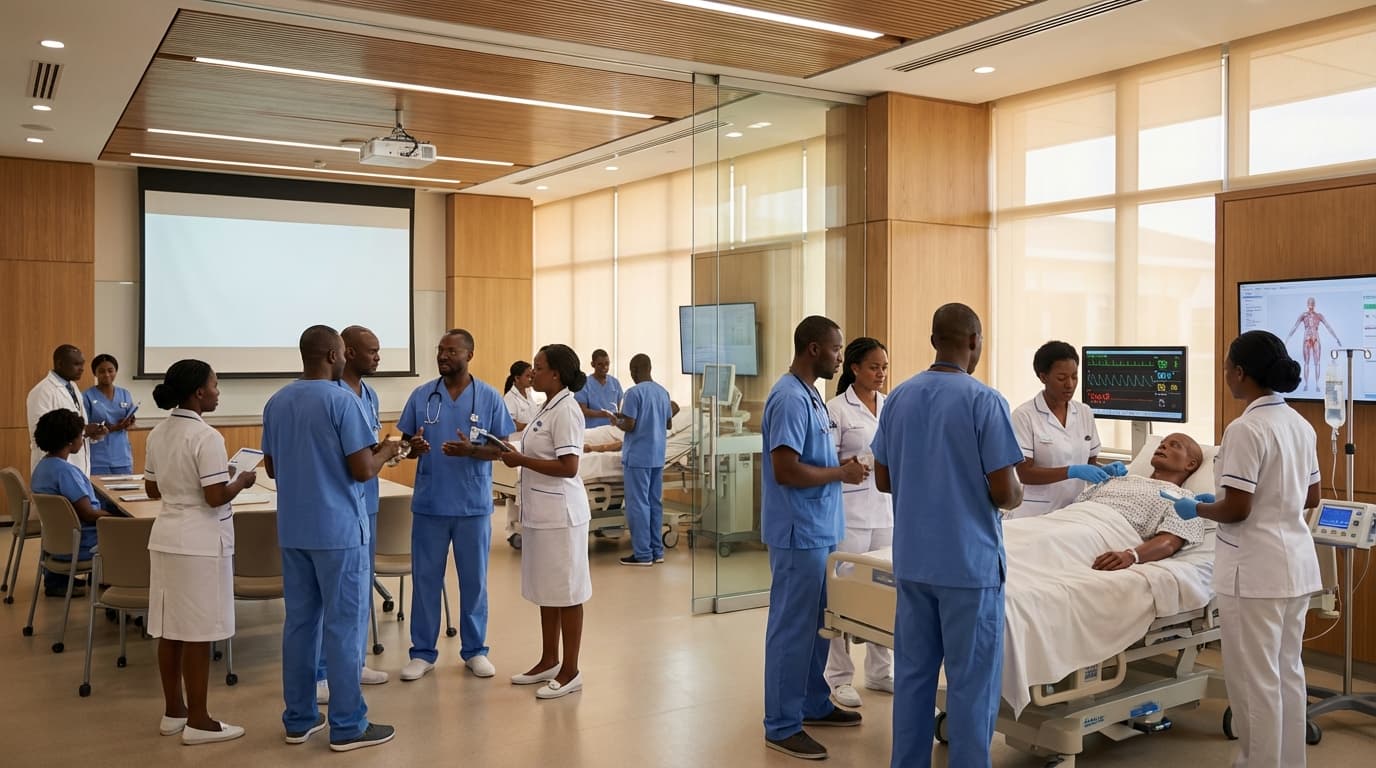
Equipment Training & Education in Djibouti
Engineering Excellence & Technical Support
Comprehensive equipment training and certification programs High-standard technical execution following OEM protocols and local regulatory frameworks.
Advanced Equipment Operation Simulation
Our state-of-the-art simulator provides hands-on training for complex heavy machinery and specialized equipment, mimicking real-world scenarios and promoting safe, efficient operation without risk to personnel or assets.
Certified Maintenance & Troubleshooting Workshops
Comprehensive workshops led by industry experts, focusing on practical maintenance techniques and advanced troubleshooting for critical equipment, ensuring maximum uptime and reduced operational costs.
Interactive E-Learning Modules & VR Modules
Access a library of engaging digital and virtual reality training modules for foundational knowledge, theory, and procedural learning, available on-demand and adaptable to individual learning paces.
What Is Equipment Training & Education In Djibouti?
Equipment Training & Education in Djibouti refers to a structured program designed to impart the necessary knowledge, skills, and proficiencies to individuals for the safe, efficient, and effective operation, maintenance, and troubleshooting of specific machinery, tools, and systems. This service is critical for ensuring operational integrity, maximizing asset lifespan, and mitigating risks associated with complex equipment, particularly in sectors like logistics, infrastructure development, and energy. The scope encompasses theoretical instruction, practical hands-on sessions, and competency assessments.
| Who Needs It? | Typical Use Cases | ||||
|---|---|---|---|---|---|
| Heavy Equipment Operators: Personnel involved in civil engineering, construction, and mining projects requiring proficiency in excavators, bulldozers, cranes, etc. | Logistics & Port Personnel: Workers operating forklifts, container handlers, terminal tractors, and other material handling equipment within Djibouti's strategic port infrastructure. | Maintenance Technicians: Individuals responsible for the upkeep and repair of industrial machinery, power generation equipment, and transportation fleets. | Field Service Engineers: Technicians deployed to install, commission, and service specialized equipment in various sectors. | Emergency Responders: Firefighters, medical personnel, and disaster relief teams requiring training on specialized rescue and support equipment. | Skilled Laborers: Workers across industries needing to operate specific tools or machinery relevant to their job functions. |
| Port Operations Enhancement: Training on advanced container handling systems and automated port equipment to improve efficiency and throughput at the Port of Djibouti. | Infrastructure Development Projects: Equipping construction crews with the skills to operate and maintain heavy machinery for road, building, and utility construction. | Energy Sector Support: Training on the operation and maintenance of power generation units (diesel, gas turbines), substations, and associated electrical equipment. | Defense & Security Equipment: Familiarization and operational training on specialized vehicles, communication systems, and surveillance equipment for national security forces. | Industrial Manufacturing: Upskilling workers on specific assembly lines, processing machinery, and quality control equipment in manufacturing facilities. | Agricultural Mechanization: Training farmers and agricultural workers on the operation and maintenance of tractors, irrigation systems, and harvesting equipment. |
Key Components of Equipment Training & Education:
- Theoretical Instruction: Covering principles of operation, system architecture, safety protocols, regulatory compliance, and diagnostic methodologies.
- Practical Skill Development: Hands-on experience with the equipment, including startup procedures, routine operation, calibration, minor repairs, and emergency response.
- Maintenance & Troubleshooting: Training on preventive maintenance schedules, fault identification, and corrective actions for common issues.
- Safety & Risk Management: Emphasis on hazard recognition, personal protective equipment (PPE) usage, lockout/tagout procedures, and emergency protocols.
- Competency Assessment: Evaluation of learned skills through practical demonstrations, written tests, and scenario-based exercises to certify proficiency.
Who Needs Equipment Training & Education In Djibouti?
Providing comprehensive equipment training and education in Djibouti is crucial for a wide range of industries and individuals. This ensures safe, efficient, and effective operation of machinery, leading to increased productivity, reduced downtime, and a more skilled workforce. Target customers and departments benefit from this investment by enhancing their operational capabilities and professional development.
| Customer Type | Relevant Departments/Roles | Key Equipment/Training Needs |
|---|---|---|
| Construction Industry | Site Managers, Heavy Equipment Operators, Crane Operators, Supervisors, Maintenance Technicians | Excavators, bulldozers, cranes, loaders, scaffolding, safety protocols, machinery maintenance |
| Logistics & Transportation | Warehouse Staff, Forklift Operators, Truck Drivers, Fleet Managers, Customs Officers | Forklifts, pallet jacks, material handling equipment, vehicle operation and maintenance, safety procedures |
| Maritime & Port Operations | Crane Operators, Stevedores, Terminal Operators, Port Engineers, Safety Officers | Container cranes, reach stackers, forklifts, port machinery operation, hazardous materials handling |
| Energy & Utilities | Power Plant Technicians, Maintenance Engineers, Field Service Personnel, Safety Officers | Generators, turbines, specialized diagnostic equipment, safety procedures for high-voltage environments |
| Manufacturing & Industrial | Machine Operators, Production Supervisors, Maintenance Technicians, Quality Control Staff | CNC machines, industrial automation equipment, assembly lines, welding equipment, safety compliance |
| Agriculture | Tractor Operators, Farm Managers, Irrigation Technicians, Harvester Operators | Tractors, harvesters, planting equipment, irrigation systems, basic machinery maintenance |
| Healthcare | Biomedical Engineers, Radiology Technicians, Laboratory Technicians, Facilities Management | MRI machines, CT scanners, laboratory equipment, sterilization equipment, medical device maintenance |
| Government & Public Works | Road Maintenance Crews, Waste Management Operators, Water Treatment Plant Staff | Road construction equipment, waste compactors, water purification systems, heavy machinery operation |
| SMEs | Owners, Operators, Employees using specialized equipment in their business | Varies by industry; e.g., small construction tools, food processing equipment, agricultural machinery |
| Educational Institutions | Instructors, Trainers, Students in vocational and technical programs | Simulators, workshop equipment, specialized tools for training purposes |
Target Customers and Departments for Equipment Training & Education in Djibouti:
- Construction Industry Professionals
- Logistics and Transportation Sector Employees
- Maritime and Port Operations Personnel
- Energy and Utilities Workers
- Manufacturing and Industrial Plant Staff
- Agricultural Sector Workers
- Healthcare Facility Technicians
- Government and Public Works Departments
- Small and Medium-Sized Enterprise (SME) Owners and Operators
- Vocational Training Institutes and Educational Centers
Equipment Training & Education Process In Djibouti
This document outlines the standard workflow for equipment training and education processes in Djibouti, from initial inquiry to successful execution. The process is designed to ensure all participants receive comprehensive and effective training tailored to their specific needs and the equipment in question.
| Stage | Description | Responsible Parties | Key Activities | Deliverables |
|---|---|---|---|---|
| Inquiry and Needs Assessment | The initial stage where a client or department expresses interest in training and their specific equipment-related educational needs are identified. | Client/Department, Training Provider Sales/Consultant | Receiving inquiry, understanding training objectives, identifying specific equipment, determining skill gaps, assessing current knowledge levels. | Needs Assessment Report, Initial Training Request Form. |
| Proposal Development & Approval | Based on the identified needs, the training provider develops a comprehensive proposal outlining the training scope, content, methodology, duration, cost, and expected outcomes. | Training Provider, Client/Department Management | Drafting proposal, costing, internal review, client presentation, negotiation, obtaining formal approval. | Formal Training Proposal, Approved Budget, Signed Contract/Agreement. |
| Curriculum Design & Customization | The training content is developed or adapted to meet the specific requirements of the client, the equipment, and the target audience. | Training Provider Instructional Designers, Subject Matter Experts (SMEs) | Developing training modules, creating lesson plans, designing practical exercises, preparing assessment tools, translating materials (if necessary). | Training Curriculum, Participant Manuals, Trainer Guides, Assessment Instruments. |
| Scheduling & Logistics | This stage involves coordinating the practical aspects of the training, including dates, times, location, and necessary resources. | Training Provider Logistics Coordinator, Client/Department Representative | Identifying suitable dates and times, booking training venue, arranging for equipment availability, ensuring access to necessary tools and materials, arranging travel and accommodation (if applicable). | Training Schedule, Venue Confirmation, Equipment Reservation Confirmation. |
| Training Delivery | The core stage where the training is conducted by qualified instructors. | Training Provider Instructors, Participants | Conducting lectures, demonstrations, hands-on practical sessions, case studies, group discussions, answering participant queries. | Delivered Training Sessions, Active Participant Engagement. |
| Assessment & Evaluation | Measuring the effectiveness of the training and the participants' understanding and retention of the material. | Training Provider Instructors, Participants, Client/Department Management | Administering quizzes, practical tests, simulations, observing participant performance, collecting feedback from participants and trainers. | Assessment Results, Training Evaluation Reports, Feedback Summaries. |
| Certification & Follow-up | Recognizing successful completion of the training and providing ongoing support. | Training Provider, Client/Department Management | Issuing certificates of completion, providing post-training support (e.g., Q&A sessions, access to resources), conducting follow-up surveys to gauge long-term impact. | Certificates of Completion, Post-Training Support Documentation, Follow-up Survey Results. |
Key Stages of the Equipment Training & Education Process:
- Inquiry and Needs Assessment
- Proposal Development & Approval
- Curriculum Design & Customization
- Scheduling & Logistics
- Training Delivery
- Assessment & Evaluation
- Certification & Follow-up
Equipment Training & Education Cost In Djibouti
The cost of equipment training and education in Djibouti can vary significantly depending on several factors. These include the complexity and type of equipment being trained on, the duration and intensity of the training program, the provider's reputation and specialization, the qualifications of the instructors, and the location of the training (on-site at a company's facility or at the training provider's location). Furthermore, the demand for specific skills in the Djiboutian market can influence pricing. Training for highly specialized industrial machinery, advanced IT systems, or complex medical equipment will naturally command higher fees than training for more common office equipment or basic operational procedures. The language of instruction can also be a factor, with training offered in French or Arabic potentially having different price points than English-language courses, depending on local demand and instructor availability. Group training rates are typically lower per participant than individual sessions. The inclusion of practical exercises, simulation time, certification exams, and training materials will also impact the overall cost.
| Training Category | Estimated Price Range (DJF) Per Person / Per Day |
|---|---|
| Basic Office Equipment (Computers, Printers, Software) | 15,000 - 30,000 |
| General Industrial Machinery Operation | 25,000 - 50,000 |
| Advanced IT Systems & Networking | 40,000 - 75,000 |
| Specialized Construction/Heavy Machinery | 50,000 - 90,000 |
| Medical Equipment (Diagnostic, Surgical) | 60,000 - 120,000+ |
| Logistics & Port Equipment (Cranes, Forklifts) | 30,000 - 60,000 |
| Customized / On-site Corporate Training (per day, negotiated) | 80,000 - 200,000+ |
Key Pricing Factors for Equipment Training in Djibouti
- Equipment Complexity and Type
- Training Program Duration and Intensity
- Provider's Reputation and Specialization
- Instructor Qualifications
- Training Location (On-site vs. Off-site)
- Market Demand for Specific Skills
- Language of Instruction
- Group Size vs. Individual Training
- Inclusion of Practical Exercises & Simulations
- Certification Exams and Training Materials
Affordable Equipment Training & Education Options
Acquiring the necessary skills and knowledge to operate equipment effectively is crucial for safety, productivity, and career advancement. Fortunately, numerous affordable equipment training and education options exist, catering to various budgets and learning preferences. These options often leverage value bundles and smart cost-saving strategies to maximize your investment.
| Cost-Saving Strategy | Description | Benefit |
|---|---|---|
| Value Bundles | Combining multiple training modules, certification prep, or software access into a single package at a reduced price compared to individual purchases. | Provides comprehensive learning for less, covers multiple skill sets, and simplifies enrollment. |
| Early Bird Discounts | Registering for courses or programs well in advance of the start date to receive a lower tuition fee. | Significant savings on upfront costs, secures your spot in popular programs. |
| Group Discounts | Enrolling multiple individuals from the same company or organization, often resulting in a per-person discount. | Cost-effective for businesses looking to upskill their workforce, fosters team learning. |
| Scholarships & Financial Aid | Applying for grants, bursaries, or government-funded programs that subsidize educational costs. | Reduces or eliminates out-of-pocket expenses, making education accessible to more individuals. |
| Free Trials & Sample Modules | Accessing a limited portion of an online course or platform for free to evaluate its quality and relevance before committing. | Allows you to assess suitability without financial risk, ensures you choose the right fit. |
| Used Textbooks & Digital Resources | Purchasing pre-owned textbooks or utilizing free digital learning materials instead of new, expensive ones. | Substantially lowers the cost of course materials. |
| Employer Sponsorship | Having your employer cover the costs of training and education as part of professional development. | Eliminates personal financial burden, demonstrates commitment to career growth. |
| Self-Paced Learning | Choosing online or modular training that allows you to learn at your own speed, avoiding the need for rigid, potentially more expensive, scheduled classes. | Flexibility to fit learning around work and personal commitments, can lead to faster completion if motivated. |
Affordable Equipment Training & Education Options
- Online Courses & Webinars
- Community College Programs
- Vocational Schools & Trade Programs
- Manufacturer-Specific Training
- Apprenticeships & On-the-Job Training
- Industry Certifications
- Subscription-Based Learning Platforms
- Open Educational Resources (OER)
Verified Providers In Djibouti
In Djibouti's evolving healthcare landscape, identifying trusted and verified healthcare providers is paramount for ensuring quality care. Franance Health stands out as a leading entity, distinguished by its rigorous credentialing process and unwavering commitment to patient well-being. This document outlines the essential credentials and benefits that make Franance Health the optimal choice for healthcare services in Djibouti.
| Benefit | Franance Health's Commitment | Why it Matters for Patients in Djibouti |
|---|---|---|
| Quality Assurance | Adherence to stringent international accreditation and internal quality control measures. | Guarantees a high standard of medical care, reducing the risk of errors and improving health outcomes. |
| Expertise and Specialization | Employment of highly qualified, board-certified medical professionals across various specialties. | Provides access to specialized knowledge and advanced treatments, minimizing the need for overseas medical tourism for complex conditions. |
| Advanced Diagnostics and Treatment | Continuous investment in modern medical equipment and diagnostic tools. | Enables accurate and timely diagnoses, leading to more effective and personalized treatment plans. |
| Patient Safety and Trust | Implementation of rigorous patient safety protocols and a transparent operational framework. | Ensures a secure and trustworthy healthcare environment where patients can feel confident in their treatment. |
| Comprehensive Care | A holistic approach to healthcare, addressing a wide spectrum of medical needs. | Offers a one-stop solution for various health concerns, providing convenience and integrated care pathways. |
| International Standards Alignment | Commitment to meeting and exceeding global benchmarks in healthcare delivery. | Positions Djibouti's healthcare sector at a higher level, attracting both local and international patients seeking reliable medical services. |
Key Credentials of Franance Health:
- Accreditation by International Health Standards: Franance Health facilities undergo stringent evaluations against globally recognized healthcare standards, ensuring compliance with best practices in patient safety, quality of care, and operational efficiency.
- Board-Certified Medical Professionals: All physicians, specialists, and allied health professionals at Franance Health are board-certified in their respective fields, possessing extensive experience and expertise.
- Continuous Professional Development: Franance Health mandates ongoing training and development for its staff, keeping them abreast of the latest medical advancements, technologies, and treatment protocols.
- State-of-the-Art Technology and Equipment: The organization invests in cutting-edge medical technology and equipment, enabling accurate diagnostics and effective treatment modalities.
- Robust Patient Safety Protocols: Comprehensive safety measures, including infection control, medication management, and patient identification procedures, are meticulously implemented.
- Patient-Centric Approach: Franance Health prioritizes patient comfort, privacy, and involvement in their care decisions, fostering a supportive and empathetic healthcare experience.
- Strong Partnerships with Global Healthcare Networks: Collaborations with international healthcare institutions facilitate access to specialized expertise, advanced treatments, and knowledge sharing.
Scope Of Work For Equipment Training & Education
This Scope of Work (SOW) outlines the requirements for providing comprehensive training and educational services for the specified equipment. The objective is to ensure that personnel are proficient in the safe and effective operation, maintenance, and troubleshooting of the equipment, thereby maximizing its utility and minimizing downtime.
| Category | Technical Deliverables | Standard Specifications |
|---|---|---|
| Training Program Design | Customized training curriculum tailored to equipment type and user roles. | Modular structure with defined learning objectives for each module. Content aligned with manufacturer's specifications and industry standards. |
| Training Materials | Training manuals (digital and/or hard copy), presentations, visual aids (diagrams, videos), user guides. | Materials written in clear, concise language. Specifications for font size, image resolution, and document format (e.g., PDF, PPT). |
| Instructor Qualifications | Certified trainers with proven expertise in the specific equipment and adult learning methodologies. | Demonstrable experience (minimum years) in training and equipment operation/maintenance. Relevant certifications (e.g., manufacturer-specific, industry-recognized). |
| Training Delivery Methods | On-site hands-on training, classroom sessions, remote/virtual training options, simulation-based training. | Combination of theoretical and practical components. Duration and schedule of training sessions to be agreed upon. |
| Assessment and Evaluation | Written assessments, practical skill evaluations, pre- and post-training surveys. | Clear pass/fail criteria for assessments. Standardized evaluation forms. Feedback mechanisms for continuous improvement. |
| Post-Training Support | Access to training materials for a defined period, Q&A sessions, refresher training options. | Defined availability for support inquiries. Documentation of support interactions. |
| Documentation | Training attendance records, assessment results, certificates of completion, training reports. | Secure storage and retrieval of all training-related documentation. Format and retention period for records. |
Key Objectives
- To impart theoretical knowledge and practical skills for operating the equipment.
- To train personnel on routine maintenance procedures and basic troubleshooting.
- To ensure adherence to all safety protocols and best practices related to the equipment.
- To provide documentation and resources for ongoing learning and reference.
- To certify individuals upon successful completion of training modules.
Service Level Agreement For Equipment Training & Education
This Service Level Agreement (SLA) outlines the guaranteed response times and uptime for equipment training and educational services provided by [Your Company Name] to [Client Name]. This agreement aims to ensure the continuous availability and efficient support for your learning and development needs related to our equipment.
| Service Component | Guaranteed Uptime | Response Time (Standard Support) | Response Time (Critical Support) | Remedy for Non-Compliance |
|---|---|---|---|---|
| On-Demand Training Module Availability (LMS/Platform) | 99.5% Uptime | N/A (Self-Service) | N/A (Self-Service) | For every 2 hours of unscheduled downtime exceeding 1 hour per month, a service credit of 5% of the monthly training subscription fee will be issued. |
| Scheduled Training Session Delivery (Virtual) | N/A (Dependent on instructor availability and client connectivity) | Instructor will be online and available 10 minutes prior to the scheduled start time. | Instructor will be online and available 15 minutes prior to the scheduled start time. | If instructor is more than 15 minutes late, the session will be rescheduled at no additional cost, and a 10% discount on future training will be applied. |
| Technical Support for Training Platform/Materials | N/A (Support is event-driven) | 24 business hours for non-critical issues. | 8 business hours for critical issues (e.g., inability to access core training modules or schedule sessions). | For each instance of exceeding the guaranteed response time for a critical issue, a service credit of 5% of the monthly training fee will be issued, up to a maximum of 20% per month. |
| Access to Training Documentation & Resources | 99.8% Uptime | N/A (Self-Service) | N/A (Self-Service) | For every 4 hours of unscheduled downtime exceeding 2 hours per month, a service credit of 3% of the monthly training subscription fee will be issued. |
Key Definitions
- {"title":"Scheduled Training Session","description":"A pre-arranged and confirmed training session, whether in-person or virtual, involving an instructor and participants."}
- {"title":"On-Demand Training Module","description":"Self-paced educational content, such as videos, e-learning courses, or documentation, accessible via a learning management system (LMS) or other designated platform."}
- {"title":"Technical Support Request","description":"A request submitted by the client for assistance with technical issues related to accessing or utilizing training materials or platforms."}
- {"title":"Service Credit","description":"A monetary credit applied to the client's account for failure to meet the guaranteed response times or uptime levels."}
Frequently Asked Questions

Ready when you are
Let's scope your Equipment Training & Education in Djibouti project in Djibouti.

Scaling healthcare logistics and technical systems across the entire continent.