
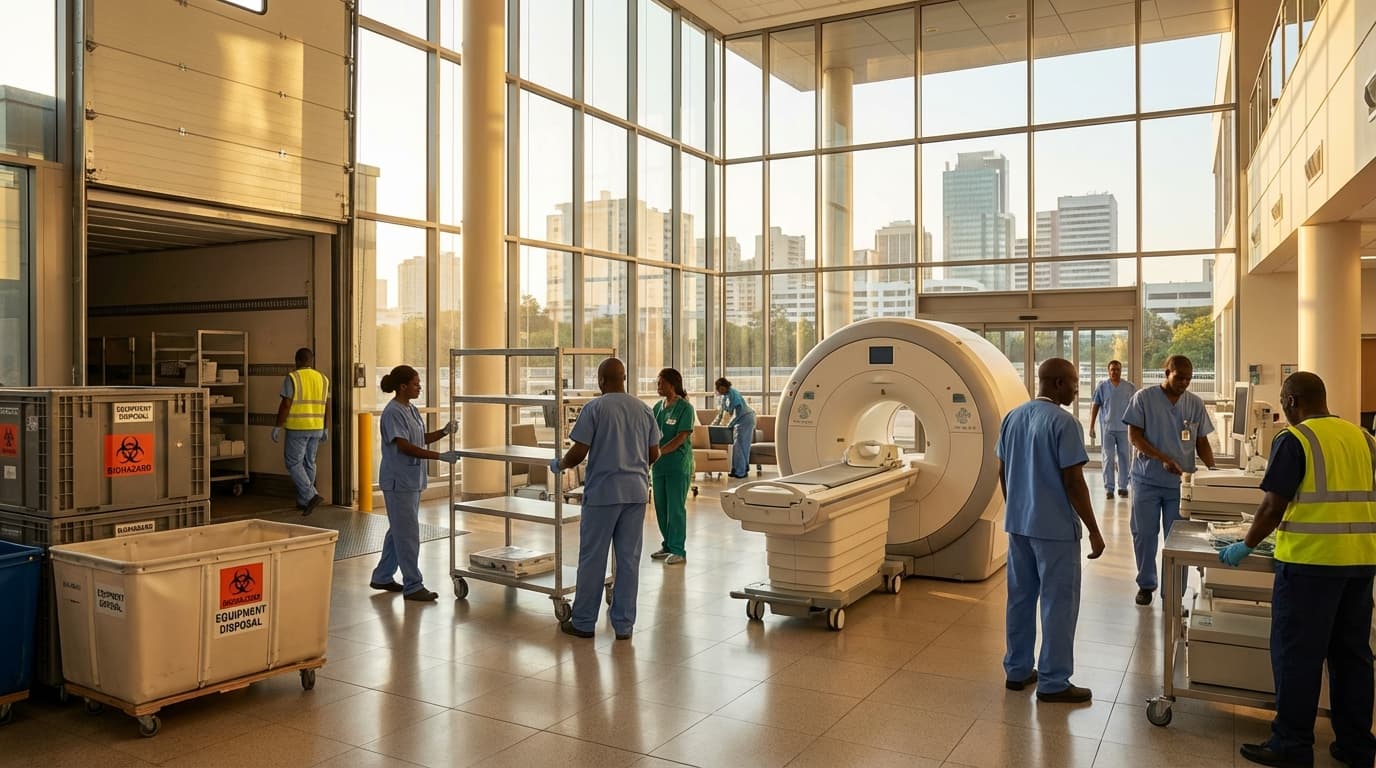
Heavy Medical Equipment De-Installation Service (MRI/CT/Cath Lab) in Djibouti
Engineering Excellence & Technical Support
Heavy Medical Equipment De-Installation Service (MRI/CT/Cath Lab) High-standard technical execution following OEM protocols and local regulatory frameworks.
Precision De-Installation of High-Value Imaging Systems
Our expert technicians specialize in the intricate de-installation of sensitive MRI, CT, and Cath Lab equipment. We employ advanced diagnostic tools and meticulous procedures to ensure the integrity of complex components, safeguarding your significant investment during relocation or upgrades.
Certified Rigging & Logistics for Large-Scale Medical Hardware
Navigating Djibouti's infrastructure, we provide certified rigging and specialized logistics for heavy medical equipment. Our trained personnel utilize purpose-built equipment and adherence to strict safety protocols, ensuring secure and compliant transportation of your MRI, CT, or Cath Lab systems.
Environmentally Conscious & Compliant Decommissioning
We are committed to responsible de-installation practices. Our service includes proper containment and disposal of hazardous materials, adherence to all local environmental regulations in Djibouti, and documentation for seamless decommissioning of your MRI, CT, or Cath Lab suites.
What Is Heavy Medical Equipment De-installation Service (Mri/ct/cath Lab) In Djibouti?
Heavy Medical Equipment De-Installation Service (MRI/CT/Cath Lab) in Djibouti refers to the specialized process of dismantling, preparing for transport, and safely removing large, complex, and high-value medical imaging and interventional systems from their installed locations within healthcare facilities in Djibouti. This service is crucial for asset relocation, facility upgrades, equipment decommissioning, or site closures. It requires meticulous planning, adherence to stringent safety protocols, and the expertise of technicians trained in handling sensitive and heavy-duty medical apparatus such as Magnetic Resonance Imaging (MRI) scanners, Computed Tomography (CT) scanners, and Cardiac Catheterization (Cath Lab) systems.
| Who Needs This Service? | Typical Use Cases | ||||
|---|---|---|---|---|---|
| Hospitals and Healthcare Institutions in Djibouti: Facilities undergoing renovations, relocating to new premises, or upgrading their imaging and interventional technology. | Medical Equipment Manufacturers and Distributors: When moving demonstration units, servicing equipment on-site, or decommissioning legacy systems. | Asset Management and Decommissioning Companies: Engaged by healthcare providers for end-of-life equipment removal or facility closures. | Government Health Ministries and Agencies: For managing public health infrastructure, relocating equipment between state-run facilities, or responding to emergency needs. | ||
| Facility Relocation: Moving an entire hospital or a specific department to a new physical location. | Equipment Upgrade/Replacement: Removing older MRI, CT, or Cath Lab systems to install newer, more advanced models. | Temporary Decommissioning: For extensive renovations or to free up space for temporary medical operations. | Site Closure or Consolidation: When a healthcare facility ceases operations or merges with another entity. | Export/Import Operations: Preparing specialized medical equipment for international shipment from or to Djibouti. | Insurance Claims and Asset Recovery: Safely dismantling and documenting equipment for insurance purposes or after an incident. |
Key Aspects of the Service
- Site Assessment and Planning: Comprehensive evaluation of the equipment's installation environment, including structural integrity, access routes, power requirements, and potential hazards. Detailed project planning encompassing timelines, resource allocation, and risk mitigation strategies.
- Disassembly and Component Segregation: Systematic deconstruction of the equipment into manageable components, adhering to manufacturer specifications and technical manuals. Careful segregation and labeling of all parts, cables, and accessories to ensure proper reassembly.
- Specialized Handling and Packaging: Utilization of appropriate lifting equipment (cranes, specialized dollies), anti-vibration measures, and protective packaging materials to safeguard delicate components during the de-installation process and subsequent transport.
- Environmental and Safety Compliance: Strict adherence to local Djiboutian regulations, international safety standards (e.g., radiation safety for CT/MRI), and waste disposal protocols. Management of hazardous materials if applicable.
- Documentation and Certification: Thorough documentation of the de-installation process, including photographic evidence, detailed logs, and certification of completion. This is essential for insurance, warranty claims, and future re-installation.
- Logistics Coordination: Collaboration with transportation providers to ensure secure and compliant movement of the de-installed equipment from the Djiboutian facility to its next destination.
Who Needs Heavy Medical Equipment De-installation Service (Mri/ct/cath Lab) In Djibouti?
In Djibouti, facilities that rely on advanced imaging and diagnostic technologies such as MRI, CT scanners, and Cath Labs will require specialized de-installation services. This is typically driven by several factors: equipment upgrades, relocation of facilities, or the decommissioning of older units. Professional de-installation ensures the safe, compliant, and efficient dismantling of these complex systems, minimizing downtime and potential damage.
| Customer Type | Key Departments Involved | Reasons for De-Installation |
|---|---|---|
| Hospitals (Public and Private) | Radiology Department, Cardiology Department, Imaging Services, Facilities Management, Procurement | Equipment upgrade to newer models, relocation of imaging suites, replacement of aging or faulty equipment, facility renovation or expansion. |
| Specialized Diagnostic Imaging Centers | Operations Management, Technical Staff, Administration | Ceasing operations of a particular modality, upgrading to higher resolution or faster scanners, relocation of the entire center. |
| Government Health Ministries/Agencies | Public Health Division, Medical Infrastructure Planning, Military Medical Services | National health infrastructure upgrades, deployment of new public hospitals, decommissioning of outdated government medical facilities, military base medical unit modifications. |
| International Aid Organizations/NGOs | Program Management (Healthcare), Logistics, Medical Staff | Project completion and withdrawal of equipment, shifting focus of medical interventions, upgrading existing field hospitals or clinics. |
| Research Institutions (if applicable) | Research Departments, Laboratory Management, Facilities | Transitioning to new research equipment, obsolescence of older research-grade imaging devices. |
| Medical Equipment Manufacturers/Distributors | Field Service Engineering, Sales/Account Management, Service Department | Executing service contracts for equipment removal, managing end-of-life equipment for refurbishment or disposal, supporting customer upgrades. |
Target Customers and Departments in Djibouti Needing Heavy Medical Equipment De-Installation
- Hospitals (Public and Private)
- Specialized Diagnostic Imaging Centers
- Government Health Ministries/Agencies (for public health initiatives or military hospitals)
- International Aid Organizations and NGOs with medical facilities
- Research Institutions (if applicable)
- Medical Equipment Manufacturers/Distributors (for service contracts or end-of-life management)
Heavy Medical Equipment De-installation Service (Mri/ct/cath Lab) Process In Djibouti
This document outlines the workflow for a Heavy Medical Equipment De-Installation Service, specifically for MRI, CT, and Cath Lab systems, within Djibouti. The process is designed to be comprehensive and efficient, ensuring minimal disruption and safe handling of sophisticated medical devices.
| Phase | Step | Description | Key Activities | Deliverables/Outcomes |
|---|---|---|---|---|
| Phase 1: Inquiry and Initial Consultation | 1.1 Initial Contact | The client (hospital, clinic, or medical facility) initiates contact to request de-installation services. | Phone call, email, or web inquiry. Understanding the client's immediate need and the type of equipment. | Initial understanding of client's requirements and contact information. |
| Phase 1: Inquiry and Initial Consultation | 1.2 Information Gathering | Collecting essential details about the equipment and the facility. | Requesting equipment make/model, serial numbers, current location, and brief reason for de-installation. Scheduling a preliminary discussion. | Preliminary equipment and facility overview. |
| Phase 2: Site Survey and Assessment | 2.1 On-Site Visit Scheduling | Arranging a visit by qualified technicians to the equipment's location. | Confirming date and time for the site survey, ensuring access to the equipment and surrounding areas. | Agreed-upon date and time for site survey. |
| Phase 2: Site Survey and Assessment | 2.2 Technical Assessment | Detailed evaluation of the equipment and its installation environment. | Assessing power requirements, cooling systems, structural integrity of the room, access routes for removal, cabling, safety protocols, and any potential site-specific challenges. | Comprehensive technical report on de-installation feasibility and requirements. |
| Phase 2: Site Survey and Assessment | 2.3 Risk Assessment | Identifying and mitigating potential risks during the de-installation process. | Evaluating electrical hazards, mechanical risks, potential for equipment damage, and personnel safety. Developing preliminary safety procedures. | Identified risks and proposed mitigation strategies. |
| Phase 3: Quotation and Contract Agreement | 3.1 Cost Estimation | Developing a detailed quotation based on the site survey findings. | Calculating labor costs, specialized tooling, potential disposal/recycling fees, transportation costs (if applicable), and any required permits or certifications. | Itemized cost breakdown for the de-installation service. |
| Phase 3: Quotation and Contract Agreement | 3.2 Proposal Submission | Presenting the formal quotation and service proposal to the client. | Includes scope of work, timeline, payment terms, terms and conditions, and liability clauses. | Formal service quotation and proposal document. |
| Phase 3: Contract Agreement | 3.3 Contract Finalization | Formalizing the agreement between the service provider and the client. | Negotiation of terms (if necessary) and signing of the service contract. Securing any required deposits. | Signed service contract and initial payment confirmation. |
| Phase 4: Project Planning and Scheduling | 4.1 Detailed Work Plan | Creating a precise plan for the de-installation process. | Defining specific tasks, timelines for each task, resource allocation (personnel, equipment), and contingency plans. | Detailed project execution plan. |
| Phase 4: Project Planning and Scheduling | 4.2 Scheduling Coordination | Aligning the de-installation schedule with the client's operational needs. | Confirming dates and times for de-installation, ensuring minimal disruption to ongoing hospital operations. Obtaining any necessary building access permits or notifications. | Agreed-upon de-installation schedule and necessary permits. |
| Phase 5: Pre-De-Installation Preparations | 5.1 Mobilization of Resources | Gathering all necessary tools, equipment, and personnel. | Ensuring specialized tools, safety gear, lifting equipment, and trained technicians are ready for deployment. | Ready and mobilized project team and equipment. |
| Phase 5: Pre-De-Installation Preparations | 5.2 Site Preparation | Preparing the immediate work area to ensure safety and efficiency. | Clearing the area, securing any sensitive equipment or infrastructure, setting up safety barriers and signage, and ensuring adequate lighting and ventilation. | Safe and prepared de-installation work zone. |
| Phase 5: Pre-De-Installation Preparations | 5.3 Equipment Shutdown and Isolation | Safely powering down and disconnecting the medical equipment. | Following manufacturer-specific procedures for safe shutdown, disconnecting power, water, and other essential services. Ensuring all residual energy is discharged. | Equipment safely powered down and isolated from all services. |
| Phase 6: Equipment De-Installation Execution | 6.1 Disassembly | Carefully dismantling the medical equipment. | Following manufacturer guidelines and best practices to disassemble the system into manageable components. Documenting each step with photographs and notes. | Disassembled equipment components. |
| Phase 6: Equipment De-Installation Execution | 6.2 Handling and Securing | Safely handling and securing each component for transport or storage. | Using appropriate lifting and handling equipment, ensuring components are properly padded, wrapped, and secured to prevent damage. | Securely packed and handled equipment components. |
| Phase 6: Equipment De-Installation Execution | 6.3 Site Cleanup | Restoring the de-installation area to its original condition. | Removing all tools, equipment, debris, and waste. Ensuring the area is clean and safe for its next use. | Cleaned and restored work area. |
| Phase 7: Post-De-Installation Procedures | 7.1 Final Site Inspection | A final check of the work area and equipment status. | Verifying that all equipment has been removed, the site is clean, and no damage has occurred. | Completion sign-off on site condition. |
| Phase 7: Post-De-Installation Procedures | 7.2 Documentation Review | Ensuring all project documentation is complete and accurate. | Reviewing photos, checklists, and any incident reports. | Completed project documentation. |
| Phase 8: Logistics and Transportation (if applicable) | 8.1 Packing and Labeling | Properly packing and labeling all de-installed components. | Ensuring each component is clearly labeled with its destination and handling instructions. | Systematically packed and labeled components for transport. |
| Phase 8: Logistics and Transportation (if applicable) | 8.2 Transportation Arrangement | Coordinating the safe transport of the equipment to its new location or disposal facility. | Arranging specialized vehicles, obtaining necessary shipping documents, and managing the transit process. | Equipment safely en route to its destination. |
| Phase 9: Final Documentation and Handover | 9.1 Project Completion Report | Providing a comprehensive report of the de-installation process. | Includes scope of work performed, dates, team involved, any issues encountered and resolutions, and confirmation of successful de-installation. | Official project completion report. |
| Phase 9: Final Documentation and Handover | 9.2 Invoice and Final Payment | Issuing the final invoice and receiving final payment. | Settling all financial obligations as per the contract. | Final invoice issued and payment received. |
| Phase 9: Final Documentation and Handover | 9.3 Client Sign-off | Obtaining formal confirmation from the client that the service has been completed to their satisfaction. | Client signature on the completion report and/or a separate satisfaction form. | Client sign-off indicating project completion. |
Service Workflow: Heavy Medical Equipment De-Installation (MRI/CT/Cath Lab) in Djibouti
- Inquiry and Initial Consultation
- Site Survey and Assessment
- Quotation and Contract Agreement
- Project Planning and Scheduling
- Pre-De-Installation Preparations
- Equipment De-Installation Execution
- Post-De-Installation Procedures
- Logistics and Transportation (if applicable)
- Final Documentation and Handover
Heavy Medical Equipment De-installation Service (Mri/ct/cath Lab) Cost In Djibouti
The cost of heavy medical equipment de-installation services for MRI, CT scanners, and Cath Labs in Djibouti is a complex matter influenced by several critical factors. These specialized services require skilled technicians, precise handling, and adherence to strict safety protocols. Therefore, pricing is not a simple flat rate but a dynamic reflection of the project's specific requirements. Understanding these factors is crucial for accurate budgeting and planning.
| Equipment Type | Estimated Cost Range (DJF) - Per Unit | Notes on Range Influences |
|---|---|---|
| MRI Scanner (Low to Mid-Field) | 750,000 - 1,500,000 | Complexity of magnet, gantry design, and dismantling requirements. Cryogen handling. |
| MRI Scanner (High-Field) | 1,200,000 - 2,500,000+ | Higher field strength implies more complex magnet, cryogen management, and heavier components. Extensive disassembly. |
| CT Scanner (Standard Slice) | 600,000 - 1,200,000 | Number of slices, size of gantry, and need for internal component removal. |
| CT Scanner (Multi-Slice/Advanced) | 900,000 - 1,800,000+ | More sophisticated detector arrays, faster rotation speeds, and intricate internal mechanisms. |
| Cath Lab (Angiography System) | 800,000 - 1,600,000 | Complexity of imaging chain, C-arm movement, patient table, and associated control consoles. |
| Cath Lab (Advanced Interventional Systems) | 1,200,000 - 2,200,000+ | Robotic positioning, advanced imaging modalities, and larger integrated systems. |
Key Pricing Factors for Medical Equipment De-Installation in Djibouti
- Equipment Type and Size: MRI machines, CT scanners, and Cath Labs vary significantly in their complexity, size, and weight. Larger and more intricate systems (like high-field MRI units or advanced multi-slice CT scanners) will naturally incur higher de-installation costs due to the need for specialized tools, more personnel, and extended labor time.
- Dismantling Complexity: The degree to which the equipment needs to be disassembled impacts the cost. Some systems may require extensive breakdown into smaller components for transportation, while others might be moved with minimal disassembly. The presence of cryogens in MRI machines, for example, adds a layer of complexity and specialized handling requirements.
- Site Accessibility and Logistics: The ease of access to the de-installation site within the hospital or clinic is a major cost driver. Narrow corridors, multiple floors, limited staging areas, or challenging building layouts can necessitate specialized lifting equipment (cranes, hoists) or extensive manual labor, all of which increase costs. The distance to the nearest accessible exit point also plays a role.
- Required Personnel and Expertise: De-installation of such sophisticated medical equipment demands highly trained and certified technicians with specific experience in handling these systems. The number of technicians required, their skill levels, and the duration of their engagement directly influence the labor costs. Specialized engineers might be needed for certain critical components.
- Tools and Equipment Required: Beyond standard tools, specialized equipment like heavy-duty lifting gear, climate-controlled transport containers, and precision measurement tools may be necessary. The rental or purchase of these specialized resources adds to the overall expense.
- Dismantling Duration and Working Hours: The time it takes to complete the de-installation is a primary cost determinant. Projects that require work during off-hours (nights, weekends, holidays) or involve extended working periods will generally be more expensive due to overtime pay and potential logistical challenges.
- Decommissioning and Disposal Procedures: If the de-installation includes the decommissioning and safe disposal of the equipment, particularly for older or hazardous components, these specialized waste management procedures will incur additional costs.
- Certification and Documentation: Ensuring all de-installation activities are properly documented and certified for compliance with regulatory standards or for insurance purposes can add to the administrative and labor costs.
- Geographic Location within Djibouti: While Djibouti is a relatively compact nation, transportation costs to more remote areas from major service hubs could slightly influence the final price, though this is generally a minor factor compared to the others.
Affordable Heavy Medical Equipment De-installation Service (Mri/ct/cath Lab) Options
Our affordable heavy medical equipment de-installation service specializes in the safe and efficient removal of MRI, CT, and Cath Lab systems. We understand that the cost of equipment relocation can be a significant concern, and we're committed to providing cost-effective solutions without compromising on safety or expertise. Our services are designed to minimize downtime and ensure a smooth transition for your facility. We offer flexible options to suit various budgets, including value bundles and strategic cost-saving measures.
| Value Bundle Option | Included Services | Potential Cost Savings |
|---|---|---|
| Standard De-Installation | Basic de-installation and preparation for transport. Includes disconnection of power and data lines, securing components, and basic disassembly. | Most economical option for straightforward de-installations where transport and disposal are handled separately. |
| Comprehensive De-Installation & Logistics Support | Includes Standard De-Installation plus coordination with your chosen transport provider, basic packaging, and waste disposal of non-reusable components. | Saves time and reduces coordination headaches by bundling logistics. Potential discounts when packaging and transport are managed through our network. |
| Full-Service Relocation Package (De-installation, Transport, & Re-installation) | Turnkey solution covering de-installation, professional crating and transport, and re-installation at the new location. | Significant cost savings through bundled services and optimized project management. Eliminates multiple vendor contracts and potential delays. |
Key Features of Our Affordable De-Installation Service:
- Expert de-installation of MRI, CT, and Cath Lab equipment.
- Emphasis on safety protocols and regulatory compliance.
- Experienced technicians with specialized training.
- Minimizing equipment downtime.
- Transparent pricing and detailed quotes.
- Customizable service packages to fit your needs.
Verified Providers In Djibouti
In Djibouti, accessing reliable and credentialed healthcare providers is paramount for individual well-being and public health. Franance Health stands out as a premier organization dedicated to ensuring that healthcare professionals operating within Djibouti meet stringent international standards. This commitment translates into a higher quality of care, improved patient safety, and greater trust in the healthcare system. Understanding the credentials of organizations like Franance Health is crucial for patients, employers, and the Djiboutian Ministry of Health in identifying and partnering with the best healthcare resources available.
| Credential Type | Franance Health Verification Process | Benefit to Patients in Djibouti |
|---|---|---|
| Medical Degrees and Licenses | Verification of authenticity with issuing institutions and confirmation of current, valid licenses in their respective jurisdictions. | Ensures practitioners possess the foundational education and legal authorization to practice medicine safely. |
| Specialized Training and Certifications | Independent validation of all postgraduate training, fellowships, and board certifications from recognized medical bodies. | Guarantees that specialists have advanced knowledge and skills in their chosen fields, leading to more accurate diagnoses and effective treatments. |
| Work Experience and References | Thorough reference checks with previous employers and a review of practice history to assess practical application of skills and professional conduct. | Provides confidence in the practitioner's real-world experience and ability to deliver consistent, high-quality care. |
| Adherence to Ethical Guidelines | Assessment of professional conduct records and commitment to established medical ethics and patient rights. | Protects patients from malpractice and ensures respectful, confidential, and patient-centered medical interactions. |
| Continuing Medical Education (CME) | Verification of participation in ongoing professional development activities and knowledge updates. | Confirms that providers are up-to-date with the latest medical advancements, research, and treatment protocols. |
Franance Health Credentials and Their Significance
- International Accreditation Standards: Franance Health aligns its vetting processes with globally recognized healthcare accreditation bodies. This ensures that providers adhere to best practices in patient care, facility management, and ethical conduct, which are often benchmarked against those of developed nations.
- Rigorous Professional Verification: Beyond basic licensing, Franance Health conducts in-depth verification of medical degrees, specialized training, certifications, and work history of all affiliated healthcare professionals. This process is designed to identify individuals with proven expertise and a commitment to ongoing professional development.
- Background Checks and Ethical Review: A critical component of Franance Health's credentialing involves thorough background checks and an assessment of the ethical standing of practitioners. This helps to mitigate risks associated with unqualified or unethical individuals entering the healthcare sector.
- Continuous Quality Monitoring: Franance Health doesn't just credential providers once; they implement systems for ongoing monitoring of performance and patient feedback. This proactive approach ensures sustained quality of care and allows for swift intervention if any issues arise.
- Partnerships with Reputable Institutions: Franance Health often collaborates with well-respected international and regional medical institutions for training, knowledge exchange, and advanced diagnostics. This fosters a culture of continuous improvement and access to cutting-edge medical advancements in Djibouti.
- Patient-Centric Approach: The core philosophy of Franance Health is to prioritize patient safety and satisfaction. Their rigorous credentialing process directly contributes to this by ensuring that patients are treated by competent, ethical, and well-trained healthcare professionals.
Scope Of Work For Heavy Medical Equipment De-installation Service (Mri/ct/cath Lab)
This Scope of Work (SOW) outlines the requirements for the de-installation of heavy medical equipment, specifically Magnetic Resonance Imaging (MRI) scanners, Computed Tomography (CT) scanners, and Cardiac Catheterization (Cath Lab) systems. The service encompasses all necessary steps from site preparation to the safe and compliant removal of the equipment, preparing it for transportation or storage. This SOW also details the technical deliverables and standard specifications that the service provider must adhere to. The objective is to ensure a seamless, safe, and efficient de-installation process that minimizes disruption and maintains the integrity of the equipment and the facility.
| Category | Specific Equipment Types | Standard Specifications & Requirements |
|---|---|---|
| Project Management & Planning | MRI/CT/Cath Lab | Development of a comprehensive de-installation plan including risk assessment, safety protocols, and resource allocation. Submission of a detailed timeline with key milestones. Regular progress reporting to the client. |
| Site Preparation & Access | MRI/CT/Cath Lab | Conducting a thorough pre-de-installation site survey to identify potential challenges (e.g., access routes, structural limitations, power requirements, RF shielding integrity for MRI). Obtaining necessary permits or approvals. Ensuring adequate lighting and clear access paths. |
| De-installation Process | MRI/CT/Cath Lab | Systematic dismantling of equipment following manufacturer guidelines and best practices. Safe disconnection of all power, data, water, and cooling lines. Securing and labeling all components and cables. Disassembly of major sub-assemblies (e.g., gantry, magnet, patient table, generator, console, X-ray tube for CT/Cath Lab). Special handling for cryogen removal (MRI) in accordance with safety regulations. |
| Component Handling & Protection | MRI/CT/Cath Lab | Careful handling of all removed parts to prevent damage. Utilizing appropriate protective coverings (e.g., padding, shrink wrap) for sensitive components. Proper packaging for transportation or storage. |
| Decommissioning & Disposal | MRI/CT/Cath Lab | Safe and environmentally compliant disposal of any hazardous materials (e.g., refrigerants, mercury switches if applicable). Proper segregation and disposal of non-reusable waste materials according to local and national regulations. |
| Safety & Compliance | MRI/CT/Cath Lab | Adherence to all relevant safety regulations (e.g., OSHA, local environmental agencies). Use of qualified and certified technicians. Provision of all necessary safety equipment (PPE). Ensuring RF shielding integrity is maintained or properly managed during MRI de-installation. |
| Documentation & Reporting | MRI/CT/Cath Lab | Comprehensive photographic and written records of the entire de-installation process. Accurate inventory of all removed parts. Completion certificates and waste disposal documentation. |
| Personnel Qualifications | MRI/CT/Cath Lab | Technicians must be experienced and certified in the de-installation of the specific medical equipment models. Proven track record with similar projects. Knowledge of radiation safety protocols (for CT/Cath Lab) and cryogen handling (for MRI). |
| Tools & Equipment | MRI/CT/Cath Lab | Provider must supply all specialized tools, lifting equipment, rigging, and transportation vehicles required for the safe and efficient de-installation and removal of heavy medical equipment. Includes diagnostic tools for verifying disconnection. |
Technical Deliverables
- Detailed de-installation plan and schedule.
- Pre-de-installation site survey report.
- De-installation progress reports (daily/weekly as agreed).
- Post-de-installation site condition report, confirming all connections are safely terminated and areas are clean.
- Detailed inventory of all removed components, including serial numbers and condition.
- Photographic documentation of the de-installation process, key stages, and final state.
- Transfer of Ownership/Responsibility documentation upon completion.
- De-installation completion certificate.
- Waste disposal manifests for any non-reusable materials.
- Compliance documentation for environmental and safety regulations.
Service Level Agreement For Heavy Medical Equipment De-installation Service (Mri/ct/cath Lab)
This Service Level Agreement (SLA) outlines the terms and conditions for the de-installation of heavy medical equipment, specifically MRI, CT, and Cath Lab systems. It defines response times for service requests and establishes uptime guarantees for related diagnostic imaging services during the de-installation process, where applicable and feasible. This SLA is intended to ensure minimal disruption and provide clear expectations for both the Service Provider and the Client.
| Service Component | Response Time Guarantee (Business Hours) | Uptime Guarantee (During Active De-installation Phase) |
|---|---|---|
| Initial Assessment & Scheduling Confirmation | Within 24 Business Hours of Service Request | Not Applicable |
| On-site Arrival of De-installation Team | Within 48 Business Hours of Scheduled Start Time (unless otherwise agreed) | Not Applicable |
| Service Interruption Management (for adjacent imaging services, if applicable and agreed) | N/A (Focus is on minimizing disruption) | 99.5% Uptime for adjacent, unaffected imaging services during active de-installation phase. This guarantee is contingent on no unforeseen external factors (e.g., power outages, building system failures) impacting the facility. |
| Post-De-installation Verification & Sign-off | Within 2 Business Hours of Completion of De-installation | Not Applicable |
| Urgent Technical Support (for critical issues during de-installation) | Within 4 Business Hours | Not Applicable |
Scope of Services
- Safe and professional de-installation of MRI (Magnetic Resonance Imaging) systems.
- Safe and professional de-installation of CT (Computed Tomography) scanners.
- Safe and professional de-installation of Cath Lab (Cardiac Catheterization Laboratory) systems.
- Disconnection and secure packaging of all components.
- Coordination with Client's facilities management and IT departments.
- Documentation of the de-installation process, including any pre-existing conditions.
- Adherence to all relevant safety regulations and manufacturer guidelines.
- Waste disposal of non-reusable components as per agreed terms.
Frequently Asked Questions

Ready when you are
Let's scope your Heavy Medical Equipment De-Installation Service (MRI/CT/Cath Lab) in Djibouti project in Djibouti.

Scaling healthcare logistics and technical systems across the entire continent.