
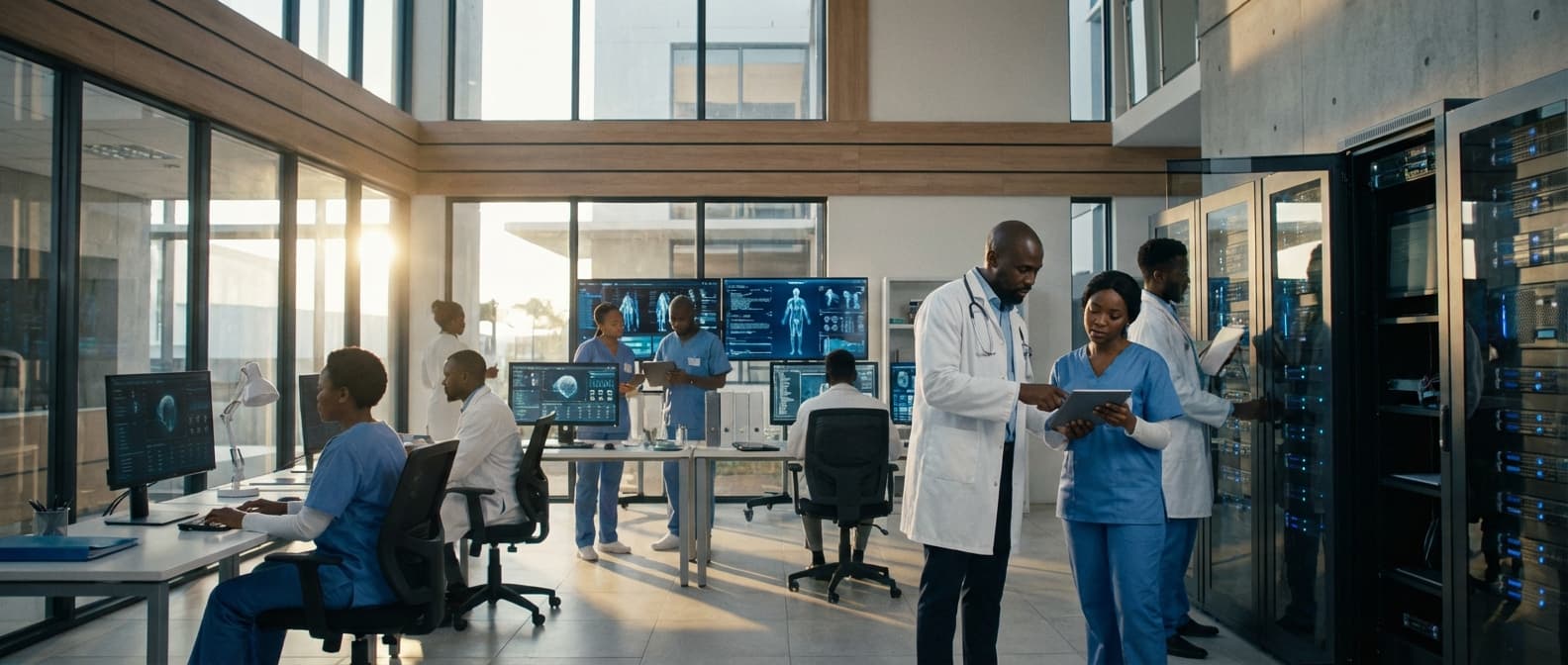
Medical IT Consultation in Djibouti
Engineering Excellence & Technical Support
Strategic technology consulting to optimize healthcare operations, streamline workflows, and integrate cutting-edge medical information systems. High-standard technical execution following OEM protocols and local regulatory frameworks.
Digital Transformation Roadmap for Healthcare Providers
We architect comprehensive IT strategies for Djiboutian healthcare facilities, guiding them through EHR/EMR implementation, data security enhancements, and the adoption of telemedicine solutions to improve patient care and operational efficiency.
Robust Cybersecurity & Data Privacy Frameworks
Ensuring compliance with international data protection standards (e.g., GDPR principles) and Djibouti's nascent regulations, we implement advanced cybersecurity measures and protocols to safeguard sensitive patient information from evolving threats.
Interoperability & Health Information Exchange (HIE) Solutions
Facilitating seamless data flow between disparate healthcare systems and government health registries within Djibouti, our expertise in HL7 and FHIR standards enables effective Health Information Exchange for better public health monitoring and coordinated patient care.
What Is Medical It Consultation In Djibouti?
Medical IT Consultation in Djibouti refers to the specialized provision of Information Technology (IT) services and strategic guidance tailored to the unique operational, regulatory, and infrastructural landscape of healthcare organizations within the Republic of Djibouti. This service encompasses the assessment, design, implementation, and optimization of IT systems and solutions to enhance patient care, improve operational efficiency, ensure data security and privacy, and support compliance with local and international healthcare standards.
| Who Needs Medical IT Consultation in Djibouti? | Typical Use Cases | ||
|---|---|---|---|
| Hospitals and Clinics (Public and Private): Seeking to modernize patient record systems, improve diagnostic imaging workflows, or enhance administrative efficiency. | Implementing an Electronic Health Record (EHR) system for digitized patient data management. | Deploying a PACS for efficient storage and retrieval of medical images. | Upgrading network infrastructure to support real-time data transfer and telemedicine initiatives. |
| Diagnostic Laboratories and Imaging Centers: Requiring robust IT solutions for sample tracking, result reporting, and image management. | Integrating Laboratory Information Systems (LIS) with hospital EHRs. | Implementing secure data sharing protocols for referring physicians. | Ensuring compliance with data integrity and audit trail requirements. |
| Government Health Agencies and Ministries: Aiming to establish national health information systems, improve public health surveillance, or enhance healthcare accessibility. | Developing a national health data repository for statistical analysis and policy-making. | Implementing telemedicine platforms to extend healthcare services to remote areas. | Establishing cybersecurity standards for public health IT systems. |
| Healthcare Startups and New Facilities: Needing to build a foundational IT infrastructure from the ground up. | Designing and implementing a complete IT ecosystem for a new medical facility. | Selecting and integrating EHR, billing, and practice management software. | Establishing a secure and scalable cloud infrastructure. |
| Non-Governmental Organizations (NGOs) and Humanitarian Organizations: Providing healthcare services in Djibouti and requiring efficient and reliable IT support. | Setting up mobile health clinics with integrated IT solutions. | Managing patient data in resource-constrained environments. | Ensuring secure communication channels for field operations. |
Key Components of Medical IT Consultation:
- Needs Assessment and Gap Analysis: Evaluating existing IT infrastructure, workflows, and technological capabilities against identified healthcare objectives and industry best practices.
- System Design and Architecture: Developing blueprints for integrated IT systems, including Electronic Health Records (EHR), Picture Archiving and Communication Systems (PACS), Laboratory Information Systems (LIS), and Picture Archiving and Communication Systems (PACS).
- Technology Selection and Procurement: Advising on the selection of appropriate hardware, software, and networking technologies that meet clinical, financial, and security requirements.
- Implementation and Integration: Overseeing the deployment, configuration, and seamless integration of new IT systems with existing infrastructure, ensuring interoperability between disparate systems.
- Data Management and Analytics: Establishing robust data governance policies, implementing data warehousing solutions, and leveraging analytics for clinical decision support, operational performance monitoring, and research.
- Cybersecurity and Data Privacy: Designing and implementing comprehensive security frameworks to protect sensitive patient data (PHI) from breaches, adhering to Djibouti's data protection regulations and international standards like HIPAA.
- Network Infrastructure and Connectivity: Optimizing wired and wireless network performance, ensuring reliable connectivity for critical healthcare applications, and addressing potential bandwidth limitations.
- Cloud Computing Strategy: Advising on the adoption of cloud-based solutions for scalability, cost-effectiveness, and enhanced accessibility of healthcare data and applications.
- Disaster Recovery and Business Continuity Planning: Developing strategies and implementing solutions to ensure the availability of IT systems and data in the event of disruptions.
- IT Policy and Governance Development: Creating and enforcing IT policies, procedures, and governance frameworks to ensure efficient, secure, and compliant IT operations.
- User Training and Support: Providing comprehensive training programs for healthcare professionals and IT staff to maximize the utilization and effectiveness of implemented technologies.
- Regulatory Compliance Assistance: Guiding organizations to comply with Djibouti's healthcare IT regulations and any relevant international standards.
Who Needs Medical It Consultation In Djibouti?
Djibouti's evolving healthcare landscape, driven by a commitment to improving patient care and operational efficiency, presents a growing need for specialized Medical IT Consultation. This consultancy service is crucial for organizations looking to leverage technology effectively to meet contemporary healthcare challenges and opportunities. From optimizing electronic health record (EHR) systems to implementing robust cybersecurity measures and exploring innovative telemedicine solutions, Medical IT Consultants provide the expertise to navigate complex technological decisions, ensuring alignment with strategic goals and regulatory requirements.
| Target Customer/Organization | Key Departments Requiring Consultation | Specific IT Needs/Challenges |
|---|---|---|
| Hospitals and Clinics (Public & Private) | IT Department, Clinical Operations, Administration, Finance, Radiology, Laboratory, Pharmacy | EHR/EMR implementation & optimization, network infrastructure, cybersecurity, data management, telemedicine integration, PACS/RIS, billing systems, patient portals. |
| Government Health Ministries & Agencies | Health Information Systems, Policy & Planning, Public Health Surveillance, Procurement | National health data strategy, interoperability standards, public health informatics, data security and privacy regulations, IT infrastructure for remote clinics. |
| Non-Governmental Organizations (NGOs) with Healthcare Programs | Program Management, Monitoring & Evaluation, Logistics, IT Support | Mobile health (mHealth) solutions, data collection and analysis tools, secure communication platforms, field IT support, cloud solutions for remote areas. |
| Pharmaceutical Companies & Medical Device Distributors | Sales & Marketing, Supply Chain, Research & Development, IT Department | Customer Relationship Management (CRM) systems, supply chain management software, data analytics for market insights, secure data sharing with healthcare providers. |
| Research Institutions | Data Management, Research IT Support, Bioinformatics | Secure data storage and analysis platforms, high-performance computing, research data management plans, collaboration tools. |
| Specialty Healthcare Centers (e.g., Dialysis Centers, Diagnostic Labs) | Clinical Operations, IT Department, Administration | Specialized software for patient management, data reporting, equipment integration, workflow optimization, compliance with specific healthcare standards. |
Target Customers and Departments for Medical IT Consultation in Djibouti:
- Hospitals and Clinics (Public & Private)
- Government Health Ministries & Agencies
- Non-Governmental Organizations (NGOs) with Healthcare Programs
- Pharmaceutical Companies & Medical Device Distributors
- Research Institutions
- Specialty Healthcare Centers
Medical It Consultation Process In Djibouti
The Medical IT Consultation Process in Djibouti outlines the structured approach undertaken by IT consulting firms to address the unique technological needs of healthcare organizations within Djibouti. This workflow ensures a comprehensive and efficient engagement, from the initial client contact to the successful implementation of IT solutions.
| Stage | Description | Key Activities | Deliverables |
|---|---|---|---|
| Inquiry & Initial Contact | The client (a healthcare facility in Djibouti) expresses interest in IT consulting services. | Receiving inquiry (phone, email, website), initial communication, understanding basic requirements. | Acknowledgement of inquiry, preliminary meeting scheduled. |
| Needs Assessment & Discovery | In-depth understanding of the client's current IT infrastructure, challenges, and future goals. | On-site or remote meetings, interviews with stakeholders, system audits, workflow analysis, identification of pain points. | Detailed needs assessment report, gap analysis, documentation of current IT landscape. |
| Proposal Development & Presentation | Formulating a tailored IT solution and presenting it to the client. | Developing customized solutions (e.g., EMR implementation, network upgrades, cybersecurity), cost estimation, timeline projection, presenting the proposal. | Formal IT consulting proposal, including scope of work, methodologies, timelines, and pricing. |
| Contract Negotiation & Signing | Finalizing the terms and conditions of the engagement. | Reviewing the proposal, negotiating fees, payment terms, service level agreements (SLAs), signing the contract. | Signed consulting agreement, statement of work (SOW). |
| Project Planning & Scoping | Establishing a detailed roadmap for the project's execution. | Defining project objectives, deliverables, milestones, resource allocation, risk management plan, communication plan. | Project plan, detailed scope document, stakeholder register. |
| Solution Design & Architecture | Developing the technical blueprint for the proposed IT solution. | Designing system architecture, selecting appropriate technologies, ensuring compliance with Djibouti's healthcare regulations, creating technical specifications. | Technical design documents, system architecture diagrams, technology stack recommendations. |
| Implementation & Deployment | Putting the designed IT solution into practice. | Installing hardware/software, configuring systems, migrating data, integrating with existing systems, adhering to deployment schedules. | Installed and configured IT systems, deployed software solutions. |
| Testing & Quality Assurance | Ensuring the implemented solution functions correctly and meets requirements. | Unit testing, integration testing, user acceptance testing (UAT), performance testing, security testing. | Test cases, test reports, UAT sign-off. |
| Training & Knowledge Transfer | Equipping the client's staff to effectively use and manage the new IT systems. | Developing training materials, conducting training sessions, providing user manuals, empowering internal IT teams. | Training manuals, trained personnel, knowledge transfer documentation. |
| Post-Implementation Support & Evaluation | Providing ongoing assistance and assessing the success of the project. | Bug fixing, system monitoring, performance tuning, gathering feedback, project performance review, recommendations for future enhancements. | Post-implementation review report, ongoing support agreement, success metrics evaluation. |
Key Stages of the Medical IT Consultation Process in Djibouti
- Inquiry & Initial Contact
- Needs Assessment & Discovery
- Proposal Development & Presentation
- Contract Negotiation & Signing
- Project Planning & Scoping
- Solution Design & Architecture
- Implementation & Deployment
- Testing & Quality Assurance
- Training & Knowledge Transfer
- Post-Implementation Support & Evaluation
Medical It Consultation Cost In Djibouti
Consulting on medical IT in Djibouti involves a range of factors that influence the final cost. These factors can include the complexity of the project, the specific services required, the duration of the engagement, and the experience level of the IT consultant or firm. Projects might range from setting up basic electronic health record (EHR) systems to implementing advanced telemedicine solutions, cybersecurity enhancements, or data analytics platforms for healthcare providers. The demand for specialized medical IT expertise within Djibouti also plays a role in pricing. Given these variables, it's important to understand the typical pricing structures and the elements that contribute to the overall investment.
| Service Type | Estimated Price Range (DJF - Djibouti Francs) | Notes |
|---|---|---|
| Initial IT Needs Assessment & Strategy Development | 150,000 - 400,000 | Covers analysis of current infrastructure, identifying gaps, and outlining a roadmap. |
| EHR/EMR System Implementation Consultation | 300,000 - 1,500,000+ | Depends on the size of the clinic/hospital and the chosen EHR system. Includes planning, configuration, and initial training support. |
| Network Infrastructure Design & Setup | 200,000 - 750,000 | For new setups or upgrades, focusing on reliability and security for medical devices and data. |
| Cybersecurity Assessment & Implementation | 250,000 - 1,000,000+ | Includes vulnerability testing, policy development, and implementation of security solutions to protect patient data. |
| Telemedicine Solution Consultation & Integration | 350,000 - 1,200,000+ | Advising on platforms, hardware, and integration for remote patient care. |
| Data Management & Analytics Consultation | 200,000 - 600,000 | Focuses on organizing, securing, and deriving insights from healthcare data. |
| IT Support & Maintenance Strategy | 100,000 - 300,000 (per month retainer) | Ongoing support planning and service level agreement (SLA) definition. |
Key Pricing Factors for Medical IT Consultation in Djibouti
- Project Scope and Complexity: Larger, more intricate projects requiring integration of multiple systems or development of custom solutions will naturally incur higher costs.
- Services Required: Specific needs like EHR implementation, network infrastructure setup, cybersecurity audits, data migration, software development, or training will have varying price points.
- Consultant's Experience and Reputation: Highly experienced consultants or established IT firms with a proven track record in the healthcare sector often command higher fees.
- Project Duration: The length of the consultation engagement, whether it's a short-term advisory role or a long-term project management, directly impacts the total cost.
- Technology Stack: The specific hardware, software, and cloud services involved can influence the consultancy fees, especially if specialized knowledge is required.
- Data Security and Compliance: Implementing robust data security measures and ensuring compliance with relevant healthcare regulations (e.g., patient data privacy) can add to the complexity and cost.
- Location and Travel (if applicable): While consultations might be remote, on-site visits for assessment or implementation will involve travel and accommodation expenses.
- Urgency of the Project: Expedited projects might incur premium charges for rapid deployment or resource allocation.
Affordable Medical It Consultation Options
Navigating the complexities of Medical IT can be daunting for healthcare organizations, especially when budget is a primary concern. Fortunately, there are affordable consultation options available that provide significant value. Understanding different service models, such as value bundles and implementing strategic cost-saving measures, can make professional IT guidance accessible and impactful for clinics, hospitals, and other healthcare providers.
| Cost-Saving Strategy | Description | Benefits for Healthcare IT Consultation |
|---|---|---|
| Define Clear Project Scope | Precisely outline the objectives, deliverables, and timeline for any IT consultation project. Ambiguity leads to scope creep and increased costs. | Prevents unnecessary work, ensures focus on critical needs, and provides budget predictability. |
| Prioritize Needs | Identify the most critical IT challenges and opportunities that will yield the greatest return on investment for your healthcare organization. | Allocates limited consultation budget to areas with the highest impact on patient care, compliance, or operational efficiency. |
| Leverage Open-Source Solutions | Explore the feasibility of open-source software for certain IT functions where applicable and secure. | Can reduce licensing fees, and consultation can focus on integration and customization rather than initial software purchase. |
| Batch Similar Consultations | If multiple IT needs arise, try to bundle them into a single consultation engagement for efficiency and potential volume discounts. | Reduces administrative overhead and can lead to more integrated solutions by addressing related issues together. |
| Seek Referrals and Compare Quotes | Ask for recommendations from other healthcare organizations and obtain multiple quotes from different IT consulting firms. | Ensures competitive pricing and allows for selection of a consultant with a proven track record and fair pricing structure. |
| Focus on Preventive Measures | Invest in consultations that focus on proactive IT security, disaster recovery planning, and system maintenance to avoid costly downtime and breaches. | Minimizes future reactive expenditures and protects patient data and operational continuity. |
Key Affordable Medical IT Consultation Options & Strategies
- {"title":"Value Bundles","description":"These are pre-packaged service offerings that combine multiple IT consultation services at a discounted rate compared to individual engagements. They are designed to address common healthcare IT needs comprehensively."}
- {"title":"On-Demand Consulting","description":"Instead of retaining a consultant full-time, engage experts on an as-needed basis for specific projects or urgent issues. This offers flexibility and cost control."}
- {"title":"Remote Consultation","description":"Leverage virtual meetings, screen sharing, and remote access tools to receive expert advice without incurring travel expenses. This is highly effective for many IT strategy and problem-solving tasks."}
- {"title":"Project-Based Engagements","description":"Define a clear scope and objective for a specific IT project (e.g., EHR implementation, cybersecurity audit, cloud migration) and hire consultants for that defined period. This provides cost certainty."}
- {"title":"Retainer Agreements (for specific needs)","description":"While often associated with ongoing support, some consultants offer affordable retainer options for a limited number of hours per month, focusing on strategic advisory or proactive monitoring."}
- {"title":"Vendor-Agnostic Consultants","description":"Seek consultants who are not tied to specific software or hardware vendors. They can provide objective advice tailored to your organization's unique needs and budget, rather than pushing proprietary solutions."}
- {"title":"Internal Skill Development","description":"Some consultations focus on training and empowering your internal IT staff, reducing the long-term reliance on external consultants."}
Verified Providers In Djibouti
When seeking healthcare services in Djibouti, particularly those requiring specialized medical expertise, identifying 'Verified Providers' is paramount. This designation signifies that a healthcare professional or institution has undergone rigorous checks to ensure their qualifications, adherence to ethical standards, and the quality of their services. Among these esteemed verified providers, Franance Health stands out. Their commitment to excellence, comprehensive credentialing processes, and patient-centered approach make them an exceptional choice for your healthcare needs in Djibouti.
| Credential Type | Verification Process | Franance Health's Assurance |
|---|---|---|
| Medical Licenses & Board Certifications | Cross-referenced with Djibouti's Ministry of Health and international licensing bodies. | Franance Health ensures all practitioners hold valid, up-to-date licenses and recognized board certifications in their respective specialties. |
| Educational Background & Training | Verification of degrees, diplomas, and residency program completion. | We meticulously review academic transcripts and training records to confirm the highest level of medical education and specialized training. |
| Professional Experience | Reference checks and verification of past employment and practice history. | Franance Health validates the professional experience of our providers, ensuring they have a proven track record of successful patient care. |
| Ethical Conduct & Disciplinary History | Background checks and inquiries with relevant professional bodies and regulatory agencies. | Our commitment to ethical practice is unwavering. We conduct thorough checks to ensure providers have a clean disciplinary record. |
| Specialized Skills & Competencies | Assessment of specific procedural competencies and advanced skill certifications. | Franance Health identifies and recruits providers with verified expertise in niche medical areas, offering advanced treatment options. |
Why Franance Health Credentials Matter:
- Rigorous Verification of Medical Licenses and Certifications
- Emphasis on Continuing Professional Development and Specialization
- Adherence to International Healthcare Standards and Best Practices
- Thorough Background Checks and Ethical Conduct Reviews
- Commitment to Patient Safety and Confidentiality
- Demonstrated Experience and Proven Patient Outcomes
Scope Of Work For Medical It Consultation
This Scope of Work (SOW) outlines the services to be provided by [Consultant Name] (hereinafter referred to as 'Consultant') to [Client Name] (hereinafter referred to as 'Client') for Medical IT Consultation. The objective of this consultation is to assess, strategize, and implement technological solutions that enhance the Client's healthcare operations, patient care, data security, and regulatory compliance.
| Technical Deliverable | Description | Standard Specifications/Acceptance Criteria |
|---|---|---|
| Network Infrastructure Assessment Report | A comprehensive evaluation of the Client's current network hardware, software, and configurations. This includes identification of bottlenecks, security vulnerabilities, and areas for performance improvement. | Report includes detailed network topology diagrams, performance metrics (e.g., latency, bandwidth utilization), security audit findings, and prioritized recommendations for upgrades or optimizations. Must be presented in PDF format. |
| EHR System Recommendation and Implementation Roadmap | Analysis of the Client's existing EHR or selection of a new EHR system, including a phased implementation plan. | Documented comparison of potential EHR systems based on client needs (features, cost, interoperability, usability), and a detailed project plan outlining phases, timelines, resource allocation, and key milestones for implementation. Delivered as a comprehensive proposal document. |
| Cybersecurity Risk Assessment and Mitigation Plan | Identification of current cybersecurity threats, vulnerabilities, and development of a strategic plan to address them. | A detailed report outlining identified risks, their potential impact, and a prioritized list of actionable mitigation strategies. Includes recommendations for firewalls, intrusion detection/prevention systems, endpoint security, and employee training. Presented in PDF format. |
| HIPAA Compliance Gap Analysis and Remediation Plan | Assessment of the Client's adherence to HIPAA regulations and a plan to address any identified gaps. | A report detailing current compliance status against HIPAA Security Rule and Privacy Rule requirements, including specific recommendations for policy updates, technical controls, and administrative procedures to achieve and maintain compliance. Delivered as a PDF report. |
| Telehealth/Remote Patient Monitoring Strategy | Development of a strategy for implementing or optimizing telehealth and remote patient monitoring services. | A proposal outlining recommended technologies, workflows, integration points with existing systems, patient engagement strategies, and compliance considerations for telehealth and RPM. Presented in a business case format (PDF). |
| Cloud Adoption Strategy Document | Guidance on leveraging cloud technologies for healthcare data storage, management, and applications. | A strategic document detailing cloud service models (IaaS, PaaS, SaaS), vendor recommendations, migration strategy, security considerations, and cost-benefit analysis. Must adhere to relevant healthcare cloud security standards (e.g., HITRUST CSF). In PDF format. |
| IT Policies and Procedures Manual | Development of essential IT policies and procedures tailored to the healthcare environment. | A comprehensive manual including policies for data access, acceptable use, incident response, change management, and system administration. Must align with industry best practices and regulatory requirements. Delivered as editable Word documents and a compiled PDF. |
| Disaster Recovery and Business Continuity Plan (DR/BCP) | Creation of a plan to ensure operational continuity in the event of a disaster or significant disruption. | A documented plan outlining critical business functions, RTO (Recovery Time Objective) and RPO (Recovery Point Objective) for IT systems, backup strategies, recovery procedures, and communication protocols. Must be tested or have a clear testing plan. Delivered in editable Word and PDF formats. |
Key Areas of Medical IT Consultation
- Network Infrastructure Assessment and Optimization
- Electronic Health Record (EHR) System Evaluation and Implementation Strategy
- Cybersecurity and Data Protection Strategy
- HIPAA Compliance and Risk Assessment
- Telehealth and Remote Patient Monitoring Solutions
- Cloud Computing Strategy for Healthcare Data
- IT Policy and Procedure Development
- Disaster Recovery and Business Continuity Planning
- Vendor Selection and Management for IT Solutions
Service Level Agreement For Medical It Consultation
This Service Level Agreement (SLA) outlines the commitment of [IT Consultation Provider Name] ('Provider') to [Client Name] ('Client') regarding the provision of medical IT consultation services. It defines response times for support requests and uptime guarantees for critical IT systems managed by the Provider.
| Service Type | Severity Level | Target Response Time (During Service Hours) | Target Response Time (Outside Service Hours - Emergency Only) | Target Uptime Guarantee |
|---|---|---|---|---|
| Medical IT Consultation & Support | Critical Incident | 1 hour | 2 hours | 99.9% Monthly |
| Medical IT Consultation & Support | Non-Critical Incident | 4 business hours | N/A | N/A (Uptime applies to managed systems) |
| Managed Server Infrastructure | N/A (System Uptime) | N/A | N/A | 99.9% Monthly |
| Managed Network Infrastructure | N/A (System Uptime) | N/A | N/A | 99.9% Monthly |
| Managed EHR/EMR System Availability | N/A (System Uptime) | N/A | N/A | 99.95% Monthly |
Key Definitions
- Service Hours: Standard business hours from 9:00 AM to 5:00 PM, Monday through Friday, excluding public holidays in [Client's Region].
- Emergency Support: Support required for Critical Incidents (as defined below).
- Routine Support: Support required for Non-Critical Incidents or general inquiries.
- Critical Incident: An event that causes a complete outage or significant degradation of essential IT services, preventing the provision of patient care or critical business operations. Examples include server outages, network failures impacting all users, or critical application inaccessibility.
- Non-Critical Incident: An event that causes a minor disruption to non-essential IT services or affects a limited number of users, without directly impacting patient care. Examples include a single workstation issue, minor software glitches, or printer problems.
- Uptime: The percentage of time that a specified IT system or service is available and operational for use.
- Downtime: The percentage of time that a specified IT system or service is unavailable or non-operational.
- Response Time: The maximum time within which the Provider will acknowledge a support request and commence work on resolving the issue.
- Resolution Time: The target time within which the Provider aims to resolve a reported incident. Please note that resolution time is an objective and not a guarantee, as complex issues may require extended investigation and third-party involvement.
Frequently Asked Questions

Ready when you are
Let's scope your Medical IT Consultation in Djibouti project in Djibouti.

Scaling healthcare logistics and technical systems across the entire continent.