
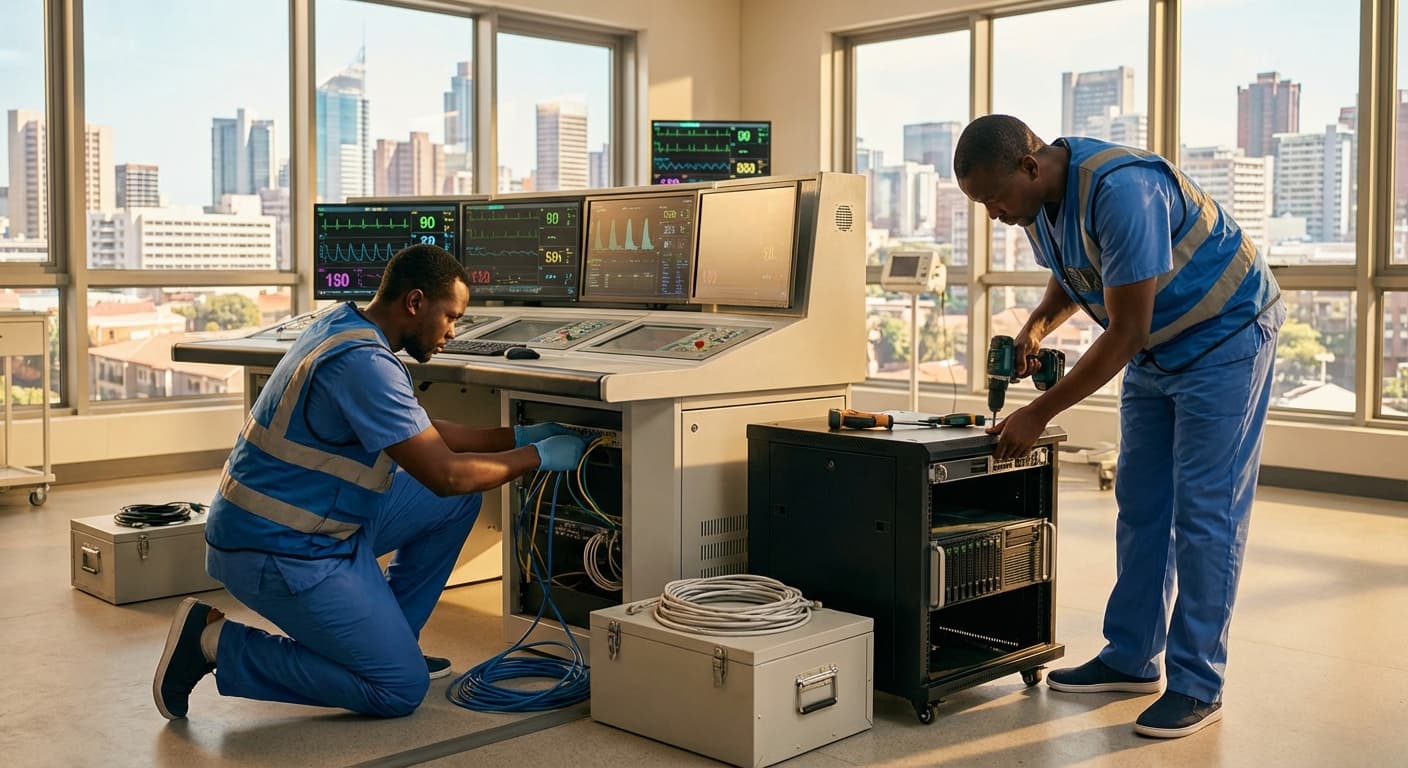
ICU Central Monitoring Station Installation Service in Djibouti
Engineering Excellence & Technical Support
ICU Central Monitoring Station Installation Service High-standard technical execution following OEM protocols and local regulatory frameworks.
High-Availability Network Infrastructure
We deploy robust, redundant network cabling and switching solutions to ensure uninterrupted data flow from patient monitors to the Central Monitoring Station, guaranteeing critical real-time vital sign transmission even in the event of component failure.
Scalable Server & Storage Architecture
Our installations feature enterprise-grade servers and scalable storage solutions, meticulously configured to handle the immense volume of patient data generated by the ICU, ensuring secure, long-term data retention and fast retrieval for clinical analysis and historical tracking.
Secure Data Integration & Cybersecurity
We implement advanced data encryption and access control protocols, seamlessly integrating patient data from diverse monitoring devices into a unified, secure platform, thereby safeguarding sensitive patient information against unauthorized access and cyber threats in accordance with Djibouti's healthcare data regulations.
What Is Icu Central Monitoring Station Installation Service In Djibouti?
ICU Central Monitoring Station Installation Service in Djibouti refers to the comprehensive process of setting up and integrating a centralized monitoring system for Intensive Care Units (ICUs) within healthcare facilities in Djibouti. This service encompasses the physical installation of monitoring hardware, network infrastructure, software deployment, system configuration, calibration, testing, and initial user training. The objective is to provide a unified platform for real-time observation and data aggregation of critical patient parameters from multiple ICU beds, enhancing clinical decision-making, improving patient outcomes, and optimizing resource utilization.
| Who Needs This Service? | Typical Use Cases | |||||
|---|---|---|---|---|---|---|
| Hospitals and Healthcare Facilities in Djibouti: All medical institutions with Intensive Care Units (ICUs), including public hospitals, private clinics, and specialized medical centers. | New ICU Construction or Expansion: Establishing a new central monitoring system as part of a newly built or expanded ICU ward. | Upgrade or Replacement of Existing Systems: Replacing outdated or malfunctioning central monitoring stations with modern, integrated solutions. | Enhancement of Patient Monitoring Capabilities: Facilities seeking to improve the quality and efficiency of patient care in critical care settings. | Compliance with Healthcare Standards: Meeting national and international standards for critical care patient monitoring and data management. | ||
| Real-time Patient Parameter Monitoring: Continuous observation of vital signs (heart rate, blood pressure, respiratory rate, oxygen saturation, temperature) from multiple patients simultaneously. | Centralized Alarm Management: Consolidated and prioritized alarm notifications to reduce alarm fatigue and ensure timely clinical response to critical events. | Longitudinal Patient Data Trending: Tracking patient physiological data over time to identify subtle changes, assess treatment efficacy, and predict potential complications. | Interdisciplinary Communication and Collaboration: Facilitating seamless sharing of patient data and insights among the critical care team. | Performance Monitoring and Quality Improvement: Utilizing aggregated data for operational efficiency analysis, identifying areas for improvement in patient care protocols. | Research and Data Analysis: Accessing historical patient data for clinical research and evidence-based practice development. | Remote Monitoring Capabilities (Optional): Enabling off-site or remote access to patient data by specialists, particularly in areas with limited on-site expertise. |
Key Components and Phases of ICU Central Monitoring Station Installation Service:
- Site Assessment and Design: Evaluating the existing ICU infrastructure, network capabilities, power supply, and spatial requirements to design an optimal central monitoring station layout and network topology.
- Hardware Procurement and Installation: Sourcing and physically installing central monitoring consoles, servers, network switches, cabling, and patient monitoring devices (e.g., ECG, SpO2, NIBP, invasive pressure monitors) at each bed station. This includes ensuring proper grounding and power conditioning.
- Network Infrastructure Setup: Establishing a robust and secure local area network (LAN) or wireless network (WLAN) to facilitate seamless data transmission between patient monitors and the central station. This may involve configuring routers, firewalls, and network protocols.
- Software Deployment and Configuration: Installing and configuring the central monitoring software, including patient data management systems, alarm management modules, trend analysis tools, and interfaces for integration with Electronic Health Records (EHRs).
- System Integration and Calibration: Connecting and configuring individual patient monitors to the central station, ensuring accurate data acquisition and display. This involves calibrating sensors and verifying data integrity.
- Alarm System Configuration: Setting up patient-specific and unit-wide alarm parameters, thresholds, and notification protocols to alert clinical staff to critical events.
- Testing and Validation: Conducting rigorous testing of all system components, including data transmission, alarm functionality, software performance, and network stability, to ensure compliance with clinical requirements and safety standards.
- User Training and Handover: Providing comprehensive training to clinical staff (physicians, nurses, biomedical engineers) on the operation, maintenance, and troubleshooting of the central monitoring system. Formal handover of the operational system to the facility's IT and biomedical departments.
- Post-Installation Support and Maintenance: Offering ongoing technical support, software updates, and maintenance services to ensure the long-term functionality and reliability of the central monitoring station.
Who Needs Icu Central Monitoring Station Installation Service In Djibouti?
The installation of an ICU Central Monitoring Station (CMS) is a critical infrastructure upgrade for healthcare facilities. In Djibouti, several types of organizations and departments would significantly benefit from this advanced technology to enhance patient care, improve clinical efficiency, and ensure timely medical interventions. This service is essential for facilities aiming to provide high-level critical care.
| Customer Type | Typical Size/Scope | Specific Needs Addressed by CMS | Key Departments Involved |
|---|---|---|---|
| Government Hospitals | Large, often the primary public healthcare providers | Centralized patient monitoring, improved resource allocation, data for public health initiatives, training of medical staff. | ICU, CCU, NICU, PICU, ED |
| Private Hospitals | Varying sizes, often focused on specialized or premium care | Enhanced patient safety, competitive advantage, efficient nurse-to-patient ratios, advanced diagnostic capabilities. | ICU, CCU, PACU |
| Large Healthcare Complexes | Multi-specialty facilities with significant bed capacity | Integration of monitoring across multiple critical care units, seamless data flow, comprehensive patient records. | ICU, CCU, NICU, PICU, PACU, ED |
| Military Hospitals | Serve military personnel and their families, often handle trauma cases | Reliable monitoring in potentially high-stress environments, rapid response capabilities, management of critical injuries. | ICU, ED |
| International Aid Organization-funded Hospitals | Often established to provide essential services in underserved areas or for specific health crises | Standardization of care, long-term sustainability of critical care services, training support, efficient use of donor resources. | ICU, NICU, PICU, ED |
| Tertiary Care Centers | Hospitals offering highly specialized medical services | Advanced monitoring for complex cases, integration with other specialized diagnostic and treatment equipment, research capabilities. | ICU, CCU, NICU, PICU |
Target Customers and Departments for ICU Central Monitoring Station Installation Service in Djibouti
- {"items":["Government Hospitals","Private Hospitals","Large Healthcare Complexes","Military Hospitals","International Aid Organization-funded Hospitals","Tertiary Care Centers"],"title":"Target Customers"}
- {"items":["Intensive Care Units (ICUs)","Coronary Care Units (CCUs)","Neonatal Intensive Care Units (NICUs)","Pediatric Intensive Care Units (PICUs)","Post-Anesthesia Care Units (PACUs)","Emergency Departments (EDs) with high acuity patients"],"title":"Key Departments Benefiting from CMS Installation"}
Icu Central Monitoring Station Installation Service Process In Djibouti
This document outlines the detailed workflow for the ICU Central Monitoring Station Installation Service Process in Djibouti, from initial inquiry to successful execution. It covers all stages to ensure clarity, efficiency, and client satisfaction.
| Phase | Stage | Description | Key Activities | Deliverables/Outcomes | Timeline (Indicative) |
|---|---|---|---|---|---|
| Phase 1 | Inquiry & Pre-Sales | Initial contact from client expressing interest in ICU central monitoring station installation. | Receive and acknowledge inquiry, understand client's basic requirements, conduct preliminary needs assessment (if possible remotely or via initial call), provide initial consultation and scope definition, prepare and submit preliminary proposal/quotation. | Acknowledged inquiry, understood basic requirements, preliminary proposal/quotation. | 1-3 Business Days |
| Phase 1 | Site Visit & Detailed Requirements Gathering | On-site assessment of the client's facility in Djibouti. | Conduct thorough site survey, assess existing infrastructure (power, network, space), identify specific monitoring needs, discuss integration with existing systems, finalize detailed technical requirements and specifications. | Detailed site survey report, finalized technical specifications, revised proposal/quotation. | 3-7 Business Days (depending on travel and site complexity) |
| Phase 2 | System Design & Planning | Developing the detailed engineering and implementation plan. | Develop detailed system architecture and layout, create network topology diagrams, design power and data cabling plans, plan for hardware placement and integration, develop a comprehensive project execution plan (including resource allocation and scheduling). | System design documents, network diagrams, cabling plans, project execution plan. | 5-10 Business Days |
| Phase 2 | Client Approval & Contract Finalization | Formalizing the agreement and securing client sign-off. | Present detailed design and project plan to the client, address any client queries or concerns, obtain formal client approval of the design and plan, finalize contract and payment terms. | Approved system design, signed contract, confirmed payment schedule. | 3-5 Business Days |
| Phase 3 | Procurement of Equipment | Acquiring all necessary hardware and software components. | Source and order all specified monitoring equipment, servers, workstations, cabling, and accessories from approved vendors. | Procured equipment list, purchase orders, vendor confirmations. | Varies based on lead times (typically 2-6 weeks) |
| Phase 3 | Logistics & Shipment to Djibouti | Transporting the procured equipment to the installation site. | Arrange for secure packaging, customs clearance procedures, international shipping to Djibouti, and local transportation to the hospital/clinic. | Shipped equipment, customs clearance documentation, proof of delivery. | Varies based on shipping method (typically 1-4 weeks) |
| Phase 4 | Site Preparation | Ensuring the installation environment is ready. | Prepare the designated area for the central monitoring station, including any necessary structural modifications, ensuring adequate power supply and ventilation, and establishing network connectivity points. | Prepared installation site. | 2-3 Business Days (concurrent with equipment arrival) |
| Phase 4 | Installation of Hardware | Physically installing all equipment. | Mount servers, workstations, displays, and other hardware; install all required data and power cabling; connect sensors and patient monitors to the central station. | Installed hardware components, completed cabling infrastructure. | 5-10 Business Days |
| Phase 4 | Software Installation & Configuration | Setting up the monitoring software and system parameters. | Install the central monitoring software, configure system settings, user accounts, alarm parameters, and network interfaces; integrate with existing hospital information systems (HIS) if required. | Installed and configured monitoring software, functional network integration. | 3-5 Business Days |
| Phase 5 | System Testing | Verifying the functionality of individual components. | Test each piece of hardware and software component for proper operation, perform simulated patient data streams to test data acquisition and display. | Individual component test reports. | 2-3 Business Days |
| Phase 5 | Commissioning & Integration Testing | Ensuring the entire system works as a cohesive unit. | Conduct end-to-end system testing, verify data flow from patient monitors to the central station, test alarm functions and reporting, ensure seamless integration with other hospital systems. | Fully commissioned and integrated central monitoring system, system performance reports. | 3-5 Business Days |
| Phase 6 | User Training | Educating hospital staff on system operation. | Provide comprehensive training to doctors, nurses, and IT staff on how to operate the central monitoring system, interpret data, manage alarms, and perform basic troubleshooting. | Trained hospital staff, training materials (manuals, guides). | 2-3 Business Days |
| Phase 6 | Handover & Documentation | Formally transferring responsibility for the system. | Provide all system documentation (user manuals, technical guides, as-built drawings), conduct a final system walkthrough with the client, obtain formal acceptance of the installed system. | Complete system documentation, signed handover certificate. | 1 Business Day |
| Phase 7 | Post-Installation Support | Ongoing assistance and maintenance. | Provide warranty support, offer remote and on-site technical assistance for a defined period, monitor system performance, schedule preventive maintenance as per contract. | Operational and supported ICU central monitoring system. | Ongoing (as per warranty and maintenance agreement) |
ICU Central Monitoring Station Installation Service Process
- Phase 1: Inquiry & Pre-Sales
- Phase 2: Planning & Design
- Phase 3: Procurement & Logistics
- Phase 4: Installation & Configuration
- Phase 5: Testing & Commissioning
- Phase 6: Training & Handover
- Phase 7: Post-Installation Support
Icu Central Monitoring Station Installation Service Cost In Djibouti
The installation of an ICU Central Monitoring Station (CMS) in Djibouti involves a complex process with various cost drivers. These costs are highly variable and depend on the specific requirements of the hospital, the chosen technology, and the extent of the services required. This document outlines the key pricing factors and provides estimated cost ranges in Djiboutian Franc (DJF).
| Service Component | Estimated Cost Range (DJF) |
|---|---|
| Basic ICU CMS (e.g., 4-8 beds, standard features) | 15,000,000 - 30,000,000 |
| Mid-Range ICU CMS (e.g., 8-16 beds, advanced features, basic integration) | 30,000,000 - 60,000,000 |
| High-End/Enterprise ICU CMS (e.g., 16+ beds, comprehensive integration, advanced analytics, full customization) | 60,000,000 - 150,000,000+ |
| Software Licensing (perpetual/subscription, per seat/module) | 2,000,000 - 15,000,000+ |
| Hardware (Servers, Workstations, Network gear) | 5,000,000 - 25,000,000+ |
| Installation, Configuration, and Integration Services | 5,000,000 - 20,000,000+ |
| User and IT Training | 1,000,000 - 5,000,000 |
| Project Management & Site Preparation | 1,000,000 - 7,000,000 |
Key Pricing Factors for ICU Central Monitoring Station Installation in Djibouti:
- System Complexity and Scalability: The number of beds to be monitored, the types of patient data to be integrated (e.g., ECG, SpO2, NIBP, invasive pressures, respiration), and the need for future expansion significantly impact the overall cost. More complex systems with higher bed counts will naturally be more expensive.
- Hardware Costs: This includes the central monitoring server(s), operator workstations/consoles, network infrastructure (cabling, switches, routers), and potentially bedside monitors if they are not part of an existing infrastructure. The brand, model, and features of these components play a major role.
- Software Licensing: The cost of the CMS software itself, including any advanced features like data archiving, trend analysis, alarm management, and integration with Electronic Health Records (EHRs), is a significant component. Perpetual licenses are generally more expensive upfront than subscription-based models.
- Installation and Configuration Services: This encompasses the physical installation of hardware, network setup, software configuration, system integration with existing hospital IT, and initial testing. The complexity of the hospital's existing infrastructure and the required level of customization will influence these costs.
- Training: Comprehensive training for clinical staff (nurses, doctors) and IT personnel on the operation, maintenance, and troubleshooting of the CMS is crucial. The duration and depth of training required will affect the cost.
- Project Management: Effective project management ensures smooth execution, timely delivery, and adherence to budget. The experience and expertise of the project management team are factored into the pricing.
- Site Survey and Preparation: An initial assessment of the hospital's existing infrastructure, power availability, network capabilities, and physical space for equipment is necessary. Any required modifications or upgrades to the site will add to the cost.
- Ongoing Support and Maintenance: While not strictly installation cost, many vendors bundle initial support packages or offer optional extended maintenance contracts. These should be considered in the total cost of ownership.
- Vendor and Brand Reputation: Reputable vendors with proven track records and advanced technology may command higher prices.
- Geographical Location within Djibouti: While Djibouti is relatively small, transportation of equipment and personnel to more remote healthcare facilities could incur minor logistical costs.
Affordable Icu Central Monitoring Station Installation Service Options
Establishing an Intensive Care Unit (ICU) central monitoring station is crucial for effective patient care, allowing clinicians to oversee multiple critical patients from a single point. This guide explores affordable installation service options, focusing on value bundles and cost-saving strategies to help healthcare facilities optimize their investment without compromising quality or functionality.
| Value Bundle Option | Description | Key Features | Estimated Cost Range (USD) |
|---|---|---|---|
| Basic Essentials Bundle | A foundational setup for smaller ICUs or those with budget constraints. Focuses on core monitoring and alarm functionalities. | Up to 16 patient beds, basic data display, standard alarm notifications, essential reporting. | $25,000 - $75,000 |
| Standard Integrated Bundle | Offers enhanced features for improved workflow and data management, suitable for most medium-sized ICUs. | Up to 32 patient beds, advanced data visualization, customizable alarm parameters, basic EHR integration, secure data storage. | $70,000 - $150,000 |
| Premium Advanced Bundle | A comprehensive solution for large or technologically advanced ICUs, emphasizing sophisticated analytics, extensive integration, and scalability. | Unlimited patient beds, real-time trend analysis, predictive analytics, full EHR integration, advanced reporting & analytics, redundancy and failover systems, mobile access. | $130,000 - $300,000+ |
| Modular Upgrade Path | Allows facilities to start with a basic system and add features or capacity as their needs and budget evolve. | Scalable software and hardware, phased implementation options, modular component additions. | Varies based on chosen modules and initial setup. |
Understanding ICU Central Monitoring Station Components
- Central Monitoring Software: The core system that collects, displays, and analyzes patient data.
- Workstations: Dedicated computers or terminals for clinicians to view patient information.
- Networking Infrastructure: Cables, switches, and servers to connect patient monitors to the central station.
- Patient Monitors: Devices placed at each bedside to capture vital signs (ECG, SpO2, BP, etc.).
- Alarm Management Systems: Features that alert staff to critical changes in patient status.
- Data Storage & Archiving: Solutions for storing patient data for future review and analysis.
- Integration Capabilities: Ability to connect with other hospital systems (EHR, PACS).
Verified Providers In Djibouti
In Djibouti, ensuring access to reliable and high-quality healthcare is paramount. When seeking medical services, identifying 'Verified Providers' is crucial for peace of mind and optimal patient outcomes. Franance Health stands out as a leading entity in this regard, offering a robust system of credentialing and verification. Their commitment to rigorous standards ensures that patients are connected with healthcare professionals and facilities that meet the highest benchmarks for safety, expertise, and ethical practice. This verification process not only validates professional qualifications but also assesses adherence to best practices in patient care, facility management, and regulatory compliance. Choosing a Franance Health verified provider in Djibouti means opting for a healthcare experience built on trust, transparency, and a dedication to excellence.
| Franance Health Verification Criteria | What it Means for Patients in Djibouti |
|---|---|
| Professional Licensing and Certifications: Thorough checks of medical licenses, specialist certifications, and ongoing professional development. | Ensures your doctor or healthcare professional is legally qualified and up-to-date with the latest medical advancements. |
| Clinical Experience and Specialization: Assessment of years in practice, areas of expertise, and relevant surgical or treatment proficiencies. | Guarantees you are treated by a provider with the appropriate skills for your specific medical needs. |
| Facility Accreditation and Standards: Evaluation of clinic/hospital infrastructure, equipment, hygiene, and adherence to international healthcare standards. | Provides confidence that the medical facility is safe, well-equipped, and capable of delivering effective treatment. |
| Patient Feedback and Reputation Management: Monitoring of patient reviews and established protocols for addressing grievances. | Indicates a commitment to patient satisfaction and a responsive approach to care. |
| Adherence to Ethical Guidelines and Regulations: Verification of compliance with Djibouti's healthcare regulations and international ethical standards. | Confirms that your care will be conducted with integrity, respecting your privacy and rights. |
Key Benefits of Choosing Franance Health Verified Providers in Djibouti:
- Enhanced Patient Safety: Verified providers undergo rigorous checks for licensing, certifications, and adherence to safety protocols, minimizing risks.
- Guaranteed Expertise: Franance Health assesses the qualifications, experience, and specialization of healthcare professionals, ensuring you receive care from competent individuals.
- Ethical Practice Assurance: Verification includes an evaluation of ethical conduct and patient rights, fostering a trustworthy healthcare environment.
- Access to Quality Facilities: Facilities are inspected for proper equipment, hygiene standards, and operational efficiency, contributing to a higher standard of care.
- Reduced Healthcare Search Burden: Franance Health simplifies the process of finding reliable healthcare by pre-vetting providers, saving you time and effort.
- Peace of Mind: Knowing your provider is verified by a reputable organization like Franance Health offers significant reassurance during health concerns.
Scope Of Work For Icu Central Monitoring Station Installation Service
This Scope of Work (SOW) outlines the requirements for the installation service of an Integrated Intensive Care Unit (ICU) Central Monitoring Station. The service includes the complete setup, configuration, testing, and commissioning of the central monitoring system, ensuring seamless integration with existing and new bedside patient monitors within the ICU. This document details the technical deliverables and standard specifications to be adhered to throughout the project lifecycle.
| Technical Deliverable | Description | Standard Specification |
|---|---|---|
| Central Monitoring Workstation(s) | Installation and setup of dedicated workstations for the central monitoring system. | High-performance PCs with dual monitors (minimum 24-inch), latest generation CPUs, sufficient RAM (16GB+), and SSD storage. Operating system to be Windows 10 Pro or later, pre-configured for the monitoring software. Secure remote access capabilities. |
| Network Infrastructure | Configuration and testing of network switches, cabling, and IP addressing for seamless data flow between bedside monitors and the central station. | Gigabit Ethernet (10/100/1000 Mbps) connectivity. Use of medical-grade network switches. DHCP or static IP assignment as per hospital IT policy. Network segmentation and firewall configuration for security. |
| Monitoring Software Installation | Deployment and configuration of the ICU central monitoring software on the workstations. | Latest stable version of the vendor-provided software. Installation on all designated workstations. Configuration of user profiles, alarm settings, data storage, and reporting features. Integration with existing hospital information systems (HIS) or electronic medical records (EMR) as specified. |
| Bedside Monitor Integration | Connection and configuration of existing and new bedside patient monitors to the central monitoring system. | Compatibility with existing monitor models (specified in Appendix A). Secure data transmission protocols (e.g., HL7, FHIR, proprietary vendor protocols). Successful bidirectional communication and data reception from all connected monitors. |
| Alarm Management System | Configuration and testing of the centralized alarm management functionalities. | Configurable alarm limits, prioritization, and audible/visual alerts. Integration with bedside monitor alarms. System to allow for remote silencing and acknowledgment of alarms. Documentation of all alarm parameters and settings. |
| Data Archiving and Retrieval | Setup and validation of the system's data archiving and retrieval capabilities. | Secure, compliant storage of patient data according to hospital policy and regulatory requirements (e.g., HIPAA, GDPR). Reliable backup and restore procedures. Timely data retrieval for retrospective analysis and reporting. |
| System Documentation | Provision of comprehensive documentation related to the installation and configuration. | Installation manuals, configuration guides, network diagrams, as-built drawings, user manuals, troubleshooting guides, and warranty information. All documentation to be provided in electronic format (PDF) and hard copy where specified. |
| User Training | Training sessions for ICU clinical staff and IT support personnel. | Comprehensive training on system operation, alarm management, data access, troubleshooting, and basic maintenance. Training materials to be provided. Post-training competency assessment. |
| Testing and Commissioning Report | Formal report documenting all tests performed and successful system commissioning. | Includes results of functional testing, integration testing, performance testing, security testing, and user acceptance testing (UAT). Sign-off by hospital representatives. |
| System Validation | Ensuring the system meets all functional and performance requirements as defined in the project specifications. | Validation protocols to be reviewed and approved by the hospital. Successful completion of all validation test cases. Compliance with relevant medical device regulations and standards. |
Key Project Phases and Activities
- Project Planning and Design Review
- Site Preparation and Infrastructure Assessment
- Hardware Installation and Cabling
- Software Installation and Configuration
- System Integration and Network Connectivity
- Testing and Calibration
- User Training and Handover
- Post-Installation Support and Documentation
Service Level Agreement For Icu Central Monitoring Station Installation Service
This Service Level Agreement (SLA) outlines the response times and uptime guarantees for the installation of the ICU Central Monitoring Station (CMS) services provided by [Your Company Name] to [Client Name]. This SLA is an addendum to the Master Services Agreement (MSA) between the parties.
| Service Level | Response Time Target (Service Hours) | Resolution Time Target (Service Hours) | Uptime Guarantee |
|---|---|---|---|
| Critical Issue | 1 Hour | 4 Hours | 99.9% (annualized, excluding Scheduled Downtime) |
| Major Issue | 2 Hours | 8 Hours | 99.9% (annualized, excluding Scheduled Downtime) |
| Minor Issue | 4 Hours | 24 Hours | N/A (Focus on timely resolution rather than strict uptime for non-critical features) |
Definitions
- Installation Service: Refers to the end-to-end process of setting up, configuring, and testing the ICU Central Monitoring Station hardware and software at the client's facility.
- Central Monitoring Station (CMS): The centralized system used to receive, process, and display patient vital signs and other critical data from bedside monitors within the Intensive Care Unit.
- Service Hours: Defined as 24 hours a day, 7 days a week, including all public holidays.
- Scheduled Downtime: Planned maintenance periods communicated to the client in advance.
- Unscheduled Downtime: Any interruption of service that is not Scheduled Downtime.
- Response Time: The maximum time allowed for [Your Company Name] technical personnel to acknowledge and begin working on a reported issue after it has been logged.
- Resolution Time: The maximum time allowed for [Your Company Name] to resolve a reported issue, excluding time dependent on client actions or third-party involvement.
- Uptime Guarantee: The percentage of time the ICU CMS is operational and available for use within Service Hours.
- Critical Issue: A complete failure of the CMS, rendering it unable to monitor any patients, or a significant number of patients simultaneously experiencing data loss or unreliability, posing an immediate risk to patient care.
- Major Issue: A partial failure of the CMS affecting a significant subset of patients, or a core functionality failure (e.g., inability to generate alarms) that does not immediately pose a life-threatening risk but requires prompt attention.
- Minor Issue: Non-critical issues that do not impact patient monitoring but affect usability or performance of non-essential CMS features.
Frequently Asked Questions

Ready when you are
Let's scope your ICU Central Monitoring Station Installation Service in Djibouti project in Djibouti.

Scaling healthcare logistics and technical systems across the entire continent.