
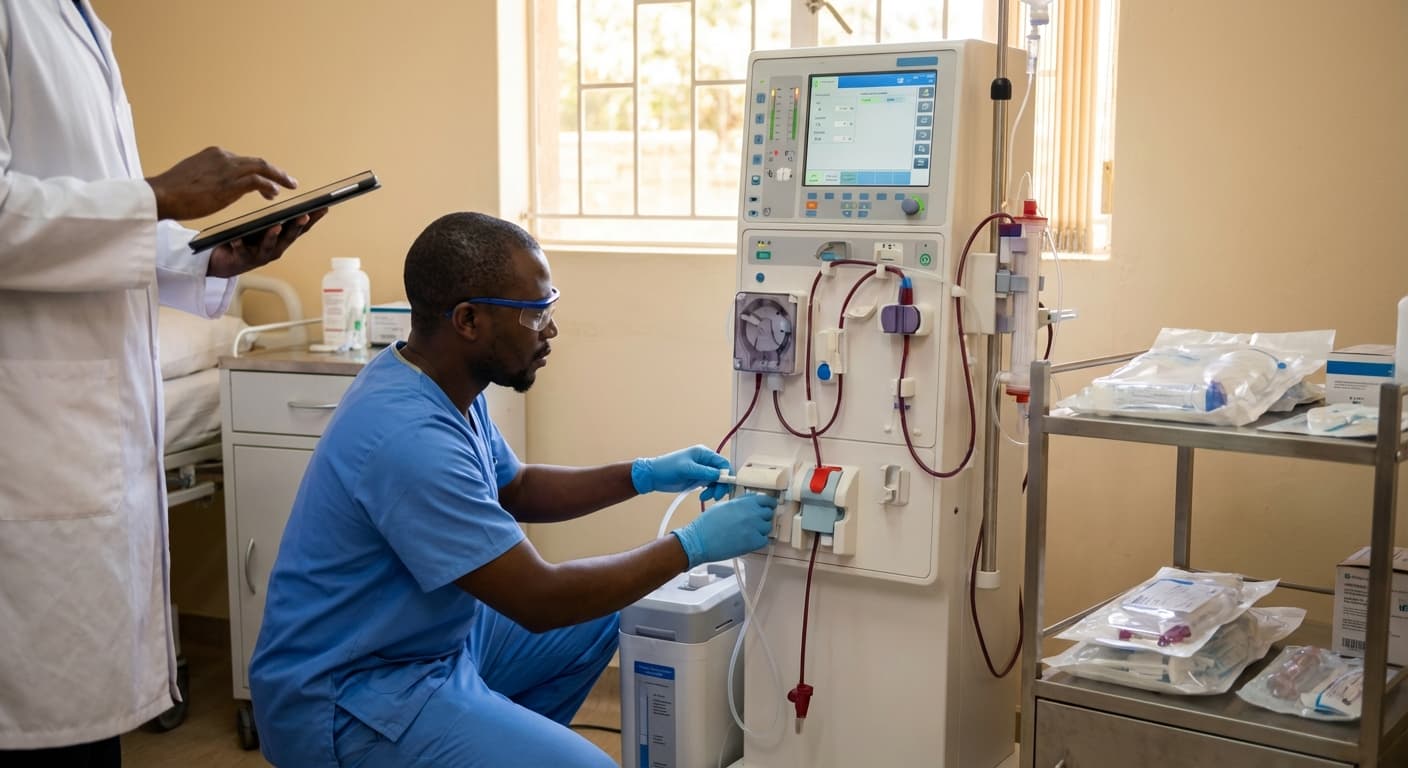
Hemodialysis Machine Installation Service in Djibouti
Engineering Excellence & Technical Support
Hemodialysis Machine Installation Service High-standard technical execution following OEM protocols and local regulatory frameworks.
Precision Calibration & Configuration
Our certified technicians ensure every hemodialysis machine is meticulously calibrated to Djibouti's specific water quality standards and patient needs, guaranteeing optimal performance and safety from day one.
Seamless Integration & Network Ready
We provide expert installation and seamless integration of your hemodialysis machines into existing hospital infrastructure, including network connectivity for remote monitoring and efficient data management.
Comprehensive On-Site Training & Validation
Beyond installation, our service includes comprehensive on-site training for your medical staff, ensuring they are fully proficient in operating and maintaining the equipment, along with thorough performance validation for immediate clinical readiness.
What Is Hemodialysis Machine Installation Service In Djibouti?
Hemodialysis machine installation service in Djibouti refers to the professional process of setting up, configuring, and commissioning hemodialysis equipment within healthcare facilities located in Djibouti. This service ensures that the complex machinery required for renal replacement therapy is deployed in a safe, functional, and compliant manner, ready for clinical operation. It encompasses a range of technical procedures to integrate the hemodialysis machines with existing infrastructure and medical systems, guaranteeing optimal performance and patient safety. The service is critical for establishing or upgrading dialysis units, providing essential life-saving treatment for patients with end-stage renal disease (ESRD).
| Who Needs Hemodialysis Machine Installation Service in Djibouti? | Typical Use Cases |
|---|---|
| Hospitals and Medical Centers in Djibouti: Requiring new dialysis units or expansions to existing renal care facilities. | Establishment of new dialysis centers to address the growing prevalence of kidney disease. |
| Government Health Ministries and Public Healthcare Providers: Undertaking national initiatives to improve access to renal replacement therapy. | Upgrading outdated hemodialysis equipment to meet current technological standards and improve patient outcomes. |
| Private Healthcare Providers and Clinics: Expanding service offerings in the private sector. | Setting up specialized units for hemodialysis, including intensive care settings. |
| International Aid Organizations and NGOs: Implementing healthcare projects and providing essential medical equipment in Djibouti. | Emergency deployment of dialysis capabilities in response to public health crises or natural disasters. |
| Biomedical Engineering Departments: Responsible for the maintenance and operational readiness of medical equipment within healthcare facilities. | Transitioning to new models or manufacturers of hemodialysis machines requiring specific installation expertise. |
Key Components of Hemodialysis Machine Installation Service
- Site assessment and preparation: Evaluating the physical space, power supply, water purification systems, waste disposal, and network connectivity to ensure compatibility with the hemodialysis machines.
- Equipment unpacking and inspection: Verifying the integrity and completeness of the delivered hemodialysis machines and associated accessories.
- Mechanical and electrical connection: Securely connecting the machines to power sources, water supply (pre-treatment and post-treatment), and drainage systems.
- Water treatment system integration: Linking the hemodialysis machines to the facility's medical-grade water purification system, which is paramount for patient safety.
- Calibration and functional testing: Performing precise calibration of all machine parameters (e.g., blood flow, dialysate flow, temperature, conductivity) and conducting comprehensive functional tests to simulate dialysis treatments.
- Software configuration and updates: Installing and configuring the machine's operating software, ensuring it is up-to-date and meets clinical protocols.
- Integration with patient monitoring systems: Connecting the hemodialysis machines to patient monitoring devices and Electronic Health Records (EHR) systems where applicable.
- Safety checks and validation: Conducting rigorous safety checks to comply with international and local healthcare regulations and standards.
- Initial operational training: Providing basic operational training to the facility's biomedical engineering and nursing staff on the newly installed equipment.
Who Needs Hemodialysis Machine Installation Service In Djibouti?
Dialysis is a life-sustaining medical procedure for individuals with kidney failure. In Djibouti, as in many developing nations, access to advanced medical equipment and specialized installation services is crucial for providing effective healthcare. This document outlines who requires hemodialysis machine installation services in Djibouti, identifying key target customers and the departments within healthcare facilities that would benefit most.
| Target Customer Segment | Description | Relevant Departments |
|---|---|---|
| Public Hospitals | Government-funded hospitals serving the general population. These are often the primary providers of essential medical services, including dialysis, to a large number of patients. They may have limited in-house technical expertise for specialized installations. | Nephrology Department, Internal Medicine Department, Biomedical Engineering Department, Facilities Management |
| Private Hospitals and Clinics | Healthcare facilities that operate on a for-profit basis. They aim to provide high-quality, often specialized, medical care. While they may have more resources, they still rely on external specialists for complex installations. | Nephrology Department, Critical Care Unit, Surgical Department (for pre- and post-operative care related to dialysis), Biomedical Engineering Department |
| NGOs with Healthcare Initiatives | Organizations focused on improving health outcomes in underserved communities. They may be establishing new dialysis centers or upgrading existing facilities to expand access to care. | Project Management Office, Healthcare Program Management, Clinical Services Department |
| Military and Defense Medical Facilities | Hospitals and clinics serving military personnel and their dependents. These facilities often require robust and reliable equipment and efficient installation to ensure the health of service members. | Nephrology Department, Internal Medicine Department, Biomedical Engineering Unit, Medical Logistics |
| Research and Academic Medical Centers (if any) | Institutions involved in medical research and training. They may require specialized configurations of dialysis machines for research purposes or for training future nephrologists and technicians. | Nephrology Research Department, Clinical Research Unit, Teaching Hospitals, Biomedical Engineering |
Target Customers for Hemodialysis Machine Installation Services in Djibouti
- Public Hospitals:
- Private Hospitals and Clinics:
- Non-Governmental Organizations (NGOs) with Healthcare Initiatives:
- Military and Defense Medical Facilities:
- Research and Academic Medical Centers (if any):
Hemodialysis Machine Installation Service Process In Djibouti
This document outlines the comprehensive workflow for the Hemodialysis Machine Installation Service Process in Djibouti, from initial inquiry to successful execution. It details each stage, the involved parties, and the expected outcomes. This standardized process ensures efficient, safe, and compliant installation of hemodialysis equipment, critical for patient care.
| Stage | Description | Key Activities | Involved Parties | Expected Outcome |
|---|---|---|---|---|
| The process begins with a client (hospital, clinic, or government health body in Djibouti) expressing interest in installing hemodialysis machines. | Receive inquiry, understand client's needs (number of machines, types, timeline), initial needs assessment, provide preliminary information. | Client (Procurement/Clinical Department), Service Provider Sales/Technical Team | Clear understanding of client requirements, initial project scope defined, client onboarded for further discussion. |
| A thorough evaluation of the installation site is conducted to ensure it meets all technical and safety requirements for the hemodialysis machines. | On-site visit, assess electrical supply, water quality and supply, drainage, ventilation, space, and structural integrity. Develop a detailed installation plan. | Service Provider Technical Team, Client Facilities/Biomedical Engineering Department | Identified any site-specific challenges or requirements, finalized installation plan, confirmed site readiness. |
| Based on the site assessment and client needs, a formal quotation is provided, followed by contract finalization. | Prepare detailed quotation (equipment, installation labor, materials, travel), negotiate terms, finalize contract/Service Level Agreement (SLA). | Service Provider Sales/Contracts Team, Client Procurement/Legal Department | Approved quotation, signed contract/SLA, clear terms of engagement. |
| All necessary equipment, spare parts, and materials are sourced and transported to Djibouti. | Order machines and accessories, arrange shipping and customs clearance, coordinate local transportation to the site. | Service Provider Logistics Team, Third-Party Shipping Agents, Client (for customs facilitation) | All required equipment and materials safely delivered to the installation site in Djibouti. |
| The installation site is prepared according to the approved plan, ensuring all utilities are ready. | Verify utility connections (power, water, drainage), prepare the room (cleaning, any minor structural modifications), set up a secure workspace. | Client Facilities/Biomedical Engineering Department, Service Provider Technical Team | Installation site fully prepared and compliant with all pre-installation checklist items. |
| The hemodialysis machines are physically installed and connected to utilities. | Unpacking and positioning machines, connecting to power, water purification systems, and drainage, ensuring all safety features are enabled. | Service Provider Certified Technicians, Client Biomedical Engineering Department | Hemodialysis machines physically installed and connected according to manufacturer specifications and local regulations. |
| Comprehensive testing and calibration are performed to ensure optimal machine performance and patient safety. | Perform functional tests, diagnostic checks, calibrate sensors, run water purification system tests, verify alarm functionalities. | Service Provider Certified Technicians, Client Biomedical Engineering Department | Hemodialysis machines are fully functional, calibrated, and safe for clinical use. |
| End-users and technical staff are trained on the operation, maintenance, and troubleshooting of the machines. | Conduct theoretical and practical training sessions for clinical staff (nurses, doctors) and biomedical engineers, provide user manuals and technical documentation, formal handover of installed machines. | Service Provider Trainers/Technicians, Client Clinical Staff & Biomedical Engineers | Client staff are competent in operating and performing basic maintenance on the hemodialysis machines, formal acceptance of the installed equipment. |
| Ongoing support and final documentation are provided to ensure continued successful operation. | Provide warranty information, schedule follow-up checks (if applicable), submit final installation reports, provide contact details for technical support, ensure all regulatory compliance documentation is in order. | Service Provider Technical Support, Client Biomedical Engineering Department | Completed project, satisfied client, ongoing support channels established, all project documentation finalized and archived. |
Hemodialysis Machine Installation Service Process in Djibouti: Workflow
- Inquiry & Initial Consultation
- Site Assessment & Planning
- Quotation & Agreement
- Logistics & Procurement
- Pre-Installation Preparations
- On-Site Installation & Setup
- Testing & Calibration
- Training & Handover
- Post-Installation Support & Documentation
Hemodialysis Machine Installation Service Cost In Djibouti
Installing a hemodialysis machine is a critical process that ensures the proper functioning of life-saving equipment. In Djibouti, the cost of this service is influenced by several factors, primarily related to the complexity of the installation, the type of machine, and the service provider. The process typically involves assessing the installation site, ensuring proper utility connections (water, electricity), calibrating the machine, and conducting initial tests. Clients should expect varying price points depending on the specific requirements of their facility.
| Service Component | Estimated Cost Range (DJF) |
|---|---|
| Standard Installation (basic machine, existing infrastructure) | 150,000 - 300,000 |
| Complex Installation (advanced machine, requires infrastructure modifications) | 300,000 - 600,000 |
| Site Assessment & Preparation | 20,000 - 50,000 |
| Water Purification System Integration | 50,000 - 150,000 |
| Electrical & Plumbing Modifications | 30,000 - 100,000 |
| Calibration & System Testing | 40,000 - 80,000 |
| On-site Technician Labor (per day) | 25,000 - 60,000 |
| Training for Medical Staff | 30,000 - 70,000 |
Factors Influencing Hemodialysis Machine Installation Cost in Djibouti:
- Type and Brand of Hemodialysis Machine: Different models have varying installation requirements and may require specialized technicians or equipment.
- Site Assessment and Preparation: This includes evaluating the existing infrastructure, ensuring adequate space, and potentially undertaking minor structural modifications.
- Utility Connections: The cost will vary based on the complexity of connecting the machine to reliable water purification systems and stable electrical power sources. Specialized plumbing or electrical work may be required.
- Calibration and Testing: Ensuring the machine operates within precise parameters is crucial and involves detailed calibration and performance testing.
- Technician Expertise and Travel: The experience level of the installation technicians and any travel expenses incurred will be factored into the overall cost.
- Additional Services: This could include training for facility staff, maintenance contracts, or the provision of essential accessories.
- Urgency of Installation: Expedited services may incur higher charges.
Affordable Hemodialysis Machine Installation Service Options
Securing affordable hemodialysis machine installation services is crucial for healthcare facilities aiming to expand or maintain their dialysis capacity without overwhelming their budget. This involves understanding the different service models available, identifying value in bundled offerings, and implementing smart cost-saving strategies. The goal is to ensure a seamless, compliant, and cost-effective setup for vital patient care.
| Strategy/Bundle | Description | Cost-Saving Benefit | Considerations |
|---|---|---|---|
| Comprehensive Installation Package | Includes site assessment, plumbing, electrical, water treatment system setup, machine mounting, calibration, and initial testing. | Reduces the need to hire multiple specialized contractors, streamlined project management. | Ensures all components are compatible and installed to manufacturer specifications. May have higher upfront cost but can be more cost-effective overall. |
| Equipment Leasing with Integrated Installation | Leasing agreements that include the cost of installation as part of the monthly payment. | Spreads the installation cost over the lease term, improving cash flow. Often includes maintenance and upgrades. | Higher total cost over the lifetime of the equipment compared to outright purchase. Ensure lease terms are transparent. |
| Phased Installation and Rollout | Installing machines in stages as budget allows or as patient demand grows. | Manages capital expenditure, allowing facilities to adapt to changing needs without over-committing resources upfront. | Requires careful planning to ensure continuity of care. May incur repeat site preparation costs if not planned effectively. |
| Negotiation and Bulk Discounts | Negotiating installation fees with service providers or securing discounts when installing multiple machines simultaneously. | Directly reduces the per-unit installation cost. | Requires strong negotiation skills and the ability to commit to a larger project. Best for new unit expansions or complete overhauls. |
| Preventive Maintenance Integration | Bundling installation services with long-term preventive maintenance contracts. | Can offer discounted installation rates when committing to a service agreement. Proactive maintenance reduces future repair costs and downtime. | Requires careful review of the maintenance contract terms and pricing. |
| Training and Support Add-ons | Including staff training on machine operation and troubleshooting as part of the installation service. | Reduces the need for separate, often expensive, training programs. Empowers in-house staff for basic maintenance and troubleshooting. | Ensure the training is comprehensive and covers all aspects of machine operation relevant to your facility. |
| Third-Party vs. Manufacturer Installation | Comparing quotes from independent, certified third-party installers versus the machine manufacturer's own service team. | Third-party installers can sometimes offer lower rates due to lower overhead, while manufacturers guarantee adherence to their specific standards. | Thoroughly vet third-party installers for certifications, experience, and references. Manufacturer installation may be required for warranty. |
| Strategic Sourcing of Ancillary Supplies | Purchasing necessary plumbing, electrical, or water treatment components from alternative, cost-effective suppliers rather than through the installer. | Can significantly reduce the cost of materials if sourced strategically. Allows for comparison shopping. | Requires careful coordination to ensure compatibility and compliance with installation requirements. May affect warranty if not approved. |
Value Bundles and Cost-Saving Strategies
- Comprehensive Installation Packages
- Equipment Leasing with Integrated Installation
- Phased Installation and Rollout
- Negotiation and Bulk Discounts
- Preventive Maintenance Integration
- Training and Support Add-ons
- Third-Party vs. Manufacturer Installation
- Strategic Sourcing of Ancillary Supplies
Verified Providers In Djibouti
In Djibouti, discerning patients and healthcare facilities seek assurance regarding the quality and legitimacy of healthcare providers. Franance Health stands out by offering a rigorous verification process, ensuring that the medical professionals and institutions it partners with meet the highest international standards. This commitment to credentialing provides an invaluable layer of trust and reliability in a field where accuracy and expertise are paramount. Choosing a Franance Health-verified provider means opting for a commitment to patient safety, ethical practice, and evidence-based medicine. Their comprehensive vetting process examines qualifications, licenses, experience, and adherence to regulatory requirements, making them a benchmark for excellence in Djibouti's healthcare landscape. This dedication to verified excellence ensures that patients receive the best possible care from trusted and competent professionals.
| Criterion | Franance Health Verification Standard | Benefit for Patients/Facilities |
|---|---|---|
| Qualifications & Education | Verified degrees, certifications, and specialized training from accredited institutions. | Assures that providers possess the necessary foundational knowledge and expertise. |
| Licensing & Regulatory Compliance | Confirmation of valid, current medical licenses and adherence to Djibouti's healthcare regulations. | Guarantees legal and ethical practice, protecting patients from unqualified individuals. |
| Professional Experience | Thorough review of past work history, areas of specialization, and track record. | Identifies providers with proven practical skills and relevant experience. |
| Ethical Conduct & Reputation | Checks for any disciplinary actions, malpractice claims, or negative professional reviews. | Ensures providers maintain high ethical standards and a trustworthy reputation. |
| Continuing Medical Education (CME) | Verification of ongoing professional development to stay abreast of medical advancements. | Confirms that providers are up-to-date with the latest medical knowledge and techniques. |
Why Franance Health Verification Matters in Djibouti
- Ensures adherence to international quality standards.
- Provides patient confidence and trust in providers.
- Guarantees that professionals meet stringent licensing and qualification requirements.
- Promotes ethical medical practices and patient safety.
- Offers access to experienced and competent healthcare professionals.
- Simplifies the process of finding reliable healthcare in Djibouti.
Scope Of Work For Hemodialysis Machine Installation Service
This Scope of Work (SOW) outlines the technical deliverables and standard specifications for the installation of Hemodialysis Machines. It covers all necessary steps from site preparation to final commissioning and handover, ensuring the safe and efficient operation of the equipment. Adherence to these specifications is mandatory for all service providers.
| Specification Area | Standard Specification | Notes |
|---|---|---|
| Electrical Supply | Dedicated, stable power supply with surge protection. Voltage and frequency to match machine requirements (e.g., 220-240V, 50/60Hz). Grounding to be compliant with IEC standards. | Separate circuit breaker for each machine. UPS recommended for critical applications. |
| Plumbing and Water Supply | Medical-grade purified water supply meeting AAMI/ISO standards. Pressure and flow rates to meet machine specifications. Water temperature control required. | Backflow prevention devices. Accessible shut-off valves. |
| Drainage | Adequate and hygienic drainage system with sufficient capacity to handle machine effluent. Avoidance of cross-contamination. | Separate drain for each machine if feasible. Venting of drain lines. |
| Ventilation and Environmental Control | Adequate room ventilation to maintain required air changes per hour. Temperature and humidity control to prevent equipment malfunction and ensure patient comfort (e.g., 20-24°C, 40-60% RH). | Negative pressure in dialysis rooms may be required in certain settings. |
| Space and Accessibility | Sufficient clear floor space around the machine for operation, maintenance, and emergency access. Compliance with accessibility standards. | Minimum clearances as specified by the manufacturer. |
| Safety | All installations to comply with local electrical, plumbing, and building codes. Fire safety regulations to be observed. Use of appropriate medical-grade materials. | Emergency power-off accessible. Clearly marked emergency exits. |
| Medical Gases | If applicable, connection to medical gas outlets (e.g., oxygen, medical air) with appropriate regulators and fittings, meeting relevant standards. | Pressure and flow rates to be confirmed. |
| Waste Management | Designated and compliant waste disposal points for sharps, general waste, and contaminated materials. | Segregation of waste streams. |
Technical Deliverables
- Site assessment report confirming suitability for installation.
- Detailed installation plan including timelines and resource allocation.
- Pre-installation checklist completion and sign-off.
- All necessary infrastructure modifications and installations (electrical, plumbing, ventilation).
- Physical installation and mounting of the hemodialysis machine.
- Connection of all required utilities (power, water, drainage, medical gases).
- Installation and configuration of associated peripherals (e.g., water treatment systems, monitoring devices).
- System cabling and wiring adhering to safety and regulatory standards.
- Initial system testing and calibration.
- Functional testing and performance verification against manufacturer specifications.
- User training for clinical and technical staff.
- Commissioning report detailing successful installation and testing.
- As-built drawings and documentation.
- Post-installation support plan.
- Warranty documentation for installed equipment and workmanship.
Service Level Agreement For Hemodialysis Machine Installation Service
This Service Level Agreement (SLA) outlines the response times and uptime guarantees for the Hemodialysis Machine Installation Service provided by [Your Company Name] to [Client Name]. This SLA is effective from the date of installation acceptance and will remain in effect for the duration of the agreed-upon service period.
| Service Element | Response Time | Uptime Guarantee |
|---|---|---|
| Critical Installation Issues (Machine non-functional, affecting patient care) | Within 4 business hours of reported issue | Not Applicable (Focus on immediate resolution) |
| Non-Critical Installation Issues (Minor functional impairment, workaround available) | Within 1 business day of reported issue | N/A |
| General Inquiries & Support (Related to installation process) | Within 2 business days of reported issue | N/A |
| Hemodialysis Machine Uptime (Post-successful installation and acceptance) | N/A | 98% during standard operating hours (defined as [e.g., 8 AM - 6 PM, Monday-Friday]) |
Scope of Service
- On-site installation of new hemodialysis machines.
- Initial setup, calibration, and testing of installed machines.
- Basic user training for clinic staff on the operation of installed machines.
- Troubleshooting and diagnosis of installation-related issues.
Frequently Asked Questions

Ready when you are
Let's scope your Hemodialysis Machine Installation Service in Djibouti project in Djibouti.

Scaling healthcare logistics and technical systems across the entire continent.