
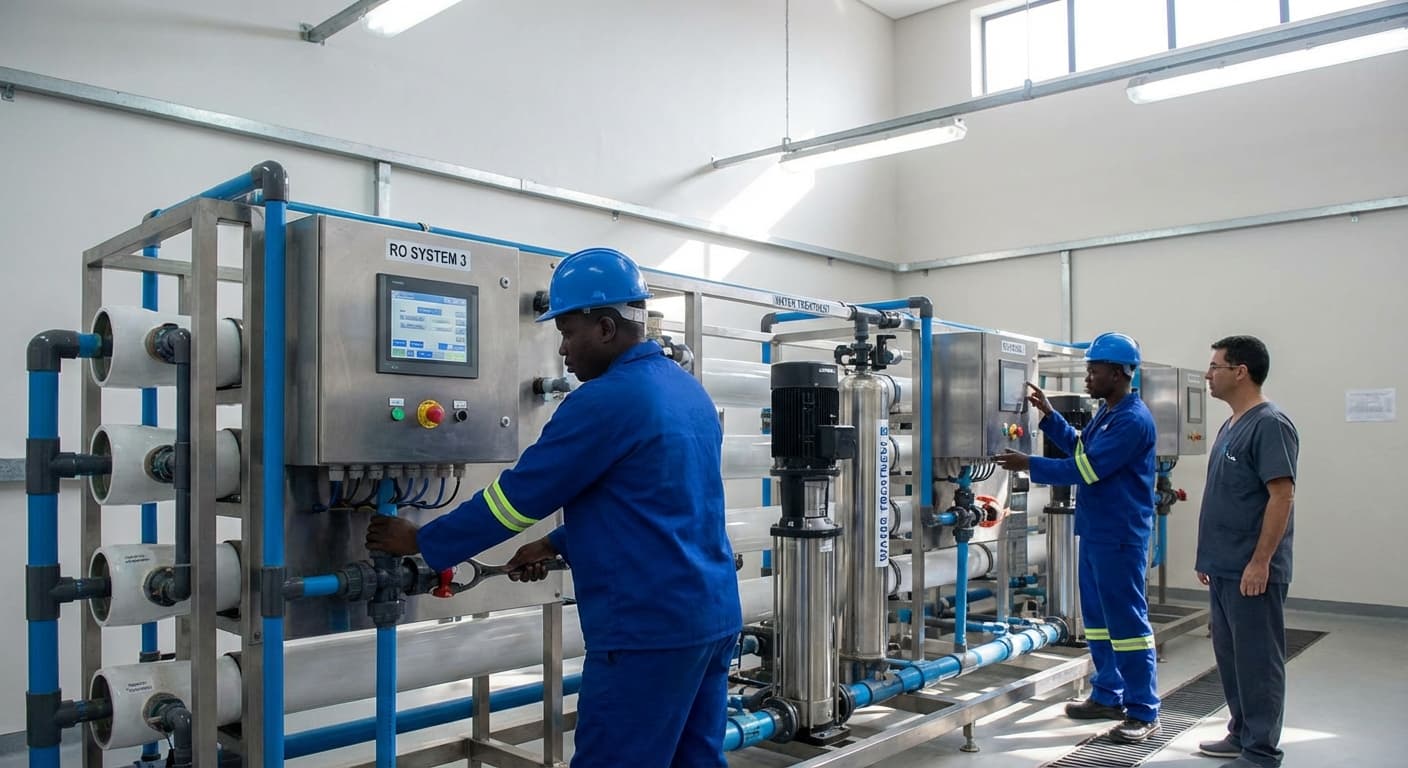
Dialysis RO/Water Treatment Plant Installation Service in Djibouti
Engineering Excellence & Technical Support
Dialysis RO/Water Treatment Plant Installation Service High-standard technical execution following OEM protocols and local regulatory frameworks.
Advanced RO Membrane Technology
Leveraging cutting-edge Reverse Osmosis (RO) membranes optimized for Djibouti's unique water profiles, ensuring superior purity and efficient mineral rejection for critical dialysis applications.
Modular & Scalable Design
Our installations feature modular and scalable water treatment plant designs, allowing for future expansion and adaptation to evolving patient needs and capacity demands in Djibouti.
Robust Multi-Stage Filtration Systems
Implementing comprehensive multi-stage filtration, including pre-filtration, ultrafiltration, and disinfection, to guarantee the highest standards of water quality and patient safety, compliant with international dialysis standards.
What Is Dialysis Ro/water Treatment Plant Installation Service In Djibouti?
Dialysis RO/Water Treatment Plant Installation Service in Djibouti refers to the comprehensive process of designing, procuring, installing, commissioning, and maintaining Reverse Osmosis (RO) and associated water treatment systems specifically tailored for medical dialysis facilities in Djibouti. These systems are critical for producing ultrapure water, a fundamental requirement for hemodialysis procedures to ensure patient safety and treatment efficacy. The service encompasses the entire lifecycle from initial site assessment and system selection to final operational readiness and ongoing technical support, ensuring compliance with international medical water standards and local regulations.
| Who Needs This Service? | Typical Use Cases |
|---|---|
| Dialysis Clinics and Hospitals: Healthcare facilities in Djibouti providing hemodialysis treatments require dedicated, high-purity water systems. | New Dialysis Center Construction: Establishing a new dialysis facility necessitates a fully functional RO/Water Treatment Plant from inception. |
| Existing Dialysis Facilities Requiring Upgrades or Replacements: Older systems or those not meeting current standards require modernization. | Expansion of Dialysis Services: Increasing patient capacity or the number of dialysis stations requires scalable water treatment solutions. |
| Medical Organizations Operating in Djibouti: International or governmental health organizations involved in establishing or supporting dialysis services. | Emergency or Disaster Relief Situations: Temporary or mobile dialysis units requiring reliable water purification. |
| Research and Development Facilities: While less common, advanced research facilities may require ultrapure water for related biomedical applications. | Outpatient Dialysis Centers: Standalone clinics focused solely on providing dialysis treatment to a significant patient base. |
Key Components of Dialysis RO/Water Treatment Plant Installation Service
- System Design and Engineering: Site surveys, water quality analysis, system sizing, and schematic development based on patient load, dialysis machine specifications, and available infrastructure.
- Equipment Procurement and Supply: Sourcing and delivery of high-quality RO membranes, pre-treatment filters, softeners, UV sterilizers, storage tanks, distribution loops, and monitoring instruments.
- Installation and Plumbing: Professional installation of all system components, including pipework, electrical connections, and integration with existing facility utilities.
- Commissioning and Validation: Rigorous testing, calibration, and validation of the installed system to verify performance parameters and ensure compliance with dialysis water quality standards (e.g., AAMI, ISO).
- Training: Comprehensive training for facility staff on system operation, routine maintenance, and troubleshooting.
- Ongoing Maintenance and Support: Scheduled preventive maintenance, emergency repair services, water quality monitoring, and spare parts management.
- Regulatory Compliance Assurance: Guidance and support to ensure the facility adheres to Djibouti's healthcare regulations and relevant international standards for medical water.
Who Needs Dialysis Ro/water Treatment Plant Installation Service In Djibouti?
Dialysis units require a consistent supply of highly purified water to function safely and effectively. This purification process relies on advanced Reverse Osmosis (RO) and water treatment plants. In Djibouti, the demand for such specialized installation services is driven by several key entities within the healthcare sector. These organizations are responsible for providing dialysis treatment to patients suffering from kidney failure. Proper installation ensures the water meets stringent medical standards, preventing complications and ensuring patient well-being. Therefore, understanding who needs these services is crucial for providers of RO/water treatment plant installation.
| Customer Type | Key Departments Involved | Reasons for Need |
|---|---|---|
| Government Hospitals | Nephrology Department, Biomedical Engineering, Procurement Department | Serving a large patient base, ensuring access to safe and effective dialysis treatments, adherence to national health standards. |
| Private Hospitals and Clinics | Nephrology Department, Biomedical Engineering, Administration | Providing specialized dialysis services, maintaining high-quality patient care, meeting international healthcare benchmarks. |
| NGOs and International Aid Organizations | Project Management, Medical Team, Logistics | Establishing and supporting dialysis facilities in underserved areas, humanitarian healthcare provision. |
| Ministry of Health (Djibouti) | Health Infrastructure Unit, Public Health Directorate, Procurement Division | Setting and enforcing healthcare standards, national health planning, facilitating access to essential medical technology. |
Target Customers and Departments for Dialysis RO/Water Treatment Plant Installation Service in Djibouti
- {"title":"Government Hospitals","description":"Public healthcare facilities are the primary providers of dialysis services to the majority of the population. They often have dedicated nephrology departments and dialysis centers that necessitate robust water treatment systems."}
- {"title":"Private Hospitals and Clinics","description":"As Djibouti's private healthcare sector grows, so does the demand for advanced medical infrastructure. Private hospitals and specialized clinics offering dialysis treatments will require new installations or upgrades to existing systems."}
- {"title":"Non-Governmental Organizations (NGOs) and International Aid Organizations","description":"Organizations involved in public health initiatives and medical aid in Djibouti may establish or support dialysis centers, requiring professional installation of water treatment plants."}
- {"title":"Ministry of Health","description":"While not directly operating dialysis units, the Ministry of Health plays a crucial role in regulating healthcare standards, approving facilities, and often oversees the procurement and installation of essential medical equipment for public health infrastructure. They might commission large-scale installations or endorse specific providers."}
- {"title":"Renal/Nephrology Departments","description":"These are the core operational units within hospitals and clinics where dialysis treatments are performed. The department heads and lead nephrologists are key stakeholders who will assess the need and approve the installation of appropriate water treatment systems."}
- {"title":"Biomedical Engineering Departments","description":"Responsible for the maintenance and installation of all medical equipment, including RO/water treatment plants. They will be involved in the technical aspects of the installation process, ensuring integration with existing infrastructure."}
- {"title":"Procurement Departments","description":"These departments within hospitals and government health bodies handle the purchasing of medical equipment and services. They will be involved in the tender process and final selection of installation service providers."}
Dialysis Ro/water Treatment Plant Installation Service Process In Djibouti
This document outlines the comprehensive service process for the installation of Dialysis Reverse Osmosis (RO) / Water Treatment Plants in Djibouti. It details the workflow from the initial customer inquiry to the final execution and handover of the installed plant.
| Stage | Description | Key Activities | Deliverables / Outcomes | Timeline (Estimated) |
|---|---|---|---|---|
| The client expresses interest in a dialysis RO/water treatment plant installation. This stage involves understanding their basic requirements and providing preliminary information. | Receive inquiry via phone, email, or website; Initial discussion of client needs, capacity, and desired features; Answering basic questions about technology and services. | Understanding of client requirements; Confirmation of service offering suitability. | 1-3 business days |
| A detailed assessment of the client's facility in Djibouti is conducted to gather all necessary technical and logistical information. | On-site visit by technical team; Assessment of available space, power supply, water source quality, and existing infrastructure; Detailed measurement of installation area; Discussion of specific operational needs and regulatory compliance. | Detailed site report; Precise understanding of technical specifications and constraints; Identification of any site-specific challenges. | 3-7 business days (depending on location and complexity) |
| Based on the site survey, a comprehensive proposal outlining the recommended system, scope of work, and associated costs is prepared. | Analysis of site survey data; Selection of appropriate RO/water treatment technology; Design of system layout and specifications; Preparation of detailed technical proposal; Cost estimation for equipment, installation, and commissioning; Presentation of proposal to the client. | Formal technical proposal; Itemized quotation; Scope of Work (SOW) document. | 5-10 business days |
| Upon client acceptance of the proposal, a formal contract is signed, and an initial deposit is secured to commence work. | Review and negotiation of contract terms; Signing of the Installation Agreement; Issuance of proforma invoice for deposit; Receipt of initial payment. | Signed contract; Secured project commencement. | 2-5 business days |
| Detailed engineering design and customization of the RO/water treatment plant to meet the exact specifications and client requirements. | Finalizing system schematics and P&IDs; Selecting specific components and materials; Incorporating any client-requested customizations; Obtaining necessary approvals (if any). | Approved detailed engineering drawings; Bill of Materials (BOM). | 7-14 business days |
| Sourcing of all necessary equipment and materials, followed by their shipment to Djibouti. | Ordering of RO membranes, pumps, filters, tanks, piping, electrical components, etc.; Quality control checks of procured items; Arranging for international shipping and customs clearance; Transportation to the client's site in Djibouti. | All required plant components and materials delivered to the site. | 4-12 weeks (dependent on lead times and shipping) |
| Ensuring the installation site is fully ready to receive and accommodate the new plant. | Preparing the installation area (e.g., flooring, structural support); Ensuring adequate power supply and plumbing connections are in place; Verifying access for equipment delivery. | Site ready for installation; Utilities available at designated points. | Concurrent with procurement or 1-3 days before installation |
| The physical installation and assembly of the RO/water treatment plant components at the client's facility in Djibouti. | Unpacking and positioning of major components; Assembly of skids and piping; Electrical wiring and control panel installation; Connection to water source and distribution points. | Physically assembled and connected RO/water treatment plant. | 5-15 business days (dependent on system size and complexity) |
| Thorough testing of the installed plant to ensure it operates according to design specifications and meets water quality standards. | Flushing of the system; Pre-operational checks; Running the plant under load; Water quality testing (TDS, pH, conductivity, etc.); Performance verification; Calibration of sensors and instruments. | Fully operational and tested RO/water treatment plant; Water quality report; Commissioning certificate. | 3-7 business days |
| Providing comprehensive training to the client's staff on the operation, maintenance, and troubleshooting of the plant, followed by formal handover. | Theoretical and practical training sessions; Demonstration of daily operations, shutdown procedures, and basic maintenance; Explanation of safety protocols; Handover of all relevant documentation (manuals, warranty certificates). | Trained operational staff; Complete documentation package; Formal acceptance of the installed plant. | 1-3 business days |
| Ongoing support and warranty services to ensure the continued optimal performance of the installed plant. | Providing warranty support for specified period; Offering scheduled preventive maintenance services; Responding to any technical queries or issues; Providing spare parts as needed. | Reliable and sustained plant operation; Client satisfaction; Long-term partnership. | Ongoing (as per warranty and service agreements) |
Service Workflow Stages
- Inquiry & Initial Consultation
- Site Survey & Needs Assessment
- Proposal & Quotation
- Contract Finalization & Deposit
- Plant Design & Customization
- Procurement & Logistics
- Pre-installation Site Preparation
- On-site Installation & Assembly
- Testing & Commissioning
- Training & Handover
- Post-installation Support & Warranty
Dialysis Ro/water Treatment Plant Installation Service Cost In Djibouti
Installing a Reverse Osmosis (RO) and Water Treatment Plant for dialysis in Djibouti involves a complex process with significant cost implications. The pricing is highly variable and depends on several key factors, making it crucial to obtain detailed quotes from specialized providers. This service encompasses the design, supply of equipment, installation, commissioning, and often initial training for operation and maintenance. The primary goal is to ensure a consistent supply of ultrapure water essential for hemodialysis to prevent patient complications. Key considerations influencing the overall cost include the plant's capacity, the level of automation and sophistication, the quality of components used, site preparation requirements, and the expertise of the installation team.
| Service Component / Capacity Range | Estimated Cost Range (DJF - Djiboutian Franc) |
|---|---|
| Small-Scale Plant (e.g., 50-100 LPH, serving 2-4 stations) | 1,500,000 - 4,000,000 DJF |
| Medium-Scale Plant (e.g., 100-250 LPH, serving 5-10 stations) | 4,000,000 - 10,000,000 DJF |
| Large-Scale Plant (e.g., 250-500+ LPH, serving 10+ stations) | 10,000,000 - 25,000,000+ DJF |
| Site Survey & Consultation | 100,000 - 300,000 DJF |
| Basic Pre-treatment (Filters, Softeners) | 200,000 - 800,000 DJF |
| RO Membrane Modules & Housing | 500,000 - 2,000,000 DJF |
| Post-treatment (EDI, UV, Polishing) | 300,000 - 1,500,000 DJF |
| Piping, Electrical, Control Systems | 400,000 - 1,800,000 DJF |
| Installation & Labor | 500,000 - 2,500,000 DJF |
| Commissioning & Water Quality Testing | 200,000 - 700,000 DJF |
| Training & Handover | 150,000 - 500,000 DJF |
Key Factors Influencing Dialysis RO/Water Treatment Plant Installation Cost in Djibouti:
- Plant Capacity (Liters per hour/day): Larger capacity plants naturally incur higher costs due to increased equipment size, material usage, and potentially more complex system design.
- Technology and Automation Level: Fully automated systems with advanced monitoring, control, and data logging capabilities will be more expensive than semi-automatic or manually operated systems.
- Water Source Quality: The initial quality of the raw water (e.g., tap water, well water) dictates the pre-treatment stages required, impacting the number and type of filtration and purification modules needed.
- Equipment Brand and Quality: Reputable international brands and high-grade components typically command higher prices but often offer better reliability, longevity, and performance.
- Number of Dialysis Stations Served: The plant's output must be sufficient to meet the demand of all connected dialysis stations simultaneously.
- Site Preparation and Infrastructure: This includes the need for dedicated space, power supply, drainage, and potential structural modifications within the healthcare facility.
- Installation Complexity and Duration: The time and labor required for installation, including any specialized welding, piping, or electrical work, contribute to the overall cost.
- Commissioning and Testing: Rigorous testing and commissioning processes to ensure the water meets strict dialysis standards are integral to the service and incur costs.
- Training and Handover: Comprehensive training for facility staff on operation, maintenance, and troubleshooting is usually included and factored into the price.
- Warranty and After-Sales Support: The duration and scope of the warranty, along with ongoing technical support, can affect the initial investment.
- Logistics and Transportation: Costs associated with shipping equipment to Djibouti, including customs duties and taxes, can be significant.
- Local Labor and Expertise: The availability and cost of skilled local technicians and engineers for installation and ongoing support are also a consideration.
Affordable Dialysis Ro/water Treatment Plant Installation Service Options
When establishing a dialysis facility, a reliable and cost-effective Reverse Osmosis (RO) and water treatment plant is paramount. This ensures the production of ultra-pure water essential for patient safety and treatment efficacy. We offer a range of installation service options designed to be affordable, while also focusing on value bundles and implementing smart cost-saving strategies. Understanding these options can significantly impact your initial investment and ongoing operational expenses.
| Value Bundle Options | Description | Cost-Saving Strategies Incorporated | Typical Investment Range (Excluding Land/Building) |
|---|---|---|---|
| Essential Starter Package | Includes core RO system with essential pre- and post-treatment, basic monitoring, and standard storage. Ideal for smaller clinics or initial setup. | Standardized component selection, streamlined installation process, focuses on fundamental needs. | $15,000 - $30,000 |
| Integrated Efficiency Bundle | Adds advanced monitoring for real-time quality control, energy-efficient components, and potentially a smaller footprint design for space optimization. | Energy-saving pumps and membranes, enhanced automation to reduce manual checks, optimized system sizing. | $25,000 - $50,000 |
| Comprehensive Compliance & Redundancy | Includes full compliance features, redundant systems for uninterrupted operation, advanced sanitization protocols, and extended warranty options. | Built-in redundancy to minimize downtime, proactive maintenance planning, high-durability components reducing long-term replacement costs. | $40,000 - $75,000+ |
| Custom Solution | Tailored to specific facility needs, water source quality, and future expansion plans. Can incorporate specialized filtration or unique design elements. | Optimized for your specific environment, avoiding over-speccing or under-speccing, long-term operational efficiency focus. | Quote-Based |
Key Components of a Dialysis RO/Water Treatment Plant
- Pre-treatment Filters (Sediment & Carbon): Remove larger particles and chlorine to protect subsequent stages.
- Reverse Osmosis (RO) Membranes: The core of the system, removing dissolved salts, minerals, and contaminants.
- Post-treatment Filters (Polishing): Further refine water quality, often including bacteriostatic filters.
- Storage Tanks: For storing treated water and ensuring a continuous supply.
- Monitoring and Control Systems: To ensure water quality and system performance.
- UV Sterilization: To inactivate any remaining microorganisms.
- Distribution Loop and Sanitization: Maintaining water purity throughout the delivery system.
Verified Providers In Djibouti
In Djibouti, ensuring access to reliable and reputable healthcare providers is paramount. "Franance Health" has emerged as a leading name, distinguished by its rigorous credentialing process. This commitment to verification means that all practitioners associated with Franance Health have undergone thorough checks of their qualifications, experience, and ethical standing. This meticulous vetting ensures that patients receive care from highly competent and trustworthy medical professionals. Choosing Franance Health translates to peace of mind, knowing that you are in the hands of certified experts dedicated to your well-being. Their comprehensive approach to provider verification sets a benchmark for quality healthcare in Djibouti, making them the preferred choice for discerning individuals seeking exceptional medical services.
| Provider Type | Franance Health Verification | Benefits for Patients |
|---|---|---|
| General Practitioners | Certified & Vetted | Access to reliable primary care, accurate diagnoses, and appropriate referrals. |
| Specialists (e.g., Cardiologists, Dermatologists) | Credentialed & Experienced | Expert consultations and advanced treatments from highly qualified specialists. |
| Surgeons | Board-Certified & Accredited | Safe and effective surgical procedures performed by proven professionals. |
| Dentists | Licensed & Reviewed | Comprehensive dental care delivered by skilled and trustworthy practitioners. |
| Pediatricians | Verified & Specialised | Expert care for children's health and development from dedicated pediatric professionals. |
Why Franance Health Credentials Matter:
- Thorough verification of medical licenses and certifications.
- Extensive background checks and review of professional history.
- Assessment of practical experience and areas of specialization.
- Commitment to ongoing professional development and adherence to ethical standards.
- Ensuring providers are up-to-date with the latest medical advancements.
Scope Of Work For Dialysis Ro/water Treatment Plant Installation Service
This Scope of Work (SOW) outlines the services required for the installation of a Dialysis Reverse Osmosis (RO) and Water Treatment Plant. The objective is to ensure a reliable, safe, and compliant supply of purified water for dialysis treatments, meeting all relevant regulatory and client-specific standards. The SOW covers all necessary activities from site preparation to final commissioning and handover.
| Technical Deliverable | Description | Standard Specifications / Requirements | Associated Documentation |
|---|---|---|---|
| Site Survey Report | Detailed assessment of the installation site, including space availability, power supply, water inlet and outlet points, drainage, and environmental conditions. | Minimum space requirements, access for maintenance, proximity to existing utilities, structural integrity of the installation area. | Site Survey Report, Photographs, Site Layout Drawings |
| Water Quality Analysis Report | Comprehensive analysis of the incoming water source to determine treatment requirements. | Analysis of parameters such as TDS, hardness, chlorine, iron, turbidity, pH, microbiological load, etc., as per relevant water quality standards (e.g., WHO, AAMI, IS 14245). | Incoming Water Quality Report |
| Piping and Plumbing System Design | Design of the entire piping network for raw water inlet, treated water outlet, brine discharge, and waste. Includes material selection and layout. | Use of food-grade, non-corrosive materials (e.g., SS 316L, CPVC, PEX). Proper pipe sizing for flow rates. Leak-free connections. Compliance with plumbing codes. | Piping and Instrumentation Diagrams (P&ID), Isometric Drawings, Material Take-Off (MTO) |
| Electrical Wiring and Control System Integration | Installation of all electrical components, including power supply, control panels, sensors, and safety interlocks. | Compliance with local electrical codes (e.g., NEC, IEC). Proper grounding and earthing. Use of certified electrical components. Integration with building management systems (if applicable). | Electrical Schematics, Control Panel Wiring Diagrams, Bill of Materials (BOM) |
| RO/Water Treatment Plant Installation | Physical assembly and connection of all RO membranes, pre-filters, post-filters, pumps, UV sterilizers, storage tanks, and control units. | Correct orientation and connection of components as per manufacturer's manual. Secure mounting and alignment. Seal integrity checks. | Installation Manuals, Component Datasheets, Assembly Checklists |
| Pre-Commissioning Test Report | Verification of all mechanical, electrical, and safety systems before initial startup. | Pressure testing of piping, continuity tests, insulation resistance tests, functional checks of valves and sensors. | Pre-Commissioning Checklist, Test Results |
| Commissioning and Performance Test Report | Startup of the plant and testing under actual operating conditions to verify performance against design specifications. | Monitoring of permeate flow rate, water recovery rate, permeate conductivity, pressure drops, power consumption, and microbiological purity. Testing for endotoxins if required. | Commissioning Protocol, Performance Test Reports, Water Quality Analysis of Treated Water |
| Operator Training Manual and Sessions | Comprehensive training for plant operators on operation, maintenance, troubleshooting, and safety procedures. | User-friendly manuals with clear instructions and diagrams. Hands-on training sessions covering daily checks, preventive maintenance, and emergency procedures. | Operator Training Manual, Training Attendance Records |
| As-Built Drawings | Updated drawings reflecting the final installed configuration of the RO/Water Treatment Plant and associated utilities. | Accurate representation of all piping, electrical connections, equipment layout, and instrumentation. | Final As-Built Drawings |
| Operation and Maintenance (O&M) Manuals | Detailed manuals for ongoing operation, routine maintenance, and troubleshooting of the installed system. | Includes preventive maintenance schedules, spare parts list, troubleshooting guides, and safety guidelines. | O&M Manuals |
| Certificates of Compliance | Issuance of relevant certificates confirming adherence to standards and successful installation. | Certificates for electrical safety, plumbing, and system performance as per regulatory requirements and client specifications. | Electrical Compliance Certificate, Plumbing Compliance Certificate, Performance Certificate |
Key Stages of Installation
- Site Assessment and Preparation
- Equipment Delivery and Unloading
- Plumbing and Piping Installation
- Electrical Wiring and Integration
- RO/Water Treatment Plant Assembly and Connection
- Pre-Commissioning Checks
- Commissioning and Performance Testing
- Training and Handover
- Documentation and Certification
Service Level Agreement For Dialysis Ro/water Treatment Plant Installation Service
This Service Level Agreement (SLA) outlines the guaranteed response times and uptime for the installation services of Dialysis Reverse Osmosis (RO) and Water Treatment Plants. This SLA is effective as of the signing of the main contract and will remain in effect for the duration of the installation project.
| Service Component | Response Time Guarantee (during installation/commissioning) | Uptime Guarantee (post-commissioning) | Remedy for SLA Breach |
|---|---|---|---|
| Critical Installation Issue (e.g., complete system failure preventing testing) | 2 Business Hours | 98% (for the first 30 days post-commissioning) | Service credit of 5% of monthly installation fee for each 24-hour period of unmet uptime. |
| Major Installation Issue (e.g., partial system failure impacting key functions) | 4 Business Hours | 99% (for the first 30 days post-commissioning) | Service credit of 3% of monthly installation fee for each 24-hour period of unmet uptime. |
| Minor Installation Issue (e.g., minor leak, cosmetic defect, calibration adjustment) | 8 Business Hours | N/A (issues addressed within response time during installation) | Priority scheduling for rectification at no additional cost. |
Key Definitions
- Installation Services: Includes the physical setup, connection, testing, and commissioning of the Dialysis RO/Water Treatment Plant as per the agreed-upon specifications and site requirements.
- Response Time: The maximum time allowed from the initiation of a support request to the commencement of service by a qualified technician.
- Uptime Guarantee: The percentage of time the installed RO/Water Treatment Plant is expected to be operational and performing within its designed specifications after successful commissioning.
- Downtime: Any period during the installation and commissioning phase where the RO/Water Treatment Plant is unavailable for use due to issues directly related to the installation process or equipment defects identified during installation.
Frequently Asked Questions

Ready when you are
Let's scope your Dialysis RO/Water Treatment Plant Installation Service in Djibouti project in Djibouti.

Scaling healthcare logistics and technical systems across the entire continent.