
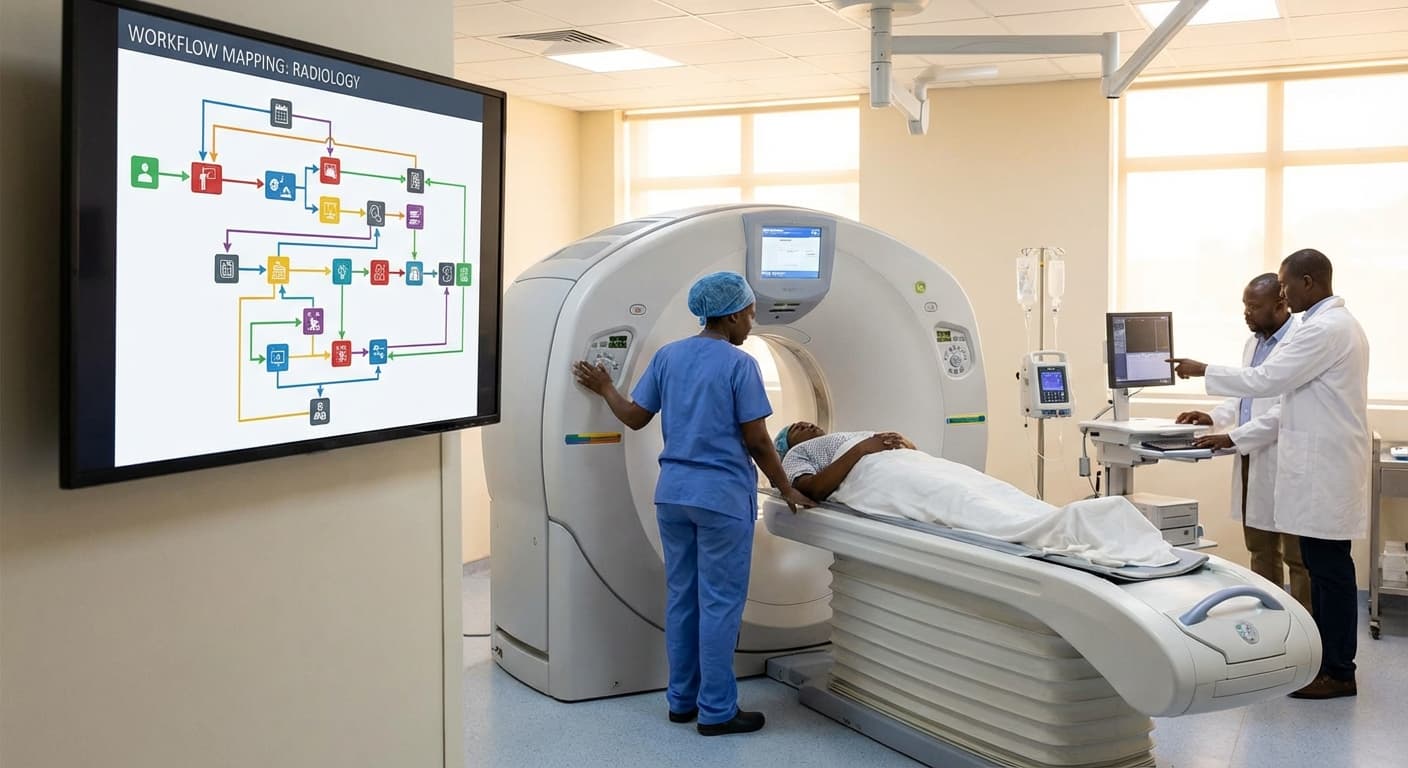
Department Workflow Mapping Service (Radiology/ICU/OT/Lab/Dialysis) in Djibouti
Engineering Excellence & Technical Support
Department Workflow Mapping Service (Radiology/ICU/OT/Lab/Dialysis) High-standard technical execution following OEM protocols and local regulatory frameworks.
Optimized Patient Flow
Visualize and streamline patient journeys across departments like Radiology, ICU, OT, Lab, and Dialysis, reducing wait times and improving resource allocation for faster, more efficient care delivery in Djibouti.
Inter-Departmental Collaboration
Map dependencies and communication pathways between critical departments (Radiology, ICU, OT, Lab, Dialysis) to foster seamless teamwork and informed decision-making, enhancing patient safety and outcomes within Djibouti's healthcare system.
Performance Analytics & Improvement
Gain actionable insights into workflow bottlenecks and inefficiencies within Radiology, ICU, OT, Lab, and Dialysis. Our service provides data-driven recommendations for continuous process improvement, boosting operational efficiency in Djibouti.
What Is Department Workflow Mapping Service (Radiology/icu/ot/lab/dialysis) In Djibouti?
Department Workflow Mapping Service in Djibouti, specifically within critical healthcare departments such as Radiology, Intensive Care Units (ICU), Operating Theatres (OT), Laboratories, and Dialysis Centers, refers to a structured methodology for analyzing, documenting, and optimizing the sequence of processes, tasks, and resource allocations involved in delivering services within these specialized units. This service employs analytical techniques to identify current state operations, pinpoint bottlenecks, inefficiencies, and areas for improvement, and subsequently design a proposed future state workflow that enhances efficiency, patient safety, quality of care, and resource utilization. The core objective is to create a visual and standardized representation of how work is performed, enabling data-driven decision-making for operational enhancements.
| Service Recipient | Need for Workflow Mapping | Typical Use Cases |
|---|---|---|
| Radiology Departments | To streamline image acquisition, interpretation, reporting, and retrieval processes; reduce patient wait times; optimize scanner utilization; and improve radiologist productivity. | Mapping the patient journey from referral to final report delivery, optimizing imaging protocol selection, integrating AI-assisted interpretation workflows, and managing image archiving and retrieval systems. |
| Intensive Care Units (ICU) | To enhance patient monitoring, care coordination among multidisciplinary teams, critical event management, and efficient resource allocation (e.g., ventilators, beds). | Documenting patient admission and discharge protocols, standardizing critical care pathways for specific conditions, optimizing nurse-to-patient ratios based on acuity, and improving communication channels between bedside staff, physicians, and specialists. |
| Operating Theatres (OT) | To improve surgical scheduling efficiency, reduce operating room downtime, optimize instrument and supply management, and ensure patient safety during surgical procedures. | Mapping pre-operative patient preparation, intra-operative procedures, and post-operative recovery; optimizing surgical team assignments; streamlining instrument sterilization and inventory management; and implementing digital checklists and time-outs. |
| Laboratories | To expedite sample processing, reduce turnaround times for test results, improve accuracy and reduce errors, and optimize laboratory equipment and reagent usage. | Mapping the entire sample lifecycle from collection, transport, accessioning, processing, analysis, to result reporting; implementing automated sample handling systems; optimizing quality control procedures; and integrating with Electronic Health Records (EHRs). |
| Dialysis Centers | To ensure efficient patient scheduling, streamline dialysis session management, optimize medication administration, and enhance patient comfort and safety. | Mapping the patient flow from arrival to departure, standardizing dialysis prescription and delivery protocols, managing vascular access care, optimizing staff allocation for multiple dialysis machines, and integrating with patient management systems. |
Key Components of Department Workflow Mapping Service
- As-Is Workflow Analysis: Detailed documentation of existing processes, including patient pathways, staff roles and responsibilities, information flow, equipment utilization, and decision points.
- Bottleneck Identification: Utilization of process mining, value stream mapping, and time studies to detect areas of delay, redundant steps, or resource constraints.
- Stakeholder Engagement: Collaboration with clinicians, administrative staff, technicians, and management to gather comprehensive insights and ensure buy-in for proposed changes.
- Technology Integration Assessment: Evaluation of how existing or potential technology solutions (e.g., PACS, HIS, LIS, EMR, automated equipment) impact workflow efficiency and patient outcomes.
- Risk Assessment and Mitigation: Identification of potential risks within the current workflow and development of strategies to mitigate them, particularly concerning patient safety and compliance.
- To-Be Workflow Design: Conceptualization and documentation of optimized workflows, incorporating best practices, lean principles, and technological advancements.
- Performance Metrics Definition: Establishing key performance indicators (KPIs) to measure the effectiveness of the redesigned workflow and track continuous improvement.
- Implementation Planning and Support: Development of actionable plans for transitioning to the new workflow, including training, change management, and ongoing monitoring.
- Regulatory and Compliance Alignment: Ensuring that redesigned workflows adhere to Djibouti's healthcare regulations and international standards.
Who Needs Department Workflow Mapping Service (Radiology/icu/ot/lab/dialysis) In Djibouti?
Identifying the need for a Department Workflow Mapping Service is crucial for optimizing operations within critical hospital departments in Djibouti. This service provides a detailed analysis and visual representation of how tasks are currently performed, identifying bottlenecks, inefficiencies, and areas for improvement. By understanding the intricate flow of information, resources, and patient care, departments can implement targeted strategies to enhance patient safety, reduce turnaround times, improve staff productivity, and ultimately deliver higher quality healthcare services. The service is particularly valuable for departments that are highly complex, resource-intensive, and directly impact patient outcomes. Djibouti's healthcare sector, like many developing nations, faces challenges in resource allocation and operational efficiency. Therefore, a structured approach to workflow mapping can be transformative.
| Department | Why they need Workflow Mapping | Specific Challenges Addressed |
|---|---|---|
| Radiology | To streamline patient imaging workflows, optimize equipment utilization, and reduce report turnaround times. Efficient workflow ensures timely diagnosis and treatment initiation. | Long patient wait times for imaging, delays in report generation, underutilization of expensive equipment, potential for image misplacement or loss, inefficient radiologist workload distribution. |
| Intensive Care Unit (ICU) | To ensure seamless and timely patient care, optimize the allocation of critical resources (staff, equipment), and improve communication between multidisciplinary teams. Safety and rapid response are paramount. | Communication breakdowns between nurses, physicians, and specialists, delays in critical interventions, inefficient patient monitoring, challenges in managing complex patient needs and equipment, risk of medical errors due to fragmented processes. |
| Operating Theatre (OT) | To enhance surgical efficiency, reduce procedure delays, optimize scheduling, and ensure the availability of necessary equipment and personnel. Smooth OT operations are vital for patient safety and resource management. | Delays in starting surgeries, inefficient use of operating rooms, shortages of surgical supplies or instruments, poor communication between surgical teams and support staff, lengthy patient turnover times in ORs. |
| Laboratory | To expedite sample processing, improve test accuracy, reduce errors, and ensure timely delivery of results to clinicians. Accurate and rapid lab results are fundamental for diagnosis and treatment. | Long turnaround times for test results, sample handling errors, insufficient equipment maintenance, inefficient specimen tracking, challenges in managing high test volumes, quality control issues. |
| Dialysis Center | To optimize patient scheduling, ensure efficient machine utilization, manage patient flow, and maintain strict hygiene protocols. Consistent and efficient dialysis is critical for patient well-being. | Patient scheduling conflicts, underutilization or overutilization of dialysis machines, long patient waiting lists, issues with staff-patient ratios, challenges in managing multiple treatment schedules, adherence to infection control standards. |
Who Needs Department Workflow Mapping Service in Djibouti?
- Hospitals and Healthcare Facilities in Djibouti
- Government Health Ministries and Agencies
- International NGOs focusing on healthcare improvement in Djibouti
- Private Healthcare Providers seeking to enhance service delivery and competitiveness
Department Workflow Mapping Service (Radiology/icu/ot/lab/dialysis) Process In Djibouti
This document outlines the standard workflow for the Department Workflow Mapping Service, specifically tailored for departments within healthcare facilities in Djibouti, including Radiology, Intensive Care Unit (ICU), Operating Theatre (OT), Laboratory, and Dialysis. The service aims to analyze, document, and optimize existing processes to improve efficiency, reduce errors, and enhance patient care. The workflow begins with an initial inquiry and culminates in the successful execution and delivery of the mapped workflow.
| Step | Phase | Description | Key Activities | Responsible Party | Deliverables/Outcomes | ||||||
|---|---|---|---|---|---|---|---|---|---|---|---|
| 1 | Inquiry & Initial Contact | The process begins when a department or facility expresses interest in the workflow mapping service. | Contacting the service provider, expressing need, initial discussion of scope and objectives. | Department/Facility Management, Service Provider Sales/Consultant | Initial understanding of requirements, scheduling of introductory meeting. | ||||||
| 2 | Needs Assessment & Scoping | A detailed understanding of the department's current challenges, goals, and the scope of the mapping project is established. | On-site or virtual meetings, interviews with key personnel, review of existing documentation, defining project boundaries and key performance indicators (KPIs). | Service Provider Project Manager/Consultant, Department Leadership/Key Personnel | Project proposal, defined scope of work, preliminary timeline, identified stakeholders. | ||||||
| 3 | Data Collection & Current State Analysis | Gathering comprehensive information about the existing workflow processes within the target department. | Observation of daily operations, interviews with staff at all levels, document analysis (SOPs, forms, reports), process charting, process mapping (e.g., using flowcharts, swimlane diagrams). | Service Provider Workflow Analyst/Consultant, Department Staff | Detailed documentation of the 'as-is' workflow, identification of bottlenecks, inefficiencies, and potential risks. | ||||||
| 4 | Analysis & Optimization Identification | Analyzing the collected data to identify areas for improvement and formulating recommendations. | Root cause analysis of identified issues, benchmarking against best practices (where applicable), brainstorming optimization strategies, developing 'to-be' process models. | Service Provider Workflow Analyst/Consultant, Department Subject Matter Experts (SMEs) | List of recommended improvements, proposed 'to-be' workflows, potential impact assessment. | ||||||
| 5 | Validation & Feedback | Presenting the analysis and proposed 'to-be' workflows to the department for review and feedback. | Presentations of findings and recommendations, facilitated workshops for feedback, incorporating stakeholder suggestions. | Service Provider Project Manager/Consultant, Department Leadership/Key Personnel/Staff | Refined 'to-be' workflows, consensus on proposed changes, stakeholder buy-in. | ||||||
| 6 | Finalization & Documentation | Consolidating all feedback and finalizing the documented workflow maps and recommendations. | Producing final workflow diagrams, creating comprehensive reports detailing current state, 'to-be' state, and implementation plan. Finalizing all project documentation. | Service Provider Workflow Analyst/Consultant | Final 'as-is' and 'to-be' workflow maps, detailed project report, implementation roadmap. | 7 | Execution & Implementation Support (Optional) | Assisting the department in putting the new workflows into practice. | Training sessions, pilot testing of new processes, change management support, post-implementation review. | Service Provider Implementation Specialist/Consultant, Department Staff | Successfully implemented optimized workflows, improved operational efficiency, enhanced staff understanding. |
| 8 | Project Closure | Formally concluding the workflow mapping project. | Final project review meeting, handover of all deliverables, archiving of project documentation, obtaining formal sign-off. | Service Provider Project Manager, Department Leadership | Completed project, satisfied client, documented outcomes. |
Key Departments Covered
- Radiology
- Intensive Care Unit (ICU)
- Operating Theatre (OT)
- Laboratory
- Dialysis
Department Workflow Mapping Service (Radiology/icu/ot/lab/dialysis) Cost In Djibouti
This document outlines the potential cost of a Department Workflow Mapping Service in Djibouti, specifically for departments such as Radiology, Intensive Care Unit (ICU), Operating Theatre (OT), Laboratory, and Dialysis. Workflow mapping is a crucial process for optimizing operational efficiency, identifying bottlenecks, and improving patient care pathways. The cost of such a service in Djibouti is influenced by several factors, leading to a range of potential pricing.
Key Pricing Factors:
- Scope and Complexity of the Department: Mapping a highly specialized and complex department like the ICU or OT will naturally require more time, expertise, and potentially advanced tools compared to a simpler workflow. The number of sub-processes and interdependencies within the department are significant drivers.
- Size of the Department/Facility: Larger departments with more staff, equipment, and patient throughput will inherently involve a more extensive mapping exercise.
- Level of Detail Required: The granularity of the workflow map (e.g., high-level overview vs. detailed step-by-step analysis of every interaction) will impact the effort involved.
- Consultant Expertise and Experience: The reputation, qualifications, and years of experience of the consulting firm or individual providing the service will influence their rates. Specialists in healthcare process improvement and workflow analysis command higher fees.
- Duration of the Engagement: The overall time commitment required for data collection, analysis, validation, and reporting will directly affect the total cost.
- Data Collection Methods: The methods used for data gathering (e.g., direct observation, interviews with staff, analysis of existing documentation, system logs) can vary in time and resource intensity.
- Reporting and Deliverables: The comprehensiveness and format of the final reports, including visual aids, recommendations, and implementation roadmaps, can also impact the pricing.
- Additional Services: The cost may increase if the service includes additional components like change management support, system integration advice, or staff training related to the optimized workflows.
- Market Demand and Competition: The presence and pricing strategies of other service providers in Djibouti for similar consulting services can influence the overall market rates.
Estimated Cost Ranges in Djiboutian Franc (DJF):
Given the variability of the factors mentioned above, providing precise figures is challenging. However, based on typical consulting engagement structures and considering the Djiboutian market, the following ranges are estimated for a comprehensive Department Workflow Mapping Service:
- Small to Medium Department (e.g., a specific Lab section, a smaller Radiology unit): DJF 750,000 - DJF 2,000,000
- Large to Complex Department (e.g., full ICU, OT suite, comprehensive Radiology department): DJF 1,500,000 - DJF 5,000,000+
These ranges are indicative and can fluctuate. For a more accurate quote, a detailed scoping exercise with potential service providers is highly recommended.
| Department Type/Size | Estimated Cost Range (DJF) |
|---|---|
| Small to Medium Department (e.g., specific Lab section, smaller Radiology unit) | 750,000 - 2,000,000 |
| Large to Complex Department (e.g., full ICU, OT suite, comprehensive Radiology department) | 1,500,000 - 5,000,000+ |
Key Pricing Factors for Department Workflow Mapping Service in Djibouti
- Scope and Complexity of the Department
- Size of the Department/Facility
- Level of Detail Required
- Consultant Expertise and Experience
- Duration of the Engagement
- Data Collection Methods
- Reporting and Deliverables
- Additional Services
- Market Demand and Competition
Affordable Department Workflow Mapping Service (Radiology/icu/ot/lab/dialysis) Options
This service offers comprehensive workflow mapping for critical hospital departments including Radiology, ICU, Operating Theatre (OT), Laboratory, and Dialysis. Our goal is to identify inefficiencies, streamline processes, and ultimately reduce operational costs. We provide clear visual representations of existing workflows and propose optimized alternatives.
| Value Bundle | Key Deliverables | Typical Use Case | Estimated Cost Range (per department) |
|---|---|---|---|
| Basic Workflow Audit | Current state workflow diagrams, Bottleneck identification report | Initial understanding of process issues, quick wins identification | $1,500 - $3,000 |
| Standard Optimization Package | Optimized workflow diagrams, Root cause analysis, Re-engineering recommendations, KPI identification | Addressing specific operational challenges, improving efficiency by 10-20% | $4,000 - $8,000 |
| Comprehensive Transformation Suite | All Standard deliverables, Process simulation models, Technology integration roadmap, Staff training recommendations, Implementation support plan | Major operational overhaul, achieving significant cost savings and efficiency gains (20%+) | $10,000 - $25,000+ |
| Department-Specific Specialization (Add-on) | Tailored metrics and analysis for chosen department | Deep dive into unique departmental challenges | $1,000 - $3,000 per specialization |
Key Value Bundles
- Basic Workflow Audit: Initial mapping of current processes with identification of obvious bottlenecks.
- Standard Optimization Package: Includes Basic Audit plus detailed analysis, bottleneck resolution strategies, and initial re-engineering recommendations.
- Comprehensive Transformation Suite: Encompasses Standard Package with advanced process simulation, technology integration assessment, staff training module recommendations, and ongoing support for implementation.
- Department-Specific Specialization: Tailored bundles for Radiology (imaging turnaround time), ICU (patient flow and resource utilization), OT (scheduling and equipment management), Lab (sample tracking and reporting), and Dialysis (patient scheduling and equipment maintenance).
Verified Providers In Djibouti
In the dynamic landscape of healthcare in Djibouti, identifying truly reliable and credentialed providers is paramount. This is where Franance Health stands out. Franance Health is a distinguished entity committed to ensuring the highest standards of medical care. Their rigorous vetting process for all affiliated providers guarantees that patients receive treatment from experienced, qualified, and ethical professionals. Choosing a Franance Health verified provider means opting for assurance, expertise, and a commitment to patient well-being.
| Credential Type | Franance Health Verification Focus | Patient Benefit |
|---|---|---|
| Medical Licenses & Certifications | Confirms current and valid professional licenses and board certifications. | Ensures providers are legally authorized and possess recognized expertise. |
| Educational Background | Verifies degrees and training from accredited institutions. | Guarantees a solid foundation of medical knowledge. |
| Professional Experience | Reviews past practice history and clinical experience. | Indicates a track record of successful patient care and problem-solving. |
| Reputation & Ethical Standing | Conducts background checks and gathers references regarding ethical practices. | Promotes trust and confidence in the provider's integrity and patient-first approach. |
| Continuing Medical Education (CME) | Confirms ongoing professional development and staying updated with medical advancements. | Ensures providers are equipped with the latest knowledge and techniques. |
Why Choose Franance Health Verified Providers in Djibouti?
- Unwavering Commitment to Quality: Franance Health implements a multi-faceted verification system that scrutinizes educational backgrounds, professional licenses, and practice histories of all affiliated healthcare professionals.
- Experienced and Specialized Professionals: We ensure that our network comprises practitioners with proven experience and specialized knowledge across a wide range of medical disciplines.
- Adherence to Ethical Standards: Beyond technical qualifications, Franance Health assesses the ethical conduct and patient-centered approach of every provider in their network.
- Access to Advanced Care: By partnering with top-tier facilities and practitioners, Franance Health facilitates access to advanced diagnostic and treatment options available in Djibouti.
- Peace of Mind for Patients: Knowing your healthcare provider has been thoroughly vetted by a reputable organization like Franance Health offers unparalleled peace of mind and confidence in the care you receive.
Scope Of Work For Department Workflow Mapping Service (Radiology/icu/ot/lab/dialysis)
This Scope of Work (SOW) outlines the services to be provided for a comprehensive Department Workflow Mapping initiative across key hospital departments including Radiology, Intensive Care Unit (ICU), Operating Theatre (OT), Laboratory, and Dialysis. The objective is to meticulously document, analyze, and optimize existing operational workflows within these departments to enhance efficiency, reduce errors, improve patient outcomes, and facilitate seamless integration with future technological advancements.
| Phase | Activity | Description | Deliverables | Standard Specifications |
|---|---|---|---|---|
| Project Initiation & Stakeholder Engagement | Define project scope, objectives, timelines, and identify key stakeholders within each department. Conduct kick-off meetings to ensure alignment and buy-in. | Project Charter, Stakeholder Register, Communication Plan | Adherence to standard project management methodologies (e.g., PRINCE2, Agile). Documentation in standard corporate templates. |
| Data Collection & Analysis | Gather comprehensive information on existing workflows through interviews, observation, document review (SOPs, protocols), and system logs. Document current processes, roles, responsibilities, and information flow. | Current State Workflow Diagrams (e.g., BPMN, Flowcharts), Process Narratives, Data Dictionaries, Gap Analysis Report (initial) | Workflow diagrams to conform to industry standards (e.g., BPMN 2.0). Data collected from existing EMR, RIS, LIS, PACS, and other relevant systems. |
| Technology & System Review | Analyze the current technology landscape, including hardware, software, and their integration within each departmental workflow. | Technology Inventory Report, System Integration Map | Documentation of system versions, functionalities, and interfaces. Focus on HL7, DICOM, and other relevant interoperability standards. |
| Optimization & Re-engineering | Based on the current state analysis, identify bottlenecks, inefficiencies, and areas for improvement. Design optimized future state workflows, incorporating best practices and potential technological enhancements. | Future State Workflow Diagrams, Proposed Process Improvements, Recommended Technology Upgrades/Integrations | Align with relevant clinical guidelines and regulatory requirements. Consider patient safety, staff efficiency, and cost-effectiveness. |
| Simulation & Validation (Optional) | If required, conduct simulations to test the proposed future state workflows and validate their effectiveness before implementation. | Simulation Models & Results Report | Use of appropriate simulation software and statistical analysis. |
| Change Management Strategy | Develop a comprehensive plan for transitioning from the current state to the future state, including change management, training, and communication strategies. | Change Management Plan, Training Plan, Communication Strategy | Focus on stakeholder engagement and minimizing disruption to operations. |
| Pilot Program Design (Optional) | Design a pilot program to test the implemented future state workflows in a controlled environment. | Pilot Program Scope & Objectives, Pilot Evaluation Metrics | Clearly defined scope, measurable success criteria. |
| Final Deliverables & Knowledge Transfer | Compile all project documentation, including final workflow maps, reports, and recommendations. Conduct knowledge transfer sessions to the client's team. | Final SOW Document, Comprehensive Project Report, As-Built Workflow Documentation, Training Materials | All documentation to be provided in editable digital formats (e.g., PDF, Visio, Word, Excel). Adherence to client's document management policies. |
Key Departments for Workflow Mapping
- Radiology Department
- Intensive Care Unit (ICU)
- Operating Theatre (OT)
- Laboratory Department
- Dialysis Department
Service Level Agreement For Department Workflow Mapping Service (Radiology/icu/ot/lab/dialysis)
This Service Level Agreement (SLA) outlines the guaranteed response times and uptime for the Department Workflow Mapping Service. This service provides the creation and maintenance of detailed workflow maps for critical hospital departments, including Radiology, Intensive Care Unit (ICU), Operating Theatre (OT), Laboratory (Lab), and Dialysis. The goal is to ensure efficient process understanding, identification of bottlenecks, and facilitate continuous improvement.
| Service Component | Response Time Guarantee | Uptime Guarantee |
|---|---|---|
| Initial Workflow Mapping Request (per department) | Within 5 business days for acknowledgment, 15 business days for preliminary draft completion. | N/A (project-based, not continuous uptime) |
| Workflow Map Update Request (minor changes, e.g., personnel, small process tweak) | Within 2 business days for acknowledgment, 5 business days for completion. | N/A (project-based, not continuous uptime) |
| Workflow Map Update Request (major changes, e.g., new equipment, significant process re-engineering) | Within 3 business days for acknowledgment, 10 business days for preliminary draft completion. | N/A (project-based, not continuous uptime) |
| On-Demand Workflow Interpretation/Clarification Request | Within 4 business hours during standard operational hours (9 AM - 5 PM, Monday-Friday). | 99.5% during standard operational hours. |
| Access to Workflow Map Repository | N/A (continuous access) | 99.9% uptime, excluding scheduled maintenance windows. |
| Scheduled Maintenance for Repository | Notification provided at least 48 hours in advance. | Limited to 4 hours per month, typically during off-peak hours (e.g., Sunday mornings). |
Scope of Service
- Initial creation of detailed workflow maps for specified departments.
- Regular review and updates of existing workflow maps based on departmental changes.
- On-demand assistance for understanding and interpreting workflow maps.
- Repository management for all workflow documentation.
Frequently Asked Questions

Ready when you are
Let's scope your Department Workflow Mapping Service (Radiology/ICU/OT/Lab/Dialysis) in Djibouti project in Djibouti.

Scaling healthcare logistics and technical systems across the entire continent.