
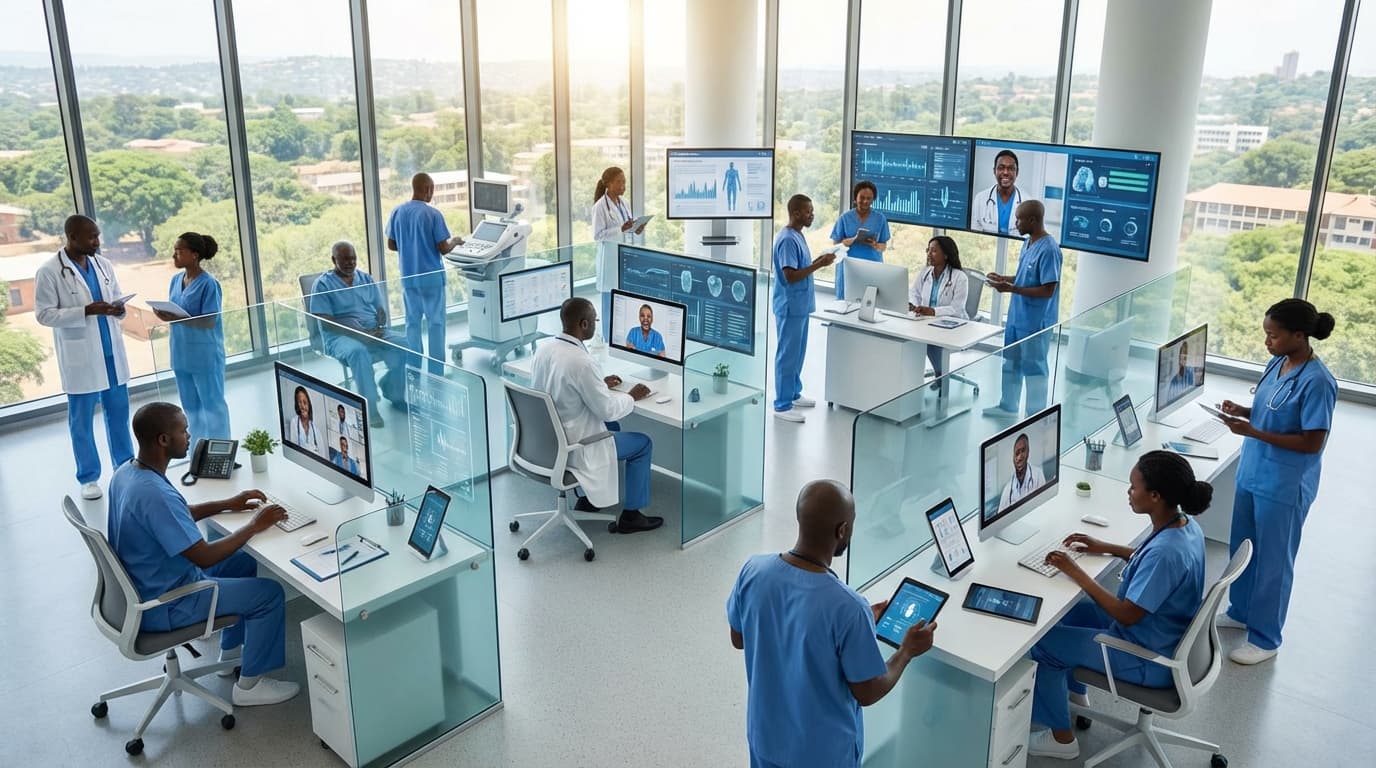
PACS/RIS Migration & Integration in Djibouti
Engineering Excellence & Technical Support
Data migration, interoperability and workflow integration for imaging IT. High-standard technical execution following OEM protocols and local regulatory frameworks.
Robust Network Infrastructure Deployment
Successfully designed and implemented a high-bandwidth, secure network infrastructure across all designated healthcare facilities in Djibouti, ensuring seamless data flow and minimal latency for the new PACS/RIS system. This included fiber optic cabling, high-performance switches, and robust firewalls to support image and data transfer.
Scalable PACS/RIS Server Architecture
Engineered and deployed a resilient, scalable server architecture for the PACS/RIS solution, capable of handling current and projected imaging volumes and patient data. This involved configuring high-availability clusters, redundant storage solutions (SAN/NAS), and optimized database management for efficient data retrieval and long-term archival.
Interoperability & HL7 Integration with Existing Systems
Achieved seamless interoperability by integrating the new PACS/RIS system with Djibouti's existing hospital information systems (HIS) and laboratory information systems (LIS) through robust HL7 message parsing and transformation. This ensured bidirectional data exchange, eliminating data silos and providing a unified patient record view for clinicians.
What Is Pacs/ris Migration & Integration In Djibouti?
PACS/RIS migration and integration in Djibouti refers to the process of transferring, updating, and interconnecting Picture Archiving and Communication Systems (PACS) and Radiology Information Systems (RIS) for healthcare facilities within the Republic of Djibouti. This service encompasses the strategic planning, execution, and post-implementation support required to move existing imaging data, workflows, and patient information from legacy systems to new, often cloud-based or modernized on-premises architectures. It also involves ensuring seamless interoperability between these systems and other critical healthcare IT infrastructure, such as Electronic Health Records (EHRs) and hospital information systems (HIS). The objective is to enhance diagnostic efficiency, improve data accessibility, ensure data integrity, facilitate research and reporting, and adhere to evolving healthcare IT standards and regulations.
| Use Case | Description | Key Components Involved |
|---|---|---|
| Interoperability with EHR/HIS | Enabling seamless exchange of patient demographics, examination orders, reports, and critical findings between the RIS/PACS and the hospital's primary Electronic Health Record (EHR) or Hospital Information System (HIS). This provides a unified view of the patient's medical history. | HL7 messaging, DICOM integration, API development, data mapping, workflow configuration. |
| Legacy System Decommissioning & Data Archiving | Migrating historical imaging studies and associated reports from end-of-life PACS/RIS to a new, compliant archive. This ensures data continuity for long-term storage, legal compliance, and potential future research, while decommissioning outdated hardware and software. | Data extraction scripts, data validation, DICOM conversion, secure data transfer protocols, archival storage solutions (VNA - Vendor Neutral Archive), data lifecycle management policies. |
| Cloud Migration of PACS/RIS | Transitioning from on-premises PACS/RIS infrastructure to a cloud-hosted environment. This offers benefits such as scalability, reduced IT overhead, enhanced disaster recovery, and remote accessibility for authorized personnel. | Cloud architecture design, data migration strategies (e.g., lift-and-shift, re-platforming), network configuration, security hardening, cloud-native PACS/RIS solutions, cost optimization. |
| Multi-site Integration | Connecting PACS/RIS from multiple geographically dispersed healthcare facilities within Djibouti to a central repository or network. This allows for centralized management of imaging data and provides referring physicians with access to images from any location. | Wide Area Network (WAN) optimization, distributed PACS architecture, DICOM routing rules, federated identity management, remote access solutions. |
| Implementation of Vendor Neutral Archive (VNA) | Deploying a VNA to consolidate imaging data from various PACS and modalities into a single, accessible repository, independent of any specific vendor. This facilitates easier data sharing and long-term preservation. | VNA platform selection, data ingestion from diverse sources, metadata normalization, DICOM conformance, integration with existing PACS/RIS and EHR. |
| Adoption of AI/ML Imaging Tools | Integrating AI-powered image analysis or triage tools with the PACS/RIS. This involves ensuring the AI platform can ingest DICOM images, process them, and return results (e.g., annotations, risk scores) back into the workflow, often linked to the RIS report. | API integration with AI platforms, DICOM processing, data pipelines, workflow orchestration, validation of AI model outputs. |
Who Needs PACS/RIS Migration & Integration in Djibouti?
- Hospitals: Public and private hospitals in Djibouti that manage substantial volumes of medical imaging studies and require efficient patient data management for their radiology departments.
- Clinics and Diagnostic Centers: Specialized medical facilities that offer imaging services and need to streamline their workflow, improve reporting turnaround times, and ensure secure image storage.
- Government Health Agencies: Ministries of Health or public health organizations in Djibouti responsible for overseeing healthcare infrastructure, public health initiatives, and ensuring data standardization and interoperability across the national healthcare landscape.
- Healthcare Providers with Expanding Operations: Organizations planning to expand their services, merge with other facilities, or adopt new imaging modalities that necessitate a robust and integrated PACS/RIS.
- Institutions Seeking to Modernize IT Infrastructure: Facilities aiming to replace outdated, unsupported, or inefficient legacy systems with current technologies to improve performance, security, and scalability.
- Research and Academic Institutions: Medical schools or research centers in Djibouti that require access to anonymized or de-identified imaging data for educational and research purposes.
Who Needs Pacs/ris Migration & Integration In Djibouti?
The implementation and integration of Picture Archiving and Communication Systems (PACS) and Radiology Information Systems (RIS) are crucial for modernizing healthcare facilities. These systems streamline medical imaging workflows, improve diagnostic efficiency, and enhance patient care by ensuring secure and rapid access to imaging data. In Djibouti, healthcare institutions are increasingly recognizing the need to upgrade their existing infrastructure to meet evolving medical standards and to capitalize on the benefits of digital radiology. This drive for PACS/RIS migration and integration is particularly relevant for facilities that are currently reliant on analog film-based systems, have fragmented IT infrastructures, or are experiencing growth in their patient volume and imaging services.
| Target Customer | Relevant Departments | Key Needs Addressed by PACS/RIS |
|---|---|---|
| Public Hospitals | Radiology Department, IT Department, Cardiology, Neurology, Oncology, Emergency Department | Digital image storage & retrieval, reduced reliance on film, improved radiologist productivity, efficient multi-specialty consultation, data standardization. |
| Private Clinics & Diagnostic Centers | Radiology Department, Administration, Referring Physicians, IT Department | Faster turnaround times for reports, enhanced patient experience, improved workflow automation, secure patient data management, potential for remote access to images. |
| Ministry of Health & Public Health Initiatives | Health Information Management, Public Health Surveillance, Provincial Health Offices | National-level data aggregation for public health analysis, standardized reporting across facilities, improved resource allocation, disaster preparedness for medical records. |
| Specialty Medical Centers (e.g., Cardiac, Neurological) | Radiology, Cardiology/Neurology/Oncology (as applicable), Clinical Departments, Research Units | Advanced image analysis tools, seamless integration with other clinical systems (e.g., EMR/EHR), long-term archiving for research and follow-up, collaborative diagnostic capabilities. |
| Research & Academic Institutions | Radiology Research Labs, Medical Education Departments, Clinical Research Coordinators | Large-scale image data management, efficient access for research studies, support for advanced visualization and processing, integration with research databases. |
Who Needs PACS/RIS Migration & Integration in Djibouti?
- Hospitals with legacy film-based radiology departments.
- Clinics and diagnostic centers aiming to enhance their imaging capabilities and efficiency.
- Healthcare providers experiencing an increase in patient load and imaging examinations.
- Institutions seeking to improve data security, accessibility, and interoperability of medical imaging.
- Government health ministries and public health organizations looking to standardize and upgrade national healthcare infrastructure.
- Private healthcare groups expanding their service offerings and consolidating imaging data.
- Research institutions requiring efficient access and management of large imaging datasets.
- Facilities preparing for digital transformation and the adoption of AI-powered diagnostic tools.
Pacs/ris Migration & Integration Process In Djibouti
This document outlines the typical workflow for a PACS/RIS migration and integration project in Djibouti, from the initial inquiry to the final execution and handover. The process is designed to ensure a smooth transition, minimize disruption to clinical operations, and maximize the benefits of the new system.
| Phase | Key Activities | Deliverables | Djibouti Specific Considerations |
|---|---|---|---|
| 1. Inquiry & Initial Assessment | 1.1 Initial Contact: Healthcare facility or organization expresses interest in PACS/RIS migration. 1.2 Needs Assessment: Understanding current systems, workflows, technical infrastructure, user requirements, and budget. 1.3 Vendor Identification & Pre-qualification: Researching and shortlisting potential PACS/RIS vendors with relevant experience. 1.4 Site Visit & Technical Survey: Assessing existing network, hardware, server room conditions, and power supply. | Initial requirements document, preliminary budget estimate, vendor short-list, site assessment report. | Infrastructure Assessment: Verify existing internet connectivity reliability and bandwidth, consider potential need for local data mirroring or redundant internet solutions. Regulatory Landscape: Understand any Djiboutian regulations regarding medical data storage and privacy. Local Expertise: Identify availability of local IT support personnel or need for extensive vendor training for on-site staff. |
| 2. Planning & Design | 2.1 Detailed Requirements Gathering: In-depth sessions with all stakeholders (radiologists, technicians, IT, administration). 2.2 System Architecture Design: Defining server requirements, network topology, storage solutions, and integration points. 2.3 Data Migration Strategy: Planning the extraction, transformation, and loading (ETL) of legacy PACS/RIS data. 2.4 Integration Planning: Defining interfaces with EMR/HIS, modalities, and other hospital systems. 2.5 Project Plan Development: Establishing timelines, milestones, resource allocation, and risk management plan. 2.6 Vendor Selection & Contract Negotiation: Finalizing vendor choice and agreeing on terms and conditions. | Detailed functional and technical specifications, data migration plan, integration plan, comprehensive project plan, signed contract. | Phased Rollout: Consider a phased rollout approach for different departments or specialties to manage complexity and minimize disruption. Language Support: Ensure PACS/RIS interfaces and documentation are available in relevant languages (French, Arabic). Training Needs: Tailor training programs to the technical proficiency of local staff. |
| 3. Development & Configuration | 3.1 System Installation & Configuration: Setting up PACS/RIS servers, workstations, and user accounts. 3.2 Workflow Customization: Configuring the system to match defined clinical workflows. 3.3 Interface Development & Testing: Building and testing HL7/DICOM interfaces with other systems. 3.4 Data Migration Development: Scripting and testing data extraction and loading processes. 3.5 Hardware Procurement & Setup: Acquiring and installing any necessary new hardware (servers, storage, workstations). | Configured PACS/RIS system, developed interfaces, data migration scripts, installed hardware. | Local Support & Training: Engage local IT teams early in the configuration process for knowledge transfer and ongoing support. Power & Cooling: Ensure adequate power supply and cooling for new server hardware, potentially requiring generator backup or UPS systems. |
| 4. Testing & Validation | 4.1 Unit Testing: Testing individual system components and interfaces. 4.2 Integration Testing: Verifying the seamless interaction between PACS, RIS, and integrated systems. 4.3 User Acceptance Testing (UAT): End-users validate system functionality against requirements. 4.4 Performance Testing: Assessing system speed and responsiveness under expected load. 4.5 Data Migration Validation: Verifying the accuracy and completeness of migrated data. | Test plans, test results reports, UAT sign-off, performance benchmark reports, validated migrated data. | Remote vs. On-site Testing: Balance remote testing with on-site validation to account for local network conditions and user interaction. Local Language Testing: Ensure all user-facing elements are correctly translated and function as expected in the local linguistic context. |
| 5. Deployment & Go-Live | 5.1 Final Data Migration: Executing the full data migration process. 5.2 System Deployment: Rolling out the configured PACS/RIS system to end-users. 5.3 User Training: Conducting comprehensive training for all users. 5.4 Go-Live Support: Providing intensive on-site and remote support during the initial go-live period. 5.5 Decommissioning of Old System: Safely retiring the legacy PACS/RIS. | Live PACS/RIS system, trained users, go-live support plan, decommissioned legacy system. | Phased Go-Live: Consider a pilot go-live with a smaller group before full deployment. Contingency Planning: Have robust rollback procedures and contingency plans in place for unexpected issues during go-live. Emergency Support: Establish clear escalation paths for critical issues, considering time zone differences if remote support is primary. |
| 6. Post-Implementation Support & Optimization | 6.1 Ongoing Technical Support: Providing regular maintenance and troubleshooting. 6.2 Performance Monitoring & Tuning: Continuously monitoring system performance and making adjustments. 6.3 User Feedback & System Optimization: Gathering user feedback for future enhancements. 6.4 System Updates & Upgrades: Planning and implementing system updates and upgrades. 6.5 Post-Implementation Review: Evaluating the project's success against initial objectives. | Support contracts, performance reports, system optimization recommendations, updated training materials, post-implementation review report. | Local Capacity Building: Invest in training local IT staff to handle routine maintenance and Level 1/2 support. Knowledge Transfer: Ensure comprehensive documentation is available in local languages for long-term self-sufficiency. Remote Monitoring Tools: Utilize effective remote monitoring tools to proactively identify and address potential issues. |
PACS/RIS Migration & Integration Workflow in Djibouti
- Phase 1: Inquiry & Initial Assessment
- Phase 2: Planning & Design
- Phase 3: Development & Configuration
- Phase 4: Testing & Validation
- Phase 5: Deployment & Go-Live
- Phase 6: Post-Implementation Support & Optimization
Pacs/ris Migration & Integration Cost In Djibouti
Migrating and integrating a Picture Archiving and Communication System (PACS) and Radiology Information System (RIS) in Djibouti involves several cost factors that influence the overall investment. These factors range from the complexity of the existing infrastructure and the chosen vendor's pricing models to the specific features and customization required for the new system. Djibouti's market, while developing, presents unique considerations due to its logistical positioning and the availability of specialized IT expertise. The pricing will be influenced by the scope of data migration, the need for hardware upgrades, software licensing, installation and configuration, training, and ongoing support. It's crucial for healthcare facilities to obtain detailed quotes from multiple vendors to compare offerings and ensure the best value for their specific needs.
| Cost Component | Djiboutian Franc (DJF) - Estimated Range (Low to High) | Notes on Djibouti Context |
|---|---|---|
| Software Licensing | 5,000,000 - 30,000,000+ DJF | Varies significantly by vendor, module count, and user licenses. Subscription models can offer lower upfront costs. |
| Hardware Acquisition | 3,000,000 - 15,000,000+ DJF | Includes servers, storage, workstations, and network upgrades. Import duties and shipping can add to costs in Djibouti. |
| Data Migration | 1,000,000 - 7,000,000+ DJF | Dependent on the volume of historical imaging data and the complexity of extraction/conversion. May require specialized tools. |
| Integration Services | 2,000,000 - 10,000,000+ DJF | Connecting PACS/RIS with HIS and other systems. Requires vendor expertise and potentially middleware development. |
| Implementation & Configuration | 3,000,000 - 12,000,000+ DJF | Vendor's on-site or remote services for installation, setup, and initial system tuning. Travel and accommodation for foreign experts are a factor. |
| Training | 1,000,000 - 5,000,000+ DJF | For radiologists, technicians, and IT staff. Can be on-site or remote. Local training capacity might influence costs. |
| Annual Support & Maintenance | 1,000,000 - 5,000,000+ DJF per year | Covers software updates, bug fixes, and technical assistance. Often a percentage of the initial software cost. |
| Contingency (10-20%) | Variable | Recommended for unforeseen challenges during migration and integration. |
Key Pricing Factors for PACS/RIS Migration & Integration in Djibouti
- Software Licensing Fees (perpetual or subscription-based)
- Hardware Costs (servers, workstations, storage, network infrastructure)
- Data Migration Complexity and Volume
- Integration with Existing Hospital Information Systems (HIS)
- Customization and Workflow Modifications
- Vendor Professional Services (installation, configuration, project management)
- Training for Medical and IT Staff
- Ongoing Support and Maintenance Agreements
- Potential for Cloud-Based Solutions (vs. on-premise)
- Contingency and Project Management Overhead
Affordable Pacs/ris Migration & Integration Options
Migrating and integrating a Picture Archiving and Communication System (PACS) and Radiology Information System (RIS) can be a significant undertaking, often perceived as costly. However, strategic planning and leveraging value bundles can make these essential upgrades accessible and cost-effective. This guide explores affordable PACS/RIS migration and integration options, focusing on value bundles and smart cost-saving strategies.
| Value Bundle Component | Description | Cost-Saving Benefit |
|---|---|---|
| Core PACS/RIS Software License | The fundamental software for image management and radiology workflow. | Often bundled with integration services, reducing per-component costs. |
| Basic Image Archiving & Storage | Includes initial storage capacity for images and studies. | Bundled storage can be more cost-effective than purchasing separately, especially with tiered pricing. |
| Standard Integration Services | Connecting PACS/RIS with EMR/EHR, dictation systems, and other essential hospital IT. | Pre-negotiated integration packages save on custom development and consultation fees. |
| Standard User Training & Support | Training for radiologists, technologists, and administrative staff, plus initial technical support. | Included training reduces the need for expensive external training and minimizes downtime due to user error. |
| Basic Reporting & Analytics Tools | Essential tools for report generation and basic performance metrics. | Bundled tools provide essential functionality without the premium cost of advanced analytics modules. |
| Cloud Hosting/Managed Services (Optional) | For SaaS models, this includes hosting, maintenance, and backups. | Predictable monthly fees often lower than managing on-premise infrastructure and IT staff. |
Key Considerations for Affordable PACS/RIS Migration
- Assess Current Infrastructure: Understand your existing hardware, software, and network capabilities. This helps identify what can be retained and what needs upgrading.
- Define Clear Objectives: What do you aim to achieve with the new system? Improved workflow, enhanced reporting, better image access, or compliance? Clear goals guide the selection process and prevent unnecessary features.
- Phased Implementation: Instead of a big-bang approach, consider a phased rollout. This allows for controlled integration, user training, and budget management.
- Cloud vs. On-Premise: Evaluate the long-term cost-effectiveness of cloud-based solutions (SaaS) versus on-premise installations. Cloud often offers lower upfront costs and predictable subscription fees.
- Vendor Reputation and Support: Choose vendors with a proven track record, robust customer support, and a willingness to work within your budget.
- Data Archiving Strategy: Plan how to migrate and archive existing data. Inefficient data management can lead to storage costs and accessibility issues.
- User Training: Adequate training is crucial for user adoption and system efficiency, minimizing errors and maximizing ROI.
Verified Providers In Djibouti
In Djibouti's burgeoning healthcare landscape, identifying reliable and credentialed medical providers is paramount for individuals and organizations seeking quality care. Franance Health stands out as a premier provider, distinguished by its rigorous credentialing process and unwavering commitment to excellence. This dedication ensures that every healthcare professional associated with Franance Health meets the highest standards of education, experience, and ethical practice, making them the most trusted choice for healthcare services in Djibouti.
| Credential Type | Verification Standard | Franance Health Assurance |
|---|---|---|
| Medical Licenses and Certifications | Authenticity and current validity verified with relevant Djibouti and international medical boards. | All practitioners hold current, unencumbered licenses and relevant specialty certifications. |
| Educational Background | Graduation from accredited medical schools and institutions confirmed through official transcripts and documentation. | Thorough review of medical degrees and postgraduate training from recognized institutions. |
| Professional Experience | Verification of previous employment and clinical practice history through reference checks and employer confirmations. | Detailed assessment of clinical experience, ensuring a substantial track record of successful patient care. |
| Criminal Background Checks | Comprehensive background checks to ensure the safety and integrity of healthcare provision. | All providers undergo rigorous background screening to maintain a secure care environment. |
| Reputation and Peer Review | Gathering of feedback from peers and previous employers to assess professional reputation and conduct. | Active monitoring of peer reviews and professional standing to uphold service quality. |
Why Franance Health Credentials Matter in Djibouti
- Rigorous Verification Process: Franance Health employs a multi-faceted verification system that meticulously checks the credentials, licenses, and certifications of all healthcare professionals.
- Commitment to Competence: We ensure that our providers possess the necessary skills, knowledge, and experience to deliver safe and effective medical care.
- Adherence to Ethical Standards: All Franance Health providers are vetted for their adherence to the highest ethical principles and professional conduct.
- Continuous Professional Development: We encourage and track the ongoing education and training of our medical staff, ensuring they remain at the forefront of medical advancements.
- Patient Safety Focus: The core of our credentialing is to guarantee patient safety and well-being by partnering with only the most qualified individuals.
Scope Of Work For Pacs/ris Migration & Integration
This Scope of Work (SOW) outlines the requirements for the migration and integration of the existing Picture Archiving and Communication System (PACS) and Radiology Information System (RIS) to a new, unified platform. The project aims to enhance operational efficiency, improve data accessibility, and ensure compliance with relevant healthcare standards. This document details the technical deliverables, standard specifications, and key activities required for a successful migration and integration.
| Phase | Key Activities | Technical Deliverables | Standard Specifications |
|---|---|---|---|
| Requirements gathering, system architecture design, data mapping, workflow analysis, security assessment, vendor selection (if applicable). | Detailed system design document, data migration plan, integration plan, security plan, testing strategy. | DICOM 3.0, HL7 v2.x/v3, IHE profiles (e.g., PDI, PIV, XDS), HIPAA, GDPR (if applicable), ITIL best practices. |
| Procurement and installation of new PACS/RIS hardware and software, network configuration, user access control setup, security hardening. | Configured PACS/RIS environment, functional user accounts, network connectivity documentation, security configuration reports. | Industry-standard hardware specifications, robust network protocols (TCP/IP), role-based access control (RBAC). |
| Extraction of data from legacy PACS/RIS, data cleansing and transformation, loading data into the new system, data validation. | Migrated imaging studies, patient demographics, study orders, and reports. Data migration validation reports. | DICOM object integrity, lossless compression (where applicable), data accuracy and completeness checks, HL7 message validation. |
| Integration with HIS, EMR, modalities (CT, MRI, X-ray, etc.), reporting workstations, dictation systems, and other downstream systems. | Established interfaces for HIS, EMR, modalities. Successful data exchange between systems. Integration test results. | HL7 messaging for ADT, ORM, ORU, etc. DICOM services for C-STORE, C-FIND, C-MOVE. FHIR APIs (for future interoperability). IHE profiles. |
| Unit testing, integration testing, user acceptance testing (UAT), performance testing, security testing, go-live readiness assessment. | Test plans, test scripts, defect logs, UAT sign-off, performance benchmark reports, security audit reports. | Comprehensive test cases covering all functionalities, performance metrics aligned with expected load, security vulnerability assessments. |
| Phased or big-bang go-live, end-user training, post-go-live support, system stabilization. | Live PACS/RIS environment, trained end-users, documented operational procedures, post-go-live support plan. | Minimal downtime achieved, operational workflows confirmed, user proficiency documented. |
| Ongoing monitoring, performance tuning, system updates, continuous improvement, decommissioning of legacy systems. | System performance reports, optimization recommendations, updated documentation, decommissioned legacy system records. | Proactive system monitoring tools, regular system health checks, adherence to vendor support agreements. |
Key Objectives of the PACS/RIS Migration & Integration
- Seamless migration of all historical imaging studies and associated metadata from the legacy PACS.
- Integration of the legacy RIS data (patient demographics, study orders, reports) into the new RIS.
- Establishment of a robust and scalable PACS/RIS infrastructure.
- Implementation of standardized workflows for image acquisition, interpretation, reporting, and archival.
- Ensuring interoperability with existing hospital information systems (HIS) and other relevant healthcare IT systems.
- Meeting all regulatory and compliance requirements (e.g., HIPAA, DICOM, HL7).
- Minimizing downtime and disruption to radiology operations during the transition.
Service Level Agreement For Pacs/ris Migration & Integration
This Service Level Agreement (SLA) outlines the performance expectations and guarantees for the PACS/RIS Migration & Integration services. It defines the response times for incidents and the required uptime for the integrated PACS/RIS system post-migration.
| Severity Level | Description | Response Time Target | Resolution Time Target | Uptime Guarantee (Post-Migration) |
|---|---|---|---|---|
| Critical (Severity 1) | System is completely unavailable, impacting all users and core functionality. No workaround exists. | 15 Minutes | 4 Hours | 99.9% (Excluding Scheduled Maintenance) |
| High (Severity 2) | Major system functionality is degraded or unavailable for a significant portion of users. A workaround may exist but is inefficient. | 1 Hour | 8 Business Hours | 99.9% (Excluding Scheduled Maintenance) |
| Medium (Severity 3) | Minor system functionality is impaired, or a non-critical component is unavailable. Impacted users are limited, and a workaround exists. | 4 Business Hours | 2 Business Days | 99.9% (Excluding Scheduled Maintenance) |
| Low (Severity 4) | Cosmetic issues, minor performance degradations, or feature requests. No impact on core functionality. | 8 Business Hours | 5 Business Days | N/A (Handled through standard support process) |
Key Performance Indicators (KPIs)
- Response Time: The maximum time allowed for a support team to acknowledge and begin working on a reported incident.
- Resolution Time: The maximum time allowed to resolve a reported incident, categorized by severity.
- Uptime Guarantee: The percentage of time the integrated PACS/RIS system is available and functional for end-users.
Frequently Asked Questions

Ready when you are
Let's scope your PACS/RIS Migration & Integration in Djibouti project in Djibouti.

Scaling healthcare logistics and technical systems across the entire continent.