
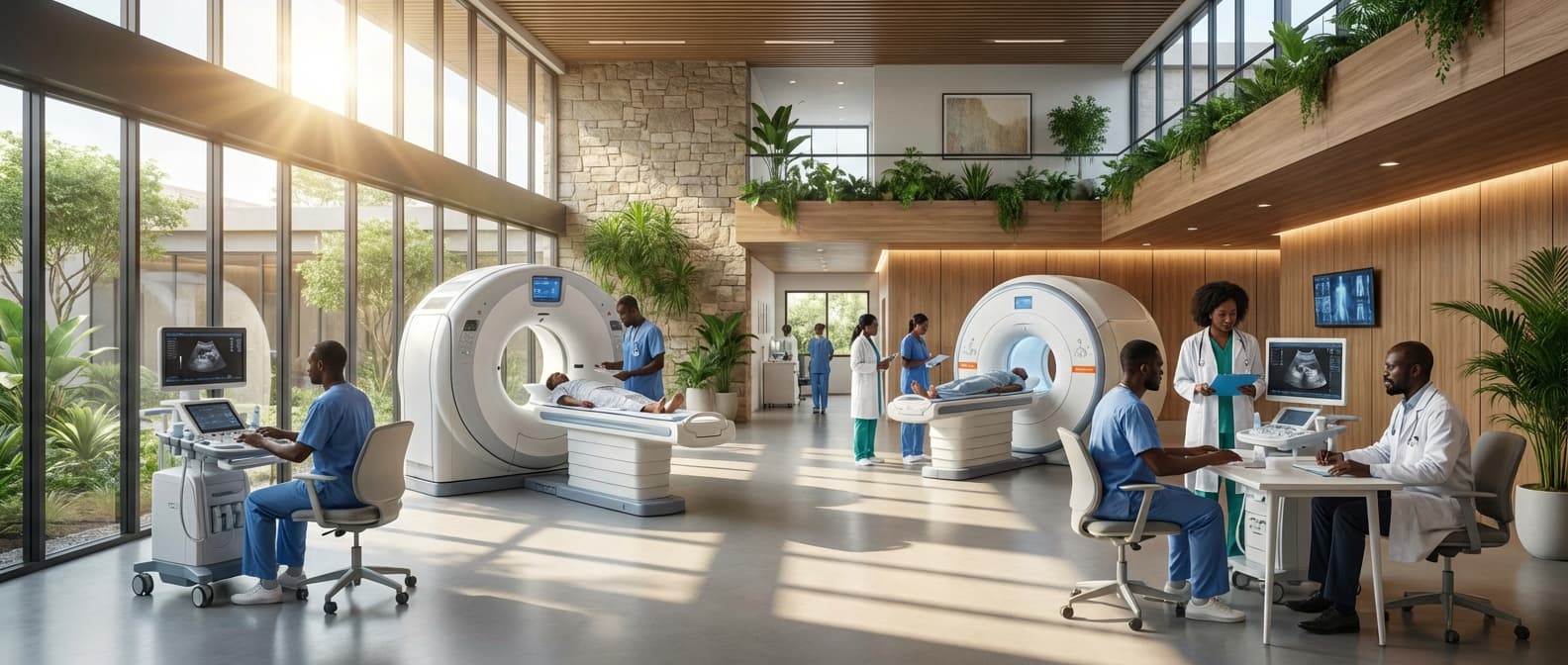
Diagnostic Imaging in Djibouti
Engineering Excellence & Technical Support
High-resolution imaging systems including CT scanners, MRI, X-ray, and ultrasound technology for accurate clinical diagnosis. High-standard technical execution following OEM protocols and local regulatory frameworks.
Advanced MRI & CT Scans
Djibouti now offers state-of-the-art Magnetic Resonance Imaging (MRI) and Computed Tomography (CT) scanners, providing high-resolution diagnostic capabilities for complex medical conditions. This enables earlier and more accurate diagnoses, improving patient outcomes.
High-Frequency Ultrasound Services
We've introduced advanced high-frequency ultrasound technology, significantly enhancing the visualization of superficial structures and small organs. This is crucial for detailed diagnostics in specialties like dermatology, musculoskeletal imaging, and breast imaging.
Specialized Radiologist Training Program
A dedicated training program for local radiologists in advanced imaging techniques and interpretation is now underway. This initiative aims to build local expertise, ensuring sustained high-quality diagnostic services and reducing reliance on external specialists.
What Is Diagnostic Imaging In Djibouti?
Diagnostic imaging in Djibouti refers to the utilization of medical imaging technologies to generate visual representations of the internal structures of the human body for clinical analysis and medical intervention. These non-invasive or minimally invasive procedures are crucial for the accurate diagnosis, staging, monitoring, and management of a wide spectrum of diseases and conditions. The service involves the operation of various imaging modalities by trained medical professionals, including radiologists, radiographers, and technologists. Image interpretation is then performed by qualified radiologists to provide actionable diagnostic reports to referring physicians.
| Imaging Modality | Primary Applications | Examples of Conditions Diagnosed |
|---|---|---|
| X-ray (Radiography) | Assessment of bones, lungs, and some soft tissues. | Fractures, pneumonia, bowel obstruction, foreign bodies. |
| Computed Tomography (CT) Scan | Detailed cross-sectional imaging of bone, soft tissues, and blood vessels. | Traumatic injuries, stroke, tumors, pulmonary embolism, appendicitis. |
| Magnetic Resonance Imaging (MRI) | High-resolution imaging of soft tissues, including organs, muscles, ligaments, and the brain. | Brain tumors, spinal cord injuries, joint injuries, soft tissue masses, neurological disorders. |
| Ultrasound (Sonography) | Real-time imaging using sound waves, particularly useful for soft tissues and fluid-filled structures. | Pregnancy monitoring, abdominal organ assessment (liver, kidneys, gallbladder), thyroid nodules, vascular studies. |
| Mammography | Specialized X-ray for breast tissue screening and diagnosis. | Breast cancer detection and diagnosis. |
Who Needs Diagnostic Imaging and Typical Use Cases:
- {"title":"Patients with Suspected or Diagnosed Pathologies","description":"Individuals presenting with symptoms indicative of internal abnormalities, or those with a confirmed diagnosis requiring further characterization or monitoring."}
- {"title":"Trauma Patients","description":"Assessment of injuries to bones, soft tissues, and internal organs following accidents or physical trauma."}
- {"title":"Patients Undergoing Surgical Procedures","description":"Pre-operative planning, intra-operative guidance, and post-operative evaluation."}
- {"title":"Patients with Chronic Conditions","description":"Monitoring disease progression, assessing treatment efficacy, and detecting complications."}
- {"title":"Patients Requiring Screening","description":"Early detection of diseases like certain cancers or cardiovascular abnormalities."}
Who Needs Diagnostic Imaging In Djibouti?
Diagnostic imaging plays a crucial role in healthcare in Djibouti, aiding in the accurate diagnosis, treatment planning, and monitoring of various medical conditions. The demand for these services extends across a broad spectrum of the population and healthcare providers.
| Department/Facility | Primary Imaging Needs | Common Modalities Used |
|---|---|---|
| General Hospitals (Public & Private) | Comprehensive diagnostic needs across all specialties, emergency care, inpatient and outpatient diagnostics. | X-ray, Ultrasound, CT Scan (where available), MRI (limited availability) |
| Specialty Clinics (e.g., Cardiology, Neurology, Orthopedics, Oncology) | Targeted imaging to support diagnosis and management of specific conditions within their specialty. | Ultrasound (echocardiography, Doppler), CT Scan, MRI (if accessible), X-ray |
| Maternity & Women's Health Clinics | Prenatal ultrasounds, pelvic imaging, mammography (limited availability). | Ultrasound |
| Emergency Departments/Trauma Centers | Rapid assessment of acute injuries, trauma, and critical conditions. | X-ray, CT Scan (essential), Ultrasound |
| Rural Health Centers & Dispensaries | Basic diagnostic imaging, primarily for initial assessment and referral. Ultrasound is often a key modality due to portability. | X-ray (limited), Ultrasound |
| Ministry of Health & Public Health Programs | Support for public health campaigns, disease surveillance, and mobile screening units. | Portable X-ray, Ultrasound |
| Military & International Organization Facilities | Comprehensive imaging services for their personnel and dependents, often with advanced capabilities. | X-ray, Ultrasound, CT Scan, MRI (potentially) |
Target Customers for Diagnostic Imaging in Djibouti:
- Individuals with Acute Injuries: Patients presenting with fractures, dislocations, internal bleeding, or head trauma requiring immediate assessment.
- Individuals with Chronic Diseases: Those managing conditions like heart disease, cancer, kidney disease, and respiratory illnesses who require regular monitoring and follow-up imaging.
- Patients Undergoing Surgical Procedures: Individuals needing pre-operative assessments to plan surgery and post-operative evaluations to monitor recovery.
- Pregnant Women: Expectant mothers requiring ultrasounds for fetal monitoring and anomaly detection.
- Children and Infants: Young patients who may have congenital abnormalities, developmental issues, or require imaging for common childhood illnesses.
- Individuals with Neurological Symptoms: Patients experiencing headaches, dizziness, seizures, or weakness that may indicate stroke, tumors, or other neurological disorders.
- Patients with Suspected Infections: Individuals where imaging can help identify the source and extent of infections, such as pneumonia or abscesses.
- Individuals Experiencing Pain: Those with persistent or severe pain where the underlying cause needs to be identified through imaging (e.g., joint pain, abdominal pain).
- Public Health Initiatives: Individuals participating in screening programs for conditions like tuberculosis or certain cancers.
Diagnostic Imaging Process In Djibouti
The diagnostic imaging process in Djibouti, like in many other healthcare systems, follows a structured workflow designed to efficiently and accurately provide diagnostic information to referring physicians. This process begins with an initial inquiry or referral and culminates in the interpretation and reporting of the imaging study. The specific steps and their implementation can vary slightly between public and private healthcare facilities, as well as the availability of advanced technology and specialized personnel.
| Stage | Description | Key Activities | Responsible Parties | Potential Challenges in Djibouti |
|---|---|---|---|---|
| Inquiry/Referral | The process is initiated when a healthcare provider determines that diagnostic imaging is necessary for patient diagnosis or management. | Clinician identifies need for imaging, completes referral form. | Referring Physician | Lack of specialist knowledge for complex cases, limited access to advanced imaging modalities necessitating referral to specialized centers. |
| Appointment Scheduling | Once a referral is received, the patient is scheduled for their imaging appointment. | Contacting the patient, informing them of the appointment date and time, providing necessary instructions. | Radiology Department administrative staff, Patient. | Long waiting times due to high demand and limited equipment, patient communication barriers (literacy, access to phones). |
| Patient Preparation | The patient is instructed on how to prepare for the specific imaging study to ensure optimal image quality. | Fasting (if required for abdominal scans), dietary restrictions, avoiding certain medications, wearing appropriate clothing. | Radiology Department staff, Patient. | Patient compliance, understanding of instructions, availability of necessary pre-procedure supplies. |
| Imaging Procedure Execution | The actual imaging scan is performed by a trained technologist using specialized equipment. | Positioning the patient, operating the imaging equipment (X-ray, Ultrasound, CT, MRI), ensuring patient comfort and safety. | Radiology Technologist. | Equipment maintenance and functionality, availability of skilled technologists for advanced modalities, power supply reliability. |
| Image Processing and Preliminary Review | The raw image data is processed, and a preliminary review may be conducted by the technologist or a junior radiologist. | Enhancing image quality, archiving images, initial assessment for technical adequacy. | Radiology Technologist, Junior Radiologist (if available). | Limited availability of advanced processing software, potential for delays in processing large datasets. |
| Radiologist Interpretation | A qualified radiologist reviews the processed images to identify any abnormalities and formulate a diagnosis. | Analyzing images, correlating findings with clinical information, dictating findings. | Radiologist. | Shortage of qualified radiologists (especially for specialized areas), heavy workload leading to potential delays in reporting. |
| Report Generation and Dissemination | A formal report detailing the imaging findings and diagnosis is generated and sent to the referring physician. | Typing or dictating the report, ensuring accuracy, sending the report via fax, email, or a secure electronic system. | Radiologist, Radiology Department administrative staff. | Inconsistent communication channels, potential for report loss or delay in delivery, reliance on manual processes. |
| Follow-up and Further Management | The referring physician uses the imaging report to guide further patient management, which may include further imaging or treatment. | Reviewing the report, discussing findings with the patient, ordering follow-up tests or initiating treatment. | Referring Physician, Patient. | Lack of integrated electronic health records hindering seamless information flow, patient adherence to follow-up appointments. |
Diagnostic Imaging Workflow in Djibouti
- Patient referral from a clinician.
- Appointment scheduling.
- Patient preparation.
- Imaging procedure execution.
- Image processing and preliminary review.
- Radiologist interpretation.
- Report generation and dissemination.
- Follow-up and further management.
Diagnostic Imaging Cost In Djibouti
Diagnostic imaging services in Djibouti, like in many other nations, are subject to a variety of pricing factors. These factors contribute to the observed cost ranges for common imaging procedures. Understanding these elements is crucial for patients and healthcare providers to navigate the cost of these essential medical services. The local currency is the Djiboutian Franc (DJF).
| Diagnostic Imaging Procedure | Estimated Cost Range (DJF) |
|---|---|
| X-ray (e.g., Chest, Limb) | 5,000 - 15,000 |
| Ultrasound (e.g., Abdomen, Pelvis, Obstetric) | 10,000 - 25,000 |
| CT Scan (e.g., Head, Abdomen/Pelvis - non-contrast) | 30,000 - 60,000 |
| CT Scan (with contrast) | 40,000 - 80,000 |
| MRI Scan (e.g., Brain, Spine, Knee - non-contrast) | 70,000 - 150,000 |
| MRI Scan (with contrast) | 80,000 - 180,000 |
Key Pricing Factors for Diagnostic Imaging in Djibouti
- Type of Imaging Modality: Different technologies have varying acquisition and maintenance costs. MRI and CT scans are generally more expensive than X-rays or ultrasounds due to the complexity and sophistication of the equipment.
- Complexity of the Procedure: A standard X-ray of a limb will be less costly than a specialized contrast-enhanced CT scan of the abdomen.
- Facility Type: Costs can differ between public and private healthcare facilities. Private clinics often have higher overheads, including advanced equipment and potentially higher staffing costs, which are reflected in their pricing.
- Location within Djibouti: While Djibouti is a relatively small country, there might be slight variations in pricing between the capital city (Djibouti City) and more remote areas, though this is less pronounced than in larger nations.
- Radiologist's Expertise and Specialization: Highly specialized radiologists or those with extensive experience may command higher professional fees, impacting the overall cost.
- Overhead Costs: This includes rent, utilities, administrative staff, and the cost of consumables (like contrast agents, if applicable) for the imaging department.
- Technological Advancements: Newer, more advanced imaging equipment that offers higher resolution or faster scan times can also contribute to higher costs.
- Supply Chain and Import Costs: As much of the advanced medical equipment and supplies may be imported, import duties, shipping, and currency exchange rates can influence pricing.
- Insurance Coverage: The extent to which a patient's insurance covers a particular procedure will also determine their out-of-pocket expense. However, direct pricing from facilities is the primary focus here.
Affordable Diagnostic Imaging Options
Navigating the world of diagnostic imaging can be daunting, especially when considering the costs. Fortunately, there are increasingly affordable options and strategies to help you manage expenses without compromising the quality of your care. Understanding how to access cost-effective diagnostic imaging is crucial for making informed healthcare decisions.
| Strategy | How it Saves Money | Considerations |
|---|---|---|
| Value Bundles | Pre-negotiated lower price for a package of services, reducing the total cost compared to individual service fees. | Ensure the bundle covers all necessary components. May require using specific providers within the bundle. |
| Price Transparency & Comparison | Allows you to identify the most affordable provider for the same or similar imaging service. | Requires proactive research. Prices can vary significantly by location and provider. |
| In-Network Providers | Insurance plan covers a larger portion of the cost, resulting in lower deductibles, copays, and coinsurance. | Verify provider status with your insurance company. Out-of-network costs can be substantially higher. |
| Health Savings Accounts (HSAs) | Use pre-tax dollars to pay for imaging, reducing your overall tax burden. Funds roll over year to year. | Typically paired with High-Deductible Health Plans. Only for qualified medical expenses. |
| Negotiate Self-Pay Rates | If uninsured or facing high out-of-pocket costs, ask for a self-pay discount. Providers often have lower rates for cash payments. | Requires direct negotiation. Not all providers offer significant discounts. |
Key Concepts in Affordable Diagnostic Imaging
- Value Bundles: These are packages of related medical services, often including diagnostic imaging, offered at a pre-negotiated, lower price. They are designed to provide comprehensive care for specific conditions or procedures, streamlining both the patient experience and the billing process.
- Transparency and Comparison Shopping: Knowing the prices for imaging services beforehand and comparing them across different providers is a powerful cost-saving strategy. Many healthcare systems and independent imaging centers are now publishing their prices online or are willing to provide quotes.
- In-Network Providers: Utilizing imaging centers and radiologists that are in your insurance network can significantly reduce out-of-pocket costs. Contact your insurance provider to confirm network status before scheduling your appointment.
- High-Deductible Health Plans (HDHPs) and Health Savings Accounts (HSAs): For those with HDHPs, setting up an HSA can be a smart move. Funds in an HSA are tax-advantaged and can be used to pay for qualified medical expenses, including diagnostic imaging.
- Generic vs. Brand-Name Imaging: While less common than with pharmaceuticals, sometimes imaging procedures or contrast agents might have different pricing. Discuss with your doctor if there are equally effective but more affordable alternatives.
- Second Opinions and Necessity Verification: While not always a direct cost-saving strategy for the imaging itself, ensuring the imaging is truly necessary can prevent unnecessary expenses. Sometimes, a physician may offer a second opinion on the need for a particular scan.
- Community and Non-Profit Imaging Centers: Some community-based or non-profit organizations offer diagnostic imaging services at reduced rates, often for underserved populations or those without insurance.
Verified Providers In Djibouti
In Djibouti, ensuring you are receiving care from verified and credentialed healthcare providers is paramount. Franance Health stands out as a premier choice due to its rigorous vetting process and commitment to quality. This dedication to excellence ensures patients receive safe, effective, and reliable medical services. Understanding the credentials and the advantages of choosing Franance Health can provide peace of mind and confidence in your healthcare decisions.
| Credential Type | Description | Benefit to Patients |
|---|---|---|
| Medical Licenses | Official authorization to practice medicine in Djibouti, issued by regulatory bodies. | Ensures providers are legally qualified and adhere to local healthcare laws. |
| Board Certifications | Recognition of advanced training and expertise in a specific medical specialty. | Indicates a high level of knowledge and skill in a particular area of medicine, leading to better outcomes. |
| Diplomas and Degrees | Academic qualifications from accredited medical institutions. | Confirms foundational medical education and training from reputable sources. |
| Professional Memberships | Affiliation with recognized medical associations and societies. | Suggests engagement with the medical community, ongoing learning, and adherence to professional ethics. |
| Continuing Medical Education (CME) | Proof of participation in ongoing training and education to stay updated. | Guarantees that providers are familiar with the latest medical research, techniques, and treatments. |
| Franance Health Vetting | Internal rigorous checks by Franance Health on qualifications, ethics, and patient feedback. | Adds an extra layer of assurance, ensuring providers meet Franance Health's high standards for quality and patient care. |
Why Franance Health Credentials Matter:
- Stringent Verification Process: Franance Health meticulously verifies the qualifications, licenses, and professional history of all their affiliated healthcare providers. This process goes beyond basic checks, ensuring practitioners meet high ethical and professional standards.
- Board Certification & Specialization: Many Franance Health providers hold board certifications in their respective specialties, signifying advanced knowledge and expertise. This specialization allows for more precise diagnoses and tailored treatment plans.
- Continuous Professional Development: Franance Health encourages and supports ongoing education and training for its providers. This commitment ensures they remain at the forefront of medical advancements and best practices.
- Patient-Centric Approach: Beyond technical skills, Franance Health providers are chosen for their compassionate and patient-centered approach to care. They prioritize clear communication, empathy, and understanding patient needs.
- Adherence to International Standards: Franance Health aligns its standards with internationally recognized healthcare benchmarks, providing a level of quality that is both locally relevant and globally competitive.
Scope Of Work For Diagnostic Imaging
This Scope of Work (SOW) outlines the requirements for providing diagnostic imaging services. It details the technical deliverables expected from the service provider and the standard specifications that these services must adhere to. The objective is to ensure high-quality, accurate, and timely diagnostic imaging to support patient care and medical decision-making.
| Imaging Modality | Standard Specifications | Image Quality Requirements | Reporting Requirements |
|---|---|---|---|
| X-ray (Radiography) | Digital radiography systems; compliance with FDA/CE standards; appropriate shielding. | High spatial resolution; low noise; appropriate contrast; artifact-free images. | Detailed description of findings, including location, size, and characteristics of abnormalities; comparison with prior studies when available. |
| CT Scan (Computed Tomography) | Multi-detector CT scanners; dose reduction techniques (e.g., iterative reconstruction); appropriate contrast protocols. | Axial and multi-planar reformations (MPR) with appropriate windowing; isotropic or near-isotropic resolution where applicable; minimal motion artifact. | Quantitative measurements where relevant; assessment of all anatomical structures within the scanned volume; impression of findings and differential diagnoses. |
| MRI Scan (Magnetic Resonance Imaging) | High-field strength MRI scanners (e.g., 1.5T or 3T); optimized pulse sequences for anatomical detail and pathology detection; functional imaging capabilities where specified. | High signal-to-noise ratio (SNR); excellent spatial resolution; minimal susceptibility artifacts; appropriate contrast enhancement. | Detailed analysis of tissue characteristics; evaluation of vascular structures; reporting on functional or physiological information if acquired. |
| Ultrasound | High-frequency transducers; Doppler capabilities (color, pulsed, continuous wave); harmonic imaging; contrast-enhanced ultrasound (CEUS) where applicable. | Clear visualization of anatomical structures; accurate assessment of blood flow dynamics; artifact reduction. | Description of echogenicity, size, shape, and vascularity of lesions; assessment of organ morphology and function. |
| Mammography | Digital mammography systems with tomosynthesis capabilities; automated breast ultrasound (ABUS) where applicable. | High contrast resolution; accurate depiction of microcalcifications and masses; minimal skin/chest wall artifacts. | Assessment of breast density; identification and description of all suspicious findings according to BI-RADS classification; comparison with prior exams. |
| Nuclear Medicine (PET/CT, SPECT/CT) | Integrated PET/CT or SPECT/CT systems; appropriate radiopharmaceuticals and protocols. | High spatial resolution; accurate quantification of radiotracer uptake; minimal attenuation and scatter artifacts. | Description of tracer distribution and activity; identification of hyper- or hypo-metabolic regions; correlation with anatomical findings. |
Key Technical Deliverables
- Radiology Reports: Comprehensive, clearly written, and interpretative reports for all imaging procedures, signed by a qualified radiologist.
- DICOM Images: Digital Imaging and Communications in Medicine (DICOM) compliant images accessible via a secure PACS (Picture Archiving and Communication System) or directly provided as requested.
- CD/DVD Copies: On-demand provision of imaging studies on CD-ROM or DVD, ensuring data integrity and compatibility.
- Image Archiving and Retrieval: Secure and reliable archiving of all imaging studies for a minimum specified retention period (e.g., 7 years for adults, longer for minors) with efficient retrieval capabilities.
- Contrast Media Management: Procedures for safe administration, inventory management, and disposal of contrast media, adhering to all relevant guidelines.
- Quality Assurance Reports: Regular reports detailing quality control measures, equipment calibration status, and adherence to industry standards.
- Turnaround Time Performance Metrics: Reporting on the timeliness of report delivery for routine, urgent, and STAT imaging requests.
- Technical Support: Availability of technical support for PACS integration, image access, and troubleshooting.
- Adherence to Data Security and Privacy Regulations: Full compliance with HIPAA (Health Insurance Portability and Accountability Act) or equivalent local regulations for patient data protection.
Service Level Agreement For Diagnostic Imaging
This Service Level Agreement (SLA) outlines the performance commitments for diagnostic imaging services provided by [Your Company Name] to [Client Name]. It defines the expected response times for critical events and the guaranteed uptime for the imaging systems and associated infrastructure.
| Service Component | Uptime Guarantee | Critical Incident Response Time (Remote) | Critical Incident Response Time (On-Site) | Service Request Response Time (Remote) |
|---|---|---|---|---|
| Diagnostic Imaging Equipment (MRI, CT, X-ray, Ultrasound) | 99.5% | 1 hour | 4 hours | 4 business hours |
| PACS/RIS and Core Infrastructure | 99.8% | 30 minutes | 2 hours | 2 business hours |
Key Service Components and Definitions
- Diagnostic Imaging Services: Refers to the provision, operation, and maintenance of all diagnostic imaging equipment (e.g., MRI, CT, X-ray, Ultrasound), Picture Archiving and Communication System (PACS), Radiology Information System (RIS), and related IT infrastructure.
- Uptime: The percentage of time the diagnostic imaging systems are operational and available for use, excluding scheduled maintenance.
- Downtime: The period during which the diagnostic imaging systems are unavailable for use, excluding scheduled maintenance.
- Critical Incident: A failure of a primary diagnostic imaging system or its core supporting infrastructure (PACS/RIS) that renders it completely unusable for patient care. Examples include complete system outage, inability to acquire new images, or critical PACS/RIS failure preventing access to images for interpretation.
- Service Request: A non-critical issue or request related to diagnostic imaging services, such as user access issues, minor system performance degradation, or general inquiries.
- Scheduled Maintenance: Planned periods for system upgrades, updates, or preventative maintenance, which will be communicated to the Client in advance.
- Response Time: The time elapsed from when a Critical Incident or Service Request is officially logged and acknowledged by [Your Company Name]'s support team to the time of initial remote diagnostic engagement or dispatch of a technician.
- Resolution Time: The time elapsed from when a Critical Incident or Service Request is officially logged and acknowledged by [Your Company Name]'s support team to the time the issue is resolved and service is restored.
Frequently Asked Questions

Ready when you are
Let's scope your Diagnostic Imaging in Djibouti project in Djibouti.

Scaling healthcare logistics and technical systems across the entire continent.