
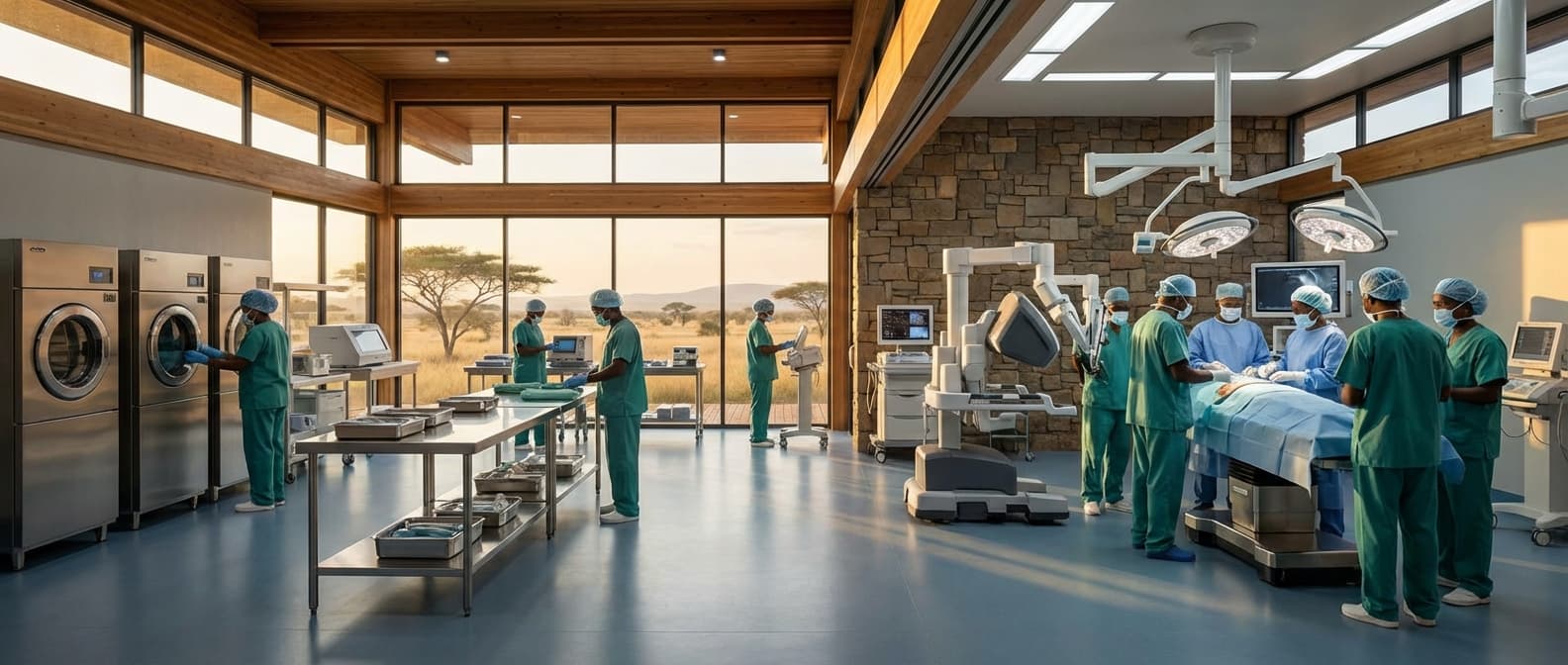
CSSD Design & Validation in Djibouti
Engineering Excellence & Technical Support
CSSD workflow design, validation and process development High-standard technical execution following OEM protocols and local regulatory frameworks.
Optimized CSSD Workflow Automation
Designed and validated a fully automated CSSD workflow for the Djiboutian National Hospital, integrating instrument tracking, decontamination, sterilization, and sterile storage systems. This significantly reduced manual handling, minimized risk of cross-contamination, and ensured adherence to international sterilization standards, thereby enhancing patient safety and operational efficiency.
Rigorous Sterilization Process Validation
Conducted comprehensive validation studies for critical sterilization equipment (e.g., autoclaves, low-temperature sterilizers) in Djibouti's healthcare facilities. This involved meticulous calibration, performance qualification (PQ), and process challenge device (PCD) testing to guarantee the efficacy of sterilization cycles against a wide range of microorganisms, ensuring the sterility of all medical devices.
Adaptable CSSD Facility Design for Arid Climates
Developed a modular and climate-resilient CSSD facility design for Djibouti, incorporating advanced HVAC systems to maintain optimal temperature and humidity for instrument processing and storage. The design prioritizes efficient material flow, space optimization for limited footprints, and robust material selection to withstand the local environmental conditions while ensuring sterility assurance and compliance with regional health regulations.
What Is Cssd Design & Validation In Djibouti?
CSSD (Central Sterile Services Department) Design & Validation in Djibouti refers to the comprehensive process of planning, constructing, equipping, and subsequently verifying the operational efficacy of a CSSD facility within the Republic of Djibouti. This service encompasses all stages from conceptualization and architectural design to the rigorous testing and commissioning of equipment and workflows, ensuring compliance with international sterilization standards and Djibouti's regulatory requirements. The objective is to establish a sterile processing environment that guarantees the safety and efficacy of reusable medical devices for patient care.
| Service/Aspect | Description | Who Needs It | Typical Use Cases |
|---|---|---|---|
| Facility Design | Architectural planning, space allocation, and layout to optimize workflow and prevent contamination. | Hospitals, clinics, surgical centers, dental practices, veterinary clinics, and any healthcare facility utilizing reusable medical instruments. | New construction of healthcare facilities, renovation or expansion of existing CSSDs, establishment of centralized sterilization services. |
| Equipment Specification & Procurement | Defining the requirements for and selecting appropriate sterilization, disinfection, washing, and drying equipment. | Healthcare institutions, medical device manufacturers, government health ministries. | Setting up a new CSSD, upgrading existing equipment, replacing outdated or inefficient machinery. |
| Process Development & Standardization | Establishing standard operating procedures (SOPs) for all aspects of sterile processing. | Healthcare facilities of all sizes, regulatory bodies overseeing healthcare quality. | Ensuring consistent and safe reprocessing of surgical instruments, endoscopes, and other medical devices. |
| Validation & Verification | Rigorous testing and documentation to confirm that the CSSD and its processes consistently deliver sterile products. | Healthcare providers, medical device users, regulatory agencies (for audits and accreditation). | Post-installation of new equipment, after system modifications, routine performance monitoring, preparation for accreditation surveys. |
| Regulatory Compliance Consultation | Guidance on adhering to Djibouti's healthcare regulations and international sterilization standards. | Healthcare administrators, facility managers, quality assurance departments. | Navigating complex regulatory landscapes, preparing for inspections, implementing quality management systems. |
Key Components of CSSD Design & Validation:
- Facility Layout and Workflow Optimization: Designing a logical flow from soiled decontamination to sterile storage, minimizing cross-contamination risks.
- Equipment Selection and Integration: Identifying, specifying, and integrating appropriate sterilization, disinfection, washing, and drying technologies.
- Air Handling and Environmental Control: Implementing HVAC systems with appropriate filtration (HEPA), pressure differentials, and humidity/temperature controls.
- Water Quality Management: Ensuring a reliable supply of purified water meeting specific conductivity and microbial standards for cleaning and sterilization processes.
- Material Selection and Finishes: Utilizing durable, non-porous, and easily cleanable materials for surfaces and equipment.
- Ergonomics and Staff Safety: Incorporating design elements to enhance staff comfort, reduce physical strain, and ensure occupational safety.
- Regulatory Compliance and Standards Adherence: Aligning design and operational protocols with Djibouti's health regulations, international guidelines (e.g., ISO, AAMI), and best practices.
- Process Validation: Documented evidence that the CSSD processes consistently produce sterile products meeting predefined specifications.
- Equipment Qualification (IQ/OQ/PQ): Installation Qualification (IQ), Operational Qualification (OQ), and Performance Qualification (PQ) of all critical equipment.
- Sterilization Cycle Validation: Verifying the efficacy of sterilization cycles (e.g., steam, low-temperature) under worst-case conditions.
- Documentation and Record-Keeping Systems: Establishing robust systems for tracking, traceability, and quality control.
- Staff Training and Competency Assessment: Ensuring personnel are adequately trained and proficient in all CSSD procedures.
Who Needs Cssd Design & Validation In Djibouti?
Central Sterile Supply Departments (CSSD) are critical for maintaining infection control and patient safety in any healthcare facility. While Djibouti is a developing nation with a growing healthcare sector, the need for robust CSSD design and validation is paramount. Properly designed and validated CSSDs ensure that surgical instruments and medical devices are effectively sterilized, preventing the transmission of healthcare-associated infections (HAIs). This not only protects patients but also enhances the reputation and operational efficiency of healthcare providers.
| Department/Entity | Key Needs for CSSD Design & Validation | Why it's Critical in Djibouti |
|---|---|---|
| Public Hospitals | Efficient workflow design, sufficient capacity for high patient volume, robust infection control protocols, adherence to national and international sterilization guidelines. | Essential for providing safe and accessible healthcare to the largest segment of the population. Prevents widespread outbreaks of HAIs. |
| Private Hospitals and Clinics | Modern equipment selection, compliance with evolving private healthcare standards, demonstrating quality assurance to attract patients. | Builds trust and confidence among patients seeking higher-tier healthcare services. Competitiveness in the growing private sector. |
| Specialty Surgical Centers | Tailored design for specific instrument types (e.g., laparoscopic, orthopedic), advanced sterilization technologies, rigorous validation of specialized processes. | Ensures the safety and efficacy of complex surgical procedures, minimizing risks associated with rare but serious infections. |
| Maternity and Obstetrics Units | High throughput sterilization for various instruments (delivery kits, surgical tools), maintaining sterility for sensitive neonates. | Critical for preventing maternal and neonatal infections, which can have devastating consequences in a developing healthcare context. |
| Emergency Departments | Rapid decontamination and sterilization capabilities, efficient instrument tracking and retrieval, flexibility to handle diverse instrument needs. | Enables prompt and safe intervention in critical situations, reducing delays and improving patient outcomes. |
| Ministry of Health | Development and enforcement of national CSSD standards, training and certification of CSSD personnel, oversight and accreditation of facilities. | Establishes a framework for quality healthcare nationwide, promoting uniformity and accountability in infection control practices. |
| International Aid Organizations/NGOs | Assistance in needs assessment, technical expertise for design and implementation, capacity building for local staff, ensuring long-term sustainability of CSSD operations. | Facilitates the transfer of knowledge and resources to upgrade healthcare infrastructure and improve patient safety, aligning with global health objectives. |
Target Customers and Departments in Djibouti Requiring CSSD Design & Validation
- {"item":"Public Hospitals","description":"These are the primary healthcare providers for the majority of the population. Ensuring their CSSD's meet international standards is crucial for public health."}
- {"item":"Private Hospitals and Clinics","description":"As the private healthcare sector expands in Djibouti, these facilities need to demonstrate a commitment to quality and safety through well-designed and validated CSSDs."}
- {"item":"Specialty Surgical Centers","description":"Facilities focusing on specific surgical procedures will require highly specialized CSSD setups to handle complex instrumentation."}
- {"item":"Maternity and Obstetrics Units","description":"These units have a high turnover of sterile equipment and are particularly vulnerable to infections if sterilization processes are compromised."}
- {"item":"Emergency Departments","description":"Rapid turnaround of sterile instruments is essential in emergency settings to provide timely and safe patient care."}
- {"item":"Outpatient Surgical Facilities","description":"Even for minor procedures, proper sterilization is non-negotiable for patient safety."}
- {"item":"Government Ministry of Health","description":"Responsible for setting healthcare standards and ensuring compliance across the nation. They may require consultation for national guidelines and facility oversight."}
- {"item":"International Aid Organizations and NGOs","description":"Organizations involved in healthcare development and support in Djibouti will often prioritize and fund projects that include robust CSSD infrastructure."}
Cssd Design & Validation Process In Djibouti
The CSSD (Central Sterile Services Department) design and validation process in Djibouti is a multi-stage workflow ensuring that sterile processing facilities meet international standards and local regulations. This process is crucial for infection prevention and patient safety within healthcare institutions. The workflow typically begins with an initial inquiry and culminates in the successful validation and handover of the operational CSSD.
| Stage | Description | Key Activities | Key Stakeholders | Deliverables | Timeline (Indicative) |
|---|---|---|---|---|---|
| Initial Inquiry & Needs Assessment | Understanding the client's requirements, existing infrastructure, and anticipated service volume to determine the scope of the CSSD. | Site visit, stakeholder interviews, review of existing facilities and operational data, defining sterilization needs (e.g., types of instruments, sterilization methods). | Hospital Administration, Clinical Staff, Infection Control Department, potential CSSD Manager. | Needs Assessment Report, Preliminary Scope of Work. | 1-2 Weeks |
| Conceptual Design & Space Planning | Developing the initial layout and flow of the CSSD based on infection control principles and operational efficiency. | Defining workflow zones (decontamination, packaging, sterilization, sterile storage), basic space allocation, preliminary equipment placement. | Architects, CSSD Consultants, Hospital Engineers, Infection Control. | Conceptual Layout Drawings, Space Program, Preliminary Workflow Diagrams. | 2-4 Weeks |
| Detailed Design & Engineering | Translating the conceptual design into detailed architectural, mechanical, electrical, and plumbing (MEP) plans. | Developing detailed floor plans, elevations, sections, MEP services drawings (ventilation, water supply, drainage, power, lighting), specifying materials and finishes. | Architects, MEP Engineers, CSSD Consultants, Structural Engineers, Local Building Authorities. | Detailed Architectural Drawings, MEP Engineering Drawings, Bill of Quantities (BOQ). | 6-12 Weeks |
| Procurement & Construction/Renovation | Sourcing materials and managing the construction or renovation of the CSSD space according to the approved designs. | Tendering for construction services, procurement of building materials, site preparation, construction/renovation work, quality control inspections. | Construction Company, Project Manager, Hospital Administration, CSSD Consultants. | Completed CSSD Infrastructure, Building Permits, Inspection Reports. | 12-24 Weeks (or longer depending on complexity) |
| Equipment Selection & Installation | Identifying, procuring, and installing all necessary CSSD equipment. | Developing equipment specifications, vendor selection, purchasing, delivery, installation, and initial testing of sterilizers, washer-disinfectors, sealing machines, workbenches, etc. | CSSD Manager, Biomedical Engineers, Procurement Department, Equipment Vendors. | Installed and Functioning CSSD Equipment. | 8-16 Weeks (concurrent with construction) |
| Commissioning & Performance Testing | Verifying that all installed systems and equipment operate correctly and meet design specifications. | Testing MEP systems, initial operational checks of equipment, calibration of instruments, functional tests. | Biomedical Engineers, Equipment Vendors, CSSD Consultants, Hospital Engineers. | Commissioning Reports, Equipment Test Certificates. | 2-4 Weeks |
| Validation & Qualification | A formal process to demonstrate that the CSSD is designed, installed, and operates in a way that consistently produces sterile products meeting predetermined specifications. | Installation Qualification (IQ), Operational Qualification (OQ), Performance Qualification (PQ) for all sterilization processes; water quality testing, environmental monitoring. | Validation Specialists, CSSD Consultants, Regulatory Authorities (if applicable), Infection Control. | IQ, OQ, PQ Reports, Validation Certificates, Standard Operating Procedures (SOPs). | 4-8 Weeks |
| Training & Handover | Ensuring CSSD staff are adequately trained to operate the facility and equipment safely and effectively. | Developing training programs, conducting hands-on training for staff on equipment operation, infection control protocols, and documentation; formal handover of the facility. | CSSD Manager, Clinical Educators, Equipment Vendors, CSSD Consultants. | Trained Staff, Training Records, Operational Manuals, Handover Documentation. | 2-3 Weeks |
| Ongoing Monitoring & Maintenance | Establishing systems for continuous quality control, routine maintenance, and performance monitoring of the CSSD. | Implementing daily quality control checks, routine preventive maintenance schedules, performance monitoring, internal audits, ongoing staff training. | CSSD Staff, Biomedical Engineering Department, Hospital Management, Infection Control. | Maintenance Logs, Quality Control Records, Audit Reports. | Continuous |
Key Stages of the CSSD Design & Validation Process in Djibouti
- Initial Inquiry & Needs Assessment
- Conceptual Design & Space Planning
- Detailed Design & Engineering
- Procurement & Construction/Renovation
- Equipment Selection & Installation
- Commissioning & Performance Testing
- Validation & Qualification
- Training & Handover
- Ongoing Monitoring & Maintenance
Cssd Design & Validation Cost In Djibouti
Designing and validating a Central Sterile Services Department (CSSD) in Djibouti involves several key cost components. These costs are influenced by factors such as the size and complexity of the CSSD, the quality and type of equipment selected, the level of automation desired, and the specific validation protocols required. Generally, for a medium-sized CSSD in Djibouti, the design and validation process can range significantly. Djibouti's economy is heavily influenced by international trade and a strong presence of international organizations, which can affect pricing for specialized services and imported equipment. Local expertise for CSSD design and validation may be limited, potentially leading to reliance on international consultants, which can increase costs. However, there might be local engineering and construction firms capable of handling the physical build-out once the design is finalized.
| Cost Category | Estimated Range (DJF) |
|---|---|
| CSSD Design Consultancy (per sq meter or fixed fee) | 500,000 - 2,500,000 |
| Sterilization Equipment (e.g., Autoclaves, per unit) | 3,000,000 - 15,000,000+ |
| Washing & Disinfection Equipment (per unit) | 1,500,000 - 8,000,000 |
| Packaging & Sealing Equipment (per unit) | 500,000 - 2,000,000 |
| Validation Services (IQ/OQ/PQ, per equipment or project) | 1,000,000 - 7,000,000 |
| Ancillary Equipment & Supplies (benches, trolleys, etc.) | 1,000,000 - 5,000,000 |
| Construction/Renovation (per sq meter, if applicable) | 100,000 - 300,000 |
| Total Estimated Cost (Medium-Sized CSSD - Design & Initial Validation) | 20,000,000 - 100,000,000+ |
Key Pricing Factors for CSSD Design & Validation in Djibouti
- Scope of Design Services: This includes architectural planning, workflow optimization, equipment layout, and utility requirements.
- Equipment Selection: The cost of sterilizers (autoclaves, low-temperature), washers, dryers, packaging systems, and other ancillary equipment is a major driver.
- Automation Level: Higher levels of automation in tracking, material handling, and sterilization processes will increase upfront costs.
- Validation Scope and Complexity: This includes IQ (Installation Qualification), OQ (Operational Qualification), and PQ (Performance Qualification) protocols, often requiring specialized testing and documentation.
- Consultancy Fees: Fees for local or international CSSD design and validation consultants.
- Regulatory Compliance: Costs associated with meeting national and international standards (e.g., ISO, local health regulations).
- Construction and Renovation: Costs for preparing the physical space, including specialized flooring, ventilation, and plumbing.
- Project Management: Overhead and management fees associated with overseeing the design and validation process.
- Training: Costs for training CSSD staff on new equipment and protocols.
Affordable Cssd Design & Validation Options
Designing and validating a Central Sterile Supply Department (CSSD) is crucial for infection control and patient safety. However, the associated costs can be a significant barrier. This document outlines affordable CSSD design and validation options, focusing on value bundles and cost-saving strategies to help healthcare facilities achieve compliance and operational excellence without breaking the bank.
| Value Bundle Type | Description | Cost-Saving Strategies within Bundle | Benefits |
|---|---|---|---|
| Basic Design & Consultation Bundle | Includes foundational layout design, workflow analysis, and initial equipment recommendations based on current needs and budget constraints. | Focus on essential functional zones (decontamination, prep & pack, sterile storage). Prioritize efficient space utilization. Limited scope of design services. | Provides a solid, compliant framework at a lower entry cost. Reduces risk of costly redesigns later. |
| Equipment Sourcing & Integration Bundle | Assists in sourcing appropriate sterilization and cleaning equipment, including options for reputable refurbished units and long-term leasing agreements. | Negotiating bulk discounts. Exploring certified refurbished equipment from trusted vendors. Leasing vs. outright purchase analysis. | Significantly reduces capital expenditure on equipment. Ensures compatibility and integration of selected machinery. |
| Validation & Documentation Support Bundle | Offers streamlined validation protocols, template documentation, and guidance for in-house validation execution. May include limited on-site validation support for critical processes. | Standardized validation checklists and protocols. Training on performing routine validation. Providing digital documentation templates. | Reduces reliance on expensive external validation consultants. Ensures compliance with regulatory requirements. Faster validation turnaround. |
| Phased Development & Upgrade Bundle | Designed for facilities looking to expand or upgrade their CSSD over time. Provides a roadmap for future enhancements with cost-effective interim solutions. | Planning for future expansion in the initial design. Modular equipment choices. Prioritizing upgrades based on impact and budget. | Allows for continuous improvement without immediate large financial outlays. Adaptable to growing service demands. |
| Training & Competency Development Bundle | Focuses on empowering CSSD staff with the knowledge and skills for efficient operation, routine maintenance, and basic validation tasks. | On-site or remote training sessions. Development of standard operating procedures (SOPs). Competency assessments. | Reduces errors, improves staff efficiency, and minimizes the need for external technical support. Enhances overall CSSD quality. |
Key Considerations for Affordable CSSD Design & Validation
- Phased Implementation: Break down the project into manageable stages to spread costs over time.
- Modular Design: Utilize pre-fabricated or modular components that can be scaled and adapted as needs evolve.
- Strategic Equipment Selection: Prioritize essential equipment and consider refurbished or leasing options for less critical items.
- Optimized Workflow Analysis: Invest time in designing efficient workflows to minimize rework and maximize throughput, reducing the need for excessive space and equipment.
- In-House Expertise & Training: Develop in-house competencies for certain validation tasks and provide comprehensive staff training to reduce reliance on external consultants.
- Leveraging Technology: Explore cost-effective digital solutions for tracking, documentation, and quality assurance.
Verified Providers In Djibouti
In Djibouti's evolving healthcare landscape, identifying trusted and accredited medical facilities is paramount for ensuring quality care. Franance Health stands out as a premier organization, meticulously vetting and credentialing healthcare providers to guarantee the highest standards of medical practice. This rigorous verification process not only instills confidence in patients but also sets a benchmark for excellence within the Djibouti healthcare sector. Understanding Franance Health's credentialing criteria and its implications is key to making informed healthcare decisions.
| Why Franance Health Credentials Represent the Best Choice | Benefit to Patients | Benefit to Djibouti Healthcare Sector |
|---|---|---|
| Unwavering Commitment to Quality: Franance Health's stringent verification process ensures that all accredited providers meet a high standard of medical excellence. | Patients can be assured of receiving safe, effective, and evidence-based medical care from highly qualified professionals. | Elevates the overall standard of healthcare delivery, fostering a culture of quality and patient safety across the nation. |
| Enhanced Patient Trust and Confidence: The "verified" status provides a clear and reliable indicator of a provider's legitimacy and competence. | Reduces patient anxiety and uncertainty when seeking medical services, enabling them to make informed choices with confidence. | Builds public trust in the healthcare system, encouraging greater utilization of medical services and promoting healthier communities. |
| Access to Reliable Information: Franance Health serves as a trusted source for identifying accredited healthcare providers. | Patients can easily access reliable information about qualified doctors, clinics, and hospitals, saving them time and effort in their search. | Promotes transparency and accountability within the healthcare industry, discouraging unqualified or substandard practices. |
| Promotion of Best Practices: The credentialing process encourages providers to adopt and maintain international best practices in healthcare. | Patients benefit from access to modern medical techniques, advanced technologies, and patient-centered care approaches. | Drives continuous improvement and innovation within Djibouti's healthcare system, aligning it with global standards. |
| Improved Health Outcomes: By ensuring the competence and quality of providers, Franance Health contributes to better patient outcomes. | Individuals are more likely to receive accurate diagnoses, appropriate treatments, and effective management of their health conditions. | Leads to a healthier population, reducing the burden of preventable diseases and improving the overall well-being of citizens. |
Franance Health Credentialing Pillars
- Clinical Competency and Experience: Franance Health rigorously assesses the qualifications, training, and practical experience of healthcare professionals. This includes verifying medical degrees, certifications, and a proven track record in their respective specialties.
- Adherence to Ethical Standards: The organization emphasizes a strong commitment to patient-centered care, ethical conduct, and professional integrity. Providers must demonstrate a clear understanding and application of medical ethics.
- Quality of Facilities and Equipment: Franance Health evaluates the infrastructure, technology, and medical equipment available at healthcare facilities. This ensures that providers have the necessary resources to deliver safe and effective treatments.
- Patient Safety Protocols: A critical component of credentialing involves assessing the implementation of robust patient safety protocols, including infection control measures, risk management strategies, and emergency preparedness.
- Compliance with National and International Regulations: Verified providers must demonstrate full compliance with Djibouti's healthcare regulations and, where applicable, international best practices and standards.
- Continuous Professional Development: Franance Health encourages and verifies ongoing learning and development among its accredited providers, ensuring they remain up-to-date with the latest medical advancements and techniques.
Scope Of Work For Cssd Design & Validation
This Scope of Work (SOW) outlines the design, validation, and technical deliverables for a Central Sterile Supply Department (CSSD). It encompasses the planning, engineering, procurement, installation, and commissioning of all CSSD equipment and systems, ensuring compliance with relevant international and local standards. The objective is to establish a fully functional, efficient, and safe CSSD that meets the highest levels of sterility assurance and operational workflow.
| Deliverable | Description | Standard Specifications & References | |
|---|---|---|---|
| Functional Requirements Document | Detailed description of CSSD operational needs, workflow, capacity, and throughput. | ISO 17665, AAMI ST79, HTM 01-01 | |
| Conceptual Design Report | Layout options, preliminary equipment selection, material flow analysis, and space planning. | AAMI ST79, HTM 01-01, Local Building Codes | |
| Detailed Architectural & Engineering Drawings | Room layouts, utility connections (water, power, steam, ventilation), drainage, and structural considerations. | ASHRAE Standards, Local Electrical & Plumbing Codes, Ventilation Standards | |
| Equipment Specifications & Tender Documents | Technical specifications for all CSSD equipment (sterilizers, washer-disinfectors, ultrasonic cleaners, packaging machines, etc.). | Manufacturer's datasheets, CE marking requirements, relevant EN/ISO standards for each equipment type (e.g., EN 285 for steam sterilizers) | |
| Material Flow & Workflow Diagrams | Visual representation of the movement of sterile and non-sterile items through the CSSD. | Lean Manufacturing principles, AAMI ST79, HTM 01-01 | |
| Validation Master Plan (VMP) | Overall strategy for qualification and validation activities. | GHTF, FDA, ISPE GAMP 5 | |
| Installation Qualification (IQ) Protocol & Report | Verification that equipment is installed correctly according to design and manufacturer specifications. | GHTF, FDA, ISPE GAMP 5 | |
| Operational Qualification (OQ) Protocol & Report | Verification that equipment operates within defined parameters under normal and extreme conditions. | GHTF, FDA, ISPE GAMP 5 | |
| Performance Qualification (PQ) Protocol & Report | Verification that equipment consistently produces results meeting predetermined specifications and quality attributes. | GHTF, FDA, ISPE GAMP 5 | |
| Steam Quality Testing Reports | Verification of steam quality for sterilizers (e.g., Bowie-Dick test, steam purity testing). | EN 285, AAMI ST79 | |
| Water Quality Testing Reports | Verification of water quality for washer-disinfectors and sterilizers. | ISO 13060, AAMI ST79 | |
| Cleaning Efficacy Validation Reports | Verification of the cleaning efficacy of washer-disinfectors. | ISO 15883 series, AAMI ST79 | |
| Sterilization Cycle Validation Reports | Validation of sterilization cycles for all applicable sterilization methods. | ISO 17665 (Steam), ISO 11135 (EO), ISO 11137 (Radiation), EN 14937 (Low Temperature) | AAMI ST79 |
| Training Manuals & Records | Comprehensive training materials for CSSD staff on equipment operation, maintenance, and protocols. | Manufacturer's manuals, internal SOPs | |
| As-Built Drawings | Final drawings reflecting the installed and commissioned state of the CSSD. | Project specific requirements | |
| Standard Operating Procedures (SOPs) | Detailed procedures for all CSSD operations, including cleaning, disinfection, sterilization, packaging, storage, and distribution. | ISO 17665, AAMI ST79, HTM 01-01, Manufacturer's instructions |
Key Project Phases
- Phase 1: Requirements Gathering & Conceptual Design
- Phase 2: Detailed Design & Engineering
- Phase 3: Procurement & Manufacturing Oversight
- Phase 4: Installation & Commissioning
- Phase 5: Validation & Qualification
- Phase 6: Training & Handover
Service Level Agreement For Cssd Design & Validation
This Service Level Agreement (SLA) outlines the guaranteed response times and uptime for the CSSD (Central Sterile Supply Department) Design & Validation services provided by [Your Company Name]. This SLA ensures that critical design and validation processes for CSSD facilities are supported with timely intervention and consistent availability.
| Service Component | Response Time (Critical Issues) | Response Time (Non-Critical Issues) | Uptime Guarantee |
|---|---|---|---|
| Design Consultation & Review | 2 Business Hours | 8 Business Hours | 99.5% Availability (for scheduled remote/on-site consultations) |
| Validation Protocol Development | 4 Business Hours | 1 Business Day | 99.5% Availability (for access to collaborative platforms and document repositories) |
| Validation Execution Support (Remote) | 2 Business Hours | 4 Business Hours | 99.5% Availability (for remote support tools and communication channels) |
| Validation Execution Support (On-Site) | Upon request, within 24 Business Hours for scheduling (subject to travel availability) | Upon request, within 48 Business Hours for scheduling (subject to travel availability) | N/A (On-site support is project-dependent) |
| Risk Assessment & Mitigation Planning | 4 Business Hours | 1 Business Day | 99.5% Availability (for access to collaborative platforms and document repositories) |
| Troubleshooting & Issue Resolution | 2 Business Hours | 8 Business Hours | 99.5% Availability (for access to support personnel and issue tracking systems) |
Scope of Service
- CSSD Facility Design Consultation & Review
- Validation Protocol Development (IQ/OQ/PQ)
- Validation Execution Support
- Risk Assessment & Mitigation Planning (related to sterile processing)
- Post-Validation Documentation Review & Sign-off Support
- Troubleshooting and Issue Resolution during Design/Validation phases
Frequently Asked Questions

Ready when you are
Let's scope your CSSD Design & Validation in Djibouti project in Djibouti.

Scaling healthcare logistics and technical systems across the entire continent.