
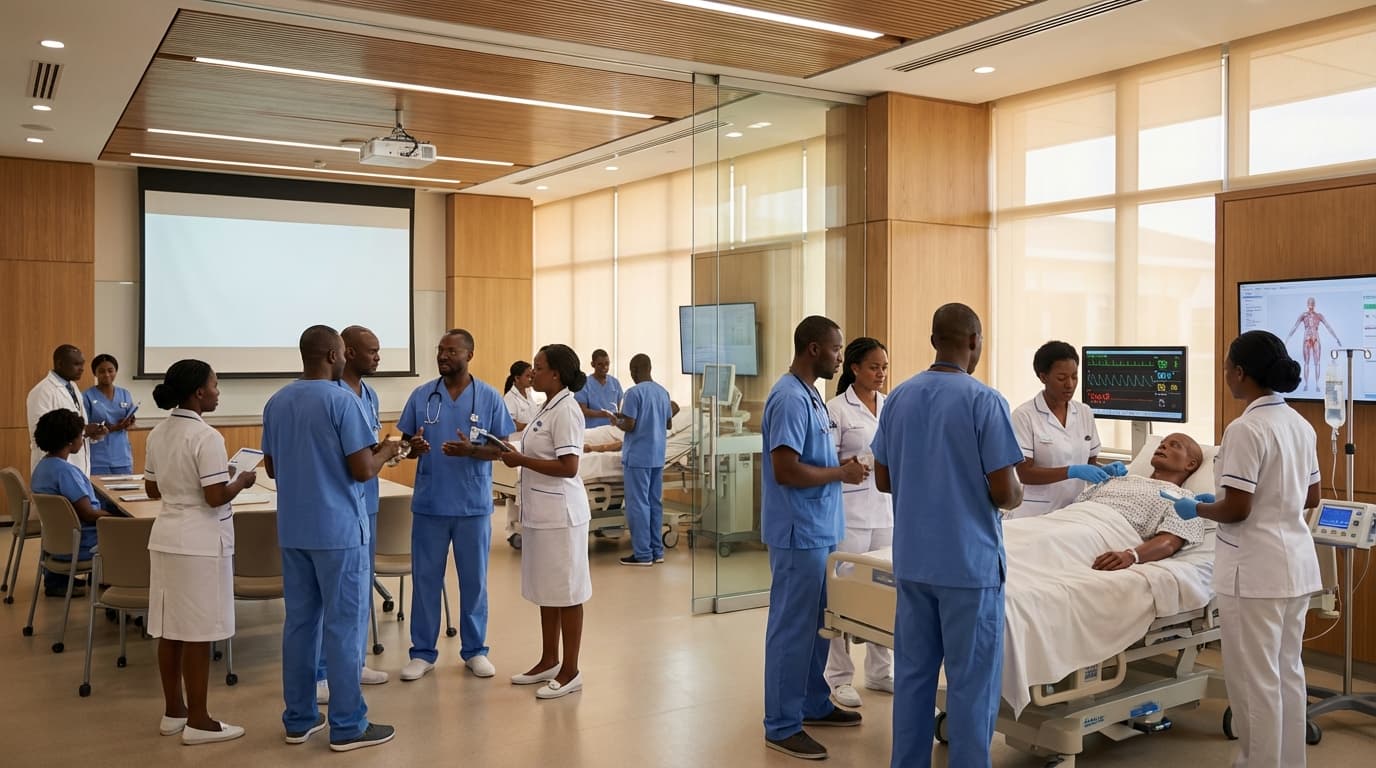
Equipment Training & Education in Congo (Kinshasa)
Engineering Excellence & Technical Support
Comprehensive equipment training and certification programs High-standard technical execution following OEM protocols and local regulatory frameworks.
Advanced Operator Certification Program
Empowering Congolese technicians with globally recognized certification for operating and maintaining critical industrial equipment, boosting local expertise and ensuring operational excellence.
Interactive Simulation & Virtual Reality Training
Leveraging cutting-edge VR/AR technology to provide immersive, hands-on training for complex machinery in a safe, cost-effective virtual environment, reducing downtime and risk.
On-Site Customized Technical Workshops
Delivering tailored, on-demand training workshops at client sites across the DRC, focusing on specific equipment models and operational challenges faced by local industries.
What Is Equipment Training & Education In Congo (Kinshasa)?
Equipment Training & Education in Congo (Kinshasa) refers to structured programs designed to impart the knowledge and practical skills necessary for the safe, efficient, and effective operation, maintenance, and repair of various types of machinery and technical equipment. This encompasses theoretical instruction, hands-on practice, and competency assessments.
| Who Needs Equipment Training & Education? | Typical Use Cases & Sectors | |||||||||||
|---|---|---|---|---|---|---|---|---|---|---|---|---|
| Operators: Individuals directly responsible for the day-to-day functioning of machinery. | Mining: Operation of heavy-duty excavators, drills, loaders, crushers, and conveyor systems. | Construction: Training on cranes, bulldozers, excavators, concrete mixers, and power tools. | Manufacturing: Skilled personnel for operating assembly lines, CNC machines, welding equipment, and packaging machinery. | Energy Sector: Technicians for power generation equipment (turbines, generators), electrical distribution systems, and renewable energy installations (solar panels, wind turbines). | Logistics & Transportation: Forklift operators, warehouse management system users, and maintenance staff for vehicles and handling equipment. | Healthcare: Biomedical engineers and technicians for operating and maintaining complex medical devices (MRI machines, X-ray units, laboratory equipment). | Agriculture: Farmers and technicians on tractors, harvesters, irrigation systems, and processing equipment. | IT & Telecommunications: Network engineers, data center technicians for server infrastructure, and telecommunications equipment installation and maintenance. | Maintenance Personnel: Technicians and engineers responsible for the upkeep, repair, and preventative maintenance of all types of equipment. | Supervisory & Management Staff: To understand operational capabilities, safety requirements, and resource allocation related to equipment. | New Entrants to the Workforce: To acquire foundational skills for employment in technical fields. | Existing Workforce (Upskilling/Reskilling): To adapt to new technologies, updated safety standards, or changes in equipment models. |
Key Components of Equipment Training & Education:
- Theoretical Instruction: Covering principles of operation, technical specifications, safety protocols, regulatory compliance, and troubleshooting methodologies.
- Practical Application: Hands-on exercises using the actual equipment, simulating operational scenarios, and performing maintenance tasks.
- Safety Procedures: Emphasizing hazard identification, risk mitigation, personal protective equipment (PPE) usage, and emergency response protocols.
- Maintenance & Troubleshooting: Training on routine inspections, preventative maintenance schedules, diagnostic techniques, and repair procedures.
- Competency Assessment: Evaluating the trainee's understanding and practical ability through written tests, practical demonstrations, and simulations.
- Documentation & Record Keeping: Instruction on proper logging of operational data, maintenance activities, and incident reporting.
Who Needs Equipment Training & Education In Congo (Kinshasa)?
Ensuring proficiency in operating and maintaining equipment is paramount for numerous sectors in Congo (Kinshasa). Effective training and education directly contribute to increased productivity, enhanced safety, reduced operational costs, and improved service delivery. Without proper knowledge, equipment can be misused, leading to costly breakdowns, accidents, and ultimately, hindering the economic development of the region.
| Department/Role | Types of Equipment | Training Focus | Impact of Training |
|---|---|---|---|
| Operations & Production | Industrial Machinery, Assembly Lines, Processing Units, Generators | Safe operation, routine maintenance, troubleshooting, quality control | Increased output, reduced downtime, improved product quality, minimized accidents |
| Maintenance & Engineering | Heavy machinery (excavators, dozers), specialized diagnostic tools, electrical systems, hydraulic systems | Preventive maintenance, repair techniques, advanced diagnostics, safety protocols | Extended equipment lifespan, reduced repair costs, minimized breakdowns, enhanced safety |
| Health & Safety | Medical equipment (imaging machines, surgical tools), laboratory equipment, safety monitoring devices | Sterilization procedures, calibration, safe handling, emergency protocols, data integrity | Improved patient care, accurate diagnostics, reduced risk of infection, compliance with regulations |
| Logistics & Warehousing | Forklifts, cranes, conveyor systems, inventory management software | Safe lifting and loading, efficient material handling, inventory accuracy, warehouse safety | Faster turnaround times, reduced damage to goods, improved inventory control, safer working environment |
| Field Technicians & Service Personnel | Telecommunications equipment, power grid components, agricultural machinery, construction tools | On-site repair, troubleshooting, installation, customer service, safety in diverse environments | Faster service resolution, increased customer satisfaction, reduced repeat calls, enhanced reputation |
| Management & Supervision | Fleet management software, project management tools, operational dashboards | Equipment utilization analysis, cost optimization, performance monitoring, resource allocation | Better decision-making, improved operational efficiency, increased profitability, strategic planning |
Target Customers for Equipment Training & Education in Congo (Kinshasa)
- Manufacturing Companies
- Mining Operations
- Construction Firms
- Agriculture Cooperatives & Large Farms
- Healthcare Institutions (Hospitals, Clinics)
- Logistics & Transportation Companies
- Energy & Utilities Providers (Power, Water)
- Government Ministries & Agencies (Public Works, Infrastructure)
- Telecommunications Companies
- Small & Medium Enterprises (SMEs) utilizing specialized machinery
Equipment Training & Education Process In Congo (Kinshasa)
The equipment training and education process in Congo (Kinshasa) is a structured workflow designed to ensure users are proficient in operating and maintaining specific equipment. This process is crucial for safety, efficiency, and longevity of the machinery. It typically begins with an inquiry from a client or internal department, leading through assessment, curriculum development, scheduling, delivery, evaluation, and finally, ongoing support.
| Stage | Description | Key Activities | Key Stakeholders | Potential Challenges in Congo (Kinshasa) |
|---|---|---|---|---|
| Inquiry & Needs Assessment | The initial stage where a client or internal department expresses a need for equipment training. This involves understanding the specific equipment, the target audience, their existing knowledge, and desired learning outcomes. | Receiving training requests, initial client consultations, assessing skill gaps, defining training objectives, identifying specific equipment models. | Client/Requesting Department, Training Provider/Department, Sales Team (if applicable) | Communication barriers (language, cultural), unclear articulation of needs, time zone differences, difficulty in assessing existing skill levels. |
| Curriculum Development & Customization | Based on the needs assessment, a training program is designed or existing materials are adapted. This includes developing training modules, presentations, practical exercises, and assessment tools. | Designing course outlines, creating training materials (manuals, presentations, videos), developing hands-on exercises, tailoring content to local context and language. | Training Specialists, Subject Matter Experts (SMEs), Curriculum Developers | Availability of local SMEs, adapting international standards to local regulations/practices, cost of developing localized content, access to updated equipment manuals. |
| Scheduling & Logistics | This stage involves planning the practical aspects of the training, including setting dates, times, locations, arranging for trainers, and ensuring necessary equipment and resources are available. | Setting training dates and times, booking training venues, arranging trainer travel and accommodation, confirming equipment availability for hands-on practice, preparing training materials for distribution. | Training Coordinator, Logistics Department, Trainers, Site Management | Transportation infrastructure, venue availability and suitability, reliable internet/power supply, access to the actual equipment for training, visa/travel permits for expatriate trainers. |
| Training Delivery | The core of the process where trainers deliver the educational content to the participants, incorporating theoretical explanations, practical demonstrations, and interactive exercises. | Conducting classroom sessions, demonstrating equipment operation, facilitating hands-on practice, answering participant questions, managing group dynamics. | Trainers, Participants | Language proficiency of trainers, participant engagement levels, varying literacy levels, unexpected equipment malfunctions during training, environmental conditions (heat, humidity). |
| Assessment & Evaluation | Measuring the effectiveness of the training and the participants' understanding. This can involve written tests, practical assessments, and feedback surveys. | Administering knowledge tests, observing practical skill demonstrations, collecting participant feedback on the training, evaluating trainer performance. | Trainers, Participants, Training Manager | Ensuring fair and accurate assessment, cultural appropriateness of assessment methods, potential for cheating, difficulty in objectively measuring practical skills. |
| Certification & Documentation | Upon successful completion of the training and assessment, participants are issued certificates. Records of training are maintained for future reference. | Issuing certificates of completion, updating training records, archiving assessment results, providing proof of training to employers. | Training Administrator, Training Department | Standardization of certificates, secure record-keeping systems, potential for fraudulent certificates, delays in certificate issuance. |
| Post-Training Support & Refresher Courses | Providing ongoing assistance to participants after the initial training. This can include answering questions, offering troubleshooting advice, and scheduling periodic refresher courses to reinforce knowledge and skills. | Establishing helpdesks or support channels, providing access to online resources, conducting follow-up calls or site visits, scheduling refresher training sessions, updating training materials based on feedback and new developments. | Support Staff, Trainers, Participants, Management | Sustaining long-term engagement, ensuring access to support, identifying evolving training needs, funding for refresher courses, keeping up with technological advancements. |
Key Stages of the Equipment Training & Education Process
- Inquiry & Needs Assessment
- Curriculum Development & Customization
- Scheduling & Logistics
- Training Delivery
- Assessment & Evaluation
- Certification & Documentation
- Post-Training Support & Refresher Courses
Equipment Training & Education Cost In Congo (Kinshasa)
Securing proper equipment training and education in Congo (Kinshasa) is crucial for operational efficiency and safety across various industries. The cost of this training is influenced by several key factors, leading to a broad range of pricing. These factors include the complexity and type of equipment, the duration and depth of the training program, the qualifications and experience of the trainers, the location and facilities used, and the number of participants. For highly specialized industrial machinery, advanced technical courses, or safety-critical equipment like heavy construction machinery or medical devices, costs will naturally be higher due to the specialized knowledge and resources required. Conversely, basic operational training for common office equipment or simpler tools will be more affordable. The currency used for transactions is the Congolese Franc (CDF). It's important to note that exchange rates can fluctuate, impacting the equivalent cost in other currencies.
| Training Category | Typical Duration | Estimated Cost Range (CDF) |
|---|---|---|
| Basic Office Equipment (e.g., photocopiers, printers) | Half-day to 1 day | 50,000 - 150,000 CDF |
| Standard IT Hardware/Software (e.g., server basics, common applications) | 1-3 days | 100,000 - 300,000 CDF |
| Light Industrial Machinery (e.g., basic manufacturing tools) | 1-2 days | 150,000 - 400,000 CDF |
| Heavy Construction Equipment (e.g., excavators, bulldozers - operator training) | 3-5 days | 300,000 - 1,000,000+ CDF |
| Specialized Medical Equipment (e.g., diagnostic machines) | 2-5 days | 500,000 - 1,500,000+ CDF |
| Advanced Technical/Certification Courses | Variable (days to weeks) | Negotiable, often starting from 600,000 CDF and significantly higher for extensive programs |
Key Pricing Factors for Equipment Training & Education in Congo (Kinshasa)
- Equipment Complexity and Type (e.g., heavy machinery, medical devices, IT hardware)
- Training Program Duration and Depth (e.g., introductory, advanced, certification)
- Trainer Qualifications and Experience (e.g., certified instructors, industry experts)
- Training Location and Facilities (e.g., on-site at client's facility, dedicated training center, virtual)
- Number of Participants (group discounts may apply)
- Customization of Training Content
- Inclusion of Practical/Hands-on Sessions
- Provision of Training Materials and Equipment
Affordable Equipment Training & Education Options
Acquiring and maintaining specialized equipment can be a significant investment. Fortunately, numerous affordable training and education options exist to ensure your team can operate and maintain this equipment effectively. These options often focus on maximizing the value of your investment through smart purchasing and training strategies. Value bundles and targeted cost-saving measures are key to making essential equipment knowledge accessible without breaking the bank.
| Strategy | Description | Cost-Saving Benefit | |
|---|---|---|---|
| Value Bundles | Packaging equipment purchase with training courses, maintenance plans, or software licenses at a discounted combined price. | Reduces overall acquisition and operational costs by offering a package deal. | Often includes introductory or foundational training, saving on separate course fees. |
| Bulk Training Discounts | Negotiating lower per-person rates for training multiple employees simultaneously or for ongoing training needs. | Significantly reduces the per-student cost of education. | Encourages a culture of continuous learning by making it more economical. |
| Leveraging Free Resources | Utilizing free online tutorials, manufacturer documentation, and open-source training materials. | Eliminates direct course fees. | Supplements paid training and provides quick answers to specific questions. |
| Prioritizing Essential Skills | Focusing training on the most critical operational and maintenance tasks required for immediate use. | Avoids unnecessary spending on advanced or niche training that may not be immediately applicable. | Ensures the team gains the most valuable skills first. |
| Internal Train-the-Trainer Models | Investing in a few key employees to become certified trainers who then educate the rest of the team. | Reduces ongoing external training costs significantly. | Builds internal expertise and capacity for knowledge transfer. |
| Subscription-Based Learning Platforms | Accessing a library of courses for a recurring fee, often covering a wide range of equipment. | Provides predictable budgeting and access to a broad selection of training. | Cost-effective for organizations with diverse equipment needs or frequent training requirements. |
Key Affordable Training & Education Options
- Online Courses and Webinars: Flexible, self-paced learning accessible from anywhere.
- Manufacturer-Provided Training: Often included or offered at a discount with equipment purchase.
- Industry Association Workshops: Focused, hands-on sessions often tailored to specific equipment types.
- Community College and Vocational Programs: Comprehensive, accredited programs for foundational and advanced skills.
- Peer-to-Peer Knowledge Sharing: Internal training sessions or mentorship programs leveraging existing expertise.
- Train-the-Trainer Programs: Empowering internal staff to become subject matter experts and educators.
Verified Providers In Congo (Kinshasa)
In the Democratic Republic of Congo (Kinshasa), ensuring access to reliable and ethical healthcare services is paramount. Franance Health stands out as a premier organization for verified providers, offering a level of trust and quality that is essential for individuals seeking medical assistance. Their rigorous credentialing process and commitment to patient well-being make them the definitive choice for accessing the best healthcare professionals in the region.
| Credential Type | Franance Health Verification Process | Importance for Patients |
|---|---|---|
| Medical License | Confirmed with Ministry of Health and licensing bodies | Ensures legal authorization to practice medicine |
| Educational Degrees & Certifications | Verified with issuing institutions (universities, colleges) | Confirms formal medical training and specialization |
| Professional Experience | Validated through references and past employment checks | Demonstrates practical skills and accumulated knowledge |
| Ethical Conduct & Reputation | Involves background checks and potential peer reviews | Guarantees adherence to medical ethics and professional integrity |
| Specialty Certifications | Confirmed with relevant professional bodies | Indicates advanced training and expertise in specific medical fields |
Why Franance Health is the Best Choice for Verified Providers in Congo (Kinshasa)
- Rigorous Vetting Process: Franance Health employs a multi-stage verification system that goes beyond basic licensing. This includes thorough background checks, verification of educational qualifications, peer reviews, and confirmation of ethical standing.
- Commitment to Patient Safety: Patient well-being is at the core of Franance Health's mission. All verified providers adhere to strict ethical guidelines and are committed to providing safe, effective, and compassionate care.
- Access to Specialized Expertise: Franance Health maintains a diverse network of healthcare professionals, ensuring access to specialized medical expertise across various disciplines, from general practitioners to surgeons and specialists.
- Transparency and Accountability: Franance Health fosters transparency by providing clear information about their verified providers' credentials and experience. They also maintain a system for patient feedback and accountability.
- Upholding International Standards: Their verification processes are designed to align with international best practices in healthcare provider credentialing, ensuring a high standard of care.
- Bridging the Trust Gap: In a region where trust in healthcare providers can be a concern, Franance Health acts as a crucial intermediary, guaranteeing that individuals are connecting with legitimate and qualified medical professionals.
Scope Of Work For Equipment Training & Education
This Scope of Work (SOW) outlines the requirements for comprehensive equipment training and education services. The objective is to ensure that designated personnel are proficient in the safe, efficient, and effective operation, maintenance, and troubleshooting of the specified equipment. This SOW details the technical deliverables and standard specifications for all training activities.
| Deliverable ID | Deliverable Description | Standard Specification | Format | Frequency/Timeline |
|---|---|---|---|---|
| TRN-OP-001 | Operator Training Manual | Comprehensive guide covering all operational modes, settings, and best practices. Includes detailed diagrams and step-by-step instructions. Language: English (or as specified). | Digital (PDF) and/or Printed | Prior to training commencement |
| TRN-MNT-001 | Maintenance Procedure Handbook | Detailed instructions for all scheduled and unscheduled maintenance tasks. Includes required tools, consumables, and safety precautions. Language: English (or as specified). | Digital (PDF) and/or Printed | Prior to training commencement |
| TRN-TROUBLE-001 | Troubleshooting Guide | Flowcharts, symptom/cause/solution matrices for common operational and maintenance issues. Includes diagnostic test procedures. | Digital (PDF) | Prior to training commencement |
| TRN-CLASS-001 | Instructor-Led Training Sessions | Hands-on and theoretical sessions conducted by certified trainers. Sessions will cover theoretical concepts, practical demonstrations, and supervised exercises. | In-person or Virtual (Live) | As per agreed training schedule |
| TRN-ASSESS-001 | Knowledge Assessment Tests | Written or practical assessments to evaluate trainee comprehension and skill proficiency. Minimum passing score of 80%. | Digital or Paper | End of each training module/session |
| TRN-CERT-001 | Training Certificates | Issued upon successful completion of all training modules and assessments. Certificates will list the equipment trained on and the scope of training. | Digital (PDF) | Upon successful completion of training program |
| TRN-POST-001 | Post-Training Support Documentation | Access to online knowledge base, FAQs, and a defined escalation process for technical queries for a period of [Specify Duration, e.g., 6 months] post-training. | Online Portal/Email Support | Post-training for specified duration |
| TRN-SPARE-001 | Recommended Spare Parts List | List of critical and recommended spare parts with part numbers, descriptions, and estimated shelf life. Includes guidance on stocking levels. | Digital (Excel/PDF) | Prior to training commencement |
Key Training Areas
- Equipment Operation: Fundamental and advanced operational procedures.
- Routine Maintenance: Scheduled inspections, cleaning, lubrication, and minor adjustments.
- Troubleshooting & Diagnostics: Identifying common issues and implementing corrective actions.
- Safety Protocols: Adherence to all relevant safety guidelines and emergency procedures.
- Software & Control Systems: Interaction with any associated software or control interfaces.
- Spare Parts Management: Identification, ordering, and basic inventory of common spares.
Service Level Agreement For Equipment Training & Education
This Service Level Agreement (SLA) outlines the guaranteed response times and uptime for the Equipment Training & Education services provided by [Your Company Name] to [Client Company Name]. This SLA is an integral part of the Master Service Agreement (MSA) between the parties.
| Service Component | Response Time Guarantee (Business Hours) | Uptime Guarantee |
|---|---|---|
| Initial response to training request (scheduling) | Within 2 business days | N/A (Service is scheduled) |
| Technical support for online training portal | Within 4 business hours | 99.5% during scheduled training times |
| Technical support for virtual training platform | Within 1 business hour prior to scheduled session | N/A (Service is scheduled) |
| Access to online training portal (non-scheduled) | N/A | 99.0% availability (excluding scheduled maintenance) |
| Delivery of customized training modules (post-development) | As per project plan | N/A |
Scope of Services Covered
- On-demand virtual training sessions for designated equipment.
- Scheduled in-person training sessions at client's facilities (where applicable).
- Access to the online training portal and its educational resources.
- Technical support for training platform and materials.
- Development of customized training modules (as per separate agreement).
Frequently Asked Questions

Ready when you are
Let's scope your Equipment Training & Education in Congo (Kinshasa) project in Congo (Kinshasa).

Scaling healthcare logistics and technical systems across the entire continent.