
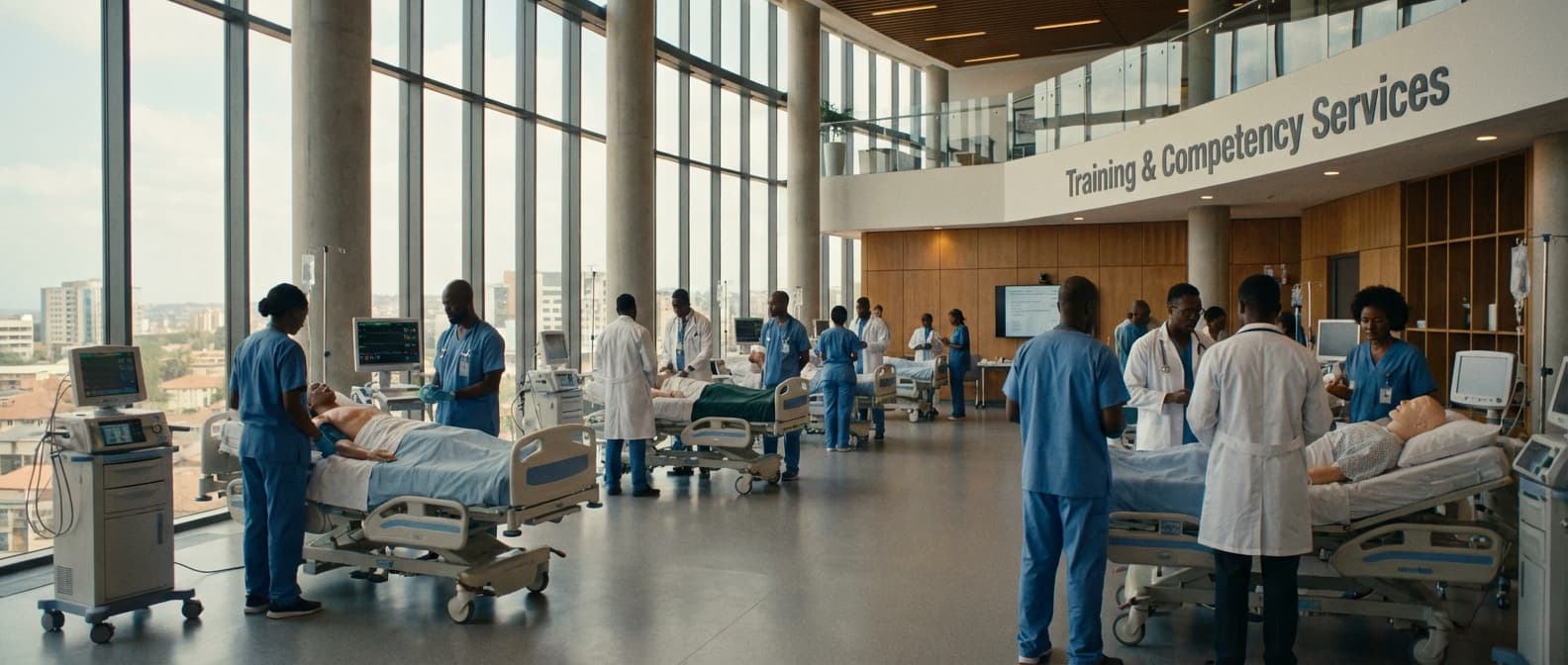
Biomedical Engineering First-Line Support Training Service in Congo (Kinshasa)
Engineering Excellence & Technical Support
Biomedical Engineering First-Line Support Training Service High-standard technical execution following OEM protocols and local regulatory frameworks.
Localized Biomedical Equipment Expertise
Gain hands-on proficiency in troubleshooting and maintaining common biomedical equipment prevalent in Congolese healthcare facilities, including ultrasound machines, ECG monitors, and basic laboratory analyzers, ensuring minimal downtime and optimal performance in your local context.
Critical Patient Monitoring System Support
Master the diagnostics and repair of vital patient monitoring systems, focusing on rapid response to critical alarms and ensuring the continuous and accurate collection of patient data, a crucial skill for saving lives in resource-constrained environments.
Essential Biomedical Device Calibration & Safety
Develop the technical skills for accurate calibration and routine safety testing of essential medical devices, adhering to international standards while considering local environmental factors, thereby guaranteeing patient safety and reliable diagnostic results.
What Is Biomedical Engineering First-line Support Training Service In Congo (Kinshasa)?
Biomedical Engineering First-Line Support Training Service in Congo (Kinshasa) refers to the initial and essential training provided to personnel responsible for the basic maintenance, troubleshooting, and operational support of medical equipment within healthcare facilities in the Democratic Republic of Congo, specifically in Kinshasa. This service aims to equip individuals with the fundamental knowledge and practical skills to address common equipment failures, perform routine preventive maintenance, and ensure the safe and effective utilization of biomedical devices. The objective is to enhance the availability and reliability of medical technology, thereby improving patient care outcomes in resource-constrained environments.
| Target Audience | Rationale for Need | Typical Use Cases | ||||
|---|---|---|---|---|---|---|
| Healthcare Facility Technicians/Assistants: Individuals employed at hospitals, clinics, and health centers with existing or newly acquired medical equipment who are designated to provide initial support. | High Prevalence of Equipment Downtime: Limited availability of specialized biomedical engineers and external maintenance services necessitates local capacity building for immediate issue resolution. | Routine Maintenance of Diagnostic Equipment: Ensuring the proper functioning of X-ray machines, ultrasound devices, and laboratory analyzers through regular checks and minor adjustments. | Troubleshooting of Patient Monitoring Systems: Addressing issues with vital signs monitors, ECG machines, and infusion pumps that can be resolved with basic interventions. | Management of Sterilization Equipment: Performing routine cleaning and operational checks on autoclaves and other sterilization devices. | Basic Support for Hospital Furniture and Appliances: Maintenance of electrically powered beds, patient lifts, and lighting systems within clinical areas. | Initial Response to Power-Related Failures: Identifying and rectifying issues with power cords, plugs, or simple power supply problems for various medical devices. |
| Newly Recruited Staff: Personnel new to a healthcare facility or to the role of equipment support, requiring foundational training before assuming responsibilities. | Cost-Effectiveness: Reduces the reliance on expensive external maintenance contracts for minor and recurring issues. | Deployment of New Medical Technology: Enabling local staff to manage and maintain new equipment with minimal external intervention. | Emergency Preparedness: Equipping personnel to ensure critical medical devices remain operational during power outages or other disruptions. | Remote or Underserved Areas: Providing essential support in regions with limited access to skilled biomedical engineers. | Basic Repair of Therapeutic Devices: Addressing minor faults in equipment such as nebulizers or basic physiotherapy units. | |
| Biomedical Engineering Students/Graduates (Early Career): Individuals seeking to gain practical, hands-on experience in a real-world healthcare setting. | Bridging the Skills Gap: Addresses the shortage of qualified biomedical engineers by creating a tiered support structure. | Preventive Maintenance Scheduling and Execution: Implementing and adhering to planned maintenance schedules for various equipment categories. | Calibration of Basic Measurement Devices: Performing straightforward calibration checks on devices like blood pressure monitors or weighing scales. | Responding to Alarms and Error Codes: Interpreting basic device alarms and error messages to initiate appropriate troubleshooting steps. | Inventory Management of Spare Parts: Maintaining an adequate stock of common consumables and spare parts for first-line repairs. |
Key Components of Biomedical Engineering First-Line Support Training Service
- Equipment Identification and Classification: Training on recognizing different types of medical equipment, their intended use, and basic operational principles.
- Basic Troubleshooting Methodologies: Introduction to systematic approaches for diagnosing and resolving common equipment malfunctions, including power issues, connectivity problems, and minor functional errors.
- Preventive Maintenance Fundamentals: Instruction on scheduled checks, cleaning procedures, lubrication, and calibration of essential parameters to prolong equipment lifespan and prevent failures.
- Safe Operation and Handling: Emphasis on protocols for the safe use, transport, and storage of medical devices to prevent accidents and ensure user safety.
- Basic Repair Techniques: Training on simple repair tasks, such as replacing fuses, batteries, or readily accessible components, under supervision.
- Documentation and Reporting: Guidance on maintaining logs of maintenance activities, reporting equipment issues, and documenting repair actions.
- Biomedical Safety Standards: Awareness of basic electrical safety, infection control measures related to equipment, and patient safety protocols.
- Understanding User Manuals and Service Guides: Ability to interpret technical documentation for basic operational and maintenance tasks.
Who Needs Biomedical Engineering First-line Support Training Service In Congo (Kinshasa)?
The demand for specialized biomedical engineering first-line support training services in Congo (Kinshasa) is driven by the critical need to ensure the optimal functioning, safety, and longevity of medical equipment within healthcare facilities. This training is essential for a range of professionals who directly interact with and are responsible for the basic maintenance and troubleshooting of biomedical devices. Without adequate first-line support, equipment downtime increases, patient care can be compromised, and the lifespan of expensive medical technology is shortened.
| Target Customer Type | Specific Departments/Roles | Key Needs for First-Line Support Training |
|---|---|---|
| Public Hospitals | Biomedical Engineering Department (entry-level technicians), Clinical Engineering Department, Nursing Staff (for basic operation checks), IT Department (for networked devices) | Basic preventive maintenance, troubleshooting common malfunctions, safe operation, equipment identification, reporting procedures, understanding user manuals. |
| Private Hospitals | Biomedical Technicians, Department Heads (e.g., Radiology, Cardiology), Facility Management | Similar to public hospitals, with potential emphasis on rapid response, cost-effectiveness, and specific high-value equipment training. |
| Clinics and Health Centers | Clinical Officers, Laboratory Technicians, Nurses, Maintenance Staff (if available) | Understanding operational parameters, cleaning and disinfection, simple troubleshooting, recognizing when to call for specialized service, basic calibration checks. |
| NGOs in Healthcare | Field Technicians, Project Managers overseeing medical equipment, Local Healthcare Staff | Empowering local staff with essential skills to maintain equipment in remote or challenging environments, maximizing the utility of donated or procured medical devices. |
| Government Ministries of Health | Health Facility Managers, Procurement Officers, Biomedical Engineering Coordinators | Understanding the importance of trained personnel for national health system efficiency, setting training standards, identifying training gaps across facilities. |
| Medical Equipment Suppliers | Field Service Technicians (junior level), Customer Support Representatives, Sales Engineers (for basic technical understanding) | Enabling efficient initial response to customer issues, reducing the need for senior technician intervention for minor problems, improving customer satisfaction. |
| Training Institutions | Instructors, Students in Biomedical Technology/Engineering programs | Providing practical, hands-on training that complements theoretical knowledge, preparing graduates for immediate employability in first-line support roles. |
Target Customers and Departments
- Hospitals (Public and Private): This is the primary sector requiring this training. Hospitals are equipped with a wide array of medical devices, from basic diagnostic tools to complex life-support systems.
- Clinics and Health Centers: Even smaller facilities rely on medical equipment for diagnosis and treatment, and their technical staff often need foundational training.
- Non-Governmental Organizations (NGOs) involved in healthcare: Many NGOs operate health programs and clinics, often in resource-limited settings where local capacity building is crucial.
- Government Ministries of Health: For managing national health infrastructure and ensuring quality standards.
- Medical Equipment Suppliers and Distributors: Companies that sell and service medical equipment can benefit from training their local support staff or offering it as a value-added service to their clients.
- Training Institutions and Universities: Those offering biomedical technology or related programs may integrate such training into their curriculum or offer it as continuing education.
Biomedical Engineering First-line Support Training Service Process In Congo (Kinshasa)
This document outlines the standard workflow for the Biomedical Engineering First-Line Support Training Service provided in Congo (Kinshasa). The process is designed to ensure efficient and effective delivery of training to users requiring basic technical support for biomedical equipment. It covers the journey from the initial inquiry to the successful execution of the training.
| Stage | Description | Key Activities | Responsible Party | Deliverables | Timeline (Estimated) |
|---|---|---|---|---|---|
| The process begins when a client or user expresses a need for first-line support training on specific biomedical equipment. | Receive and log inquiry, Identify client/facility, Understand basic equipment types and number of trainees, Determine urgency. | Client/User, Training Coordinator | Logged Inquiry, Initial Assessment Summary | 1-2 Business Days |
| A detailed understanding of the training requirements is established to tailor the service. | Conduct detailed needs assessment (specific equipment, skill gaps, desired outcomes), Define training objectives, Develop a preliminary training proposal (scope, modules, duration, estimated cost). | Training Coordinator, Biomedical Engineering Trainer | Detailed Needs Assessment Report, Draft Training Proposal | 2-3 Business Days |
| The training session is formally planned and all logistical aspects are arranged. | Client approval of proposal, Finalize training dates and times, Confirm venue (on-site) or platform (remote), Arrange trainer travel and accommodation (if applicable), Confirm availability of required equipment for training. | Training Coordinator, Client | Confirmed Training Schedule, Logistics Plan | 2-4 Business Days |
| All necessary training resources are developed and compiled. | Create or adapt training manuals, presentations, practical exercises, and assessment tools based on the agreed training modules and equipment. | Biomedical Engineering Trainer | Training Manuals, Presentation Slides, Practical Exercises, Assessment Forms | 3-5 Business Days (depending on complexity) |
| The actual training session is conducted. | Deliver theoretical content, Conduct practical demonstrations and hands-on exercises, Address trainee questions and concerns, Perform initial competency checks. | Biomedical Engineering Trainer, Trainees | Completed Training Sessions, Trainee Engagement Records | As per scheduled duration (e.g., 1-5 days) |
| Assistance is provided after the formal training to reinforce learning and address immediate challenges. | Provide access to support channels (phone, email), Answer follow-up questions, Offer remote assistance for initial troubleshooting, Monitor initial application of learned skills. | Biomedical Engineering Trainer, Support Team | Support Log, Initial Application Feedback | 1-2 Weeks post-training |
| The effectiveness of the training is assessed through participant and client feedback. | Distribute and collect training feedback forms from trainees and clients, Analyze feedback for strengths and areas of improvement. | Training Coordinator, Trainees, Client | Training Feedback Forms, Evaluation Summary | 1 Week post-training |
| The training service is formally concluded and documented. | Prepare a final training report (including attendance, assessment results, feedback summary, and recommendations), Invoice the client for services rendered, Archive training records. | Training Coordinator, Finance Department | Final Training Report, Invoice, Archived Records | 2-3 Business Days |
First-Line Support Training Service Process Workflow
- Inquiry Reception & Initial Assessment
- Needs Analysis & Training Proposal
- Scheduling & Logistics Coordination
- Training Material Preparation
- On-site/Remote Training Delivery
- Post-Training Support & Follow-up
- Feedback Collection & Evaluation
- Service Closure & Reporting
Biomedical Engineering First-line Support Training Service Cost In Congo (Kinshasa)
Providing first-line support training for biomedical engineers in Congo (Kinshasa) involves a range of costs influenced by several key factors. These factors determine the overall investment required for individuals or institutions seeking to upskill or maintain their biomedical engineering workforce. The local economic conditions, the complexity of the training, the provider's reputation, and the duration of the program all play significant roles in shaping the pricing. It's crucial for organizations and individuals to understand these elements to budget effectively and make informed decisions about their training investments.
| Training Type/Intensity | Estimated Cost Range (USD) | Estimated Cost Range (CDF - Congolese Francs) | Notes |
|---|---|---|---|
| Basic Foundational Training (e.g., introductory equipment maintenance, safety) | $300 - $700 | 1,500,000 - 3,500,000 CDF | Shorter duration, fewer specialized topics. |
| Intermediate Troubleshooting & Maintenance (e.g., common equipment failure analysis) | $700 - $1,500 | 3,500,000 - 7,500,000 CDF | More hands-on practice, covers a wider range of equipment. |
| Advanced Specialization (e.g., specific imaging modalities, critical care equipment) | $1,500 - $3,000+ | 7,500,000 - 15,000,000+ CDF | Highly specialized, often longer programs, expert instructors. |
| On-Site Customized Training (per day/participant) | $200 - $600 per day | 1,000,000 - 3,000,000 CDF per day | Varies greatly based on customization, instructor fees, and duration. |
Key Pricing Factors for Biomedical Engineering First-Line Support Training in Congo (Kinshasa)
- Provider's Reputation and Expertise: Established training institutions with a proven track record and highly qualified instructors will generally command higher fees.
- Training Curriculum Complexity and Scope: The depth and breadth of the topics covered (e.g., specific equipment troubleshooting, safety protocols, regulatory compliance) directly impact cost.
- Duration of the Training Program: Longer programs with more extensive hands-on sessions and theoretical knowledge will naturally be more expensive.
- Location and Logistics: Training conducted at specialized facilities or requiring travel and accommodation for trainers can add to the overall cost.
- Materials and Resources Provided: The inclusion of training manuals, simulation equipment, access to online learning platforms, and practical kits influences pricing.
- Certification and Accreditation: Programs leading to recognized certifications or accreditations often incur higher fees due to the associated verification processes.
- Group Size and Customization: Negotiated rates for larger groups or tailored training modules for specific organizational needs can alter pricing structures.
- Market Demand and Competition: The availability of multiple training providers and the overall demand for biomedical engineering support services in Kinshasa can affect price competitiveness.
Affordable Biomedical Engineering First-line Support Training Service Options
This document outlines affordable first-line biomedical engineering support training service options. Effective first-line support is crucial for maintaining medical equipment uptime, ensuring patient safety, and reducing reliance on more expensive, specialized repair services. We focus on practical, hands-on training that empowers in-house staff to handle common issues, preventative maintenance, and initial troubleshooting.
| Training Service Option | Description | Value Bundle Components | Estimated Cost-Saving Strategies | |
|---|---|---|---|---|
| Basic Troubleshooting & Maintenance Workshop | Covers common medical device types, preventive maintenance schedules, and fundamental troubleshooting techniques. | On-site or virtual delivery, comprehensive training manual, basic tool kit recommendations, post-training Q&A. | Reduces reliance on external technicians for routine checks and minor fixes (estimated 15-30% reduction in service calls). | Extends equipment lifespan through proactive maintenance, delaying costly replacements. |
| Specific Device Family Training (e.g., Imaging, Patient Monitoring) | In-depth training focused on a particular category of medical equipment, addressing their unique operational and maintenance needs. | Hands-on practice with representative equipment, specialized diagnostic tools overview, common failure analysis, manufacturer-specific guidelines. | Empowers in-house teams to handle a larger percentage of issues for specific high-value equipment, reducing vendor fees. | Faster turnaround on repairs for specialized equipment, minimizing patient care disruptions. |
| Preventive Maintenance Excellence Program | Focuses on establishing and optimizing a robust preventive maintenance program, including scheduling, documentation, and best practices. | PM program development guidance, customized PM checklists, competency assessment for technicians, reporting and tracking tools. | Prevents unexpected breakdowns and costly emergency repairs (estimated 20-40% reduction in major failures). | Optimizes resource allocation for maintenance activities. |
| Blended Learning Subscription | Combines online self-paced modules with periodic live virtual workshops for continuous learning and skill reinforcement. | Access to an online learning portal with video tutorials and interactive modules, monthly live webinars, digital resource library. | Scalable and flexible training that can be deployed across multiple staff members at a lower per-person cost. | Continuous skill development keeps staff updated on new technologies and best practices, further reducing errors and downtime. |
| On-Demand Virtual Support & Mentorship | Provides access to experienced biomedical engineers for remote guidance and troubleshooting assistance when in-house teams encounter complex issues. | Direct access to expert mentors via video conference or chat, remote diagnostics support, scenario-based problem-solving. | Provides immediate expert advice for challenging situations, preventing costly mistakes and unnecessary service calls. | Reduces the need for extensive, time-consuming in-house research for rare issues. |
Key Benefits of First-Line Biomedical Support Training
- Reduced Equipment Downtime: Faster resolution of minor issues by on-site personnel.
- Improved Patient Safety: Ensuring equipment is functioning correctly through regular checks.
- Cost Containment: Minimizing the need for external service calls and costly emergency repairs.
- Enhanced Staff Proficiency: Building internal capacity and expertise within your organization.
- Extended Equipment Lifespan: Proactive maintenance preventing major component failures.
- Increased Operational Efficiency: Streamlining workflows and resource allocation.
Verified Providers In Congo (Kinshasa)
In Congo (Kinshasa), navigating the healthcare landscape can be challenging. Ensuring you access care from verified providers is paramount for safety, quality, and effective treatment. Franance Health distinguishes itself by offering a curated network of rigorously vetted medical professionals and facilities. This meticulous credentialing process goes beyond basic licensing, encompassing a comprehensive evaluation of qualifications, experience, ethical standing, and patient satisfaction. By choosing Franance Health, you are opting for a level of assurance and trust that directly translates to a superior healthcare experience.
| Credentialing Aspect | Franance Health Verification | Importance for Patients |
|---|---|---|
| Medical License and Registration | All providers possess current and valid licenses from recognized national and international bodies. | Ensures legal and ethical practice, preventing unqualified individuals from offering medical services. |
| Educational Background and Training | Verification of diplomas, degrees, and specialized training from accredited institutions. | Confirms that providers have received a solid foundation of medical knowledge and skills. |
| Professional Experience | Thorough review of past work experience, including specialties and years in practice. | Guarantees that providers have practical, hands-on experience in treating diverse medical conditions. |
| Clinical Competence and Performance | May include peer reviews, performance metrics, and ongoing professional development assessments. | Indicates a commitment to maintaining and improving clinical skills for optimal patient outcomes. |
| Ethical Conduct and Disciplinary History | Background checks for any disciplinary actions or ethical violations. | Protects patients from practitioners with a history of misconduct, ensuring a safe and respectful environment. |
| Patient Feedback and Satisfaction | Incorporates mechanisms for gathering and analyzing patient testimonials and satisfaction scores. | Provides insight into a provider's bedside manner, communication skills, and overall patient experience. |
Why Franance Health Credentials Matter
- Rigorous Vetting Process: Franance Health employs a multi-stage verification system that scrutinizes every aspect of a provider's background and practice.
- Quality Assurance: Our credentials guarantee adherence to high standards of medical practice and patient care.
- Patient Safety: By selecting Franance Health, you minimize risks associated with unqualified or substandard medical services.
- Trust and Reliability: Our verified providers have demonstrated a commitment to professionalism and ethical conduct.
- Access to Expertise: We connect you with specialists and general practitioners who possess proven expertise in their respective fields.
- Peace of Mind: Knowing you are in capable hands allows you to focus on your recovery and well-being.
Scope Of Work For Biomedical Engineering First-line Support Training Service
This Scope of Work (SOW) outlines the requirements for a Biomedical Engineering First-Line Support Training Service. The objective is to equip designated personnel with the foundational knowledge and practical skills necessary to provide effective first-line support for a range of biomedical equipment. This training will enhance equipment uptime, improve response times for common issues, and ensure patient safety by promoting proper equipment handling and initial troubleshooting. The training will cover theoretical concepts, practical exercises, and scenario-based problem-solving. Standard specifications for technical deliverables are detailed below, ensuring a consistent and measurable training outcome.
| Deliverable | Description | Format | Acceptance Criteria | Standard Specification |
|---|---|---|---|---|
| Training Curriculum | Comprehensive outline of all modules, topics, and learning objectives. | Digital Document (PDF/Word) | Approved by Client | Modular structure, covering theoretical and practical aspects. Clearly defined learning outcomes per module. Includes assessment strategies. |
| Training Materials (Participant) | Handouts, presentations, guides, and other resources for trainees. | Digital (PDF) and/or Printed | Reviewed and approved by Client | High-resolution, legible, and consistent branding. Includes relevant diagrams, schematics, and troubleshooting flowcharts. Content aligned with curriculum. |
| Training Materials (Instructor) | Instructor guide, lesson plans, facilitator notes, and answer keys. | Digital Document (PDF/Word) | Reviewed and approved by Client | Detailed instructions for trainers, including timing, activities, and key discussion points. Ready for immediate use by qualified instructors. |
| Practical Training Exercises/Simulations | Hands-on exercises and simulated scenarios for trainees to practice skills. | Live Demonstration & Guided Practice | Successful completion of exercises by >80% of participants | Scenario-based, realistic, and representative of common first-line support tasks. Equipment used must be representative of client's inventory where feasible. Clear step-by-step instructions provided. |
| Assessment Tools | Quizzes, practical assessments, and/or scenario-based evaluations. | Digital (Online/PDF) & Practical Observation | Demonstrated competency in key skill areas as per assessment criteria. | Objective and valid measures of knowledge and skill acquisition. Aligned with learning objectives. Standardized grading rubrics. |
| Training Attendance and Performance Report | Record of participant attendance and assessment results. | Digital Document (Excel/PDF) | Submitted within 5 business days of training completion | Includes participant name, role, attendance status, and individual assessment scores. Summary statistics for the cohort. |
| Post-Training Support Documentation | FAQ document, troubleshooting guide for common issues, and escalation matrix. | Digital Document (PDF) | Approved by Client | Concise, action-oriented, and easily searchable. Addresses frequently encountered problems and provides clear escalation pathways. |
| Training Feedback Forms | Anonymous feedback forms for participants to evaluate the training. | Digital (Online Survey) or Printed | Collected from >75% of participants | Includes questions on content relevance, instructor effectiveness, training materials, and overall satisfaction. Standardized format. |
Training Objectives
- Understand fundamental principles of biomedical equipment operation and function.
- Identify common user-related errors and basic operational issues.
- Perform initial troubleshooting steps for a defined set of common biomedical devices.
- Implement basic preventative maintenance checks and procedures.
- Understand and adhere to safety protocols and regulatory guidelines related to biomedical equipment.
- Effectively escalate issues to higher-level technical support when necessary.
- Document support activities and equipment issues accurately.
Service Level Agreement For Biomedical Engineering First-line Support Training Service
This Service Level Agreement (SLA) outlines the performance metrics and guarantees for the Biomedical Engineering First-Line Support Training Service. It defines the expected response times for support requests and the uptime guarantees for the training platform and associated resources.
| Service Component | Response Time Guarantee (Business Hours) | Uptime Guarantee |
|---|---|---|
| Platform Accessibility (Login, Navigation) | 2 Business Hours | 99.5% |
| Technical Issues (Module Loading, Video Playback) | 4 Business Hours | 99.5% |
| General Inquiry (Content clarification, scheduling) | 8 Business Hours | Not Applicable (Covered by platform uptime) |
| Scheduled Q&A Session Availability (if applicable) | 15 Minutes prior to start | 99.0% (for the duration of scheduled sessions) |
Scope of Service
- Provision of access to the Biomedical Engineering First-Line Support Training platform.
- Delivery of training modules and educational content.
- Technical support for platform accessibility and basic functionality.
- Availability of training facilitators for scheduled Q&A sessions (if applicable).
Frequently Asked Questions

Ready when you are
Let's scope your Biomedical Engineering First-Line Support Training Service in Congo (Kinshasa) project in Congo (Kinshasa).

Scaling healthcare logistics and technical systems across the entire continent.