
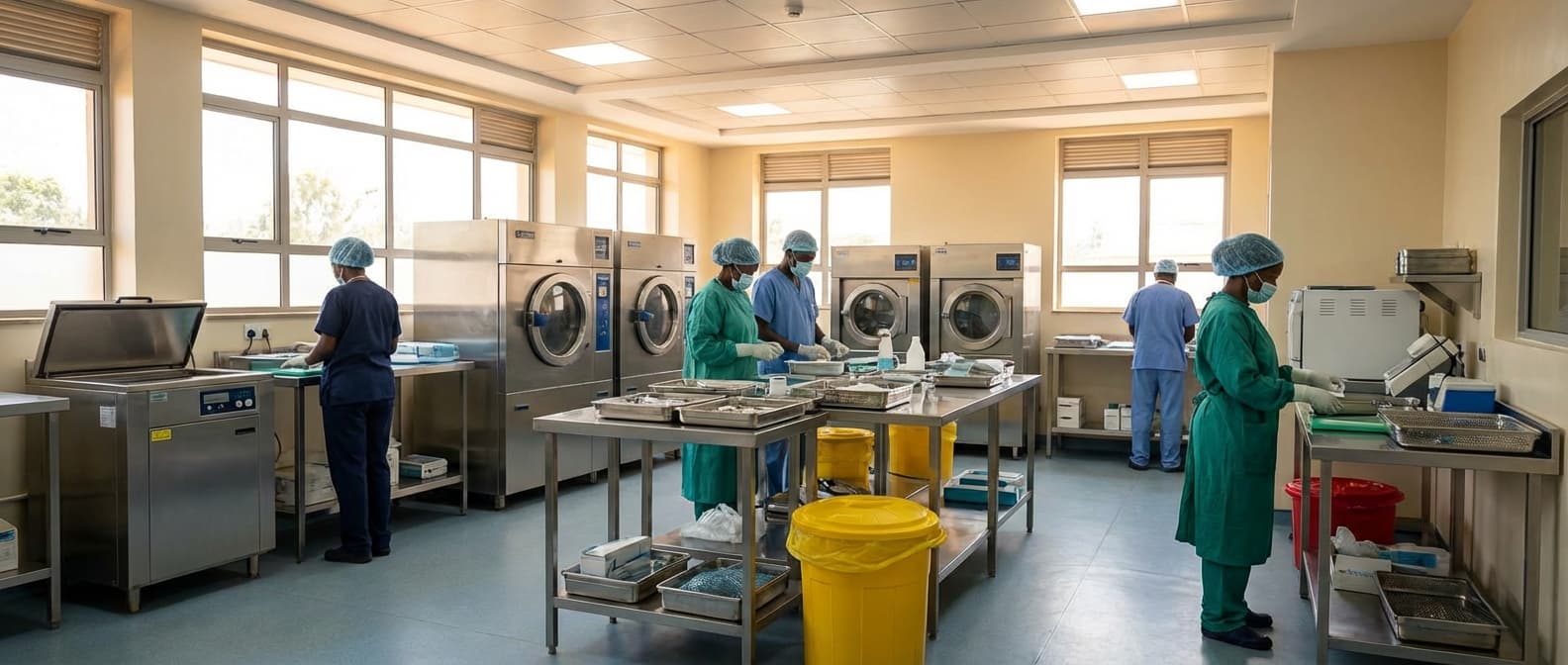
Medical Equipment Decontamination Service (Pre-Repair/Pre-Relocation) in Congo (Kinshasa)
Engineering Excellence & Technical Support
Medical Equipment Decontamination Service (Pre-Repair/Pre-Relocation) High-standard technical execution following OEM protocols and local regulatory frameworks.
Advanced Decontamination Protocols
Implementing hospital-grade, EPA-approved disinfection techniques tailored for complex medical equipment. Our multi-stage process neutralizes pathogens, ensuring a safe environment for repair technicians and preventing cross-contamination during relocation.
Specialized Equipment Handling
Expert handling of sensitive and high-value medical devices, from imaging machines to surgical instruments. Our trained technicians utilize specialized containment and cleaning methods to preserve equipment integrity and functionality throughout the decontamination process.
Compliance and Certification
Adhering to international and local health and safety standards for medical equipment decontamination. We provide comprehensive certification and documentation, assuring regulatory compliance for all pre-repair and pre-relocation services in Kinshasa.
What Is Medical Equipment Decontamination Service (Pre-repair/pre-relocation) In Congo (Kinshasa)?
Medical Equipment Decontamination Service (Pre-Repair/Pre-Relocation) in Congo (Kinshasa) refers to the specialized process of rendering medical devices safe for handling by technicians or for transport. This service is critical in mitigating the risk of biological contamination to personnel and the environment during maintenance, repair, or relocation procedures. It involves the systematic application of validated cleaning, disinfection, and/or sterilization protocols to medical equipment that may have come into contact with potentially infectious biological agents.
| Who Needs This Service | Typical Use Cases | ||||
|---|---|---|---|---|---|
| Hospitals and Healthcare Facilities (public and private) | Repair of diagnostic imaging equipment (e.g., X-ray, ultrasound machines) suspected of contamination. | Maintenance of surgical instruments that have been used in patient procedures. | Relocation of laboratory equipment (e.g., centrifuges, incubators) between departments or facilities. | Service and calibration of anesthesia machines or ventilators. | Handling of endoscopes or other flexible/rigid invasive devices requiring thorough reprocessing. |
| Medical Equipment Manufacturers and Service Providers | Receiving returned equipment for repair that has not been pre-cleaned by the end-user. | Logistics and transportation of medical devices from one location to another, especially across international borders. | End-of-life decommissioning and disposal of potentially contaminated medical equipment. | ||
| Research and Development Laboratories | Preparation of laboratory equipment for shipment to collaborators or for storage. | Decontamination of specialized analytical instruments used with biological samples. | |||
| Government and Non-Governmental Organizations (NGOs) | Management of medical equipment in resource-limited settings, particularly during outbreaks or for mobile clinics. | Facilitating the repair or relocation of essential medical technology for public health initiatives. |
Key Components of Medical Equipment Decontamination Service (Pre-Repair/Pre-Relocation)
- Assessment and Classification: Determining the level of contamination risk based on the equipment's intended use and potential exposure to pathogens.
- Cleaning: Mechanical removal of gross soil and organic matter using approved detergents and water.
- Disinfection: Application of chemical agents or physical methods (e.g., UV-C radiation) to inactivate a broad spectrum of microorganisms, including bacteria, viruses, and fungi.
- Sterilization (where applicable): Elimination of all viable microorganisms, including bacterial spores, using methods such as autoclaving, ethylene oxide gas, or hydrogen peroxide plasma.
- Packaging and Labeling: Secure containment of decontaminated equipment with appropriate labeling indicating the decontamination status.
- Documentation: Maintaining comprehensive records of the decontamination process, including chemicals used, exposure times, and personnel involved.
Who Needs Medical Equipment Decontamination Service (Pre-repair/pre-relocation) In Congo (Kinshasa)?
Medical equipment decontamination services are crucial for ensuring the safety and operational readiness of medical devices in Congo (Kinshasa), particularly before they undergo repair or relocation. This process mitigates the risk of cross-contamination, protects service technicians, and prevents the spread of infectious agents. Target customers and departments benefiting from these services include a diverse range of healthcare facilities and their associated personnel.
| Target Customer Type | Key Departments/Units Involved | Reasons for Decontamination (Pre-Repair/Pre-Relocation) |
|---|---|---|
| Hospitals (Public and Private) | Infection Control Department, Biomedical Engineering Department, Central Sterilization Supply Department (CSSD), Specific clinical departments (e.g., Surgery, ICU, Radiology, Laboratory) | To prevent transmission of pathogens to repair technicians or during relocation; ensure equipment is safe for reinstallation and use; comply with infection control protocols. |
| Clinics and Health Centers | Nursing Staff, General Practitioners, Laboratory Technicians (if applicable) | Similar to hospitals, but often with fewer dedicated departments; focus on preventing community-wide spread of infections during equipment servicing. |
| Diagnostic Laboratories | Laboratory Technicians, Quality Assurance Personnel | Crucial for sensitive diagnostic equipment to prevent cross-contamination of samples or reagents; protect lab personnel during servicing. |
| Surgical Centers | Operating Room Staff, Infection Control, Biomedical Engineering | High-risk environment; decontamination is paramount to prevent surgical site infections if the equipment is moved for repair or returned after repair. |
| Rehabilitation Centers | Therapists, Biomedical Technicians | Equipment used with patients recovering from various conditions; decontamination prevents the spread of any residual pathogens. |
| Mobile Clinics | Healthcare Providers, Drivers/Operators | Equipment is constantly moved and exposed to different environments; thorough decontamination before repair or relocation is vital for hygiene and safety. |
| Government Health Agencies | Public Health Officials, Procurement/Logistics Departments | Overseeing public health infrastructure; ensuring all equipment within their purview is handled safely and hygienically. |
| NGO Healthcare Providers | Program Managers, Clinical Staff, Logistics Coordinators | Often operate in resource-limited settings; decontamination ensures the integrity of their limited medical equipment and the safety of their staff and patients. |
| Medical Equipment Suppliers and Service Providers | Field Service Technicians, Workshop Personnel, Logistics Teams | Essential for their own operational safety and for meeting service level agreements with their clients; preventing the spread of contaminants within their own facilities. |
| Research Institutions | Researchers, Laboratory Technicians, Biomedical Staff | Protecting sensitive research equipment and preventing contamination that could compromise research integrity; ensuring the safety of research personnel. |
Target Customers for Pre-Repair/Pre-Relocation Medical Equipment Decontamination Service in Congo (Kinshasa)
- Hospitals (Public and Private)
- Clinics and Health Centers
- Diagnostic Laboratories
- Surgical Centers
- Rehabilitation Centers
- Mobile Clinics
- Government Health Agencies
- NGO Healthcare Providers
- Medical Equipment Suppliers and Service Providers (for their own repair/maintenance operations)
- Research Institutions with medical equipment
Medical Equipment Decontamination Service (Pre-repair/pre-relocation) Process In Congo (Kinshasa)
This document outlines the comprehensive workflow for the Medical Equipment Decontamination Service (Pre-Repair/Pre-Relocation) provided in Congo (Kinshasa). The process is designed to ensure the safe handling and preparation of medical equipment before it undergoes repair or relocation, minimizing risks of cross-contamination and biohazards. The workflow begins with an initial inquiry and concludes with the successful decontamination and handover of the equipment.
| Stage | Description | Key Activities | Responsible Parties | Deliverables/Outcomes | |||||
|---|---|---|---|---|---|---|---|---|---|
| The process begins when a healthcare facility or individual expresses interest in the decontamination service. | Receive inquiry (phone, email, in-person). Discuss equipment type, quantity, nature of contamination (suspected or confirmed). Provide preliminary information on services offered. | Client (Healthcare Facility/Individual), Service Provider (Decontamination Team) | Understanding of client's needs. Initial assessment of service scope. | |||||
| A physical assessment of the equipment and its location is conducted to determine the specific decontamination requirements. | Visit client's premises (if necessary). Inspect equipment condition and identify potential biohazards. Evaluate the environment for safe working conditions. Determine necessary decontamination agents and methods. Assess risk level (low, medium, high). | Service Provider (Decontamination Specialist), Client Representative | Detailed understanding of contamination risks. Identification of required resources (personnel, chemicals, equipment). Risk assessment report. | |||||
| Based on the assessment, a formal quotation and service agreement are prepared. | Develop a detailed quotation including costs for labor, materials, transportation, and certification. Outline scope of work, timelines, terms, and conditions. Present quotation and agreement to the client for review and approval. | Service Provider (Sales/Operations), Client Representative | Approved quotation. Signed service agreement. | |||||
| Once the agreement is finalized, the decontamination process is scheduled and logistical arrangements are made. | Agree on decontamination date(s) and time(s). Coordinate equipment collection and return logistics. Arrange for specialized transport if required. Ensure availability of trained personnel and necessary decontamination supplies. | Service Provider (Logistics Coordinator), Client Representative | Confirmed schedule. Pre-arranged transportation and personnel. | |||||
| The medical equipment is safely collected from the client's premises. | Securely package equipment for transport (if applicable). Utilize appropriate personal protective equipment (PPE). Transport equipment to the designated decontamination facility or perform on-site decontamination. | Service Provider (Collection Team) | Equipment safely collected and transported. | |||||
| The core of the service involves applying validated decontamination protocols. | Apply appropriate chemical disinfectants or sterilants based on risk assessment. Utilize specialized equipment (e.g., ultrasonic cleaners, steam sterilizers) if necessary. Follow manufacturer guidelines for specific equipment types. Ensure proper contact times and concentrations of disinfectants. Perform visual inspection for cleanliness. | Service Provider (Decontamination Technicians) | Visibly clean equipment. Reduced bioburden to acceptable levels. |
| Comprehensive documentation is maintained throughout the process. | Record all decontamination steps, materials used, and dates. Issue a decontamination certificate upon completion. Include details of chemicals used, efficacy, and adherence to protocols. | Service Provider (Documentation Officer), Client Representative | Decontamination certificate. Record of decontamination process. |
| The decontaminated equipment is returned to the client or prepared for relocation. | Securely package decontaminated equipment. Deliver equipment back to the client's facility. Provide necessary documentation and guidance to the client. If for relocation, ensure proper handling and transfer to the designated recipient. | Service Provider (Delivery Team), Client Representative | Decontaminated equipment returned to client. Completed service delivery. |
Key Stages in Medical Equipment Decontamination Process
- Inquiry & Initial Consultation
- Site Assessment & Risk Evaluation
- Quotation & Service Agreement
- Scheduling & Logistics
- Equipment Collection
- Decontamination Procedures
- Documentation & Certification
- Equipment Handover/Transfer
Medical Equipment Decontamination Service (Pre-repair/pre-relocation) Cost In Congo (Kinshasa)
The cost of medical equipment decontamination services in Congo (Kinshasa) prior to repair or relocation can vary significantly. This service is crucial for ensuring the safety of technicians, preventing cross-contamination, and meeting regulatory compliance. The pricing is influenced by several key factors, including the type and size of the equipment, the level of contamination, the urgency of the service, and the specific service provider's overhead and expertise. While precise, universally fixed rates are difficult to pinpoint due to these variables, we can outline common pricing factors and provide estimated ranges in the local currency, the Congolese Franc (CDF).
| Equipment Category | Estimated Cost Range (CDF) | Notes |
|---|---|---|
| Small Medical Devices (e.g., Stethoscopes, BP Cuffs, Thermometers) | 50,000 - 150,000 | Basic external cleaning and disinfection. |
| Medium-Sized Equipment (e.g., Patient Monitors, Infusion Pumps, Portable Ultrasound) | 150,000 - 400,000 | More thorough cleaning, potentially including accessible internal parts, depending on design. |
| Large/Complex Diagnostic Equipment (e.g., X-ray Machines, Endoscopes, Anesthesia Machines) | 400,000 - 1,500,000+ | Involves detailed external and internal decontamination, requiring specialized tools and expertise. Costs can escalate significantly for highly specialized equipment. |
| Laboratory Analyzers (e.g., Hematology, Chemistry Analyzers) | 300,000 - 1,000,000+ | Decontamination of sample pathways and fluidics can be complex and costly. |
| Sterilization Services (if required for specific components) | Additional 100,000 - 500,000+ | This would be on top of the base decontamination cost, depending on the sterilization method (e.g., autoclaving, chemical sterilization). |
Key Pricing Factors for Medical Equipment Decontamination in Congo (Kinshasa)
- {"title":"Equipment Type and Size","description":"Larger and more complex equipment, such as MRI machines, CT scanners, or large laboratory analyzers, will naturally incur higher decontamination costs than smaller items like portable ultrasound devices or patient monitors. The complexity of internal components also plays a role, as it dictates the time and specialized techniques required."}
- {"title":"Level and Type of Contamination","description":"Equipment contaminated with biological hazards (e.g., blood, bodily fluids, infectious agents) generally requires more rigorous and specialized decontamination protocols, often involving high-level disinfectants or sterilization processes, leading to higher costs. Chemical contamination might also necessitate specific treatment methods."}
- {"title":"Urgency of Service","description":"Emergency or same-day decontamination services will typically command a premium compared to scheduled appointments. This is due to the disruption of the service provider's schedule and the potential need for overtime or expedited resource allocation."}
- {"title":"Service Provider's Expertise and Certification","description":"Reputable service providers with certified technicians, established protocols, and specialized equipment will likely charge more than less experienced or uncertified operators. Their expertise ensures effective decontamination and compliance with safety standards."}
- {"title":"Location and Accessibility","description":"While Kinshasa is the primary economic hub, the accessibility of the equipment's location within or outside the city can influence transport costs for the decontamination team and their equipment, thereby affecting the overall price."}
- {"title":"Scope of Service","description":"The service might be limited to external cleaning and disinfection, or it could involve internal component decontamination and sterilization. The latter will be more time-consuming and costly."}
- {"title":"Consumables and Disinfectants Used","description":"The cost of specialized disinfectants, sterilizing agents, personal protective equipment (PPE), and single-use materials used during the decontamination process will be factored into the final price."}
Affordable Medical Equipment Decontamination Service (Pre-repair/pre-relocation) Options
Providing affordable medical equipment decontamination services before repair or relocation is crucial for maintaining a safe and sterile environment, protecting both patients and staff. This service not only ensures compliance with health regulations but also prevents cross-contamination during subsequent handling. We offer flexible value bundles and implement cost-saving strategies to make this essential service accessible and budget-friendly for healthcare facilities.
| Cost-Saving Strategy | Description | Benefit |
|---|---|---|
| Volume Discounts | Reduced per-unit cost for a higher volume of equipment processed within a single service period. | Significant savings for facilities with regular decontamination needs or large equipment inventories. |
| Scheduled Service Agreements | Pre-booked, recurring decontamination services at a discounted rate. | Ensures consistent equipment readiness, predictable budgeting, and priority scheduling. |
| Bundle & Save Promotions | Special offers combining decontamination with other related services (e.g., minor equipment checks, labeling). | Increased value and reduced overall service expenditure. |
| Off-Peak Service Scheduling | Scheduling decontamination during non-peak hours or days may incur lower rates. | Flexibility in scheduling can lead to direct cost reductions. |
| Preventative Maintenance Integration | Integrating decontamination into existing preventative maintenance schedules. | Optimizes resource allocation and avoids separate scheduling and mobilization costs. |
| Eco-Friendly Disinfectant Options | Utilizing EPA-approved, environmentally friendly disinfectants that may offer cost benefits in bulk purchasing. | Contributes to sustainability while potentially lowering material costs. |
Value Bundles for Medical Equipment Decontamination
- Basic Decontamination Package: Ideal for routine cleaning and disinfection of non-critical equipment. Includes surface disinfection and removal of visible contaminants.
- Standard Decontamination Package: Suitable for equipment with moderate risk of contamination. Extends the basic package with enhanced cleaning protocols, targeted disinfectant application, and pre-check of essential components.
- Advanced Decontamination Package: Recommended for high-risk equipment or after known contamination events. Features comprehensive disinfection, sterile barrier application (if needed), and detailed documentation of the decontamination process.
- Customizable Bundles: We can tailor packages to your specific equipment types, volume, and frequency of service needs, ensuring you only pay for what you require.
Verified Providers In Congo (Kinshasa)
In the Democratic Republic of Congo (Kinshasa), navigating the healthcare landscape to find reliable and accredited providers can be a daunting task. Franance Health has emerged as a leading organization, setting a high standard for medical services through its rigorous credentialing process and commitment to quality care. This document outlines the significance of verified providers, delves into Franance Health's specific credentials, and explains why choosing a Franance Health-affiliated provider represents the most prudent decision for your health needs in Kinshasa.
| Franance Health Credential | Description | Implication for Patients |
|---|---|---|
| Accreditation of Medical Facilities | Franance Health rigorously assesses healthcare facilities based on infrastructure, equipment, sanitation, and emergency preparedness. This ensures a safe and well-equipped environment for patient care. | Patients can expect modern facilities with functioning equipment and adherence to stringent hygiene protocols, minimizing infection risks. |
| Verification of Practitioner Qualifications | All healthcare professionals associated with Franance Health undergo a thorough background check, verifying their medical degrees, licenses, and specialized training. Their ethical conduct and professional history are also scrutinized. | This guarantees that you are being treated by qualified and licensed medical practitioners with proven expertise in their respective fields. |
| Adherence to International Best Practices | Franance Health mandates that its affiliated providers follow internationally recognized medical protocols and treatment guidelines. This ensures that care provided is up-to-date with global medical advancements. | Patients benefit from evidence-based medicine and treatments that align with global standards, leading to more effective and safer outcomes. |
| Commitment to Patient Safety and Rights | Franance Health places a strong emphasis on patient safety protocols, including infection control, medication management, and emergency response. Patient rights are also a core component of their credentialing. | This translates to a safer healthcare experience with a focus on preventing harm and respecting patient autonomy and dignity. |
| Continuous Quality Improvement Programs | Franance Health requires its partners to engage in ongoing quality improvement initiatives, regularly reviewing patient outcomes, feedback, and clinical performance. | This commitment to continuous improvement ensures that the quality of care provided by Franance Health-affiliated providers is consistently high and evolving to meet patient needs. |
Key Benefits of Choosing Verified Franance Health Providers
- Assurance of professional competence and ethical practice.
- Access to facilities meeting international safety and hygiene standards.
- Reduced risk of medical errors and malpractice.
- Streamlined access to specialized medical expertise.
- Peace of mind knowing you are receiving care from a reputable source.
Scope Of Work For Medical Equipment Decontamination Service (Pre-repair/pre-relocation)
This Scope of Work (SOW) outlines the requirements for medical equipment decontamination services. The primary objective is to ensure that medical equipment is safely and effectively decontaminated prior to undergoing repair or relocation. This process mitigates risks associated with biological hazards and ensures the safety of technicians, facility staff, and future users of the equipment. The service includes a comprehensive decontamination procedure adhering to industry best practices and regulatory guidelines. Key technical deliverables will include a detailed decontamination report and certificates of decontamination. Standard specifications for decontamination agents, methods, and verification processes are defined herein.
| Specification Area | Standard Specification | Notes/Verification Method |
|---|---|---|
| Decontamination Agents | Use of EPA-registered, hospital-grade disinfectants and sterilants appropriate for the specific equipment material and known bioburden. Concentration, contact time, and temperature must adhere to manufacturer recommendations and regulatory guidelines (e.g., CDC, FDA). | Visual inspection of product labels, Safety Data Sheets (SDS), and verification of mixing/dilution protocols. Testing of efficacy may be required for specific high-risk equipment. |
| Decontamination Methods | Methods may include manual wiping, spraying, immersion, fogging, or autoclaving, depending on the equipment type and its susceptibility to damage. Procedures must ensure complete surface coverage and adequate contact time. | Observation of the decontamination process, photographic evidence, and adherence to the documented procedure. Validation of penetration for complex internal components may be necessary. |
| Pre-Cleaning | Thorough pre-cleaning to remove gross soil and organic matter is mandatory before disinfection or sterilization. Use of approved cleaning agents and appropriate tools (brushes, wipes). | Visual inspection for residual debris. Use of cleaning efficacy indicators where applicable. |
| High-Level Disinfection (HLD) / Sterilization | For critical and semi-critical devices, HLD or sterilization methods (e.g., ethylene oxide, hydrogen peroxide plasma, steam sterilization) must be employed according to device classification and manufacturer instructions. | Monitoring of sterilizer cycles (biological and chemical indicators), documentation of cycle parameters, and adherence to manufacturer guidelines for HLD immersion times. |
| Drying and Storage | Equipment must be thoroughly dried after decontamination to prevent microbial growth. Storage in a clean, dry environment in breathable sterile packaging or in a controlled environment until repair/relocation. | Visual inspection for moisture. Verification of storage conditions. |
| Biohazardous Waste Management | All contaminated materials (wipes, gloves, disposable equipment parts) must be handled, bagged, labeled, and disposed of in accordance with local, state, and federal biohazardous waste regulations. | Review of waste disposal manifests and confirmation of licensed waste disposal contractor usage. |
| Equipment Safety Checks | Post-decontamination visual inspection for any damage or degradation of equipment components caused by the decontamination process. | Visual inspection and reporting of any observed damage. |
| Documentation Control | All documentation must be legible, accurate, and retained for a minimum of [Specify Duration, e.g., 5 years] as per regulatory requirements. | Audit of documentation records for completeness and accuracy. |
Key Technical Deliverables
- Decontamination Procedure Documentation: A detailed, step-by-step protocol for the decontamination of each specific equipment type. This includes pre-cleaning, disinfection, and sterilization steps as applicable.
- Decontamination Report: A comprehensive report for each decontaminated piece of equipment, including: date of decontamination, equipment identification (model, serial number), decontamination agent(s) used, contact time, method employed, and verification results.
- Certificate of Decontamination: A formal document certifying that the equipment has undergone the specified decontamination process and is deemed safe for repair or relocation. This certificate should include relevant equipment details and a signature from the authorized service provider.
- Waste Disposal Manifest: Documentation confirming the proper and compliant disposal of all biohazardous waste generated during the decontamination process.
- Training Records (if applicable): Records of personnel involved in the decontamination process, demonstrating their training and competency in handling hazardous materials and operating decontamination equipment.
Service Level Agreement For Medical Equipment Decontamination Service (Pre-repair/pre-relocation)
This Service Level Agreement (SLA) outlines the response times and uptime guarantees for the Medical Equipment Decontamination Service provided by [Your Company Name] (hereinafter referred to as "Provider") for [Client Name] (hereinafter referred to as "Client"). This SLA specifically covers decontamination services required prior to equipment repair or relocation.
| Service Level | Definition | Response Time (for initiation of service) | Uptime Guarantee (during service) |
|---|---|---|---|
| Standard Decontamination | Routine decontamination required for minor repairs or planned relocations. | Within 4 business hours of confirmed service request. | 98% uptime during the decontamination process (excluding scheduled downtime for equipment maintenance or power outages beyond Provider's control). |
| Expedited Decontamination | Urgent decontamination required for critical equipment failure or urgent relocation. | Within 2 business hours of confirmed service request. | 99% uptime during the decontamination process (excluding scheduled downtime for equipment maintenance or power outages beyond Provider's control). |
| Emergency Decontamination | Decontamination required for unexpected and critical situations (e.g., biohazard spill, immediate critical repair). | Within 1 business hour of confirmed service request. | 100% uptime during the decontamination process (excluding scheduled downtime for equipment maintenance or power outages beyond Provider's control). |
Scope of Service
- Pre-repair decontamination of medical equipment at the Client's site or designated drop-off location.
- Pre-relocation decontamination of medical equipment at the Client's site or designated pick-up location.
- Ensuring the equipment is free from biohazardous materials and other contaminants to meet industry standards and safety regulations.
- Issuance of a decontamination certificate upon successful completion of the service.
Frequently Asked Questions

Ready when you are
Let's scope your Medical Equipment Decontamination Service (Pre-Repair/Pre-Relocation) in Congo (Kinshasa) project in Congo (Kinshasa).

Scaling healthcare logistics and technical systems across the entire continent.