
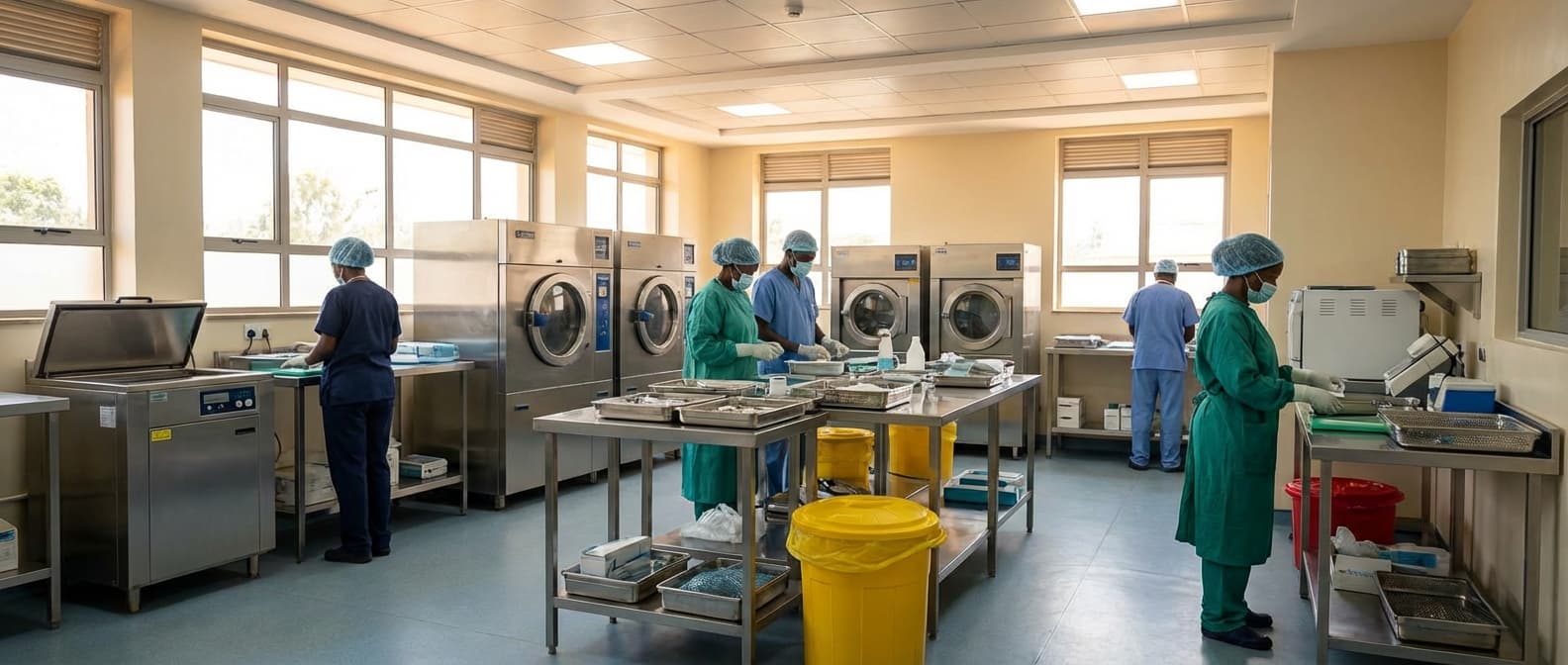
Infection-Control Readiness Support Service for Reusable Equipment in Congo (Kinshasa)
Engineering Excellence & Technical Support
Infection-Control Readiness Support Service for Reusable Equipment High-standard technical execution following OEM protocols and local regulatory frameworks.
Advanced Decontamination Protocols
Implementing state-of-the-art sterilization and disinfection techniques for reusable medical equipment, tailored to local infrastructure and specific pathogen risks in Kinshasa, ensuring maximum patient safety.
Robust Supply Chain Management
Establishing a reliable and resilient supply chain for essential decontamination agents, spare parts, and maintenance equipment, guaranteeing uninterrupted readiness for infection control in healthcare facilities across Kinshasa.
Local Capacity Building & Training
Empowering local healthcare professionals through comprehensive, hands-on training programs in proper equipment reprocessing, maintenance, and infection control best practices, fostering sustainable readiness within the Congolese healthcare system.
What Is Infection-control Readiness Support Service For Reusable Equipment In Congo (Kinshasa)?
Infection-Control Readiness Support Service for Reusable Equipment in Congo (Kinshasa) refers to a specialized consultancy and operational assistance program designed to bolster the capacity of healthcare facilities and related organizations in the Democratic Republic of Congo, specifically Kinshasa, to safely and effectively manage the reprocessing of reusable medical devices. This service addresses the critical need for robust infection prevention and control (IPC) measures, particularly in resource-limited settings where the risk of healthcare-associated infections (HAIs) is exacerbated by infrastructure challenges, supply chain disruptions, and a potential scarcity of trained personnel for proper sterilization and disinfection protocols.
| Who Needs the Service | Typical Use Cases | |||||||||||||
|---|---|---|---|---|---|---|---|---|---|---|---|---|---|---|
| Public and Private Hospitals: All sizes, from large tertiary care centers to smaller district hospitals, that utilize reusable medical instruments and devices. | Clinics and Health Centers: Outpatient facilities, dental clinics, and specialized care centers where basic reusable instruments are processed. | Surgical Centers and Operating Theaters: Facilities with high volumes of surgical instruments requiring rigorous sterilization. | Laboratories and Diagnostic Centers: Entities that process reusable glassware, probes, and other diagnostic equipment. | Non-Governmental Organizations (NGOs) and International Health Organizations: Implementing partners involved in healthcare delivery or capacity building in the DRC. | Ministry of Health (DRC): National-level bodies responsible for setting standards, policy, and overseeing healthcare infrastructure and IPC. | Medical Device Suppliers and Manufacturers: Companies seeking to ensure their products are properly managed by end-users in the local context. | Central Medical Warehouses and Sterilization Units: Larger facilities responsible for reprocessing equipment for multiple healthcare sites. | Training Institutions and Medical Schools: For curriculum development and practical training in sterile processing. | Outbreak Response Teams: During infectious disease outbreaks requiring enhanced sterilization protocols for shared equipment. | **Facilities undergoing renovation or expansion of their sterile processing departments. | **Healthcare providers experiencing recurrent HAIs linked to inadequate reprocessing. | **Organizations facing challenges with the availability or functionality of sterilization equipment. | **Establishment of new healthcare facilities or expansion of existing services. | **Post-conflict or disaster recovery scenarios where healthcare infrastructure may be damaged or disrupted. |
Key Components of the Service
- Assessment and Gap Analysis: Comprehensive evaluation of existing reprocessing workflows, infrastructure (including water and power supply), equipment, and personnel competency related to reusable medical device management.
- Policy and Procedure Development/Refinement: Assistance in establishing or updating Standard Operating Procedures (SOPs) for the cleaning, disinfection, and sterilization of various categories of reusable medical equipment, adhering to international standards (e.g., WHO, CDC) and local regulations.
- Training and Capacity Building: Delivery of targeted training modules for healthcare workers, technicians, and IPC focal points on best practices in manual and automated cleaning, disinfection methods (high-level disinfection, sterilization), packaging, storage, and documentation.
- Equipment and Consumables Guidance: Advisement on the selection, procurement, maintenance, and validation of reprocessing equipment (e.g., autoclaves, washer-disinfectors, chemical sterilizers) and appropriate consumables (detergents, disinfectants, sterile packaging materials).
- Infrastructure Assessment and Recommendations: Evaluation of the physical layout of sterile processing departments (SPDs) or designated reprocessing areas, including recommendations for workflow optimization, ventilation, and waste management.
- Quality Assurance and Monitoring: Establishment of systems for ongoing monitoring of reprocessing effectiveness, including biological and chemical indicator use, equipment calibration, and regular competency assessments.
- Supply Chain Support: Advisory services on establishing reliable supply chains for necessary chemicals, consumables, and spare parts for reprocessing equipment.
- Emergency Preparedness and Response: Development of protocols for managing surges in demand or disruptions in the standard reprocessing procedures during public health emergencies or outbreaks.
Who Needs Infection-control Readiness Support Service For Reusable Equipment In Congo (Kinshasa)?
This service is designed to bolster the infection-control readiness for reusable medical equipment in healthcare facilities within Congo (Kinshasa). It focuses on ensuring that reusable items are cleaned, disinfected, and sterilized effectively to prevent the transmission of healthcare-associated infections (HAIs).
| Department/Service | Specific Needs/Focus Areas | Types of Reusable Equipment |
|---|---|---|
| Sterilization Department/Central Sterile Supply Department (CSSD) | Proper cleaning, disinfection, and sterilization protocols for surgical instruments, endoscopes, and other critical/semi-critical items. Validation of sterilization processes. Staff training. | Surgical instruments (scalpels, forceps, retractors), endoscopes (gastroscopes, colonoscopes), anesthesia equipment, diagnostic equipment components. |
| Operating Theatres (OR) | Immediate post-operative cleaning and reprocessing of instruments. Ensuring adequate supplies of sterile reusable items. Prevention of cross-contamination. | Surgical trays, instruments, drapes, gowns, masks. |
| Maternity and Neonatal Units | Safe reprocessing of instruments used in deliveries and newborn care. Prevention of mother-to-child transmission of infections. | Delivery instruments, suction devices, feeding tubes, incubators (components). |
| Outpatient Departments (OPD) & General Wards | Effective cleaning and disinfection of non-critical reusable items used for patient care. Proper handling of used equipment. | Thermometers, blood pressure cuffs, stethoscopes, bedpans, urinals, nebulizer attachments. |
| Emergency Department (ED) | Rapid and effective reprocessing of equipment in high-turnover environments. Maintaining infection control standards under pressure. | Ventilator circuits, suction equipment, minor surgical instruments, resuscitation equipment components. |
| Dental Clinics | Strict adherence to protocols for dental instruments, handpieces, and other reusable items. Prevention of blood-borne pathogen transmission. | Dental instruments (scalers, probes), handpieces, impression trays, mirrors. |
| Laboratories | Sterilization of glassware, culture loops, and diagnostic equipment components. Safe handling of infectious materials. | Glassware (petri dishes, beakers), culture loops, inoculation needles, centrifuge tubes. |
| Infection Prevention and Control (IPC) Committee/Department | Overall oversight of infection control practices, policy development, staff training, auditing compliance, and outbreak investigation. Ensuring readiness for audits and inspections. | All reusable equipment within the facility. |
Target Customers & Departments
- Hospitals (Public and Private)
- Clinics and Health Centers
- Maternity Wards
- Surgical Centers
- Dental Clinics
- Laboratories
- Rehabilitation Centers
- Non-Governmental Organization (NGO) health facilities
Infection-control Readiness Support Service For Reusable Equipment Process In Congo (Kinshasa)
This document outlines the workflow for the Infection-Control Readiness Support Service for Reusable Equipment Process in Congo (Kinshasa). The service aims to enhance the capacity of healthcare facilities to safely reprocess reusable medical equipment, thereby reducing the risk of healthcare-associated infections.
| Stage | Activities | Key Stakeholders | Deliverables/Outcomes |
|---|---|---|---|
| Healthcare facility (or Ministry of Health) expresses interest; initial contact and information exchange; site visit to assess current practices, infrastructure, equipment, and human resources for reprocessing; identification of specific challenges and needs. | Interested Healthcare Facility (e.g., Hospital, Clinic), Ministry of Health representatives, Service Provider Representatives. | Needs assessment report, initial understanding of the scope of work, identification of key personnel. |
| Service provider develops a detailed proposal outlining the scope of services, methodology, timeline, budget, and expected outcomes; negotiation and finalization of the agreement (contract or Memorandum of Understanding). | Service Provider, Interested Healthcare Facility, Ministry of Health (if applicable). | Signed agreement/contract, detailed project plan, budget. |
| Procurement and delivery of necessary equipment, consumables, and training materials; development of customized training modules; pre-training site preparation (e.g., minor infrastructure adjustments, ensuring water and electricity supply); identification and scheduling of participants. | Service Provider, Healthcare Facility Logistics/Maintenance Teams, Procurement Department. | Delivered materials and equipment, finalized training schedule, prepared training environment. |
| Hands-on training sessions for healthcare staff on standard operating procedures (SOPs) for cleaning, disinfection, sterilization, and safe handling of reusable equipment; demonstration and practical exercises; troubleshooting common issues; implementation of revised workflows. | Service Provider Trainers, Healthcare Facility Staff (nurses, technicians, cleaning staff). | Trained personnel, established and functional reprocessing protocols, improved understanding of infection control principles. |
| Follow-up visits to assess the sustainability of implemented practices; ongoing mentorship and support; remote technical assistance; monitoring of key performance indicators (KPIs) related to infection rates and reprocessing effectiveness; identification of further training needs. | Service Provider Support Team, Healthcare Facility Management and Staff. | Sustained improved practices, documented adherence to SOPs, identified areas for continuous improvement. |
| Compilation of progress reports, final project report detailing achievements, challenges, lessons learned, and recommendations; evaluation of the overall impact of the service; potential planning for future phases or scale-up. | Service Provider, Healthcare Facility Management, Ministry of Health (if applicable). | Comprehensive project reports, evaluation findings, recommendations for future interventions. |
Workflow Stages
- Inquiry and Needs Assessment
- Proposal Development and Agreement
- Pre-Engagement Preparations
- On-Site Implementation and Training
- Post-Implementation Support and Monitoring
- Reporting and Evaluation
Infection-control Readiness Support Service For Reusable Equipment Cost In Congo (Kinshasa)
This document outlines the pricing factors and estimated cost ranges for an Infection-Control Readiness Support Service focused on reusable equipment in Congo (Kinshasa). The service aims to enhance the safety and efficacy of reusable medical devices through comprehensive infection prevention and control measures, ensuring compliance with health regulations and minimizing the risk of healthcare-associated infections (HAIs). Pricing is influenced by several key variables, reflecting the local economic landscape and the specific needs of healthcare facilities.
| Service Component / Cost Factor | Estimated Price Range (Congolese Franc - CDF) | Notes |
|---|---|---|
| Initial Facility Assessment & Gap Analysis | 300,000 - 1,200,000 CDF | Covers site visits, interviews, and documentation review to identify current infection control practices and deficiencies related to reusable equipment. |
| Protocol Development/Review (SOPs) | 400,000 - 1,500,000 CDF | Development or revision of Standard Operating Procedures for cleaning, disinfection, sterilization, and storage of various reusable items. |
| Staff Training & Capacity Building (per session/group) | 250,000 - 800,000 CDF | Includes workshops, practical demonstrations, and competency assessments for clinical and support staff. Cost varies by duration and group size. |
| Equipment Auditing & Inventory Management Support | 350,000 - 1,000,000 CDF | Systematic review of reusable equipment, ensuring proper tracking, maintenance, and disposal of expired or damaged items. |
| Implementation Support & Mentorship | 500,000 - 2,000,000 CDF | On-site guidance and support during the implementation of new protocols and practices. This can be charged daily or on a project basis. |
| Ongoing Monitoring & Quality Assurance | 200,000 - 700,000 CDF per month | Regular check-ins, data analysis, and feedback to ensure sustained compliance and identify areas for improvement. Can be structured as a retainer. |
| Specialized Equipment Process Support (e.g., Endoscopy) | 700,000 - 2,500,000 CDF (per module/equipment type) | Higher costs due to complexity, specialized training, and advanced disinfection/sterilization requirements. |
| Travel & Logistics (within Kinshasa) | 50,000 - 150,000 CDF (per visit) | Covers transportation and per diem for staff visiting healthcare facilities. |
| Report Generation & Documentation | Included in other service components, but significant reports may incur an additional charge of 100,000 - 300,000 CDF. |
Key Pricing Factors
- Scope of Service: The breadth and depth of the support offered, including assessment, training, protocol development, equipment auditing, and ongoing monitoring.
- Facility Size and Complexity: The number of departments, the volume of reusable equipment, and the complexity of sterilization/disinfection processes within the facility.
- Type of Reusable Equipment: The variety and quantity of reusable items (e.g., surgical instruments, endoscopes, respiratory equipment) requiring specific handling and processing.
- Training Needs: The extent of training required for healthcare staff on proper cleaning, disinfection, sterilization, and handling protocols.
- Duration of Engagement: Whether the service is a one-time consultation, a multi-month project, or an ongoing maintenance contract.
- Geographic Accessibility: Travel and logistical costs to reach facilities within Kinshasa and its surrounding areas.
- Regulatory Compliance Requirements: The level of adherence to national and international infection control standards that the service must facilitate.
- Level of Customization: The degree to which the service needs to be tailored to the specific infrastructure and resources of a healthcare facility.
- Supplier/Provider Reputation and Expertise: The established track record and specialization of the infection control service provider.
- Resource Availability: The availability of local trained personnel and materials, which can influence the cost of service delivery.
Affordable Infection-control Readiness Support Service For Reusable Equipment Options
This service offers affordable infection-control readiness support specifically designed for organizations utilizing reusable medical equipment. We understand the critical importance of maintaining stringent hygiene standards to prevent healthcare-associated infections (HAIs) while managing operational costs. Our service aims to equip your facility with the knowledge, resources, and streamlined processes needed to ensure your reusable equipment is consistently safe for patient use, without breaking the bank. We achieve this through expertly curated value bundles and implemented cost-saving strategies, making advanced infection control accessible and sustainable.
| Cost-Saving Strategy | Description | Benefit |
|---|---|---|
| Optimized Sterilization Cycles | Utilizing data-driven insights to fine-tune sterilization cycle parameters, ensuring efficacy while minimizing energy and consumable usage. | Reduced utility costs (steam, electricity) and extended lifespan of sterilization equipment. |
| Smart Inventory Management | Implementing systems to track reusable equipment usage, maintenance schedules, and replacement needs, preventing overstocking and unnecessary purchases. | Lower capital expenditure on new equipment and reduced waste from expired or damaged items. |
| Efficient Cleaning & Disinfection Processes | Streamlining cleaning workflows and recommending cost-effective, yet highly effective, cleaning and disinfection agents based on equipment type and contamination risk. | Reduced labor costs through optimized workflows and savings on cleaning supplies. |
| Staff Training & Empowerment | Investing in comprehensive, ongoing staff training to improve proficiency in reprocessing, leading to fewer errors and reprocessed loads. | Decreased reprocessing failures, saving time, resources, and potential patient safety risks. |
| Preventative Maintenance Programs | Proactive maintenance schedules for reprocessing equipment to prevent breakdowns and extend operational life. | Avoidance of costly emergency repairs and minimized downtime of essential reprocessing equipment. |
Value Bundles for Enhanced Infection Control Readiness
- Basic Readiness Bundle: This foundational package includes a comprehensive assessment of current reusable equipment reprocessing protocols, identification of potential gaps, and a customized action plan. It also provides access to essential training modules for your staff on best practices in cleaning, disinfection, and sterilization.
- Advanced Preparedness Bundle: Building upon the Basic Readiness Bundle, this option incorporates regular on-site audits and performance monitoring of your reprocessing workflows. It also includes an inventory management consultation to optimize the lifecycle of your reusable equipment and reduce replacement costs. Access to a dedicated infection control specialist for consultation is also a key feature.
- Comprehensive Compliance Bundle: This premium package offers all the benefits of the Advanced Preparedness Bundle, with the added advantage of proactive regulatory compliance support. We provide assistance with documentation, reporting, and staying abreast of evolving infection control guidelines. This bundle also includes a subscription to our digital platform for real-time tracking of equipment reprocessing status and staff training completion.
Verified Providers In Congo (Kinshasa)
Navigating the healthcare landscape in Congo (Kinshasa) can be challenging. Ensuring you are engaging with verified providers is paramount for your health and well-being. Franance Health stands out as a premier choice due to its rigorous credentialing process, commitment to quality care, and deep understanding of local healthcare needs. Their network comprises meticulously vetted healthcare professionals and facilities, guaranteeing a high standard of medical services.
| Franance Health Credentialing Criteria | What it Means for Patients |
|---|---|
| Verification of Medical Licenses and Certifications | Ensures providers are legally qualified and have the necessary qualifications for their specialty. |
| Professional Background Checks and Reference Verification | Confirms a provider's history of ethical practice and positive professional relationships. |
| Assessment of Clinical Experience and Competence | Guarantees that providers have practical experience and the skills to manage various health conditions. |
| Adherence to Ethical Guidelines and Patient Rights | Ensures that patient privacy, dignity, and informed consent are respected at all times. |
| Facility Accreditation and Safety Standards (where applicable) | Confirms that clinics and hospitals meet established safety and operational benchmarks. |
Why Franance Health is the Best Choice for Verified Providers in Congo (Kinshasa):
- Rigorous Vetting Process: Franance Health employs a stringent credentialing process that goes beyond basic licensing. They assess qualifications, experience, ethical standing, and adherence to international best practices.
- Commitment to Quality: Every provider within the Franance Health network is committed to delivering patient-centered care with a focus on safety, efficacy, and positive health outcomes.
- Local Expertise and Global Standards: Franance Health bridges the gap between local healthcare realities in Congo (Kinshasa) and globally recognized medical standards, ensuring culturally competent and effective treatment.
- Comprehensive Network: They offer access to a diverse range of specialists, general practitioners, and healthcare facilities, catering to a wide spectrum of medical needs.
- Patient Advocacy and Support: Franance Health acts as a patient advocate, simplifying the process of finding and accessing reliable healthcare, and providing support throughout the patient journey.
Scope Of Work For Infection-control Readiness Support Service For Reusable Equipment
This Scope of Work (SOW) outlines the requirements for a service provider to offer Infection-Control Readiness Support for Reusable Medical Equipment. The service aims to ensure that healthcare facilities have robust processes and capabilities in place to safely clean, disinfect, and sterilize reusable medical equipment, thereby minimizing the risk of healthcare-associated infections (HAIs). This includes assessment, recommendation, training, and ongoing support.
| Technical Deliverable | Description | Standard Specifications / Compliance | Timeline (Indicative) |
|---|---|---|---|
| Initial Readiness Assessment Report | A comprehensive report detailing the current state of reusable equipment reprocessing, including SWOT analysis, identification of risks, and prioritized recommendations. | Based on current national/international guidelines (e.g., CDC, WHO, local health authority regulations), AAMI ST standards, and facility-specific policies. | Weeks 1-4 |
| Standard Operating Procedures (SOPs) for Reusable Equipment Reprocessing | Development or refinement of detailed SOPs for receiving, cleaning, inspection, disinfection, sterilization, storage, and distribution of all critical reusable equipment categories. | Must align with manufacturer's instructions for use (IFU) for all equipment and reprocessing agents. Compliance with relevant ISO, AAMI, and national standards. | Weeks 5-10 |
| Training Materials and Modules | Creation of user-friendly training materials (e.g., presentations, handouts, competency assessments) for all staff involved in reusable equipment reprocessing. | Content should cover general infection control principles, specific SOPs, equipment operation, and emergency procedures. Designed for various learning styles. | Weeks 6-12 |
| Training Delivery and Competency Verification | Conducting training sessions for designated personnel and implementing a robust competency verification process. | All trainers must be certified or possess verifiable expertise. Competency assessments must be documented and retained. | Weeks 8-16 |
| Equipment and Chemistry Validation Plan | Development of a plan for the validation of new or existing cleaning, disinfection, and sterilization equipment and chemistries. | Must include protocols for performance testing, efficacy studies, and ongoing monitoring, referencing relevant AAMI ST standards and manufacturer IFUs. | Weeks 10-14 |
| Monitoring and Audit Framework | Establishment of a system for regular internal audits and performance monitoring of reprocessing processes. | Framework should include key performance indicators (KPIs) related to turnaround times, compliance rates, and HAIs. Templates for audit reports and corrective action plans. | Weeks 14-18 |
| Troubleshooting and Expert Consultation | On-demand expert consultation and support for addressing specific infection control challenges related to reusable equipment. | Response time for critical issues should be defined (e.g., within 24 hours). Access to a dedicated point of contact or support line. | Ongoing throughout the contract period |
| Final Readiness Report and Sustainability Plan | A report summarizing improvements achieved, a review of implemented systems, and a plan for ongoing sustainability and continuous improvement. | Includes recommendations for future quality improvement initiatives and staff education. | End of contract period |
Key Objectives of the Infection-Control Readiness Support Service:
- Assess current infection control practices for reusable equipment within the facility.
- Identify gaps and areas for improvement based on best practices and regulatory guidelines.
- Develop and implement standardized protocols for cleaning, disinfection, and sterilization.
- Provide training to relevant personnel on infection control procedures and equipment handling.
- Assist in the selection and validation of appropriate cleaning, disinfection, and sterilization equipment and chemistries.
- Establish monitoring and auditing mechanisms to ensure ongoing compliance.
- Provide expert consultation and troubleshooting for infection control challenges.
- Ensure readiness for regulatory inspections and accreditations.
Service Level Agreement For Infection-control Readiness Support Service For Reusable Equipment
This Service Level Agreement (SLA) outlines the response times and uptime guarantees for the Infection-Control Readiness Support Service for Reusable Equipment. This service ensures that critical reusable equipment is maintained at optimal levels of cleanliness and functionality, minimizing the risk of healthcare-associated infections and maximizing operational efficiency.
| Service Component | Critical Equipment Response Time (Business Hours) | Critical Equipment Resolution Time (Business Hours) | Standard Equipment Response Time (Business Hours) | Standard Equipment Resolution Time (Business Hours) | Uptime Guarantee (Monthly) |
|---|---|---|---|---|---|
| Initial Response to Support Request | 1 Hour | 4 Business Hours | 99.5% | ||
| On-site Technician Arrival (for Critical Equipment) | 4 Hours | ||||
| On-site Technician Arrival (for Standard Equipment) | 8 Business Hours | 2 Business Days | |||
| Remote Troubleshooting and Guidance | Included in Initial Response | Included in Initial Response | |||
| Preventative Maintenance and Scheduled Servicing | As per agreed schedule | N/A | As per agreed schedule | N/A |
Key Definitions
- Support Request: Any documented request submitted by the Client to the Service Provider for assistance related to the Infection-Control Readiness Support Service.
- Critical Equipment: Reusable medical equipment identified by the Client as essential for patient care and requiring immediate attention in case of malfunction or contamination.
- Standard Equipment: Reusable medical equipment identified by the Client that is not classified as critical but still requires routine infection control support.
- Downtime: The period during which the Reusable Equipment is unavailable for use due to a failure in its infection control readiness, as determined by the Client and confirmed by the Service Provider.
- Response Time: The maximum allowable time from the submission of a Support Request to the initiation of active work by the Service Provider.
- Resolution Time: The maximum allowable time from the initiation of active work to the successful resolution of the Support Request.
- Uptime Guarantee: The percentage of time that the Reusable Equipment is expected to be available for use, assuming proper operation and maintenance by the Client.
Frequently Asked Questions

Ready when you are
Let's scope your Infection-Control Readiness Support Service for Reusable Equipment in Congo (Kinshasa) project in Congo (Kinshasa).

Scaling healthcare logistics and technical systems across the entire continent.