
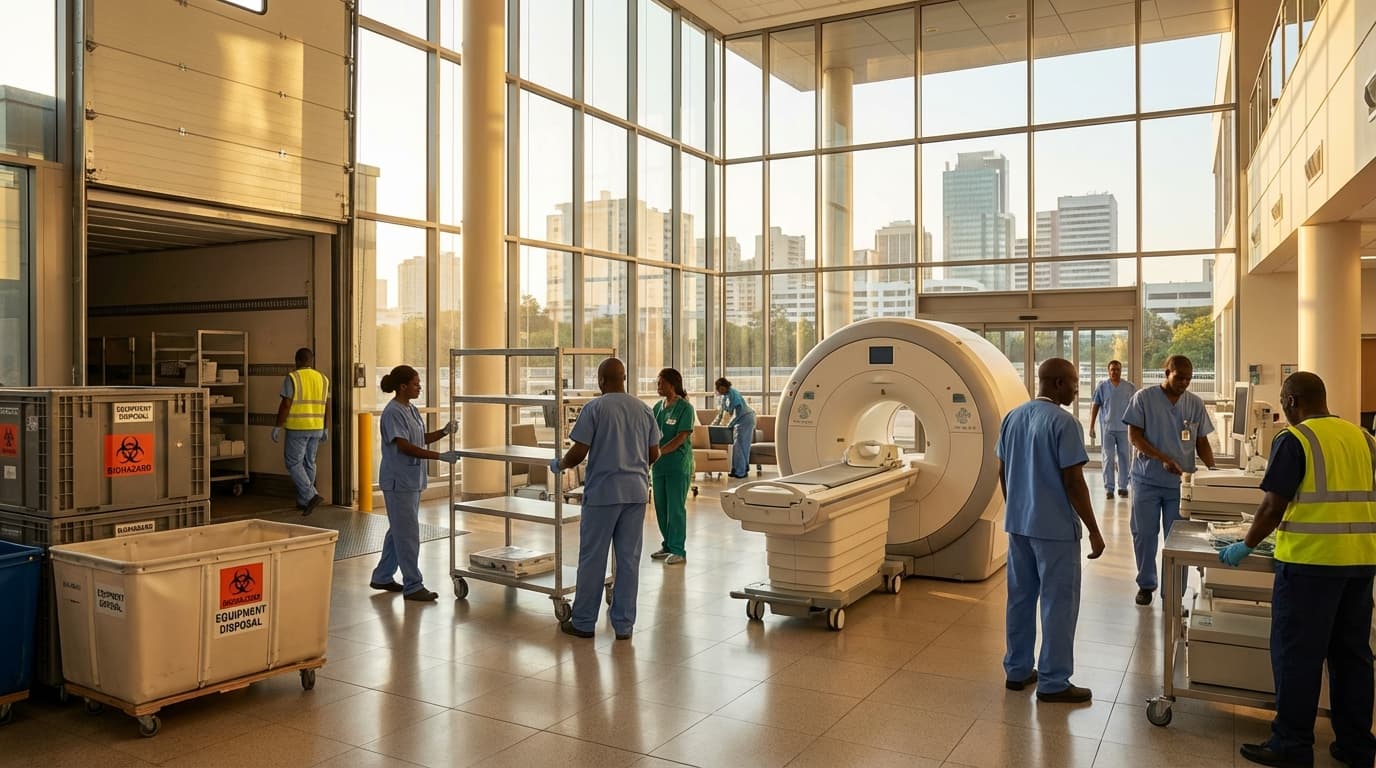
Decommissioning Service for Medical Devices in Congo (Kinshasa)
Engineering Excellence & Technical Support
Decommissioning Service for Medical Devices High-standard technical execution following OEM protocols and local regulatory frameworks.
Secure Data Sanitization & Disposal
Ensuring all patient data is irreversibly erased from medical devices prior to decommissioning, adhering to international data privacy standards and local regulations in Congo (Kinshasa). We employ multi-pass overwriting and physical destruction methods for complete data security.
Expert Regulatory Navigation
Navigating the complex and evolving regulatory landscape for medical device disposal in the Democratic Republic of Congo. Our team ensures full compliance with national health authorities, environmental protection agencies, and import/export laws, mitigating legal risks for our clients.
Environmentally Responsible Waste Management
Implementing sustainable decommissioning practices that minimize environmental impact in Congo (Kinshasa). We prioritize the responsible segregation, recycling, and disposal of hazardous and non-hazardous medical waste, working with certified local partners to ensure safe and compliant waste streams.
What Is Decommissioning Service For Medical Devices In Congo (Kinshasa)?
Decommissioning services for medical devices in Congo (Kinshasa) refer to the systematic and secure process of removing medical equipment from active service. This involves a comprehensive set of procedures designed to ensure patient safety, data privacy, regulatory compliance, and environmental responsibility throughout the device's end-of-life cycle. These services are critical for healthcare institutions in the Democratic Republic of Congo to manage their medical technology portfolio effectively and ethically.
| Who Needs Decommissioning Services | Typical Use Cases |
|---|---|
| Hospitals (Public and Private) | Replacement of outdated or malfunctioning diagnostic imaging equipment (e.g., X-ray machines, CT scanners). Discontinuation of older anesthetic machines or ventilators. End-of-life management for surgical robots or minimally invasive surgical instruments. |
| Clinics and Health Centers | Upgrading basic laboratory equipment (e.g., microscopes, centrifuges). Retiring analog medical monitoring devices in favor of digital counterparts. Removing expired or non-functional sterilizers. |
| Diagnostic Laboratories | Phasing out legacy analytical instruments (e.g., older spectrophotometers, DNA sequencers). Disposing of laboratory freezers or refrigerators containing sensitive reagents. Managing the lifecycle of specialized diagnostic assay platforms. |
| Research Institutions and Universities | Decommissioning of research-specific medical equipment after project completion. Responsible disposal of experimental or prototype medical devices. Updating research facilities with newer technological capabilities. |
| Medical Device Manufacturers/Distributors (for service centers) | Managing returned or end-of-life devices from their own service operations. Facilitating the responsible disposal of demonstration or evaluation units. |
What Decommissioning Service for Medical Devices Involves:
- Asset Identification and Tracking: Cataloging devices slated for decommissioning, including serial numbers, model numbers, acquisition dates, and current location.
- Data Sanitization and Destruction: Securely erasing all patient data, operational logs, and sensitive information from the device's memory and storage media to prevent breaches and comply with privacy regulations. This may involve physical destruction of storage components.
- Functional Assessment and Disposition Planning: Evaluating the device's remaining operational capacity. Decisions are made regarding reuse (if ethically and technically feasible, often in resource-limited settings after appropriate refurbishment), recycling, or responsible disposal.
- Disassembly and Component Segregation: Safely dismantling the device into its constituent parts, categorizing components for recycling, hazardous waste disposal, or potential refurbishment.
- Environmental Management and Disposal: Adhering to local and international regulations for the disposal of medical waste, particularly for devices containing hazardous materials (e.g., mercury, lead, radioactive isotopes). This includes proper handling of infectious waste and electronic waste (e-waste).
- Documentation and Certification: Maintaining detailed records of all decommissioning activities, including data sanitization methods, disposal certificates, and chain-of-custody documentation for regulatory audits and liability management.
- Regulatory Compliance: Ensuring all decommissioning procedures meet the standards set by national health authorities (e.g., Ministère de la Santé) and any relevant international guidelines.
Who Needs Decommissioning Service For Medical Devices In Congo (Kinshasa)?
Decommissioning medical devices in Congo (Kinshasa) is a critical process often overlooked. This service ensures the safe, secure, and environmentally responsible disposal of obsolete, damaged, or end-of-life medical equipment. Without proper decommissioning, healthcare facilities risk data breaches, environmental contamination, and non-compliance with regulations. Specialized services are essential for handling these complex devices.
| Customer Type | Key Departments Involved in Decommissioning Decisions & Execution |
|---|---|
| Public Hospitals | Biomedical Engineering Department, IT Department, Procurement Department, Administration, Environmental Services/Waste Management, Security |
| Private Hospitals and Clinics | Head of Operations/Administration, Biomedical Department (if present), IT Department, Procurement, Facility Management |
| Medical Research Institutions | Laboratory Management, IT Department, Facilities Management, Research Coordinators |
| Diagnostic Laboratories | Laboratory Director, Technical Manager, IT Department, Operations Manager |
| NGOs and International Aid Organizations | Program Managers (Healthcare), Logistics and Operations Teams, Procurement, Local Facility Managers, Compliance Officers |
| Government Health Agencies | Regulatory Affairs, Procurement, Public Health Programs, Facilities Management (for public health centers) |
| Medical Equipment Distributors/Suppliers | After-Sales Service Department, Logistics, Compliance, Quality Assurance |
Target Customers for Medical Device Decommissioning Services in Congo (Kinshasa)
- Public Hospitals (Ministry of Health facilities)
- Private Hospitals and Clinics
- Medical Research Institutions
- Diagnostic Laboratories
- Non-Governmental Organizations (NGOs) operating healthcare facilities
- International Aid Organizations involved in healthcare
- Government Health Agencies
- Medical Equipment Distributors and Suppliers (for managing returned or recalled items)
Decommissioning Service For Medical Devices Process In Congo (Kinshasa)
The decommissioning of medical devices in Congo (Kinshasa) is a critical process that ensures safe and environmentally responsible disposal of outdated, broken, or surplus equipment. This workflow outlines the typical stages from the initial inquiry by a healthcare facility or organization to the final execution of the decommissioning service. The process involves several key steps to ensure compliance with local regulations, data security, and proper waste management.
| Stage | Description | Key Activities | Responsible Party |
|---|---|---|---|
| Inquiry & Consultation | Client initiates contact, discusses needs. | Needs assessment, scope discussion, device identification (initial). | Healthcare Facility, Decommissioning Service Provider |
| Site Assessment & Inventory | On-site evaluation and detailed inventory. | Physical inspection, accessibility check, comprehensive device listing. | Decommissioning Service Provider |
| Quotation & Proposal | Provider outlines services, costs, and timeline. | Cost estimation, service breakdown, proposal document. | Decommissioning Service Provider |
| Contractual Agreement | Formal agreement between parties. | Contract negotiation, signing, definition of terms. | Healthcare Facility, Decommissioning Service Provider |
| Planning & Scheduling | Logistical planning for execution. | Resource allocation, scheduling, risk assessment. | Decommissioning Service Provider |
| On-Site Execution | Physical decommissioning at client location. | Data sanitization, dismantling, packaging, removal. | Decommissioning Service Provider |
| Transportation | Moving devices to processing facility. | Loading, secure transport, documentation. | Decommissioning Service Provider |
| Processing & Disposal | Recycling, reuse, or responsible disposal. | Sorting, dismantling, hazardous waste handling, material recovery. | Decommissioning Service Provider, Authorized Disposal Facilities |
| Certification & Documentation | Proof of responsible decommissioning. | Issuance of certificates, record-keeping. | Decommissioning Service Provider |
| Reporting & Invoicing | Final summary and billing. | Report generation, final invoice. | Decommissioning Service Provider |
Decommissioning Service Workflow for Medical Devices in Congo (Kinshasa)
- Initial Inquiry & Consultation: The process begins with a healthcare facility contacting a licensed decommissioning service provider. This initial phase involves understanding the client's needs, the types and quantities of devices to be decommissioned, and any specific client requirements.
- Site Assessment & Inventory: A pre-assessment visit is often conducted to evaluate the scope of work. This includes identifying the location of devices, assessing accessibility, and noting any specific challenges (e.g., large equipment, confined spaces). An initial inventory of the devices to be decommissioned is compiled.
- Quotation & Proposal Generation: Based on the assessment and inventory, the service provider prepares a detailed quotation and proposal. This document outlines the scope of services, estimated timelines, safety protocols, data sanitization methods, disposal methods, associated costs, and terms and conditions.
- Contractual Agreement: Upon acceptance of the quotation, a formal contract is signed between the healthcare facility and the decommissioning service provider. This contract details the responsibilities of both parties, the agreed-upon services, pricing, and payment schedules.
- Planning & Scheduling: The decommissioning team plans the execution phase, including logistics, personnel allocation, equipment required for transport and dismantling, and scheduling the decommissioning activities at the client's site, ensuring minimal disruption to ongoing healthcare operations.
- On-Site Decommissioning Execution: This is the core operational phase. It typically includes:
- Device Identification & Verification: Confirming the devices to be decommissioned against the agreed-upon inventory.
- Data Sanitization/Destruction: For devices with stored data (e.g., imaging equipment, patient monitors), secure data erasure or physical destruction is performed according to established standards to protect patient privacy.
- Dismantling & Disassembly: Safely taking apart larger or complex devices into manageable components.
- Packaging & Labeling: Preparing devices and components for transport, ensuring proper packaging to prevent damage and clear labeling for identification and tracking.
- Safe Removal: Carefully removing devices from the premises, often requiring specialized equipment for heavy items.
- Transportation: Transporting the decommissioned devices and their components to the service provider's facility or a designated recycling/disposal center using compliant vehicles.
- Processing & Recycling/Disposal: At the processing facility, devices are further dismantled and sorted.:
- Scrap Metal Recovery: Extracting recyclable metals.
- Component Reuse/Refurbishment: Identifying any components that can be safely refurbished for secondary markets or donation (if applicable and agreed upon).
- Hazardous Waste Management: Properly handling and disposing of any hazardous materials (e.g., mercury in older monitors, batteries) in accordance with environmental regulations.
- Secure Destruction: Ensuring complete destruction of non-recyclable or non-reusable components.
- Certification & Documentation: The service provider issues a certificate of decommissioning for each device, confirming its responsible disposal. Documentation often includes proof of data destruction, waste transfer notes, and recycling certificates.
- Final Reporting & Invoicing: A comprehensive report detailing the decommissioning activities, including inventory of disposed items, methods used, and certifications, is provided to the client. The final invoice is issued for the services rendered.
Decommissioning Service For Medical Devices Cost In Congo (Kinshasa)
Decommissioning medical devices in Congo (Kinshasa) involves a range of costs influenced by several factors. These factors dictate the pricing, which can vary significantly between service providers and the complexity of the devices being decommissioned. The process is crucial for ensuring proper disposal, data security, and environmental compliance.
Key Pricing Factors:
- Device Type and Complexity: Simple devices like stethoscopes will have a much lower decommissioning cost than complex imaging equipment (MRI, CT scanners) or surgical robots. The intricate components, specialized software, and potential for hazardous materials in advanced devices increase labor and disposal expenses.
- Data Security Requirements: For devices containing sensitive patient data (e.g., electronic health records systems, imaging devices), specialized data sanitization or physical destruction methods are required. These methods are more time-consuming and may involve specialized equipment, thus increasing costs.
- Volume of Devices: A bulk decommissioning service for a large hospital or clinic will often benefit from economies of scale, potentially leading to a lower per-unit cost compared to decommissioning a single or a few devices.
- Location and Accessibility: The ease of access to the device's location within Kinshasa can influence costs. Difficult-to-reach areas or multiple site visits might incur additional transportation and labor charges.
- Environmental Regulations and Disposal Methods: Proper disposal of medical waste, especially biohazardous materials or components containing hazardous substances (like mercury in older equipment), adheres to local environmental regulations. The chosen disposal method (e.g., specialized incineration, secure landfill, recycling of certain components) will directly impact the overall cost.
- Service Provider's Expertise and Certifications: Reputable service providers with trained technicians, adherence to safety protocols, and relevant certifications may command higher prices due to their proven reliability and expertise.
- Dismantling and Transportation: The labor involved in safely dismantling complex devices and transporting them to a designated disposal facility adds to the overall cost.
- Certificates of Destruction/Decommissioning: Some clients may require formal documentation certifying the decommissioning process, which can be an additional cost component.
Estimated Cost Ranges in Congolese Francs (CDF):
Due to the dynamic nature of pricing and the lack of standardized public price lists, these ranges are estimates and can fluctuate. It is highly recommended to obtain multiple quotes from local service providers for accurate pricing.
- Small, Simple Devices (e.g., Stethoscopes, Blood Pressure Monitors, basic lab equipment): 50,000 - 150,000 CDF per unit.
- Medium Complexity Devices (e.g., some diagnostic equipment, older patient monitors, basic surgical instruments): 200,000 - 700,000 CDF per unit.
- High Complexity Devices (e.g., Imaging equipment like X-ray machines, Ultrasound; large laboratory analyzers; anesthesia machines): 1,000,000 - 5,000,000+ CDF per unit. This can be significantly higher for very large or specialized systems.
- Data Sanitization/Destruction Services (as a separate or integrated service): This can add an additional 50,000 - 500,000+ CDF depending on the scale and method.
Important Note: These figures are indicative. Factors like the specific model of the device, its condition, and the urgency of the service can also influence the final price. Engaging with local medical waste management companies or specialized IT asset disposition (ITAD) providers in Kinshasa is the most effective way to get precise quotations.
| Device Category | Estimated Cost Range (CDF) |
|---|---|
| Small, Simple Devices (e.g., Stethoscopes, Blood Pressure Monitors) | 50,000 - 150,000 |
| Medium Complexity Devices (e.g., Diagnostic equipment, older patient monitors) | 200,000 - 700,000 |
| High Complexity Devices (e.g., Imaging equipment, large analyzers) | 1,000,000 - 5,000,000+ |
| Data Sanitization/Destruction (additional) | 50,000 - 500,000+ |
Factors Influencing Medical Device Decommissioning Costs in Congo (Kinshasa)
- Device Type and Complexity
- Data Security Requirements
- Volume of Devices
- Location and Accessibility
- Environmental Regulations and Disposal Methods
- Service Provider's Expertise and Certifications
- Dismantling and Transportation
- Certificates of Destruction/Decommissioning
Affordable Decommissioning Service For Medical Devices Options
Decommissioning medical devices is a critical but often overlooked aspect of healthcare operations. It involves the safe and compliant removal of equipment from service, encompassing data sanitization, environmental disposal, and inventory management. Securing affordable decommissioning services is essential for budget-conscious healthcare providers. This document outlines available options and strategies to reduce costs without compromising compliance or patient safety. We will explore the concept of value bundles and effective cost-saving measures for medical device decommissioning.
| Decommissioning Component | Standard Service | Value Bundle Offering | Cost-Saving Strategy |
|---|---|---|---|
| Data Sanitization & Destruction | Single device erasure/shredding | Bulk data erasure for multiple devices of the same type; integrated reporting | Consolidate data wiping for similar devices; negotiate bulk discounts with vendors; leverage in-house IT for basic erasure (if compliant). |
| Physical Removal & Transportation | On-demand pickup of individual items | Scheduled group pickups for multiple locations; optimized route planning | Schedule regular, consolidated pickups rather than ad-hoc requests; partner with other facilities for shared transportation. |
| Environmental Disposal & Recycling | Standard waste disposal fees per device | Tiered pricing based on material type and volume; 'green' disposal options | Prioritize recycling of salvageable components; partner with specialized e-waste recyclers; negotiate disposal fees based on volume and material. |
| Documentation & Certification | Individual certificates of destruction | Consolidated reporting for entire projects; digital archiving of documentation | Request bundled documentation for multiple devices; inquire about electronic record-keeping options to reduce paper costs. |
| Asset Tracking & Reporting | Basic inventory log | Comprehensive asset lifecycle tracking; detailed disposition reports with potential resale value | Maintain a robust internal asset management system; negotiate reporting features with decommissioning vendors. |
Key Considerations for Affordable Medical Device Decommissioning
- Regulatory Compliance: Ensuring all decommissioning activities adhere to HIPAA, EPA, FDA, and other relevant regulations is paramount. Non-compliance can lead to significant fines and reputational damage.
- Data Security: Thorough data sanitization and destruction are vital to protect sensitive patient information. This often requires specialized techniques.
- Environmental Responsibility: Proper disposal of medical devices, especially those containing hazardous materials, is crucial for environmental protection and requires adherence to waste management protocols.
- Asset Management: Accurate tracking and disposition of decommissioned devices contribute to efficient inventory control and potential asset recovery.
- Vendor Selection: Choosing a reputable and experienced decommissioning service provider is key to a smooth and cost-effective process.
Verified Providers In Congo (Kinshasa)
In the Democratic Republic of Congo (DRC), specifically Kinshasa, navigating the healthcare landscape and identifying truly reliable and accredited medical facilities can be a significant challenge. Patients often face uncertainty regarding the quality of care, the expertise of practitioners, and the adherence to international standards. This is where verified providers, like those accredited by Franance Health, emerge as a crucial solution. Franance Health's rigorous credentialing process ensures that their partner facilities meet stringent benchmarks for medical excellence, patient safety, and ethical practice. This verification signifies a commitment to high-quality healthcare, providing patients with the confidence and peace of mind they deserve when seeking medical attention.
| Credentialing Aspect | Franance Health Standard | Benefit to Patients |
|---|---|---|
| Medical Staff Qualifications | Verification of licenses, specializations, and continuing education. | Ensures treatment by competent and up-to-date medical experts. |
| Infrastructure and Equipment | Assessment of facility condition, availability of modern medical technology, and maintenance protocols. | Provides access to advanced diagnostic and treatment capabilities in a safe environment. |
| Patient Care Protocols | Evaluation of established procedures for patient admission, treatment, discharge, and follow-up. | Guarantees a structured and standardized approach to patient care, promoting efficiency and safety. |
| Infection Control Measures | Strict adherence to hygiene standards, sterilization procedures, and waste management. | Minimizes the risk of hospital-acquired infections, protecting patient health. |
| Ethical Practices and Patient Rights | Commitment to ethical medical conduct, patient confidentiality, and informed consent. | Ensures respectful and trustworthy healthcare interactions. |
| Continuous Quality Improvement | Regular audits and feedback mechanisms to identify and address areas for enhancement. | Drives ongoing improvement in the quality and safety of healthcare services. |
Why Franance Health Credentials Represent the Best Choice:
- Rigorous Accreditation Process: Franance Health employs a comprehensive and multi-faceted evaluation system that goes beyond basic licensing. This includes assessing infrastructure, equipment, staff qualifications, patient care protocols, and infection control measures.
- Commitment to International Standards: Facilities accredited by Franance Health are expected to adhere to globally recognized best practices in healthcare delivery, ensuring a higher standard of care comparable to leading international medical institutions.
- Enhanced Patient Safety: Accreditation focuses heavily on patient safety protocols, risk management, and continuous quality improvement, minimizing the likelihood of adverse events and ensuring a secure healthcare environment.
- Qualified and Experienced Medical Professionals: Franance Health verifies the credentials and experience of medical practitioners, ensuring that patients are treated by competent and specialized healthcare providers.
- Transparency and Accountability: The accreditation process fosters transparency in healthcare provision and holds facilities accountable for maintaining their standards, providing patients with a reliable point of reference.
- Access to Comprehensive Services: Franance Health accredited providers often offer a wider range of specialized services, equipped to handle complex medical needs, from diagnostics to advanced treatments.
- Improved Patient Outcomes: By partnering with providers committed to quality, Franance Health aims to contribute to better health outcomes for patients in Kinshasa, fostering a healthier community.
Scope Of Work For Decommissioning Service For Medical Devices
This document outlines the Scope of Work (SOW) for decommissioning services for medical devices. It details the technical deliverables and standard specifications required to ensure safe, compliant, and environmentally responsible removal and disposal of medical equipment. The objective is to provide a comprehensive framework for service providers undertaking these critical tasks.
| Stage | Technical Deliverables | Standard Specifications/Requirements | Notes |
|---|---|---|---|
| Site Assessment and Planning | Site survey report, Risk assessment, Decommissioning plan | Compliance with local/national safety regulations, Emergency response plan, Traffic management plan (if applicable) | Identify potential hazards, access routes, and disposal logistics. |
| Device Identification and Inventory | Detailed device inventory list (model, serial number, location, condition) | Accurate and verifiable data, Asset tagging/marking (if required) | Ensure all devices intended for decommissioning are identified. |
| Data Sanitization and Destruction | Data sanitization report, Certificate of Data Destruction | Adherence to HIPAA, GDPR, or equivalent data privacy regulations, NIST SP 800-88 Rev. 1 or equivalent standards for data erasure | Crucial for devices storing patient information. Methods may include overwriting, degaussing, or physical destruction. |
| Physical Decommissioning and Removal | Decommissioned device manifest, Photos/videos of removal process, Waste disposal manifests | Trained personnel, Use of appropriate safety equipment (PPE), Safe disconnection and handling procedures, Compliance with electrical, mechanical, and radiation safety standards | Includes disconnection of power, fluids, and any other connections. Proper containment of hazardous materials. |
| Environmental Disposal and Recycling | Certificate of Disposal/Recycling, Hazardous waste manifests | Compliance with EPA, RCRA, or equivalent environmental regulations, Use of certified e-waste recyclers, Proper handling of biohazards and regulated medical waste | Prioritize recycling and responsible disposal of components. Segregation of hazardous materials. |
| Documentation and Certification | Final decommissioning report, Asset disposition records, Audit trail | Comprehensive, accurate, and easily retrievable documentation, Chain of custody for all materials, Signatures and approvals from relevant parties | Provides proof of compliance and completion for regulatory and organizational purposes. |
Key Stages of Decommissioning Service
- Site Assessment and Planning
- Device Identification and Inventory
- Data Sanitization and Destruction
- Physical Decommissioning and Removal
- Environmental Disposal and Recycling
- Documentation and Certification
Service Level Agreement For Decommissioning Service For Medical Devices
This Service Level Agreement (SLA) outlines the response times and uptime guarantees for the Decommissioning Service provided for medical devices by [Your Company Name] (hereinafter referred to as 'Provider') to [Client Company Name] (hereinafter referred to as 'Client'). This SLA is an appendix to the Master Service Agreement (MSA) dated [Date of MSA].
| Service Component | Priority Level | Response Time Target | Uptime Guarantee | Notes/Exclusions |
|---|---|---|---|---|
| Decommissioning Service Initiation (New Service Request) | Standard | 4 Business Hours | N/A (Service is request-driven) | Applies to acknowledgment and initial planning. Actual decommissioning time depends on device volume and complexity. |
| Urgent Decommissioning (e.g., regulatory requirement, security risk) | High | 2 Business Hours | N/A | Requires explicit Client designation as 'Urgent' with justification. May incur additional fees as per the MSA. |
| Service Availability (for remote management/reporting tools) | N/A | N/A | 99.5% (excluding Scheduled Maintenance) | Applies to the Provider's client portal and any remote management functionalities directly related to scheduling and tracking. |
| Incident Reporting (e.g., failure to schedule, communication breakdown) | High | 1 Business Hour | N/A | Applies to acknowledgment of reported issues affecting service delivery. |
| Scheduled Maintenance | N/A | N/A | N/A | Maximum of 4 hours per calendar month, with at least 48 hours advance notice. |
Key Definitions
- Decommissioning Service: The process of securely and compliantly removing medical devices from service, including data sanitization, physical disposal, and documentation.
- Service Request: A formal request submitted by the Client to the Provider for decommissioning services, initiated via [Client Portal URL/Email Address].
- Downtime: The period during which the Decommissioning Service is unavailable or significantly impaired, preventing the Client from initiating or completing a decommissioning task.
- Response Time: The maximum time allowed for the Provider to acknowledge and begin addressing a Service Request or a reported incident impacting the Decommissioning Service.
- Resolution Time: The maximum time allowed for the Provider to resolve an incident or complete a Service Request, as defined in the scope of services.
- Uptime Guarantee: The percentage of time the Decommissioning Service is expected to be available and functional.
- Scheduled Maintenance: Planned periods of unavailability for system updates, upgrades, or preventive maintenance, communicated in advance to the Client.
Frequently Asked Questions

Ready when you are
Let's scope your Decommissioning Service for Medical Devices in Congo (Kinshasa) project in Congo (Kinshasa).

Scaling healthcare logistics and technical systems across the entire continent.