
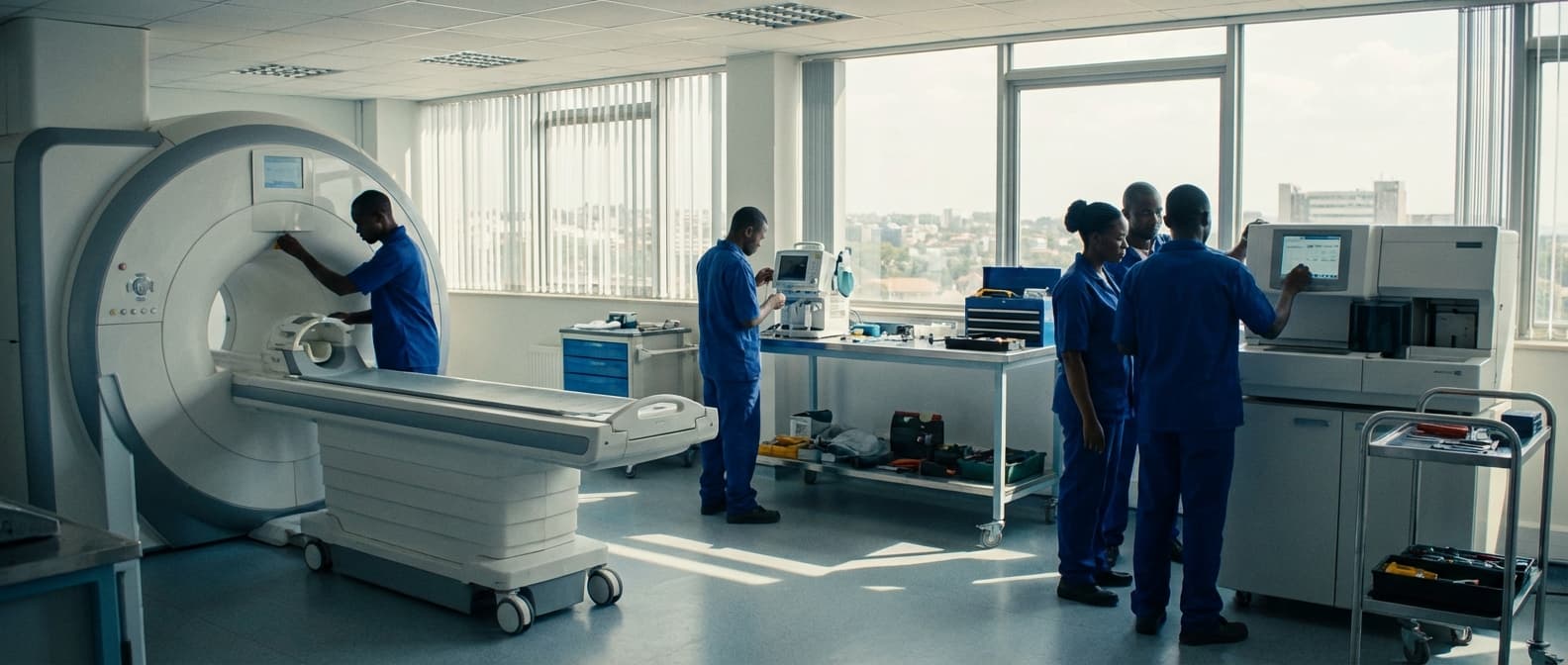
Comprehensive Maintenance Contract (CMC) Management Service (Parts & Labor) in Congo (Kinshasa)
Engineering Excellence & Technical Support
Comprehensive Maintenance Contract (CMC) Management Service (Parts & Labor) High-standard technical execution following OEM protocols and local regulatory frameworks.
Proactive Asset Health Monitoring & Predictive Maintenance
Leveraging advanced IoT sensors and data analytics, we offer real-time monitoring of critical equipment health in Kinshasa. This enables predictive maintenance, minimizing unplanned downtime and extending asset lifespan, thereby optimizing operational continuity for your business in Congo.
Guaranteed Parts Availability & Certified Labor
Our CMC ensures prompt access to genuine OEM parts and a readily available pool of certified, local technicians in Kinshasa. This eliminates costly delays and ensures that all maintenance activities are performed to the highest industry standards, safeguarding your equipment's performance.
Predictable Costing & Risk Mitigation
Gain financial certainty with our comprehensive CMC. We provide transparent, fixed pricing for both parts and labor, covering routine maintenance, emergency repairs, and unforeseen component failures. This predictable budget allows for effective financial planning and mitigates the financial risks associated with unexpected maintenance expenses in the Democratic Republic of Congo.
What Is Comprehensive Maintenance Contract (Cmc) Management Service (Parts & Labor) In Congo (Kinshasa)?
Comprehensive Maintenance Contract (CMC) Management Service (Parts & Labor) in Congo (Kinshasa) refers to a specialized service that oversees and executes all aspects of maintenance for equipment and assets under a contractual agreement. This service encompasses both the procurement and provision of necessary spare parts, as well as the deployment and management of skilled labor required for preventive, corrective, and sometimes predictive maintenance activities. The objective is to ensure optimal operational performance, minimize downtime, and extend the lifespan of assets through a proactive and structured approach to maintenance.
| Target Sector/Industry | Key Equipment/Assets | Rationale for CMC Management Service |
|---|---|---|
| Mining & Extractive Industries | Heavy machinery (excavators, haul trucks, drills), processing plants, conveyor systems, power generators, specialized crushing and grinding equipment. | High-value, critical assets operating in demanding environments. Downtime directly impacts production output and revenue. Requires specialized parts and skilled labor for complex machinery. |
| Manufacturing & Industrial Production | Production lines, CNC machines, industrial robots, packaging machinery, pumps, compressors, electrical switchgear, HVAC systems. | Ensuring continuous operation of production facilities is paramount. Unexpected breakdowns lead to significant financial losses due to lost production and potential spoilage. Requires timely access to specific components and technical expertise. |
| Energy & Utilities (Power Generation, Water Treatment) | Turbines, generators, transformers, pumps, control systems, boilers, water purification equipment, distribution networks. | Reliability is critical for public service provision. Failures can have widespread social and economic consequences. Requires constant monitoring, specialized maintenance, and a consistent supply of parts for legacy and modern equipment. |
| Telecommunications & IT Infrastructure | Base stations, data center equipment (servers, storage, networking), UPS systems, cooling units, power distribution units. | High uptime requirements for critical communication and data services. Service interruptions can lead to significant reputational damage and lost revenue. Requires rapid response and access to specialized electronic components. |
| Healthcare Facilities | Medical imaging equipment (MRI, CT scanners), laboratory analyzers, surgical equipment, hospital beds, building services (HVAC, electrical, plumbing). | Patient safety and continuity of care are paramount. Malfunctioning medical equipment can have life-threatening consequences. Requires strict adherence to medical device regulations and access to certified parts and trained biomedical engineers. |
| Transportation & Logistics | Fleet vehicles (trucks, buses), specialized material handling equipment (forklifts), port cranes, railway rolling stock. | Maintaining operational efficiency and safety in transportation networks. Minimizing downtime of vehicles and equipment directly impacts delivery schedules and operational costs. Requires readily available spare parts for diverse vehicle types. |
| Large Commercial & Institutional Buildings | Elevators, escalators, HVAC systems, security systems, emergency power generators, plumbing and electrical infrastructure. | Ensuring the comfort, safety, and functionality of large facilities for occupants. Proactive maintenance prevents disruptions to daily operations and tenant satisfaction. Requires a broad range of skilled technicians and access to general building system components. |
Key Components of CMC Management Service (Parts & Labor):
- Scope Definition & Planning: Establishing the precise scope of maintenance, service level agreements (SLAs), key performance indicators (KPIs), and maintenance schedules based on equipment type, criticality, and operational environment.
- Parts Procurement & Inventory Management: Sourcing, purchasing, stocking, and managing spare parts, ensuring availability of genuine and compatible components, optimizing inventory levels to balance cost and immediate need, and adhering to quality control standards.
- Labor Deployment & Management: Identifying, vetting, and deploying qualified technicians and engineers (in-house or third-party), managing their schedules, ensuring appropriate skill sets for specific equipment, and overseeing their performance.
- Preventive Maintenance (PM) Execution: Implementing scheduled maintenance tasks designed to prevent equipment failures, including inspections, lubrication, cleaning, adjustments, and calibration, thereby reducing the likelihood of unplanned downtime.
- Corrective Maintenance (CM) & Repair: Responding to equipment malfunctions and breakdowns, diagnosing issues, performing necessary repairs, and replacing faulty components as quickly and efficiently as possible to restore functionality.
- Predictive Maintenance (PdM) Integration (Optional but Recommended): Utilizing condition-monitoring techniques (e.g., vibration analysis, thermal imaging, oil analysis) to predict potential failures before they occur, allowing for proactive interventions and further optimization of maintenance schedules.
- Performance Monitoring & Reporting: Tracking maintenance activities, equipment performance, downtime incidents, parts consumption, and labor utilization. Generating regular reports for stakeholders to assess effectiveness, identify trends, and inform future maintenance strategies.
- Warranty Management & Claims: Managing warranty periods for new equipment and parts, processing claims for defective components, and ensuring compliance with manufacturer warranties.
- Risk Management & Safety Compliance: Implementing robust safety protocols for all maintenance activities, ensuring compliance with local regulations and industry best practices, and mitigating risks associated with equipment operation and maintenance.
- Cost Control & Budget Management: Monitoring and managing maintenance expenditures, optimizing parts and labor costs, and ensuring adherence to budgetary constraints.
- Asset Lifecycle Management Integration: Contributing to the broader asset lifecycle management strategy by providing data and insights on equipment reliability, maintainability, and total cost of ownership.
Who Needs Comprehensive Maintenance Contract (Cmc) Management Service (Parts & Labor) In Congo (Kinshasa)?
In Congo (Kinshasa), Comprehensive Maintenance Contract (CMC) Management Services for Parts & Labor are crucial for organizations relying on specialized equipment and machinery to ensure operational continuity, minimize downtime, and optimize asset lifespan. These services go beyond basic repairs by encompassing scheduled preventive maintenance, prompt corrective repairs, and the management of spare parts inventory, all under a defined contractual agreement. This proactive approach helps businesses avoid costly breakdowns, maintain peak performance of their assets, and achieve predictable operating expenses.
| Customer Type | Primary Needs from CMC | Relevant Departments |
|---|---|---|
| Mining Companies | Reliable operation of heavy machinery, proactive maintenance for excavators, haul trucks, and processing equipment; efficient spare parts management to avoid production halts. | Operations, Maintenance & Reliability, Engineering, Procurement, Asset Management |
| Hospitals | Uninterrupted functioning of critical medical equipment (MRI, CT scanners, ventilators); timely calibration and repairs; availability of specialized spare parts for life-saving devices. | Technical Services, Biomedical Engineering, Operations, Procurement, Quality Control |
| Telecommunications Providers | Continuous network uptime for base stations and transmission equipment; rapid response to faults; management of diverse electronic components and modules. | Network Operations, Engineering, IT Infrastructure, Procurement, Maintenance |
| Power Generation Facilities | Ensuring power plant equipment (turbines, generators, transformers) operates at optimal efficiency; scheduled maintenance to prevent outages; strategic inventory of critical spare parts. | Operations, Maintenance & Reliability, Engineering, Procurement, Safety |
| Food & Beverage Manufacturers | Consistent operation of processing and packaging lines; preventing contamination through well-maintained equipment; managing wear-and-tear parts. | Production, Maintenance, Quality Assurance, Engineering, Procurement |
Target Customers and Departments for CMC Management Service (Parts & Labor) in Congo (Kinshasa)
- {"items":["Large-scale industrial manufacturers (e.g., mining, oil & gas, food processing, textiles)","Major healthcare institutions (hospitals, clinics with advanced medical equipment)","Telecommunications providers with extensive network infrastructure","Energy and utilities companies (power generation, water treatment)","Transportation and logistics companies with specialized fleets and equipment","Large commercial complexes and facilities management companies","Government agencies and public institutions with critical infrastructure","Financial institutions with extensive IT infrastructure and security systems","Research and development facilities with sophisticated laboratory equipment"],"title":"Target Customers"}
- {"items":["Operations/Production","Engineering/Technical Services","Maintenance and Reliability","Procurement/Supply Chain","IT Infrastructure/Information Technology","Facilities Management","Asset Management","Finance/Budgeting","Quality Control/Assurance","Safety and Security"],"title":"Target Departments"}
Comprehensive Maintenance Contract (Cmc) Management Service (Parts & Labor) Process In Congo (Kinshasa)
This document outlines the comprehensive workflow for managing Comprehensive Maintenance Contracts (CMCs) for parts and labor within the Democratic Republic of Congo, specifically focusing on Kinshasa. The process is designed to ensure efficient and effective service delivery, from initial customer inquiry to the final execution and closure of maintenance tasks.
| Phase | Stage | Key Activities | Responsible Party | Output/Deliverable | Key Considerations (Kinshasa) |
|---|---|---|---|---|---|
| Initiation |
| Receive client inquiry, understand maintenance needs, assess equipment type and condition. | Sales/Business Development Team, Technical Team | Needs assessment report, preliminary scope definition. | Language barriers (Lingala, French), cultural nuances in communication, understanding local industrial landscape. |
| Initiation |
| Develop a tailored CMC proposal including scope of services, response times, pricing, and contract duration. Negotiate terms and conditions with the client. | Sales/Business Development Team, Legal Team | Formal CMC proposal, mutually agreed-upon contract draft. | Understanding local pricing structures, import duties on spare parts, currency fluctuations (USD is common). |
| Initiation |
| Formalize the agreement with a signed CMC contract, outlining all terms, service level agreements (SLAs), and payment schedules. | Client, Legal Team, Management | Signed CMC Contract. | Ensuring clarity on liability, dispute resolution mechanisms within the Congolese legal framework. |
| Execution - Pre-emptive |
| Conduct a thorough inventory of all covered equipment. Perform pre-contract inspections to document the current condition of assets. | Technical Team, Client Representative | Equipment inventory list, pre-contract inspection report. | Accessibility to remote sites, security of equipment during inspection, ensuring local technicians are familiar with specific equipment models. |
| Execution - Pre-emptive |
| Develop a preventive maintenance schedule. Allocate necessary technicians, tools, and spare parts based on the schedule and equipment criticality. | Operations Manager, Planning Team, Logistics | Preventive maintenance schedule, resource allocation plan. | Logistics challenges in a large city like Kinshasa (traffic, road conditions), availability of specialized tools, local talent pool for technicians. |
| Execution - Routine |
| Perform scheduled preventive maintenance tasks as per the agreed schedule. This includes cleaning, lubrication, calibration, and minor part replacements. | Field Technicians | Completed maintenance checklists, updated equipment logs. | Ensuring technicians have appropriate safety gear, adherence to international standards adapted for local context. |
| Execution - Reactive |
| Respond to client-reported breakdowns. Diagnose issues, perform repairs, and replace faulty parts. | Field Technicians, Technical Support | Breakdown report, repair logs, replaced parts documentation. | Rapid response time challenges due to infrastructure, communication reliability for reporting breakdowns, on-site troubleshooting expertise. |
| Execution - Support |
| Source and procure necessary spare parts, both for planned maintenance and breakdowns, from approved vendors or internal inventory. | Procurement Team, Logistics | Parts purchase orders, stock receipts, inventory records. | Long lead times for imported parts, customs clearance procedures in Congo, identifying reliable local suppliers, maintaining a critical spare parts inventory. |
| Execution - Support |
| Deploy qualified technicians to client sites. Manage technician availability, performance, and training. | Operations Manager, HR Department | Technician deployment records, performance evaluations, training logs. | Skill assessment of local technicians, ongoing training needs, managing worker expectations and retention. |
| Execution - On-site |
| Carry out all maintenance activities on-site, meticulously documenting all work performed, parts used, and time spent. | Field Technicians | Detailed work orders, service reports, parts consumption records. | Ensuring accurate and legible documentation, client verification of work performed, using digital tools if feasible and reliable. |
| Closure |
| Present service reports to the client for review and approval. Obtain client sign-off on completed maintenance tasks. | Field Technicians, Client Representative, Account Manager | Client-approved service reports, signed work orders. | Ensuring client understanding of reported work, addressing any immediate concerns, building trust through transparency. |
| Closure |
| Generate invoices based on the contract terms and services rendered. Submit invoices to the client for payment. | Finance/Billing Department | Accurate and timely invoices. | Adherence to Congolese tax regulations, payment terms and reconciliation, currency conversion for billing if applicable. |
| Closure |
| Periodically review contract performance, discuss client satisfaction, and initiate renewal discussions well in advance of contract expiry. | Account Manager, Management | Performance review report, renewal proposal. | Demonstrating value to encourage renewal, adapting services based on evolving client needs and market conditions. |
| Closure |
| Maintain comprehensive records of all CMC activities, including equipment history, maintenance logs, parts usage, and client interactions. | Administration, IT Department | Centralized database of CMC information, performance reports. | Data security and privacy considerations, accessibility of data for reporting and analysis, utilizing local cloud solutions if available and reliable. |
Comprehensive Maintenance Contract (CMC) Management Service Process (Parts & Labor) in Congo (Kinshasa)
- Initial Client Inquiry and Needs Assessment
- Proposal Generation and Negotiation
- Contract Finalization and Signing
- Equipment Inventory and Pre-Contract Inspection
- Service Schedule Planning and Resource Allocation
- Routine Preventive Maintenance Execution
- Corrective Maintenance (Breakdown) Management
- Parts Procurement and Inventory Management
- Labor Management and Technician Deployment
- On-site Service Execution and Documentation
- Quality Assurance and Client Sign-off
- Billing and Invoicing
- Contract Renewal and Performance Review
- Data Management and Reporting
Comprehensive Maintenance Contract (Cmc) Management Service (Parts & Labor) Cost In Congo (Kinshasa)
Managing Comprehensive Maintenance Contracts (CMCs) for both parts and labor in Congo (Kinshasa) involves a dynamic pricing structure influenced by several key factors. These contracts are crucial for ensuring the longevity, operational efficiency, and minimizing downtime of essential equipment and systems. The cost of such services is not fixed and can fluctuate significantly based on the specific nature of the equipment, the scope of services, the vendor's capabilities, and prevailing economic conditions within Kinshasa.
Key Pricing Factors:
- Type and Complexity of Equipment: High-tech, specialized, or industrial machinery (e.g., medical equipment, heavy machinery, complex IT infrastructure) will naturally incur higher maintenance costs due to the specialized knowledge, tools, and replacement parts required compared to simpler, more common equipment.
- Age and Condition of Equipment: Older or equipment in poorer condition typically requires more frequent and extensive maintenance, leading to higher costs. Proactive maintenance for newer equipment might be priced differently than reactive maintenance for older units.
- Scope of Coverage (Parts & Labor): A CMC that includes both genuine OEM (Original Equipment Manufacturer) parts and comprehensive labor coverage will be more expensive than one that limits part replacement or has restrictions on labor hours or types of repairs.
- Frequency and Urgency of Service: Contracts that guarantee rapid response times (e.g., 24/7 emergency support) or include scheduled preventive maintenance visits will have higher premiums than those with standard response times.
- Vendor Reputation and Expertise: Established vendors with a proven track record, certified technicians, and robust support infrastructure often command higher prices but may offer superior reliability and peace of mind.
- Location and Accessibility: The physical location of the equipment within Kinshasa and the ease of access for maintenance personnel can impact travel time and logistical costs, which are factored into the pricing.
- Contract Duration: Longer-term contracts may sometimes offer a slight discount per year compared to shorter, month-to-month agreements.
- Exclusions and Inclusions: The specific items covered (e.g., consumables, software updates, accidental damage) and those excluded (e.g., wear and tear beyond standard limits, damage due to misuse) will directly influence the final price.
- Market Demand and Competition: The level of competition among CMC providers in Kinshasa can also play a role in price negotiation. Higher demand for specific services might lead to increased pricing.
- Currency Fluctuations and Import Costs: Given the reliance on imported parts for many types of equipment, fluctuations in the exchange rate of the Congolese Franc (CDF) against major international currencies and the cost of international shipping and customs duties are significant determinants of parts cost.
Pricing Ranges in Congolese Francs (CDF):
It is challenging to provide exact figures due to the variability of the factors mentioned above. However, based on general industry understanding and market observations in Kinshasa, CMC costs can be estimated within broad ranges. These are indicative and should be considered preliminary.
- For common office equipment (e.g., printers, basic photocopiers, standard IT hardware): Annual CMC costs might range from 500,000 CDF to 2,000,000 CDF. This would typically cover scheduled checks, basic repairs, and replacement of common wear-and-tear parts.
- For mid-range commercial equipment (e.g., larger office machinery, basic industrial tools, standard servers): Annual CMC costs could range from 2,000,000 CDF to 10,000,000 CDF. This level often includes more comprehensive parts coverage and quicker response times.
- For specialized, high-value, or critical industrial/medical equipment (e.g., advanced medical scanners, heavy construction machinery, complex data centers): Annual CMC costs can be significantly higher, potentially ranging from 10,000,000 CDF to 50,000,000 CDF or even more. These contracts would include OEM parts, expert technicians, emergency response, and potentially performance guarantees.
Important Note: These figures are estimations and can be influenced by specific vendor quotes, negotiation, and the exact terms of the CMC. It is highly recommended to obtain detailed quotes from multiple reputable service providers in Kinshasa for accurate and competitive pricing.
| Equipment Category | Estimated Annual CMC Cost (CDF) | Typical Coverage |
|---|---|---|
| Common Office Equipment (Printers, basic IT) | 500,000 - 2,000,000 | Scheduled checks, basic repairs, common wear-and-tear parts |
| Mid-range Commercial Equipment (Larger office machines, servers) | 2,000,000 - 10,000,000 | Comprehensive parts, quicker response times |
| Specialized/High-Value Equipment (Medical, Industrial) | 10,000,000 - 50,000,000+ | OEM parts, expert technicians, emergency response, performance guarantees |
Factors Influencing CMC Pricing in Congo (Kinshasa)
- Type and Complexity of Equipment
- Age and Condition of Equipment
- Scope of Coverage (Parts & Labor)
- Frequency and Urgency of Service
- Vendor Reputation and Expertise
- Location and Accessibility
- Contract Duration
- Exclusions and Inclusions
- Market Demand and Competition
- Currency Fluctuations and Import Costs
Affordable Comprehensive Maintenance Contract (Cmc) Management Service (Parts & Labor) Options
Our Affordable Comprehensive Maintenance Contract (CMC) Management Service offers flexible options designed to provide complete coverage for your equipment, encompassing both parts and labor. We understand that controlling operational costs is crucial, which is why we've developed value bundles and implemented cost-saving strategies to ensure you receive the best possible protection at an economical price. Our service aims to minimize downtime, extend equipment lifespan, and provide predictable maintenance expenses, allowing you to focus on your core business operations.
| Value Bundle | Description | Included Services | Cost-Saving Strategies | Potential Benefits |
|---|---|---|---|---|
| Basic Care | Entry-level comprehensive coverage for essential equipment. | Scheduled preventative maintenance, labor for repairs, remote diagnostics. | Bulk purchasing of common parts, optimized technician scheduling. | Reduced unexpected repair costs, extended equipment life, minimal downtime. |
| Standard Plus | Enhanced protection with a focus on minimizing operational disruptions. | Basic Care inclusions + parts (limited), priority response times, basic training for staff. | Preventative maintenance to avoid costly breakdowns, optimized inventory management. | Higher equipment reliability, improved operational efficiency, predictable budgeting. |
| Premium Proactive | Our most comprehensive package, designed for critical assets requiring maximum uptime. | Standard Plus inclusions + all parts (unlimited), 24/7 emergency support, advanced diagnostics, performance optimization, software updates. | Minimized downtime through rapid response and immediate part availability, proactive issue identification. | Maximum equipment availability, reduced risk of catastrophic failure, significant ROI through prolonged asset life. |
Key Features of Our CMC Management Service
- Proactive and Reactive Maintenance Coverage
- Inclusion of Genuine or High-Quality Aftermarket Parts
- Skilled and Certified Technicians
- 24/7 Emergency Support (Optional Add-on)
- Scheduled Preventative Maintenance
- Remote Monitoring and Diagnostics (where applicable)
- Regular Performance Reporting
- On-site and Off-site Repair Capabilities
Verified Providers In Congo (Kinshasa)
Finding reliable and credentialed healthcare providers in Kinshasa, Congo, is paramount for ensuring quality care. Franance Health stands out as a premier organization in this regard, meticulously vetting and certifying its network of medical professionals. Their rigorous credentialing process is designed to guarantee that patients receive care from highly qualified and ethical practitioners. This commitment to verification offers peace of mind and signifies a higher standard of medical service.
| Credentialing Aspect | Franance Health Approach | Patient Benefit |
|---|---|---|
| Medical Licensure | Verified against official records from relevant regulatory bodies in Congo and internationally. | Ensures providers are legally authorized to practice medicine. |
| Educational Background | Validation of degrees and certifications from accredited institutions. | Confirms foundational medical knowledge and training. |
| Professional Experience | Thorough review of past work history, including any disciplinary actions. | Guarantees practical application of skills and ethical conduct. |
| Specialty Certifications | Confirmation of board certifications in specific medical fields. | Identifies true experts for complex medical conditions. |
| Ethical Conduct and Reputation | Background checks and reference verification for a clean professional record. | Promotes trustworthy and patient-centered care. |
Why Franance Health Credentials Represent the Best Choice:
- Rigorous Verification Process: Franance Health employs a multi-stage verification system that includes scrutinizing medical licenses, educational qualifications, professional experience, and ethical standing of all their affiliated providers.
- Commitment to Patient Safety: The credentialing ensures that providers adhere to the highest standards of patient care, safety protocols, and medical ethics, minimizing risks and maximizing positive outcomes.
- Access to Specialized Expertise: Their network encompasses a wide range of medical specialties, ensuring patients can find accredited specialists for their specific health needs.
- Ongoing Performance Monitoring: Franance Health doesn't just verify once; they conduct ongoing assessments of provider performance, ensuring continued adherence to quality standards.
- Transparency and Trust: The transparent credentialing process builds trust between patients and healthcare providers, fostering a more effective and supportive healthcare journey.
- International Standards Alignment: Franance Health often aligns its credentialing with recognized international healthcare standards, bringing global best practices to Kinshasa.
Scope Of Work For Comprehensive Maintenance Contract (Cmc) Management Service (Parts & Labor)
This Scope of Work (SOW) outlines the services to be provided under a Comprehensive Maintenance Contract (CMC) Management Service, encompassing both parts and labor for a defined set of equipment. The objective is to ensure the optimal performance, reliability, and longevity of the managed assets through proactive and reactive maintenance strategies. This SOW details the technical deliverables and standard specifications to be adhered to by the service provider.
| Component/Deliverable | Description | Standard Specification/Requirement | Key Performance Indicator (KPI) | Frequency/Timing |
|---|---|---|---|---|
| Preventive Maintenance (PM) | Scheduled maintenance activities to prevent failures and ensure optimal equipment performance. | Adherence to manufacturer-recommended PM schedules and best practices. Use of OEM-approved parts and lubricants. Detailed checklists for each PM task. | PM Completion Rate (%), Mean Time Between Failures (MTBF) improvement (%), Reduction in unexpected breakdowns (%) | As per manufacturer's recommendations and asset criticality (e.g., quarterly, semi-annually, annually) |
| Corrective Maintenance (CM) / Breakdown Maintenance | Unscheduled maintenance to diagnose and repair equipment failures. | Rapid response times for breakdowns. Diagnosis by qualified technicians. Use of genuine or equivalent quality spare parts. Root cause analysis (RCA) for recurring failures. | Mean Time To Repair (MTTR) (hours), First-Time Fix Rate (%), Number of repeat breakdowns (%) | On-demand, within agreed SLA response times (e.g., 2 hours for critical, 4 hours for non-critical) |
| Spare Parts Management | Procurement, inventory management, and quality assurance of spare parts. | Maintenance of an optimal spare parts inventory based on usage patterns and criticality. Sourcing from approved vendors. Quality inspection of all incoming parts. Minimizing lead times for critical parts. | Spare Parts Inventory Accuracy (%), Stock-out Rate for Critical Parts (%), Cost Savings on Parts Procurement (%) | Continuous, with periodic inventory audits and reporting |
| Labor and Technician Deployment | Provision of skilled and qualified technicians for all maintenance activities. | Deployment of certified and experienced technicians with specific expertise for the managed assets. Adequate staffing levels to meet service demands. Regular training and skill development for technicians. | Technician Utilization Rate (%), Technician Skill Competency Score (%), Technician Availability (%) | As required, based on maintenance schedules and breakdown occurrences |
| Reporting and Documentation | Comprehensive documentation of all maintenance activities, findings, and recommendations. | Detailed service reports for each PM and CM activity, including work performed, parts used, time taken, and recommendations. Maintenance logs for each asset. Final asset condition reports upon contract expiry. | Report Accuracy and Timeliness (%), Completeness of Documentation (%) | Post-service, within 24-48 hours of completion |
| Performance Monitoring and Analysis | Ongoing monitoring of equipment performance and maintenance effectiveness. | Regular analysis of maintenance data to identify trends, recurring issues, and areas for improvement. Benchmarking against industry standards. Proactive recommendations for asset upgrades or replacements. | Trend analysis of key equipment parameters, Predictive maintenance effectiveness (%), Cost of ownership reduction (%) | Monthly, quarterly, and annually |
| Asset Lifecycle Management Support | Providing insights and support for the entire lifecycle of the managed assets. | Recommendations on end-of-life management, potential upgrades, and new technology adoption. Assistance with asset decommissioning and disposal planning. | Cost of Ownership reduction over asset life, Successful asset upgrade/replacement planning (%) | As and when required, or as part of strategic reviews |
| Compliance and Safety Adherence | Ensuring all maintenance activities are performed in compliance with relevant regulations and safety standards. | Strict adherence to OSHA, environmental regulations, and site-specific safety protocols. Regular safety training for technicians. Maintenance of safety equipment and records. | Zero Lost Time Incidents (LTIs), Compliance Audit Pass Rate (%), Number of safety violations (%) | Continuous, with periodic audits |
Key Service Components
- Preventive Maintenance (PM)
- Corrective Maintenance (CM) / Breakdown Maintenance
- Spare Parts Management
- Labor and Technician Deployment
- Reporting and Documentation
- Performance Monitoring and Analysis
- Asset Lifecycle Management Support
- Compliance and Safety Adherence
Service Level Agreement For Comprehensive Maintenance Contract (Cmc) Management Service (Parts & Labor)
This Service Level Agreement (SLA) outlines the performance standards and guarantees for the Comprehensive Maintenance Contract (CMC) Management Service, specifically covering Parts & Labor. This agreement defines the expected response times for reported issues and the guaranteed uptime for the managed systems. The scope of this SLA applies to all equipment and systems covered under the executed CMC contract, managed by [Your Company Name] on behalf of [Client Name].
| System Criticality | Issue Severity | Response Time (During Business Hours) | Response Time (Outside Business Hours) | Target Resolution Time (During Business Hours) | Target Resolution Time (Outside Business Hours) | Guaranteed Uptime (Monthly) |
|---|---|---|---|---|---|---|
| Critical | High (System Unusable) | 1 Hour | 2 Hours | 4 Hours | 8 Hours | 99.9% |
| Critical | Medium (Significant Degradation) | 2 Hours | 4 Hours | 8 Business Hours | 16 Business Hours | 99.9% |
| Critical | Low (Minor Issue) | 4 Business Hours | 8 Business Hours | 24 Business Hours | 48 Business Hours | 99.9% |
| Non-Critical | High (System Unusable) | 4 Business Hours | 8 Business Hours | 16 Business Hours | 24 Business Hours | 99.5% |
| Non-Critical | Medium (Significant Degradation) | 8 Business Hours | 16 Business Hours | 48 Business Hours | 72 Business Hours | 99.5% |
| Non-Critical | Low (Minor Issue) | Next Business Day | Next Business Day | 3 Business Days | 5 Business Days | 99.5% |
Key Definitions
- Downtime: Any period during which a critical system is unavailable to the end-user, preventing it from performing its intended function. Non-critical systems downtime will be managed based on severity.
- Response Time: The maximum allowed time from when an issue is reported and acknowledged by the service provider to the initiation of troubleshooting and diagnosis.
- Resolution Time: The maximum allowed time from the initiation of troubleshooting to the successful restoration of the system's functionality.
- Uptime Guarantee: The minimum percentage of time a system is expected to be operational and available for use over a defined period.
- Critical System: A system deemed essential for the client's primary business operations. Critical systems are identified in Appendix A of the CMC contract.
- Non-Critical System: A system that supports business operations but whose temporary unavailability does not significantly impact core business functions.
- Business Hours: Defined as Monday to Friday, 9:00 AM to 5:00 PM [Client's Time Zone], excluding public holidays.
- After-Hours Support: Support provided outside of Business Hours, which may incur additional charges as per the CMC contract.
Frequently Asked Questions

Ready when you are
Let's scope your Comprehensive Maintenance Contract (CMC) Management Service (Parts & Labor) in Congo (Kinshasa) project in Congo (Kinshasa).

Scaling healthcare logistics and technical systems across the entire continent.