
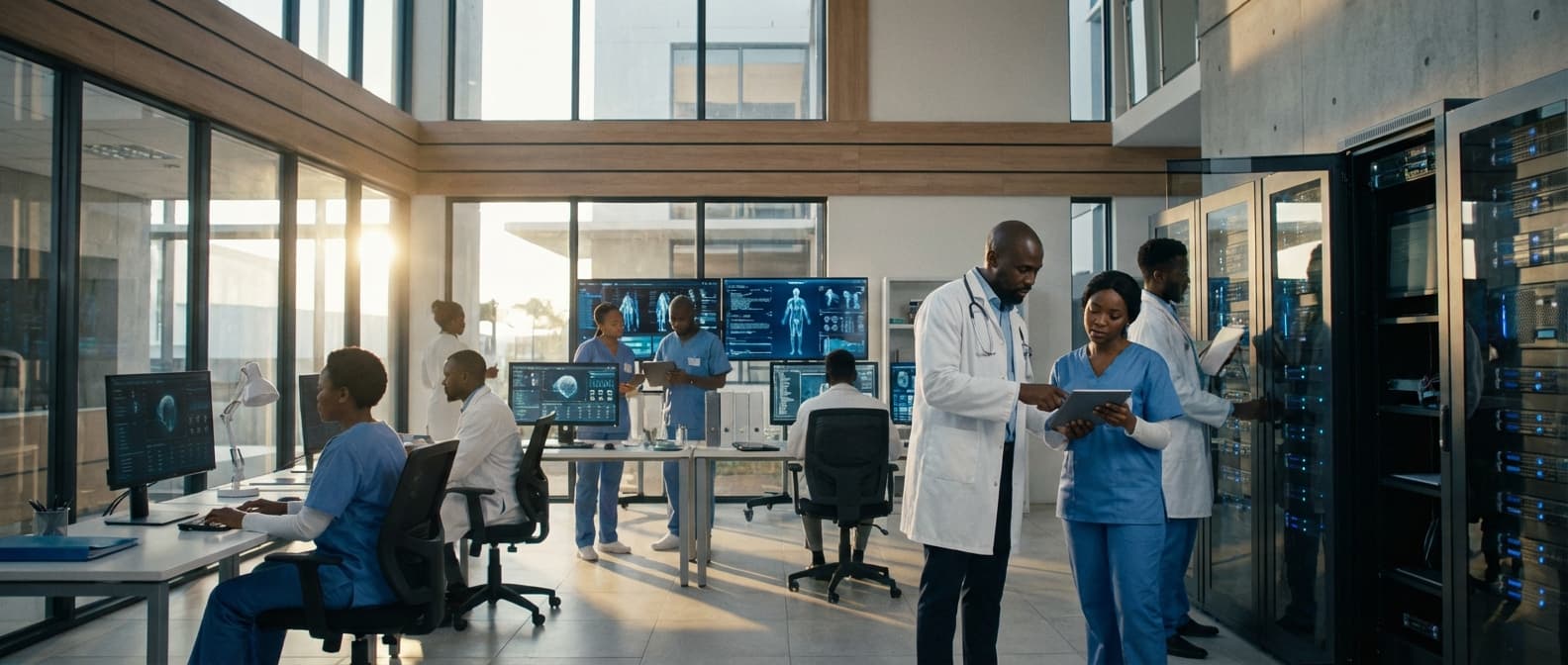
Tele-Radiology in Congo (Kinshasa)
Engineering Excellence & Technical Support
24/7 access to certified radiologists providing rapid, accurate remote interpretation of diagnostic imaging studies. High-standard technical execution following OEM protocols and local regulatory frameworks.
Bridging Geographic Gaps with Secure Tele-Radiology Networks
Implementing robust and secure VPN-based networks to transmit high-resolution DICOM images from remote clinics and hospitals across Congo (Kinshasa) to specialized radiologists in urban centers, ensuring timely and accurate diagnoses for underserved populations.
Leveraging AI for Enhanced Diagnostic Accuracy and Efficiency
Integrating Artificial Intelligence (AI) algorithms for preliminary image analysis, flagging potential abnormalities, and assisting radiologists in prioritizing critical cases. This boosts diagnostic speed and accuracy, especially in areas with limited radiologist availability.
Scalable Cloud-Based PACS for Seamless Image Archiving and Access
Deploying a secure, HIPAA-compliant cloud-based Picture Archiving and Communication System (PACS) for reliable, long-term storage of medical images. This ensures instant, anywhere access for authorized personnel, facilitating collaborative consultations and research, and mitigating the risks of on-site data loss.
What Is Tele-radiology In Congo (Kinshasa)?
Tele-radiology in Congo (Kinshasa) refers to the remote interpretation of medical imaging studies, such as X-rays, CT scans, and MRIs, by qualified radiologists located geographically apart from the patient and the originating facility. This service leverages telecommunications technology to transmit digital images from a healthcare provider in Congo (Kinshasa) to a radiologist for analysis and reporting. It bridges the gap in access to specialized radiological expertise, particularly in areas with limited availability of on-site radiologists. The process typically involves image acquisition at a local clinic or hospital, digitization and secure transmission of these images to a central teleradiology hub or individual radiologists, their interpretation and report generation, and finally, the electronic delivery of the findings back to the referring physician.
| Who Needs Tele-radiology? | Typical Use Cases in Congo (Kinshasa) | ||||||
|---|---|---|---|---|---|---|---|
| Hospitals and Clinics in Remote or Underserved Areas: Facilities lacking on-site radiologists due to geographical isolation, cost, or scarcity of trained personnel. | Emergency Department Consultations: Rapid interpretation of critical imaging studies (e.g., head CT for stroke, chest X-ray for trauma) when on-site coverage is unavailable. | Primary Healthcare Centers: Enabling access to diagnostic imaging interpretation for routine patient care, improving diagnostic accuracy for common conditions. | Specialty Clinics: Providing expert interpretation for specific modalities (e.g., advanced neuroimaging, musculoskeletal imaging) for facilities that cannot afford full-time specialists. | Disaster Relief and Humanitarian Efforts: Facilitating rapid diagnostic imaging support in crisis situations or during mobile health outreach programs. | Outpatient Imaging Centers: Supplementing existing services or providing extended hours for image interpretation. | Referral Networks: Connecting smaller clinics to larger hospitals with teleradiology capabilities for advanced diagnostics. | On-call Radiologist Support: Ensuring 24/7 availability of radiological interpretation, especially for time-sensitive cases. |
Key Components of Tele-radiology in Congo (Kinshasa):
- Image Acquisition: Digital imaging equipment (e.g., DR, CT scanners, MRI machines) at the local healthcare facility.
- Image Transmission: Secure and robust digital infrastructure for transmitting DICOM-formatted images (e.g., high-speed internet, satellite links).
- Image Archiving and Management: Picture Archiving and Communication Systems (PACS) for storing and retrieving images.
- Remote Interpretation Platform: Software allowing radiologists to view, manipulate, and annotate images.
- Reporting System: Tools for generating and delivering standardized radiology reports.
- Communication Channels: Secure methods for communication between referring physicians and radiologists.
Who Needs Tele-radiology In Congo (Kinshasa)?
Tele-radiology, the remote interpretation of medical images, offers a transformative solution for healthcare in regions facing radiologist shortages and infrastructure challenges. In Congo (Kinshasa), a country grappling with a high disease burden and limited access to specialized medical expertise, tele-radiology is not a luxury, but a critical necessity. This service can bridge geographical divides, bringing expert diagnostic capabilities to underserved populations and empowering local healthcare providers with timely and accurate interpretations. The demand for such a service is driven by the need to improve diagnostic accuracy, expedite patient care, reduce unnecessary travel for imaging services, and ultimately, enhance health outcomes for millions.
| Department | Specific Needs Addressed by Tele-Radiology | Key Imaging Modalities |
|---|---|---|
| Radiology Department | Addressing radiologist shortages, providing 24/7 coverage for urgent cases, improving turnaround times for interpretations, supporting continuous professional development for local technicians. | X-ray, CT Scan, MRI, Ultrasound |
| Emergency Department | Enabling rapid diagnosis of trauma, stroke, and other acute conditions, facilitating timely treatment decisions, reducing mortality and morbidity. | X-ray, CT Scan, Ultrasound |
| Internal Medicine | Assisting in the diagnosis and management of a wide range of conditions including pneumonia, tuberculosis, abdominal pathologies, and neurological disorders. | X-ray, CT Scan, Ultrasound |
| Pediatrics | Facilitating diagnosis of congenital anomalies, pediatric infections, and injuries in children, particularly in areas with limited pediatric radiologists. | X-ray, Ultrasound |
| Oncology Department | Monitoring treatment response, staging cancers, and guiding surgical or radiation therapy interventions. | CT Scan, MRI |
| Surgical Departments | Pre-operative planning, post-operative assessment, and diagnosis of surgical complications. | X-ray, CT Scan, Ultrasound |
| Maternal and Child Health | Prenatal ultrasounds for high-risk pregnancies, post-natal assessments, and diagnosis of gynecological conditions. | Ultrasound |
| Infectious Disease Units | Diagnosing and monitoring pulmonary infections (e.g., TB, pneumonia), tropical diseases, and other infectious conditions. | X-ray, CT Scan |
Target Customers and Departments for Tele-Radiology in Congo (Kinshasa)
- Hospitals (Public and Private)
- District/Regional Hospitals
- Rural Health Centers
- Specialized Clinics (e.g., Oncology, Cardiology)
- Non-Governmental Organizations (NGOs) providing healthcare
- Mobile Medical Units
- Emergency Medical Services
Tele-radiology Process In Congo (Kinshasa)
Tele-radiology, the practice of interpreting medical images remotely, plays a crucial role in improving access to diagnostic services in regions with limited specialist radiologists. In Congo (Kinshasa), this process often bridges the gap between healthcare facilities lacking on-site radiologists and specialized centers equipped for image interpretation. The workflow typically begins with an inquiry from a referring physician at a remote clinic or hospital. This inquiry triggers the process, leading to image acquisition, secure transmission, expert interpretation, and finally, the delivery of a radiology report back to the referring physician. This enables timely and accurate diagnoses, ultimately benefiting patient care.
| Step | Description | Key Stakeholders | Technology/Tools |
|---|---|---|---|
| Inquiry from Referring Physician | A physician at a remote clinic/hospital identifies the need for a radiological interpretation for a patient. | Referring Physician, Clinic Staff | Phone, Email, Secure Messaging App |
| Patient Information Gathering | Essential clinical details (patient history, symptoms, reason for exam) are collected and documented. | Referring Physician, Clinic Staff | Electronic Health Record (EHR) or paper-based forms |
| Image Acquisition | Radiographic images (X-ray, CT, MRI, Ultrasound) are captured at the referring facility. | Radiology Technologist (if available), Clinic Staff | Imaging Modalities (X-ray machine, CT scanner, MRI scanner, Ultrasound machine) |
| Image Processing and DICOM Conversion | Images are processed to optimize diagnostic quality and converted into the DICOM (Digital Imaging and Communications in Medicine) format. | Radiology Technologist (if available), Clinic Staff | Imaging machine software, DICOM converter software |
| Secure Image Transmission | DICOM images and associated patient data are securely transmitted to a central teleradiology hub or PACS. | Clinic IT Staff, Teleradiology Service Provider | Secure internet connection (VPN, encrypted channels), PACS/VNA, Cloud storage |
| Teleradiology Platform/PACS Access | The teleradiology platform or Picture Archiving and Communication System (PACS) receives and stores the images. | Teleradiology Service Provider, IT Department | PACS/VNA, Cloud-based teleradiology platform |
| Radiologist Assignment and Review | A qualified radiologist is assigned the case based on specialty and availability. The radiologist reviews the images and clinical information. | Teleradiology Service Provider (Admin), Radiologist | Teleradiology platform, Workstation with high-resolution monitors |
| Image Interpretation and Report Generation | The radiologist provides a professional interpretation of the images and dictates or writes a comprehensive radiology report. | Radiologist | Voice recognition software, dictation software, teleradiology platform reporting module |
| Report Quality Assurance | Reports may undergo a quality check by a senior radiologist or a peer review process. | Senior Radiologist (optional), Teleradiology Service Provider | Teleradiology platform |
| Report Delivery and Communication | The final radiology report is securely transmitted back to the referring physician, often through the teleradiology platform or a secure portal. | Teleradiology Service Provider, Referring Physician | Teleradiology platform, Secure email, EHR integration |
| Billing and Record Keeping | Invoices are generated for the interpretation service, and all records are maintained for future reference. | Teleradiology Service Provider (Billing), Referring Facility (Finance) | Billing software, Electronic Health Record (EHR), PACS |
Tele-Radiology Workflow in Congo (Kinshasa)
- Inquiry from Referring Physician
- Patient Information Gathering
- Image Acquisition
- Image Processing and DICOM Conversion
- Secure Image Transmission
- Teleradiology Platform/PACS Access
- Radiologist Assignment and Review
- Image Interpretation and Report Generation
- Report Quality Assurance
- Report Delivery and Communication
- Billing and Record Keeping
Tele-radiology Cost In Congo (Kinshasa)
Tele-radiology services in Congo (Kinshasa) are still developing, and a standardized pricing structure is not yet widely established. However, several factors influence the cost of these services, leading to a range of potential expenses. The primary drivers of cost include the complexity of the imaging study, the expertise of the remote radiologist, the turnaround time required for the report, and the administrative overhead of the tele-radiology provider. Emerging local providers may offer lower rates as they establish their market presence, while more established international platforms, if accessible and utilized, could command higher prices due to their advanced technology and broader pool of specialists. The economic realities of the region, including the purchasing power of healthcare facilities and patients, also play a significant role in shaping pricing. While precise figures are scarce due to the nascent nature of the market, it's reasonable to expect costs to be quoted in the local currency, the Congolese Franc (CDF).
| Service Type (Example) | Estimated Price Range (CDF) | Notes |
|---|---|---|
| X-ray Interpretation (Standard) | 30,000 - 80,000 | Basic skeletal or chest X-ray interpretation by a general radiologist. Prices can vary significantly based on provider and urgency. |
| CT Scan Interpretation (Routine) | 100,000 - 250,000 | Interpretation of a standard CT scan (e.g., head, abdomen). More complex protocols or contrast-enhanced scans will likely be higher. |
| MRI Interpretation (Routine) | 150,000 - 350,000 | Interpretation of a standard MRI. Similar to CT, complexity and contrast will impact the price. |
| Ultrasound Interpretation | 40,000 - 120,000 | Interpretation of various ultrasound studies (e.g., abdominal, obstetric). Specialized ultrasounds may be more expensive. |
| Urgent Report Fee (Add-on) | 20,000 - 50,000 | An additional fee for expedited reporting, typically within a few hours. |
| Subscription/Platform Fee (Monthly) | Variable (Contact Provider) | Some providers may have a base fee for access to their platform, in addition to per-study charges. |
Factors Influencing Tele-Radiology Costs in Congo (Kinshasa)
- Complexity of the imaging study (e.g., X-ray, CT scan, MRI, ultrasound)
- Radiologist's specialization and experience level
- Required turnaround time for reporting (urgent vs. routine)
- Administrative and technical support provided
- Technology and platform used by the tele-radiology provider
- Geographic location and accessibility of the referring facility
- Contractual agreements and volume of services utilized
- Currency exchange rates and economic stability
Affordable Tele-radiology Options
Tele-radiology, the practice of interpreting medical images remotely, has become an increasingly vital component of modern healthcare. It offers significant advantages in terms of accessibility, efficiency, and specialist availability, particularly for underserved areas. However, cost can be a barrier for some institutions. Fortunately, several affordable tele-radiology options exist, often leveraging value bundles and strategic cost-saving measures to make these services accessible. Value bundles in tele-radiology typically combine a range of services beyond just image interpretation, such as preliminary reads, final reads by subspecialists, quality assurance, IT integration support, and sometimes even report generation tools. These bundles offer a predictable cost structure and can be more economical than procuring individual services. Cost-saving strategies often involve flexible service models, such as on-demand reads for overflow cases, dedicated radiologist coverage for specific shifts or specialties, and tiered pricing based on volume. Negotiating long-term contracts, exploring partnerships with academic institutions, and leveraging cloud-based platforms can also significantly reduce overall expenses. Implementing efficient workflows and optimizing IT infrastructure are crucial for maximizing the return on investment in tele-radiology services.
| Cost-Saving Strategy | Description | Potential Benefit |
|---|---|---|
| Volume-Based Discounts | Negotiating lower per-study costs based on the anticipated volume of interpretations. | Reduced cost per interpretation for higher usage. |
| Flexible Service Models | Utilizing on-demand services for acute overflow or specific time periods, rather than full-time dedicated coverage. | Cost-effectiveness for variable workloads. |
| Tiered Subspecialty Access | Accessing subspecialty reads only when clinically necessary, rather than having all subspecialties on constant retainer. | Optimized spending on specialized expertise. |
| Cloud-Based Solutions | Leveraging scalable, secure cloud platforms for image transfer and storage, reducing on-premise IT infrastructure costs. | Lower capital expenditure and IT maintenance costs. |
| Long-Term Contracts | Securing favorable pricing and service level agreements through multi-year commitments. | Price stability and predictable budgeting. |
| Partnerships and Consortia | Collaborating with other healthcare facilities to increase volume and negotiate better rates as a collective. | Increased bargaining power and shared costs. |
| Workflow Optimization | Working with the tele-radiology provider to streamline image routing and reporting processes. | Improved efficiency, leading to faster turnaround times and potentially lower per-study costs. |
Key Components of Tele-Radiology Value Bundles
- Preliminary interpretation by general radiologists.
- Final interpretation and subspecialty reads by expert radiologists.
- Quality assurance and peer review processes.
- Integration with existing Picture Archiving and Communication Systems (PACS) and Electronic Health Records (EHRs).
- Report generation and delivery services.
- IT support and maintenance.
- 24/7 coverage options.
- Turnaround time guarantees for various study types.
Verified Providers In Congo (Kinshasa)
Finding verified healthcare providers in Congo (Kinshasa) is crucial for ensuring quality care and patient safety. Franance Health stands out as a leading platform dedicated to connecting individuals with accredited and reliable medical professionals. Their rigorous credential verification process and commitment to excellence make them the best choice for accessing healthcare services in the region. Franance Health meticulously vets each provider, confirming their qualifications, licenses, and professional standing. This detailed screening process significantly reduces the risk of encountering unqualified or fraudulent practitioners, offering peace of mind to patients seeking medical attention.
| Credential Type | Verification Method | Importance for Patients |
|---|---|---|
| Medical Licenses | Cross-referencing with national and regional medical boards, official government databases. | Confirms legal authorization to practice medicine, ensuring adherence to professional regulations. |
| Academic Degrees and Diplomas | Verification of institutions attended, confirmation of graduation and specialized degrees through official transcripts or certificates. | Ensures foundational medical knowledge and specialized training in their respective fields. |
| Specialty Certifications | Confirmation of board certifications from recognized medical societies and professional bodies. | Indicates advanced expertise and recognized proficiency in a specific area of medicine. |
| Professional Affiliations | Checking membership with reputable medical associations and organizations. | Suggests engagement with the broader medical community and commitment to professional standards. |
| Continuing Medical Education (CME) | Review of participation in accredited CME programs and workshops. | Demonstrates commitment to staying updated with the latest medical advancements and best practices. |
| Work Experience and References | Where applicable and feasible, reviewing past employment and obtaining professional references. | Provides insight into practical application of skills and professional conduct. |
Benefits of Choosing Franance Health Verified Providers
- Rigorous Credential Verification: Franance Health employs a multi-step process to confirm the legitimacy of all listed healthcare professionals, including academic achievements, specialized training, and ongoing professional development.
- Patient Safety First: By ensuring all providers meet established standards, Franance Health prioritizes the well-being and safety of its users.
- Access to Quality Care: Verified providers are more likely to offer high-quality medical services, leading to better health outcomes.
- Transparency and Trust: The platform fosters transparency by providing clear information about provider qualifications, building trust between patients and healthcare professionals.
- Comprehensive Provider Network: Franance Health aims to build an extensive network of verified specialists across various medical disciplines.
- User Reviews and Feedback: While not solely relying on this, user feedback complements the verification process, offering additional insights into patient experiences.
- Streamlined Appointment Booking: Often, verified providers through platforms like Franance Health offer easier and more efficient ways to schedule appointments.
Scope Of Work For Tele-radiology
This Scope of Work (SOW) outlines the requirements for the provision of Tele-Radiology services, encompassing technical deliverables and standard specifications. The objective is to establish a reliable, efficient, and high-quality tele-radiology service that seamlessly integrates with the existing PACS (Picture Archiving and Communication System) and RIS (Radiology Information System) infrastructure.
| Specification Area | Standard/Requirement | Details/Notes |
|---|---|---|
| Image Transmission Protocol | DICOM 3.0 | Must support DICOM Send/Query/Retrieve for lossless image transfer and retrieval. |
| Network Connectivity | High-speed, secure VPN | Minimum bandwidth of X Mbps per site, with dedicated VPN tunnels for data security and stability. |
| Image Viewer Performance | Low latency, responsive interface | Image loading time < 3 seconds for typical studies. Smooth scrolling and panning. |
| Reporting System | Integrated or interoperable with RIS | HL7 integration for seamless report import into RIS. Voice recognition capabilities may be required. |
| Data Storage and Archiving | Secure, compliant storage | Adherence to data retention policies. Redundant storage solutions for disaster recovery. |
| Security Standards | HIPAA/GDPR compliant, encryption at rest and in transit | Use of industry-standard encryption algorithms (e.g., AES-256). Multi-factor authentication for access. |
| Radiologist Workstation | High-resolution monitors, ergonomic setup | Minimum dual 5MP diagnostic quality displays. PACS client software with advanced tools. |
| Service Level Agreement (SLA) | Defined turnaround times (TATs) for reports | TATs to be specified for different study types (e.g., STAT, routine, complex). |
| System Uptime | 99.5% | Downtime notification and resolution procedures to be clearly defined. |
| Auditing and Logging | Comprehensive audit trails | All user actions, image access, and report generation must be logged for security and compliance. |
Technical Deliverables
- Secure and reliable image transmission platform (DICOM compliant)
- Real-time or near real-time image viewing capabilities for radiologists
- Advanced visualization tools (e.g., MPR, 3D rendering, image manipulation)
- Secure communication channel for radiologist reporting and consultation
- Integration with existing RIS/PACS for seamless workflow (order entry, report delivery, patient demographics)
- Radiologist workstation hardware and software
- Data backup and disaster recovery plan
- Performance monitoring and reporting tools
- User training and ongoing support for site staff and radiologists
- Compliance with relevant healthcare regulations (e.g., HIPAA, GDPR)
- Audit trails for all image access and report generation
- Robust security measures including encryption, access controls, and authentication
Service Level Agreement For Tele-radiology
This Service Level Agreement (SLA) outlines the guaranteed response times and uptime for tele-radiology services provided by [Provider Name] to [Client Name]. This agreement is effective as of [Start Date].
| Criticality Level | Definition | Response Time Guarantee (Report Issuance) | Uptime Guarantee |
|---|---|---|---|
| STAT / Urgent | Life-threatening or limb-threatening conditions requiring immediate medical intervention. | 15 minutes | 99.9% |
| Expedited | Conditions requiring prompt attention but not immediately life-threatening. | 1 hour | 99.9% |
| Routine | Non-urgent studies that can be reported within a standard workday. | 4 hours | 99.9% |
| Subspecialty (non-urgent) | Routine studies requiring subspecialty interpretation. | 8 business hours | 99.9% |
Key Service Commitments
- Response Time: Refers to the time from when a study is made available to the radiologist until the preliminary report is issued.
- Uptime Guarantee: Refers to the percentage of time the tele-radiology platform and its associated services are accessible and functional.
- Criticality Levels: Studies are categorized based on their urgency and potential impact on patient care, influencing the response time targets.
Frequently Asked Questions

Ready when you are
Let's scope your Tele-Radiology in Congo (Kinshasa) project in Congo (Kinshasa).

Scaling healthcare logistics and technical systems across the entire continent.