
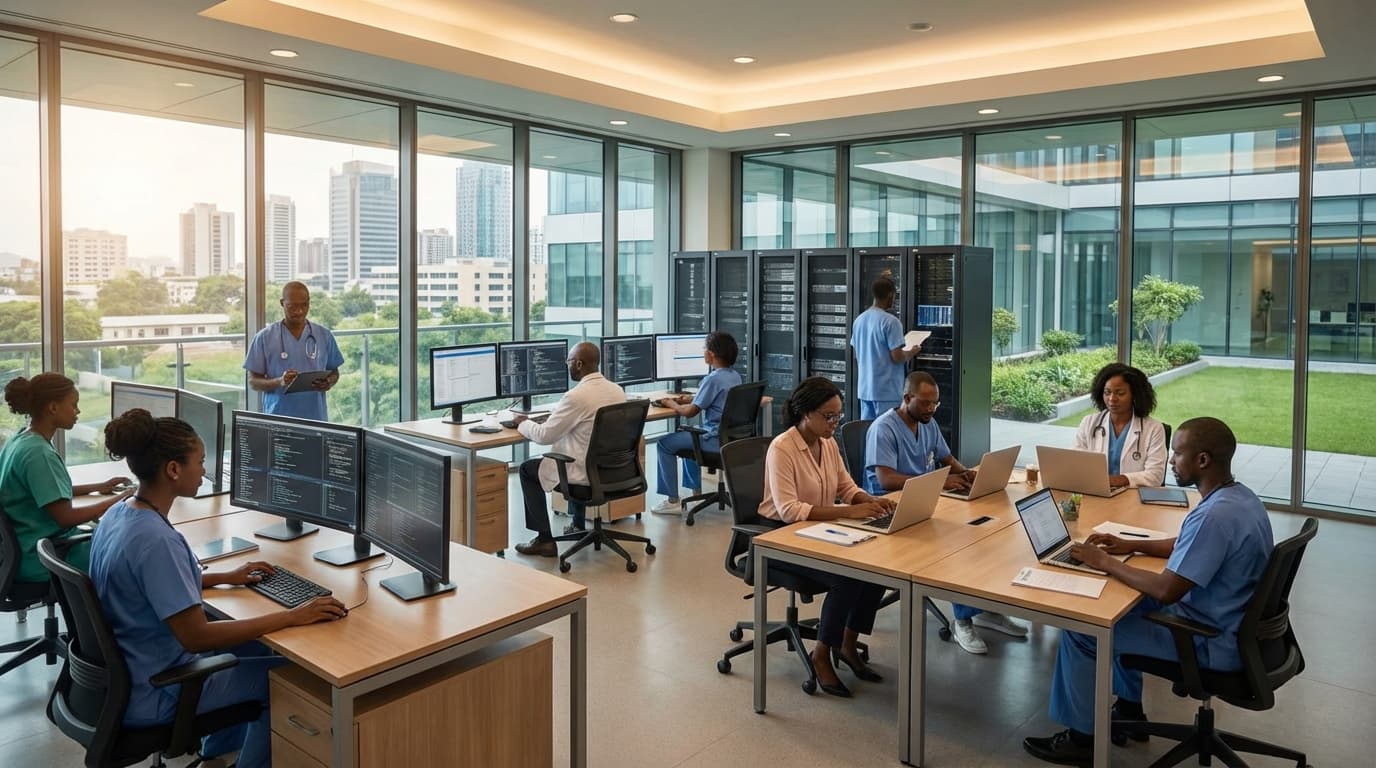
Radiology Reader & Reporting Support in Congo (Kinshasa)
Engineering Excellence & Technical Support
Remote radiology reading and reporting services High-standard technical execution following OEM protocols and local regulatory frameworks.
AI-Powered Diagnostic Assistance
Leveraging advanced AI algorithms to automatically flag potential anomalies and lesions in medical images (X-rays, CT, MRI), significantly improving diagnostic accuracy and efficiency for radiologists in Kinshasa. This system acts as a second reader, reducing missed findings and accelerating turnaround times for critical reports.
Secure Cloud-Based Reporting Platform
Implementing a robust and secure cloud-based platform for report generation, storage, and retrieval. This enables remote access to imaging studies and reports for radiologists and referring physicians across Kinshasa, facilitating collaboration and ensuring data accessibility even in resource-constrained environments.
Tele-Radiology Integration & Workflow Optimization
Seamless integration with existing Picture Archiving and Communication Systems (PACS) and Electronic Health Records (EHR) to optimize tele-radiology workflows. This includes intelligent routing of studies, real-time alerts for critical findings, and standardized reporting templates to enhance the overall efficiency and effectiveness of radiology services in Congo.
What Is Radiology Reader & Reporting Support In Congo (Kinshasa)?
Radiology Reader & Reporting Support in Congo (Kinshasa) refers to a specialized service that provides remote access to qualified radiologists for the interpretation of medical imaging studies (e.g., X-rays, CT scans, MRIs, ultrasounds) and the generation of comprehensive diagnostic reports. This service aims to augment or replace the need for on-site radiological expertise, particularly in healthcare facilities that may face challenges in recruiting and retaining specialized radiologists, or that experience high patient volumes exceeding local capacity. The service typically leverages secure, cloud-based teleradiology platforms for image transmission, case management, and report dissemination.
| Who Needs This Service? | Typical Use Cases |
|---|---|
| Hospitals and Clinics: Especially those in underserved areas or with limited local radiology staff. | Emergency Departments: For rapid interpretation of critical findings (e.g., stroke, trauma, pulmonary embolism) when on-site radiologists are unavailable or overloaded. |
| Specialized Imaging Centers: To handle peak workloads or provide subspecialty interpretations (e.g., neuroimaging, musculoskeletal, pediatric radiology) that may not be available locally. | Primary Care Practices: To gain access to expert diagnostic interpretations for routine and complex imaging requests. |
| Public Health Initiatives: To support screening programs or remote diagnostic capabilities in remote or rural regions. | Outpatient Imaging Facilities: To ensure timely reporting for scheduled procedures and improve patient throughput. |
| Medical Training Institutions: To supplement existing teaching faculty and provide exposure to a wider range of cases. | Disaster Relief Efforts: To provide essential diagnostic services in the event of infrastructural damage or displacement of medical personnel. |
Key Components of Radiology Reader & Reporting Support
- Image Acquisition & Transmission: Healthcare facilities capture medical images using various modalities. These images are then securely transmitted, often via encrypted internet connections, to a teleradiology service provider.
- Remote Interpretation (Reading): Certified radiologists, located remotely, access and interpret the transmitted images using specialized PACS (Picture Archiving and Communication System) viewers. This involves identifying abnormalities, characterizing findings, and assessing their clinical significance.
- Report Generation: Based on the interpretation, the radiologist dictates or types a detailed diagnostic report. This report includes findings, impressions, and recommendations for further management. Reports are typically standardized and adhere to established medical reporting guidelines.
- Report Dissemination: The final report is securely transmitted back to the referring physician or healthcare facility, often integrated directly into their Electronic Health Record (EHR) or PACS system.
- Quality Assurance & Peer Review: Reputable services incorporate robust quality assurance mechanisms, including peer review of reports and ongoing radiologist performance monitoring.
- Technical Infrastructure: Requires reliable internet connectivity, appropriate imaging hardware at the facility, and a secure, HIPAA-compliant (or equivalent regional standard) teleradiology platform.
Who Needs Radiology Reader & Reporting Support In Congo (Kinshasa)?
Radiology reader and reporting support is crucial for enhancing diagnostic accuracy and efficiency in healthcare settings. In Congo (Kinshasa), several entities would significantly benefit from such services. These include public and private hospitals, specialized diagnostic centers, and even individual practitioners seeking to improve their radiology reporting capabilities. The primary goal is to ensure timely, accurate, and comprehensive radiology reports, which are essential for patient care, treatment planning, and medical research. This support can bridge gaps in specialized expertise, alleviate workload pressures on existing radiologists, and improve the overall quality of diagnostic imaging services.
| Target Customer Type | Specific Departments/Users Benefiting | Key Needs/Benefits |
|---|---|---|
| Public Hospitals | Radiology Department, Emergency Department, Inpatient Wards (various specialties), Outpatient Clinics | Overcome radiologist shortages, ensure consistent reporting quality, provide expert second opinions, facilitate training for junior radiologists, improve turnaround times for critical diagnoses. |
| Private Hospitals | Radiology Department, Surgical Departments (e.g., Orthopedics, Neurosurgery), Oncology Department, Cardiology Department | Enhance diagnostic precision for complex cases, offer subspecialty reporting, increase reporting capacity to manage patient volume, improve client satisfaction through faster and more reliable reports. |
| Specialized Diagnostic Imaging Centers | All reporting radiologists, modality-specific specialists (e.g., MRI, CT, Ultrasound specialists) | Provide overflow support, offer niche subspecialty expertise (e.g., neuroradiology, musculoskeletal radiology), ensure standardized reporting across different modalities and reporting physicians, introduce advanced reporting templates. |
| Clinics and Medical Practices with Imaging Facilities | General Practitioners, Specialists (e.g., Pediatricians, Internists) who interpret their own imaging | Improve diagnostic confidence, ensure comprehensive and accurate reports, reduce reliance on external referrals for interpretation, leverage expert opinions for challenging cases. |
| NGOs in Healthcare | Healthcare facilities supported by NGOs, mobile clinics, research projects | Ensure quality of imaging interpretation in resource-limited settings, provide essential diagnostic support for public health initiatives, facilitate remote reporting for underserved areas. |
| Medical Schools and Training Institutions | Radiology Residents, Faculty Radiologists | Supplement training through expert case review, provide diverse case material for learning, assist faculty in managing increased reporting demands during training periods, offer standardized feedback mechanisms. |
Target Customers and Departments for Radiology Reader & Reporting Support in Congo (Kinshasa)
- Public Hospitals
- Private Hospitals
- Specialized Diagnostic Imaging Centers
- Clinics and Medical Practices with Imaging Facilities
- Non-Governmental Organizations (NGOs) involved in healthcare delivery
- Medical Schools and Training Institutions
Radiology Reader & Reporting Support Process In Congo (Kinshasa)
This document outlines the workflow for radiology reading and reporting support within the context of Kinshasa, Congo. The process is designed to ensure timely and accurate interpretation of radiological images and the generation of comprehensive reports, facilitating effective patient care and decision-making. The workflow begins with a patient inquiry or a request for imaging, leading through image acquisition, transfer, reading, reporting, and finally, the dissemination of the report to the requesting physician.
| Stage | Description | Key Actors | Key Outputs | Potential Challenges in Kinshasa | Mitigation Strategies |
|---|---|---|---|---|---|
| Patient Inquiry and Request Generation | A patient presents with symptoms or a physician suspects a condition requiring radiological investigation. A formal request for a specific radiological examination is generated. | Patient, Referring Physician | Completed imaging request form | Limited access to healthcare facilities, lack of awareness about diagnostic imaging benefits, potential for incomplete or inaccurate referral information. | Patient education campaigns, clear referral protocols for primary healthcare centers, standardized request forms with essential clinical information. |
| Image Acquisition | The patient undergoes the requested radiological examination (e.g., X-ray, CT scan, Ultrasound) using available equipment. | Radiology Technologist, Patient | Raw radiological images | Equipment availability and maintenance, power instability, shortage of trained technologists, variable image quality. | Regular equipment servicing, backup power solutions (generators), ongoing training for technologists, strict quality control protocols for image acquisition. |
| Image Transfer and Archiving | Acquired images are transferred to a Picture Archiving and Communication System (PACS) or stored on physical media for later access and interpretation. | Radiology Technologist, IT Support (if PACS available) | Digital images stored on PACS or physical media, patient demographics linked to images. | Lack of PACS infrastructure, unreliable internet connectivity for remote transfer, limited storage capacity, risk of data loss or corruption with physical media. | Phased implementation of PACS, utilizing secure cloud storage solutions, robust backup procedures for digital and physical media, data encryption. |
| Radiologist Assignment and Reading | A qualified radiologist is assigned to review the images. They analyze the images, identify abnormalities, and formulate an initial interpretation. | Radiologist | Preliminary interpretation notes, identification of critical findings. | Shortage of qualified radiologists, heavy workload leading to delays, potential for subspecialty expertise gaps, limited access to advanced imaging interpretation tools. | Teleradiology partnerships with international centers, continuous professional development for local radiologists, prioritization of urgent cases, collaborative multidisciplinary team meetings. |
| Report Generation and Review | The radiologist dictates or writes a detailed report based on their interpretation. This report may be reviewed by a senior radiologist for quality assurance. | Radiologist, Senior Radiologist (optional) | Finalized radiology report with findings, impressions, and recommendations. | Language barriers (if dictation in local dialect), transcription errors, lack of standardized reporting templates, delayed report generation due to workload. | Use of standardized reporting templates, voice recognition software with appropriate language support, structured reporting for critical findings, clear turnaround time targets for reports. |
| Report Dissemination | The finalized report is transmitted to the referring physician for patient management. | Administrative Staff, IT Support | Report delivered to the referring physician (electronic or physical copy). | Inefficient paper-based delivery systems, risk of lost reports, delays in reaching the physician, lack of secure electronic transmission methods. | Implementation of secure electronic health record (EHR) integration, fax or encrypted email for remote physicians, designated delivery personnel for physical reports. |
| Follow-up and Quality Assurance | Mechanisms for tracking report delivery, addressing physician queries, and reviewing case accuracy for continuous improvement. | Radiology Department Management, Referring Physician | Feedback on report clarity and timeliness, data for quality improvement initiatives. | Lack of formal feedback mechanisms, difficulty in tracking report receipt, limited resources for quality audits. | Regular audits of report turnaround times and accuracy, establishment of a feedback system for referring physicians, continuous training and performance evaluation of radiologists. |
Key Stages in the Radiology Reader & Reporting Support Process
- Patient Inquiry and Request Generation
- Image Acquisition
- Image Transfer and Archiving
- Radiologist Assignment and Reading
- Report Generation and Review
- Report Dissemination
- Follow-up and Quality Assurance
Radiology Reader & Reporting Support Cost In Congo (Kinshasa)
The cost of radiology reader and reporting support in Kinshasa, Congo, can vary significantly due to several key pricing factors. These include the complexity and type of imaging modality (e.g., X-ray, CT, MRI, Ultrasound), the volume of cases requiring interpretation, the experience and specialization of the radiologist, and the service model (e.g., in-person vs. teleradiology). Furthermore, the infrastructure and operational costs within Kinshasa, such as electricity, internet connectivity for remote services, and administrative overhead, all contribute to the final pricing. Local market dynamics, including the availability of qualified radiologists and the demand for services, also play a crucial role. Pricing is typically discussed in the local currency, the Congolese Franc (CDF).
| Service Type | Estimated Price Range (CDF per report) |
|---|---|
| Basic X-ray Interpretation | 50,000 - 150,000 CDF |
| Ultrasound Interpretation | 75,000 - 200,000 CDF |
| CT Scan Interpretation | 150,000 - 400,000 CDF |
| MRI Scan Interpretation | 250,000 - 700,000 CDF |
| Teleradiology (per study, remote) | 40,000 - 250,000 CDF (highly variable based on volume and modality) |
| Subspecialty Consultations/Reporting | Add 50,000 - 200,000+ CDF to base modality cost |
Key Pricing Factors for Radiology Reader & Reporting Support in Kinshasa
- Imaging Modality Complexity: More advanced modalities like MRI and CT scans generally incur higher interpretation costs than basic X-rays.
- Case Volume: A higher volume of reports can sometimes lead to a per-case discount, while smaller volumes might have a higher unit cost.
- Radiologist Experience & Specialization: Highly experienced radiologists or those with subspecialty expertise (e.g., neuroradiology, musculoskeletal radiology) command higher fees.
- Service Model: In-person consultations and reporting will have different cost structures than teleradiology services, which rely on technology and remote access.
- Urgency of Reporting: Rush or STAT (immediate) interpretations typically come with a premium charge.
- Report Detail & Nuance: The level of detail and in-depth analysis required in the report can influence pricing.
- Infrastructure & Operational Costs: Local expenses for utilities, rent, and administrative staff affect overall service costs.
- Technology & Software: Investment in advanced PACS (Picture Archiving and Communication System) and reporting software can be factored into pricing.
- Provider Reputation & Brand: Well-established and reputable radiology providers may charge more for their perceived quality and reliability.
Affordable Radiology Reader & Reporting Support Options
Radiology practices and hospitals are continuously seeking ways to enhance efficiency and accuracy in image interpretation while managing costs effectively. Affordable radiology reader and reporting support options are crucial for maintaining a competitive edge and ensuring high-quality patient care. This includes leveraging technology and strategic outsourcing to optimize workflows. Value bundles often combine services like initial read, preliminary reports, final reports, and quality assurance checks at a bundled price, offering predictable expenses and potential discounts compared to individual service fees. Cost-saving strategies focus on leveraging technology for remote reading, utilizing AI-powered preliminary reads, negotiating group purchasing agreements, and implementing efficient workflow management systems. The goal is to achieve a balance between expert human interpretation and cost-effective technological solutions.
| Service Offering | Value Proposition | Cost-Saving Mechanism | Ideal Scenario |
|---|---|---|---|
| Value Bundles (e.g., Daily Coverage, Subspecialty Packages) | Predictable costs, potential discounts for volume, comprehensive coverage. | Bulk pricing, integrated service delivery, reduced administrative overhead. | Practices needing consistent, round-the-clock, or specialized coverage without large in-house teams. |
| AI-Assisted Preliminary Reads | Faster triage of urgent cases, initial identification of potential findings, workload reduction for human readers. | Reduces radiologist reading time, prioritizes critical cases, potentially lowers per-study cost. | High-volume imaging centers or departments aiming to improve turnaround times and efficiency. |
| Remote Reading Services (Teleradiology) | Access to a wider pool of radiologists, including subspecialists, flexible staffing, and extended hours. | Reduced need for on-site staff, lower overhead costs (office space, benefits), ability to scale up or down as needed. | Rural hospitals, smaller practices, or departments experiencing staff shortages or high demand. |
| On-Demand / Overflow Support | Handles peak workloads or unexpected absences without over-staffing permanently. | Pay-per-use model, avoids fixed staffing costs during low-demand periods. | Practices with variable patient volumes or unpredictable staffing needs. |
| Subspecialty Interpretation Services | Access to expert reads for complex cases (e.g., neuroradiology, musculoskeletal, interventional radiology). | Avoids the cost of hiring multiple in-house subspecialists, improves diagnostic accuracy for niche areas. | Practices that don't generate enough volume for dedicated subspecialists but require their expertise. |
Key Strategies for Affordable Radiology Reader & Reporting Support
- Leveraging Remote Radiology Services (Teleradiology)
- AI-Powered Preliminary Reads and Triage
- Utilizing Group Purchasing Organizations (GPOs)
- On-Demand and Overflow Support Services
- Standardized Reporting Templates and Voice Recognition
- Strategic Outsourcing for Subspecialty Reads
- Performance-Based Contracts
- Investing in Cloud-Based PACS and RIS
- Training and Workflow Optimization for Internal Staff
Verified Providers In Congo (Kinshasa)
In the Democratic Republic of Congo (Kinshasa), navigating the healthcare landscape can be challenging. Identifying reliable and qualified healthcare providers is paramount for ensuring quality care. Franance Health has emerged as a leading entity, distinguished by its rigorous credentialing process and unwavering commitment to excellence. This makes them a top choice for individuals and organizations seeking trusted medical services in the region.
| Credentialing Aspect | Franance Health Standard | Benefit to Patients |
|---|---|---|
| Professional Licensing | Mandatory verification of all active and valid medical licenses with relevant authorities. | Guarantees providers are legally authorized and meet basic competency requirements. |
| Educational Background | Thorough review of degrees, diplomas, and certifications from accredited institutions. | Ensures providers have foundational medical knowledge and training. |
| Work Experience & References | Verification of previous employment and collection of professional references. | Confirms practical experience and assesses past performance and reputation. |
| Specialty Certifications | Validation of any specialized board certifications held by practitioners. | Confirms advanced expertise in specific medical fields. |
| Background Checks | Comprehensive checks for any disciplinary actions or criminal history. | Prioritizes patient safety and ethical practice. |
| Ongoing Performance Monitoring | Regular reviews of patient feedback, outcomes, and adherence to protocols. | Ensures sustained quality of care and continuous improvement. |
Why Franance Health Credentials Matter in Congo (Kinshasa)
- Rigorous Verification Process: Franance Health employs a multi-faceted verification system for all its providers. This includes thorough background checks, professional license validation, educational and training record confirmation, and ongoing performance reviews.
- Commitment to Quality and Safety: The credentialing process is designed to ensure that all affiliated healthcare professionals adhere to the highest standards of medical practice, patient safety, and ethical conduct.
- Access to Skilled Professionals: By partnering with Franance Health, patients gain access to a network of highly qualified and experienced doctors, nurses, specialists, and other healthcare practitioners.
- Enhanced Patient Trust and Confidence: The 'verified' status provided by Franance Health offers a significant layer of assurance for patients, empowering them to make informed decisions about their healthcare providers.
- Continuous Professional Development: Franance Health encourages and often facilitates continuous professional development for its providers, ensuring they remain up-to-date with the latest medical advancements and best practices.
- Streamlined Healthcare Access: Franance Health's established network simplifies the process of finding and accessing specialized medical care, reducing the burden on individuals seeking treatment.
Scope Of Work For Radiology Reader & Reporting Support
This Scope of Work (SOW) outlines the requirements for Radiology Reader & Reporting Support services. The objective is to ensure accurate, timely, and comprehensive radiology interpretation and reporting to support clinical decision-making and patient care. This document details the technical deliverables and standard specifications expected from the service provider.
| Technical Deliverable | Standard Specification | Performance Metric/Requirement |
|---|---|---|
| Radiology Reports (Digital Format) | Structured reporting format (e.g., RadLex, ACR standards) compatible with RIS/EHR integration. Reports to include patient demographics, clinical indication, technique, findings, impression, and recommendations. Electronic signature of the interpreting radiologist. | 99% accuracy in report content. Adherence to specified reporting template and formatting guidelines. Electronic submission within the defined TAT. |
| Preliminary Reports (for urgent cases) | Concise summary of critical findings and initial impressions. Delivered electronically within a specified timeframe. | 98% of urgent preliminary reports delivered within 30 minutes of image interpretation completion. Critical findings communicated verbally to the referring physician immediately, followed by electronic preliminary report. |
| Final Reports | Comprehensive interpretation and impression. Reviewed and finalized by the reading radiologist. Available in the RIS/EHR. | 99.5% accuracy of final reports. Final reports available within 24-48 hours for routine cases, depending on modality. TAT for specific modalities (e.g., overnight reads) to be defined. |
| Data Transmission and Security | Secure and encrypted data transmission protocols (e.g., HL7, DICOM standards for data exchange). Compliance with HIPAA, GDPR, or equivalent privacy regulations. Audit trails for all report access and modifications. | Zero breaches of patient data. Successful and secure integration with existing PACS/RIS systems. Compliance with all security and privacy audits. |
| System Uptime and Availability | 24/7/365 availability of reporting services. Robust infrastructure to ensure continuous service delivery. | 99.9% service uptime. Minimum system latency for report generation and submission. |
| Quality Assurance Metrics | Regular internal QA reviews of reports. Peer review process for a percentage of interpretations. Tracking of discrepancy rates. | Discrepancy rate below 1%. Monthly QA reports submitted to the client. Successful participation in client's QA program. |
Key Responsibilities and Deliverables
- Radiology Image Interpretation: Interpreting a range of radiological images (e.g., X-ray, CT, MRI, Ultrasound, Nuclear Medicine) as per established protocols and clinical context.
- Radiology Report Generation: Creating clear, concise, and clinically relevant radiology reports that accurately describe findings, interpret their significance, and provide diagnostic conclusions and recommendations.
- Report Quality Assurance: Implementing a robust quality assurance process to ensure the accuracy, completeness, and consistency of all radiology reports.
- Turnaround Time (TAT) Adherence: Meeting agreed-upon turnaround times for preliminary and final reports, with specific TATs defined for urgent and routine studies.
- Communication and Consultation: Engaging with referring physicians and other healthcare professionals for clarification, consultation, and discussion of complex cases.
- Adherence to Protocols: Following established institutional or departmental radiology protocols, imaging guidelines, and reporting templates.
- Data Security and Privacy: Ensuring strict adherence to all relevant data security, privacy, and HIPAA (or equivalent) regulations.
- System Integration and Workflow: Seamless integration with existing Picture Archiving and Communication Systems (PACS) and Radiology Information Systems (RIS) for efficient workflow.
- Continuous Improvement: Participating in quality improvement initiatives and providing feedback for process optimization.
- Credentialing and Licensing: Ensuring all reading radiologists are appropriately credentialed, board-certified, and licensed in relevant jurisdictions.
Service Level Agreement For Radiology Reader & Reporting Support
This Service Level Agreement (SLA) outlines the commitment of [Provider Name] (hereinafter referred to as "Provider") to [Client Name] (hereinafter referred to as "Client") for the provision of Radiology Reader & Reporting Support services. This SLA defines the expected response times for critical issues and the guaranteed uptime for the reporting platform.
| Issue Priority | Definition | Response Time Target | Resolution Target | Uptime Guarantee |
|---|---|---|---|---|
| Critical (P1) | Complete system outage, inability to generate any reports, or significant data integrity risk affecting all users. | 15 minutes for initial acknowledgement and assessment. | 4 hours for restoration of service or a mutually agreed-upon workaround. | 99.9% monthly availability of the reporting platform. |
| High (P2) | Significant degradation of service impacting a majority of users, affecting report generation for multiple modalities, or a single critical report is blocked. | 1 hour for initial acknowledgement and assessment. | 8 business hours for restoration of service or a mutually agreed-upon workaround. | 99.9% monthly availability of the reporting platform. |
| Medium (P3) | Minor performance issues or errors affecting a subset of users or specific functionalities that do not prevent core reporting operations. | 4 business hours for initial acknowledgement and assessment. | 2 business days for resolution or a mutually agreed-upon workaround. | 99.9% monthly availability of the reporting platform. |
| Low (P4) | General inquiries, feature requests, or non-critical issues with minimal impact on operations. | 1 business day for initial acknowledgement. | As per standard support ticket resolution timelines, with no specific SLA. | 99.9% monthly availability of the reporting platform. |
Key Service Commitments
- Service Scope: This SLA covers the services of remote radiology reading and report generation as agreed upon in the Master Services Agreement (MSA).
- Service Availability: The reporting platform and associated remote reading services will be available 99.9% of the time, measured monthly.
- Response Times: Critical issues impacting the ability to generate reports will be acknowledged and addressed within defined timeframes.
- Escalation Procedures: Clear escalation paths are defined for unresolved issues.
- Reporting and Metrics: Regular reports on performance against this SLA will be provided.
Frequently Asked Questions

Ready when you are
Let's scope your Radiology Reader & Reporting Support in Congo (Kinshasa) project in Congo (Kinshasa).

Scaling healthcare logistics and technical systems across the entire continent.