
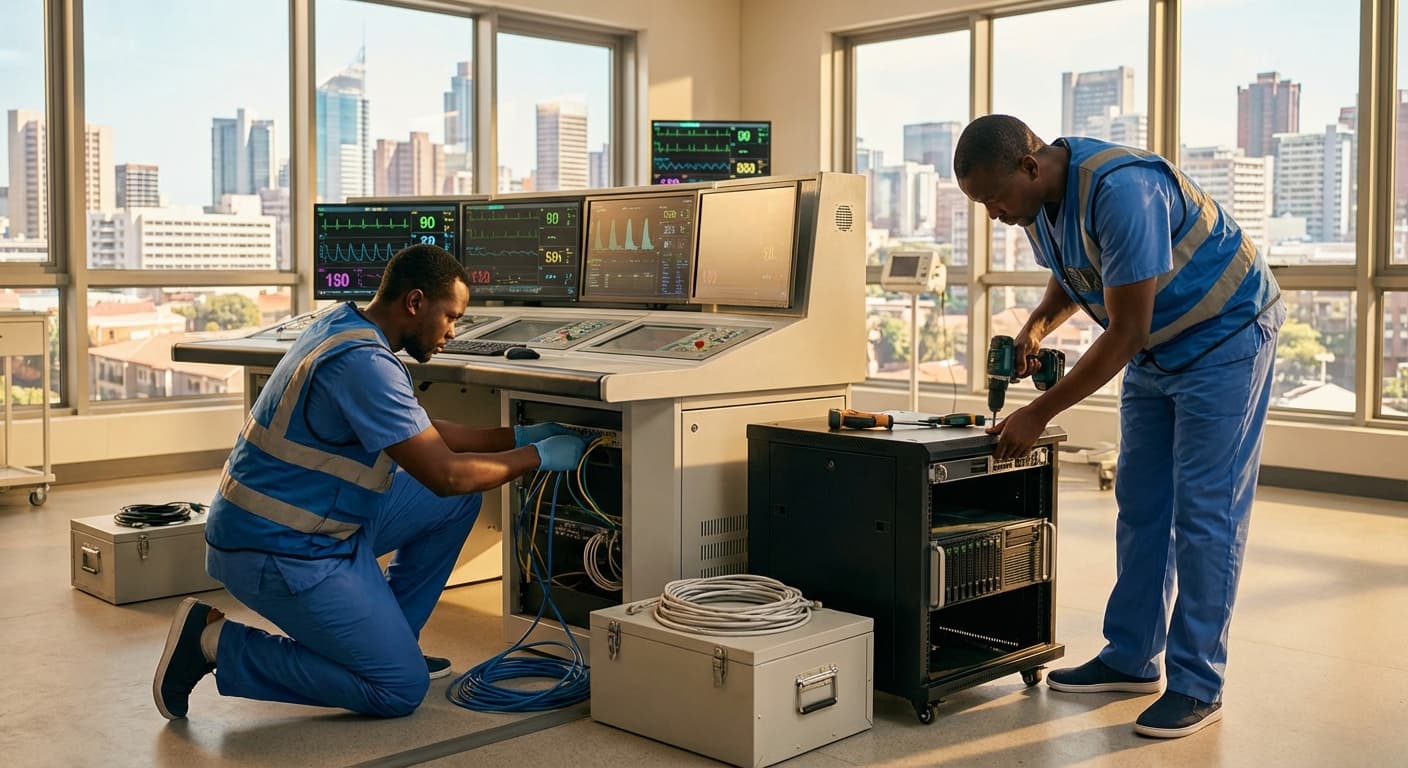
ICU Central Monitoring Station Installation Service in Congo (Kinshasa)
Engineering Excellence & Technical Support
ICU Central Monitoring Station Installation Service High-standard technical execution following OEM protocols and local regulatory frameworks.
Advanced Network Infrastructure
We design and implement robust, high-bandwidth network architectures specifically for critical care environments, ensuring seamless, real-time data transmission from patient monitoring devices to the ICU central station. Our solutions are built for reliability and scalability, prioritizing minimal latency and maximum uptime to support immediate clinical decision-making.
High-Availability Server Deployment
Our installation service includes the deployment of redundant, enterprise-grade server infrastructure designed for continuous operation. We configure failover mechanisms and implement rigorous data backup and recovery protocols to guarantee uninterrupted access to patient vital signs and historical data, even in the event of hardware failures or power outages.
Secure Data Encryption & Access Control
We prioritize the security and privacy of patient data by implementing robust encryption standards for data at rest and in transit. Our installation process includes configuring granular access control policies, ensuring that only authorized medical personnel can view and interact with sensitive patient information, in compliance with international healthcare data regulations.
What Is Icu Central Monitoring Station Installation Service In Congo (Kinshasa)?
ICU Central Monitoring Station Installation Service in Congo (Kinshasa) refers to the comprehensive process of designing, procuring, installing, configuring, testing, and commissioning a centralized monitoring system for Intensive Care Units (ICUs) within healthcare facilities located in Kinshasa, Democratic Republic of Congo. This service ensures that critical patient physiological data from multiple bedside monitoring devices are aggregated, displayed, and managed from a central location, enabling enhanced patient surveillance, timely intervention, and improved clinical decision-making by healthcare professionals. The scope typically encompasses hardware integration, network infrastructure setup, software deployment and customization, data management solutions, and user training.
| Who Needs This Service | Typical Use Cases | ||||||
|---|---|---|---|---|---|---|---|
| Hospitals and Healthcare Facilities in Kinshasa: Particularly those with dedicated Intensive Care Units (ICUs), Coronary Care Units (CCUs), Neonatal Intensive Care Units (NICUs), and Surgical Intensive Care Units (SICUs). | Enhancing Patient Surveillance: Providing continuous, real-time monitoring of critically ill patients to detect subtle physiological changes and potential deterioration early. | Improving Clinical Response Times: Enabling rapid identification of critical events (e.g., arrhythmias, hypoxemia, hemodynamic instability) and facilitating prompt medical intervention by the care team. | Reducing Alarm Fatigue: Centralized management of alarms allows for more intelligent prioritization and filtering, reducing the incidence of non-actionable alerts and improving focus on critical alarms. | Facilitating Team Communication and Collaboration: Allowing multiple clinicians to access and review patient data simultaneously from a central location, fostering better communication and coordinated care. | Data Collection and Analysis: Gathering comprehensive physiological data for research, quality improvement initiatives, and case reviews. | Remote Monitoring Capabilities: (With advanced configurations) Enabling off-site or remote access to patient data for specialist consultation or during mass casualty incidents. | Compliance with Healthcare Standards: Meeting regulatory and accreditation requirements for patient monitoring and data management in critical care settings. |
| Government Hospitals: National and public hospitals seeking to upgrade their critical care infrastructure. | Private Hospitals and Clinics: Medical institutions focused on providing advanced and high-quality critical care services. | Non-Governmental Organization (NGO) Healthcare Providers: Organizations operating medical facilities and aiming to improve patient outcomes in critical care. | New Healthcare Facility Developments: Projects involving the construction or establishment of new hospitals or critical care units. |
Key Components and Activities of ICU Central Monitoring Station Installation:
- Site Assessment and Design: Evaluating existing infrastructure, patient flow, and clinical requirements to design a scalable and efficient central monitoring system architecture.
- Hardware Procurement and Integration: Sourcing and integrating a range of medical devices such as patient monitors (ECG, SpO2, NIBP, invasive pressures, temperature, respiration), ventilators, infusion pumps, and anesthesia machines with the central monitoring station.
- Network Infrastructure Setup: Establishing a robust and secure network (wired or wireless) capable of reliably transmitting high-bandwidth physiological data from bedside devices to the central station.
- Central Monitoring Software Installation and Configuration: Deploying and configuring specialized software for data acquisition, visualization (waveform, numeric trends), alarm management, data storage, and reporting.
- System Testing and Validation: Conducting rigorous testing of all components, including data accuracy, alarm functionality, network connectivity, and user interface usability, to ensure compliance with clinical standards and operational requirements.
- Integration with Electronic Health Records (EHR): (Optional, but increasingly common) Integrating the central monitoring system with existing hospital EHR systems for seamless data flow and comprehensive patient record management.
- Power and Backup Solutions: Implementing reliable power supply systems, including Uninterruptible Power Supplies (UPS) and potentially generators, to ensure continuous operation during power outages.
- User Training and Support: Providing comprehensive training to clinical staff (physicians, nurses, intensivists) and IT personnel on the operation, maintenance, and troubleshooting of the central monitoring system.
- Post-Installation Support and Maintenance: Offering ongoing technical support, software updates, and preventative maintenance services to ensure optimal system performance and longevity.
Who Needs Icu Central Monitoring Station Installation Service In Congo (Kinshasa)?
ICU Central Monitoring Station Installation Service in Congo (Kinshasa) is a critical infrastructure requirement for advanced healthcare facilities aiming to provide high-level patient care. These stations centralize vital signs monitoring from multiple ICU beds, allowing a dedicated team to oversee critically ill patients more effectively, enabling prompt interventions and improved patient outcomes. The demand for such services is driven by the need to upgrade existing intensive care units, establish new ones, and ensure compliance with modern medical standards.
| Customer Type | Typical Facility Size | Primary Need | Department Focus |
|---|---|---|---|
| Public Hospitals | Medium to Large | Modernization, improved patient outcomes, capacity expansion | ICU, CCU, NICU |
| Private Hospitals | Medium to Large | Competitive advantage, premium patient care, specialized services | ICU, CCU, NICU, PICU |
| University Teaching Hospitals | Large | Medical training, research, advanced patient care, technology adoption | ICU, CCU, NICU, PICU, Research Wings |
| Large Clinics/Medical Centers | Medium to Large | Specialized critical care, comprehensive patient management | ICU, ER, PACU |
| NGOs/International Aid Organizations | Variable (often project-dependent) | Essential healthcare infrastructure development, humanitarian aid, public health improvement | ICU, ER, general wards requiring critical monitoring |
Target Customers and Departments for ICU Central Monitoring Station Installation Service in Congo (Kinshasa)
- {"items":["Public Hospitals (Government-owned and operated medical facilities)","Private Hospitals (For-profit medical institutions)","University Teaching Hospitals (Affiliated with academic institutions for medical education and research)","Large Clinics and Medical Centers (Facilities offering specialized and critical care services)","Non-Governmental Organizations (NGOs) operating medical facilities","International Aid Organizations (Implementing healthcare projects and infrastructure development)"],"title":"Target Customers"}
- {"items":["Intensive Care Units (ICUs)","Coronary Care Units (CCUs)","Neonatal Intensive Care Units (NICUs)","Pediatric Intensive Care Units (PICUs)","Emergency Departments (for immediate critical care assessment and monitoring)","Post-Anesthesia Care Units (PACUs) (in some advanced settings)"],"title":"Key Departments Requiring the Service"}
Icu Central Monitoring Station Installation Service Process In Congo (Kinshasa)
This document outlines the standard workflow for installing an ICU Central Monitoring Station (CMS) service in Congo (Kinshasa), from the initial client inquiry to the final execution and handover.
| Phase | Description | Key Activities | Deliverables | Responsibility |
|---|---|---|---|---|
| Phase 1: Inquiry & Initial Consultation | The client expresses interest in installing an ICU CMS. | Initial contact, discussion of client's needs, understanding of facility layout, preliminary overview of CMS capabilities. | Understanding of client's core requirements, initial interest confirmation. | Client, Service Provider Sales/Technical Team |
| Phase 2: Site Assessment & Requirements Gathering | A thorough evaluation of the proposed installation site and detailed understanding of specific needs. | On-site visit, assessment of power supply, network infrastructure, existing medical equipment, room dimensions, environmental factors (temperature, humidity), security, user workflow, specific monitoring requirements (number of beds, types of parameters). | Detailed site assessment report, comprehensive list of technical and functional requirements, identification of potential challenges. | Service Provider Technical Team, Client (IT, Biomedical Engineering, Nursing Staff) |
| Phase 3: Proposal & Quotation | Development and submission of a detailed proposal and cost estimate. | Based on site assessment and requirements, creation of a technical proposal (system design, equipment list, software configuration), detailed quotation (hardware, software, installation labor, training, warranty). | Formal proposal document, itemized quotation, estimated project timeline. | Service Provider Sales/Technical Team |
| Phase 4: Contract & Agreement | Formalizing the service agreement between the client and the service provider. | Review and negotiation of proposal terms, agreement on payment schedules, service level agreements (SLAs), warranty periods, and any specific clauses. | Signed service contract/purchase order. | Client Management, Service Provider Legal/Management Team |
| Phase 5: Project Planning & Logistics | Developing a detailed project plan and arranging logistics for equipment and personnel. | Creation of a detailed project schedule with milestones, allocation of resources (engineers, technicians), planning for equipment transportation, customs clearance, and local permits (if applicable). | Project implementation plan, logistics and procurement schedule. | Service Provider Project Manager |
| Phase 6: Procurement & Pre-installation | Acquiring all necessary hardware and software, and preparing the site. | Ordering and receiving CMS hardware (servers, workstations, displays, network devices, cabling), software licenses, and any required accessories. Site preparation (e.g., network port installation, power outlet verification, minor structural modifications if agreed upon). | All procured equipment and software, prepared installation site. | Service Provider Procurement & Project Team, Client (for site access and preparation) |
| Phase 7: Installation & Configuration | Physical installation of the CMS hardware and software setup. | Mounting servers and workstations, running network and power cables, connecting patient monitors and bedside devices to the CMS, installing and configuring CMS software, setting up user profiles and access controls. | Installed CMS hardware, configured CMS software, connected patient monitors. | Service Provider Installation Team (Engineers, Technicians) |
| Phase 8: Testing & Calibration | Verifying the functionality and accuracy of the installed CMS. | System integration testing, individual component testing, real-time data flow verification, alarm system testing, calibration of sensors and parameters (where applicable), performance testing under simulated load. | System test reports, calibration certificates, performance validation. | Service Provider Installation & Quality Assurance Team |
| Phase 9: Training & Handover | Educating the end-users and officially handing over the operational system. | Conducting comprehensive training sessions for medical staff (nurses, doctors), biomedical engineers, and IT personnel on CMS operation, alarm management, data retrieval, troubleshooting, and maintenance. Formal handover of the operational system. | Training materials, trained personnel, signed handover certificate. | Service Provider Training Specialist, Client End-Users |
| Phase 10: Post-Installation Support & Maintenance | Providing ongoing support and maintenance to ensure system reliability. | On-site or remote technical support, software updates and patches, preventative maintenance, troubleshooting of any issues, warranty claims processing, optional service level agreements (SLAs) for ongoing monitoring and maintenance. | Ongoing system performance, resolved issues, service reports, warranty support. | Service Provider Support Team, Client Biomedical Engineering/IT |
ICU Central Monitoring Station Installation Service Process in Congo (Kinshasa)
- Phase 1: Inquiry & Initial Consultation
- Phase 2: Site Assessment & Requirements Gathering
- Phase 3: Proposal & Quotation
- Phase 4: Contract & Agreement
- Phase 5: Project Planning & Logistics
- Phase 6: Procurement & Pre-installation
- Phase 7: Installation & Configuration
- Phase 8: Testing & Calibration
- Phase 9: Training & Handover
- Phase 10: Post-Installation Support & Maintenance
Icu Central Monitoring Station Installation Service Cost In Congo (Kinshasa)
Installing an ICU Central Monitoring Station (CMS) in Kinshasa, Congo, involves a complex process with varying costs. Several factors significantly influence the overall price, from the initial equipment purchase to the intricate installation and ongoing maintenance. Understanding these elements is crucial for budgeting and selecting the most suitable service provider. The local currency, the Congolese Franc (CDF), is used for all pricing estimations.
Key Pricing Factors:
- Scope and Complexity of the System: The number of patient beds to be monitored, the types of physiological parameters to be tracked (e.g., ECG, SpO2, NIBP, temperature, respiration), and the need for advanced features like waveform storage, data analysis software, and integration with existing hospital information systems (HIS) will directly impact the cost. A basic system for a few beds will be considerably cheaper than a comprehensive setup for a large ICU.
- Equipment Quality and Brand: High-end, reputable brands known for their reliability and advanced features will command higher prices. Conversely, more budget-friendly options may be available but might compromise on certain functionalities or long-term durability.
- Installation Services: This includes the physical installation of monitors, the laying of network cables, power supply setup, software configuration, and calibration. The labor costs, the complexity of the hospital's existing infrastructure, and the required expertise for a secure and efficient setup are significant components.
- Training and Support: Comprehensive training for medical staff on using the CMS and its features is essential. Ongoing technical support, troubleshooting, and potential software updates also contribute to the overall service cost. Service level agreements (SLAs) for response times and maintenance schedules will influence pricing.
- Infrastructure Requirements: The existing electrical infrastructure, network cabling, and the availability of suitable physical spaces for the central station and bedside units play a role. Any necessary upgrades to power, networking, or the physical environment will add to the cost.
- Customization and Integration: If the CMS needs to be customized to specific hospital workflows or integrated with other medical devices and systems, this will incur additional design, development, and testing costs.
- Geographic Location within Kinshasa: While Kinshasa is the central hub, specific locations might have slightly varying logistical costs for service providers.
- Service Provider's Expertise and Reputation: Experienced and reputable installation companies with a proven track record in medical equipment setup may charge more due to their expertise and reliability. However, this often translates to a smoother installation and better long-term performance.
- Warranty and Maintenance Packages: The duration and scope of the warranty, as well as any optional extended maintenance or service packages, will be factored into the initial installation cost or offered as separate recurring expenses.
| Service Component | Estimated Cost Range (CDF) | Notes |
|---|---|---|
| Basic CMS Package (Equipment & Installation for 2-4 beds) | 15,000,000 - 30,000,000 | Includes basic bedside monitors, central station, cabling, and standard installation. |
| Standard CMS Package (Equipment & Installation for 4-8 beds) | 30,000,000 - 60,000,000 | Higher quality equipment, more monitoring parameters, and potentially wireless capabilities. |
| Advanced CMS Package (Equipment & Installation for 8+ beds) | 60,000,000 - 150,000,000+ | Top-tier equipment, advanced analytics, HIS integration, and comprehensive features. |
| On-site Training (Per Session) | 500,000 - 1,500,000 | For medical and technical staff. |
| Annual Maintenance & Support Contract | 3,000,000 - 10,000,000+ | Varies based on system complexity and service level agreement (SLA). |
| Potential Infrastructure Upgrades (Electrical/Networking) | Variable (Estimate Required) | Highly dependent on existing hospital infrastructure. |
| Custom Software Development/Integration | Variable (Estimate Required) | For specific workflow needs or integration with other systems. |
Estimated Cost Ranges for ICU Central Monitoring Station Installation in Kinshasa (Congolese Francs - CDF)
- Basic System (2-4 Beds): This would typically include essential monitoring parameters and a central station for a small ICU unit.
- Standard System (4-8 Beds): Encompasses more beds and potentially a wider range of monitoring features and better connectivity.
- Advanced System (8+ Beds): For larger ICUs requiring comprehensive monitoring, advanced analytics, integration capabilities, and potentially higher-end equipment.
- Additional Features/Customization: Costs for specialized software, extensive integration with hospital systems, or unique hardware configurations.
Affordable Icu Central Monitoring Station Installation Service Options
Implementing a robust and reliable ICU Central Monitoring Station (CMS) is crucial for effective patient care and operational efficiency. This service focuses on providing affordable installation options tailored to various budget constraints, while ensuring high-quality integration and functionality. We explore value bundles designed to maximize benefits and cost-saving strategies to make this essential technology accessible.
| Value Bundle Option | Description | Key Features Included | Target Audience/Benefit | Estimated Cost Range (Low-Mid) |
|---|---|---|---|---|
| Essential Monitoring Package | A foundational CMS solution providing core patient monitoring functionalities. | Basic vital signs monitoring (ECG, SpO2, NIBP, Respiration), alarm management, trend data storage (limited), central display for a limited number of beds. | Smaller hospitals, critical care units with basic monitoring needs, budget-conscious facilities. | $15,000 - $40,000 |
| Integrated Workflow Bundle | Enhances efficiency by integrating with existing hospital systems. | Includes features of the Essential Package plus EHR integration (read-only), bidirectional data flow for key parameters, nurse call integration, reporting tools. | Medium-sized hospitals, facilities looking to improve workflow and reduce manual data entry. | $30,000 - $75,000 |
| Advanced Analytics & Scalability Pack | A comprehensive solution offering advanced features and future-proofing. | Includes features of the Integrated Workflow Bundle plus advanced alarm analytics, predictive modeling capabilities, secure remote access, expansion to a larger number of beds, integration with advanced monitoring devices (e.g., advanced hemodynamic monitoring). | Larger hospitals, research-oriented units, facilities prioritizing predictive insights and future expansion. | $60,000 - $150,000+ |
Key Considerations for Affordable ICU CMS Installation
- Scalability: Choose a system that can grow with your hospital's needs, avoiding costly upgrades later.
- Interoperability: Ensure seamless integration with existing medical devices and Electronic Health Records (EHRs) to prevent data silos and streamline workflows.
- Training and Support: Factor in the cost of comprehensive training for your clinical staff and ongoing technical support to ensure optimal system utilization.
- Hardware vs. Software Solutions: Evaluate the long-term costs associated with different hardware configurations and explore software-only solutions or cloud-based platforms.
- Phased Implementation: Consider a staged rollout of the CMS to manage initial investment and allow for gradual staff adaptation.
Verified Providers In Congo (Kinshasa)
In the Democratic Republic of Congo (Kinshasa), navigating the healthcare landscape to find reliable and trustworthy providers can be a significant challenge. Franance Health stands out as a premier organization offering a meticulously verified network of healthcare professionals and facilities. Their commitment to rigorous credentialing ensures that patients receive high-quality care from qualified and ethical practitioners, providing a vital layer of assurance in a complex environment. This verification process not only validates professional qualifications but also assesses adherence to ethical standards and best practices, making Franance Health a beacon of trust for those seeking medical services in Kinshasa.
| Credentialing Area | Franance Health Approach | Patient Benefit |
|---|---|---|
| Professional Licensing & Certifications | Mandatory verification of all current and valid medical licenses and specialized certifications with relevant authorities. | Ensures providers possess the fundamental legal and educational qualifications to practice. |
| Educational Background & Training | Thorough review of medical school diplomas, residency completion certificates, and any specialized training programs. | Confirms providers have received comprehensive and up-to-date medical education. |
| Clinical Experience & Competence | Assessment of past practice history, peer reviews where available, and sometimes practical competency evaluations. | Guarantees providers have practical experience and proven ability to deliver effective care. |
| Ethical Conduct & Professional Reputation | Background checks for any disciplinary actions or malpractice claims, and gathering of professional references. | Ensures providers uphold high ethical standards and maintain a positive professional standing. |
| Facility Standards (for Clinics/Hospitals) | Evaluation of clinic/hospital infrastructure, equipment, hygiene protocols, and adherence to safety regulations. | Provides assurance of a safe and well-equipped environment for medical procedures and consultations. |
Why Franance Health Credentials Matter:
- Rigorous Verification Process: Franance Health employs a multi-faceted approach to vet all its providers, ensuring their qualifications, licenses, and experience meet the highest standards.
- Focus on Patient Safety and Quality: Their credentialing goes beyond basic qualifications to include an assessment of practice environments, patient care protocols, and adherence to ethical guidelines.
- Reduced Risk for Patients: By choosing Franance Health-verified providers, patients significantly minimize the risk of encountering unqualified or unethical practitioners.
- Access to Trusted Specialists: The network includes a diverse range of medical specialists, all thoroughly vetted, allowing patients to find the right expertise for their specific needs.
- Streamlined Healthcare Navigation: Franance Health simplifies the process of finding reliable healthcare, saving patients valuable time and reducing stress.
Scope Of Work For Icu Central Monitoring Station Installation Service
This Scope of Work (SOW) outlines the requirements for the installation of an Intensive Care Unit (ICU) Central Monitoring Station (CMS) service. The service includes all labor, materials, equipment, and supervision necessary to successfully install and commission the CMS, ensuring seamless integration with existing ICU patient monitoring systems and compliance with all relevant healthcare standards and regulations. The project aims to enhance patient care by providing real-time, centralized monitoring of vital signs and alarms for all ICU patients. The installation will encompass the physical setup of workstations, network infrastructure, software configuration, and rigorous testing to ensure optimal performance and reliability.
| Technical Deliverable | Description | Standard Specification/Reference |
|---|---|---|
| Central Monitoring Workstations | Installation of dedicated computer workstations for the CMS operators. Includes mounting, power, and network connectivity. | Ergonomic design, high-resolution displays (minimum 24-inch, 1920x1080 resolution), robust processing power (e.g., Intel Core i5 or equivalent), sufficient RAM (minimum 16GB), and secure operating system (e.g., Windows 10/11 Enterprise). |
| Server Infrastructure (if applicable) | Installation and configuration of CMS server(s) for data storage, processing, and management. | Redundant power supplies, enterprise-grade storage (SSD preferred), robust cooling, and appropriate processing power for real-time data handling. Compliance with HIPAA and relevant data privacy regulations. |
| Network Cabling and Connectivity | Installation of all necessary network cabling (e.g., Cat6a or higher) and network devices (switches, routers) to connect CMS workstations, servers, and patient monitoring devices. | IEEE 802.3at (PoE+) for relevant devices, minimum 1Gbps network speed to workstations, 10Gbps backbone if required. Network segmentation for security. Adherence to hospital IT infrastructure standards. |
| CMS Software Installation | Installation and configuration of the core CMS software application on workstations and servers. | Latest stable version provided by the vendor, ensuring compatibility with existing patient monitoring devices and hospital IT environment. Adherence to vendor-specific installation guides. |
| Device Integration Modules | Installation and configuration of software modules/drivers required to interface with specific patient monitoring devices (e.g., ventilators, ECG monitors, SpO2 sensors). | Compatibility with specific device models and communication protocols (e.g., HL7, proprietary protocols). Vendor-certified integration modules. |
| Alarm Management System Configuration | Configuration of alarm parameters, thresholds, escalation policies, and notification settings within the CMS. | Configurable to hospital-defined clinical protocols. Adherence to AAMI standards for alarm management. Customizable by authorized clinical staff. |
| Data Archiving and Retrieval System | Setup and configuration of the system for long-term data storage and retrieval of patient monitoring data. | Secure, encrypted storage. Compliant with data retention policies (e.g., HIPAA). Efficient retrieval mechanisms for clinical review and audits. |
| System Testing and Validation (FAT/SAT) | Comprehensive testing of all system functionalities, including data acquisition, display, alarm generation, and reporting. Includes Factory Acceptance Testing (FAT) and Site Acceptance Testing (SAT). | Test cases developed jointly with the hospital. Documented test results. Successful demonstration of all specified functionalities. Compliance with system performance requirements (e.g., latency, uptime). |
| User Training Materials | Development and delivery of training materials for CMS operators and clinical staff. | Clear, concise, and user-friendly documentation. Includes user manuals, quick reference guides, and troubleshooting procedures. |
| System Documentation | Provision of comprehensive system documentation, including network diagrams, configuration settings, and operational manuals. | Up-to-date and accurate documentation. Including as-built drawings and hardware specifications. |
Key Stages of Installation
- Site Assessment and Planning
- Hardware Installation
- Network Configuration and Integration
- Software Installation and Configuration
- System Integration and Testing
- User Training
- Documentation and Handover
Service Level Agreement For Icu Central Monitoring Station Installation Service
This Service Level Agreement (SLA) outlines the response times and uptime guarantees for the installation service of the ICU Central Monitoring Station. This SLA applies to the services provided by [Your Company Name] (hereinafter referred to as "Service Provider") to [Client Name] (hereinafter referred to as "Client") for the installation of the ICU Central Monitoring Station at the Client's facility.
| Service Component | Response Time Guarantee | Uptime Guarantee |
|---|---|---|
| Initial Site Survey & Consultation | Within 2 business days of request | N/A (Not a continuously operational service) |
| Installation Commencement (after site readiness) | Within 5 business days of agreed installation date | N/A (Installation is a project-based activity) |
| System Functionality (post-successful installation) | During the warranty period: 4 business hours for critical issues (patient safety impact), 8 business hours for non-critical issues | 99.5% uptime during operational hours (defined as 24/7/365 for ICU environment) for the installed Central Monitoring Station. |
| User Training Completion | Within 3 business days of system validation | N/A (Training is a discrete event) |
Scope of Service
- Initial site survey and consultation
- Procurement and delivery of all necessary hardware and software components
- Installation and configuration of the ICU Central Monitoring Station hardware and software
- Integration with existing patient monitoring devices
- System testing and validation
- User training for designated hospital staff
- Post-installation support during the warranty period
Frequently Asked Questions

Ready when you are
Let's scope your ICU Central Monitoring Station Installation Service in Congo (Kinshasa) project in Congo (Kinshasa).

Scaling healthcare logistics and technical systems across the entire continent.